

A psychoacoustic test for misophonia assessment
Open accessThe DOI matches its Crossref record; 41 of the 42 references it cites were found in a registry or an index.
Abstract
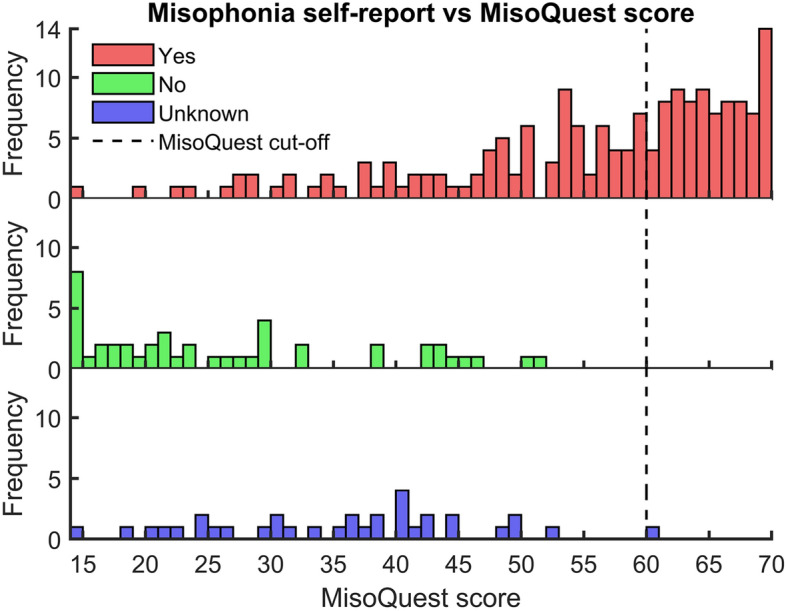
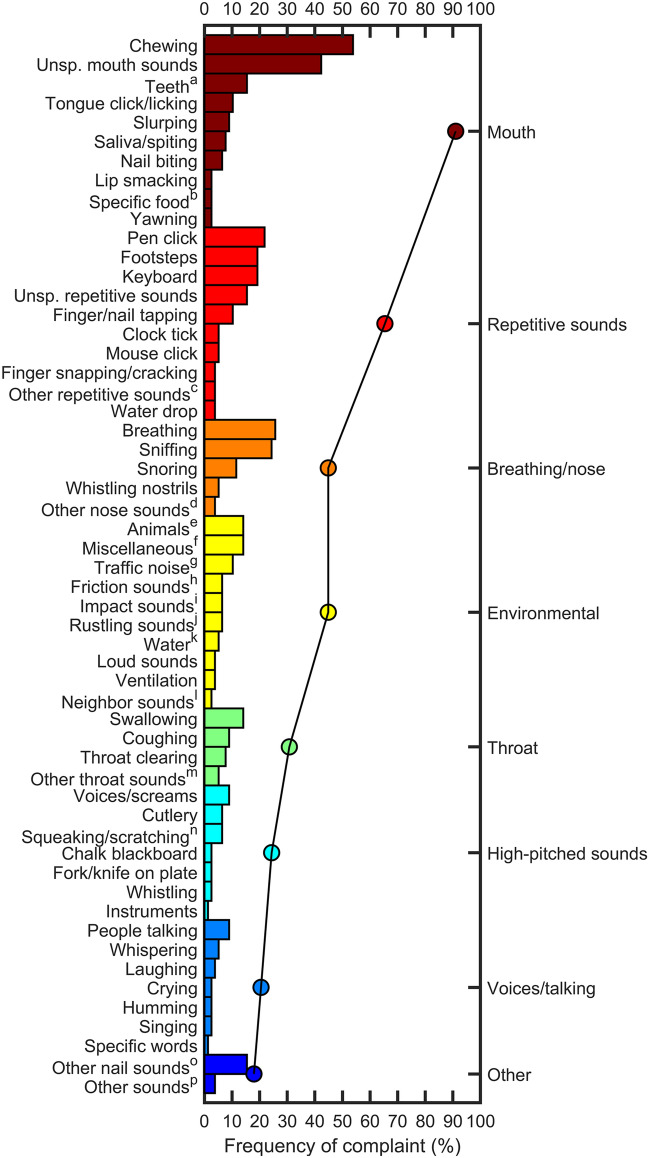
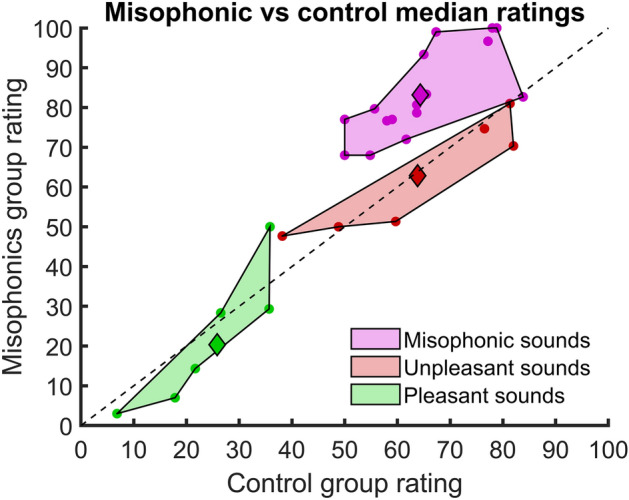
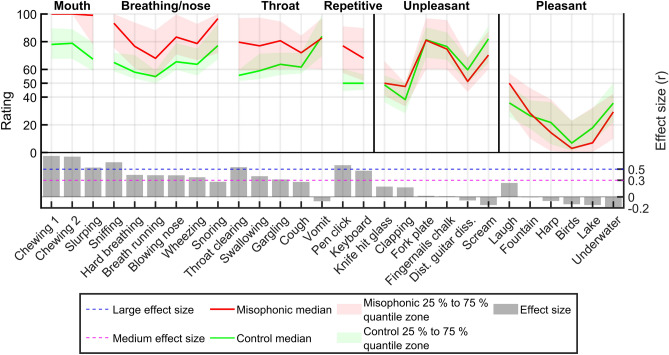
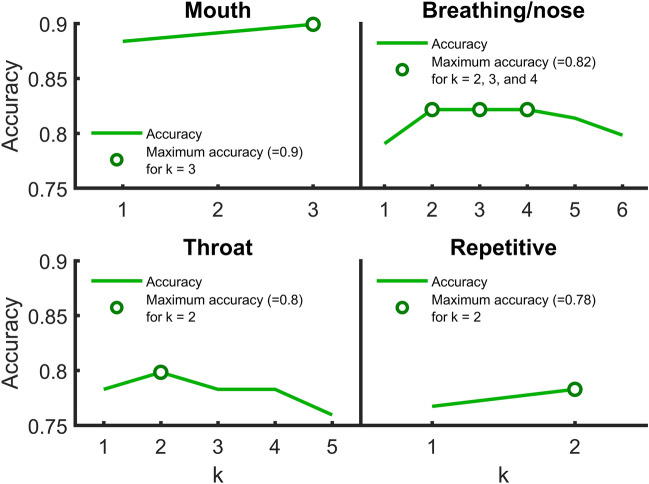
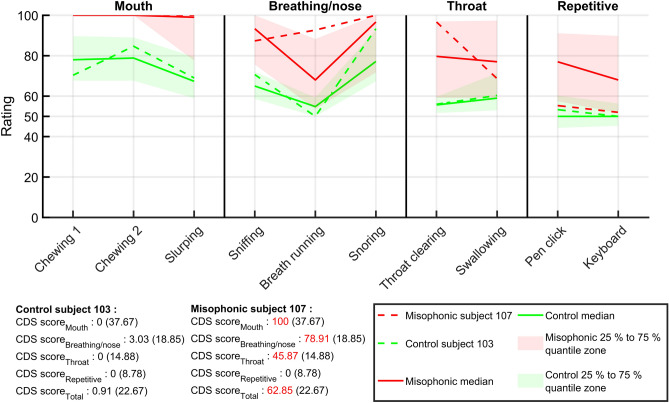
Misophonia is a condition where a strong arousal response is triggered when hearing specific human generated sounds, like chewing, and/or repetitive tapping noises, like pen clicking. It is diagnosed with clinical interviews and questionnaires since no psychoacoustic tools exist to assess its presence. The present study was aimed at developing and testing a new assessment tool for misophonia. The method was inspired by an approach we have recently developed for hyperacusis. It consisted of presenting subjects (n = 253) with misophonic, pleasant, and unpleasant sounds in an online experiment. The task was to rate them on a pleasant to unpleasant visual analog scale. Subjects were labeled as misophonics (n = 78) or controls (n = 55) by using self-report questions and a misophonia questionnaire, the MisoQuest. There was a significant difference between controls and misophonics in the median global rating of misophonic sounds. On the other hand, median global rating of unpleasant, and pleasant sounds did not differ significantly. We selected a subset of the misophonic sounds to form the core discriminant sounds of misophonia (CDS Miso). A metric: the CDS score, was used to quantitatively measure misophonia, both with a global score and with subscores. The latter could specifically quantify aversion towards different sound sources/events, i.e., mouth, breathing/nose, throat, and repetitive sounds. A receiver operating characteristic analysis showed that the method accurately classified subjects with and without misophonia (accuracy = 91%). The present study suggests that the psychoacoustic test we have developed can be used to assess misophonia reliably and quickly.
Overview
The claims and statistics of this paper haven’t been checked yet.
Free: it reads the open-access text and checks the first 5 claims that cite a source we can check. Create a free account to check every claim.
Integrity signals
Registry
Cites
Statistics
Figures
Verification
Claims the paper makes
The claims and statistics of this paper haven’t been checked yet.
Free: it reads the open-access text and checks the first 5 claims that cite a source we can check. Create a free account to check every claim.
Claims other papers make about this one
Each is checked against this paper’s own text: does it say what the citing paper says it does?
The cited source says what the claim attributes to it.
In the citing paper
“A 2021 study, which assessed (n = 253) misophonia with an online psychoacoustic test, suggested that such a test can be used to assess misophonia reliably and quickly [72].”
From Misophonia: A Systematic Review of Current and Future Trends in This Emerging Clinical Field (2022) · cites this paper as [72]
The cited source says what the claim attributes to it.
In the citing paper
“The last study with this type of measurement is from 2021, and its authors suggested this online psychoacoustic test as a reliable and rapid test for the measurement of misophonia [72].”
From Misophonia: A Systematic Review of Current and Future Trends in This Emerging Clinical Field (2022) · cites this paper as [72]
Self-check
Percentages, sums and reported differences re-computed from the paper’s own numbers.
The self-check needs the paper’s full text.
Citations
Cites
Statistical power analysis for the behavioral sciences
(1990) · Computers, Environment and Urban Systems · doi:10.1016/0198-9715(90)90050-4 · Cited by 65,269
A guideline of selecting and reporting intraclass correlation coefficients for reliability research
Koo, T. K., & Li, M. Y. (2016) · Journal of Chiropractic Medicine · doi:10.1016/j.jcm.2016.02.012 · Cited by 31,709
brms : An R Package for Bayesian Multilevel Models Using Stan
Bürkner, P.-C. (2017) · Journal of Statistical Software · doi:10.18637/jss.v080.i01 · Cited by 9,476
Effect size estimates: Current use, calculations, and interpretation.
Fritz, C. O., Morris, P. E., & Richler, J. J. (2012) · Journal of Experimental Psychology: General · doi:10.1037/a0024338 · Cited by 5,199
Two-sided confidence intervals for the single proportion: comparison of seven methods
Newcombe, R. G. (1998) · Statistics in Medicine · doi:10.1002/(sici)1097-0258(19980430)17:8<857::aid-sim777>3.0.co;2-e · Cited by 5,107
Advanced Bayesian Multilevel Modeling with the R Package brms
Bürkner, P.-C. (2018) · The R Journal · doi:10.32614/rj-2018-017 · Cited by 3,015
(2002) · The Concise Dictionary of Crime and Justice · doi:10.4135/9781452229300.n390 · Cited by 509
Misophonia: Diagnostic Criteria for a New Psychiatric Disorder
Schröder, A., Vulink, N., & Denys, D. (2013) · PLoS ONE · doi:10.1371/journal.pone.0054706 · Cited by 410
Misophonia: Incidence, Phenomenology, and Clinical Correlates in an Undergraduate Student Sample
Wu, M. S., Lewin, A. B., Murphy, T. K., & Storch, E. A. (2014) · Journal of Clinical Psychology · doi:10.1002/jclp.22098 · Cited by 360
Misophonia: Physiological investigations and case descriptions
Edelstein, M., Brang, D., Rouw, R., & Ramachandran, V. S. (2013) · Frontiers in Human Neuroscience · doi:10.3389/fnhum.2013.00296 · Cited by 330
A review of hyperacusis and future directions: Part I. Definitions and manifestations
Tyler, R. S., Pienkowski, M., Roncancio, E. R., Jun, H. J., Brozoski, T., Dauman, N., Coelho, C. B., Andersson, G., Keiner, A. J., Cacace, A. T., et al. (2014) · American Journal of Audiology · doi:10.1044/2014_aja-14-0010 · Cited by 329
The brain basis for misophonia
Kumar, S., Tansley-Hancock, O., Sedley, W., Winston, J. S., Callaghan, M. F., Allen, M., Cope, T. E., Gander, P. E., Bamiou, D.-E., & Griffiths, T. D. (2017) · Current Biology · doi:10.1016/j.cub.2016.12.048 · Cited by 290
Hypersensitivity to sound: Questionnaire data, audiometry and classification
Anari, M., Axelsson, A., Eliasson, A., & Magnusson, L. (1999) · Scandinavian Audiology · doi:10.1080/010503999424653 · Cited by 271
Misophonia: Phenomenology, comorbidity and demographics in a large sample
Jager, I., de Koning, P., Bost, T., Denys, D., & Vulink, N. (2020) · PLOS ONE · doi:10.1371/journal.pone.0231390 · Cited by 271
Increased perception of loudness in autism
Khalfa, S., Bruneau, N., Rogé, B., Georgieff, N., Veuillet, E., Adrien, J.-L., Barthélémy, C., & Collet, L. (2004) · Hearing Research · doi:10.1016/j.heares.2004.07.006 · Cited by 268
Zhou, X., Wu, M. S., & Storch, E. A. (2017) · Journal of Obsessive-Compulsive and Related Disorders · doi:10.1016/j.jocrd.2017.05.001 · Cited by 177
Williams, Z. J., He, J. L., Cascio, C. J., & Woynaroski, T. G. (2021) · Neuroscience & Biobehavioral Reviews · doi:10.1016/j.neubiorev.2020.11.030 · Cited by 175
The Odor of the Other: Olfactory Symbolism and Cultural Categories
CLASSEN, C. (1992) · Ethos · doi:10.1525/eth.1992.20.2.02a00010 · Cited by 160
(2015) · Handbook of Clinical Neurology · doi:10.1016/b978-0-444-62630-1.00021-4 · Cited by 151
Misophonia is associated with altered brain activity in the auditory cortex and salience network
Schröder, A., van Wingen, G., Eijsker, N., San Giorgi, R., Vulink, N. C., Turbyne, C., & Denys, D. (2019) · Scientific Reports · doi:10.1038/s41598-019-44084-8 · Cited by 141
Cognitive behavioral therapy is effective in misophonia: An open trial
Schröder, A. E., Vulink, N. C., van Loon, A. J., & Denys, D. A. (2017) · Journal of Affective Disorders · doi:10.1016/j.jad.2017.04.017 · Cited by 139
Naylor, J., Caimino, C., Scutt, P., Hoare, D. J., & Baguley, D. M. (2021) · Psychiatric Quarterly · doi:10.1007/s11126-020-09825-3 · Cited by 118
Misophonia: A scoping review of research
Potgieter, I., MacDonald, C., Partridge, L., Cima, R., Sheldrake, J., & Hoare, D. J. (2019) · Journal of Clinical Psychology · doi:10.1002/jclp.22771 · Cited by 116
Development and Psychometric Properties of MisoQuest—A New Self-Report Questionnaire for Misophonia
Siepsiak, M., Śliwerski, A., & Łukasz Dragan, W. (2020) · International Journal of Environmental Research and Public Health · doi:10.3390/ijerph17051797 · Cited by 103
Prevalence of Misophonia and Correlates of Its Symptoms among Inpatients with Depression
Siepsiak, M., Sobczak, A. M., Bohaterewicz, B., Cichocki, Ł., & Dragan, W. Ł. (2020) · International Journal of Environmental Research and Public Health · doi:10.3390/ijerph17155464 · Cited by 76
[ROC (receiver operating characteristics) curve: principles and application in biology].
Delacour, H., Servonnet, A., Perrot, A., Vigezzi, J. F., & Ramirez, J. M. (2005) · PubMed · Cited by 73
Cassiello-Robbins, C., Anand, D., McMahon, K., Guetta, R., Trumbull, J., Kelley, L., & Rosenthal, M. Z. (2020) · Frontiers in Psychiatry · doi:10.3389/fpsyt.2020.00847 · Cited by 68
Emo-soundscapes: A dataset for soundscape emotion recognition
Fan, J., Thorogood, M., & Pasquier, P. (2017) · International Conference on Affective Computing and Intelligent Interaction and workshops · doi:10.1109/acii.2017.8273600 · Cited by 59
A psychoacoustic test for diagnosing hyperacusis based on ratings of natural sounds
Enzler, F., Fournier, P., & Noreña, A. J. (2021) · Hearing Research · doi:10.1016/j.heares.2020.108124 · Cited by 51
Self-citationSanchez, T. G., & Silva, F. E. D. (2018) · Brazilian Journal of Otorhinolaryngology · doi:10.1016/j.bjorl.2017.06.014 · Cited by 49
Lévy‐Leboyer, C., & Naturel, V. (1991) · Journal of Environmental Psychology · doi:10.1016/s0272-4944(05)80006-4 · Cited by 48
Cassiello-Robbins, C., Anand, D., McMahon, K., Brout, J., Kelley, L., & Rosenthal, M. Z. (2021) · Frontiers in Psychology · doi:10.3389/fpsyg.2020.519681 · Cited by 41
Alimentation et précarité: Considérer la pluralité des situations
Poulain, J., & Tibère, L. (2008) · Anthropology of food · doi:10.4000/aof.4773 · Cited by 40
Wiggins, S. (2019) · Frontiers in Psychology · doi:10.3389/fpsyg.2019.01404 · Cited by 39
Hyperacusis and Disorders of Sound Intolerance: Clinical and Research Perspectives
Fagelson, M. A., & Baguley, D. (2018) · Repository@Nottingham (University of Nottingham) · Cited by 38
Tuning the cognitive environment: Sound masking with “natural” sounds in open-plan offices
DeLoach, A., Carter, J. P., & Braasch, J. (2015) · The Journal of the Acoustical Society of America · doi:10.1121/1.4920363 · Cited by 34
Context influences how individuals with misophonia respond to soundsPreprint
Edelstein, M., Monk, B., Ramachandran, V. S., & Rouw, R. (2020) · bioRxiv (Cold Spring Harbor Laboratory) · doi:10.1101/2020.09.12.292391 · Cited by 30
Increased orbitofrontal connectivity in misophoniaPreprint
Cerliani, L., & Rouw, R. (2020) · bioRxiv (Cold Spring Harbor Laboratory) · doi:10.1101/2020.10.29.346650 · Cited by 22
Evidence for autosomal dominant inheritance?
Iwama∥, T., & Matsui, T. (1999) · Diseases of the Colon & Rectum · doi:10.1007/bf02234186 · Cited by 13
Emotion and identification of environmental sounds and electroencephalographic activity.
Shimai, S. (1992) · PubMed · Cited by 12
Towards a sociological theory of eating: a review of Alan Warde's The Practice of Eating
Poulain, J. (2020) · Anthropology of Food · doi:10.4000/aof.10866 · Cited by 6
Research works printed but not linked: 2
- 1. Jastreboff, M. M. & Jastreboff, P. J. Components of decreased sound tolerance: Hyperacusis, Misophonia, Phonophobia. ITHS News Lett. 2, 5-7 (2001).
- 19. Delacour, H., Servonnet, A., Perrot, A., Vigezzi, J. F. & La Ramirez, J. M. courbe ROC (receiver operating characteristic): Principes et principales applications en biologie clinique. Ann. Biol. Clin. 63, 11 (2005).
Cited by
Misophonia: A Systematic Review of Current and Future Trends in This Emerging Clinical Field
Ferrer-Torres, A., & Giménez-Llort, L. (2022) · International Journal of Environmental Research and Public Health · doi:10.3390/ijerph19116790 · Cited by 64
“The last study with this type of measurement is from 2021, and its authors suggested this online psychoacoustic test as a reliable and rapid test for the measurement of misophonia [72].”
BackgroundSiepsiak, M., Rosenthal, M. Z., Raj-Koziak, D., & Dragan, W. (2022) · Journal of Psychosomatic Research · doi:10.1016/j.jpsychores.2022.110777 · Cited by 60
Does context matter in misophonia? A multi-method experimental investigation
Siepsiak, M., Vrana, S. R., Rynkiewicz, A., Rosenthal, M. Z., & Dragan, W. Ł. (2023) · Frontiers in Neuroscience · doi:10.3389/fnins.2022.880853 · Cited by 53
Aazh, H., Erfanian, M., Danesh, A. A., & Moore, B. C. J. (2022) · Frontiers in Neuroscience · doi:10.3389/fnins.2022.900065 · Cited by 53
Specificity of Affective Responses in Misophonia Depends on Trigger Identification
Savard, M.-A., Sares, A. G., Coffey, E. B. J., & Deroche, M. L. D. (2022) · Frontiers in Neuroscience · doi:10.3389/fnins.2022.879583 · Cited by 39
“While the original authors provided an English translation, and the questionnaire (in English and translated in French) was recently used in a French sample (Enzler et al., 2021), it has not yet been validated in an English-speaking population.”
Background
Metadata
- Authors
- Enzler, F., Loriot, C., Fournier, P., & Noreña, A. J.
- Affiliations
- Centre National de la Recherche Scientifique (FR)
- Université de Montpellier (FR)
- Corresponding author
- Noreña, Arnaud J.
- Venue
- Scientific Reports
- Published
- 2021-05-26
- Volume
- 11
- Issue
- 1
- Pages
- 11044-11044
- ISSN
- 2045-2322 (ISSN-L)
- PMC
- PMC8155015
- OpenAlex
- W3133442929
- Cited by
- 54
- References
- 42
- Citations by year
- 2026: 6 · 2025: 19 · 2024: 11 · 2023: 8 · 2022: 10
- FWCI
- 4.04
- Type
- journal article
- Language
- en
- Open access
- gold
- doi.org
- Licence
- cc-by
- creativecommons.org/licenses/by/4.0 (tdm)
- creativecommons.org/licenses/by/4.0 (vor)
- Locations
- Scientific Reports (publishedVersion, cc-by)
- Research Square (acceptedVersion, cc-by)
- PubMed Central (publishedVersion, cc-by)
- PubMed (publishedVersion)
- HAL (submittedVersion, cc-by)
- DOAJ (DOAJ: Directory of Open Access Journals) (submittedVersion, cc-by-sa)
- Funders
- European Research Council (ERC) under the European Union's Horizon 2020 research and innovation program
- Excellence Initiative of Aix-Marseille University – A*Midex, a French “Investissements d’Avenir programme”
- La Fondation Pour l'Audition
- Topics
- Life Sciences › Neuroscience › Sensory Systems › Hearing, Cochlea, Tinnitus, Genetics
- Physical Sciences › Physics and Astronomy › Acoustics and Ultrasonics › Noise Effects and Management
- Health Sciences › Health Professions › Speech and Hearing › Hearing Loss and Rehabilitation
- Keywords
- misophonia, hyperacusis, diagnostic classification
- MeSH terms
- Adult, Affective Symptoms, Arousal, Emotions, Female, Humans, Male, Psychoacoustics, Surveys and Questionnaires, Hyperacusis, Self Report
About these checks
Registry, retraction, Cites and statistics results are computed, not judged, with one exception: a printed reference that no index lists is read once by a model before it counts as a citation error. Claims are extracted by a model and kept only when their quote appears verbatim in the text; each cited source is then checked, with a model’s help, for whether it says what the claim relies on. Those verdicts can be wrong — read the claim’s quote and the cited source before relying on one.
Statistics and arithmetic are recomputed, not judged.
Confidence bands are shown only for fields calibrated on our annotated test set. None is calibrated yet, so no band is shown.
What counts as a claim ›How we measure confidence ›How we check this ›
Are you an author, or do you see a problem with this page? Request a review
Data sources
Bibliographic data: Semantic Scholar, OpenAlex, Crossref.
Contains information from the Semantic Scholar Academic Graph Datasets, made available under the ODC Attribution License (ODC-BY 1.0).
Semantic Scholar’s data is described in: Kinney, R., et al. (2023). The Semantic Scholar Open Data Platform. arXiv:2301.10140.
