

Metabolic syndrome in women with previous gestational diabetes
Open accessThe DOI matches its Crossref record; 21 of the 21 references it cites were found in a registry or an index.
Abstract
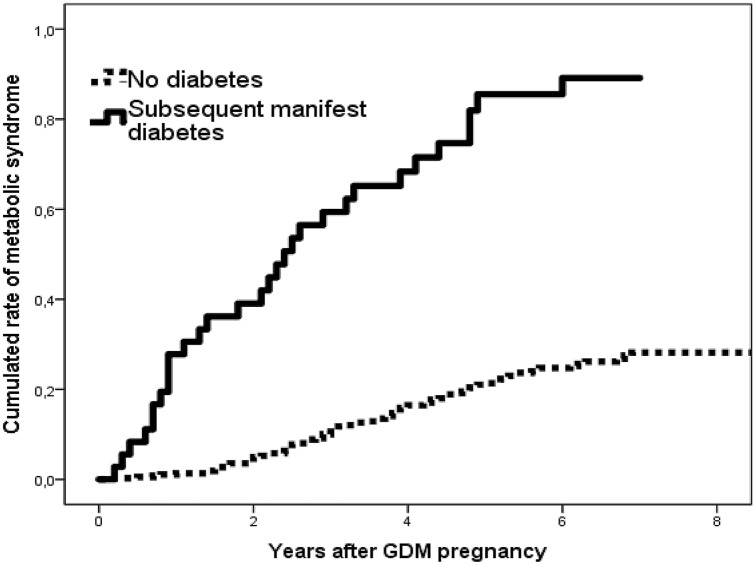
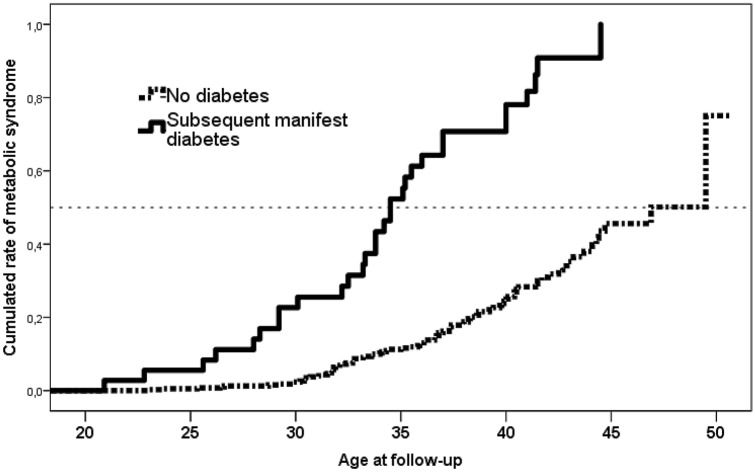
To evaluate the incidence and timing of the diagnosis of metabolic syndrome in a cohort of Danish women after a pregnancy with gestational diabetes (GDM) to estimate the optimum time for preventative actions in relation to metabolic syndrome (MetS). In this follow-up study, 435 women were included from a consecutive cohort with prior history of GDM. Data on dyslipidemia, hypertension and other cardiovascular disorders (CVD) were extracted from the electronic patient journal. Any antidiabetic, cardiovascular and cholesterol-lowering medicine was ascertained in the national prescription database. Similarly, any blood test taken was evaluated. We defined a patient having MetS if the criteria of the WHO based definition of diabetes or impaired glucose regulation were met. Further, we added as alternative for glucose intolerance, a glycosylated hemoglobin (HbA1c) > 44 mmol/mol or the former level ≥ 6.5%. Further, dyslipidemia, lipid lowering medications, BMI > 30 kg/m 2 or antihypertensive treatment were used. For MetS outcome, diagnosis or medication for CVD was registered. All women were followed for median 5.7 years (range 0; 9). The incidence of MetS was 28%. Thirteen percent of these qualified already within one year after pregnancy for the diagnosis of MetS. Postpartum MetS was detected after a median of 3 years (range 0; 7 years); further, 36 (8%) had been diagnosed with manifest diabetes after pregnancy. The diagnosis of postpartum MetS was strongly associated with the prevalence of manifest diabetes. Six years after pregnancy the rate of metabolic syndrome was more than tripled (25 vs. 89%, no DM vs manifest DM, RR: 6.7; 95% CI 2.7–17, p < 0.001). At 40 years the MetS rate nearly tripled if manifest DM was diagnosed (26 vs. 78%, no DM vs. manifest DM, RR: 3.3, 95% CI 1.8–6, p < 0.001). We found that GDM and later on manifest DM in women increase the risk of metabolic syndrome. There seems to be a window of opportunity before the early thirties where it would be especially beneficial to begin preventive efforts in women with GDM.
Overview
The claims and statistics of this paper haven’t been checked yet.
Free: it reads the open-access text and checks the first 5 claims that cite a source we can check. Create a free account to check every claim.
Integrity signals
Registry
Cites
Statistics
Figures
Verification
Claims the paper makes
The claims and statistics of this paper haven’t been checked yet.
Free: it reads the open-access text and checks the first 5 claims that cite a source we can check. Create a free account to check every claim.
Claims other papers make about this one
Each is checked against this paper’s own text: does it say what the citing paper says it does?
The cited source says what the claim attributes to it.
In the citing paper
“GDM is considered an important risk factor for subsequent metabolic disorders, including metabolic syndrome, which in turn increases the risk of cardiovascular diseases (CVDs) [10,11].”
The cited source says what the claim attributes to it.
In the citing paper
“Kaiser et al. reported a high prevalence of metabolic syndrome in this population [10,23].”
Self-check
Percentages, sums and reported differences re-computed from the paper’s own numbers.
The self-check needs the paper’s full text.
Citations
Cites
Grundy, S. M., Bilheimer, D. W., Chait, A., Clark, L. T., Denke, M. A., Havel, R. J., Hazzard, W. R., Hulley, S. B., Hunninghake, D. B., Kreisberg, R. A., et al. (1993) · JAMA · doi:10.1001/jama.269.23.3015 · Cited by 27,947
Expert Panel on Detection, E. (2001) · JAMA: The Journal of the American Medical Association · doi:10.1001/jama.285.19.2486 · Cited by 26,011
Gestational Diabetes and the Incidence of Type 2 Diabetes
Kim, C., Newton, K. M., & Knopp, R. H. (2002) · Diabetes Care · doi:10.2337/diacare.25.10.1862 · Cited by 2,276
Comment on the provisional report from the WHO consultation
(1999) · Diabetic Medicine · doi:10.1046/j.1464-5491.1999.00059.x · Cited by 1,820
Increased Risk of Cardiovascular Disease in Young Women Following Gestational Diabetes Mellitus
Shah, B. R., Retnakaran, R., & Booth, G. L. (2008) · Diabetes Care · doi:10.2337/dc08-0706 · Cited by 489
The metabolic syndrome: useful concept or clinical tool? Report of a WHO Expert Consultation
Simmons, R. K., Alberti, K. G. M. M., Gale, E. A. M., Colagiuri, S., Tuomilehto, J., Qiao, Q., Ramachandran, A., Tajima, N., Brajkovich Mirchov, I., Ben-Nakhi, A., et al. (2010) · Diabetologia · doi:10.1007/s00125-009-1620-4 · Cited by 456
Daly, B., Toulis, K. A., Thomas, N., Gokhale, K., Martin, J., Webber, J., Keerthy, D., Jolly, K., Saravanan, P., & Nirantharakumar, K. (2018) · PLOS Medicine · doi:10.1371/journal.pmed.1002488 · Cited by 328
Lauenborg, J., Mathiesen, E., Hansen, T., Glümer, C., Jørgensen, T., Borch-Johnsen, K., Hornnes, P., Pedersen, O., & Damm, P. (2005) · The Journal of Clinical Endocrinology & Metabolism · doi:10.1210/jc.2004-1713 · Cited by 279
Noctor, E., Crowe, C., Carmody, L. A., Kirwan, B., O’Dea, A., Glynn, L. G., McGuire, B. E., O’Shea, P. M., & Dunne, F. P. (2015) · Acta Diabetologica · doi:10.1007/s00592-014-0621-z · Cited by 79
Albareda, M., Caballero, A., Badell, G., Rodríguez-Espinosa, J., Ordóñez‐Llanos, J., de Leiva, A., & Corcoy, R. (2005) · Metabolism · doi:10.1016/j.metabol.2005.03.017 · Cited by 72
Cited by
Martin, S. S., Aday, A. W., Allen, N. B., Almarzooq, Z. I., Anderson, C. A. M., Arora, P., Avery, C. L., Baker-Smith, C. M., Bansal, N., Beaton, A. Z., et al. (2025) · Circulation · doi:10.1161/cir.0000000000001303 · Cited by 1,080
Xie, W., Wang, Y., Xiao, S., Qiu, L., Yu, Y., & Zhang, Z. (2022) · BMJ · doi:10.1136/bmj-2022-070244 · Cited by 204
Obuchowska, A., Gorczyca, K., Standyło, A., Obuchowska, K., Kimber-Trojnar, Ż., Wierzchowska-Opoka, M., & Leszczyńska‐Gorzelak, B. (2022) · International Journal of Molecular Sciences · doi:10.3390/ijms23158253 · Cited by 63
“Women at a higher risk of developing MS should be identified using antenatal glucose measurements and BMI [85].”
BackgroundInfluentialHigh Folate, Perturbed One-Carbon Metabolism and Gestational Diabetes Mellitus
Williamson, J. M., Arthurs, A. L., Smith, M. D., Roberts, C. T., & Jankovic-Karasoulos, T. (2022) · Nutrients · doi:10.3390/nu14193930 · Cited by 56
Towards precision medicine in bariatric surgery prescription
Pereira, S. S., Guimarães, M., & Monteiro, M. P. (2023) · Reviews in Endocrine and Metabolic Disorders · doi:10.1007/s11154-023-09801-9 · Cited by 40
“So, weight loss in women with obesity and history of GDM actively reduce the higher risk of metabolic syndrome and T2D throughout life [76, 78], so there seems that surgical techniques with proven long-lasting results, such as RYGB or DS, should be privileged.”
BackgroundMelero, V., Arnoriaga, M., Barabash, A., Valerio, J., del Valle, L., Martin O’Connor, R., de Miguel, M. P., Diaz, J. A., Familiar, C., Moraga, I., et al. (2023) · Nutrients · doi:10.3390/nu15143252 · Cited by 14
“Likewise, GDM can increase the predisposition for metabolic syndrome (MetS) [17].”
BackgroundKek, H.-P., Su, Y., Tey, S.-J., Yang, M., Chang, L.-C., Hung, Y.-H., & Tsai, C. (2023) · BMC Pregnancy and Childbirth · doi:10.1186/s12884-023-05829-6 · Cited by 16
“The risk of developing metabolic syndrome and subsequently DM is nearly tripled in GDM women after 6 years of pregnancy or after the age of 40 when compared with non-diabetic women [22].”
BackgroundMassalha, M., Iskander, R., Hassan, H., Spiegel, E., Erez, O., & Nachum, Z. (2025) · Frontiers in Clinical Diabetes and Healthcare · doi:10.3389/fcdhc.2025.1527076 · Cited by 16
Ziqubu, K., Dludla, P. V., Mthembu, S. X. H., Nkambule, B. B., & Mazibuko-Mbeje, S. E. (2024) · Adipocyte · doi:10.1080/21623945.2024.2390833 · Cited by 14
“Like the pathological consequences of T2DM [9], GDM is associated with deteriorated metabolic health and poor health patterns in pregnant women [10,11].”
BackgroundJacobsen, K. H., Aalders, J., Mortensen, K. S. B., Andersen, M., Snogdal, L. S., Christensen, M. H., Vinter, C. A., Højlund, K., & Jensen, D. M. (2022) · Journal of Diabetes Research · doi:10.1155/2022/4900209 · Cited by 13
Shen, Y., Zheng, Y., Su, Y., Jiang, S., Ma, X., Hu, J., Li, C., Huang, Y., Teng, Y., Bao, Y., et al. (2022) · Chinese Medical Journal · doi:10.1097/cm9.0000000000002337 · Cited by 12
“Women with prior GDM will have a high risk of recurrent GDM after the first pregnancy and postpartum metabolic disorders.([2-5]) GDM itself may be associated with a series of adverse pregnancy outcomes including preeclampsia, macrosomia, preterm delivery, and primary cesarean section.”
BackgroundLiang, W., & Sun, F. (2023) · Journal of Endocrinological Investigation · doi:10.1007/s40618-023-02233-x · Cited by 12
Pregnancy Complications and Long-Term Atherosclerotic Cardiovascular Disease Risk
Rabadia, S. V., Heimberger, S., Cameron, N. A., & Shahandeh, N. (2025) · Current Atherosclerosis Reports · doi:10.1007/s11883-024-01273-9 · Cited by 9
Li, L., Shi, G., Zhang, X., Wang, H., & He, S. (2021) · Evidence-based Complementary and Alternative Medicine · doi:10.1155/2021/8470944 · Cited by 7
RetractedCanbaz, B., Tütüncü, Y., Can, B., Keskin, H., Bekpınar, S., & Dınççağ, N. (2022) · Journal of Obstetrics and Gynaecology · doi:10.1080/01443615.2022.2048363 · Cited by 6
“Our rate of progression to MetS was 52%, which was consistent with previous reports (Hakkarainen et al. 2016, Kaiser et al. 2021).”
ResultSonaglioni, A., Casieri, F., Nicolosi, G. L., Bianchi, S., & Lombardo, M. (2025) · Journal of Clinical Medicine · doi:10.3390/jcm14041271 · Cited by 5
“In this regard, women with a previous history of gestational diabetes mellitus (pGDM) were reported to be at risk of developing type 2 diabetes mellitus, metabolic syndrome and chronic kidney disease later in life [5–8].”
Jia, Y., Hu, Q., Liao, H., Liu, H., Zeng, Z., & Yu, H. (2024) · Diabetes & Metabolic Syndrome Clinical Research & Reviews · doi:10.1016/j.dsx.2024.103144 · Cited by 6
Long-term Outcomes Associated With Post–kidney Donation Pregnancy Complications
Palzer, E. F., Helgeson, E. S., Evans, M. D., Vock, D. M., & Matas, A. J. (2023) · Transplantation · doi:10.1097/tp.0000000000004540 · Cited by 5
“Of the 6 women who had ≥2 postdonation pregnancies with gHTN, none of them developed HTN during a median postdonation follow-up time of 22 y, whereas 56.5% of women with 1 gHTN pregnancy developed HTN during a median postdonation follow-up time of 21 y. Similarly, none of the 6 women with ≥2 gDM pregnancies developed…”
BackgroundResultInfluentialPre–kidney Donation Pregnancy Complications and Long-term Outcomes
Helgeson, E. S., Palzer, E. F., Vock, D. M., Porrett, P. M., Sawinski, D. L., & Matas, A. J. (2022) · Transplantation · doi:10.1097/tp.0000000000004146 · Cited by 6
“In addition, gestational DM (GDM) has been associated with subsequent development of type 2 DM and CVD.(32-49) Importantly, these increased risks are often observed early postpartum, with HTN or type 2 DM often occurring within the first decade after delivery.”
BackgroundSíndrome metabólico y hemoglobina glicosilada en Latinoamérica
Chiquito-Guale, B. M., Plúas-Vargas, M. P., & Lucas-Parrales, E. N. (2023) · MQRInvestigar · doi:10.56048/mqr20225.7.3.2023.3137-3153 · Cited by 3
Bagde, N. D., Bagde, M. N., Shanbhag, V., Trigunait, P., Sheikh, N., & Agrawal, S. (2024) · Journal of Family Medicine and Primary Care · doi:10.4103/jfmpc.jfmpc_2451_22 · Cited by 2
“[3] The risk of metabolic syndrome and frank diabetes is increased in women with gestational diabetes [4] with risk of diabetes increased to fivefold [5] and cardiovascular disease to two‑ to fivefold.”
BackgroundResultGestational Diabetes Management and Risk Factors
Ali, Y. N. M. (2025) · Medicina Moderna - Modern Medicine · doi:10.31689/rmm.2025.32.4.375 · Cited by 2
“Women who experienced preeclamptic pregnancies may have underlying metabolic syndrome traits that predispose them to GDM in a subsequent gestation 40 .”
Mutebi, C., Jaamour, D., Tolu-Akinnawo, O. Z., Ezekwueme, F., Ughagwu, K. P., Obarombi, J., Ogunniyi, K. E., Awoyemi, T., & Galvin, S. (2025) · Women s Health Reports · doi:10.1177/26884844251405808 · Cited by 1
Derse, T. K., Kidie, D. M., Asgai, A. S., & Kelkay, J. M. (2026) · Diabetes Research and Clinical Practice · doi:10.1016/j.diabres.2026.113317 · Cited by 2
Schultz, K., Ha, S., & Williams, A. (2024) · Metabolic Syndrome and Related Disorders · doi:10.1089/met.2023.0269 · Cited by 1
Tsushima, R., Ito, A., Oishi, M., Ishihara, K., Iino, K., Tanaka, K., & Yokoyama, Y. (2026) · Journal of Clinical Medicine · doi:10.3390/jcm15072634
“In a Chinese cohort, Liu et al. demonstrated that postpartum weight gain substantially increased the risk of subsequent diabetes in women with previous GDM, whereas Kaiser et al. reported a high prevalence of metabolic syndrome in this population [10,23].”
InfluentialAnjum, M. S., Badam, L. K., Lakshmi, V. B., & Kumar, T. A. (2024) · Journal of Research in Applied and Basic Medical Sciences · doi:10.61186/rabms.10.4.410
Botasheva, T. L., Grigorian, A. K., Deriglazova, O. I., Keller, O. V., Заводнов, О. П., & Kudrin, R. A. (2025) · Bulletin Biomedicine and sociology · doi:10.26787/nydha-2618-8783-2025-10-2-12-20
Botasheva, T. L., Grigorian, A. K., Deriglazova, O. I., Kudrin, R. A., Gorbaneva, E. P., & Zavodnov, O. P. (2025) · Экология человека · doi:10.17816/humeco677061
Quansah, D. Y., Arhab, A., & Puder, J. J. (2025) · Cardiovascular Diabetology – Endocrinology Reports · doi:10.1186/s40842-025-00240-w
“GDM is characterized by increased insulin resistance and decreased insulin secretion [2] and is associated with increased risk of the metabolic syndrome (MetS) and future diabetes [3].”
Einfluss eines Gestationsdiabetes auf die Gefäßfunktion in der Plazenta
Carstens, P. S. (2024) · Qucosa (Saxon State and University Library Dresden)
Metadata
- Authors
- Kaiser, K., Nielsen, M. F., Kallfa, E., Dubietyte, G., & Lauszus, F. F.
- Affiliations
- Sygehus Sønderjylland (DK)
- Region of Southern Denmark (DK)
- Corresponding author
- Lauszus, Finn Friis
- Venue
- Scientific Reports
- Published
- 2021-06-02
- Volume
- 11
- Issue
- 1
- Pages
- 11558-11558
- ISSN
- 2045-2322 (ISSN-L)
- PMC
- PMC8172609
- OpenAlex
- W3165040643
- Semantic Scholar
- 7577dea8d5bd409b2ecb251ee52113e4cb44cc70
- Cited by
- 30
- References
- 21
- Citations by year
- 2026: 2 · 2025: 8 · 2024: 5 · 2023: 7 · 2022: 7 · 2021: 1
- FWCI
- 4.54
- Type
- journal article
- Language
- en
- Open access
- gold
- doi.org
- Licence
- cc-by
- creativecommons.org/licenses/by/4.0 (tdm)
- creativecommons.org/licenses/by/4.0 (vor)
- Locations
- Scientific Reports (publishedVersion, cc-by)
- PubMed Central (publishedVersion, cc-by)
- PubMed (publishedVersion)
- DOAJ (DOAJ: Directory of Open Access Journals) (submittedVersion, cc-by-sa)
- University of Southern Denmark Research Portal (University of Southern Denmark) (submittedVersion, cc-by)
- Topics
- Health Sciences › Medicine › Obstetrics and Gynecology › Gestational Diabetes Research and Management
- Health Sciences › Medicine › Endocrinology, Diabetes and Metabolism › Diabetes, Cardiovascular Risks, and Lipoproteins
- Health Sciences › Medicine › Pediatrics, Perinatology and Child Health › Birth, Development, and Health
- Keywords
- metabolic syndrome, gestational diabetes mellitus, type 2 diabetes, dyslipidemia, hypertension, cardiovascular disease, incidence, time to diagnosis, prevention, women
- MeSH terms
- Adult, Female, Follow-Up Studies, Glucose Tolerance Test, Glycated Hemoglobin, Humans, Middle Aged, Pregnancy, Diabetes, Gestational, Metabolic Syndrome, Young Adult
About these checks
Registry, retraction, Cites and statistics results are computed, not judged, with one exception: a printed reference that no index lists is read once by a model before it counts as a citation error. Claims are extracted by a model and kept only when their quote appears verbatim in the text; each cited source is then checked, with a model’s help, for whether it says what the claim relies on. Those verdicts can be wrong — read the claim’s quote and the cited source before relying on one.
Statistics and arithmetic are recomputed, not judged.
Confidence bands are shown only for fields calibrated on our annotated test set. None is calibrated yet, so no band is shown.
What counts as a claim ›How we measure confidence ›How we check this ›
Are you an author, or do you see a problem with this page? Request a review
Data sources
Bibliographic data: Semantic Scholar, OpenAlex, Crossref.
Contains information from the Semantic Scholar Academic Graph Datasets, made available under the ODC Attribution License (ODC-BY 1.0).
Semantic Scholar’s data is described in: Kinney, R., et al. (2023). The Semantic Scholar Open Data Platform. arXiv:2301.10140.
