

Socioeconomic position links circulatory microbiota differences with biological age
Open accessThe DOI matches its Crossref record; 74 of the 74 references it cites were found in a registry or an index.
Abstract
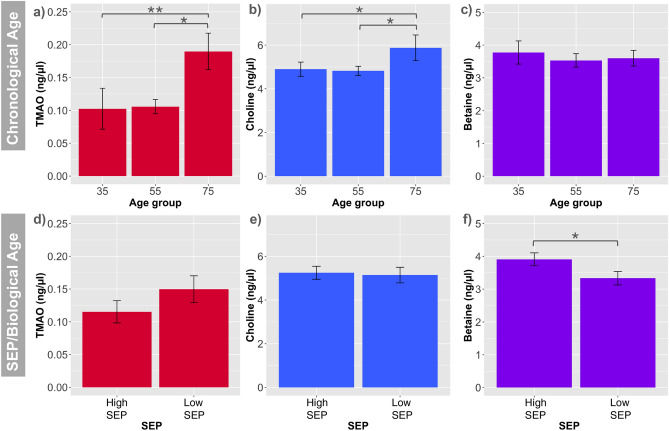
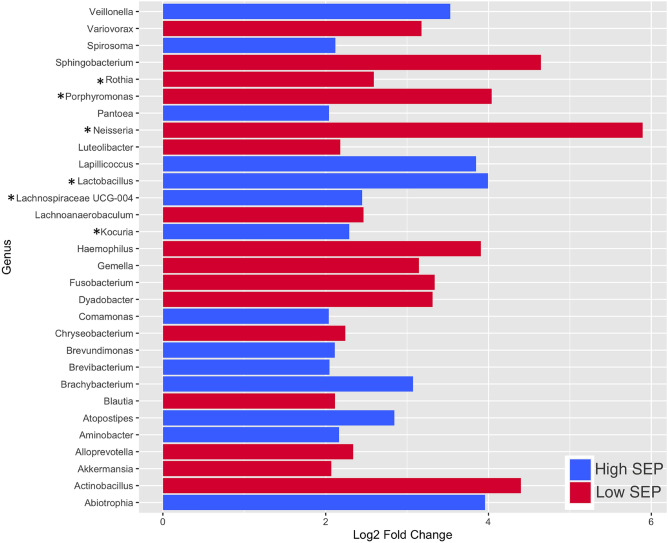
Imbalanced nutrition is associated with accelerated ageing, possibly mediated by microbiota. An analysis of the circulatory microbiota obtained from the leukocytes of participants in the MRC Twenty-07 general population cohort was performed. We now report that in this cohort, the most biologically aged exhibit a significantly higher abundance of circulatory pathogenic bacteria, including Neisseria, Rothia and Porphyromonas, while those less biologically aged possess more circulatory salutogenic (defined as being supportive of human health and wellbeing) bacteria, including Lactobacillus, Lachnospiraceae UCG-004 and Kocuria. The presence of these salutogenic bactreria is consistent with a capacity to metabolise and produce Nrf2 agonists. We also demonstrate that associated one carbon metabolism, notably betaine levels, did not vary with chronological age, but displayed a difference with socioeconomic position (SEP). Those at lower SEP possessed significantly lower betaine levels indicative of a poorer diet and poorer health span and consistent with reduced global DNA methylation levels in this group. Our data suggest a clear route to improving age related health and resilience based on dietary modulation of the microbiota.
Overview
The claims and statistics of this paper haven’t been checked yet.
Free: it reads the open-access text and checks the first 5 claims that cite a source we can check. Create a free account to check every claim.
Integrity signals
Registry
Cites
Statistics
Figures
Verification
Claims the paper makes
The claims and statistics of this paper haven’t been checked yet.
Free: it reads the open-access text and checks the first 5 claims that cite a source we can check. Create a free account to check every claim.
Claims other papers make about this one
Each is checked against this paper’s own text: does it say what the citing paper says it does?
The check wasn’t confident either way, so it gives no verdict — never disputed.
In the citing paper
“A significant reduction in dietary fibre intake and reduced consumption of fermented foods in modern populations has led to microbial dysbiosis [73, 74].”
From Ignoring the planet: A critical blind spot for research on ageing (2025) · cites this paper as [73]
Experimental — accuracy not yet measured
Self-check
Percentages, sums and reported differences re-computed from the paper’s own numbers.
The self-check needs the paper’s full text.
Citations
Cites
1 retracted
RETRACTED ARTICLE: Microbiome analyses of blood and tissues suggest cancer diagnostic approach
Poore, G. D., Kopylova, E., Zhu, Q., Carpenter, C., Fraraccio, S., Wandro, S., Kosciolek, T., Janssen, S., Metcalf, J., Song, S. J., et al. (2020) · Nature · doi:10.1038/s41586-020-2095-1 · Cited by 989
RetractedModerated estimation of fold change and dispersion for RNA-seq data with DESeq2
Love, M. I., Huber, W., & Anders, S. (2014) · Genome Biology · doi:10.1186/s13059-014-0550-8 · Cited by 95,106
MAFFT Multiple Sequence Alignment Software Version 7: Improvements in Performance and Usability
Katoh, K., & Standley, D. M. (2013) · Molecular Biology and Evolution · doi:10.1093/molbev/mst010 · Cited by 46,209
QIIME allows analysis of high-throughput community sequencing data
Caporaso, J. G., Kuczynski, J., Stombaugh, J., Bittinger, K., Bushman, F. D., Costello, E. K., Fierer, N., Peña, A. G., Goodrich, J. K., Gordon, J. I., et al. (2010) · Nature Methods · doi:10.1038/nmeth.f.303 · Cited by 34,887
phyloseq: An R Package for Reproducible Interactive Analysis and Graphics of Microbiome Census Data
McMurdie, P. J., & Holmes, S. (2013) · PLoS ONE · doi:10.1371/journal.pone.0061217 · Cited by 21,322
FastTree 2 – Approximately Maximum-Likelihood Trees for Large Alignments
Price, M. N., Dehal, P. S., & Arkin, A. P. (2010) · PLoS ONE · doi:10.1371/journal.pone.0009490 · Cited by 14,894
Gut flora metabolism of phosphatidylcholine promotes cardiovascular disease
Wang, Z., Klipfell, E., Bennett, B. J., Koeth, R., Levison, B. S., DuGar, B., Feldstein, A. E., Britt, E. B., Fu, X., Chung, Y.-M., et al. (2011) · Nature · doi:10.1038/nature09922 · Cited by 5,597
Intestinal microbiota metabolism of l-carnitine, a nutrient in red meat, promotes atherosclerosis
Koeth, R. A., Wang, Z., Levison, B. S., Buffa, J. A., Org, E., Sheehy, B. T., Britt, E. B., Fu, X., Wu, Y., Li, L., et al. (2013) · Nature Medicine · doi:10.1038/nm.3145 · Cited by 4,386
Review article: the role of butyrate on colonic function
HAMER, H. M., JONKERS, D., VENEMA, K., VANHOUTVIN, S., TROOST, F. J., & BRUMMER, R. ‐. (2008) · Alimentary Pharmacology & Therapeutics · doi:10.1111/j.1365-2036.2007.03562.x · Cited by 2,721
Does social class predict diet quality?
Darmon, N., & Drewnowski, A. (2008) · The American Journal of Clinical Nutrition · doi:10.1093/ajcn/87.5.1107 · Cited by 2,250
Cited by
Ageing – Oxidative stress, PTMs and disease
Ebert, T., Ngoc, T. U., Schurgers, L. J., Stenvinkel, P., & Shiels, P. G. (2022) · Molecular Aspects of Medicine · doi:10.1016/j.mam.2022.101099 · Cited by 128
Self-citationIntegrating Environment and Aging Research: Opportunities for Synergy and Acceleration
Malecki, K. M. C., Andersen, J. K., Geller, A. M., Harry, G. J., Jackson, C. L., James, K. A., Miller, G. W., & Ottinger, M. A. (2022) · Frontiers in Aging Neuroscience · doi:10.3389/fnagi.2022.824921 · Cited by 65
Archaea from the gut microbiota of humans: Could be linked to chronic diseases?
Mafra, D., Ribeiro, M. M., Fonseca, L. D. S., Regis, B., Cardozo, L., dos Santos, H. F., de Jesus, H. E., Schultz, J., Shiels, P. G., Stenvinkel, P., et al. (2022) · Anaerobe · doi:10.1016/j.anaerobe.2022.102629 · Cited by 66
Self-citationManipulating the exposome to enable better ageing
Shiels, P. G., Painer, J., Natterson-Horowitz, B., Johnson, R. J., Miranda, J. J., & Stenvinkel, P. (2021) · Biochemical Journal · doi:10.1042/bcj20200958 · Cited by 42
Self-citationBy what molecular mechanisms do social determinants impact cardiometabolic risk?
Baumer, Y., Pita, M. A., Baez, A. S., Ortiz-Whittingham, L. R., Cintron, M., Rose, R., Gray, V. C., Baah, F. O., & Powell‐Wiley, T. M. (2023) · Clinical Science · doi:10.1042/cs20220304 · Cited by 45
“…our data show that the NDI-to-TMAO relationship was significantly mediated by the TNF α and IL-1 β [147], indicating the overall significant role of systemic low-grade inflammation in potentially accelerating CVD through multiple mechanisms, including effects related to the microbiome [150].”
Metadata
- Authors
- Craven, H., McGuinness, D., Buchanan, S., Galbraith, N., McGuinness, D. H., Jones, B., Combet, E., Mafra, D., Bergman, P., Ellaway, A., Stenvinkel, P., Ijaz, U. Z., & Shiels, P. G.
- Affiliations
- University of Glasgow (GB)
- Universidade Federal Fluminense (BR)
- Karolinska Institutet (SE)
- Corresponding author
- Ijaz, Umer Z.
- Shiels, Paul G.
- ORCID
- Venue
- Scientific Reports
- Published
- 2021-06-16
- Volume
- 11
- Issue
- 1
- Pages
- 12629-12629
- ISSN
- 2045-2322 (ISSN-L)
- PMC
- PMC8209159
- OpenAlex
- W3170671461
- Cited by
- 21
- References
- 73
- Citations by year
- 2026: 3 · 2025: 1 · 2024: 4 · 2023: 7 · 2022: 4 · 2021: 2
- FWCI
- 1.33
- Type
- journal article
- Language
- en
- Open access
- gold
- doi.org
- Licence
- cc-by
- creativecommons.org/licenses/by/4.0 (tdm)
- creativecommons.org/licenses/by/4.0 (vor)
- Locations
- Scientific Reports (publishedVersion, cc-by)
- PubMed Central (publishedVersion, cc-by)
- PubMed (publishedVersion)
- ENLIGHTEN (Jurnal Bimbingan dan Konseling Islam) (acceptedVersion, cc-by-sa)
- DOAJ (DOAJ: Directory of Open Access Journals) (submittedVersion, cc-by-sa)
- Funders
- 4D Pharma
- NHS GG&C endowment award
- Topics
- Life Sciences › Biochemistry, Genetics and Molecular Biology › Molecular Biology › Gut microbiota and health
- Health Sciences › Dentistry › Periodontics › Oral microbiology and periodontitis research
- Life Sciences › Biochemistry, Genetics and Molecular Biology › Molecular Biology › Epigenetics and DNA Methylation
- Keywords
- biological age, socioeconomic position, accelerated aging, pathogenic bacteria, Nrf2 agonists, one-carbon metabolism, betaine, global DNA methylation, healthspan, diet, gut microbiota
- MeSH terms
- Adult, Aged, Aging, Bacteria, Betaine, Female, Humans, Life Style, Male, Methylamines, Middle Aged, Phylogeny, Prospective Studies, RNA, Ribosomal, 16S, Socioeconomic Factors, Sequence Analysis, DNA
About these checks
Registry, retraction, Cites and statistics results are computed, not judged, with one exception: a printed reference that no index lists is read once by a model before it counts as a citation error. Claims are extracted by a model and kept only when their quote appears verbatim in the text; each cited source is then checked, with a model’s help, for whether it says what the claim relies on. Those verdicts can be wrong — read the claim’s quote and the cited source before relying on one.
Statistics and arithmetic are recomputed, not judged.
Confidence bands are shown only for fields calibrated on our annotated test set. None is calibrated yet, so no band is shown.
What counts as a claim ›How we measure confidence ›How we check this ›
Are you an author, or do you see a problem with this page? Request a review
How to cite
Cite CoChat for the checks on this page, and the paper for its own findings.
- This page
- CoChat. (2026). Citation check: Socioeconomic position links circulatory microbiota differences with biological age. https://app.cochat.ai/papers/10.1038/s41598-021-92042-0
- The paper
- Craven, H., McGuinness, D., Buchanan, S., Galbraith, N., McGuinness, D. H., Jones, B., Combet, E., Mafra, D., Bergman, P., Ellaway, A., Stenvinkel, P., Ijaz, U. Z., & Shiels, P. G. (2021). Socioeconomic position links circulatory microbiota differences with biological age. Scientific Reports. https://doi.org/10.1038/s41598-021-92042-0
Data sources
Bibliographic data: Semantic Scholar, OpenAlex, Crossref.
Contains information from the Semantic Scholar Academic Graph Datasets, made available under the ODC Attribution License (ODC-BY 1.0).
Semantic Scholar’s data is described in: Kinney, R., et al. (2023). The Semantic Scholar Open Data Platform. arXiv:2301.10140.
