

The DOI matches its Crossref record; 62 of the 62 references it cites were found in a registry or an index.
Changes in abdominal subcutaneous adipose tissue phenotype following menopause is associated with increased visceral fat mass
Open accessAbstract
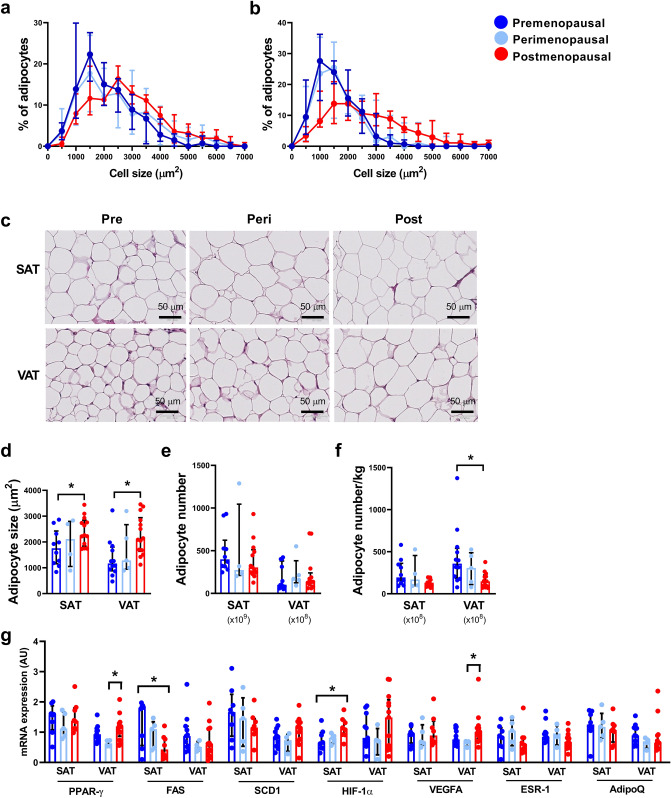
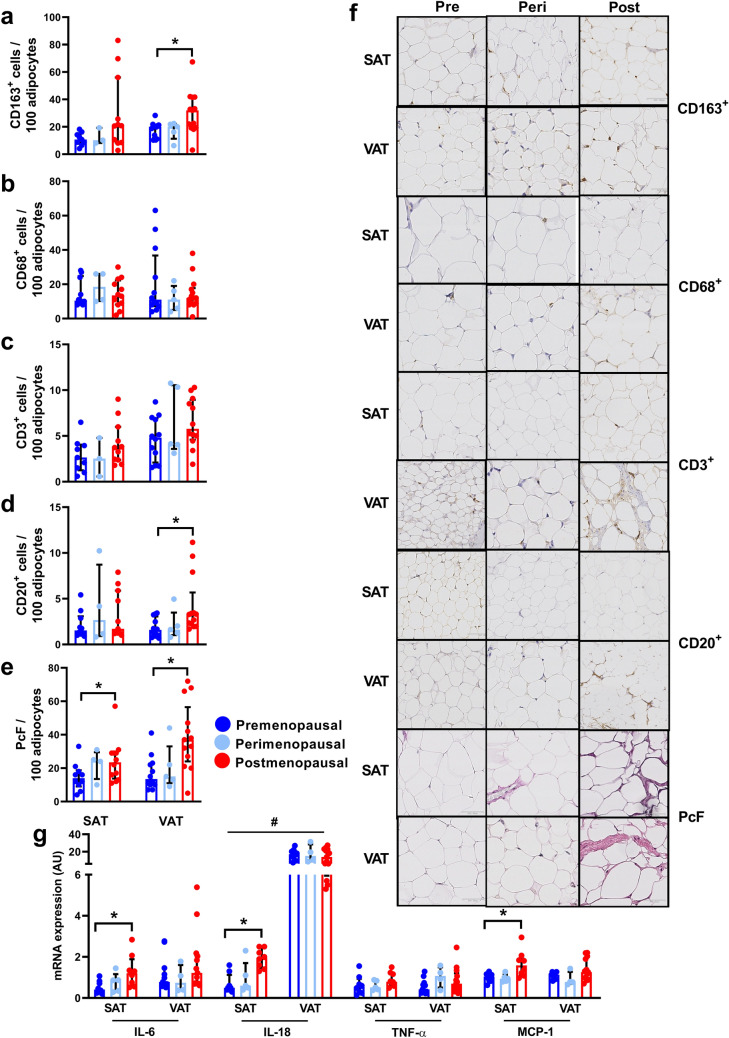
Menopause is associated with a redistribution of adipose tissue towards central adiposity, known to cause insulin resistance. In this cross-sectional study of 33 women between 45 and 60 years, we assessed adipose tissue inflammation and morphology in subcutaneous adipose tissue (SAT) and visceral adipose tissue (VAT) across menopause and related this to menopausal differences in adipose tissue distribution and insulin resistance. We collected paired SAT and VAT biopsies from all women and combined this with anthropometric measurements and estimated whole-body insulin sensitivity. We found that menopause was associated with changes in adipose tissue phenotype related to metabolic dysfunction. In SAT, postmenopausal women showed adipocyte hypertrophy, increased inflammation, hypoxia and fibrosis. The postmenopausal changes in SAT was associated with increased visceral fat accumulation. In VAT, menopause was associated with adipocyte hypertrophy, immune cell infiltration and fibrosis. The postmenopausal changes in VAT phenotype was associated with decreased insulin sensitivity. Based on these findings we suggest, that menopause is associated with changes in adipose tissue phenotype related to metabolic dysfunction in both SAT and VAT. Whereas increased SAT inflammation in the context of menopause is associated with VAT accumulation, VAT morphology is related to insulin resistance.
Overview
The claims and statistics of this paper haven’t been checked yet.
Run the check — free, no account needed. It reads the open-access text and checks the sources it cites.
Integrity signals
Registry
Cites
Statistics
Figures
Verification
Claims the paper makes
The claims and statistics of this paper haven’t been checked yet.
Run the check — free, no account needed. It reads the open-access text and checks the sources it cites.
Claims other papers make about this one
Each is checked against this paper’s own text: does it say what the citing paper says it does?
In the citing paper
“Hormone dysfunction is another explanation for the ageing‐induced increase in adipogenesis and the accelerated loss of bone and muscle mass after menopause in women and andropause in men.[ 17 ]”
From Pathogenesis of sarcopenia and the relationship with fat mass: descriptive review (2022) · cites this paper as [17]
Self-check
Percentages, sums and reported differences re-computed from the paper’s own numbers.
The self-check needs the paper’s full text.
Citations
Cites
Matsuda, M., & DeFronzo, R. A. (1999) · Diabetes Care · doi:10.2337/diacare.22.9.1462 · Cited by 5,621
Macrophage-specific PPARγ controls alternative activation and improves insulin resistance
Odegaard, J. I., Ricardo-Gonzalez, R. R., Goforth, M. H., Morel, C. R., Subramanian, V., Mukundan, L., Eagle, A. R., Vats, D., Brombacher, F., Ferrante, A. W., et al. (2007) · Nature · doi:10.1038/nature05894 · Cited by 2,107
Ectopic Fat in Insulin Resistance, Dyslipidemia, and Cardiometabolic Disease
Shulman, G. I. (2014) · New England Journal of Medicine · doi:10.1056/nejmra1011035 · Cited by 1,126
Winer, D. A., Winer, S., Shen, L., Wadia, P. P., Yantha, J., Paltser, G., Tsui, H., Wu, P., Davidson, M. G., Alonso, M. N., et al. (2011) · Nature Medicine · doi:10.1038/nm.2353 · Cited by 1,050
Increased visceral fat and decreased energy expenditure during the menopausal transition
Lovejoy, J. C., Champagne, C. M., de Jonge, L., Xie, H., & Smith, S. R. (2008) · International Journal of Obesity · doi:10.1038/ijo.2008.25 · Cited by 1,020 · cited 1×
“Exclusion criteria were: (1) chronic diseases (including endometriosis), (2) infections during the last 4 weeks, (3) more than 7 alcohol units/week, (4) premature menopause (before age 40 years), (5) hysterectomy or oophorectomy prior to study inclusion, (6) body mass index (BMI) > 35 kg/m2 (as MRIs could not be perfo…”
BackgroundFibrosis and adipose tissue dysfunction.
Sun, K., Tordjman, J., Clément, K., & Scherer, P. E. (2013) · Cell Metabolism · doi:10.1016/j.cmet.2013.06.016 · Cited by 960
Kratz, M., Coats, B. R., Hisert, K. B., Hagman, D. K., Mutskov, V. J., Peris, E., Schoenfelt, K. Q., Kuzma, J. N., Larson, I. A., Billing, P. S., et al. (2014) · Cell Metabolism · doi:10.1016/j.cmet.2014.08.010 · Cited by 866
Androgens Decrease Plasma Adiponectin, an Insulin-Sensitizing Adipocyte-Derived Protein
Nishizawa, H., Shimomura, I., Kishida, K., Maeda, N., Kuriyama, H., Nagaretani, H., Matsuda, M., Kondo, H., Furuyama, N., Kihara, S., et al. (2002) · Diabetes · doi:10.2337/diabetes.51.9.2734 · Cited by 837
Gluteofemoral body fat as a determinant of metabolic health
Manolopoulos, K. N., Karpe, F., & Frayn, K. N. (2010) · International Journal of Obesity · doi:10.1038/ijo.2009.286 · Cited by 811
Altered adipose tissue and adipocyte function in the pathogenesis of metabolic syndrome
Kahn, C. R., Wang, G., & Lee, K. Y. (2019) · Journal of Clinical Investigation · doi:10.1172/jci129187 · Cited by 686
Cited by
Sorted by citations
Items 101–116 of 116
Völker, L. A., & Ceccon, G. S. (2026) · Springer eBooks · doi:10.1007/978-3-476-06005-1_55-1
Azadani, M. N., Lotfaliany, M., Davoodian, N., Berk, M., Woods, R. L., Ryan, J. L., McNeil, J. J., Pasco, J. A., Stocks, N. P., Roberts, S. K., et al. (2026) · GeroScience · doi:10.1007/s11357-026-02446-x
Chang, Y.-C., Lin, T., & Li, W.-C. (2026) · Frontiers in Cardiovascular Medicine · doi:10.3389/fcvm.2026.1852845
Alum, E. U., Obasi, D. C., Uzor, S., Eji, M. O., Amadi, E. B., Emeruwa, A. C., Akwari, A. A., Okoroh, P. N., Aniokete, U. C., Alum, B. N., et al. (2026) · Obesity Medicine · doi:10.1016/j.obmed.2026.100738
Heimer, J., Spielhofer, N., Schwyzer, M., Becker, A. S., Reinisch, I., Krämer, S. D., Hamilton, B. S., Panova‐Noeva, M., Neubauer, H., Wolfrum, C., et al. (2026) · EANM Innovation · doi:10.1016/j.eanmi.2026.100304
de Menezes, A. C. L., Maciel, I. A., Barros, E. C. O., Maestá, N., Witkin, S. S., Orsatti, F. L., & Orsatti, C. L. (2026) · Endocrine · doi:10.1007/s12020-026-04762-w
Metabolic effects of a GLP-1 analog combined with aerobic training in ovariectomized rats
Selau, B., Bastos, L. M., Normann, R. S., Cubas, G. K., Herrmann, R. D. O. C. D. C., de Barros, L. D. A. D. O., de Amaral, M., Trapp, M., Kucharski, L. C., Vogt, É. L., et al. (2026) · Molecular and Cellular Endocrinology · doi:10.1016/j.mce.2026.112917
Sun, X., Zhou, J., Zhou, L., Zheng, Y., Ren, J., Jiang, Z., Wang, X., Zhang, J., Xin, Z., Yi, K., et al. (2026) · Frontiers in Endocrinology · doi:10.3389/fendo.2026.1927643
Cavalheira, M. A., da Silva, E. M., de Menezes, M. P., Silva, D. L. B., de Oliveira, B. C., Bertasso, I. M., Lisboa, P. C., Fernandes‐Santos, C., da Costa, C. A., Resende, Â. C., et al. (2026) · Nutrition Research · doi:10.1016/j.nutres.2026.09.006
Rising star 2026: How menopause rewires adipocytes and raises metabolic risk
Horváth, C. (2026) · Metabologia · doi:10.1007/s44357-026-00016-4
Endocrine determinants of MASLD: mechanisms and therapeutic targets
Chaturvedi, R., Mathew, A., Pradhan, A., Goyal, M., Sharma, M., Kachroo, V., Agrawal, C., Krishnamurthy, A., Atreja, S. M., & Atreja, A. (2026) · Frontiers in Endocrinology · doi:10.3389/fendo.2026.1967494
Nakao, H., Yokomoto‐Umakoshi, M., Fujita, M., Nakatani, K., Kitamura, Y., Ogasawara, R., Kaneko, H., Iwahashi, N., Nakano, Y., Fukumoto, T., et al. (2026) · iScience · doi:10.1016/j.isci.2026.117776
Kruger, R. E., Yohannes, H., Cho, E., Eisner, L. E., Pfau, D. R., Chan‐Sui, R. K., Migotsky, N., da Rocha, A. M., Killian, M. L., Moravek, M. B., et al. (2026) · Frontiers in Endocrinology · doi:10.3389/fendo.2026.1940100
Precision Nutrition and Health Outcomes Across the Lifespan
Yang, S., Brown, A. G. M., Dixit, S., Shiroma, E. J., Farmer, N. M., Lu, Q., Sood, B. G., Vitalis, D., Ilias, M. R., Lachowicz-Scroggins, M. E., et al. (2026) · Nutrients · doi:10.3390/nu18203424
Aljawini, N., Habib, S. S., & Al-Regaiey, K. (2026) · Nutrients · doi:10.3390/nu18213531
Liu, Y., Gu, S., & Tang, S. (2026) · Frontiers in Public Health · doi:10.3389/fpubh.2026.1925532
Metadata
- Authors
- Abildgaard, J., Ploug, T., Al-Saoudi, E., Wagner, T., Thomsen, C., Ewertsen, C., Bzorek, M., Pedersen, B. K., Pedersen, A. T., & Lindegaard, B.
- Affiliations
- University of Copenhagen (DK)
- Copenhagen University Hospital (DK)
- Zealand University Hospital (DK)
- Corresponding author
- Abildgaard, Julie
- ORCID
- Venue
- Scientific Reports
- Published
- 2021-07-20
- Volume
- 11
- Issue
- 1
- Pages
- 14750-14750
- ISSN
- 2045-2322 (ISSN-L)
- PMC
- PMC8292317
- OpenAlex
- W3184145417
- Cited by
- 116
- References
- 62
- Citations by year
- 2026: 38 · 2025: 33 · 2024: 14 · 2023: 19 · 2022: 11 · 2021: 1
- FWCI
- 8.10
- Type
- journal article
- Language
- en
- Open access
- gold
- doi.org
- Locations
- Scientific Reports (publishedVersion, cc-by)
- PubMed Central (publishedVersion, cc-by)
- PubMed (publishedVersion)
- Research at the University of Copenhagen (University of Copenhagen) (publishedVersion, cc-by)
- DOAJ (DOAJ: Directory of Open Access Journals) (submittedVersion, cc-by-sa)
- Funders
- Augustinus Fonden (17-2354)
- Topics
- Health Sciences › Medicine › Endocrinology, Diabetes and Metabolism › Adipokines, Inflammation, and Metabolic Diseases
- Health Sciences › Medicine › Physiology (medical) › Adipose Tissue and Metabolism
- Health Sciences › Medicine › Cardiology and Cardiovascular Medicine › Cardiovascular Disease and Adiposity
- Keywords
- menopause, subcutaneous adipose tissue, visceral adipose tissue, adipose tissue inflammation, adipocyte hypertrophy, adipose tissue fibrosis, adipose tissue hypoxia, immune cell infiltration, insulin resistance, visceral fat accumulation, adipose tissue redistribution, abdominal obesity, postmenopausal women
- MeSH terms
- Aging, Female, Humans, Inflammation, Insulin, Insulin Resistance, Menopause, Middle Aged, Phenotype, Metabolic Syndrome, Peroxisome Proliferator-Activated Receptors, Estrogen Receptor alpha, Intra-Abdominal Fat, Body Fat Distribution, Subcutaneous Fat, Abdominal
About these checks
Registry, retraction, Cites and statistics results are computed, not judged, with one exception: a printed reference that no index lists is read once by a model before it counts as a citation error. Claims are extracted by a model and kept only when their quote appears verbatim in the text; each cited source is then checked, with a model’s help, for whether it says what the claim relies on. Those verdicts can be wrong — read the claim’s quote and the cited source before relying on one.
Statistics and arithmetic are recomputed, not judged.
Confidence bands are shown only for fields calibrated on our annotated test set. None is calibrated yet, so no band is shown.
What counts as a claim ›How we measure confidence ›How we check this ›
Are you an author, or do you see a problem with this page? Request a review
