

The DOI matches its Crossref record; 86 of the 99 references it cites were found in a registry or an index.
Molecular diversity of Uzbekistan’s fishes assessed with DNA barcoding
Open accessPublished version of a preprint
Abstract
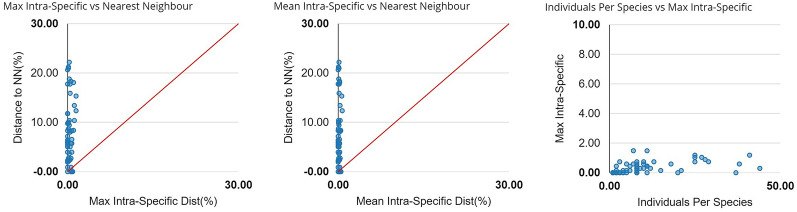
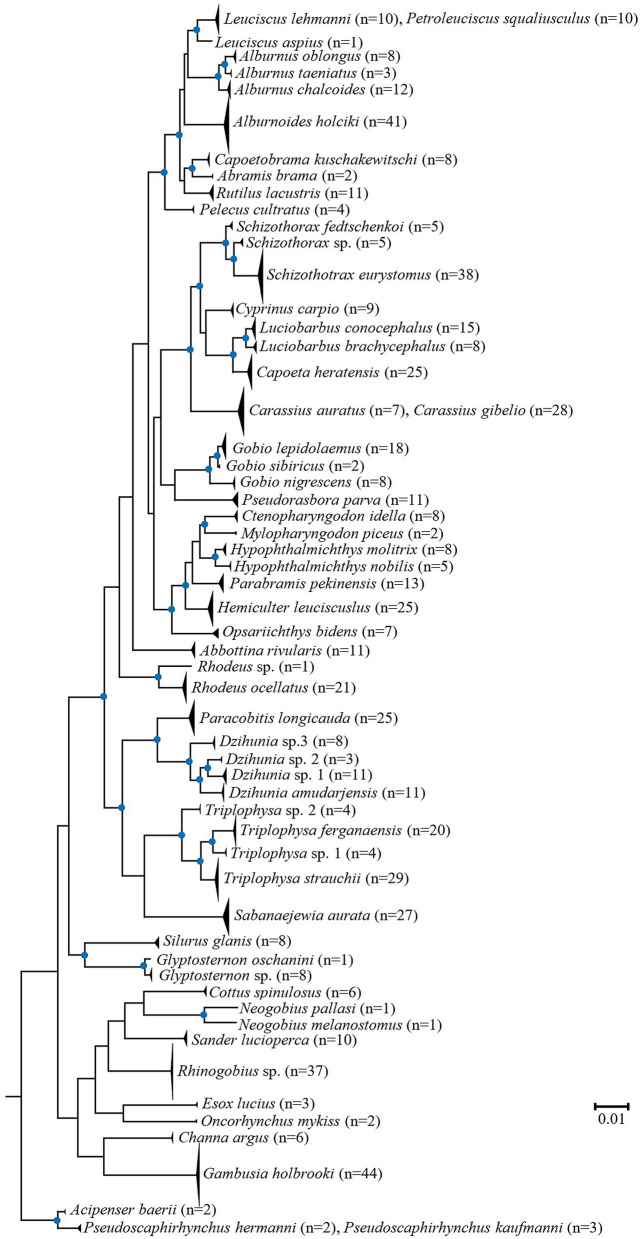
Uzbekistan is one of two doubly landlocked countries in the world, where all rivers are endorheic basins. Although fish diversity is relatively poor in Uzbekistan, the fish fauna of the region has not yet been fully studied. The aim of this study was to establish a reliable barcoding reference database for fish in Uzbekistan. A total of 666 specimens, belonging to 59 species within 39 genera, 17 families, and 9 orders, were subjected to polymerase chain reaction amplification in the barcode region and sequenced. The length of the 666 barcodes was 682 bp. The average K2P distances within species, genera, and families were 0.22%, 6.33%, and 16.46%, respectively. The average interspecific distance was approximately 28.8 times higher than the mean intraspecific distance. The Barcode Index Number (BIN) discordance report showed that 666 specimens represented 55 BINs, of which five were singletons, 45 were taxonomically concordant, and five were taxonomically discordant. The barcode gap analysis demonstrated that 89.3% of the fish species examined could be discriminated by DNA barcoding. These results provide new insights into fish diversity in the inland waters of Uzbekistan and can provide a basis for the development of further studies on fish fauna.
Overview
The claims and statistics of this paper haven’t been checked yet.
Run the check — free, no account needed. It reads the open-access text and checks the sources it cites.
Integrity signals
Registry
Cites
Statistics
Figures
Verification
Claims the paper makes
The claims and statistics of this paper haven’t been checked yet.
Run the check — free, no account needed. It reads the open-access text and checks the sources it cites.
Self-check
Percentages, sums and reported differences re-computed from the paper’s own numbers.
The self-check needs the paper’s full text.
Citations
Cites
MEGA7: Molecular Evolutionary Genetics Analysis Version 7.0 for Bigger Datasets
Kumar, S., Stecher, G., & Tamura, K. (2016) · Molecular Biology and Evolution · doi:10.1093/molbev/msw054 · Cited by 44,059
Kimura, M. (1980) · Journal of Molecular Evolution · doi:10.1007/bf01731581 · Cited by 29,778
MrBayes 3.2: Efficient Bayesian Phylogenetic Inference and Model Choice Across a Large Model Space
Ronquist, F., Teslenko, M., van der Mark, P., Ayres, D. L., Darling, A., Höhna, S., Larget, B., Liu, L., Suchard, M. A., & Huelsenbeck, J. P. (2012) · Systematic Biology · doi:10.1093/sysbio/sys029 · Cited by 27,843
Biological identifications through DNA barcodes
Hebert, P. D. N., Cywinska, A., Ball, S. L., & deWaard, J. R. (2003) · Proceedings of the Royal Society of London. Series B: Biological Sciences · doi:10.1098/rspb.2002.2218 · Cited by 13,376
Historical Overfishing and the Recent Collapse of Coastal Ecosystems
Jackson, J. B. C., Kirby, M. X., Berger, W. H., Bjorndal, K. A., Botsford, L. W., Bourque, B. J., Bradbury, R. H., Cooke, R., Erlandson, J., Estes, J. A., et al. (2001) · Science · doi:10.1126/science.1059199 · Cited by 6,652
Biological Identifications Through DNA Barcodes
Ramadan, H., & Baeshen, N. (2012) · doi:10.5772/49967 · Cited by 5,825
DNA barcoding Australia's fish species
Ward, R. D., Zemlak, T. S., Innes, B. H., Last, P. R., & Hebert, P. D. N. (2005) · Philosophical Transactions of the Royal Society B: Biological Sciences · doi:10.1098/rstb.2005.1716 · Cited by 4,332
Hebert, P. D. N., Penton, E. H., Burns, J. M., Janzen, D. H., & Hallwachs, W. (2004) · Proceedings of the National Academy of Sciences · doi:10.1073/pnas.0406166101 · Cited by 3,587
ABGD, Automatic Barcode Gap Discovery for primary species delimitation
PUILLANDRE, N., LAMBERT, A., BROUILLET, S., & ACHAZ, G. (2012) · Molecular Ecology · doi:10.1111/j.1365-294x.2011.05239.x · Cited by 3,324
Identification of Birds through DNA Barcodes
Hebert, P. D. N., Stoeckle, M. Y., Zemlak, T. S., & Francis, C. M. (2004) · PLoS Biology · doi:10.1371/journal.pbio.0020312 · Cited by 2,653
Research works printed but not linked: 8
- Ratnasingham, S. & Hebert, P. D. N. BOLD: The barcode of life data system. Mol. Ecol. Notes 7, 355–364 (2007). · DOI · Paper page
- Mirabdullaev, I. M. & Mullabaev, N. R. Ichthyofauna of Uzbekistan: Modern state and taxonomy. J. Biol. Uzbekistan 5, 43–49 (2020) (In Russian with English abstract).
- Atamuratova, M. S. Ichthyofauna of reservoirs in the Akhangaran river basin. (Ph.D. dissertation, Institute of Zoology, Tashkent, Uzbekistan, 2021) (In Uzbek).
- Berg, L. S. Fishes of Fresh Waters of the USSR and Adjacent Countries. Vol. 2. (Academy of Sciences of the USSR Press, 1949) (In Russian).
- Turdakov, F. A. Fishes of Kirghizia (Academy of Sciences of the Kyrgyz SSR Press, 1963) (In Russian).
- Prokofiev, A. M. Loaches of the subfamily Nemacheilinae of the World (Filigran, 2017) (In Russian).
- Berg, L. S. The Freshwater Fishes of the USSR and Adjacent Countries (Academy of Sciences of the USSR Press, 1948) (In Russian).
- Mirabdullaev, I. M., Mirzaev, U. T., Kuzmetov, A. R. & Kimsanov, Z. O. Keys to Fishes of Uzbekistan and Adjacent Regions (Sano-Standard Press, 2011) (In Uzbek).
Cited by
Mitochondrial DNA barcoding of mosquito species (Diptera: Culicidae) in Thailand
Chaiphongpachara, T., Changbunjong, T., Laojun, S., Nutepsu, T., Suwandittakul, N., Kuntawong, K., Sumruayphol, S., & Ruangsittichai, J. (2022) · PLoS ONE · doi:10.1371/journal.pone.0275090 · Cited by 54
DNA Barcoding of Fish Species Diversity in Guizhou, China
Tang, Q., Deng, L., Luo, Q., Duan, Q., Wang, X., & Zhang, R. (2023) · Diversity · doi:10.3390/d15020203 · Cited by 17
Afrand, M., Sourinejad, I., Shahdadi, A., & Vera, M. (2023) · Estuaries and Coasts · doi:10.1007/s12237-023-01306-7 · Cited by 9
“Its presence increases the effectiveness of DNA barcodes for species identification (Sheraliev and Peng 2021).”
Rozimov, A., Wang, Y.-F., Wang, M., Zou, M., Sobirov, J., Karimov, E., Kholmatov, B., Freyhof, J., Namozov, S., Wang, C., et al. (2025) · Zoosystematics and Evolution · doi:10.3897/zse.101.137787 · Cited by 8
“The K2P distance between Schizothorax sp. and other valid species ranges from 3.18% to 6.72%, while the distance between our sequenced Schizothorax sp. individual and that from previous study (Sheraliev and Peng 2021) is 0 (Fig.”
InfluentialRen, J., & Zhang, R.-Z. (2024) · Journal of Insect Science · doi:10.1093/jisesa/ieae083 · Cited by 8
“…of this approach has been successfully demonstrated across various taxonomic groups, including birds (Charles et al. 2004), fish (Ward et al. 2005, Sheraliev and Peng 2021), and, subsequently, insects (Park et al. 2011, Pramual and Adler 2014, Nzelu et al. 2015, Dinca et al. 2021, da Conceição…”
BackgroundSheraliev, B., Kayumova, Y., & Peng, Z.-G. (2022) · ZooKeys · doi:10.3897/zookeys.1125.85431 · Cited by 8
“Triplophysa strauchii occurs in all waters of the Fergana Valley, whereas T. ferganaensis has only been recorded from its type locality, the Shakhimardan stream (Sheraliev and Peng 2021b).”
BackgroundInfluentialSelf-citationDNA barcoding the Lake Edward basin: high taxonomic coverage of a tropical freshwater ichthyofauna
Decru, E., Vranken, N., Maetens, H., Vry, A. M. D., Kayenbergh, A., Snoeks, J., & Steenberge, M. V. (2022) · Hydrobiologia · doi:10.1007/s10750-022-04812-0 · Cited by 8
Karimov, E., Zeiringer, B., Coeck, J., Verhelst, P., Karimov, B., Omonov, O., Schletterer, M., & Hayes, D. S. (2024) · Fishes · doi:10.3390/fishes9030094 · Cited by 7
DNA barcoding of fish diversity from Batanghari River, Jambi, Indonesia
Marnis, H., Syahputra, K., Darmawan, J., Febrianti, D., Tahapari, E., Larashati, S., Iswanto, B., Primanita, E. P. H., Syaifudin, M., & Subangkit, A. T. (2024) · Fisheries and aquatic sciences · doi:10.47853/fas.2024.e10 · Cited by 6
Assessing larval fish diversity and conservation needs in the Luzon strait using DNA barcoding
Li, H., Chen, Y., Li, X., Zhou, P., & Xiong, X. (2023) · Frontiers in Marine Science · doi:10.3389/fmars.2023.1268399 · Cited by 6
Ichthyofauna of Tajikistan: Diversity and Changes Over the Past Century
Artaev, O., Thoni, R., Mirzoev, N., & Levin, B. (2025) · American Museum Novitates · doi:10.1206/4032.1 · Cited by 5
DNA Barcoding for the Identification of Adult Mosquitoes (Diptera: Culicidae) in Western Australia
Lamichhane, B., Brockway, C., Evasco, K. L., Nicholson, J., Neville, P., Mackenzie, J. S., Smith, D. W., & Imrie, A. (2024) · Ecology and Evolution · doi:10.1002/ece3.70493 · Cited by 5
Panthum, T., Ariyaphong, N., Wattanadilokchatkun, P., Singchat, W., Ahmad, S. F., Kraichak, E., Dokkaew, S., Muangmai, N., Han, K., Duengkae, P., et al. (2022) · Genes & Genomics · doi:10.1007/s13258-022-01353-7 · Cited by 6
“An average barcoding gap of 92.54% mirrors other studies like 89.3% for Uzbekistan fish (Sheraliev and Peng 2021).”
ResultInfluentialLevin, B., Levina, M., Artaev, O. N., Bolotovskiy, A., Gandlin, A. A., Turbanov, I., Komarova, A. S., Mugue, N., Pozdeev, I., Ruchin, A., et al. (2026) · Metabarcoding and Metagenomics · doi:10.3897/mbmg.10.174947 · Cited by 3
Karimov, E., Omonov, O., Verhelst, P., Karimov, B., Schletterer, M., & Hayes, D. S. (2025) · Fishes · doi:10.3390/fishes10080377 · Cited by 3
Sahu, A., Singh, M., & Sarkar, U. (2025) · Scientific Reports · doi:10.1038/s41598-025-26773-9 · Cited by 2
Turbanov, I., Bolotovskiy, A., Artaev, O. N., Gandlin, A. A., Levina, M., Vasil'eva, E. D., & Levin, B. (2025) · Zoosystematics and Evolution · doi:10.3897/zse.101.147368 · Cited by 2
“…et al. 2016; Yang et al. 2016; Corse et al. 2017; Friedrich et al. 2018; Li et al. 2018; Aksu and Bektaş 2019; Sheraliev et al. 2020; Yi and Fu 2020; Behrens-Chapuis et al. 2021; Sheraliev and Peng 2021; and unpublished sequences in GenBank – https:// www.ncbi.nlm.nih.gov/) (see Suppl. material 1).”
Sarkar, B., Bhakta, J. N., Jana, B., Sarkar, U. K., & Singh, M. (2024) · Thalassas: An International Journal of Marine Sciences · doi:10.1007/s41208-024-00774-3 · Cited by 2
Kaya, C., Kurtul, I., Bayçelebi, E., Ilhan, A., & Sarı, H. (2023) · Turkish Journal of Fisheries and Aquatic Sciences · doi:10.4194/trjfas23846 · Cited by 2
“2018; Sheraliev and Peng, 2021).”
BackgroundInfluentialThe preliminary DNA barcoding dataset of fishes from Chinese coastal waters
Wang, L., Wu, Z.-H., Sun, G.-Y., Chen, H., Liu, H., & You, F. (2022) · Regional Studies in Marine Science · doi:10.1016/j.rsma.2022.102699 · Cited by 2
Zhang, D., Liu, P., Lu, X.-M., Hao, H.-M., Sun, H., Nie, Z.-L., & Ren, S. (2026) · Biology · doi:10.3390/biology15120894 · Cited by 1
“Evidence for its utility is accumulating across different regions [22].”
Peng, Z., Shi, L., Zhang, Y., Wang, Z., Hui, Y., Feng, S., Ji, F., & Chen, D. (2026) · Aquatic Sciences · doi:10.1007/s00027-026-01280-9 · Cited by 1
“However, tra‑ ditional method encounters substantial challenges, such as difficulties in species identification and incomplete data col‑ lection, which impede accurate assessments of biodiversity levels and trends (Sheraliev and Peng 2021; Xu et al. 2022).”
Self-citationMa, X., Xu, Y., Chen, X.-D., Sun, C., & Lu, C.-H. (2026) · ZooKeys · doi:10.3897/zookeys.1270.182564 · Cited by 1
“Although gene frag - ments such as COXI (Chang et al. 2017; Sheraliev and Peng 2021) and 12S rRNA (Miya et al. 2015) are often used as DNA barcodes, the complete mitochon - drial genome can provide more comprehensive and uniform genetic variation information, effectively overcoming the phylogenetic…”
Thakur, K., Sharma, A., Sharma, D., Bist, C. M. S., Mahajan, D., Kumar, S., Jindal, R., & Kumar, R. (2025) · Gene Reports · doi:10.1016/j.genrep.2025.102300 · Cited by 1
Rozimov, A., Turaev, L., Namozov, S., Agzamov, F., Sobirov, J., Wang, C., Kholmatov, B., Li, X.-X., & Guo, B.-C. (2025) · Journal of Applied Ichthyology · doi:10.1155/jai/6648940 · Cited by 1
Sheraliev, B., & Kayumova, Y. (2024) · Zootaxa · doi:10.11646/zootaxa.5536.1.8 · Cited by 1
Self-citationParmaksiz, A., & Demir, A. (2022) · Turkish Journal of Bioscience and Collections · doi:10.26650/tjbc.1112782 · Cited by 1
“…Özbekistan MW649280 96.14 Sheraliev & Peng, 2021 Çin JQ319113 96.14 Cheng, vd., 2012 Çin AB379922 96.14 Komiyama, vd., 2009 Özbekistan MW649276 95.97 Sheraliev & Peng, 2021 Cyt b Türkiye OP173205 100 Bu çalışma Türkiye MF083610 99.82 Ağdamar & Tarkan, 2019 Yunanistan DQ868878 99.66 Tsipas vd.,…”
InfluentialArtaev, O., Turbanov, I., Levina, M., Mamilov, N. S., Sharakhmetov, S., Khassengaziyeva, G., Simonov, E., Thoni, R., & Levin, B. (2026) · American Museum Novitates · doi:10.1206/4058.1
Lee, S. H., Kim, S. K., Jang, S., Suh, K., Park, J. K., & Kim, K.-R. (2026) · International Journal of Molecular Sciences · doi:10.3390/ijms27146325
“The barcode-gap analysis reinforces this cautious taxonomic interpretation [16,36].”
InfluentialSahu, A., & Singh, M. (2026) · Total Environment Advances · doi:10.1016/j.teadva.2026.200148
Teimori, A., Esmaeili, H., Abbasi, K., Pourhosseini, F., Motamedi, M., Mustafayev, N., & Levin, B. A. (2026) · Regional Studies in Marine Science · doi:10.1016/j.rsma.2026.104864
Sheraliev, B. (2026) · Acta zoologica bulgarica · doi:10.71424/azb78.1.002968
Self-citationBernaś, R., Radtke, G., Horbacz, T., Wąs-Barcz, A., & Święcki, W. (2025) · Folia Biologica · doi:10.3409/fb_73-4.16
Phukan, B., Kumar, A. P., Barman, M., Das, P., Talukdar, A., Kalita, R., Deshmukhe, G., Tamuli, K., Bhattacharjya, B. K., & Nayak, B. B. (2025) · Taxonomy · doi:10.3390/taxonomy5040069
Gong, Z., Wang, H.-S., Liu, Y., & Li, J.-C. (2025) · ZooKeys · doi:10.3897/zookeys.1262.172819
“The distribution of glyptosternine catfishes is concentrated in the East Hima - layas, Indo-Burman Ranges, Gaoligong Mountains, Shan Hills and Kachin Hills; these catfishes range from Uzbekistan in the west to South China in the east ZooKeys 1262: 289–301 (2025), DOI: 10.3897/zookeys.1262.172819 Zheng Gong et al.: Gla…”
InfluentialSheraliev, B., Khalimov, S., Rakhmonov, M., Komilova, D., Nazarov, M. S., Умаров, Ф. Ф., & Azamov, O. (2025) · Check List · doi:10.15560/21.4.755
“…velocity (Mamilov et al. 2025 2021) from the lower reaches of the Amu Darya (yellow circle), Amanov (1985) from the lower reaches of the Surkhandarya river (red square), and Sheraliev and Peng (2021) from the Surkhandarya, Kashkadarya and lower reaches of the Zeravshan rivers (green diamond).”
InfluentialSelf-citationHaque, M. A., Hadi, S., Sumona, A. A., Rashid, J., Khan, M. G. Q., & Alam, M. S. (2025) · Ecology and Evolution · doi:10.1002/ece3.71559
“Sheraliev and Peng (2021) found that the average intraspecific K2P distance was 0.22% in their study.”
InfluentialChua, X.-Y., Ord, L., Bent, S., Lovell, D., & McGrath, A. (2024) · Environmental DNA · doi:10.1002/edn3.597
“Using the extremes of the histograms as coordinates for a scatter plot—minimum intra-species distance versus maximum inter-species distance—ad-dresses these limitations, as observed in previous studies (Ma, Ren, and Zhang 2022; Sheraliev and Peng 2021; Chapple and Ritchie 2013).”
InfluentialGenetic diversity of the tilapia (Oreochromis spp.) in the Aguamilpa Reservoir, Nayarit, Mexico
Rubio-Gómez, W. K., Sandoval-Castro, E., Zavala-Leal, Ó., Valdez-Gónzález, F. J., Granados-Amores, J., Rodríguez-Preciado, J. A., Ruiz-Velazco, J. M. D. J., & Cuevas-Rodríguez, B. L. (2026) · Revista Brasileira de Zootecnia · doi:10.37496/rbz5520240183
Khamdamov, A. (2026) · Научное обозрение Биологические науки (Scientific Review Biological Sciences) · doi:10.17513/srbs.1466
Metadata
- Authors
- Sheraliev, B., & Peng, Z.
- Affiliations
- Southwest University (CN)
- Corresponding author
- Peng, Zuogang
- Venue
- Scientific Reports
- Published
- 2021-08-19
- Volume
- 11
- Issue
- 1
- Pages
- 16894-16894
- ISSN
- 2045-2322 (ISSN-L)
- PMC
- PMC8376971
- OpenAlex
- W3195447945
- Cited by
- 42
- References
- 99
- Citations by year
- 2026: 10 · 2025: 11 · 2024: 8 · 2023: 5 · 2022: 8
- FWCI
- 3.82
- Type
- journal article
- Language
- en
- Open access
- gold
- doi.org
- Licence
- cc-by
- creativecommons.org/licenses/by/4.0 (tdm)
- creativecommons.org/licenses/by/4.0 (vor)
- Locations
- Scientific Reports (publishedVersion, cc-by)
- bioRxiv (Cold Spring Harbor Laboratory) (acceptedVersion, cc-by-nc-nd)
- PubMed Central (publishedVersion, cc-by)
- PubMed (publishedVersion)
- DOAJ (DOAJ: Directory of Open Access Journals) (submittedVersion, cc-by-sa)
- Funders
- Foundation for Innovative Research Groups of the National Natural Science Foundation of China (31872204)
- Topics
- Life Sciences › Agricultural and Biological Sciences › Aquatic Science › Fish Biology and Ecology Studies
- Physical Sciences › Environmental Science › Ecology › Environmental DNA in Biodiversity Studies
- Life Sciences › Agricultural and Biological Sciences › Ecology, Evolution, Behavior and Systematics › Invertebrate Taxonomy and Ecology
- Keywords
- fish diversity, DNA barcoding, endorheic basin, landlocked countries, Barcode Index Number, barcode gap analysis, species identification, molecular taxonomy, inland waters
- MeSH terms
- Animals, Bayes Theorem, Electron Transport Complex IV, Fishes, Geography, Phylogeny, Species Specificity, Uzbekistan, Genetic Variation, Sample Size, DNA Barcoding, Taxonomic
About these checks
Registry, retraction, Cites and statistics results are computed, not judged, with one exception: a printed reference that no index lists is read once by a model before it counts as a citation error. Claims are extracted by a model and kept only when their quote appears verbatim in the text; each cited source is then checked, with a model’s help, for whether it says what the claim relies on. Those verdicts can be wrong — read the claim’s quote and the cited source before relying on one.
Statistics and arithmetic are recomputed, not judged.
Confidence bands are shown only for fields calibrated on our annotated test set. None is calibrated yet, so no band is shown.
What counts as a claim ›How we measure confidence ›How we check this ›
Are you an author, or do you see a problem with this page? Request a review
Data sources
Bibliographic data: Semantic Scholar, OpenAlex, Crossref.
Contains information from the Semantic Scholar Academic Graph Datasets, made available under the ODC Attribution License (ODC-BY 1.0).
Semantic Scholar’s data is described in: Kinney, R., et al. (2023). The Semantic Scholar Open Data Platform. arXiv:2301.10140.
