

The DOI matches its Crossref record; 86 of the 99 references it cites were found in a registry or an index.
Molecular diversity of Uzbekistan’s fishes assessed with DNA barcoding
Open accessPublished version of a preprint
Abstract
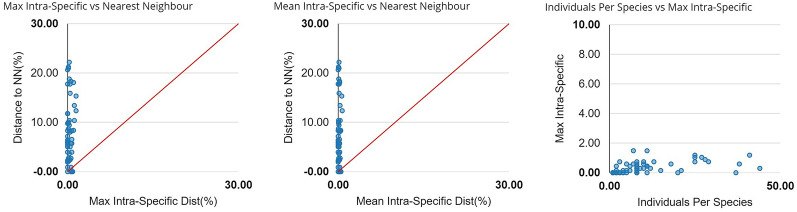
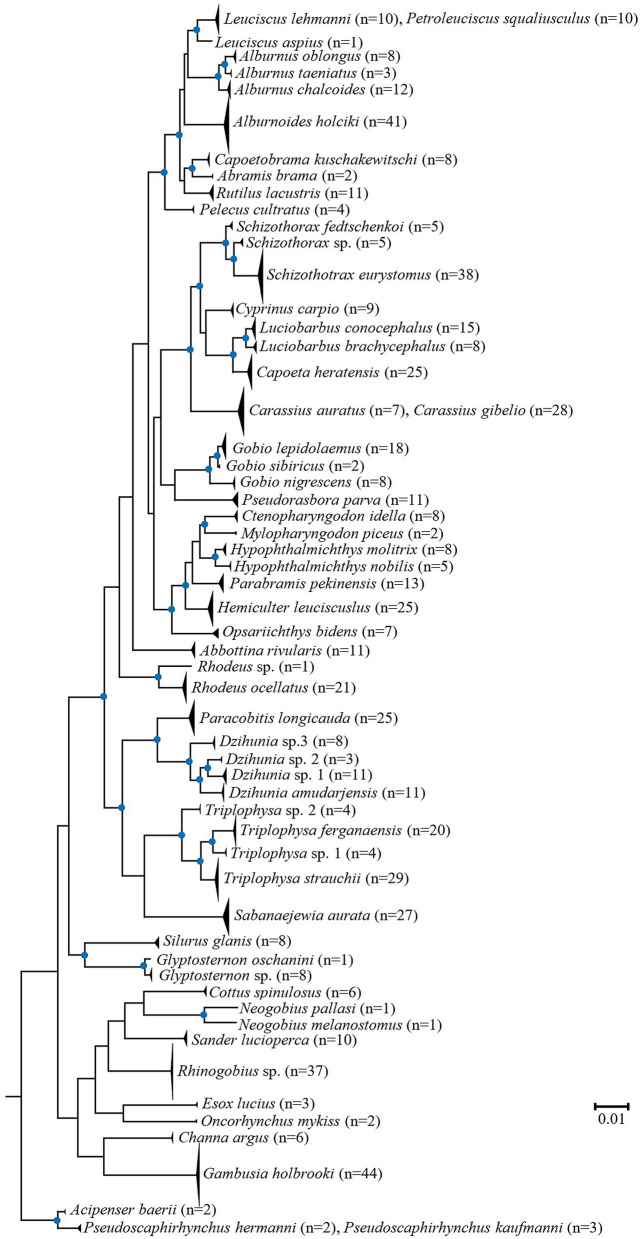
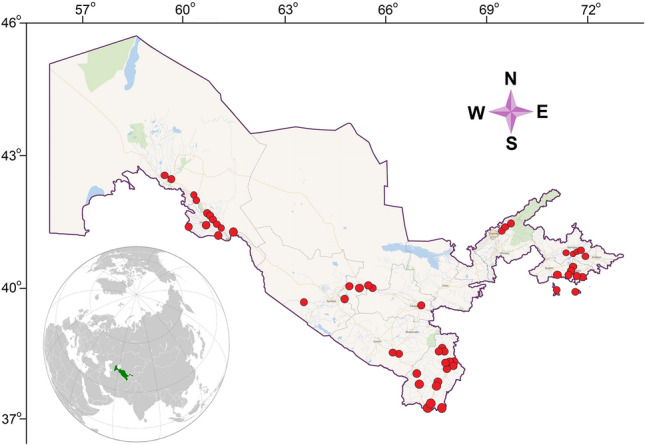
Uzbekistan is one of two doubly landlocked countries in the world, where all rivers are endorheic basins. Although fish diversity is relatively poor in Uzbekistan, the fish fauna of the region has not yet been fully studied. The aim of this study was to establish a reliable barcoding reference database for fish in Uzbekistan. A total of 666 specimens, belonging to 59 species within 39 genera, 17 families, and 9 orders, were subjected to polymerase chain reaction amplification in the barcode region and sequenced. The length of the 666 barcodes was 682 bp. The average K2P distances within species, genera, and families were 0.22%, 6.33%, and 16.46%, respectively. The average interspecific distance was approximately 28.8 times higher than the mean intraspecific distance. The Barcode Index Number (BIN) discordance report showed that 666 specimens represented 55 BINs, of which five were singletons, 45 were taxonomically concordant, and five were taxonomically discordant. The barcode gap analysis demonstrated that 89.3% of the fish species examined could be discriminated by DNA barcoding. These results provide new insights into fish diversity in the inland waters of Uzbekistan and can provide a basis for the development of further studies on fish fauna.
Overview
The claims and statistics of this paper haven’t been checked yet.
Run the check — free, no account needed. It reads the open-access text and checks the sources it cites.
Integrity signals
Registry
Cites
Statistics
Figures
Verification
Claims the paper makes
The claims and statistics of this paper haven’t been checked yet.
Run the check — free, no account needed. It reads the open-access text and checks the sources it cites.
Self-check
Percentages, sums and reported differences re-computed from the paper’s own numbers.
The self-check needs the paper’s full text.
Citations
Cites
MEGA7: Molecular Evolutionary Genetics Analysis Version 7.0 for Bigger Datasets
Kumar, S., Stecher, G., & Tamura, K. (2016) · Molecular Biology and Evolution · doi:10.1093/molbev/msw054 · Cited by 44,059
Kimura, M. (1980) · Journal of Molecular Evolution · doi:10.1007/bf01731581 · Cited by 29,778
MrBayes 3.2: Efficient Bayesian Phylogenetic Inference and Model Choice Across a Large Model Space
Ronquist, F., Teslenko, M., van der Mark, P., Ayres, D. L., Darling, A., Höhna, S., Larget, B., Liu, L., Suchard, M. A., & Huelsenbeck, J. P. (2012) · Systematic Biology · doi:10.1093/sysbio/sys029 · Cited by 27,843
Biological identifications through DNA barcodes
Hebert, P. D. N., Cywinska, A., Ball, S. L., & deWaard, J. R. (2003) · Proceedings of the Royal Society of London. Series B: Biological Sciences · doi:10.1098/rspb.2002.2218 · Cited by 13,376
Historical Overfishing and the Recent Collapse of Coastal Ecosystems
Jackson, J. B. C., Kirby, M. X., Berger, W. H., Bjorndal, K. A., Botsford, L. W., Bourque, B. J., Bradbury, R. H., Cooke, R., Erlandson, J., Estes, J. A., et al. (2001) · Science · doi:10.1126/science.1059199 · Cited by 6,652
Biological Identifications Through DNA Barcodes
Ramadan, H., & Baeshen, N. (2012) · doi:10.5772/49967 · Cited by 5,825
DNA barcoding Australia's fish species
Ward, R. D., Zemlak, T. S., Innes, B. H., Last, P. R., & Hebert, P. D. N. (2005) · Philosophical Transactions of the Royal Society B: Biological Sciences · doi:10.1098/rstb.2005.1716 · Cited by 4,332
Hebert, P. D. N., Penton, E. H., Burns, J. M., Janzen, D. H., & Hallwachs, W. (2004) · Proceedings of the National Academy of Sciences · doi:10.1073/pnas.0406166101 · Cited by 3,587
ABGD, Automatic Barcode Gap Discovery for primary species delimitation
PUILLANDRE, N., LAMBERT, A., BROUILLET, S., & ACHAZ, G. (2012) · Molecular Ecology · doi:10.1111/j.1365-294x.2011.05239.x · Cited by 3,324
Identification of Birds through DNA Barcodes
Hebert, P. D. N., Stoeckle, M. Y., Zemlak, T. S., & Francis, C. M. (2004) · PLoS Biology · doi:10.1371/journal.pbio.0020312 · Cited by 2,653
Nelson, J. S., Grande, T. C., & Wilson, M. V. H. (2016) · Wiley eBooks · doi:10.1002/9781119174844 · Cited by 2,096
(1996) · Oceanographic Literature Review · doi:10.1016/0967-0653(96)86731-7 · Cited by 1,914
Universal primer cocktails for fish DNA barcoding
IVANOVA, N. V., ZEMLAK, T. S., HANNER, R. H., & HEBERT, P. D. N. (2007) · Molecular Ecology Notes · doi:10.1111/j.1471-8286.2007.01748.x · Cited by 1,488
Meier, R., Kwong, S.-Y., Vaidya, G., & Ng, P. (2006) · Systematic Biology · doi:10.1080/10635150600969864 · Cited by 1,409
Environmental DNA for wildlife biology and biodiversity monitoring
Bohmann, K., Evans, A., Gilbert, M. T. P., Carvalho, G. R., Creer, S., Knapp, M., Yu, D. W., & de Bruyn, M. (2014) · Trends in Ecology & Evolution · doi:10.1016/j.tree.2014.04.003 · Cited by 1,348
Bending the Curve of Global Freshwater Biodiversity Loss: An Emergency Recovery Plan
Tickner, D., Opperman, J. J., Abell, R., Acreman, M., Arthington, A. H., Bunn, S. E., Cooke, S. J., Dalton, J., Darwall, W., Edwards, G., et al. (2020) · BioScience · doi:10.1093/biosci/biaa002 · Cited by 1,241
Ruppert, K. M., Kline, R. J., & Rahman, M. S. (2019) · Global Ecology and Conservation · doi:10.1016/j.gecco.2019.e00547 · Cited by 1,231
Handbook of European Freshwater Fishes
Page, L. (2008) · Copeia · doi:10.1643/ot-08-098a.1 · Cited by 1,144
The campaign to DNA barcode all fishes, FISH‐BOL
Ward, R. D., Hanner, R., & Hebert, P. D. N. (2009) · Journal of Fish Biology · doi:10.1111/j.1095-8649.2008.02080.x · Cited by 964
Kalign – an accurate and fast multiple sequence alignment algorithm
Lassmann, T., & Sonnhammer, E. L. (2005) · BMC Bioinformatics · doi:10.1186/1471-2105-6-298 · Cited by 705
Systematics and the Origin of Species from the Viewpoint of a Zoologist
Mayr, E. (1943) · Geographical Journal · doi:10.2307/1790142 · Cited by 574
Using Environmental DNA to Estimate the Distribution of an Invasive Fish Species in Ponds
Takahara, T., Minamoto, T., & Doi, H. (2013) · PLoS ONE · doi:10.1371/journal.pone.0056584 · Cited by 484
Iucn Red List Of Threatened Species
Ragle, J. S., & Remsen, D. P. (2010) · Zenodo (CERN European Organization for Nuclear Research) · doi:10.5281/zenodo.46240 · Cited by 398
Declines in the numbers of amateur and professional taxonomists: implications for conservation
Hopkins, G. W., & Freckleton, R. P. (2002) · Animal Conservation · doi:10.1017/s1367943002002299 · Cited by 384
Geiger, M. F., Herder, F., Monaghan, M. T., Almada, F., Barbieri, R., Bariche, M., Berrebi, P., Bohlen, J., Casal‐López, M., Delmastro, G. B., et al. (2014) · Molecular Ecology Resources · doi:10.1111/1755-0998.12257 · Cited by 328
Development of farmed fish: a nutritionally necessary alternative to meat
Sargent, J., & Tacon, A. (1999) · Proceedings of the Nutrition Society · doi:10.1017/s0029665199001366 · Cited by 302
Prospects and challenges of environmental DNA (eDNA) monitoring in freshwater ponds
Harper, L. R., Buxton, A. S., Rees, H. C., Bruce, K., Brys, R., Halfmaerten, D., Read, D. S., Watson, H. V., Sayer, C. D., Jones, E. P., et al. (2018) · Hydrobiologia · doi:10.1007/s10750-018-3750-5 · Cited by 295
Karthe, D., Chalov, S., & Borchardt, D. (2014) · Environmental Earth Sciences · doi:10.1007/s12665-014-3789-1 · Cited by 274
Gaston, K. J., & May, R. M. (1992) · Nature · doi:10.1038/356281a0 · Cited by 268
Evaluating the Accuracy of Morphological Identification of Larval Fishes by Applying DNA Barcoding
Ko, H.-L., Wang, Y.-T., Chiu, T.-S., Lee, M.-A., Leu, M., Chang, K.-Z., Chen, W.-Y., & Shao, K.-T. (2013) · PLoS ONE · doi:10.1371/journal.pone.0053451 · Cited by 251
Identifying Fishes through DNA Barcodes and Microarrays
Kochzius, M., Seidel, C., Antoniou, A., Botla, S. K., Campo, D., Cariani, A., Vazquez, E. G., Hauschild, J., Hervet, C., Hjorleifsdottir, S., et al. (2010) · PLoS ONE · doi:10.1371/journal.pone.0012620 · Cited by 234
DNA barcoding gap: reliable species identification over morphological and geographical scales
Čandek, K., & Kuntner, M. (2014) · Molecular Ecology Resources · doi:10.1111/1755-0998.12304 · Cited by 231
Are fish introductions a threat to endemic freshwater fishes in the northern Mediterranean region?
Crivelli, A. J. (1995) · Biological Conservation · doi:10.1016/0006-3207(94)00092-5 · Cited by 196
DNA metabarcoding of insects and allies: an evaluation of primers and pipelines
Brandon-Mong, G.-J., Gan, H. M., Sing, K., Lee, P., Lim, P. E., & Wilson, J. (2015) · Bulletin of Entomological Research · doi:10.1017/s0007485315000681 · Cited by 192
Clausen, R. J., & York, R. (2007) · Social Science Research · doi:10.1016/j.ssresearch.2007.10.002 · Cited by 187
A critical review on the utility of DNA barcoding in biodiversity conservation
Krishnamurthy, P. K., & Francis, R. A. (2012) · Biodiversity and Conservation · doi:10.1007/s10531-012-0306-2 · Cited by 173
Zou, K.-S., Chen, J.-W., Ruan, H., Li, Z.-H., Guo, W.-J., Li, M., & Liu, L. (2019) · Science of the Total Environment · doi:10.1016/j.scitotenv.2019.134704 · Cited by 166
Five years of FISH-BOL: Brief status report
Becker, S., Hanner, R., & Steinke, D. (2011) · Mitochondrial DNA · doi:10.3109/19401736.2010.535528 · Cited by 139
van der Heyde, M., Bunce, M., Wardell‐Johnson, G., Fernandes, K., White, N. E., & Nevill, P. (2020) · Molecular Ecology Resources · doi:10.1111/1755-0998.13148 · Cited by 132
Sales, N., McKenzie, M. B., Drake, J., Harper, L. R., Browett, S. S., Coscia, I., Wangensteen, O., Baillie, C., Bryce, E., Dawson, D., et al. (2020) · Journal of Applied Ecology · doi:10.1111/1365-2664.13592 · Cited by 130
Ford, M. J., Hempelmann, J. A., Hanson, M. B., Ayres, K. L., Baird, R. W., Emmons, C. K., Lundin, J. I., Schorr, G. S., Wasser, S. K., & Park, L. K. (2016) · PLoS ONE · doi:10.1371/journal.pone.0144956 · Cited by 118
DNA barcoding commercially important fish species of T urkey
Keskin, E., & Atar, H. H. (2013) · Molecular Ecology Resources · doi:10.1111/1755-0998.12120 · Cited by 114
Bryant, M. D. (2009) · Climatic Change · doi:10.1007/s10584-008-9530-x · Cited by 109
Life in a drop: Sampling environmental DNA for marine fishery management and ecosystem monitoring
Gilbey, J., Carvalho, G. R., Castilho, R., Coscia, I., Coulson, M. W., Dahle, G., Derycke, S., Francisco, S. M., Helyar, S., Johansen, T., et al. (2020) · Marine Policy · doi:10.1016/j.marpol.2020.104331 · Cited by 107
DNA barcodes of the native ray‐finned fishes in Taiwan
Chang, C., Shao, K., Lin, H., Chiu, Y., Lee, M., Liu, S., & Lin, P. (2016) · Molecular Ecology Resources · doi:10.1111/1755-0998.12601 · Cited by 105
Alien fish species in the Czech Republic and their impact on the native fish fauna
Lusk, S., Lusková, V., & Hanel, L. (2010) · Folia Zoologica · doi:10.25225/fozo.v59.i1.a9.2010 · Cited by 102
Food Matters: Fish, Income, and Food Supply—A Comparative Analysis
Tacon, A., & Metian, M. (2018) · Reviews in Fisheries Science & Aquaculture · doi:10.1080/23308249.2017.1328659 · Cited by 99
Ecological consequences of global climate change for freshwater ecosystems in South Africa
Dallas, H. F., & Rivers-Moore, N. (2014) · South African Journal of Science · doi:10.1590/sajs.2014/20130274 · Cited by 95
Decru, E., Moelants, T., Gelas, K. D., Vreven, E., Verheyen, E., & Snoeks, J. (2016) · Molecular Ecology Resources · doi:10.1111/1755-0998.12445 · Cited by 90
Accuracy of species identification by fisheries observers in a north Australian shark fishery
Tillett, B. J., Field, I. C., Bradshaw, C. J. A., Johnson, G. J., Buckworth, R. C., Meekan, M. G., & Ovenden, J. R. (2012) · Fisheries Research · doi:10.1016/j.fishres.2012.04.007 · Cited by 84
Shen, Y.-J., Guan, L.-H., Wang, D.-Q., & Gan, X.-N. (2016) · Ecology and Evolution · doi:10.1002/ece3.2060 · Cited by 83
Chen, W., Ma, X., Shen, Y., Mao, Y., & He, S. (2015) · Scientific Reports · doi:10.1038/srep17437 · Cited by 77
Still not enough taxonomists: reply to Joppa et al.
Bacher, S. (2012) · Trends in Ecology & Evolution · doi:10.1016/j.tree.2011.11.003 · Cited by 77
Bariche, M., Torres, M., Smith, C. A., Sayar, N., Azzurro, E., Baker, R., & Bernardi, G. (2015) · Journal of Biogeography · doi:10.1111/jbi.12595 · Cited by 72
Changes in the Aral Sea ecosystems during the period 1960–1990
Aladin, N., & Potts, W. (1992) · Hydrobiologia · doi:10.1007/bf00016032 · Cited by 64
Ramon, M. L., Lobel, P., & Sorenson, M. D. (2003) · Molecular Ecology · doi:10.1046/j.1365-294x.2003.01966.x · Cited by 62
Cryptic species in the Neotropical fish genus Curimatopsis (Teleostei, Characiformes)
Melo, B., Ochoa, L., Vari, R., & Oliveira, C. (2016) · Zoologica Scripta · doi:10.1111/zsc.12178 · Cited by 61
The genetic signature of recent speciation in manta rays (Manta alfredi and M. birostris)
Kashiwagi, T., Marshall, A. D., Bennett, M. B., & Ovenden, J. R. (2012) · Molecular Phylogenetics and Evolution · doi:10.1016/j.ympev.2012.03.020 · Cited by 61
Jouladeh-Roudbar, A., Ghanavi, H., & Doadrio, I. (2020) · Zoological Studies · doi:10.6620/zs.2020.59-21 · Cited by 56
DNA barcoding to characterize biodiversity of freshwater fishes of Egypt
Ali, F. S., Ismail, M., & Aly, W. (2020) · Molecular Biology Reports · doi:10.1007/s11033-020-05657-3 · Cited by 55
Chang, C.-H., Jang-Liaw, N., Lin, Y.-S., Fang, Y., & Shao, K.-T. (2013) · doi:10.1016/j.jfda.2013.07.010 · Cited by 51
Moran, Z., Orth, D., Schmitt, J., Hallerman, E., & Aguilar, R. (2015) · Environmental Biology of Fishes · doi:10.1007/s10641-015-0448-7 · Cited by 47
DNA barcoding for identification of marine gastropod species from Hainan island, China
Ran, K., Li, Q., Qi, L., Li, W.-D., & Kong, L. (2020) · doi:10.1016/j.fishres.2020.105504 · Cited by 44
Hofmann, T., Knebelsberger, T., Kloppmann, M., Ulleweit, J., & Raupach, M. J. (2017) · Journal of Applied Ichthyology · doi:10.1111/jai.13389 · Cited by 37
Hulley, E., Tharmalingam, S., Zarnke, A., & Boreham, D. (2019) · PLoS ONE · doi:10.1371/journal.pone.0210165 · Cited by 35
Krück, N. C., Tibbetts, I., Ward, R., Johnson, J. W., Loh, W., & Ovenden, J. (2013) · Fisheries Research · doi:10.1016/j.fishres.2013.01.007 · Cited by 34
DNA barcoding of freshwater fishes from Brahmaputra River in Eastern Himalaya biodiversity hotspot
Kundu, S., Chandra, K., Tyagi, K., Pakrashi, A., & Kumar, V. (2019) · Mitochondrial DNA Part B: Resources · doi:10.1080/23802359.2019.1637290 · Cited by 32
Dillman, C. B., Wood, R. M., Kuhajda, B., Ray, J. M., Salnikov, V. B., & Mayden, R. (2007) · Journal of Applied Ichthyology · doi:10.1111/j.1439-0426.2007.00919.x · Cited by 32
Guimarães-Costa, A. J., Machado, F. S., Oliveira, R. R. S., Silva-Costa, V., Andrade, M. C., Giarrizzo, T., Saint‐Paul, U., Sampaio, I., & Schneider, H. (2019) · Scientific Reports · doi:10.1038/s41598-019-43930-z · Cited by 29
Do non-native fish as prey favour the conservation of the threatened indigenous Eurasian otter?
Balestrieri, A., Remonti, L., Vezza, P., Prigioni, C., & Copp, G. (2013) · Freshwater Biology · doi:10.1111/fwb.12102 · Cited by 29
Vulnerability of Cape Fold Ecoregion freshwater fishes to climate change and other human impacts
Shelton, J. M., Weyl, O. L. F., Chakona, A., Ellender, B. R., Esler, K. J., Impson, N. D., Jordaan, M. S., Marr, S. M., Ngobela, T., Paxton, B. R., et al. (2017) · Aquatic Conservation Marine and Freshwater Ecosystems · doi:10.1002/aqc.2849 · Cited by 29
Lee, E.-J., Lee, Y.-H., Moon, S., Kim, N., Kim, S.-H., Yang, M.-S., Choi, D.-H., & Han, M. (2013) · Journal of Forensic and Legal Medicine · doi:10.1016/j.jflm.2012.06.014 · Cited by 28
Muchlisin, Z. A., Batubara, A. S., Fadli, N., Muhammadar, A. A., Utami, A. I., Farhana, N., & Nor, S. A. M. (2017) · F1000Research · doi:10.12688/f1000research.10715.1 · Cited by 27
Sullivan, J., Peng, Z.-G., Lundberg, J., Peng, J.-L., & He, S.-P. (2008) · doi:10.1635/0097-3157(2008)157[51:mefdot]2.0.co;2 · Cited by 27
Self-citationFeng, C., Tang, Y., Liu, S., Tian, F., Zhang, C., & Zhao, K. (2019) · BMC Evolutionary Biology · doi:10.1186/s12862-019-1503-3 · Cited by 25
Molecular analysis of polymorphic species of the genus Marshallagia (Nematoda: Ostertagiinae)
Kuchboev, A., Sobirova, K., Karimova, R. R., Amirov, O., von Samson-Himmelstjerna, G., & Krücken, J. (2020) · Parasites & Vectors · doi:10.1186/s13071-020-04265-1 · Cited by 22
DNA barcoding using skin exuviates can improve identification and biodiversity studies of snakes
Khedkar, T., Sharma, R., Tiknaik, A., Khedkar, G., Naikwade, B. S., Ron, T. '., & Haymer, D. (2016) · Mitochondrial DNA. Part A, DNA mapping, sequencing, and analysis · doi:10.3109/19401736.2014.905830 · Cited by 17
Nedoluzhko, A., Сергеевич, Ш. Ф., Tsygankova, S., Boulygina, E., Barmintseva, A. E., Krasivskaya, A. A., Ibragimova, A. S., Gruzdeva, N. M., Rastorguev, S., & Mugue, N. S. (2020) · Scientific Reports · doi:10.1038/s41598-020-57581-y · Cited by 15
Impacts of invasions by alien species
Rainbow, P. (1998) · doi:10.1111/j.1469-7998.1998.tb00153.x · Cited by 14
Sheraliev, B., & Peng, Z.-G. (2021) · Journal of Fish Biology · doi:10.1111/jfb.14764 · Cited by 12
Self-citationSheraliev, B., Allayarov, S., & Peng, Z.-G. (2020) · doi:10.1111/jai.14019 · Cited by 10
Self-citationDNA Barcoding Identifies Illegal Parrot Trade.
Gonçalves, P. F. M., Oliveira-Marques, A. R., Matsumoto, T. E., & Miyaki, C. (2015) · Journal of Heredity · doi:10.1093/jhered/esv035 · Cited by 5
Sheraliev, B., Allayarov, S., & Peng, Z.-G. (2021) · doi:10.1111/jai.14206 · Cited by 3
Self-citationPourshabanan, A., Yazdani-Moghaddam, F., Ghassemzadeh, F., Mousavi-Sabet, H., Rossi, G., & Aliabadian, M. (2021) · doi:10.1080/09397140.2021.1918205 · Cited by 2
Matveyev, M., Levina, M., Mamilov, N., & Levin, B. (2017) · Inland Water Biology · doi:10.1134/s1995082917030105 · Cited by 2
(2022) · CABI Compendium · doi:10.1079/cabicompendium.118229 · Cited by 1
Research works printed but not linked: 8
- Ratnasingham, S. & Hebert, P. D. N. BOLD: The barcode of life data system. Mol. Ecol. Notes 7, 355–364 (2007). · DOI · Paper page
- Mirabdullaev, I. M. & Mullabaev, N. R. Ichthyofauna of Uzbekistan: Modern state and taxonomy. J. Biol. Uzbekistan 5, 43–49 (2020) (In Russian with English abstract).
- Atamuratova, M. S. Ichthyofauna of reservoirs in the Akhangaran river basin. (Ph.D. dissertation, Institute of Zoology, Tashkent, Uzbekistan, 2021) (In Uzbek).
- Berg, L. S. Fishes of Fresh Waters of the USSR and Adjacent Countries. Vol. 2. (Academy of Sciences of the USSR Press, 1949) (In Russian).
- Turdakov, F. A. Fishes of Kirghizia (Academy of Sciences of the Kyrgyz SSR Press, 1963) (In Russian).
- Prokofiev, A. M. Loaches of the subfamily Nemacheilinae of the World (Filigran, 2017) (In Russian).
- Berg, L. S. The Freshwater Fishes of the USSR and Adjacent Countries (Academy of Sciences of the USSR Press, 1948) (In Russian).
- Mirabdullaev, I. M., Mirzaev, U. T., Kuzmetov, A. R. & Kimsanov, Z. O. Keys to Fishes of Uzbekistan and Adjacent Regions (Sano-Standard Press, 2011) (In Uzbek).
Cited by
Mitochondrial DNA barcoding of mosquito species (Diptera: Culicidae) in Thailand
Chaiphongpachara, T., Changbunjong, T., Laojun, S., Nutepsu, T., Suwandittakul, N., Kuntawong, K., Sumruayphol, S., & Ruangsittichai, J. (2022) · PLoS ONE · doi:10.1371/journal.pone.0275090 · Cited by 54
DNA Barcoding of Fish Species Diversity in Guizhou, China
Tang, Q., Deng, L., Luo, Q., Duan, Q., Wang, X., & Zhang, R. (2023) · Diversity · doi:10.3390/d15020203 · Cited by 17
Afrand, M., Sourinejad, I., Shahdadi, A., & Vera, M. (2023) · Estuaries and Coasts · doi:10.1007/s12237-023-01306-7 · Cited by 9
“Its presence increases the effectiveness of DNA barcodes for species identification (Sheraliev and Peng 2021).”
Rozimov, A., Wang, Y.-F., Wang, M., Zou, M., Sobirov, J., Karimov, E., Kholmatov, B., Freyhof, J., Namozov, S., Wang, C., et al. (2025) · Zoosystematics and Evolution · doi:10.3897/zse.101.137787 · Cited by 8
“The K2P distance between Schizothorax sp. and other valid species ranges from 3.18% to 6.72%, while the distance between our sequenced Schizothorax sp. individual and that from previous study (Sheraliev and Peng 2021) is 0 (Fig.”
InfluentialRen, J., & Zhang, R.-Z. (2024) · Journal of Insect Science · doi:10.1093/jisesa/ieae083 · Cited by 8
“…of this approach has been successfully demonstrated across various taxonomic groups, including birds (Charles et al. 2004), fish (Ward et al. 2005, Sheraliev and Peng 2021), and, subsequently, insects (Park et al. 2011, Pramual and Adler 2014, Nzelu et al. 2015, Dinca et al. 2021, da Conceição…”
Background
Metadata
- Authors
- Sheraliev, B., & Peng, Z.
- Affiliations
- Southwest University (CN)
- Corresponding author
- Peng, Zuogang
- Venue
- Scientific Reports
- Published
- 2021-08-19
- Volume
- 11
- Issue
- 1
- Pages
- 16894-16894
- ISSN
- 2045-2322 (ISSN-L)
- PMC
- PMC8376971
- OpenAlex
- W3195447945
- Cited by
- 42
- References
- 99
- Citations by year
- 2026: 10 · 2025: 11 · 2024: 8 · 2023: 5 · 2022: 8
- FWCI
- 3.82
- Type
- journal article
- Language
- en
- Open access
- gold
- doi.org
- Licence
- cc-by
- creativecommons.org/licenses/by/4.0 (tdm)
- creativecommons.org/licenses/by/4.0 (vor)
- Locations
- Scientific Reports (publishedVersion, cc-by)
- bioRxiv (Cold Spring Harbor Laboratory) (acceptedVersion, cc-by-nc-nd)
- PubMed Central (publishedVersion, cc-by)
- PubMed (publishedVersion)
- DOAJ (DOAJ: Directory of Open Access Journals) (submittedVersion, cc-by-sa)
- Funders
- Foundation for Innovative Research Groups of the National Natural Science Foundation of China (31872204)
- Topics
- Life Sciences › Agricultural and Biological Sciences › Aquatic Science › Fish Biology and Ecology Studies
- Physical Sciences › Environmental Science › Ecology › Environmental DNA in Biodiversity Studies
- Life Sciences › Agricultural and Biological Sciences › Ecology, Evolution, Behavior and Systematics › Invertebrate Taxonomy and Ecology
- Keywords
- fish diversity, DNA barcoding, endorheic basin, landlocked countries, Barcode Index Number, barcode gap analysis, species identification, molecular taxonomy, inland waters
- MeSH terms
- Animals, Bayes Theorem, Electron Transport Complex IV, Fishes, Geography, Phylogeny, Species Specificity, Uzbekistan, Genetic Variation, Sample Size, DNA Barcoding, Taxonomic
About these checks
Registry, retraction, Cites and statistics results are computed, not judged, with one exception: a printed reference that no index lists is read once by a model before it counts as a citation error. Claims are extracted by a model and kept only when their quote appears verbatim in the text; each cited source is then checked, with a model’s help, for whether it says what the claim relies on. Those verdicts can be wrong — read the claim’s quote and the cited source before relying on one.
Statistics and arithmetic are recomputed, not judged.
Confidence bands are shown only for fields calibrated on our annotated test set. None is calibrated yet, so no band is shown.
What counts as a claim ›How we measure confidence ›How we check this ›
Are you an author, or do you see a problem with this page? Request a review
Data sources
Bibliographic data: Semantic Scholar, OpenAlex, Crossref.
Contains information from the Semantic Scholar Academic Graph Datasets, made available under the ODC Attribution License (ODC-BY 1.0).
Semantic Scholar’s data is described in: Kinney, R., et al. (2023). The Semantic Scholar Open Data Platform. arXiv:2301.10140.
