

An explainable machine learning-based clinical decision support system for prediction of gestational diabetes mellitus
Open accessThe DOI matches its Crossref record; 44 of the 46 references it cites were found in a registry or an index, and 2 are not checked yet.
Abstract
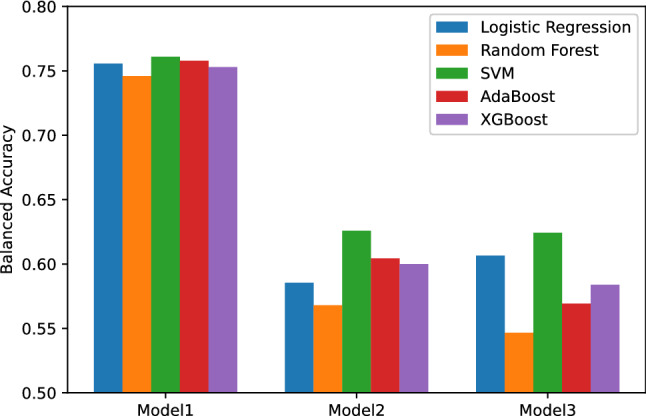
Gestational Diabetes Mellitus (GDM), a common pregnancy complication associated with many maternal and neonatal consequences, is increased in mothers with overweight and obesity. Interventions initiated early in pregnancy can reduce the rate of GDM in these women, however, untargeted interventions can be costly and time-consuming. We have developed an explainable machine learning-based clinical decision support system (CDSS) to identify at-risk women in need of targeted pregnancy intervention. Maternal characteristics and blood biomarkers at baseline from the PEARS study were used. After appropriate data preparation, synthetic minority oversampling technique and feature selection, five machine learning algorithms were applied with five-fold cross-validated grid search optimising the balanced accuracy. Our models were explained with Shapley additive explanations to increase the trustworthiness and acceptability of the system. We developed multiple models for different use cases: theoretical (AUC-PR 0.485, AUC-ROC 0.792), GDM screening during a normal antenatal visit (AUC-PR 0.208, AUC-ROC 0.659), and remote GDM risk assessment (AUC-PR 0.199, AUC-ROC 0.656). Our models have been implemented as a web server that is publicly available for academic use. Our explainable CDSS demonstrates the potential to assist clinicians in screening at risk patients who may benefit from early pregnancy GDM prevention strategies.
Overview
The claims and statistics of this paper haven’t been checked yet.
Free: it reads the open-access text and checks the first 5 claims that cite a source we can check. Create a free account to check every claim.
Integrity signals
Registry
Cites
Statistics
Figures
Verification
Claims the paper makes
The claims and statistics of this paper haven’t been checked yet.
Free: it reads the open-access text and checks the first 5 claims that cite a source we can check. Create a free account to check every claim.
Self-check
Percentages, sums and reported differences re-computed from the paper’s own numbers.
The self-check needs the paper’s full text.
Citations
Cites
Scikit-learn: Machine Learning in Python
Pedregosa, F., Varoquaux, G., Gramfort, A., Michel, V., Thirion, B., Grisel, O., Blondel, M., Müller, A., Nothman, J., Louppe, G., et al. (2012) · arXiv · doi:10.48550/arxiv.1201.0490 · Cited by 71,016
XGBoost: A Scalable Tree Boosting System
Chen, T., & Guestrin, C. (2016) · Proceedings of the 22nd ACM SIGKDD International Conference on Knowledge Discovery and Data Mining · doi:10.1145/2939672.2939785 · Cited by 54,569
Ror2 signaling regulates Golgi structure and transport through IFT20 for tumor invasiveness
Nishita, M., Park, S.-Y., Nishio, T., Kamizaki, K., Wang, Z., Tamada, K., Takumi, T., Hashimoto, R., Otani, H., Pazour, G. J., et al. (2017) · Scientific Reports · doi:10.1038/s41598-016-0028-x · Cited by 15,947
Ng, M., Fleming, T., Robinson, M., Thomson, B., Graetz, N., Margono, C., Mullany, E. C., Biryukov, S., Abbafati, C., Abera, S. F., et al. (2014) · The Lancet · doi:10.1016/s0140-6736(14)60460-8 · Cited by 11,952
Harris hawks optimization: Algorithm and applications
Heidari, A. A., Mirjalili, S., Faris, H., Aljarah, I., Mafarja, M., & Chen, H. (2019) · Future Generation Computer Systems · doi:10.1016/j.future.2019.02.028 · Cited by 6,324 · cited 1×
“We recognise that the performance of our models may require further improvement for use in a clinical setting, for example, by using some intelligent optimization algorithms 40–44 .”
MethodInternational Association of Diabetes and Pregnancy Study Groups Consensus Panel (2010) · Diabetes Care · doi:10.2337/dc09-1848 · Cited by 5,390
Proceedings of the 21st International Conference on Neural Information Processing Systems
Koller, D., Schuurmans, D., Bengio, Y., & Bottou, L. (2008) · Cited by 4,461
Slime mould algorithm: A new method for stochastic optimization
Li, S., Chen, H., Wang, M., Heidari, A. A., & Mirjalili, S. (2020) · Future Generation Computer Systems · doi:10.1016/j.future.2020.03.055 · Cited by 3,036 · cited 1×
“Our models included a very small set of features (4 or 5) compared with published models (4-2355), which means our models would be easier and faster to use.”
MethodAdaptive Control Processes: A Guided Tour
Bellman, R. E. (1961) · doi:10.1515/9781400874668 · Cited by 2,802
Intelligible Models for HealthCare: Predicting Pneumonia Risk and Hospital 30-day Readmission
Caruana, R., Lou, Y., Gehrke, J., Koch, P., Sturm, M., & Elhadad, N. (2015) · Proceedings of the 21th ACM SIGKDD International Conference on Knowledge Discovery and Data Mining · doi:10.1145/2783258.2788613 · Cited by 1,685 · cited 1×
“Our models included a very small set of features (4 or 5) compared with published models (4-2355), which means our models would be easier and faster to use.”
Method(1998) · PubMed · Cited by 992
Monarch butterfly optimization
Wang, G.-G., Deb, S., & Cui, Z. (2019) · Neural Computing and Applications · doi:10.1007/s00521-015-1923-y · Cited by 983 · cited 1×
“We recognise that the performance of our models may require further improvement for use in a clinical setting, for example, by using some intelligent optimization algorithms 40–44 .”
MethodClinical decision support in the era of artificial intelligence
Shortliffe, E. H., & Sepúlveda, M. J. (2018) · JAMA · doi:10.1001/jama.2018.17163 · Cited by 920 · cited 1×
“Our models included a very small set of features (4 or 5) compared with published models (4-2355), which means our models would be easier and faster to use.”
MethodMoth search algorithm: a bio-inspired metaheuristic algorithm for global optimization problems
Wang, G.-G. (2018) · Memetic Computing · doi:10.1007/s12293-016-0212-3 · Cited by 780
Antoniadi, A. M., Du, Y., Guendouz, Y., Wei, L., Mazo, C., Becker, B. A., & Mooney, C. (2021) · Applied Sciences · doi:10.3390/app11115088 · Cited by 629
Self-citationWang, C., Wei, Y., Zhang, X., Zhang, Y., Xu, Q., Sun, Y., Su, S., Zhang, L., Liu, C., Feng, Y., et al. (2017) · American Journal of Obstetrics and Gynecology · doi:10.1016/j.ajog.2017.01.037 · Cited by 416 · cited 1×
“Our models included a very small set of features (4 or 5) compared with published models (4-2355), which means our models would be easier and faster to use.”
MethodWang, G. G., Deb, S., & Coelho, L. D. S. (2018) · International Journal of Bio-Inspired Computation · doi:10.1504/ijbic.2018.093328 · Cited by 355
The fetal and maternal consequences of gestational diabetes mellitus
Reece, E. A. (2010) · The Journal of Maternal-Fetal & Neonatal Medicine · doi:10.3109/14767050903550659 · Cited by 309 · cited 3×
“(5) Balanced ACC = Specificity + Sensitivity”
BackgroundMethodcollaborators, O. B. O. T. A. D., O’Sullivan, E. P., Avalos, G., O’Reilly, M., Dennedy, M. C., Gaffney, G., & Dunne, F. (2011) · Diabetologia · doi:10.1007/s00125-011-2150-4 · Cited by 307
Prediction of gestational diabetes based on nationwide electronic health records
Artzi, N. S., Shilo, S., Hadar, E., Rossman, H., Barbash-Hazan, S., Ben-Haroush, A., Balicer, R. D., Feldman, B., Wiznitzer, A., & Segal, E. (2020) · Nature Medicine · doi:10.1038/s41591-019-0724-8 · Cited by 281 · cited 1×
“Our models included a very small set of features (4 or 5) compared with published models (4-2355), which means our models would be easier and faster to use.”
MethodHigh Prevalence of Gestational Diabetes in Women from Ethnic Minority Groups
Dornhorst, A., Paterson, C. M., Nicholls, J. S. D., Wadsworth, J., Chiu, D. C., Elkeles, R. S., Johnston, D. G., & Beard, R. W. (1992) · Diabetic Medicine · doi:10.1111/j.1464-5491.1992.tb01900.x · Cited by 263 · cited 1×
“Our models included a very small set of features (4 or 5) compared with published models (4-2355), which means our models would be easier and faster to use.”
MethodWang, G., Deb, S., & Coelho, L. D. S. (2015) · International Journal of Bio-Inspired Computation · doi:10.1504/ijbic.2015.10004283 · Cited by 242
Shin, D., & Song, W. O. (2015) · The Journal of Maternal-Fetal & Neonatal Medicine · doi:10.3109/14767058.2014.964675 · Cited by 200
Wu, Y.-T., Zhang, C.-J., Mol, B. W., Kawai, A., Li, C., Chen, L., Wang, Y., Sheng, J.-Z., Fan, J.-X., Shi, Y., et al. (2021) · The Journal of Clinical Endocrinology & Metabolism · doi:10.1210/clinem/dgaa899 · Cited by 194 · cited 5×
“All others used data collected in a single centre in different cities in China (Sichuan 17,21 , Shanghai 18,19,24,25 , Beijing 22 ) and the participants are all or mainly Chinese.”
BackgroundMethodInfluentialAdhikari, R. P., Shrestha, M. L., Satinsky, E. N., & Upadhaya, N. (2021) · BMC Pregnancy and Childbirth · doi:10.1186/s12884-020-03485-8 · Cited by 152
QUINLIVAN, J. A., LAM, L. T., & FISHER, J. (2011) · Australian and New Zealand Journal of Obstetrics and Gynaecology · doi:10.1111/j.1479-828x.2010.01268.x · Cited by 147 · cited 1×
“Our models included a very small set of features (4 or 5) compared with published models (4-2355), which means our models would be easier and faster to use.”
MethodYe, Y., Xiong, Y., Zhou, Q., Wu, J., Li, X., & Xiao, X. (2020) · Journal of Diabetes Research · doi:10.1155/2020/4168340 · Cited by 132
Learning-based elephant herding optimization algorithm for solving numerical optimization problems
Li, W., Wang, G., & Alavi, A. H. (2020) · Knowledge-Based Systems · doi:10.1016/j.knosys.2020.105675 · Cited by 131
Pregnancy Exercise and Nutrition With Smartphone Application Support: A Randomized Controlled Trial
Kennelly, M. A., Ainscough, K., Lindsay, K. L., O'Sullivan, E., Gibney, E. R., McCarthy, M., Segurado, R., DeVito, G., Maguire, O., Smith, T., et al. (2018) · Obstetrics & Gynecology · doi:10.1097/aog.0000000000002582 · Cited by 126
Self-citationLow-educated women have an increased risk of gestational diabetes mellitus: the Generation R Study
Bouthoorn, S. H., Silva, L. M., Murray, S. E., Steegers, E. A. P., Jaddoe, V. W. V., Moll, H., Hofman, A., Mackenbach, J. P., & Raat, H. (2015) · Acta Diabetologica · doi:10.1007/s00592-014-0668-x · Cited by 110
Zheng, T., Ye, W., Wang, X., Li, X., Zhang, J., Little, J., Zhou, L., & Zhang, L. (2019) · BMC Pregnancy and Childbirth · doi:10.1186/s12884-019-2374-8 · Cited by 91 · cited 1×
“Our models included a very small set of features (4 or 5) compared with published models (4-2355), which means our models would be easier and faster to use.”
MethodElectronic Health Record Driven Prediction for Gestational Diabetes Mellitus in Early Pregnancy
Qiu, H., Yu, H., Wang, L., Yao, Q., Wu, S., Yin, C., Fu, B., Zhu, X., Zhang, Y., Xing, Y., et al. (2017) · Scientific Reports · doi:10.1038/s41598-017-16665-y · Cited by 80 · cited 3×
“All others used data collected in a single centre in different cities in China (Sichuan 17,21 , Shanghai 18,19,24,25 , Beijing 22 ) and the participants are all or mainly Chinese.”
BackgroundMethodThe Business of Medicine in the Era of COVID-19
Cutler, D., Nikpay, S., & Huckman, R. S. (2020) · JAMA · doi:10.1001/jama.2020.7242 · Cited by 78 · cited 1×
“Our models included a very small set of features (4 or 5) compared with published models (4-2355), which means our models would be easier and faster to use.”
MethodOzgu-Erdinc, A. S., Yilmaz, S., Yeral, M. I., Seckin, K. D., Erkaya, S., & Danisman, A. N. (2015) · The Journal of Maternal-Fetal & Neonatal Medicine · doi:10.3109/14767058.2014.973397 · Cited by 73 · cited 1×
“Our models included a very small set of features (4 or 5) compared with published models (4-2355), which means our models would be easier and faster to use.”
MethodLi, W., & Wang, G. (2021) · Engineering With Computers · doi:10.1007/s00366-021-01293-y · Cited by 73 · cited 1×
“Intelligent optimization algorithms were not considered in this work 13–16 .”
MethodXiong, Y., Lin, L., Chen, Y., Salerno, S. M., Li, Y., Zeng, X., & Li, H. (2020) · The Journal of Maternal-Fetal & Neonatal Medicine · doi:10.1080/14767058.2020.1786517 · Cited by 67 · cited 1×
“Our models included a very small set of features (4 or 5) compared with published models (4-2355), which means our models would be easier and faster to use.”
MethodSun, Y., & Zhao, H. (2015) · Applied Nursing Research · doi:10.1016/j.apnr.2015.10.006 · Cited by 49
DLEA: A dynamic learning evolution algorithm for many-objective optimization
Gui, L., Wang, G., Dong, J., Yeh, W., & Li, K. (2021) · Information Sciences · doi:10.1016/j.ins.2021.05.064 · Cited by 44
Antoniadi, A. M., Galvin, M., Heverin, M., Hardiman, O. M., & Mooney, C. (2021) · Scientific Reports · doi:10.1038/s41598-021-91632-2 · Cited by 34 · cited 1×
“SHAP was applied to improve explainability for a machine learning-based CDSS in neurology 38 .”
MethodSelf-citationWu, Y., Ma, S., Wang, Y., Chen, F., Zhu, F., Sun, W., Shen, W., Zhang, J., & Chen, H. (2021) · Diabetes Research and Clinical Practice · doi:10.1016/j.diabres.2021.109001 · Cited by 33 · cited 1×
“All others used data collected in a single centre in different cities in China (Sichuan 17,21 , Shanghai 18,19,24,25 , Beijing 22 ) and the participants are all or mainly Chinese.”
MethodPrediction of Gestational Diabetes Based on LightGBM
Hou, F. F., Cheng, Z.-X., Kang, L., & Zheng, W. (2020) · Conference on Artificial Intelligence and Healthcare (CAIH) · doi:10.1145/3433996.3434025 · Cited by 32 · cited 1×
“Hou et al. 23 trained a model based on data from an unknown population.”
MethodAssociation between maternal education level and gestational diabetes mellitus: a meta-analysis
Wang, J., Wang, Q., Wang, X., Wang, M., Cao, S., & Wang, J.-N. (2019) · The Journal of Maternal-Fetal & Neonatal Medicine · doi:10.1080/14767058.2019.1611773 · Cited by 24
O’Sullivan, E. J., Rokicki, S., Kennelly, M. A., Ainscough, K. M., & McAuliffe, F. M. (2020) · International Journal of Obesity · doi:10.1038/s41366-020-0531-9 · Cited by 23 · cited 8×
“This is consistent with the medical knowledge: weight, BMI and MUAC are all anthropometric measurements that provide assessment of nutritional status, and BMI is derived from height and weight.”
BackgroundInfluentialSelf-citationIs maternal educational level a risk factor for gestational diabetes in Caucasian women?
Bertolotto, A., Corfini, M., Ghio, A., Resi, V., Lencioni, C., Lacaria, E., Volpe, L., Prato, S. D., & Cianni, G. D. (2011) · Diabetic Medicine · doi:10.1111/j.1464-5491.2011.03484.x · Cited by 10 · cited 1×
“Our models included a very small set of features (4 or 5) compared with published models (4-2355), which means our models would be easier and faster to use.”
MethodZhang, C., Wang, L., Sun, W., Chen, L., Zhang, C., Hong, L., Yu, J., Fan, J., Ruan, H., Zheng, T., et al. (2021) · BMC Pregnancy and Childbirth · doi:10.1186/s12884-021-04039-2 · Cited by 10
A Prediction Model of Gestational Diabetes Mellitus Based on First Pregnancy Test Index
Yan, J., Geng, Y., Xu, H., Tan, S., He, D., Yu, Y., Deng, S., & Du, X. (2020) · Lecture notes in computer science · doi:10.1007/978-3-030-61951-0_12 · Cited by 4 · cited 1×
“All others used data collected in a single centre in different cities in China (Sichuan 17,21 , Shanghai 18,19,24,25 , Beijing 22 ) and the participants are all or mainly Chinese.”
Method
Research works printed but not linked: 2
- Bellman RE Adaptive Control Processes 2015 Princeton Princeton University Press
- Lemaître G Nogueira F Aridas CK Imbalanced-learn: A python toolbox to tackle the curse of imbalanced datasets in machine learning J. Mach. Learn. Res. 2017 18 1 5
Cited by
Loh, H. W., Ooi, C. P., Seoni, S., Barua, P. D., Molinari, F., & Acharya, U. R. (2022) · Computer Methods and Programs in Biomedicine · doi:10.1016/j.cmpb.2022.107161 · Cited by 734
Albahri, A. S., Duhaim, A. M., Fadhel, M. A., Alnoor, A., Baqer, N. S., Alzubaidi, L., Albahri, O. S., Alamoodi, A. H., Bai, J., Salhi, A., et al. (2023) · Information Fusion · doi:10.1016/j.inffus.2023.03.008 · Cited by 716
Survey of Explainable AI Techniques in Healthcare
Chaddad, A., Peng, J., Xu, J., & Bouridane, A. (2023) · Sensors · doi:10.3390/s23020634 · Cited by 591
Harnessing the Power of Clinical Decision Support Systems: Challenges and Opportunities
Chen, Z., Liang, N., Zhang, H., Li, H., Yang, Y., Zong, X., Chen, Y., Wang, Y., & Shi, N. (2023) · Open Heart · doi:10.1136/openhrt-2023-002432 · Cited by 244
Explainable Artificial Intelligence-Based Decision Support Systems: A Recent Review
Kostopoulos, G., Davrazos, G., & Kotsiantis, S. B. (2024) · Electronics · doi:10.3390/electronics13142842 · Cited by 281
“Three explainable ML-based CDSSs were developed in [52] for predicting gestational diabetes mellitus in mothers with overweight and obesity utilizing the SVMs classifier, while exploiting maternal characteristics and blood biomarkers.”
Metadata
- Authors
- Du, Y., Rafferty, A. R., McAuliffe, F. M., Wei, L., & Mooney, C.
- Affiliations
- University College Dublin (IE)
- Corresponding author
- Mooney, Catherine
- Venue
- Scientific Reports
- Published
- 2022-01-21
- Volume
- 12
- Issue
- 1
- Pages
- 1170-1170
- ISSN
- 2045-2322 (ISSN-L)
- PMC
- PMC8782851
- OpenAlex
- W4206997722
- Cited by
- 128
- References
- 43
- Citations by year
- 2026: 20 · 2025: 32 · 2024: 33 · 2023: 32 · 2022: 11
- FWCI
- 20.24
- Type
- journal article
- Language
- en
- Open access
- gold
- doi.org
- Licence
- cc-by
- creativecommons.org/licenses/by/4.0 (tdm)
- creativecommons.org/licenses/by/4.0 (vor)
- Locations
- Scientific Reports (publishedVersion, cc-by)
- PubMed Central (publishedVersion, cc-by)
- PubMed (publishedVersion)
- DOAJ (DOAJ: Directory of Open Access Journals) (submittedVersion, cc-by-sa)
- Funders
- UCD School of Computer Science
- UCD School of Medicine
- Topics
- Health Sciences › Health Professions › Health Information Management › Artificial Intelligence in Healthcare
- Health Sciences › Medicine › Obstetrics and Gynecology › Gestational Diabetes Research and Management
- Physical Sciences › Computer Science › Artificial Intelligence › Machine Learning in Healthcare
- Keywords
- gestational diabetes mellitus, clinical decision support systems, explainable machine learning, SHAP, GDM risk prediction, GDM screening, prenatal care, blood biomarkers, maternal obesity, synthetic minority oversampling
- MeSH terms
- Smartphone, Machine Learning, Adult, Female, Humans, Maternal Age, Pregnancy, Risk Factors, ROC Curve, Models, Statistical, Randomized Controlled Trials as Topic, Diabetes, Gestational, Risk Assessment, Decision Support Systems, Clinical, Overweight, Mobile Applications
About these checks
Registry, retraction, Cites and statistics results are computed, not judged, with one exception: a printed reference that no index lists is read once by a model before it counts as a citation error. Claims are extracted by a model and kept only when their quote appears verbatim in the text; each cited source is then checked, with a model’s help, for whether it says what the claim relies on. Those verdicts can be wrong — read the claim’s quote and the cited source before relying on one.
Statistics and arithmetic are recomputed, not judged.
Confidence bands are shown only for fields calibrated on our annotated test set. None is calibrated yet, so no band is shown.
What counts as a claim ›How we measure confidence ›How we check this ›
Are you an author, or do you see a problem with this page? Request a review
Data sources
Bibliographic data: Semantic Scholar, OpenAlex, Crossref.
Contains information from the Semantic Scholar Academic Graph Datasets, made available under the ODC Attribution License (ODC-BY 1.0).
Semantic Scholar’s data is described in: Kinney, R., et al. (2023). The Semantic Scholar Open Data Platform. arXiv:2301.10140.
