

The DOI matches its Crossref record; 72 of the 76 references it cites were found in a registry or an index.
The influence of the respiratory cycle on reaction times in sensory-cognitive paradigms
Open accessPublished version of a preprint
Abstract
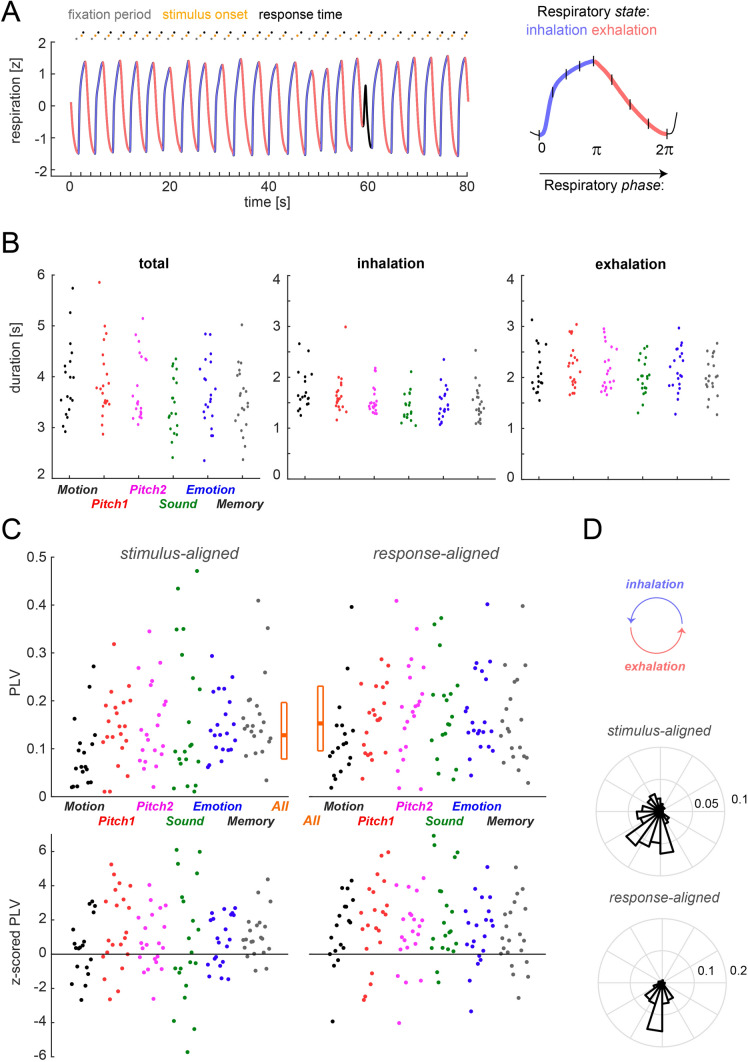
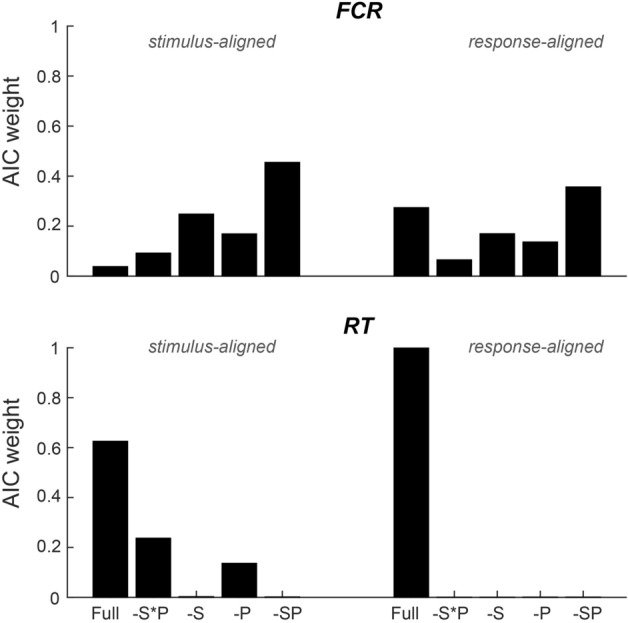
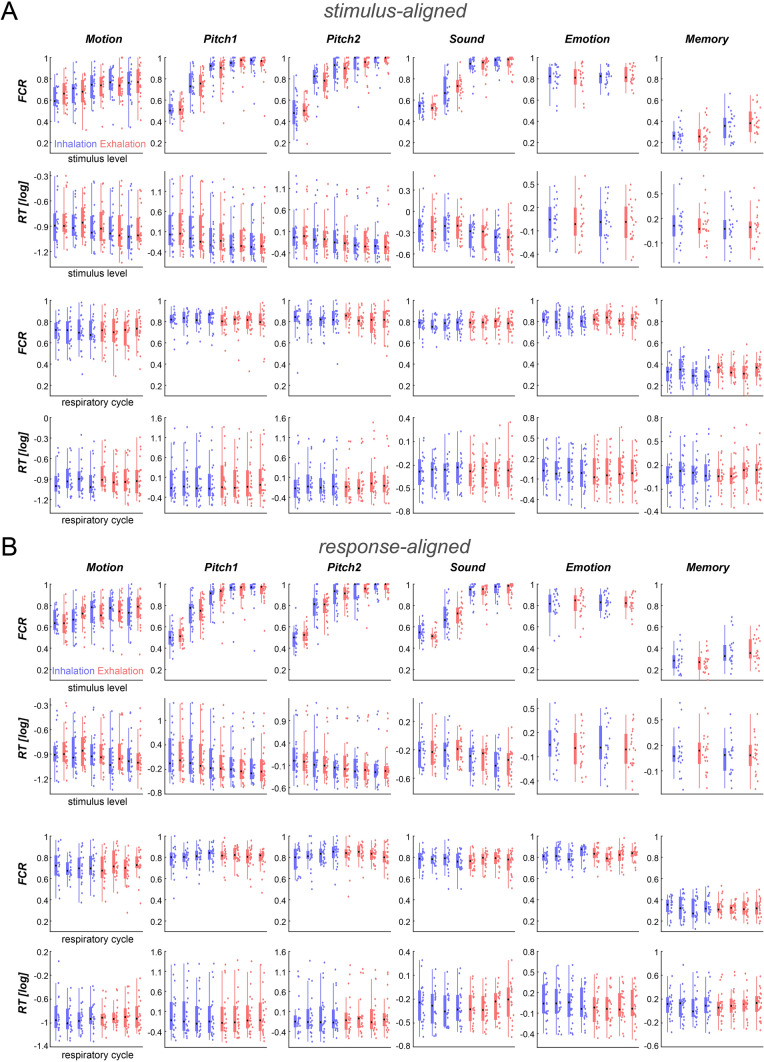
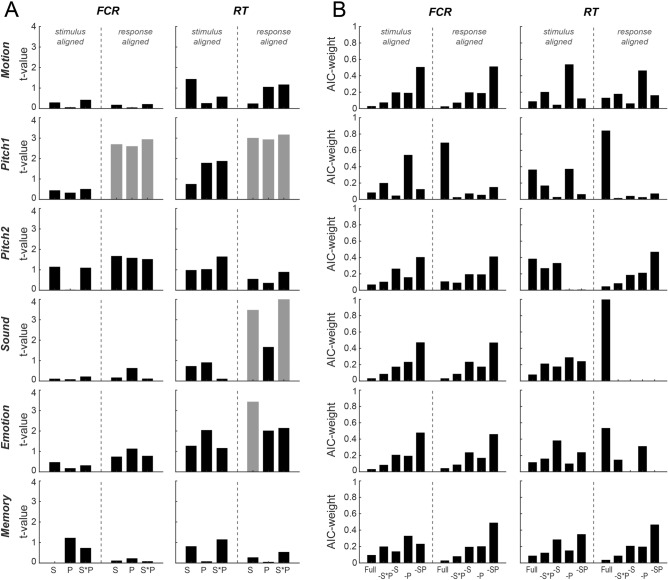
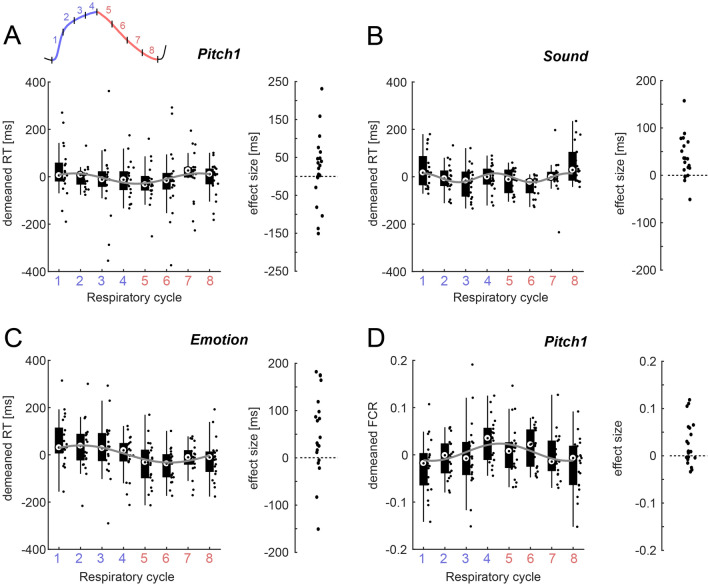
Behavioural and electrophysiological studies point to an apparent influence of the state of respiration, i.e., whether we inhale or exhale, on brain activity and cognitive performance. Still, the prevalence and relevance of such respiratory-behavioural relations in typical sensory-cognitive tasks remain unclear. We here used a battery of six tasks probing sensory detection, discrimination and short-term memory to address the questions of whether and by how much behaviour covaries with the respiratory cycle. Our results show that participants tend to align their respiratory cycle to the experimental paradigm, in that they tend to inhale around stimulus presentation and exhale when submitting their responses. Furthermore, their reaction times, but not so much their response accuracy, consistently and significantly covary with the respiratory cycle, differing between inhalation and exhalation. This effect is strongest when analysed contingent on the respiratory state around participants’ responses. The respective effect sizes of these respiration-behaviour relations are comparable to those seen in other typical experimental manipulations in sensory-cognitive tasks, highlighting the relevance of these effects. Overall, our results support a prominent relation between respiration and sensory-cognitive function and show that sensation is intricately linked to rhythmic bodily or interoceptive functions.
Overview
The claims and statistics of this paper haven’t been checked yet.
Run the check — free, no account needed. It reads the open-access text and checks the sources it cites.
Integrity signals
Registry
Cites
Statistics
Figures
Verification
Claims the paper makes
The claims and statistics of this paper haven’t been checked yet.
Run the check — free, no account needed. It reads the open-access text and checks the sources it cites.
Claims other papers make about this one
Each is checked against this paper’s own text: does it say what the citing paper says it does?
The cited source says what the claim attributes to it.
In the citing paper
“Reaction times in various auditory and visual tasks vary along the respiratory cycle 145 .”
From Interoceptive rhythms in the brain (2023) · cites this paper as [145]
Self-check
Percentages, sums and reported differences re-computed from the paper’s own numbers.
The self-check needs the paper’s full text.
Citations
Cites
Controlling the False Discovery Rate: A Practical and Powerful Approach to Multiple Testing
Benjamini, Y., & Hochberg, Y. (1995) · Journal of the Royal Statistical Society Series B: Statistical Methodology · doi:10.1111/j.2517-6161.1995.tb02031.x · Cited by 109,482
Oostenveld, R., Fries, P., Maris, E., & Schoffelen, J.-M. (2011) · Computational Intelligence and Neuroscience · doi:10.1155/2011/156869 · Cited by 10,323
Simmons, J. P., Nelson, L. D., & Simonsohn, U. (2011) · Psychological Science · doi:10.1177/0956797611417632 · Cited by 6,567
Alpha-band oscillations, attention, and controlled access to stored information
Klimesch, W. (2012) · Trends in Cognitive Sciences · doi:10.1016/j.tics.2012.10.007 · Cited by 3,310
CircStat : A MATLAB Toolbox for Circular Statistics
Berens, P. (2009) · Journal of Statistical Software · doi:10.18637/jss.v031.i10 · Cited by 3,099
AIC model selection using Akaike weights
Wagenmakers, E.-J., & Farrell, S. (2004) · Psychonomic Bulletin & Review · doi:10.3758/bf03206482 · Cited by 2,684
Introduction to Robust Estimation and Hypothesis Testing
Wilcox, R. R. (2012) · Elsevier eBooks · doi:10.1016/c2010-0-67044-1 · Cited by 2,086
Thut, G., Nietzel, A., Brandt, S., & Pascual-Leone, Á. (2006) · Journal of Neuroscience · doi:10.1523/jneurosci.0875-06.2006 · Cited by 1,662
Ebner, N. C., Riediger, M., & Lindenberger, U. (2010) · Behavior Research Methods · doi:10.3758/brm.42.1.351 · Cited by 1,262
On the computational architecture of the neocortex: II The role of cortico-cortical loops
Mumford, D. (1992) · Biological Cybernetics · doi:10.1007/bf00198477 · Cited by 1,074
Cited by
Sorted by citations
Interoceptive rhythms in the brain
Engelen, T., Solcà, M., & Tallon-Baudry, C. (2023) · Nature Neuroscience · doi:10.1038/s41593-023-01425-1 · Cited by 207
Respiratory rhythms of the predictive mind.
Allen, M., Varga, S., & Heck, D. H. (2023) · Psychological Review · doi:10.1037/rev0000391 · Cited by 114
Cognitive processing of a common stimulus synchronizes brains, hearts, and eyes
Madsen, J., & Parra, L. C. (2022) · PNAS Nexus · doi:10.1093/pnasnexus/pgac020 · Cited by 91
Grossman, P. (2023) · Biological Psychology · doi:10.1016/j.biopsycho.2023.108739 · Cited by 82
Brændholt, M., Kluger, D. S., Varga, S., Heck, D. H., Groß, J., & Allen, M. (2023) · Neuroscience & Biobehavioral Reviews · doi:10.1016/j.neubiorev.2023.105262 · Cited by 85
Metadata
- Authors
- Johannknecht, M., & Kayser, C.
- Affiliations
- Heinrich Heine University Düsseldorf (DE)
- Bielefeld University (DE)
- Corresponding author
- Kayser, Christoph
- Venue
- Scientific Reports
- Published
- 2022-02-16
- Volume
- 12
- Issue
- 1
- Pages
- 2586-2586
- ISSN
- 2045-2322 (ISSN-L)
- PMC
- PMC8850565
- OpenAlex
- W4220780205
- Cited by
- 101
- References
- 76
- Citations by year
- 2026: 26 · 2025: 33 · 2024: 15 · 2023: 15 · 2022: 10
- FWCI
- 9.63
- Type
- journal article
- Language
- en
- Open access
- gold
- doi.org
- Locations
- Scientific Reports (publishedVersion, cc-by)
- bioRxiv (Cold Spring Harbor Laboratory) (acceptedVersion)
- PubMed Central (publishedVersion, cc-by)
- PubMed (publishedVersion)
- DOAJ (DOAJ: Directory of Open Access Journals) (submittedVersion, cc-by-sa)
- Publikationen an der Universität Bielefeld (Universität Bielefeld) (submittedVersion, cc-by)
- Funders
- Universität Bielefeld
- Topics
- Life Sciences › Neuroscience › Endocrine and Autonomic Systems › Neuroscience of respiration and sleep
- Health Sciences › Medicine › Cardiology and Cardiovascular Medicine › Heart Rate Variability and Autonomic Control
- Life Sciences › Neuroscience › Cognitive Neuroscience › Neural and Behavioral Psychology Studies
- Keywords
- respiratory cycle, respiration, reaction time, inhalation and exhalation, sensory detection, sensory discrimination, short-term memory, interoception
- MeSH terms
- Adult, Inhalation, Brain, Cognition, Female, Humans, Male, Memory, Short-Term, Reaction Time, Respiratory Physiological Phenomena, Sensation, Exhalation, Young Adult, Respiratory Rate
About these checks
Registry, retraction, Cites and statistics results are computed, not judged, with one exception: a printed reference that no index lists is read once by a model before it counts as a citation error. Claims are extracted by a model and kept only when their quote appears verbatim in the text; each cited source is then checked, with a model’s help, for whether it says what the claim relies on. Those verdicts can be wrong — read the claim’s quote and the cited source before relying on one.
Statistics and arithmetic are recomputed, not judged.
Confidence bands are shown only for fields calibrated on our annotated test set. None is calibrated yet, so no band is shown.
What counts as a claim ›How we measure confidence ›How we check this ›
Are you an author, or do you see a problem with this page? Request a review
