

Equivalency of four research-grade movement sensors to assess movement behaviors and its implications for population surveillance
Open accessThe DOI matches its Crossref record; 41 of the 42 references it cites were found in a registry or an index.
Abstract
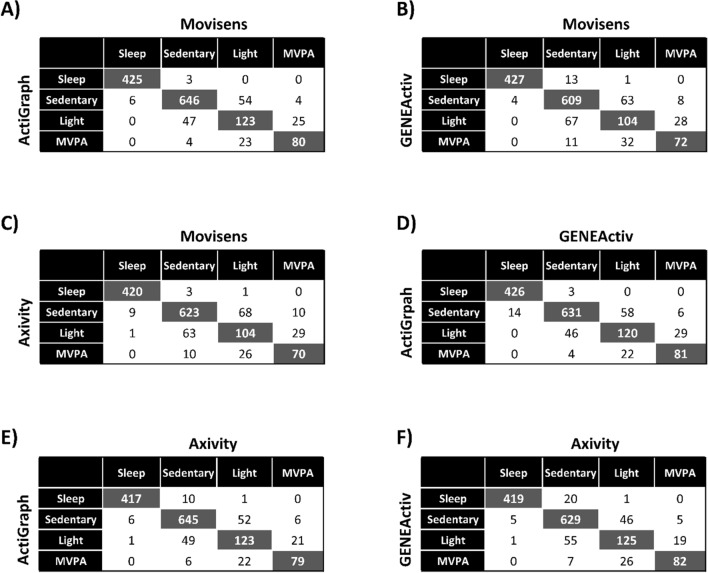
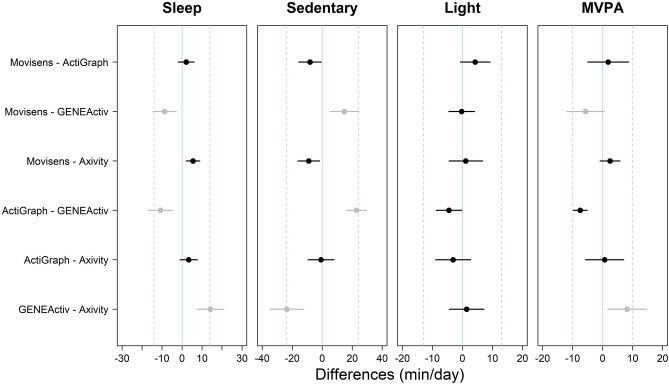
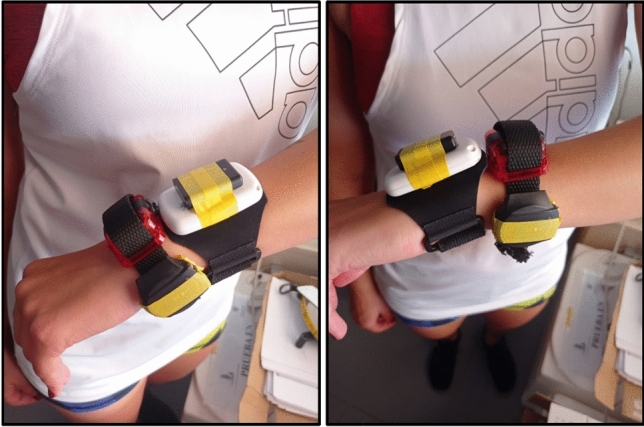
the benefits of physical activity (PA) and sleep for health, accurate and objective population-based surveillance is important. Monitor-based surveillance has potential, but the main challenge is the need for replicable outcomes from different monitors. This study investigated the agreement of movement behavior outcomes assessed with four research-grade activity monitors (i.e., Movisens Move4, ActiGraph GT3X+, GENEActiv, and Axivity AX3) in adults. Twenty-three participants wore four monitors on the non-dominant wrist simultaneously for seven days. Open-source software (GGIR) was used to estimate the daily time in sedentary, light, moderate-to-vigorous PA (MVPA), and sleep (movement behaviors). The prevalence of participants meeting the PA and sleep recommendations were calculated from each monitor’s data. Outcomes were deemed equivalent between monitors if the absolute standardized difference and its 95% confidence intervals (CI 95%) fell within ± 0.2 standard deviations (SD) of the mean of the differences. The participants were mostly men (n = 14, 61%) and aged 36 (SD = 14) years. Pairwise confusion matrices showed that 83–87% of the daily time was equally classified into the movement categories by the different pairs of monitors. The between-monitor difference in MVPA ranged from 1 (CI 95%: − 6, 7) to 8 (CI 95%: 1, 15) min/day. Most of the PA and sleep metrics could be considered equivalent. The prevalence of participants meeting the PA and the sleep guidelines was 100% consistent across monitors (22 and 5 participants out of the 23, respectively). Our findings indicate that the various research-grade activity monitors investigated show high inter-instrument reliability with respect to sedentary, PA and sleep-related estimates when their raw data are processed in an identical manner. These findings may have important implications for advancement towards monitor-based PA and sleep surveillance systems.
Overview
The claims and statistics of this paper haven’t been checked yet.
Free: it reads the open-access text and checks the first 5 claims that cite a source we can check. Create a free account to check every claim.
Integrity signals
Registry
Cites
Statistics
Figures
Verification
Claims the paper makes
The claims and statistics of this paper haven’t been checked yet.
Free: it reads the open-access text and checks the first 5 claims that cite a source we can check. Create a free account to check every claim.
Claims other papers make about this one
Each is checked against this paper’s own text: does it say what the citing paper says it does?
The cited source says what the claim attributes to it.
In the citing paper
“The devices used have been shown to have a high inter-instrument agreement (>80%) in derived sedentary and sleep-related time estimates in free-living environments28.”
From Self-supervised learning of accelerometer data provides new insights for sleep and its association with mortality (2024) · cites this paper as [28]
Self-check
Percentages, sums and reported differences re-computed from the paper’s own numbers.
The self-check needs the paper’s full text.
Citations
Cites
The Measurement of Observer Agreement for Categorical Data
Landis, J. R., & Koch, G. G. (1977) · Biometrics · doi:10.2307/2529310 · Cited by 81,148
World Health Organization 2020 guidelines on physical activity and sedentary behaviour
Bull, F. C., Al-Ansari, S. S., Biddle, S., Borodulin, K., Buman, M. P., Cardon, G., Carty, C., Chaput, J.-P., Chastin, S., Chou, R., et al. (2020) · British Journal of Sports Medicine · doi:10.1136/bjsports-2020-102955 · Cited by 11,657
Self-citation‘Small Changes' to Diet and Physical Activity Behaviors for Weight Management
Hills, A. P., Byrne, N. M., Lindstrom, R., & Hill, J. O. (2013) · Obesity Facts · doi:10.1159/000345030 · Cited by 9,493
Cohen, J. (1992) · Psychological Bulletin · doi:10.1037//0033-2909.112.1.155 · Cited by 8,771
Lee, I.-M., Shiroma, E. J., Lobelo, F., Puska, P., Blair, S. N., & Katzmarzyk, P. T. (2012) · The Lancet · doi:10.1016/s0140-6736(12)61031-9 · Cited by 8,215
Physical Activity in the United States Measured by Accelerometer
TROIANO, R. P., BERRIGAN, D., DODD, K. W., MÂSSE, L. C., TILERT, T., & MCDOWELL, M. (2008) · Medicine & Science in Sports & Exercise · doi:10.1249/mss.0b013e31815a51b3 · Cited by 7,638
National Sleep Foundation's sleep time duration recommendations: methodology and results summary.
Hirshkowitz, M., Whiton, K., Albert, S. M., Alessi, C., Bruni, O., DonCarlos, L., Hazen, N., Herman, J., Katz, E. S., Kheirandish-Gozal, L., et al. (2015) · Sleep Health · doi:10.1016/j.sleh.2014.12.010 · Cited by 4,404
Health inequalities among British civil servants: the Whitehall II study
Marmot, M. G., Stansfeld, S., Patel, C., North, F., Head, J., White, I., Brunner, E., Feeney, A., Marmot, M. G., & Smith, G. D. (1991) · The Lancet · doi:10.1016/0140-6736(91)93068-k · Cited by 3,608
The pandemic of physical inactivity: global action for public health
Kohl, H. W., Craig, C. L., Lambert, E. V., Inoue, S., Alkandari, J. R., Leetongin, G., & Kahlmeier, S. (2012) · The Lancet · doi:10.1016/s0140-6736(12)60898-8 · Cited by 2,985
Fit Yourself and Take Your Lungs to Heart
Palange, P., & Bonini, M. (2013) · Respiration · doi:10.1159/000350831 · Cited by 2,779
Research works printed but not linked: 1
- World Health Organization Global Action Plan on Physical Activity 2018–2030: More Active People for a Healthier World 2018 World Health Organization
Cited by
Yuan, H., Plekhanova, T., Walmsley, R., Reynolds, A. C., Maddison, K. J., Bucan, M., Gehrman, P., Rowlands, A., Ray, D. W., Bennett, D., et al. (2024) · npj Digital Medicine · doi:10.1038/s41746-024-01065-0 · Cited by 40
“%) in derived sedentary and sleep-related time estimatesinfree-livingenvironments 28 .”
BackgroundSelf-citationSansom, K., Reynolds, A. C., McVeigh, J. A., Mazzotti, D. R., Dhaliwal, S. S., Maddison, K. J., Walsh, J. H., Singh, B., Eastwood, P. R., & McArdle, N. (2023) · SLEEP Advances · doi:10.1093/sleepadvances/zpad028 · Cited by 32
Schwendinger, F., Wagner, J., Knaier, R., Infanger, D., Rowlands, A. V., Hinrichs, T., & Schmidt‐Trucksäss, A. (2023) · Medicine & Science in Sports & Exercise · doi:10.1249/mss.0000000000003299 · Cited by 22
“However, the clear advantage of cut-point – free metrics is that they are comparable across cohorts and the most commonly used accelerometers (13,38).”
MethodSelf-citationRowlands, A. V., Kingsnorth, A. P., Hansen, B. H., Fairclough, S. J., Boddy, L. M., Maylor, B. D., Eckmann, H. R., Cruz, B. D. P., Dawkins, N. P., Razieh, C., et al. (2024) · Journal of sport and health science/Journal of Sport and Health Science · doi:10.1016/j.jshs.2024.100977 · Cited by 19
Self-citationPohl, J., Verheyden, G., Held, J. P. O., Luft, A. R., Easthope, C. A., & Veerbeek, J. M. (2025) · Journal of NeuroEngineering and Rehabilitation · doi:10.1186/s12984-024-01512-9 · Cited by 15
“Activity outcomes previously showed consistency across various devices when raw data is processed uniformly [47, 48].”
Lettink, A., van Wieringen, W. N., Altenburg, T. M., Chinapaw, M. J. M., & van Hees, V. T. (2024) · Journal for the Measurement of Physical Behaviour · doi:10.1123/jmpb.2024-0003 · Cited by 14
“Research based on comparisons of multiple devices worn concurrently suggests that some derived physical behavior estimates may differ by brand (Buchan, 2022; Crowley et al., 2019; Edwardson et al., 2022; Migueles et al., 2022; Rowlands et al., 2016, 2018).”
Janek, M., Kühnová, J., Cardon, G., Dyck, D. V., Cimler, R., Elavsky, S., Fezeu, L., Oppert, J., Buck, C., Hebestreit, A., et al. (2025) · PLoS ONE · doi:10.1371/journal.pone.0318772 · Cited by 13
Artese, A., Rawat, R., & Sung, A. D. (2023) · Current Opinion in Clinical Nutrition & Metabolic Care · doi:10.1097/mco.0000000000000970 · Cited by 12
Schwendinger, F., Knaier, R., Wagner, J., Infanger, D., Lichtenstein, E., Hinrichs, T., Rowlands, A. V., & Schmidt‐Trucksäss, A. (2025) · BMC Public Health · doi:10.1186/s12889-025-21800-w · Cited by 11
“Cut-point-free metrics have the advantage of enhancing comparability across studies, populations, and the most commonly used raw acceleration devices [8].”
Self-citationYuan, H., Plekhanova, T., Walmsley, R., Reynolds, A. C., Maddison, K. J., Bucan, M., Gehrman, P., Rowlands, A., Ray, D. W., Bennett, D., et al. (2023) · doi:10.1101/2023.07.07.23292251 · Cited by 3
Self-citationKwaro, D., Kassem, N., Munga, S., Muma, J. O., Gunga, H., Barteit, S., & Maggioni, M. A. (2025) · BMC Public Health · doi:10.1186/s12889-025-24373-w · Cited by 5
“Unlike self-reports or spot measurements, this continuous, high-resolution, non-invasive approach improves ecological validity and sensitivity [57–60].”
Schwendinger, F., Wagner, J., Knaier, R., Infanger, D., Rowlands, A. V., Hinrichs, T., & Schmidt‐Trucksäss, A. (2023) · medRxiv · doi:10.1101/2023.04.19.23288786 · Cited by 2
“GENEActiv, Movisens Move 4, ActiGraph GT3X+, and Axivity 311 AX3).[24] 312 Reference values and percentile curves for cut-point-based metrics (VPA and MVPA, see 313 Supplement: Figure 3 and Table 2) were also created.”
BackgroundMethodInfluentialSelf-citationMobility Assessment Instruments
Fessele, K. L., & Syrkin, G. (2024) · Seminars in Oncology Nursing · doi:10.1016/j.soncn.2024.151660 · Cited by 3
Comparative Validity of Two Thigh-Worn Activity Monitors in Free-Living Conditions
Duhamahoro, J., Lamoureux, N. R., Hibbing, P. R., Taylor, M. A., & Welk, G. J. (2025) · Journal for the Measurement of Physical Behaviour · doi:10.1123/jmpb.2024-0034 · Cited by 1
Murphy, J., Rasmussen, C. L., Brazo‐Sayavera, J., Ademola, V. D., Podrekar, N., Oluwayomi, A., Sardinha, L. B., Wedderkopp, N., & Murtagh, E. (2025) · Annals of Human Biology · doi:10.1080/03014460.2025.2523764 · Cited by 1
“Recently, recommendations for analytical approaches to assess associations between movement behaviours and health outcomes, using accelerometer-determined movement behaviours, have been made (Dumuid et al. 2020; Migueles et al. 2022).”
Banson, M., Lear, G., Darko, K., Moor, R., Patel, J. M., & Rahman, M. (2026) · Journal of Neuro-Oncology · doi:10.1007/s11060-026-05543-1 · Cited by 1
Kinuthia, S. K., Stratton, G., Wachira, L.-J. M., Okoth, V., Owino, G., Ochola, S., Kiplamai, F., Onywera, V. O., & Swindell, N. J. (2025) · PLoS ONE · doi:10.1371/journal.pone.0329173 · Cited by 1
Doherty, A., Yuan, H., Plekhanova, T., Walmsley, R., Reynolds, A., Maddison, K., Bucan, M., Gehrman, P., Rowlands, A., Ray, D., et al. (2023) · doi:10.21203/rs.3.rs-3275989/v1
Self-citationRowlands, A. V., & Troiano, R. P. (2024) · Journal of sport and health science/Journal of Sport and Health Science · doi:10.1016/j.jshs.2024.101004
Self-citationCoyle-Asbil, H. J., Murphy, B., & Vallis, L. A. (2026) · Biomedical Signal Processing and Control · doi:10.1016/j.bspc.2026.109627
Strączkiewicz, M. (2026) · Sensors · doi:10.3390/s26206652
“Previous device-comparison studies suggest that selected raw and derived accelerometry measures can show good correspondence across devices when processed consistently, although differences in acceleration magnitude may remain [34,35].”
Metadata
- Authors
- Migueles, J. H., Molina-Garcia, P., Torres-Lopez, L. V., Cadenas-Sanchez, C., Rowlands, A. V., Ebner-Priemer, U. W., Koch, E. D., Reif, A., & Ortega, F. B.
- Affiliations
- Universidad de Granada (ES)
- University of Leicester (GB)
- Karlsruhe Institute of Technology (DE)
- Goethe University Frankfurt (DE)
- Corresponding author
- Migueles, Jairo H.
- Ortega, Francisco B.
- Venue
- Scientific Reports
- Published
- 2022-04-01
- Volume
- 12
- Issue
- 1
- Pages
- 5525-5525
- ISSN
- 2045-2322 (ISSN-L)
- PMC
- PMC8975935
- OpenAlex
- W4220804768
- Cited by
- 22
- References
- 42
- Citations by year
- 2026: 3 · 2025: 7 · 2024: 6 · 2023: 6
- FWCI
- 2.94
- Type
- journal article
- Language
- en
- Open access
- gold
- doi.org
- Licence
- cc-by
- creativecommons.org/licenses/by/4.0 (tdm)
- creativecommons.org/licenses/by/4.0 (vor)
- Locations
- Scientific Reports (publishedVersion, cc-by)
- PubMed Central (publishedVersion, cc-by)
- PubMed (publishedVersion)
- UniSA Research Outputs Repository (University of South Australia) (acceptedVersion, cc-by)
- Repository KITopen (Karlsruhe Institute of Technology) (submittedVersion, cc-by)
- Adelaide Research & Scholarship (AR&S) (University of Adelaide) (submittedVersion, cc-by)
- Academica-e (Universidad Pública de Navarra) (submittedVersion, cc-by)
- Jyväskylä University Digital Archive (University of Jyväskylä) (submittedVersion, cc-by)
- Institutional Repository of the University of Granada (University of Granada) (submittedVersion, cc-by)
- DOAJ (DOAJ: Directory of Open Access Journals) (submittedVersion, cc-by-sa)
- Figshare (submittedVersion, cc-by)
- Publication Server of Goethe University Frankfurt am Main (Goethe University Frankfurt) (submittedVersion, cc-by)
- KITopen (cc-by)
- Funders
- Forskningsrådet om Hälsa, Arbetsliv och Välfärd (2021-00036)
- Ministerio de Ciencia, Innovación y Universidades (FPU17/04802, FJC2018-037925-I)
- NIHR Leicester Biomedical Research Centre
- Collaboration for Leadership in Applied Health Research and Care - Greater Manchester
- Horizon 2020 Framework Programme (667302)
- Universidad de Granada (Units of Excellence; Scientific Excellence Unit on Exercise and Health (UCEES))
- Junta de Andalucía (SOMM17/6107/UGR)
- SAMID III network (RETICS)
- ISCIII‐ Sub‐Directorate General for Research Assessment and Promotion
- European Regional Development Fund (RD16/0022)
- EXERNET Research Network on Exercise and Health (DEP2005‐00046/ACTI)
- Topics
- Health Sciences › Medicine › Public Health, Environmental and Occupational Health › Physical Activity and Health
- Physical Sciences › Computer Science › Computer Vision and Pattern Recognition › Context-Aware Activity Recognition Systems
- Social Sciences › Psychology › Experimental and Cognitive Psychology › Sleep and related disorders
- Keywords
- accelerometer, wearable activity trackers, movement behavior, physical activity, sleep, sedentary behavior, moderate-to-vigorous physical activity, population surveillance, ActiGraph GT3X+, GENEActiv, wrist-worn sensors, physical activity guidelines, sleep guidelines
- MeSH terms
- Adult, Humans, Male, Population Surveillance, Wrist Joint, Reproducibility of Results, Exercise, Sedentary Behavior
About these checks
Registry, retraction, Cites and statistics results are computed, not judged, with one exception: a printed reference that no index lists is read once by a model before it counts as a citation error. Claims are extracted by a model and kept only when their quote appears verbatim in the text; each cited source is then checked, with a model’s help, for whether it says what the claim relies on. Those verdicts can be wrong — read the claim’s quote and the cited source before relying on one.
Statistics and arithmetic are recomputed, not judged.
Confidence bands are shown only for fields calibrated on our annotated test set. None is calibrated yet, so no band is shown.
What counts as a claim ›How we measure confidence ›How we check this ›
Are you an author, or do you see a problem with this page? Request a review
Data sources
Bibliographic data: Semantic Scholar, OpenAlex, Crossref.
Contains information from the Semantic Scholar Academic Graph Datasets, made available under the ODC Attribution License (ODC-BY 1.0).
Semantic Scholar’s data is described in: Kinney, R., et al. (2023). The Semantic Scholar Open Data Platform. arXiv:2301.10140.
