

The DOI matches its Crossref record; 34 of the 35 references it cites were found in a registry or an index.
Skin lesion classification of dermoscopic images using machine learning and convolutional neural network
Open accessAbstract
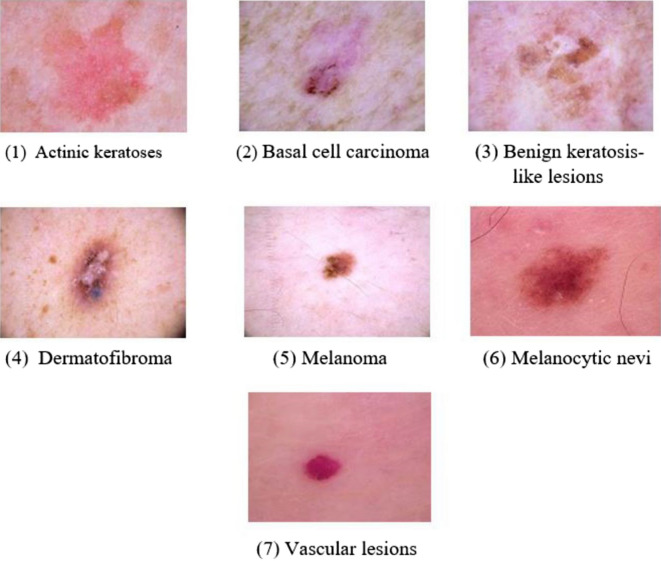
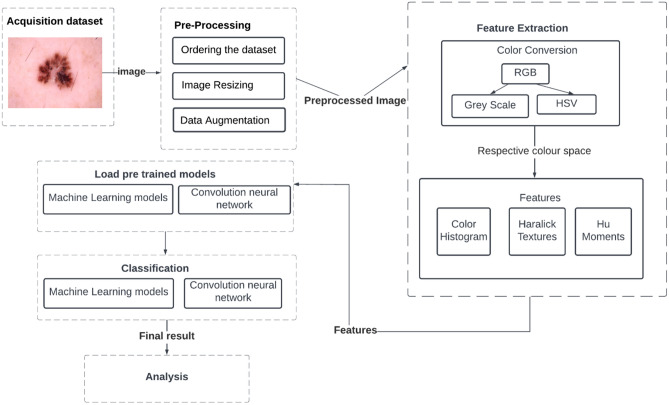
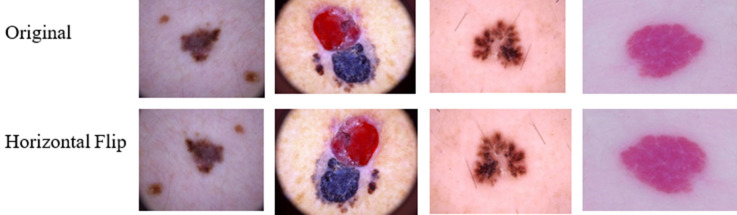
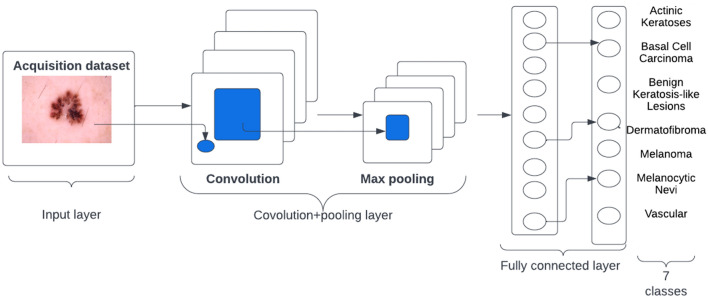
Detecting dangerous illnesses connected to the skin organ, particularly malignancy, requires the identification of pigmented skin lesions. Image detection techniques and computer classification capabilities can boost skin cancer detection accuracy. The dataset used for this research work is based on the HAM10000 dataset which consists of 10015 images. The proposed work has chosen a subset of the dataset and performed augmentation. A model with data augmentation tends to learn more distinguishing characteristics and features rather than a model without data augmentation. Involving data augmentation can improve the accuracy of the model. But that model cannot give significant results with the testing data until it is robust. The k-fold cross-validation technique makes the model robust which has been implemented in the proposed work. We have analyzed the classification accuracy of the Machine Learning algorithms and Convolutional Neural Network models. We have concluded that Convolutional Neural Network provides better accuracy compared to other machine learning algorithms implemented in the proposed work. In the proposed system, as the highest, we obtained an accuracy of 95.18% with the CNN model. The proposed work helps early identification of seven classes of skin disease and can be validated and treated appropriately by medical practitioners.
Overview
The claims and statistics of this paper haven’t been checked yet.
Run the check — free, no account needed. It reads the open-access text and checks the sources it cites.
Integrity signals
Registry
Cites
Statistics
Figures
Verification
Claims the paper makes
The claims and statistics of this paper haven’t been checked yet.
Run the check — free, no account needed. It reads the open-access text and checks the sources it cites.
Claims other papers make about this one
Each is checked against this paper’s own text: does it say what the citing paper says it does?
The source backs part of the claim, not all of it — or backs it for a different population, condition or comparison.
In the citing paper
“However, most prior studies primarily focused on improving classification accuracy through increasingly complex architectures without sufficient attention to explaining model decisions (14–22).”
From Interpretable multimodal fusion for skin lesion classification using dermoscopic images and patient metadata (2026) · cites this paper as [14]
Experimental — accuracy not yet measuredThe source backs part of the claim, not all of it — or backs it for a different population, condition or comparison.
In the citing paper
“Later, CNN-based automatic feature extraction (14) and transfer learning with pretrained models (15, 18) improved representation learning.”
From Interpretable multimodal fusion for skin lesion classification using dermoscopic images and patient metadata (2026) · cites this paper as [14]
Experimental — accuracy not yet measuredThe source backs part of the claim, not all of it — or backs it for a different population, condition or comparison.
In the citing paper
“Most prior studies address this issue through conventional image-level augmentation (7, 14, 15, 17, 18, 20, 21, 23), which increases data volume but does not introduce genuine semantic diversity.”
From Interpretable multimodal fusion for skin lesion classification using dermoscopic images and patient metadata (2026) · cites this paper as [14]
Experimental — accuracy not yet measuredThe cited source says what the claim attributes to it.
In the citing paper
“Class imbalance remains a central challenge in seven-class skin lesion classification using HAM10000.”
From Interpretable multimodal fusion for skin lesion classification using dermoscopic images and patient metadata (2026) · cites this paper as [14]
The check wasn’t confident either way, so it gives no verdict — never disputed.
In the citing paper
“In the classification stage, most prior studies relied primarily on the fully connected layer for final classification (7, 14, 16–18, 20).”
From Interpretable multimodal fusion for skin lesion classification using dermoscopic images and patient metadata (2026) · cites this paper as [14]
Experimental — accuracy not yet measured
Self-check
Percentages, sums and reported differences re-computed from the paper’s own numbers.
The self-check needs the paper’s full text.
Citations
Cites
2 retracted
RETRACTED ARTICLE: Hybrid genetic algorithm and a fuzzy logic classifier for heart disease diagnosis
Gadekallu, T. R., Maddikunta, P. K. R., Lakshmanna, K., Rajput, D. S., Kaluri, R., & Srivastava, G. (2019) · Evolutionary Intelligence · doi:10.1007/s12065-019-00327-1 · Cited by 407
Self-citationRetractedRETRACTED ARTICLE: Skin lesion classification using decision trees and random forest algorithms
Dhivyaa, C. R., Sangeetha, K., -, M. B., Amaran, S., Vetriselvi, T., & Johnpaul, P. (2020) · Journal of Ambient Intelligence and Humanized Computing · doi:10.1007/s12652-020-02675-8 · Cited by 90
RetractedTschandl, P., Rosendahl, C., & Kittler, H. (2018) · Scientific Data · doi:10.1038/sdata.2018.161 · Cited by 3,628
Classification of Skin Disease Using Deep Learning Neural Networks with MobileNet V2 and LSTM
Srinivasu, P. N., SivaSai, J. G., Ijaz, M. F., Bhoi, A. K., Kim, W., & Kang, J. J. (2021) · Sensors · doi:10.3390/s21082852 · Cited by 763
Transfer learning using a multi-scale and multi-network ensemble for skin lesion classification
Mahbod, A., Schaefer, G., Wang, C., Dorffner, G., Ecker, R., & Ellinger, I. (2020) · Computer Methods and Programs in Biomedicine · doi:10.1016/j.cmpb.2020.105475 · Cited by 326
Skin cancer diagnosis based on optimized convolutional neural network
Zhang, N., Cai, Y.-X., Wang, Y.-Y., Tian, Y., Wang, X., & Badami, B. (2019) · Artificial Intelligence in Medicine · doi:10.1016/j.artmed.2019.101756 · Cited by 325
A multi-class skin Cancer classification using deep convolutional neural networks
Chaturvedi, S. S., Tembhurne, J. V., & Diwan, T. (2020) · Multimedia Tools and Applications · doi:10.1007/s11042-020-09388-2 · Cited by 297
Melanoma Recognition in Dermoscopy Images via Aggregated Deep Convolutional Features
Yu, Z., Jiang, X., Zhou, F., Qin, J., Ni, D., Chen, S., Lei, B., & Wang, T. (2018) · IEEE Transactions on Biomedical Engineering · doi:10.1109/tbme.2018.2866166 · Cited by 253
Khan, M. A., Akram, T., Zhang, Y., & Sharif, M. I. (2021) · Pattern Recognition Letters · doi:10.1016/j.patrec.2020.12.015 · Cited by 247
Convolutional Neural Networks Using MobileNet for Skin Lesion Classification
Sae-Lim, W., Wettayaprasit, W., & Aiyarak, P. (2019) · International Joint Conference on Computer Science and Software Engineering · doi:10.1109/jcsse.2019.8864155 · Cited by 233
Research works printed but not linked: 1
- Zaqout, I. Diagnosis of skin lesions based on dermoscopic images using image processing techniques. J. Pattern Recogn. Sel. Methods Appl. 2019, 189–204 (2019).
Cited by
Sorted by citations
Items 101–200 of 314
Skin Sense AI: Detecting Cancerous Skin Diseases using CNN for Multiclass Classification
Ashvin, Sharma, G., Shoeb, M., Nirwal, A., & Sharma, H. (2025) · International Conference on Communication, Security and Artificial Intelligence (ICCSAI) · doi:10.1109/iccsai64074.2025.11064130 · Cited by 5
DAMMD-Net: A lightweight and enhanced deep segmentation network for skin lesion detection
Polat, H. (2025) · Digital Signal Processing · doi:10.1016/j.dsp.2025.105477 · Cited by 5
Two-stage CNN with weakly supervised segmentation for skin lesion classification
Azhari, A. A., Yudistira, N., Widodo, A. W., & Yagi, Y. (2025) · Multimedia Tools and Applications · doi:10.1007/s11042-025-21091-8 · Cited by 5
Deep Learning-Based Automated Classification of Skin Lesions Using CNN and Computer Vision
Kumar, H. S. R., N, G. B. C., Vijay, C. P., Raju, K., Kumar, K., Prabhavathi, K., & Puttegowda, K. (2025) · SN Computer Science · doi:10.1007/s42979-025-04375-6 · Cited by 5
A new SVM solver applied to Skin Lesion Classification
SILVA, J. D. C., Alves, A., Santos, P. S. M., & Matioli, L. C. (2024) · Statistics Optimization & Information Computing · doi:10.19139/soic-2310-5070-2005 · Cited by 5
Automated Skin Cancer Detection using Deep Learning with Self-Attention Mechanism
Singh, H., Devi, K. S., Gaur, S. S., & Bhattacharjee, R. (2023) · International Conference on Computational Intelligence and Sustainable Engineering Solutions (CISES) · doi:10.1109/cises58720.2023.10183586 · Cited by 5
Şengül, S. B., & Özkan, İ. A. (2024) · International Journal of Imaging Systems and Technology · doi:10.1002/ima.23108 · Cited by 5
Multiresolution Evaluation of Contourlet Transform for the Diagnosis of Skin CancerPreprint
Sikkander, A. R. M., Lakshmi, V. V., Theivanathan, G., & Radhakrishnan, K. (2024) · Research Square · doi:10.21203/rs.3.rs-4778827/v1 · Cited by 5
Artificial Intelligence-Driven Multidirectional Curvelet Analysis for Enganced Skin Cancer DetectionPreprint
RAZAK, M. S. A., Lakshmi, V., V, Theivanathan, G., & Radhakrishnan, K. (2025) · SSRN Electronic Journal · doi:10.2139/ssrn.5127060 · Cited by 5
Efat, A. H. (2026) · Franklin Open · doi:10.1016/j.fraope.2026.100546 · Cited by 4
Prabu, M., MuthuKumar, S., Sudhahar, T. N., Chakaravarthi, S., Shanmugapriya, N., & Mahajan, R. (2024) · Australian Journal of Electrical & Electronics Engineering · doi:10.1080/1448837x.2024.2432715 · Cited by 4
Na, A. (2024) · International Conference on Electrical, Communication, and Computer Engineering (ICECCE) · doi:10.1109/icecce63537.2024.10823569 · Cited by 4
Jabber, A. A., Shadeed, G. A., Salim, N., & Dibs, H. (2025) · Operations Research Forum · doi:10.1007/s43069-025-00430-3 · Cited by 5
Enhancing Interpretability of Skin Lesion Classification Using Grad-CAM and Weighted Grad-CAM
Chand, H., Kumar, D., & Bali, K. K. (2024) · International Conference on Sustainable Technology and Engineering (i-COSTE) · doi:10.1109/i-coste63786.2024.11024650 · Cited by 4
Applications of Artificial Intelligence in Dermatology
Arza, A., Lebhar, J., & Lipoff, J. B. (2025) · Dermatologic Clinics · doi:10.1016/j.det.2025.05.003 · Cited by 5
Pramila, R. P., Subhashini, R., & Surendran, R. (2024) · IEEE International Conference on Engineering Technologies and Applied Sciences (ICETAS) · doi:10.1109/icetas62372.2024.11120165 · Cited by 4
Skin disease diagnosis using decision and feature level fusion of deep features
Uddin, M. Z., Shahriar, M. A., Schuller, B. W., Mahamood, M. N., & Ahad, M. A. R. (2025) · Frontiers in Digital Health · doi:10.3389/fdgth.2025.1478688 · Cited by 4
Ramos-Briceño, D. A., Pinto-Cuberos, J., Linfante, A. W., & Wilkerson, M. G. (2025) · Scientific Reports · doi:10.1038/s41598-025-31259-9 · Cited by 4
Interpretable Skin Cancer Identification Using a Hybrid Deep Learning and XAI Framework on HAM10000
Sonune, B. S., Kumar, R. U., Sankar, K., Agrawal, P., Nemane, S. G., Tulaskar, D. P., Bhaiyya, M. L., & Kulkarni, M. B. (2026) · Bioengineering · doi:10.3390/bioengineering13060677 · Cited by 4
Yuan, H., Aucott, J. N., Hadžić, A., Paul, W., de Flores, M. D. V., Mathew, P., Burlina, P., & Cao, Y. (2023) · Lecture notes in computer science · doi:10.1007/978-3-031-43901-8_36 · Cited by 5
Computer-Aided Classification of Melanoma: A Comprehensive Survey
Sharma, U., Aggarwal, P., & Mittal, A. K. (2024) · Archives of Computational Methods in Engineering · doi:10.1007/s11831-024-10138-y · Cited by 4
Wong, T. H., Wei, J., Chen, H., & Ng, B. F. L. (2024) · Digital Chinese Medicine · doi:10.1016/j.dcmed.2024.04.005 · Cited by 4
Computer-Aided Classification of Skin Cancer based on the YOLO Algorithm
Tchema, R. B., Nestoros, M., & Polycarpou, A. C. (2024) · International Conference on Modern Circuits and Systems Technologies · doi:10.1109/mocast61810.2024.10615645 · Cited by 4
Roy, A. L., Maruf, A. A., Sony, R. I., Roy, A. P., Prova, N. N. I., & Aung, Z. (2025) · Journal of Ambient Intelligence and Humanized Computing · doi:10.1007/s12652-025-04984-2 · Cited by 4
A Novel Edge-Assisted IoT-ML-Based Smart Healthcare Framework for COVID-19
Mir, M. H., Jamwal, S., Iqbal, U., Mehbodniya, A., Webber, J. L., & Khan, U. H. (2023) · Computer Modeling in Engineering & Sciences · doi:10.32604/cmes.2023.027173 · Cited by 4
Skin Lesion Segmentation Detection Using U-Net Architecture
Kamalam, T., Vinoth Raj, R., Yalabaka, S., S, V. P., & Dinesh Sithik varshan, A. (2024) · International Conference on Wireless Communications, Signal Processing and Networking (WiSPNET) · doi:10.1109/wispnet61464.2024.10532992 · Cited by 4
Applying Convolutional Neural Networks (CNNs): A Machine Learning Method in Modern Sports
Amin, M. R. R. M., Nasir, A., Sidik, M. H. M., Jamaludin, A. S., & Rosli, A. M. (2024) · Lecture notes in bioengineering · doi:10.1007/978-981-97-3741-3_36 · Cited by 3
Ma, S., Chan, Y.-H., Ngai, E. C. ‐., & Ho, J. W. K. (2025) · Computer Methods and Programs in Biomedicine · doi:10.1016/j.cmpb.2025.109073 · Cited by 3
Rana, L., Modi, N., & Pandey, S. (2025) · Discover Artificial Intelligence · doi:10.1007/s44163-025-00637-7 · Cited by 3
Exploring Deep Neural Architectures for Skin Lesion Detection and Classification
Dhange, P. G., & William, P. (2025) · International Conference on Computational Intelligence and Knowledge Economy (ICCIKE) · doi:10.1109/iccike67021.2025.11318236 · Cited by 3
Li, X., Ouyang, J., Chen, Y., Diao, Z., Li, K., He, D., Liang, W., & Poniszewska-Marańda, A. (2026) · Scientific Reports · doi:10.1038/s41598-026-37846-8 · Cited by 3
Deep neural network-based robust framework for automated skin lesion segmentation and analysis
Mehdar, K. M., Soomro, T. A., Ali, A., Ubaid, F. B., Irfan, M., Halawani, H. T., Mashraqi, A. M., Elshafie, S. E. M., Asiri, A. A. M., & Magzoub, M. A. (2026) · Digital Health · doi:10.1177/20552076261427501 · Cited by 3
Faizal, S., Rajput, C. A., & Prusty, M. R. (2026) · Frontiers in Artificial Intelligence · doi:10.3389/frai.2026.1781796 · Cited by 3
Whewell, J., Peters, R., & Kulon, J. (2026) · Technologies · doi:10.3390/technologies14070391 · Cited by 3
Automated Skin Lesion and Cancer Detection Using Computer Vision: A Comprehensive Review
Sonune, B. S., Ramanathan, U., Tulaskar, D. P., Nemane, S. G., Kulkarni, M. B., Rewatkar, P., & Bhaiyya, M. L. (2026) · Bioengineering · doi:10.3390/bioengineering13080872 · Cited by 3
Nabila, E. A., Sari, C. A., Rachmawanto, E. H., & Doheir, M. (2023) · Advance Sustainable Science Engineering and Technology · doi:10.26877/asset.v5i3.16854 · Cited by 3
JILDYA ‐Net: An Efficient Lightweight Multi‐Class Classification Architecture for Skin Lesions
Laouarem, A., Kara‐Mohamed, C., Bourennane, E., & Hamdi‐Cherif, A. (2025) · International Journal of Imaging Systems and Technology · doi:10.1002/ima.70102 · Cited by 3
Skin Cancer Detection Using Ensemble Learning: ViT, InceptionV3, and MobileNetV2
Junaedi, E., Fatichah, C., & Fabroyir, H. (2025) · International Conference on Smart Computing, IoT and Machine Learning (SIML) · doi:10.1109/siml65326.2025.11081030 · Cited by 3
Das, J. P., Ma, H. Y., de Jong, D., Prendergast, C. M., Dahooiyeh, A. B., Braumuller, B., Giarratana, A. O., Khonji, M. S., Paily, J., Shobeiri, P., et al. (2025) · Clinical Imaging · doi:10.1016/j.clinimag.2025.110571 · Cited by 3
To, H. D., Nguyen, H. G., Le, H. T. T., Le, H. M., & Quan, T. (2023) · Biomedical Physics & Engineering Express · doi:10.1088/2057-1976/acd1f0 · Cited by 3
Sharma, R. K., Sharma, M. R., Mahendra, A., Sharma, U., Singh, S., Ramniwas, S., & Sharma, A. K. (2023) · Current Dermatology Reports · doi:10.1007/s13671-023-00408-6 · Cited by 3
Guerra-Rosas, E., López-Ávila, L. F., Garza-Flores, E., Vidales-Basurto, C. A., & Álvarez-Borrego, J. (2023) · Applied Sciences · doi:10.3390/app132011425 · Cited by 3
Hait, M., Das, R., Ali, A., Chaudhari, S. S., & Djemal, K. (2023) · International Conference on Image Processing Theory, Tools and Applications (IPTA) · doi:10.1109/ipta59101.2023.10319992 · Cited by 3
Sayyad, E. A. J. (2023) · International Journal on Recent and Innovation Trends in Computing and Communication · doi:10.17762/ijritcc.v11i10.8494 · Cited by 3
Enumerating the K-Fold Configurations in Multi-Class Classification Problems
Fazekas, A., & Kovács, G. (2025) · International Conference on Data Science and Machine Learning Applications (CDMA) · doi:10.1109/cdma61895.2025.00008 · Cited by 3
Federated Averaging Optimization for Efficient Skin Cancer Image Analysis
Vashistha, P., Vashistha, D., Saxena, V. P., Kumhar, M., Bhatia, J., Gupta, R., Jadav, N. K., & Tanwar, S. (2025) · Procedia Computer Science · doi:10.1016/j.procs.2025.04.634 · Cited by 3
Advancements in acne detection and classification: A bibliometric analysis
Paluri, K. V., Nain, G., & Gupta, A. (2025) · Computers & Electrical Engineering · doi:10.1016/j.compeleceng.2025.110693 · Cited by 3
Lightweight CNN Towards Skin Lesions Automated Diagnosis In Dermoscopic Images
Sakli, M., Essid, C., Salah, M. B. B., & Sakli, H. (2023) · International Conference on Innovations in Intelligent Systems and Applications (INISTA) · doi:10.1109/inista59065.2023.10310480 · Cited by 3
Thepade, S. D., Shriwardhankar, V. R., Sayyad, A. I., Shukla, S. B., & Mehta, P. M. (2023) · International Conference on Computing Communication Control and automation · doi:10.1109/iccubea58933.2023.10392065 · Cited by 2
Skin Lesion 7 Class Classification using MobileNetV2 CNN
Kumar, M. V., Khulbe, H., Khan, M. Z., & Vikas (2024) · International Conference on Advanced Computing and Emerging Technologies (ACET) · doi:10.1109/acet61898.2024.10730501 · Cited by 2
Trong, N. H., Nghia, N. H., Thư, N. T. A., & Tuan, P. V. (2024) · IEEE International Conference on Control & Automation, Electronics, Robotics, Internet of Things, and Artificial Intelligence (CERIA) · doi:10.1109/ceria64726.2024.10914766 · Cited by 2
Identification Improvement of Malignant Skin Diseases for Diverse Skin Tones with Grad-CAM
Na, A. (2025) · Lecture notes in computer science · doi:10.1007/978-3-031-87660-8_10 · Cited by 2
State-of-the-Art Skin Disease Classification Using Ensemble Learning and Advanced Image Processing
Nirupama, & Virupakshappa, V. (2025) · Cybernetics & Systems · doi:10.1080/01969722.2025.2551843 · Cited by 2
Prabowo, A. S., Prasetyo, S. Y., Santy, S., Asmare, M. H., Aditjakra, C., & Clarawita (2025) · Procedia Computer Science · doi:10.1016/j.procs.2025.09.035 · Cited by 2
A Sequential Segmentation and Classification Learning Approach for Skin Lesion Images
Gallazzi, M., Gallo, I., & Corchs, S. (2025) · Applied Sciences · doi:10.3390/app152312614 · Cited by 2
Type 1 and Type 2 Diabetes Measurement Using Human Face Skin Region
Euprazia, L. A., Rajeswari, A., Thyagharajan, K. K., & Shanker, N. R. (2023) · Journal of Diabetes Research · doi:10.1155/2023/9931010 · Cited by 2
Artificial Intelligence as a Tool for Population Screening of Skin Tumors
Uskova, K. A., Garanina, O. E., Ukharov, A. O., Александровна, К. И., Gamayunov, S. V., Mironycheva, A. M., Dardyk, V. I., Burdakov, A. V., Леонидовна, Ш. И., Stepanova, Y. L., et al. (2024) · Effective Pharmacotherapy · doi:10.33978/2307-3586-2024-20-1-62-71 · Cited by 2
Facial Skin Disorder Prediction Based on Non-Visual Information Using ANN Model
Rismayani, R., Ilham, A. A., Achmad, A., & Rachman, M. R. Y. (2024) · International Conference on Informatics and Computational Sciences (ICICoS) · doi:10.1109/icicos62600.2024.10636923 · Cited by 2
Skin Lesion Classification using Deep Learning Architectures
Gothivrekar, S., Khanvilkar, A., Nandi, U., Singh, K., & Maktum, T. (2024) · International Conference on Networks, Multimedia and Information Technology (NMITCON) · doi:10.1109/nmitcon62075.2024.10698794 · Cited by 2
Skin Lesion Image Segmentation Algorithm Based on MC-UNet
Yang, G., & Pan, B. (2025) · IEEE Access · doi:10.1109/access.2025.3531508 · Cited by 2
Miracle, S. M., Rianto, L., Kelvin, K., Tandarto, K., Setiadi, F., Angela, A., Brunner, T. M., Darmawan, H., Tanojo, H., Kupwiwat, R., et al. (2025) · Journal of Craniofacial Surgery · doi:10.1097/scs.0000000000011498 · Cited by 2
Wang, S., Ke, C., Cui, S., Wu, C., Huang, Z., Huang, Y., Yang, J., Zhang, L., & Bi, M. (2022) · doi:10.1117/12.2643849 · Cited by 2
Rahmaniar, T. D., Safitri, A. S., Maulidin, I., Wijayanto, I., & Hadiyoso, S. (2024) · International Conference on Information Technology, Information Systems and Electrical Engineering (ICITISEE) · doi:10.1109/icitisee63424.2024.10729972 · Cited by 2
Optimized Vision Transformer with Adaptive Attention for High-Precision Skin Cancer Classification
Rani, U., V, & Santhiya, R. (2025) · doi:10.1109/icoact63339.2025.11004694 · Cited by 2
Ensemble Deep Learning Approaches for Skin Cancer Detection and Prediction
Kingsly, C. S., Lakshmi, A. A., Ahila, A., Nallasivan, G., Anitha, A., Nisha, M. S., Ponkumar, D. D. N., Franklin, N. M., Roselin, V., & Saravanakumar, R. (2025) · Lecture notes in networks and systems · doi:10.1007/978-981-96-2329-7_19 · Cited by 2
Shegar, S. R., & Patil, S. S. (2025) · Journal of Smart Sensors and Computing · doi:10.64189/ssc.25213 · Cited by 2
AI-Driven Skin Disease Detection, Diagnosis, and Tailored Medication Recommendations Model
Jadhav, S. R., Pirjade, S., Bhutnal, V. H., Rathod, L., Jagdale, S., & Naik, J. (2025) · Lecture notes in networks and systems · doi:10.1007/978-981-97-8602-2_18 · Cited by 1
Robust Skin Disease Classification Leveraging EfficientNet-B7
Samarasam, B., Bharathidasan, M. S., Kumaaran, S. I., & Dharanidharan, R. (2025) · International Conference on Augmented Intelligence and Sustainable Systems (ICAISS) · doi:10.1109/icaiss61471.2025.11041960 · Cited by 1
Brzozowski, K., Buler, J., Buler, R., & Grochowski, M. (2025) · International Conference on Methods and Models in Automation and Robotics · doi:10.1109/mmar65820.2025.11151064 · Cited by 1
A Hybrid Approach Combining CNN and Ensemble Algorithms for Dermoscopic Image Classification
Soares, P. A. A., Ensina, L. A., & Foleis, J. H. (2025) · doi:10.5753/eniac.2025.12460 · Cited by 1
Barman, A. D., Roy, K. R., Sultana, M. T., Mandal, A. K., & Bhowmik, P. (2025) · Communications in computer and information science · doi:10.1007/978-3-032-11335-1_28 · Cited by 1
Skin Cancer Classification using Deep Learning and Explainable AI Techniques
Chorge, N., & Parihar, V. (2025) · IEEE International Symposium on Sustainable Energy, Signal Processing and Cyber Security (iSSSC) · doi:10.1109/isssc66652.2025.11388972 · Cited by 1
A novel multi-agent spatiotemporal fusion framework for intelligent skin cancer diagnosis
Zheng, P., Yang, J., Wen, X., & Hu, B. (2026) · Frontiers in Oncology · doi:10.3389/fonc.2026.1759960 · Cited by 1
Mahalakshmi, G., Sasithradevi, A., & Baskar, C. (2026) · PeerJ Computer Science · doi:10.7717/peerj-cs.3277 · Cited by 1
Lin, R. Z., Amith, M. “., Wang, C. X., Strickley, J. D., & Tao, C. (2024) · JMIR Medical Informatics · doi:10.2196/49613 · Cited by 1
Image Classification of Skin Cancer Using Deep Neural Networks with Scaling Laws
Xu, R. (2024) · International Journal of Computer Science and Information Technology · doi:10.62051/ijcsit.v3n2.12 · Cited by 1
Exploring the application of machine learning for skin cancer image identification
Chen, S. (2024) · Advances in Engineering Innovation · doi:10.54254/2977-3903/11/2024108 · Cited by 1
Munthuli, A., Thepsoparn, M., Pooprasert, P., Phienphanich, P., Pongcharoen, P., Sakonlaya, D., Sittiwattanawong, P., Weschawalit, S., Chakkavittumrong, P., Thongthawee, B., et al. (2024) · Annual International Conference of the IEEE Engineering in Medicine and Biology Society (EMBC) · doi:10.1109/embc53108.2024.10782522 · Cited by 1
Sharma, R. (2024) · Communications on Applied Nonlinear Analysis · doi:10.52783/cana.v32.2940 · Cited by 1
Advancing Crop Health: The Role of Artificial Intelligence in Disease Management
Almasoudi, N. M. (2024) · International Journal of Phytopathology · doi:10.33687/10.33687/phytopath.013.03.5526 · Cited by 1
Zegair, F. A., Betz-Stablein, B., Janda, M., Soyer, H., & Chandra, S. S. (2025) · Physical and Engineering Sciences in Medicine · doi:10.1007/s13246-025-01636-9 · Cited by 1
Cheng, C., Guo, D., Gu, J., Wang, D., Li, W., Cao, X., Miao, B., & Fei, S. (2025) · Journal of Clinical Gastroenterology · doi:10.1097/mcg.0000000000002311 · Cited by 1
Gabriel, C. I.-O., & Kumar, R. (2026) · Digital Transformation and Society · doi:10.1108/dts-08-2025-0267 · Cited by 1
Bridging Research and Practice: A Systematic Review of Deep Learning Techniques in Medical Imaging
Singh, V. K., Arora, S., Singhal, D., & Bhardwaj, P. (2026) · Archives of Computational Methods in Engineering · doi:10.1007/s11831-026-10524-8 · Cited by 1
Semi-supervised GNN for Multi-modal Skin Lesion Classification
Nguyen, T., Vu, V. H., & Nguyen, V. A. (2026) · International Journal of Computational Intelligence Systems · doi:10.1007/s44196-026-01296-x · Cited by 1
A deep learning framework for skin lesion classification using ResNet50 and ELM
Vidal-Basurto, C., & Rivera, M. (2026) · Computer Methods and Programs in Biomedicine Update · doi:10.1016/j.cmpbup.2026.100253 · Cited by 1
Bhutnal, V. H., Rathod, L., Naik, J., & Jagadale, S. (2023) · International Conference on Communication and Electronics Systems (ICCES) · doi:10.1109/icces57224.2023.10192734 · Cited by 1
SkinNet: Enhancing Dermatological Diagnosis Through a New Deep Learning Framework
Edder, A., Ben-Bouazza, F.-E., & Jioudi, B. (2024) · Lecture notes in networks and systems · doi:10.1007/978-3-031-52388-5_17 · Cited by 1
Improving Skin Cancer Diagnosis: A Comprehensive Analysis of Transfer Learning and Ensemble Models
Rahman, S., Siddique, M. A. I., & Ashik, S. (2023) · International Conference on Computer and Information Technology (ICCIT) · doi:10.1109/iccit60459.2023.10440993 · Cited by 1
A CNN-Based Approach For The Detectıon Of Skın Cancer
Sahu, S. R., Bhargavi, V., Keerthi, K. M., Kumar, I. S., & Srikanth, G. (2024) · Advances in computer science research · doi:10.2991/978-94-6463-471-6_10 · Cited by 1
Saroja, N. J. S., & Jacob, L. (2024) · International Conference on Trends in Quantum Computing and Emerging Business Technologies (TQCEBT) · doi:10.1109/tqcebt59414.2024.10545241 · Cited by 1
Skin Disease Pre-diagnosis with Novel Visual Transformers
Espinosa, E., Castilla, J. S. R., & García‐Lamont, F. (2024) · Communications in computer and information science · doi:10.1007/978-3-031-74595-9_10 · Cited by 1
Preprocessing with Skin Segmentation to Improve Monk Skin Tone (MST) Classification
Alifia, R. V., & Ayu, M. A. (2024) · Proceeding of the Electrical Engineering Computer Science and Informatics · doi:10.1109/eecsi63442.2024.10776291 · Cited by 1
Shaheen, H., & Singh, M. P. (2025) · Communications in computer and information science · doi:10.1007/978-3-031-81339-9_1 · Cited by 1
MFENet: Multi-scale and Local Frequency Enhancement Network for Skin Lesion Classification
Jin, Y., Xiao, Z., Yuan, J., He, M., Liu, L., Yu, F. Q., & Jiang, M. (2025) · Lecture notes in computer science · doi:10.1007/978-3-031-82024-3_15 · Cited by 1
Deep Learning-Based Multi-class Skin Disease Diagnosis Toward Sustainable Healthcare
Nassar, Y. M., Makhlouf, M., El-tohamy, M. H., Abdelgawad, W., Darwish, E., Abdalla, H., & Sayed, G. I. (2025) · Springer eBooks · doi:10.1007/978-3-031-78038-7_7 · Cited by 1
Human Skin Disease Detection and Classification Using Ensemble Learning
Kumar, V., & Rani, J. (2025) · Journal of Recent Innovations in Computer Science and Technology · doi:10.70454/jricst.2025.20212 · Cited by 1
DermInsight: A diagnostic System for Human Skin Diseases utilizing Deep Learning
Skandar, A., Asim, Z., Arbab, T., & Batool, N. (2025) · VAWKUM Transactions on Computer Sciences · doi:10.21015/vtcs.v13i1.2021 · Cited by 1
López-Ávila, L. F., & Álvarez-Borrego, J. (2025) · Applied Sciences · doi:10.3390/app15115860 · Cited by 1
Shafin, M. S., Tasnim, H., Haque, M. R., Hasan, S. M. M., Fahim, A. S. M. M., & Alam, M. S. (2024) · International Conference on Computing Advancements (ICCA) · doi:10.1145/3723178.3723306 · Cited by 1
Metadata
- Authors
- Shetty, B., Fernandes, R., Rodrigues, A. P., Chengoden, R., Bhattacharya, S., & Lakshmanna, K.
- Affiliations
- Nitte University (IN)
- Vellore Institute of Technology University (IN)
- Corresponding author
- Lakshmanna, Kuruva
- Venue
- Scientific Reports
- Published
- 2022-10-28
- Volume
- 12
- Issue
- 1
- Pages
- 18134-18134
- ISSN
- 2045-2322 (ISSN-L)
- PMC
- PMC9616944
- OpenAlex
- W4307511304
- Cited by
- 290
- References
- 35
- Citations by year
- 2026: 61 · 2025: 101 · 2024: 78 · 2023: 46 · 2022: 4
- FWCI
- 23.96
- Type
- journal article
- Language
- en
- Update notices
- correction (2022-12-19)
- Open access
- gold
- doi.org
- Locations
- Scientific Reports (publishedVersion, cc-by)
- Research Square (acceptedVersion, cc-by)
- PubMed Central (publishedVersion, cc-by)
- PubMed (publishedVersion)
- DOAJ (DOAJ: Directory of Open Access Journals) (submittedVersion, cc-by-sa)
- Funders
- VIT University (632014)
- Topics
- Health Sciences › Medicine › Oncology › Cutaneous Melanoma Detection and Management
- Physical Sciences › Computer Science › Artificial Intelligence › AI in cancer detection
- Physical Sciences › Computer Science › Computer Vision and Pattern Recognition › Advanced Neural Network Applications
- Keywords
- skin lesion classification, dermoscopic images, pigmented skin lesions, skin cancer detection, HAM10000 dataset, data augmentation, k-fold cross-validation, convolutional neural networks, machine learning classification
- MeSH terms
- Machine Learning, Algorithms, Humans, Skin Diseases, Skin Neoplasms, Neural Networks, Computer
About these checks
Registry, retraction, Cites and statistics results are computed, not judged, with one exception: a printed reference that no index lists is read once by a model before it counts as a citation error. Claims are extracted by a model and kept only when their quote appears verbatim in the text; each cited source is then checked, with a model’s help, for whether it says what the claim relies on. Those verdicts can be wrong — read the claim’s quote and the cited source before relying on one.
Statistics and arithmetic are recomputed, not judged.
Confidence bands are shown only for fields calibrated on our annotated test set. None is calibrated yet, so no band is shown.
What counts as a claim ›How we measure confidence ›How we check this ›
Are you an author, or do you see a problem with this page? Request a review
