

EEG-based spatio-temporal relation signatures for the diagnosis of depression and schizophrenia
Open accessThe DOI matches its Crossref record; 66 of the 66 references it cites were found in a registry or an index.
Abstract
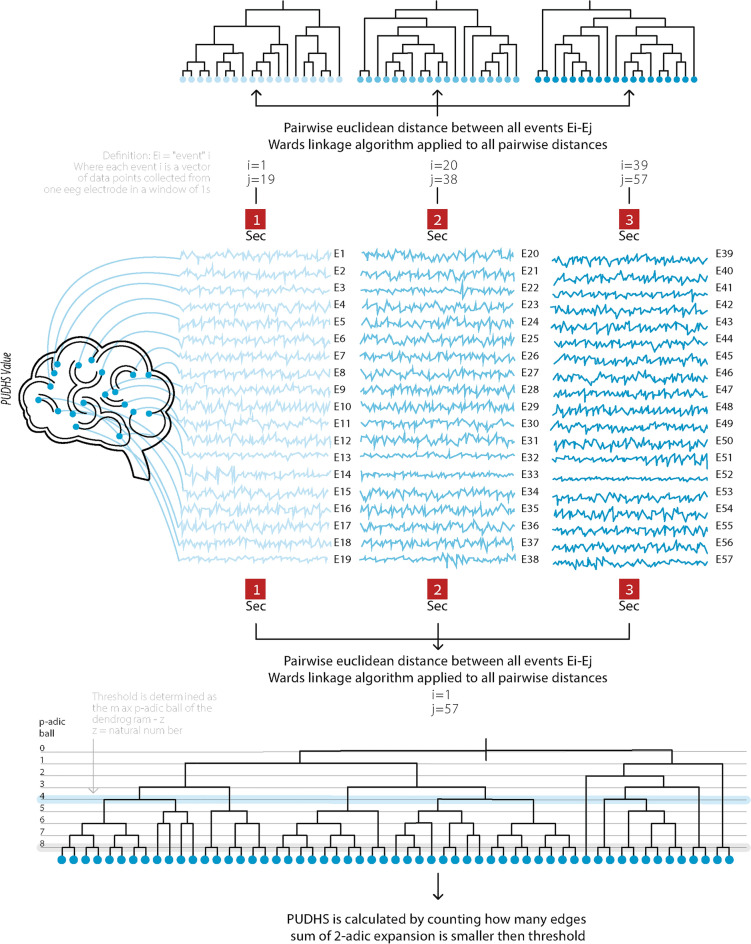
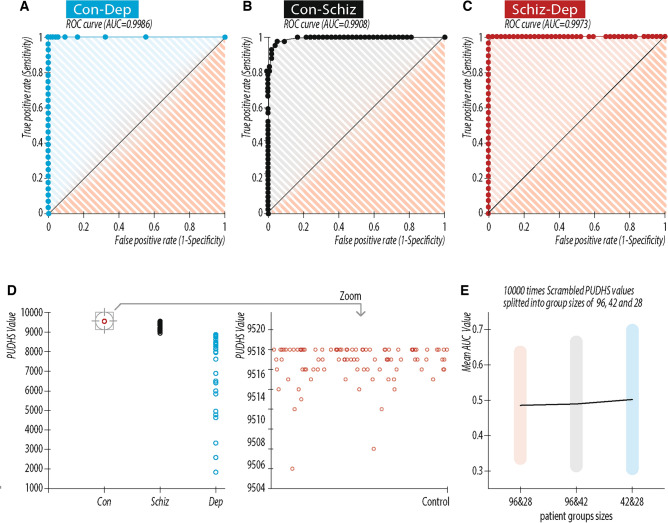
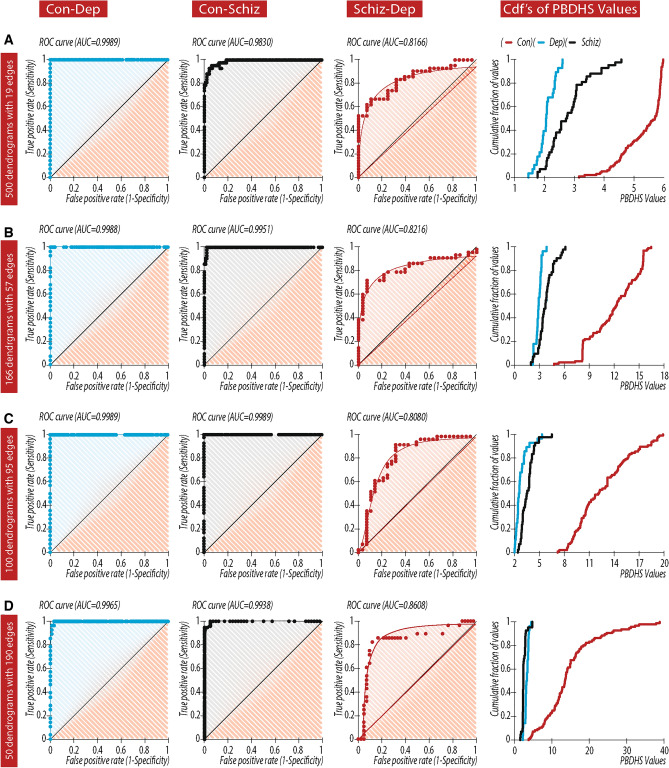
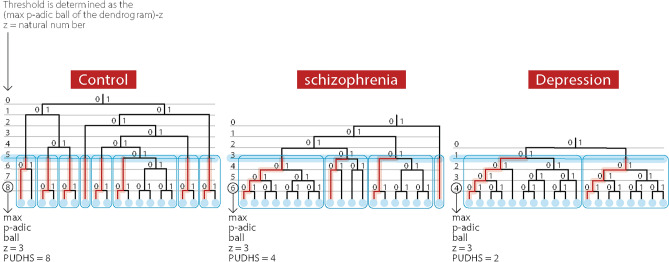
The diagnosis of psychiatric disorders is currently based on a clinical and psychiatric examination (intake). Ancillary tests are used minimally or only to exclude other disorders. Here, we demonstrate a novel mathematical approach based on the field of p-adic numbers and using electroencephalograms (EEGs) to identify and differentiate patients with schizophrenia and depression from healthy controls. This novel approach examines spatio-temporal relations of single EEG electrode signals and characterizes the topological structure of these relations in the individual patient. Our results indicate that the relational topological structures, characterized by either the personal universal dendrographic hologram (DH) signature (PUDHS) or personal block DH signature (PBDHS), form a unique range for each group of patients, with impressive correspondence to the clinical condition. This newly developed approach results in an individual patient signature calculated from the spatio-temporal relations of EEG electrodes signals and might help the clinician with a new objective tool for the diagnosis of a multitude of psychiatric disorders.
Overview
The claims and statistics of this paper haven’t been checked yet.
Free: it reads the open-access text and checks the first 5 claims that cite a source we can check. Create a free account to check every claim.
Integrity signals
Registry
Cites
Statistics
Figures
Verification
Claims the paper makes
The claims and statistics of this paper haven’t been checked yet.
Free: it reads the open-access text and checks the first 5 claims that cite a source we can check. Create a free account to check every claim.
Self-check
Percentages, sums and reported differences re-computed from the paper’s own numbers.
The self-check needs the paper’s full text.
Citations
Cites
Delorme, A., & Makeig, S. (2004) · Journal of Neuroscience Methods · doi:10.1016/j.jneumeth.2003.10.009 · Cited by 24,371
Dementia prevention, intervention, and care
Livingston, G., Sommerlad, A., Orgeta, V., Costafreda, S. G., Huntley, J., Ames, D., Ballard, C., Banerjee, S., Burns, A., Cohen-Mansfield, J., et al. (2017) · The Lancet · doi:10.1016/s0140-6736(17)31363-6 · Cited by 6,072 · cited 1×
“(1) Controls: Participants (n = 96; age: 52.”
Malhi, G. S., & Mann, J. J. (2018) · The Lancet · doi:10.1016/s0140-6736(18)31948-2 · Cited by 4,099
Owen, M. J., Sawa, A., & Mortensen, P. B. (2016) · The Lancet · doi:10.1016/s0140-6736(15)01121-6 · Cited by 1,870
Infinite Number of Order Parameters for Spin-Glasses
Parisi, G. (1979) · Physical Review Letters · doi:10.1103/physrevlett.43.1754 · Cited by 1,140
FASTER: Fully Automated Statistical Thresholding for EEG artifact Rejection
Nolan, H., Whelan, R., & Reilly, R. B. (2010) · Journal of Neuroscience Methods · doi:10.1016/j.jneumeth.2010.07.015 · Cited by 1,077
Quantum Models of Cognition and Decision
Busemeyer, J. R., & Bruza, P. D. (2012) · Cambridge University Press eBooks · doi:10.1017/cbo9780511997716 · Cited by 1,059
EEG frequency bands in psychiatric disorders: a review of resting state studies
Newson, J. J., & Thiagarajan, T. C. (2019) · Frontiers in Human Neuroscience · doi:10.3389/fnhum.2018.00521 · Cited by 863
The order parameter for spin glasses: a function on the interval 0-1
Parisi, G. (1980) · Journal of Physics A: Mathematical and General · doi:10.1088/0305-4470/13/3/042 · Cited by 846
A sequence of approximated solutions to the S-K model for spin glasses
Parisi, G. (1980) · Journal of Physics A: Mathematical and General · doi:10.1088/0305-4470/13/4/009 · Cited by 821
Research works printed but not linked: 5
- Smolin, L. Einstein's Unfinished Revolution: The Search for What Lies Beyond the Quantum. (Penguin Publishing Group, 2019).
- Plotnitsky A Epistemology and Probability: Bohr, Heisenberg, Schrödinger, and the Nature of Quantum-Theoretical Thinking 2009 Springer
- Wheeler, J. A. in Proceedings III International Symposium on Foundations of Quantum Mechanics. 354–358 (1989).
- Khrennikov, A. Y. p-Adic Valued Distributions in Mathematical Physics. Vol. 309 (Springer, 2013).
- Hameroff SR Quantum coherence in microtubules: A neural basis for emergent consciousness? J. Conscious. Stud. 1994 1 91 118
Cited by
Neurosteroids: mechanistic considerations and clinical prospects
Maguire, J. L., & Mennerick, S. J. (2023) · Neuropsychopharmacology · doi:10.1038/s41386-023-01626-z · Cited by 78
“In fact, many different approaches have demonstrated success in using EEG signatures as a diagnostic criterion for depression [148 – 151] as well as predict antidepressant response [152 – 155].”
Sarisik, E., Popovic, D., Keeser, D., Khuntia, A. T., Schiltz, K., Falkai, P., Pogarell, O. M., & Koutsouleris, N. (2024) · Schizophrenia Bulletin · doi:10.1093/schbul/sbae150 · Cited by 32
“31,39,40 However, there is a strong possibility that these high accuracies may be the result of models being overfitted on small samples.”
Coupling quantum-like cognition with the neuronal networks within generalized probability theory
Khrennikov, A., Ozawa, M., Benninger, F., & Shor, O. (2025) · Journal of Mathematical Psychology · doi:10.1016/j.jmp.2025.102923 · Cited by 17
“While this paper focuses on cognition and neuronal networks, the formalism and methodology presented here can be easily applied to a variety of biological and social networks, including quantum-like modeling in genetics, medicine, and social science [4,59,85,88].”
Khrennikov, A. Y., Iriki, A., & Basieva, I. (2025) · Biosystems · doi:10.1016/j.biosystems.2025.105573 · Cited by 22
“More recently, the QL approach has begun to be used in medical diagnostics, particularly for neurological disorders [81]-[84].”
Quantum-like representation of neuronal networks' activity: modeling “mental entanglement”
Khrennikov, A. Y., & Yamada, M. (2025) · Frontiers in Human Neuroscience · doi:10.3389/fnhum.2025.1685339 · Cited by 15
Han, P., Min, L., Zhu, Y., Li, Z., & Liu, Z. (2024) · Journal of Affective Disorders · doi:10.1016/j.jad.2024.11.056 · Cited by 10
Next-generation wearable sensors for biopsychosocial care in mental health: a narrative review
Brasier, N., Mahato, K., Princip, M., Gonçalves, V. M., Mutuyimana, C., Bourke, S., Schaffarczyk, D., Goldhahn, J., Barata, F., von Känel, R., et al. (2025) · BMJ Digital Health & AI · doi:10.1136/bmjdhai-2025-000018 · Cited by 14
“37 Wearable enzyme electrodes can detect elevated amounts of lactate, linked to neuroinflammation and oxidative stress, to offer an enhanced understanding of the metabolic changes in schizophrenia.”
Altıntop, Ç. G. (2025) · Diagnostics · doi:10.3390/diagnostics15172132 · Cited by 9
Osorio, F. A. C., López, L. J. R., & Renza, D. (2025) · Neurology International · doi:10.3390/neurolint17100160 · Cited by 6
“Lastly, the study by Shor et al. [38] reinforces the importance of microstate C in diagnostic differentiation between depression and schizophrenia, showing that this microstate can serve as a distinctive biomarker in psychiatric disorders.”
InfluentialToward interpretable schizophrenia detection from EEG using autoencoder and EfficientNet
Mudavath, U. K. N., Ahamed, S. R., & Wong‐Lin, K. (2025) · Pattern Recognition Letters · doi:10.1016/j.patrec.2025.09.011 · Cited by 6
Bocianowski, J., Niemann, J., Jagieniak, A., & Szwarc, J. (2024) · Genes · doi:10.3390/genes15091114 · Cited by 7
“Dendrographic measures are very similar to classical measures but reflect similarities and differences at the genetic level [48,49].”
BackgroundGeneration of genetic codes with 2-adic codon algebra and adaptive dynamics
Axelsson, E. Y., & Khrennikov, A. Y. (2024) · Biosystems · doi:10.1016/j.biosystems.2024.105230 · Cited by 6
Shor, O., Benninger, F., & Khrennikov, A. Y. (2025) · Scientific Reports · doi:10.1038/s41598-025-90225-7 · Cited by 4
Rezaee, K., Dehghanpour, M., & Anari, M. S. (2026) · Brain Research Bulletin · doi:10.1016/j.brainresbull.2026.111897 · Cited by 3
Rao-Fisher information geometry and dynamics of the event-universe views distributions
Shor, O., Benninger, F., & Khrennikov, A. Y. (2023) · Heliyon · doi:10.1016/j.heliyon.2023.e19863 · Cited by 4
“The role of the four parameters that stem from the shape complexity measure is intriguing and should be carefully studied further with possible application to other fields of physics, mathematics, biology, and medicine [32,33].”
BackgroundUniversal dynamical function behind all genetic codes: P -adic attractor dynamical model
Axelsson, E. Y., & Khrennikov, A. Y. (2024) · Biosystems · doi:10.1016/j.biosystems.2024.105353 · Cited by 3
Fahandari, A. S., Moshiryan, S., & Goshvarpour, A. (2025) · Brain Sciences · doi:10.3390/brainsci15010068 · Cited by 4
Prediction, Diagnosis and Treatment of Depression in Recent Ten Years
Bai, C. (2025) · Theoretical and Natural Science · doi:10.54254/2753-8818/2025.20448 · Cited by 2
Budiarti, L., Sasono, M. A. H., Akbar, A. S., Fatoni, M. R., Negara, M. A. P., & Anam, K. (2024) · IEEE International Conference on Electrical Engineering, Computer and Information Technology (ICEECIT) · doi:10.1109/iceecit63698.2024.10859806 · Cited by 1
“Spatio-temporal methods allow combining both channel dimensions and EEG signal patterns that change over time, so as to read and understand the character of complex brain signal patterns [17] [18].”
Discrete Models in Control Systems Theory : XI International Conference
(2023) · LCC MAKS Press eBooks · doi:10.29003/m3789.978-5-317-07114-1 · Cited by 1
Ильдаровна, С. Р., Gashkarimov, V. R., Efremov, I. S., & Asadullin, A. R. (2024) · Consortium Psychiatricum · doi:10.17816/cp15525 · Cited by 2
Emergent Minkowski-like spaces of many-observers relational event universesPreprint
Shor, O., Benninger, F., & Khrennikov, A. Y. (2023) · Qeios · doi:10.32388/mmveof.2 · Cited by 1
Shor, O., Benninger, F., & Khrennikov, A. Y. (2023) · Qeios · doi:10.32388/mmveof
Shor, O., Benninger, F., & Khrennikov, A. Y. (2023) · Qeios · doi:10.32388/xyz4tb
Optimization-Based Deep Learning Approaches for Efficient Schizophrenia Detection Technique
Badhe, N., Bohara, N., Dalal, Y., Dayma, R., & Egamberdiev, K. (2026) · Lecture notes in networks and systems · doi:10.1007/978-3-032-10400-7_39
Zhang, W., Xiong, B., Shen, D., & Wang, W. (2026) · BMC Psychiatry · doi:10.1186/s12888-025-07681-8
“Previous studies have utilized EEG for depression diagnosis [15, 16] or prognostic assessment for patients receiving conventional treatment, including transcranial magnetic stimulation [17, 18], medication [19, 20], or electroconvulsive therapy [21, 22].”
Correlation of frontal lobe electroencephalogram asymmetry and cognitive prognosis in schizophrenia
Sang, S., & Wang, F. (2026) · World Journal of Psychiatry · doi:10.5498/wjp.v16.i2.111799
Lilin, L., Zhang, J., Yang, C., & Zhang, Y. (2026) · IEEE International Conference on Acoustics Speech and Signal Processing · doi:10.1109/icassp55912.2026.11463504
Research on depression diagnosis method based on multi-scale analysis of frontal lead EEG
Wang, H., & 况蔚林 (2026) · BMC Medical Informatics and Decision Making · doi:10.1186/s12911-026-03521-1
AI-based Psychiatric Prediction in Youth: Neuroimaging Provides Minimal Gains Beyond ConfoundsPreprint
Gijsen, S., Ibrahim, A., Tochadse, M., & Ritter, K. (2026) · bioRxiv (Cold Spring Harbor Laboratory) · doi:10.64898/2026.05.22.727174
Metadata
- Authors
- Shor, O., Yaniv-Rosenfeld, A., Valevski, A., Weizman, A., Khrennikov, A., & Benninger, F.
- Affiliations
- Tel Aviv University (IL)
- Linnaeus University (SE)
- Corresponding author
- Shor, Oded
- Venue
- Scientific Reports
- Published
- 2023-01-14
- Volume
- 13
- Issue
- 1
- Pages
- 776-776
- ISSN
- 2045-2322 (ISSN-L)
- PMC
- PMC9840633
- OpenAlex
- W4316127606
- Cited by
- 30
- References
- 65
- Citations by year
- 2026: 7 · 2025: 10 · 2024: 7 · 2023: 6
- FWCI
- 4.48
- Type
- journal article
- Language
- en
- Update notices
- correction (2023-03-21)
- Open access
- gold
- doi.org
- Licence
- cc-by
- creativecommons.org/licenses/by/4.0 (tdm)
- creativecommons.org/licenses/by/4.0 (vor)
- Locations
- Scientific Reports (publishedVersion, cc-by)
- PubMed Central (publishedVersion, cc-by)
- PubMed (publishedVersion)
- DiVA (Linkoping University) (submittedVersion, other-oa)
- DOAJ (DOAJ: Directory of Open Access Journals) (submittedVersion, cc-by-sa)
- Topics
- Life Sciences › Neuroscience › Cognitive Neuroscience › EEG and Brain-Computer Interfaces
- Physical Sciences › Computer Science › Artificial Intelligence › Emotion and Mood Recognition
- Social Sciences › Psychology › Experimental and Cognitive Psychology › Mental Health Research Topics
- Keywords
- depression, schizophrenia, EEG, p-adic numbers, spatio-temporal relations, psychiatric diagnosis
- MeSH terms
- Depression, Electrodes, Electroencephalography, Humans, Mathematics, Schizophrenia
About these checks
Registry, retraction, Cites and statistics results are computed, not judged, with one exception: a printed reference that no index lists is read once by a model before it counts as a citation error. Claims are extracted by a model and kept only when their quote appears verbatim in the text; each cited source is then checked, with a model’s help, for whether it says what the claim relies on. Those verdicts can be wrong — read the claim’s quote and the cited source before relying on one.
Statistics and arithmetic are recomputed, not judged.
Confidence bands are shown only for fields calibrated on our annotated test set. None is calibrated yet, so no band is shown.
What counts as a claim ›How we measure confidence ›How we check this ›
Are you an author, or do you see a problem with this page? Request a review
Data sources
Bibliographic data: Semantic Scholar, OpenAlex, Crossref.
Contains information from the Semantic Scholar Academic Graph Datasets, made available under the ODC Attribution License (ODC-BY 1.0).
Semantic Scholar’s data is described in: Kinney, R., et al. (2023). The Semantic Scholar Open Data Platform. arXiv:2301.10140.
