

Overlap in meaning is a stronger predictor of semantic activation in GPT-3 than in humans
Open accessPublished version of a preprint
The DOI matches its Crossref record; 34 of the 34 references it cites were found in a registry or an index.
Abstract
Modern large language models generate texts that are virtually indistinguishable from those written by humans and achieve near-human performance in comprehension and reasoning tests. Yet, their complexity makes it difficult to explain and predict their functioning. We examined a state-of-the-art language model (GPT-3) using lexical decision tasks widely used to study the structure of semantic memory in humans. The results of four analyses showed that GPT-3’s patterns of semantic activation are broadly similar to those observed in humans, showing significantly higher semantic activation in related (e.g., “lime–lemon”) word pairs than in other-related (e.g., “sour–lemon”) or unrelated (e.g., “tourist–lemon”) word pairs. However, there are also significant differences between GPT-3 and humans. GPT-3’s semantic activation is better predicted by similarity in words’ meaning (i.e., semantic similarity) rather than their co-occurrence in the language (i.e., associative similarity). This suggests that GPT-3’s semantic network is organized around word meaning rather than their co-occurrence in text.
Overview
The claims and statistics of this paper haven’t been checked yet.
Free: it reads the open-access text and checks the first 5 claims that cite a source we can check. Create a free account to check every claim.
Integrity signals
Registry
Cites
Statistics
Figures
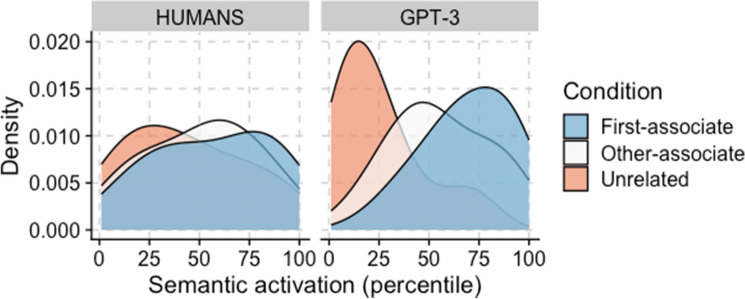
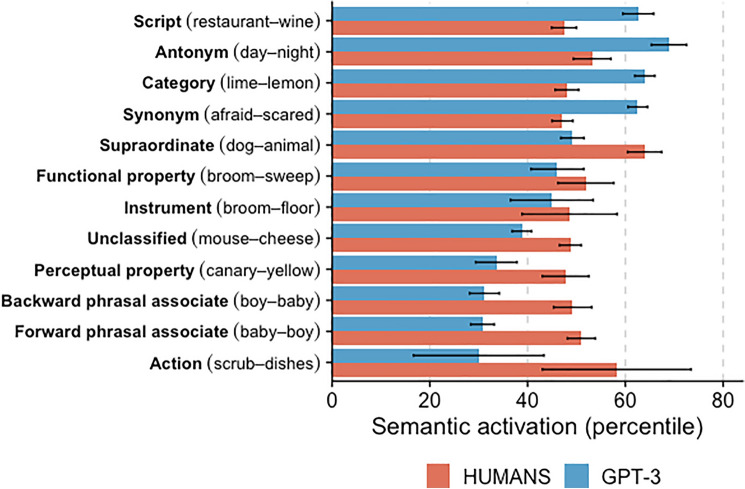
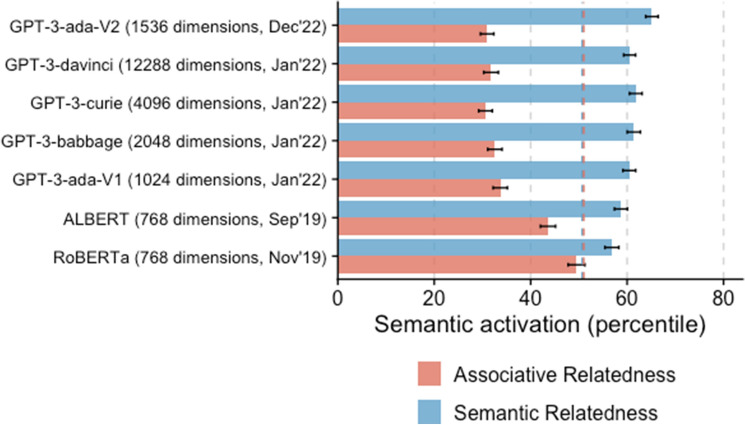
Verification
Claims the paper makes
The claims and statistics of this paper haven’t been checked yet.
Free: it reads the open-access text and checks the first 5 claims that cite a source we can check. Create a free account to check every claim.
Claims other papers make about this one
Each is checked against this paper’s own text: does it say what the citing paper says it does?
The source backs part of the claim, not all of it — or backs it for a different population, condition or comparison.
In the citing paper
“To effectively predict the next word in a sentence generated by a human, LLMs must model not only grammar and vocabulary but also the psychological processes humans use when generating language (35, 36).”
From Evaluating large language models in theory of mind tasks (2024) · cites this paper as [36]
Experimental — accuracy not yet measuredThe cited source says what the claim attributes to it.
In the citing paper
“LLMs trained to predict the next word in a sentence surprised their creators not only by their inclination to be racist and sexist (34) but also by their emergent reasoning and arithmetic skills (35), ability to translate between languages (22), and propensity to semantic priming (36).”
From Evaluating large language models in theory of mind tasks (2024) · cites this paper as [36]
The cited source says what the claim attributes to it.
In the citing paper
“For example, both humans and LLMs seem to organize information about words and their meanings in similar ways (36).”
From Evaluating large language models in theory of mind tasks (2024) · cites this paper as [36]
Self-check
Percentages, sums and reported differences re-computed from the paper’s own numbers.
The self-check needs the paper’s full text.
Citations
Cites
Statistical Power Analysis for the Behavioral Sciences
Muller, K. (1989) · Technometrics · doi:10.1080/00401706.1989.10488618 · Cited by 99,167
Language Models are Few-Shot Learners
Brown, T. B., Mann, B., Ryder, N., Subbiah, M., Kaplan, J., Dhariwal, P., Neelakantan, A., Shyam, P., Sastry, G., Askell, A., et al. (2020) · arXiv · doi:10.48550/arxiv.2005.14165 · Cited by 23,372
RoBERTa: A Robustly Optimized BERT Pretraining Approach
Liu, Y., Ott, M., Goyal, N., Du, J., Joshi, M., Chen, D., Levy, O., Lewis, M., Zettlemoyer, L., & Stoyanov, V. (2019) · arXiv · doi:10.48550/arxiv.1907.11692 · Cited by 16,515
A spreading-activation theory of semantic processing.
Collins, A. M., & Loftus, E. F. (1975) · Psychological Review · doi:10.1037/0033-295x.82.6.407 · Cited by 8,141
On the Dangers of Stochastic Parrots: Can Language Models Be Too Big? 🦜
Bender, E. M., Gebru, T., McMillan-Major, A., & Shmitchell, S. (2021) · Proceedings of the 2021 ACM Conference on Fairness, Accountability, and Transparency · doi:10.1145/3442188.3445922 · Cited by 6,988
ALBERT: A Lite BERT for Self-supervised Learning of Language Representations
Lan, Z., Chen, M., Goodman, S., Gimpel, K., Sharma, P., & Soricut, R. (2019) · arXiv · doi:10.48550/arxiv.1909.11942 · Cited by 4,308
Facilitation in recognizing pairs of words: Evidence of a dependence between retrieval operations.
Meyer, D. E., & Schvaneveldt, R. W. (1971) · Journal of Experimental Psychology · doi:10.1037/h0031564 · Cited by 2,949
The Structure of a Semantic Theory
Katz, J. J., & Fodor, J. A. (1963) · Language · doi:10.2307/411200 · Cited by 2,214
Producing high-dimensional semantic spaces from lexical co-occurrence
Lund, K., & Burgess, C. (1996) · Behavior Research Methods, Instruments, & Computers · doi:10.3758/bf03204766 · Cited by 1,811
Baroni, M., Dinu, G., & Kruszewski, G. (2014) · Proceedings of the 52nd Annual Meeting of the Association for Computational Linguistics (Volume 1: Long Papers) · doi:10.3115/v1/p14-1023 · Cited by 1,364
Research works printed but not linked: 1
- McNamara TP Healy AF Proctor RW Semantic memory and priming Experimental Psychology. Vol. 4 in I. B. Weiner (Editor-in-chief), Handbook of psychology 2013 2 Wiley 449 471
Cited by
Evaluating large language models in theory of mind tasks
Kosinski, M. (2024) · Proceedings of the National Academy of Sciences · doi:10.1073/pnas.2405460121 · Cited by 339
“To effectively predict the next word in a sentence generated by a human, LLMs must model not only grammar and vocabulary but also the psychological processes humans use when generating language ( 35 , 36 ).”
BackgroundDennstädt, F., Zink, J., Putora, P. M., Hastings, J., & Cihoric, N. (2024) · Systematic Reviews · doi:10.1186/s13643-024-02575-4 · Cited by 145
“At the same time, considerable problems with the usage of LLMs such as “hallucinations” of models [26], inherent biases [27, 28], and weak alignment with human evaluation [29] have been described.”
BackgroundEvaluating Large Language Models in Theory of Mind Tasks
Kosinski, M. (2023) · arXiv · doi:10.48550/arxiv.2302.02083 · Cited by 339
“To effectively predict the next word in a sentence generated by a human, LLMs must model not only grammar and vocabulary but also the psychological processes humans use when generating language ( 35 , 36 ).”
BackgroundLarge language models can infer psychological dispositions of social media users
Peters, H., & Matz, S. C. (2024) · PNAS Nexus · doi:10.1093/pnasnexus/pgae231 · Cited by 85
“On the one hand, our findings contribute to a growing body of research comparing the abilities of LLMs to those observed in humans [5, 7, 8].”
BackgroundResultAbstractive text summarization: State of the art, challenges, and improvements
Shakil, H., Farooq, A., & Kalita, J. K. (2024) · Neurocomputing · doi:10.1016/j.neucom.2024.128255 · Cited by 134
“Among these foundational models, Large Language Models (LLMs), for instance GPT, have demonstrated remarkable capabilities in capturing semantic nuances [151].”
GPT and CLT: The impact of ChatGPT's level of abstraction on consumer recommendations
Kirshner, S. N. (2024) · Journal of Retailing and Consumer Services · doi:10.1016/j.jretconser.2023.103580 · Cited by 51
Exploring Capabilities of Large Language Models such as ChatGPT in Radiation Oncology
Dennstädt, F., Hastings, J., Putora, P. M., Vu, E., Fischer, G. F., Süveg, K., Glatzer, M., Riggenbach, E., Hà, H.-L., & Cihoric, N. (2024) · Advances in Radiation Oncology · doi:10.1016/j.adro.2023.101400 · Cited by 48
“34,35 Despite some good results, ChatGPT failed to consistently provide correct and good answers for many of the questions in our study.”
ResultExperiential Narratives in Marketing: A Comparison of Generative AI and Human Content
Wen, Y., & Laporte, S. (2025) · Journal of Public Policy & Marketing · doi:10.1177/07439156241297973 · Cited by 81
“Recent research in computer science has tested the cognitive (Zhuang et al. 2023), emotional (Tak and Gratch 2023), and linguistic abilities (Digutsch and Kosinski 2023) of large language models (LLMs).”
Chen, H., & Ding, N. (2023) · Findings of the Association for Computational Linguistics: EMNLP 2023 · doi:10.18653/v1/2023.findings-emnlp.858 · Cited by 40
Large language models know how the personality of public figures is perceived by the general public
Cao, X., & Kosiński, M. (2024) · Scientific Reports · doi:10.1038/s41598-024-57271-z · Cited by 57
“Second, the research expands our understanding of word embeddings, which bear some similarity to human semantic memory 31 .”
BackgroundThe Rise of GPT-3: Implications for Natural Language Processing and Beyond
Imamguluyev, R. (2023) · International Journal of Research Publication and Reviews · doi:10.55248/gengpi.2023.4.33987 · Cited by 49
Meaning in Hyperspace: Word Embeddings as Tools for Cultural Measurement
Boutyline, A., & Arseniev‐Koehler, A. (2025) · Annual Review of Sociology · doi:10.1146/annurev-soc-090324-024027 · Cited by 36
Integration of cognitive tasks into artificial general intelligence test for large models
Qu, Y., Wei, C., Du, P., Che, W., Zhang, C., Ouyang, W., Bian, Y., Xu, F., Hu, B., Du, K., et al. (2024) · iScience · doi:10.1016/j.isci.2024.109550 · Cited by 25
Adaptive Cancer Therapy in the Age of Generative Artificial Intelligence
Derbal, Y. M. (2024) · Cancer Control: Journal of the Moffitt Cancer Cente · doi:10.1177/10732748241264704 · Cited by 16
“108 Repurposing LLMs to predict treatment response raises the question about the space being constructed by OncoGPT when trained using cancer treatment data.”
MethodThe fluency-based semantic network of LLMs differs from humans
Wang, Y., Deng, Y., Wang, G., Li, T., Xiao, H., & Zhang, Y. (2024) · Computers in Human Behavior Artificial Humans · doi:10.1016/j.chbah.2024.100103 · Cited by 34
Machine vs. human, who makes a better judgment on innovation? Take GPT-4 for example
Du, M. (2023) · Frontiers Artif. Intell. · doi:10.3389/frai.2023.1206516 · Cited by 6
“There are some studies using GPT to examine the human mind, including semantic association (Digutsch and Kosinski, 2023), Theory of Mind (Kosinski, 2023), personality (Cao and Kosinski, 2023), decision making (Hagendorff et al., 2022), and even stock market (Lopez-Lira and Tang, 2023).”
Osorio, S., Straube, B., Meyer, L., & He, Y. (2023) · Language Cognition and Neuroscience · doi:10.1080/23273798.2023.2295499 · Cited by 14
“While it was informative, subsequent large language models may outperform GPT-2 due to their expanded training datasets and re fi ned architectures, and may provide better fi t to the EEG data (Digutsch & Kosinski, 2023; Mahowald et al., 2023; Michaelov et al., 2023).”
MethodLarge language models and humans converge in judging public figures’ personalities
Cao, X., & Kosiński, M. (2024) · PNAS Nexus · doi:10.1093/pnasnexus/pgae418 · Cited by 7
“For instance, the semantic spaces that LLMs use to encode information about word meanings and relationships have been found to resemble human semantic memory, grouping words by meaning rather than by superficial features like co-occurrence, spelling, or phonetics ( 1).”
BackgroundBoosting LLMS with Ontology-Aware Prompt for Ner Data Augmentation
Luo, Z., Wang, Y., Ke, W., Qi, R., Guo, Y., & Wang, P. (2024) · IEEE International Conference on Acoustics Speech and Signal Processing · doi:10.1109/icassp48485.2024.10446860 · Cited by 8
“The hierarchical information conveyed in ontology devotes to generalizing the corresponding labels of the input x i , which could explicitly feed into LLMs to reduce the entity-boundary deviation of generated sentences [18].”
BackgroundSocial Perception of Faces in a Vision-Language Model
Hausladen, C. I., Knott, M., Camerer, C. F., & Perona, P. (2025) · ACM Conference on Fairness, Accountability, and Transparency (FAccT) · doi:10.1145/3715275.3732041 · Cited by 22
“They include similarities between word embeddings and human semantic memory [55], including group stereotypes [56–59].”
Auditing the Shadows: A Review of Methods to Detect Shared Training Data in Large Language Models
Naser, M. Z. (2025) · ACM Computing Surveys · doi:10.1145/3774897 · Cited by 9
“Then, subsequent literature extended beyond simple likelihood-based membership inference to incorporate lexical and semantic overlap metrics [ 46 ].”
Towards a psychology of machines: large language models predict human memory
Ulakçı, E., Göbel, J. P., & Huff, M. (2025) · PeerJ Computer Science · doi:10.7717/peerj-cs.3324 · Cited by 13
Semantic Search of Educational Texts
Choudhary, S., Jaiswal, H. K., Rajeevan, A. S., Mukherjee, P. D., & Hudnurkar, S. (2024) · International Conference on Intelligent Systems and Advanced Applications (ICISAA) · doi:10.1109/icisaa62385.2024.10828786 · Cited by 3
Are transformers truly foundational for robotics?
Marshall, J. A. R., & Barron, A. (2024) · npj Robotics · doi:10.1038/s44182-025-00025-4 · Cited by 9
“…show interesting corollaries with function of nat-ural brains 56 , transformers do appear to capture some interesting fundamental aspects of language and visual recapitulation 57 (but see 58 and 59 ), and hence may form a component of a fully autonomous system grounded on fi rmer foundations.”
Romero, P., Fitz, S., & Nakatsuma, T. (2023) · Research Square · doi:10.21203/rs.3.rs-2717108/v1 · Cited by 17
“In summary, prior work shows that LLM display emergent properties in terms of abilities [4] [2] [3] [5] [6] and psychological latent traits [7] [13] [16] [18] [19].”
BackgroundMethodInfluentialDebelak, R., Koch, T. K., Aßenmacher, M., & Stachl, C. (2024) · PsyArXiv (OSF Preprints) · doi:10.31234/osf.io/bc56a · Cited by 4
Golikov, A. A., Akimov, D. A., Romanovskii, M., & Trashchenkov, S. (2023) · Litera · doi:10.25136/2409-8698.2023.12.69353 · Cited by 5
Generative Künstliche Intelligenz: Mögliche Auswirkungen auf die psychologische Forschung
Buder, J., Lindner, M. A., Oestermeier, U., Huff, M., Gerjets, P. H., Utz, S., & Creß, U. (2024) · Psychologische Rundschau · doi:10.1026/0033-3042/a000699 · Cited by 4
Are Your Requests Your True Needs? Checking Excessive Data Collection in VPA App
Xie, F., Yan, C., Meng, M. H., Teng, S., Zhang, Y., & Bai, G. (2024) · ACM/IEEE International Conference on Software Engineering: Companion Proceedings (ICSE-Companion) · doi:10.1145/3597503.3639107 · Cited by 9
Osorio, S., Straube, B., Meyer, L., & He, Y. (2022) · doi:10.31234/osf.io/xj76u · Cited by 1
What do Large Language Models ‘think’ determines occupational prestige?Preprint
de Vries, R., Hill, M. J., & Ruis, L. (2024) · SocArXiv (OSF Preprints) · doi:10.31235/osf.io/57tzm · Cited by 4
How Multimodal can Predict Human JudgmentPreprint
Du, M. (2023) · PsyArXiv (OSF Preprints) · doi:10.31234/osf.io/ejrvk
MF-SET: A Multitask Learning Framework for Student Evaluation of Teaching
Butt, S., Mejía-Almada, P. G., Alvarado-Uribe, J., Ceballos, H. G., Sidorov, G., & Gelbukh, A. F. (2023) · Lecture notes in networks and systems · doi:10.1007/978-3-031-47454-5_20
Relasi Simbolik pada Mural di Surakarta tentang Kampanye 3 Capres-Cawapres
Fadilah, A. S. N., Markhamah, M., & Sabardila, A. (2025) · Jurnal Onoma Pendidikan Bahasa dan Sastra · doi:10.30605/onoma.v11i1.4592
“…interaksi antara pengguna dengan makna (Boleda, 2020; Markhamah & Sabardila, 2014; Soleh, Sabardila, & Markhamah, 2023), tentang kata dan maknanya (Digutsch & Kosinski, 2023), dan hubungan sebab akibat untuk menciptakan kalimat yang logis (Setiawaty, Sulistyorini, Sabardila, & Markhamah, 2019).”
Enigma Visual: uma abordagem de classificação gamificada de texto
Azeredo, C. S., Farias, K. D. S., de Barros, L. P., Parreiras, M., & Xexeo, G. B. (2025) · Simpósio Brasileiro de Jogos e Entretenimento Digital (SBGames) · doi:10.5753/sbgames_estendido.2025.10362
“Estudos recentes sobre processamento linguístico mostram que modelos neurais alcançam desempenhos próximos aos humanos [Eysenck e Eysenck 2023], embora organizem conhecimento mais por similaridade semântica que por co-ocorrência de palavras [Digutsch e Kosinski 2023].”
Dennstädt, F., Zink, J., Putora, P. M., Hastings, J., & Cihoric, N. (2024) · Figshare · doi:10.6084/m9.figshare.26045554
Dennstädt, F., Zink, J., Putora, P. M., Hastings, J., & Cihoric, N. (2024) · Figshare · doi:10.6084/m9.figshare.26734479
Dennstädt, F., Zink, J., Putora, P. M., Hastings, J., & Cihoric, N. (2024) · Figshare · doi:10.6084/m9.figshare.26045481
Dennstädt, F., Zink, J., Putora, P. M., Hastings, J., & Cihoric, N. (2024) · Figshare · doi:10.6084/m9.figshare.26734476
Arora, V., Sutoski, A., Boilard, J., Leone, E., Zizzo, H., Wang, B., Calic, G., Parpia, S., Bhandari, M., & Thabane, A. (2025) · AI & Society · doi:10.1007/s00146-025-02816-7 · Cited by 1
“Early outputs tend to favour high-probability, closely linked concepts, while later outputs draw on more remote associations (Digutsch and Kosinski 2023).”
GPT-5 Measures Personality and Creativity: Divergent Thinking and Negative EmotionPreprint
Du, M. (2026) · SSRN Electronic Journal · doi:10.2139/ssrn.6056559
Božić, S., & Đurđević, D. F. (2026) · Elsevier eBooks · doi:10.1016/b978-0-323-95504-1.01349-1
Structural priming in humans and large language models
Sinclair, A., Klimovich‐Gray, A., Jumelet, J., Adamian, N., & Konopka, A. E. (2026) · Journal of Memory and Language · doi:10.1016/j.jml.2025.104713 · Cited by 3
Does GPT-5 dream of (il)literate minds? A network analysis of semantic fluency
Cinar, G., Robinson, M. N., & Gedik, T. A. (2026) · Yearbook of the German Cognitive Linguistics Association · doi:10.1515/gcla-2025-0103
“They can approximate human-like similarity judgments, feature norms, and categorization behavior (Digutsch and Kosinski 2023; Hansen and Hebart 2022; Suresh et al. 2023).”
Exploring occupational prestige through large language models: A multi-dimensional approach
de Vries, R., Hill, M., & Ruis, L. (2026) · Research in Social Stratification and Mobility · doi:10.1016/j.rssm.2026.101185 · Cited by 2
Contreras, C. R., & Valette‐Florence, P. (2026) · Journal of Product & Brand Management · doi:10.1108/jpbm-02-2025-5785
Lexical organization in humans and large language models: Evidence from L1, L2 and LLM networks
Laserna, M. S.-S. (2026) · Language and Cognition · doi:10.1017/langcog.2026.10119
“…parallels with human data, including alignment with semantic similarity judgments and lexical decision behavior, although model-generated conceptual structures tend to be less coherent and less stable than those observed in humans (Digutsch & Kosinski, 2023; Suresh et al., 2023; Xiao et al., 2025).”
Metadata
- Authors
- Digutsch, J., & Kosinski, M.
- Affiliations
- TU Dortmund University (DE)
- Corresponding author
- Digutsch, Jan
- ORCID
- Digutsch, Jan
- Venue
- Scientific Reports
- Published
- 2023-03-28
- Volume
- 13
- Issue
- 1
- Pages
- 5035-5035
- ISSN
- 2045-2322 (ISSN-L)
- PMC
- PMC10050205
- OpenAlex
- W4361204756
- Semantic Scholar
- 06247dd68681762e0dc8798c1400892f4417ff0b
- Cited by
- 49
- References
- 31
- Citations by year
- 2026: 7 · 2025: 9 · 2024: 20 · 2023: 12
- FWCI
- 4.52
- Type
- journal article
- Language
- en
- Open access
- gold
- doi.org
- Licence
- cc-by
- creativecommons.org/licenses/by/4.0 (tdm)
- creativecommons.org/licenses/by/4.0 (vor)
- Locations
- Scientific Reports (publishedVersion, cc-by)
- PubMed Central (publishedVersion, cc-by)
- PubMed (publishedVersion)
- Alexandria (UniSG) (University of St.Gallen) (submittedVersion)
- DOAJ (DOAJ: Directory of Open Access Journals) (submittedVersion, cc-by-sa)
- Informationszentrum Lebenswissenschaften (ZB MED) (submittedVersion, cc-by)
- PsyArXiv (OSF Preprints) (submittedVersion, cc-by)
- PsyArXiv (OSF Preprints) (submittedVersion)
- OSF Preprints (OSF Preprints) (submittedVersion)
- OSF Preprints (OSF Preprints) (submittedVersion, cc-by)
- Topics
- Physical Sciences › Computer Science › Artificial Intelligence › Topic Modeling
- Life Sciences › Neuroscience › Cognitive Neuroscience › Neurobiology of Language and Bilingualism
- Physical Sciences › Computer Science › Artificial Intelligence › Natural Language Processing Techniques
- Keywords
- GPT-3, semantic activation, semantic similarity, lexical decision, semantic memory, large language models, word meaning, word co-occurrence, semantic networks, human-computer comparison
- MeSH terms
- Humans, Natural Language Processing, Semantics, Word Association Tests, Comprehension
About these checks
Registry, retraction, Cites and statistics results are computed, not judged, with one exception: a printed reference that no index lists is read once by a model before it counts as a citation error. Claims are extracted by a model and kept only when their quote appears verbatim in the text; each cited source is then checked, with a model’s help, for whether it says what the claim relies on. Those verdicts can be wrong — read the claim’s quote and the cited source before relying on one.
Statistics and arithmetic are recomputed, not judged.
Confidence bands are shown only for fields calibrated on our annotated test set. None is calibrated yet, so no band is shown.
What counts as a claim ›How we measure confidence ›How we check this ›
Are you an author, or do you see a problem with this page? Request a review
Data sources
Bibliographic data: Semantic Scholar, OpenAlex, Crossref.
Contains information from the Semantic Scholar Academic Graph Datasets, made available under the ODC Attribution License (ODC-BY 1.0).
Semantic Scholar’s data is described in: Kinney, R., et al. (2023). The Semantic Scholar Open Data Platform. arXiv:2301.10140.
