

Overlap in meaning is a stronger predictor of semantic activation in GPT-3 than in humans
Open accessPublished version of a preprint
The DOI matches its Crossref record; 34 of the 34 references it cites were found in a registry or an index.
Abstract
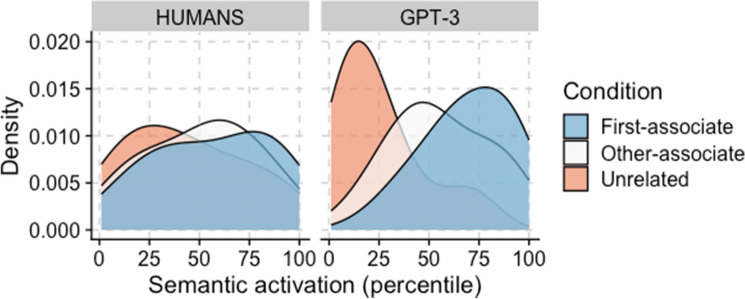
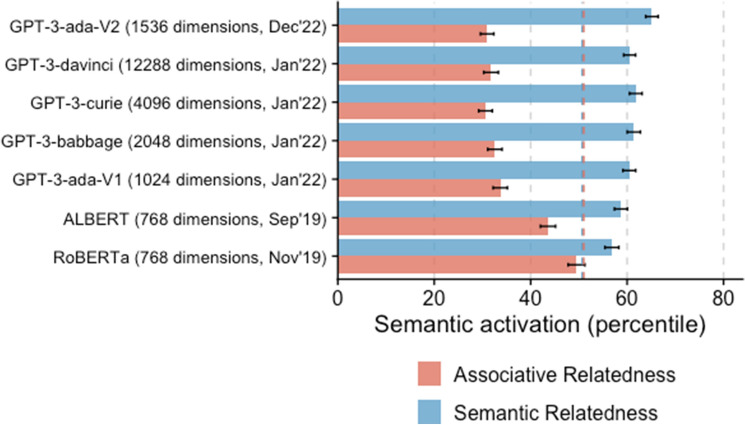
Modern large language models generate texts that are virtually indistinguishable from those written by humans and achieve near-human performance in comprehension and reasoning tests. Yet, their complexity makes it difficult to explain and predict their functioning. We examined a state-of-the-art language model (GPT-3) using lexical decision tasks widely used to study the structure of semantic memory in humans. The results of four analyses showed that GPT-3’s patterns of semantic activation are broadly similar to those observed in humans, showing significantly higher semantic activation in related (e.g., “lime–lemon”) word pairs than in other-related (e.g., “sour–lemon”) or unrelated (e.g., “tourist–lemon”) word pairs. However, there are also significant differences between GPT-3 and humans. GPT-3’s semantic activation is better predicted by similarity in words’ meaning (i.e., semantic similarity) rather than their co-occurrence in the language (i.e., associative similarity). This suggests that GPT-3’s semantic network is organized around word meaning rather than their co-occurrence in text.
Overview
The claims and statistics of this paper haven’t been checked yet.
Free: it reads the open-access text and checks the first 5 claims that cite a source we can check. Create a free account to check every claim.
Integrity signals
Registry
Cites
Statistics
Figures
Verification
Claims the paper makes
The claims and statistics of this paper haven’t been checked yet.
Free: it reads the open-access text and checks the first 5 claims that cite a source we can check. Create a free account to check every claim.
Claims other papers make about this one
Each is checked against this paper’s own text: does it say what the citing paper says it does?
The source backs part of the claim, not all of it — or backs it for a different population, condition or comparison.
In the citing paper
“To effectively predict the next word in a sentence generated by a human, LLMs must model not only grammar and vocabulary but also the psychological processes humans use when generating language (35, 36).”
From Evaluating large language models in theory of mind tasks (2024) · cites this paper as [36]
Experimental — accuracy not yet measuredThe cited source says what the claim attributes to it.
In the citing paper
“LLMs trained to predict the next word in a sentence surprised their creators not only by their inclination to be racist and sexist (34) but also by their emergent reasoning and arithmetic skills (35), ability to translate between languages (22), and propensity to semantic priming (36).”
From Evaluating large language models in theory of mind tasks (2024) · cites this paper as [36]
The cited source says what the claim attributes to it.
In the citing paper
“For example, both humans and LLMs seem to organize information about words and their meanings in similar ways (36).”
From Evaluating large language models in theory of mind tasks (2024) · cites this paper as [36]
Self-check
Percentages, sums and reported differences re-computed from the paper’s own numbers.
The self-check needs the paper’s full text.
Citations
Cites
Statistical Power Analysis for the Behavioral Sciences
Muller, K. (1989) · Technometrics · doi:10.1080/00401706.1989.10488618 · Cited by 99,167
Language Models are Few-Shot Learners
Brown, T. B., Mann, B., Ryder, N., Subbiah, M., Kaplan, J., Dhariwal, P., Neelakantan, A., Shyam, P., Sastry, G., Askell, A., et al. (2020) · arXiv · doi:10.48550/arxiv.2005.14165 · Cited by 23,372
RoBERTa: A Robustly Optimized BERT Pretraining Approach
Liu, Y., Ott, M., Goyal, N., Du, J., Joshi, M., Chen, D., Levy, O., Lewis, M., Zettlemoyer, L., & Stoyanov, V. (2019) · arXiv · doi:10.48550/arxiv.1907.11692 · Cited by 16,515
A spreading-activation theory of semantic processing.
Collins, A. M., & Loftus, E. F. (1975) · Psychological Review · doi:10.1037/0033-295x.82.6.407 · Cited by 8,141
On the Dangers of Stochastic Parrots: Can Language Models Be Too Big? 🦜
Bender, E. M., Gebru, T., McMillan-Major, A., & Shmitchell, S. (2021) · Proceedings of the 2021 ACM Conference on Fairness, Accountability, and Transparency · doi:10.1145/3442188.3445922 · Cited by 6,988
ALBERT: A Lite BERT for Self-supervised Learning of Language Representations
Lan, Z., Chen, M., Goodman, S., Gimpel, K., Sharma, P., & Soricut, R. (2019) · arXiv · doi:10.48550/arxiv.1909.11942 · Cited by 4,308
Facilitation in recognizing pairs of words: Evidence of a dependence between retrieval operations.
Meyer, D. E., & Schvaneveldt, R. W. (1971) · Journal of Experimental Psychology · doi:10.1037/h0031564 · Cited by 2,949
The Structure of a Semantic Theory
Katz, J. J., & Fodor, J. A. (1963) · Language · doi:10.2307/411200 · Cited by 2,214
Producing high-dimensional semantic spaces from lexical co-occurrence
Lund, K., & Burgess, C. (1996) · Behavior Research Methods, Instruments, & Computers · doi:10.3758/bf03204766 · Cited by 1,811
Baroni, M., Dinu, G., & Kruszewski, G. (2014) · Proceedings of the 52nd Annual Meeting of the Association for Computational Linguistics (Volume 1: Long Papers) · doi:10.3115/v1/p14-1023 · Cited by 1,364
CONVERGENCE, ADAPTATION, AND CONSTRAINT
Losos, J. B. (2011) · Evolution · doi:10.1111/j.1558-5646.2011.01289.x · Cited by 985
Holcomb, P. J., & Neville, H. J. (1990) · Language and Cognitive Processes · doi:10.1080/01690969008407065 · Cited by 654
Semantic context effects in visual word recognition: An analysis of semantic strategies
Becker, C. A. (1980) · Memory & Cognition · doi:10.3758/bf03213769 · Cited by 652
Using cognitive psychology to understand GPT-3
Binz, M., & Schulz, E. (2023) · Proceedings of the National Academy of Sciences · doi:10.1073/pnas.2218523120 · Cited by 559
Neely, J. H., Keefe, D. E., & Ross, K. L. (1989) · Journal of Experimental Psychology: Learning, Memory, and Cognition · doi:10.1037//0278-7393.15.6.1003 · Cited by 482
Is semantic priming due to association strength or feature overlap? A microanalytic review
Hutchison, K. A. (2003) · Psychonomic Bulletin & Review · doi:10.3758/bf03196544 · Cited by 477
Mandera, P., Keuleers, E., & Brysbaert, M. (2017) · Journal of Memory and Language · doi:10.1016/j.jml.2016.04.001 · Cited by 428
Semantic priming without association: A meta-analytic review
Lucas, M. (2000) · Psychonomic Bulletin & Review · doi:10.3758/bf03212999 · Cited by 408
Semantic memory: A review of methods, models, and current challenges
Kumar, A. A. (2021) · Psychonomic Bulletin & Review · doi:10.3758/s13423-020-01792-x · Cited by 314
High-dimensional semantic space accounts of priming
Jones, M. N., Kintsch, W., & Mewhort, D. J. K. (2006) · Journal of Memory and Language · doi:10.1016/j.jml.2006.07.003 · Cited by 214
The effects of associative and semantic priming in the lexical decision task
Perea, M., & Rosa, E. (2002) · Psychological Research · doi:10.1007/s00426-002-0086-5 · Cited by 213
Hutchison, K. A., Balota, D. A., Neely, J. H., Cortese, M. J., Cohen-Shikora, E. R., Tse, C.-S., Yap, M. J., Bengson, J. J., Niemeyer, D., & Buchanan, E. (2013) · Behavior Research Methods · doi:10.3758/s13428-012-0304-z · Cited by 178
Predicting Semantic Priming at the Item Level
Hutchison, K. A., Balota, D. A., Cortese, M. J., & Watson, J. M. (2008) · Quarterly Journal of Experimental Psychology · doi:10.1080/17470210701438111 · Cited by 176
Using Large Language Models to Simulate Multiple Humans and Replicate Human Subject Studies
Aher, G., Arriaga, R. I., & Kalai, A. T. (2022) · arXiv · doi:10.48550/arxiv.2208.10264 · Cited by 161
Word meaning in minds and machines.
Lake, B. M., & Murphy, G. L. (2023) · Psychological Review · doi:10.1037/rev0000297 · Cited by 131
Illusory Motion Reproduced by Deep Neural Networks Trained for Prediction
Watanabe, E., Kitaoka, A., Sakamoto, K., Yasugi, M., & Tanaka, K. (2018) · Frontiers in Psychology · doi:10.3389/fpsyg.2018.00345 · Cited by 101
Comparing Object Recognition in Humans and Deep Convolutional Neural Networks—An Eye Tracking Study
van Dyck, L. E., Kwitt, R., Denzler, S. J., & Gruber, W. R. (2021) · Frontiers in Neuroscience · doi:10.3389/fnins.2021.750639 · Cited by 82
Exploring BERT’s Sensitivity to Lexical Cues using Tests from Semantic Priming
Misra, K., Ettinger, A., & Rayz, J. (2020) · Findings of the Association for Computational Linguistics: EMNLP (Findings of EMNLP) · doi:10.18653/v1/2020.findings-emnlp.415 · Cited by 81
A comparative evaluation and analysis of three generations of Distributional Semantic Models
Lenci, A., Sahlgren, M., Jeuniaux, P., Cuba Gyllensten, A., & Miliani, M. (2022) · Language Resources and Evaluation · doi:10.1007/s10579-021-09575-z · Cited by 73
Using cognitive psychology to understand GPT-3Preprint
Binz, M., & Schulz, E. (2022) · doi:10.31234/osf.io/6dfgk · Cited by 62
How language-generation AIs could transform science
Noorden, R. V. (2022) · Nature · doi:10.1038/d41586-022-01191-3 · Cited by 28
Word2Box: Capturing Set-Theoretic Semantics of Words using Box Embeddings
Dasgupta, S. S., Boratko, M., Mishra, S., Atmakuri, S., Patel, D., Li, X., & McCallum, A. (2022) · Proceedings of the conference - Association for Computational Linguistics. Meeting · doi:10.18653/v1/2022.acl-long.161 · Cited by 25
Shared visual illusions between humans and artificial neural networks
Benjamin, A. S., Qiu, C., Zhang, L.-Q., Kording, K. P., & Stocker, A. A. (2019) · Conference on Cognitive Computational Neuroscience (CCN) · doi:10.32470/ccn.2019.1299-0 · Cited by 19
Zhang, L., Wang, L., Yang, J., Qian, P., Wang, X. J., Qiu, X., Zhang, Z., & Tian, X. (2019) · bioRxiv (Cold Spring Harbor Laboratory) · doi:10.1101/843896 · Cited by 2
Research works printed but not linked: 1
- McNamara TP Healy AF Proctor RW Semantic memory and priming Experimental Psychology. Vol. 4 in I. B. Weiner (Editor-in-chief), Handbook of psychology 2013 2 Wiley 449 471
Cited by
Evaluating large language models in theory of mind tasks
Kosinski, M. (2024) · Proceedings of the National Academy of Sciences · doi:10.1073/pnas.2405460121 · Cited by 339
“To effectively predict the next word in a sentence generated by a human, LLMs must model not only grammar and vocabulary but also the psychological processes humans use when generating language ( 35 , 36 ).”
BackgroundDennstädt, F., Zink, J., Putora, P. M., Hastings, J., & Cihoric, N. (2024) · Systematic Reviews · doi:10.1186/s13643-024-02575-4 · Cited by 145
“At the same time, considerable problems with the usage of LLMs such as “hallucinations” of models [26], inherent biases [27, 28], and weak alignment with human evaluation [29] have been described.”
BackgroundEvaluating Large Language Models in Theory of Mind Tasks
Kosinski, M. (2023) · arXiv · doi:10.48550/arxiv.2302.02083 · Cited by 339
“To effectively predict the next word in a sentence generated by a human, LLMs must model not only grammar and vocabulary but also the psychological processes humans use when generating language ( 35 , 36 ).”
BackgroundLarge language models can infer psychological dispositions of social media users
Peters, H., & Matz, S. C. (2024) · PNAS Nexus · doi:10.1093/pnasnexus/pgae231 · Cited by 85
“On the one hand, our findings contribute to a growing body of research comparing the abilities of LLMs to those observed in humans [5, 7, 8].”
BackgroundResultAbstractive text summarization: State of the art, challenges, and improvements
Shakil, H., Farooq, A., & Kalita, J. K. (2024) · Neurocomputing · doi:10.1016/j.neucom.2024.128255 · Cited by 134
“Among these foundational models, Large Language Models (LLMs), for instance GPT, have demonstrated remarkable capabilities in capturing semantic nuances [151].”
Metadata
- Authors
- Digutsch, J., & Kosinski, M.
- Affiliations
- TU Dortmund University (DE)
- Corresponding author
- Digutsch, Jan
- ORCID
- Digutsch, Jan
- Venue
- Scientific Reports
- Published
- 2023-03-28
- Volume
- 13
- Issue
- 1
- Pages
- 5035-5035
- ISSN
- 2045-2322 (ISSN-L)
- PMC
- PMC10050205
- OpenAlex
- W4361204756
- Cited by
- 49
- References
- 31
- Citations by year
- 2026: 7 · 2025: 9 · 2024: 20 · 2023: 12
- FWCI
- 4.52
- Type
- journal article
- Language
- en
- Open access
- gold
- doi.org
- Licence
- cc-by
- creativecommons.org/licenses/by/4.0 (tdm)
- creativecommons.org/licenses/by/4.0 (vor)
- Locations
- Scientific Reports (publishedVersion, cc-by)
- PubMed Central (publishedVersion, cc-by)
- PubMed (publishedVersion)
- Alexandria (UniSG) (University of St.Gallen) (submittedVersion)
- DOAJ (DOAJ: Directory of Open Access Journals) (submittedVersion, cc-by-sa)
- Informationszentrum Lebenswissenschaften (ZB MED) (submittedVersion, cc-by)
- PsyArXiv (OSF Preprints) (submittedVersion, cc-by)
- PsyArXiv (OSF Preprints) (submittedVersion)
- OSF Preprints (OSF Preprints) (submittedVersion)
- OSF Preprints (OSF Preprints) (submittedVersion, cc-by)
- Topics
- Physical Sciences › Computer Science › Artificial Intelligence › Topic Modeling
- Life Sciences › Neuroscience › Cognitive Neuroscience › Neurobiology of Language and Bilingualism
- Physical Sciences › Computer Science › Artificial Intelligence › Natural Language Processing Techniques
- Keywords
- GPT-3, semantic activation, semantic similarity, lexical decision, semantic memory, large language models, word meaning, word co-occurrence, semantic networks, human-computer comparison
- MeSH terms
- Humans, Natural Language Processing, Semantics, Word Association Tests, Comprehension
About these checks
Registry, retraction, Cites and statistics results are computed, not judged, with one exception: a printed reference that no index lists is read once by a model before it counts as a citation error. Claims are extracted by a model and kept only when their quote appears verbatim in the text; each cited source is then checked, with a model’s help, for whether it says what the claim relies on. Those verdicts can be wrong — read the claim’s quote and the cited source before relying on one.
Statistics and arithmetic are recomputed, not judged.
Confidence bands are shown only for fields calibrated on our annotated test set. None is calibrated yet, so no band is shown.
What counts as a claim ›How we measure confidence ›How we check this ›
Are you an author, or do you see a problem with this page? Request a review
Data sources
Bibliographic data: Semantic Scholar, OpenAlex, Crossref.
Contains information from the Semantic Scholar Academic Graph Datasets, made available under the ODC Attribution License (ODC-BY 1.0).
Semantic Scholar’s data is described in: Kinney, R., et al. (2023). The Semantic Scholar Open Data Platform. arXiv:2301.10140.
