

Machine learning predictive model for aspiration screening in hospitalized patients with acute stroke
Open accessThe DOI matches its Crossref record; 76 of the 76 references it cites were found in a registry or an index.
Abstract
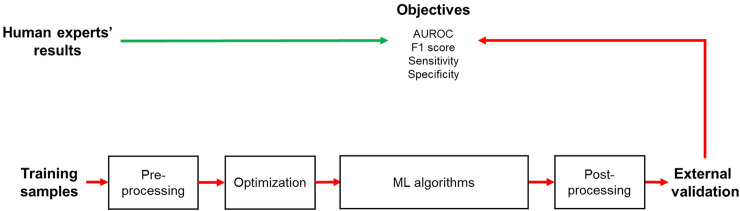
Dysphagia is a fatal condition after acute stroke. We established machine learning (ML) models for screening aspiration in patients with acute stroke. This retrospective study enrolled patients with acute stroke admitted to a cerebrovascular specialty hospital between January 2016 and June 2022. A videofluoroscopic swallowing study (VFSS) confirmed aspiration. We evaluated the Gugging Swallowing Screen (GUSS), an early assessment tool for dysphagia, in all patients and compared its predictive value with ML models. Following ML algorithms were applied: regularized logistic regressions (ridge, lasso, and elastic net), random forest, extreme gradient boosting, support vector machines,k-nearest neighbors, and naïve Bayes. We finally analyzed data from 3408 patients, and 448 of them had aspiration on VFSS. The GUSS showed an area under the receiver operating characteristics curve (AUROC) of 0.79 (0.77–0.81). The ridge regression model was the best model among all ML models, with an AUROC of 0.81 (0.76–0.86), an F1 measure of 0.45. Regularized logistic regression models exhibited higher sensitivity (0.66–0.72) than the GUSS (0.64). Feature importance analyses revealed that the modified Rankin scale was the most important feature of ML performance. The proposed ML prediction models are valid and practical for screening aspiration in patients with acute stroke.
Overview
The claims and statistics of this paper haven’t been checked yet.
Free: it reads the open-access text and checks the first 5 claims that cite a source we can check. Create a free account to check every claim.
Integrity signals
Registry
Cites
Statistics
Figures


Verification
Claims the paper makes
The claims and statistics of this paper haven’t been checked yet.
Free: it reads the open-access text and checks the first 5 claims that cite a source we can check. Create a free account to check every claim.
Claims other papers make about this one
Each is checked against this paper’s own text: does it say what the citing paper says it does?
The source backs part of the claim, not all of it — or backs it for a different population, condition or comparison.
In the citing paper
“Videofluoroscopy of swallowing was used as the reference examination in most studies.”
From Artificial intelligence in the diagnosis and management of dysphagia: a scoping review (2025) · cites this paper as [16]
Experimental — accuracy not yet measuredThe source backs part of the claim, not all of it — or backs it for a different population, condition or comparison.
In the citing paper
“Studies on AI in dysphagia primarily rely on imaging resources such as VFSS for comparative analysis due to its high reliability(16,23-28).”
From Artificial intelligence in the diagnosis and management of dysphagia: a scoping review (2025) · cites this paper as [16]
Experimental — accuracy not yet measuredThe cited source says what the claim attributes to it.
In the citing paper
“with stroke being the most cited in 12 studies(16,18,21,22,27,32,36,40,46,48-51)”
From Artificial intelligence in the diagnosis and management of dysphagia: a scoping review (2025) · cites this paper as [16]
The cited source says what the claim attributes to it.
In the citing paper
“In research, the most addressed pathologies in adults were predominantly related to the neurological area, with stroke being highlighted in several studies(16,21,22,24,27,36,40,46,48-51).”
From Artificial intelligence in the diagnosis and management of dysphagia: a scoping review (2025) · cites this paper as [16]
Self-check
Percentages, sums and reported differences re-computed from the paper’s own numbers.
The self-check needs the paper’s full text.
Citations
Cites
XGBoost: A Scalable Tree Boosting System
Chen, T., & Guestrin, C. (2016) · Proceedings of the 22nd ACM SIGKDD International Conference on Knowledge Discovery and Data Mining · doi:10.1145/2939672.2939785 · Cited by 54,569
Rosuvastatin to Prevent Vascular Events in Men and Women with Elevated C-Reactive Protein
Ridker, P. M., Danielson, E., Fonseca, F. A. H., Genest, J., Gotto, A. M., Kastelein, J. J. P., Koenig, W., Libby, P., Lorenzatti, A. J., MacFadyen, J. G., et al. (2008) · New England Journal of Medicine · doi:10.1056/nejmoa0807646 · Cited by 6,674 · cited 1×
“In a previous study, Scheitz et al. 69 reported that statin users’ risk of post-stroke pneumonia was reduced; the results of this study supported their findings, which might be related to the intravascular anti-inflammatory effect of statin 70 .”
What is a support vector machine?
Noble, W. S. (2006) · Nature Biotechnology · doi:10.1038/nbt1206-1565 · Cited by 4,301
A penetration-aspiration scale
Rosenbek, J. C., Robbins, J. A., Roecker, E. B., Coyle, J. L., & Wood, J. L. (1996) · Dysphagia · doi:10.1007/bf00417897 · Cited by 2,803 · cited 1×
“We defined aspiration, the target outcome of this study, as the detection of one or more swallowing with a Penetration-Aspiration scale score of 6–8 on the VFSS during hospitalization 39 .”
Dysphagia After Stroke: Incidence, Diagnosis, and Pulmonary Complications
Martino, R., Foley, N., Bhogal, S., Diamant, N., Speechley, M., & Teasell, R. (2005) · Stroke · doi:10.1161/01.str.0000190056.76543.eb · Cited by 1,973
Dong, X., Yu, Z., Cao, W., Shi, Y., & Ma, Q. (2020) · Frontiers of Computer Science · doi:10.1007/s11704-019-8208-z · Cited by 1,928 · cited 1×
“This method helps more accurate prediction by combining several weaker models instead of one robust model, and bagging and boosting types are the most representative 47,48 .”
Validity and Reliability of the Eating Assessment Tool (EAT-10)
Belafsky, P. C., Mouadeb, D. A., Rees, C. J., Pryor, J. C., Postma, G. N., Allen, J., & Leonard, R. J. (2008) · Annals of Otology, Rhinology & Laryngology · doi:10.1177/000348940811701210 · Cited by 1,751 · cited 1×
“In particular, questionnaires such as the dysphagia handicap index and eating assessment tool-10 are relatively more restricted by the limitations mentioned above, although they have the advantage of being non-invasive, unlike the GUSS 16,17 .”
Stroke-Associated Pneumonia: Major Advances and Obstacles
Hannawi, Y., Hannawi, B., Rao, C. P. V., Suarez, J. I., & Bershad, E. M. (2013) · Cerebrovascular Diseases · doi:10.1159/000350199 · Cited by 1,656
Introduction to machine learning: k-nearest neighbors
Zhang, Z. (2016) · Annals of Translational Medicine · doi:10.21037/atm.2016.03.37 · Cited by 1,294 · cited 1×
“KNN works by finding the nearest neighbors based on the distance between data points and predicting the label of new data by referring to the labels of those neighbors 58 .”
Machine learning in medicine: a practical introduction
Sidey-Gibbons, J. A. M., & Sidey-Gibbons, C. J. (2019) · BMC Medical Research Methodology · doi:10.1186/s12874-019-0681-4 · Cited by 1,271
Cited by
Lai, D. K.-H., Cheng, E. S.-W., Lim, H.-J., So, B. P.-H., Lam, W., Cheung, D. S. K., Wong, D. W., & Cheung, J. C. (2023) · Frontiers in Bioengineering and Biotechnology · doi:10.3389/fbioe.2023.1205009 · Cited by 22
Artificial intelligence in the diagnosis and management of dysphagia: a scoping review
Silva, R. D. D., Almeida, S. B., Gonçalves, F. M., Zeigelboim, B. S., Stechman-Neto, J., Schroder, A. G. D., Nascimento, W. V., Santos, R. S., & Araujo, C. M. D. (2025) · CoDAS · doi:10.1590/2317-1782/e20240305en · Cited by 6
“Videofluoroscopy swallowing study (VFSS) was utilized in studies (16,23-28) , with four of them concurrently using high-resolution manometry (27,29-31) , only two studies (32,33) used fiberoptic endoscopic evaluation of swallowing (FEES), and 2 studies reported electromyography use (3,17) .”
InfluentialDigital health technologies in swallowing care from screening to rehabilitation: A narrative review
Alter, I. L., Dias, C. G., Briano, J. A., & Rameau, A. (2025) · Auris Nasus Larynx · doi:10.1016/j.anl.2025.05.002 · Cited by 6
Predicting Long-Term Prognosis of Poststroke Dysphagia with Machine Learning
Seo, M., Lee, C., Nam, K., Kwon, B. S., Kim, B. H., & Park, J. (2025) · Journal of Clinical Medicine · doi:10.3390/jcm14145025 · Cited by 5
“Furthermore, Park et al. [17] developed an aspiration screening tool using machine learning algorithms trained on large-scale hospital datasets.”
InfluentialMachine learning for dysphagia risk prediction in older adults after acute ischemic stroke
Zhang, J., & Zhao, C. (2026) · BMC Medical Informatics and Decision Making · doi:10.1186/s12911-026-03365-9 · Cited by 4
“ML algorithms have demonstrated enhanced predictive accuracy for diverse stroke-related outcomes, including dysphagia severity and aspiration risk stratification [16, 17].”
Metadata
- Authors
- Park, D., Son, S. I., Kim, M. S., Kim, T. Y., Choi, J. H., Lee, S.-E., Hong, D., & Kim, M.-C.
- Affiliations
- Pohang University of Science and Technology (KR)
- Pohang Medical Center (KR)
- Corresponding author
- Park, Dougho
- Venue
- Scientific Reports
- Published
- 2023-05-15
- Volume
- 13
- Issue
- 1
- Pages
- 7835-7835
- ISSN
- 2045-2322 (ISSN-L)
- PMC
- PMC10185509
- OpenAlex
- W4376642969
- Cited by
- 17
- References
- 76
- Citations by year
- 2026: 9 · 2025: 5 · 2024: 2 · 2023: 1
- FWCI
- 6.23
- Type
- journal article
- Language
- en
- Open access
- gold
- doi.org
- Licence
- cc-by
- creativecommons.org/licenses/by/4.0 (tdm)
- creativecommons.org/licenses/by/4.0 (vor)
- Locations
- Scientific Reports (publishedVersion, cc-by)
- PubMed Central (publishedVersion, cc-by)
- PubMed (publishedVersion)
- DOAJ (DOAJ: Directory of Open Access Journals) (submittedVersion, cc-by-sa)
- Topics
- Health Sciences › Health Professions › Speech and Hearing › Dysphagia Assessment and Management
- Health Sciences › Health Professions › Health Information Management › Artificial Intelligence in Healthcare
- Physical Sciences › Computer Science › Artificial Intelligence › Machine Learning in Healthcare
- Keywords
- acute stroke, dysphagia, machine learning prediction models, Gugging Swallowing Screen, videofluoroscopic swallowing study, hospitalized patients, modified Rankin Scale, feature importance, ridge regression, random forest, extreme gradient boosting
- MeSH terms
- Machine Learning, Bayes Theorem, Deglutition Disorders, Humans, Retrospective Studies, Stroke
About these checks
Registry, retraction, Cites and statistics results are computed, not judged, with one exception: a printed reference that no index lists is read once by a model before it counts as a citation error. Claims are extracted by a model and kept only when their quote appears verbatim in the text; each cited source is then checked, with a model’s help, for whether it says what the claim relies on. Those verdicts can be wrong — read the claim’s quote and the cited source before relying on one.
Statistics and arithmetic are recomputed, not judged.
Confidence bands are shown only for fields calibrated on our annotated test set. None is calibrated yet, so no band is shown.
What counts as a claim ›How we measure confidence ›How we check this ›
Are you an author, or do you see a problem with this page? Request a review
How to cite
Cite CoChat for the checks on this page, and the paper for its own findings.
- This page
- CoChat. (2026). Citation check: Machine learning predictive model for aspiration screening in hospitalized patients with acute stroke. https://app.cochat.ai/papers/10.1038/s41598-023-34999-8
- The paper
- Park, D., Son, S. I., Kim, M. S., Kim, T. Y., Choi, J. H., Lee, S.-E., Hong, D., & Kim, M.-C. (2023). Machine learning predictive model for aspiration screening in hospitalized patients with acute stroke. Scientific Reports. https://doi.org/10.1038/s41598-023-34999-8
Data sources
Bibliographic data: Semantic Scholar, OpenAlex, Crossref.
Contains information from the Semantic Scholar Academic Graph Datasets, made available under the ODC Attribution License (ODC-BY 1.0).
Semantic Scholar’s data is described in: Kinney, R., et al. (2023). The Semantic Scholar Open Data Platform. arXiv:2301.10140.
