

3-Hydroxy coumarin demonstrates anti-biofilm and anti-hyphal efficacy against Candida albicans via inhibition of cell-adhesion, morphogenesis, and virulent genes regulation
Open accessThe DOI matches its Crossref record; 74 of the 74 references it cites were found in a registry or an index.
Abstract
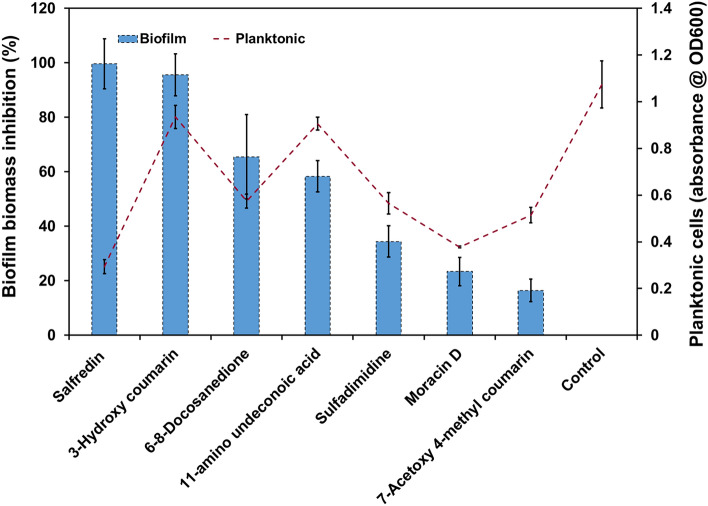
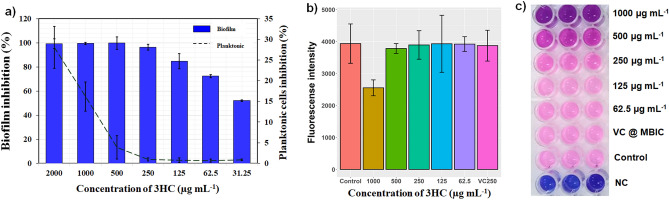
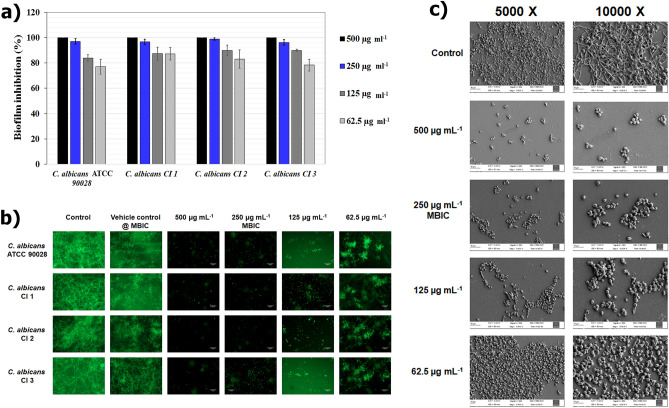
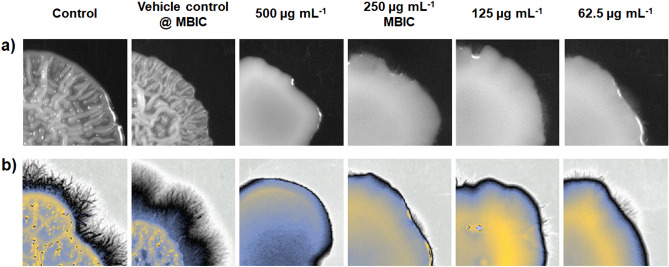
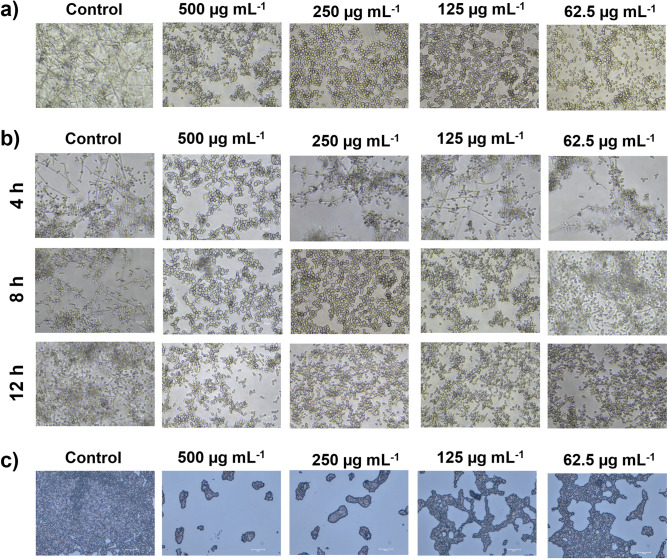
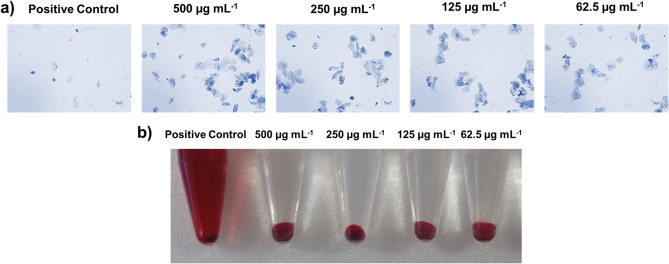
Candida albicans, a common fungus of human flora, can become an opportunistic pathogen and causes invasive candidiasis in immunocompromised individuals. Biofilm formation is the prime cause of antibiotic resistance during C. albicans infections and treating biofilm-forming cells is challenging due to their intractable and persistent nature. The study intends to explore the therapeutic potential of naturally produced compounds by competitive marine bacteria residing in marine biofilms against C. albicans biofilm. To this end, 3-hydroxy coumarin (3HC), a compound identified from the cell-free culture supernatant of the marine bacterium Brevundimonas abyssalis, was found to exhibit anti-biofilm and anti-hyphal activity against both reference and clinical isolates of C. albicans. The compound demonstrated significant inhibitory effects on biofilms and impaired the yeast-to-hyphal transition, wrinkle, and filament morphology at the minimal biofilm inhibitory concentration (MBIC) of 250 µg mL−1. Intriguingly, quantitative PCR analysis of 3HC-treated C. albicans biofilm revealed significant downregulation of virulence genes (hst7, ume6, efg1, cph1, ras1, als1) associated with adhesion and morphogenesis. Moreover, 3HC displayed non-fungicidal and non-toxic characteristics against human erythrocytes and buccal cells. In conclusion, this study showed that marine biofilms are a hidden source of diverse therapeutic drugs, and 3HC could be a potent drug to treat C. albicans infections.
Overview
The claims and statistics of this paper haven’t been checked yet.
Free: it reads the open-access text and checks the first 5 claims that cite a source we can check. Create a free account to check every claim.
Integrity signals
Registry
Cites
Statistics
Figures
Verification
Claims the paper makes
The claims and statistics of this paper haven’t been checked yet.
Free: it reads the open-access text and checks the first 5 claims that cite a source we can check. Create a free account to check every claim.
Self-check
Percentages, sums and reported differences re-computed from the paper’s own numbers.
The self-check needs the paper’s full text.
Citations
Cites
Basic local alignment search tool
Altschul, S. F., Gish, W., Miller, W., Myers, E. W., & Lipman, D. J. (1990) · Journal of Molecular Biology · doi:10.1006/jmbi.1990.9999 · Cited by 98,669
MEGA6: Molecular Evolutionary Genetics Analysis Version 6.0
Tamura, K., Stecher, G., Peterson, D., Filipski, A., & Kumar, S. (2013) · Molecular Biology and Evolution · doi:10.1093/molbev/mst197 · Cited by 47,205
A new mathematical model for relative quantification in real-time RT-PCR
Pfaffl, M. W. (2001) · Nucleic Acids Research · doi:10.1093/nar/29.9.e45 · Cited by 34,610
MEGA11: Molecular Evolutionary Genetics Analysis Version 11
Tamura, K., Stecher, G., & Kumar, S. (2021) · Molecular Biology and Evolution · doi:10.1093/molbev/msab120 · Cited by 22,403
Hidden Killers: Human Fungal Infections
Brown, G. D., Denning, D. W., Gow, N. A. R., Levitz, S. M., Netea, M. G., & White, T. C. (2012) · Science Translational Medicine · doi:10.1126/scitranslmed.3004404 · Cited by 4,284
Candida albicans pathogenicity mechanisms
Mayer, F. L., Wilson, D., & Hube, B. (2013) · Virulence · doi:10.4161/viru.22913 · Cited by 1,848
Pappas, P. G., Lionakis, M. S., Arendrup, M. C., Ostrosky-Zeichner, L., & Kullberg, B. J. (2018) · Nature Reviews Disease Primers · doi:10.1038/nrdp.2018.26 · Cited by 1,636 · cited 1×
“Studies have recorded nearly 50,000 deaths annually due to invasive candidiasis, with C. albicans being the most reported species, accounting for 40–50% of the cases 3,4 .”
Comparison of multiple methods for quantification of microbial biofilms grown in microtiter plates
Peeters, E., Nelis, H. J., & Coenye, T. (2008) · Journal of Microbiological Methods · doi:10.1016/j.mimet.2007.11.010 · Cited by 1,143
Natural and Synthetic Coumarin Derivatives with Anti-Inflammatory / Antioxidant Activities
Fylaktakidou, K., Hadjipavlou-Litina, D., Litinas, K., & Nicolaides, D. (2004) · Current Pharmaceutical Design · doi:10.2174/1381612043382710 · Cited by 970
Saville, S. P., Lazzell, A. L., Monteagudo, C., & Lopez-Ribot, J. L. (2003) · Eukaryotic Cell · doi:10.1128/ec.2.5.1053-1060.2003 · Cited by 655 · cited 1×
“This was discovered in a study by Saville et al. 61 , where a group of mice was injected with a modified C. albicans strain that could be externally modulated for yeast-to-hyphal morphology transition.”
Cited by
Ahmed, G. E., Elshahid, Z. A., El-Sawy, E. R., Abdel-aziz, M. S., & Abdel‐Aziem, A. (2024) · Scientific Reports · doi:10.1038/s41598-024-59072-w · Cited by 44
Coumarins: Quorum Sensing and Biofilm Formation Inhibition
El-Sawy, E. R., Abdel-aziz, M. S., Abdelmegeed, H., & Kirsch, G. (2024) · Molecules · doi:10.3390/molecules29194534 · Cited by 38
Dalabehera, M., Rathore, C., Rathee, A., & Lal, U. R. (2024) · Therapeutic Delivery · doi:10.4155/tde-2023-0133 · Cited by 12
PlzD modifies Vibrio vulnificus foraging behavior and virulence in response to elevated c-di-GMP
Chen, T., Pu, M., Subramanian, S., Kearns, D. B., & Rowe‐Magnus, D. A. (2023) · mBio · doi:10.1128/mbio.01536-23 · Cited by 11
Li, R., Yang, X., Dan, W., & Dai, J. (2025) · Bioorganic & Medicinal Chemistry · doi:10.1016/j.bmc.2025.118435 · Cited by 9
Metadata
- Authors
- Sushmitha, T. J., Rajeev, M., Kathirkaman, V., Shivam, S., Rao, T. S., & Pandian, S. K.
- Affiliations
- Alagappa University (IN)
- Sai University (IN)
- Corresponding author
- Pandian, Shunmugiah Karutha
- Venue
- Scientific Reports
- Published
- 2023-07-19
- Volume
- 13
- Issue
- 1
- Pages
- 11687-11687
- ISSN
- 2045-2322 (ISSN-L)
- PMC
- PMC10356798
- OpenAlex
- W4384818215
- Cited by
- 30
- References
- 74
- Citations by year
- 2026: 11 · 2025: 12 · 2024: 6 · 2023: 1
- FWCI
- 6.17
- Type
- journal article
- Language
- en
- Open access
- gold
- doi.org
- Licence
- cc-by
- creativecommons.org/licenses/by/4.0 (tdm)
- creativecommons.org/licenses/by/4.0 (vor)
- Locations
- Scientific Reports (publishedVersion, cc-by)
- PubMed Central (publishedVersion, cc-by)
- PubMed (publishedVersion)
- DOAJ (DOAJ: Directory of Open Access Journals) (submittedVersion, cc-by-sa)
- Funders
- Board of Research in Nuclear Sciences (51/14/06/2019-BRNS)
- Topics
- Health Sciences › Medicine › Infectious Diseases › Antifungal resistance and susceptibility
- Life Sciences › Biochemistry, Genetics and Molecular Biology › Molecular Biology › Bacterial biofilms and quorum sensing
- Life Sciences › Immunology and Microbiology › Applied Microbiology and Biotechnology › Microbial Natural Products and Biosynthesis
- Keywords
- Candida albicans, antifungal activity, biofilm inhibition, yeast-to-hypha transition, cell adhesion, morphogenesis, virulence gene regulation, marine bacteria, marine biofilms, cell-free supernatant, invasive candidiasis, natural products
- MeSH terms
- Antifungal Agents, Candida albicans, Coumarins, Fungal Proteins, Humans, Morphogenesis, Mouth Mucosa, Gene Expression Regulation, Fungal, Biofilms, Hyphae
About these checks
Registry, retraction, Cites and statistics results are computed, not judged, with one exception: a printed reference that no index lists is read once by a model before it counts as a citation error. Claims are extracted by a model and kept only when their quote appears verbatim in the text; each cited source is then checked, with a model’s help, for whether it says what the claim relies on. Those verdicts can be wrong — read the claim’s quote and the cited source before relying on one.
Statistics and arithmetic are recomputed, not judged.
Confidence bands are shown only for fields calibrated on our annotated test set. None is calibrated yet, so no band is shown.
What counts as a claim ›How we measure confidence ›How we check this ›
Are you an author, or do you see a problem with this page? Request a review
How to cite
Cite CoChat for the checks on this page, and the paper for its own findings.
- This page
- CoChat. (2026). Citation check: 3-Hydroxy coumarin demonstrates anti-biofilm and anti-hyphal efficacy against Candida albicans via inhibition of cell-adhesion, morphogenesis, and virulent genes regulation. https://app.cochat.ai/papers/10.1038/s41598-023-37851-1
- The paper
- Sushmitha, T. J., Rajeev, M., Kathirkaman, V., Shivam, S., Rao, T. S., & Pandian, S. K. (2023). 3-Hydroxy coumarin demonstrates anti-biofilm and anti-hyphal efficacy against Candida albicans via inhibition of cell-adhesion, morphogenesis, and virulent genes regulation. Scientific Reports. https://doi.org/10.1038/s41598-023-37851-1
Data sources
Bibliographic data: Semantic Scholar, OpenAlex, Crossref.
Contains information from the Semantic Scholar Academic Graph Datasets, made available under the ODC Attribution License (ODC-BY 1.0).
Semantic Scholar’s data is described in: Kinney, R., et al. (2023). The Semantic Scholar Open Data Platform. arXiv:2301.10140.
