

The DOI matches its Crossref record; 44 of the 44 references it cites were found in a registry or an index; none of the 47 sources its claims cite is checked for support yet.
Similar effects on exercise performance following different respiratory muscle training programs in healthy young men
Open accessAbstract
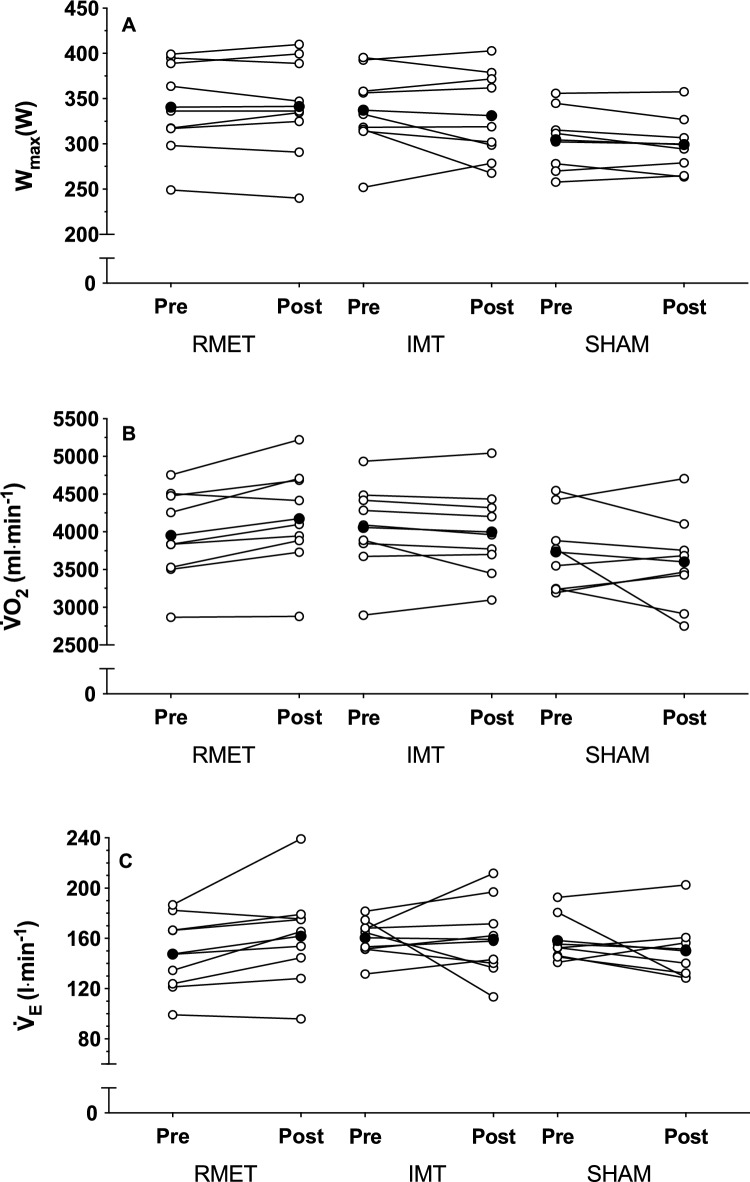
Both respiratory muscle endurance training (RMET) and inspiratory resistive training (IMT) seem to increase whole-body exercise performance, but direct comparisons between the two are scarce. We hypothesized that the similarity of RMET to exercise-induced ventilation would induce larger improvements compared to IMT. Twenty-six moderately-trained men performed either 4 weeks of RMET, IMT or SHAM training. Before and after the interventions, respiratory muscle endurance, 3-km running time-trial performance and leg muscle fatigue after intense constant-load cycling (assessed with femoral nerve magnetic stimulation) were measured. Both RMET (+ 59%) and IMT (+ 38%) increased respiratory muscle endurance (both p < 0.01 vs. SHAM) but only IMT increased inspiratory strength (+ 32%, p < 0.001 vs. SHAM). 3-km time improved showing a main effect of training (p = 0.026), however with no differences between groups. Leg fatigue after cycling was not attenuated with training (p = 0.088 for group-training interaction). All groups showed a significant (~ 0.3 l) increase in average tidal volume during cycling exercise combined with a concomitant reduction in respiratory exertion. While RMET and IMT improved specific aspects of respiratory muscles performance, no benefits beyond SHAM were seen during whole-body exercise. Changes in respiratory sensations might be a result of altered breathing pattern.
Overview
CoChat Summary
TL;DR
In 26 moderately trained men, 4 weeks of RMET or IMT improved respiratory muscle endurance—and IMT also improved inspiratory strength—but neither improved whole-body running or cycling performance beyond SHAM. Quadriceps fatigue after high-intensity cycling was not attenuated, questioning ergogenic effects of respiratory muscle training in this population.
Key findings
- Respiratory muscle endurance increased after RMET (+59%) and IMT (+38%) versus SHAM (both p < 0.01), but only IMT increased maximal inspiratory pressure (+32%, p < 0.001 vs. SHAM).
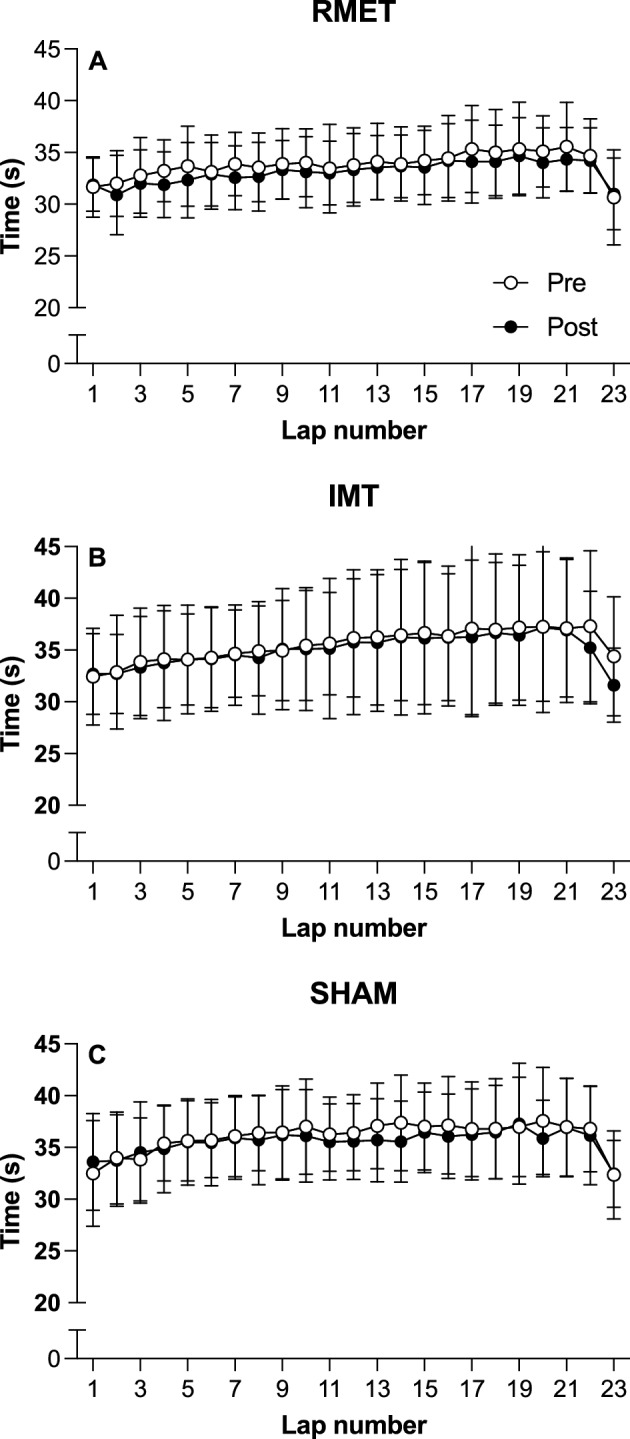
- 3-km running time improved across all groups (main effect of training p = 0.026; RMET −1.9 ± 2.4%, IMT −1.3 ± 2.7%, SHAM −1.4 ± 4.4%), with no differences between groups.
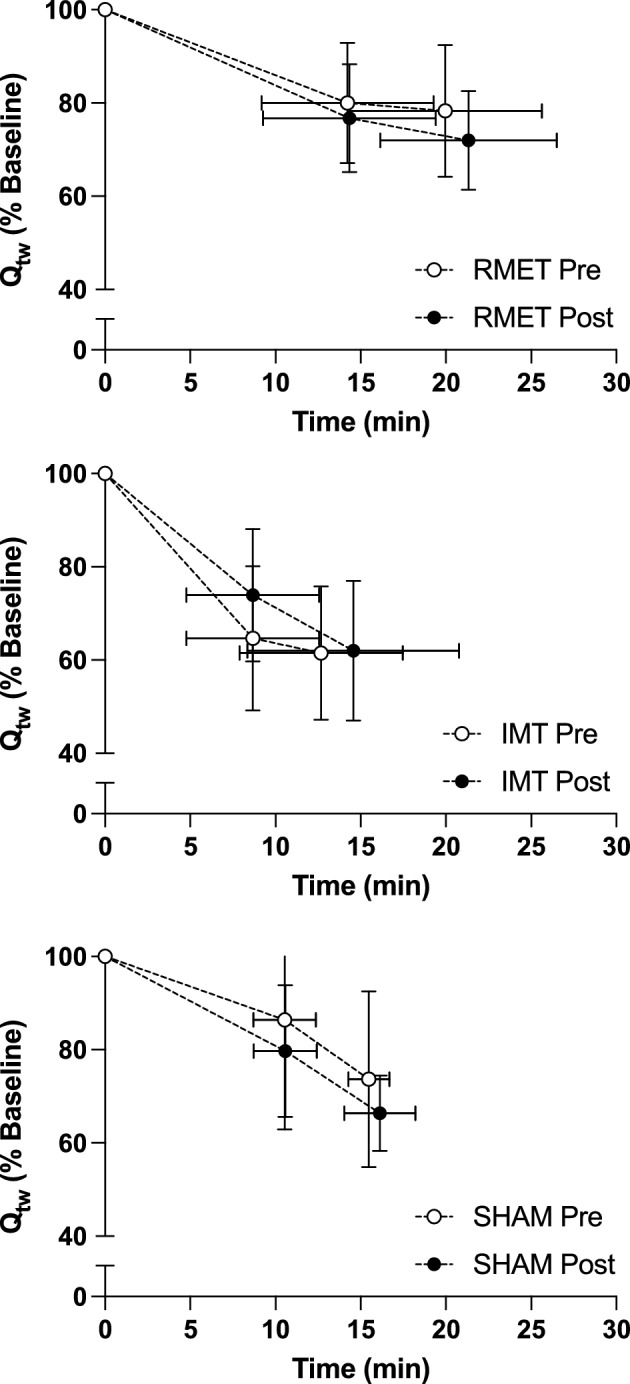
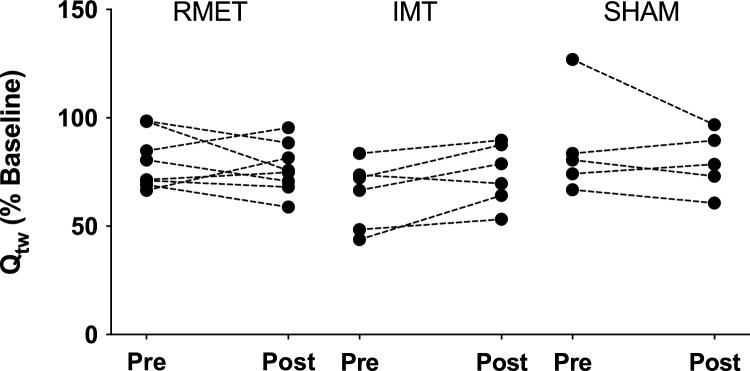
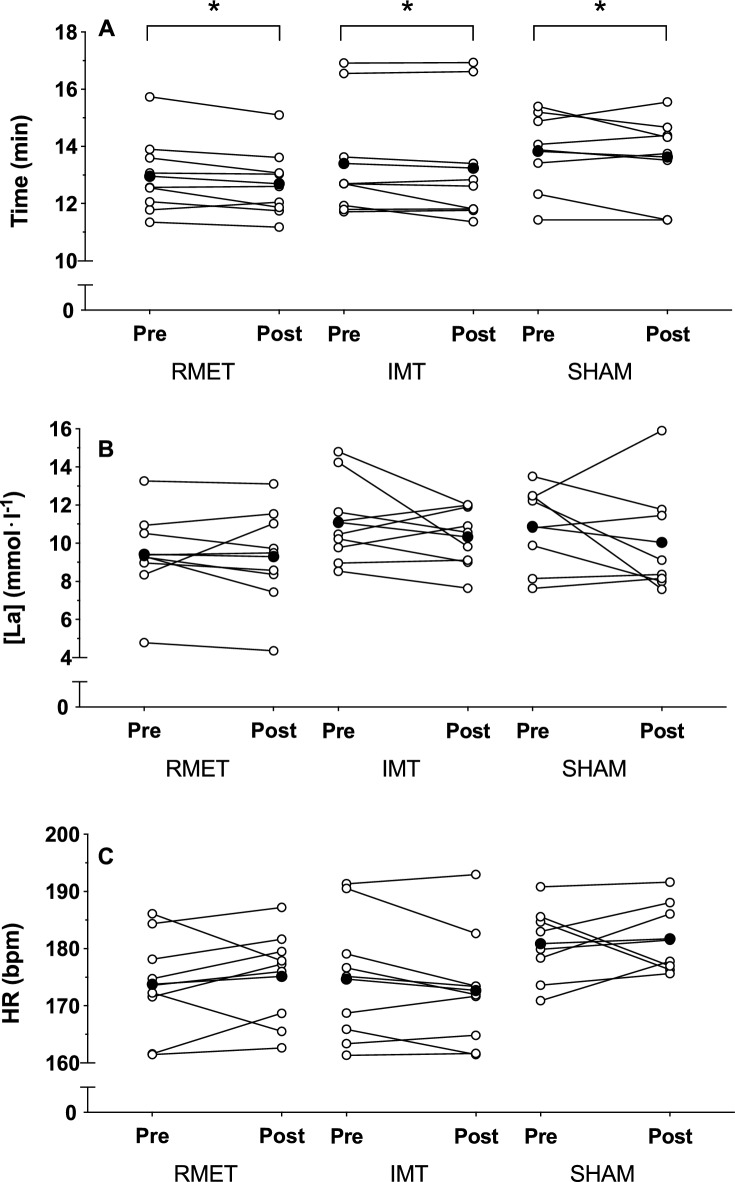
- Cycling endurance duration did not change with training (group-training interaction p = 0.645), and leg fatigue after equal cycling was not attenuated (group-training interaction p = 0.088 for Qtw after first exhaustion/isotime; no within-group changes).
- All groups showed an ~0.3 L increase in average tidal volume during cycling and a reduction in respiratory exertion (main effect of training p = 0.010), but these did not translate into benefits beyond SHAM.
Methods
- Single-blinded randomized study in 26 active, non-smoking men with normal lung function assigned to RMET (n = 9), IMT (n = 9), or SHAM (n = 8) for 4 weeks.
- Pre/post assessments included lung function, incremental cycling, constant-load cycling to exhaustion at 85% Wmax with coached ventilation and femoral nerve magnetic stimulation for quadriceps twitch force (Qtw), a 3-km running time-trial, and a respiratory muscle endurance test.
- Main analysis used 2-way ANOVA (group and training) with Tukey post hoc when required; Qtw was expressed as a percentage of baseline values; p < 0.05 was considered significant.
Limitations
- Stated: during post-training cycling tests, coached V̇E was slightly lower than before training; the authors note this magnitude is unimportant for fatigue but could have amplified any ergogenic effect if anything.
- Stated: only men were studied; the authors call for more trials on potential sex differences given women’s smaller lungs for body size and higher O2 cost of ventilation.
- Stated/evident: possible lack of familiarity with the performance tests, though similar pacing and Qtw results support robustness; evident from the text: small per-group samples (n = 8–9) and the SHAM group performed slow deep inspirations plus MVV15 tracking, which may have induced breathing-pattern changes rather than being inert.
Model-written summary. Check it against the paper before relying on it.
Integrity signals
Registry
Cites
Statistics
Figures
Verification
Claims the paper makes
0 Valid · 0 Not valid · 26 Not checked · 65 Own results and interpretations
A result the paper reports from its own data — it cites no other source for it, so there is none to check. The quote shows it is in the paper.
In the paper
“No changes in the extent of quadriceps fatigue developed after high-intensity cycling was noted following either IMT or RMET.”
§ Similar effects on exercise performance following different respiratory muscle training programs in healthy young men > Discussion > Effects of different RMT on quadriceps contractility
plain- Asserted: passes — The authors put it forward as true.
- Checkable: passes — It can be checked against evidence.
- Load-bearing: passes — The paper’s conclusions depend on it.
- Based: passes — The paper gives a reason why it holds.
A result the paper reports from its own data — it cites no other source for it, so there is none to check. The quote shows it is in the paper.
In the paper
“All groups showed a significant (~ 0.3 l) increase in average tidal volume during cycling exercise combined with a concomitant reduction in respiratory exertion.”
§ Similar effects on exercise performance following different respiratory muscle training programs in healthy young men > Abstract
plainstates an association- Asserted: passes — The authors put it forward as true.
- Checkable: passes — It can be checked against evidence.
- Load-bearing: unclear — It is unclear whether the paper’s conclusions depend on it.
- Based: passes — The paper gives a reason why it holds.
A result the paper states — it cites no source for it, so there is none to check. The quote shows it is in the paper.
In the paper
“The increases in MVV15 seen after IMT and RMET were similar to those exhibited by the SHAM group.”
§ Similar effects on exercise performance following different respiratory muscle training programs in healthy young men > Discussion > Effects of different RMT on respiratory muscle function
plain- Asserted: passes — The authors put it forward as true.
- Checkable: passes — It can be checked against evidence.
- Load-bearing: passes — The paper’s conclusions depend on it.
- Based: passes — The paper gives a reason why it holds.
A result the paper reports from its own data — it cites no other source for it, so there is none to check. The quote shows it is in the paper.
In the paper
“3-km time improved showing a main effect of training (p = 0.026), however with no differences between groups.”
§ Similar effects on exercise performance following different respiratory muscle training programs in healthy young men > Abstract
plainn = 6- Asserted: passes — The authors put it forward as true.
- Checkable: passes — It can be checked against evidence.
- Load-bearing: passes — The paper’s conclusions depend on it.
- Based: passes — The paper gives a reason why it holds.
A result the paper reports from its own data — it cites no other source for it, so there is none to check. The quote shows it is in the paper.
In the paper
“Qtw decreased nearly 30% from baseline levels following the first exhaustion/isotime (Fig. 2).”
§ Similar effects on exercise performance following different respiratory muscle training programs in healthy young men > Results > Constant-load cycling endurance test
plainstates a cause- Asserted: passes — The authors put it forward as true.
- Checkable: passes — It can be checked against evidence.
- Load-bearing: unclear — It is unclear whether the paper’s conclusions depend on it.
- Based: passes — The paper gives a reason why it holds.
39 more claims
Create a free account to see all 91 claims and to verify the 47 references still open.
- It may state two separate claims as one. 36
- The quote only partly states this claim. 1
- Probably not a substantial claim. 17
Self-check
Percentages, sums and reported differences re-computed from the paper’s own numbers.
Each contradiction between two passages listed here was confirmed by an independent check.
Rated major: it would touch a result — a value a result rests on, reported and recomputed p-values on opposite sides of the significance level, two passages that conflict with no sign which is right, or a cited work retracted before this paper was published.
In the paper
§ Similar effects on exercise performance following different respiratory muscle training programs in healthy young men > Results > Constant-load cycling endurance test
“while no differences were seen for respiratory exertion and breathlessness”
§ Similar effects on exercise performance following different respiratory muscle training programs in healthy young men > Results > Constant-load cycling endurance test
“| Post | 6.6 (2.4)† | 6.2 (3.2)† | 8.4 (2.5)† |”
Rated minor: it would not touch a result — a value no result rests on, a p-value that stays on the same side of the significance level, or a conflict that is clerical, resolved elsewhere in the paper, or outside its own findings.
In the paper
§ Similar effects on exercise performance following different respiratory muscle training programs in healthy young men > Abstract
“Leg fatigue after cycling was not attenuated with training (p = 0.088 for group-training interaction).”
§ Similar effects on exercise performance following different respiratory muscle training programs in healthy young men > Results > Constant-load cycling endurance test
“No group-training interaction was noted for Qtw after the first exhaustion/isotime (p = 0.086).”
Citations
Cites
ATS/ERS Statement on Respiratory Muscle Testing
(2002) · American Journal of Respiratory and Critical Care Medicine · doi:10.1164/rccm.166.4.518 · Cited by 2,991
Respiratory muscle work compromises leg blood flow during maximal exercise
Harms, C. A., Babcock, M. A., McClaran, S. R., Pegelow, D. F., Nickele, G. A., Nelson, W. B., & Dempsey, J. A. (1997) · Journal of Applied Physiology · doi:10.1152/jappl.1997.82.5.1573 · Cited by 711
Illi, S. K., Held, U., Frank, I., & Spengler, C. M. (2012) · Sports Medicine · doi:10.1007/bf03262290 · Cited by 411
Self-citationConsequences of exercise-induced respiratory muscle work
Dempsey, J. A., Romer, L., Rodman, J., Miller, J., & Smith, C. (2006) · Respiratory Physiology & Neurobiology · doi:10.1016/j.resp.2005.12.015 · Cited by 398
Ventilatory muscle strength and endurance training
Leith, D. E., & Bradley, M. (1976) · Journal of Applied Physiology · doi:10.1152/jappl.1976.41.4.508 · Cited by 396
Exercise‐induced diaphragmatic fatigue in healthy humans.
Johnson, B. D., Babcock, M. A., Suman, O. E., & Dempsey, J. A. (1993) · The Journal of Physiology · doi:10.1113/jphysiol.1993.sp019477 · Cited by 364
HajGhanbari, B., Yamabayashi, C., Buna, T. R., Coelho, J. D., Freedman, K. D., Morton, T. A., Palmer, S. A., Toy, M. A., Walsh, C., Sheel, A. W., et al. (2013) · Journal of Strength and Conditioning Research · doi:10.1519/jsc.0b013e318269f73f · Cited by 279
Effect of inspiratory muscle work on peripheral fatigue of locomotor muscles in healthy humans
Romer, L. M., Lovering, A. T., Haverkamp, H. C., Pegelow, D. F., & Dempsey, J. A. (2006) · The Journal of Physiology · doi:10.1113/jphysiol.2005.099697 · Cited by 225
Inspiratory muscle training attenuates the human respiratory muscle metaboreflex
Witt, J. D., Guenette, J. A., Rupert, J. L., McKenzie, D. C., & Sheel, A. W. (2007) · The Journal of Physiology · doi:10.1113/jphysiol.2007.140855 · Cited by 220
Inspiratory muscle training improves rowing performance
VOLIANITIS, S., MCCONNELL, A. K., KOUTEDAKIS, Y., MCNAUGHTON, L., BACKX, K., & JONES, D. A. (2001) · Medicine & Science in Sports & Exercise · doi:10.1097/00005768-200105000-00020 · Cited by 219
Research works printed but not linked: 1
- Tong, T. K., Wu, S., Nie, J., Baker, J. S. & Lin, H. The occurrence of core muscle fatigue during high-intensity running. J. Sport. Sci. Med. 13, 244–251 (2014).
Cited by
Kowalski, T., Klusiewicz, A., Rębiś, K., Wilk, A., & Starczewski, M. (2024) · Life · doi:10.3390/life14091159 · Cited by 15
Tosun, M. İ., Demirkan, E., Kaplan, A., Yılmaz, Y. A., Arıcı, İ. E., Favre, M., Aslan, V., & Kutlu, M. (2025) · Frontiers in Physiology · doi:10.3389/fphys.2025.1492446 · Cited by 14
Kowalski, T., Rodrigues, G. D., & Zanini, M. (2025) · Frontiers in Sports and Active Living · doi:10.3389/fspor.2025.1632207 · Cited by 12
Iqbal, M., Hassan, K., Bliss, E., Whiteside, E., Hoffman, B. W., & Mills, D. E. (2024) · Chronic Respiratory Disease · doi:10.1177/14799731241289423 · Cited by 2
Ren, Z., Zhou, Z., Yang, J., Wei, D., & Wu, H. (2025) · Life · doi:10.3390/life15081191 · Cited by 1
Metadata
- Authors
- Notter, D. A., Verges, S., Renggli, A. S., Beltrami, F. G., & Spengler, C. M.
- Affiliations
- ETH Zurich (CH)
- University of Zurich (CH)
- Corresponding author
- Spengler, Christina M.
- Venue
- Scientific Reports
- Published
- 2023-09-26
- Volume
- 13
- Issue
- 1
- Pages
- 16135-16135
- ISSN
- 2045-2322 (ISSN-L)
- PMC
- PMC10522679
- OpenAlex
- W4387043375
- Semantic Scholar
- 11b7b6631d19b75bb0b340fe7149dfb0ab0b0cc3
- Cited by
- 11
- References
- 44
- Citations by year
- 2026: 3 · 2025: 6 · 2024: 2
- FWCI
- 1.68
- Type
- journal article
- Language
- en
- Open access
- gold
- doi.org
- Locations
- Scientific Reports (publishedVersion, cc-by)
- PubMed Central (publishedVersion, cc-by)
- PubMed (publishedVersion)
- HAL (submittedVersion)
- DOAJ (DOAJ: Directory of Open Access Journals) (submittedVersion, cc-by-sa)
- Repository for Publications and Research Data (ETH Zurich) (submittedVersion, cc-by)
- ETH Zürich Research Collection
- Funders
- Scientific Council of AGIRàdom
- Topics
- Health Sciences › Medicine › Physiology (medical) › Cardiovascular and exercise physiology
- Health Sciences › Medicine › Orthopedics and Sports Medicine › Sports Performance and Training
- Health Sciences › Medicine › Pulmonary and Respiratory Medicine › Respiratory Support and Mechanisms
- Keywords
- respiratory muscle training, respiratory muscle endurance training, exercise performance, leg muscle fatigue, respiratory muscle endurance, tidal volume, breathing pattern, sham training, young men
- MeSH terms
- Breathing Exercises, Humans, Lung, Male, Respiration, Respiratory Muscles, Exercise, Muscle Strength
About these checks
Registry, retraction, Cites and statistics results are computed, not judged, with one exception: a printed reference that no index lists is read once by a model before it counts as a citation error. Claims are extracted by a model and kept only when their quote appears verbatim in the text; each cited source is then checked, with a model’s help, for whether it says what the claim relies on. Those verdicts can be wrong — read the claim’s quote and the cited source before relying on one.
A language model drew the claims from the paper on 2026-11-13, under version 3 of the claim definition (model deepseek-v4.1-flash, prompt extract-v3).
A second model labelled each claim on 2026-11-13 (model jev-1.13-20260917, definition revision gold-guideline-v0.2).
Statistics and arithmetic are recomputed, not judged.
Confidence bands are shown only for fields calibrated on our annotated test set. None is calibrated yet, so no band is shown.
What counts as a claim ›How we measure confidence ›How we check this ›
Are you an author, or do you see a problem with this page? Request a review
How to cite
Cite CoChat for the checks on this page, and the paper for its own findings.
- This page
- CoChat. (2026). Citation check: Similar effects on exercise performance following different respiratory muscle training programs in healthy young men. https://app.cochat.ai/papers/10.1038/s41598-023-41580-w
- The paper
- Notter, D. A., Verges, S., Renggli, A. S., Beltrami, F. G., & Spengler, C. M. (2023). Similar effects on exercise performance following different respiratory muscle training programs in healthy young men. Scientific Reports. https://doi.org/10.1038/s41598-023-41580-w
Data sources
Bibliographic data: Semantic Scholar, OpenAlex, Crossref.
Contains information from the Semantic Scholar Academic Graph Datasets, made available under the ODC Attribution License (ODC-BY 1.0).
Semantic Scholar’s data is described in: Kinney, R., et al. (2023). The Semantic Scholar Open Data Platform. arXiv:2301.10140.
