

A novel hybrid model integrating MFCC and acoustic parameters for voice disorder detection
Open accessThe DOI matches its Crossref record; 61 of the 61 references it cites were found in a registry or an index.
Abstract
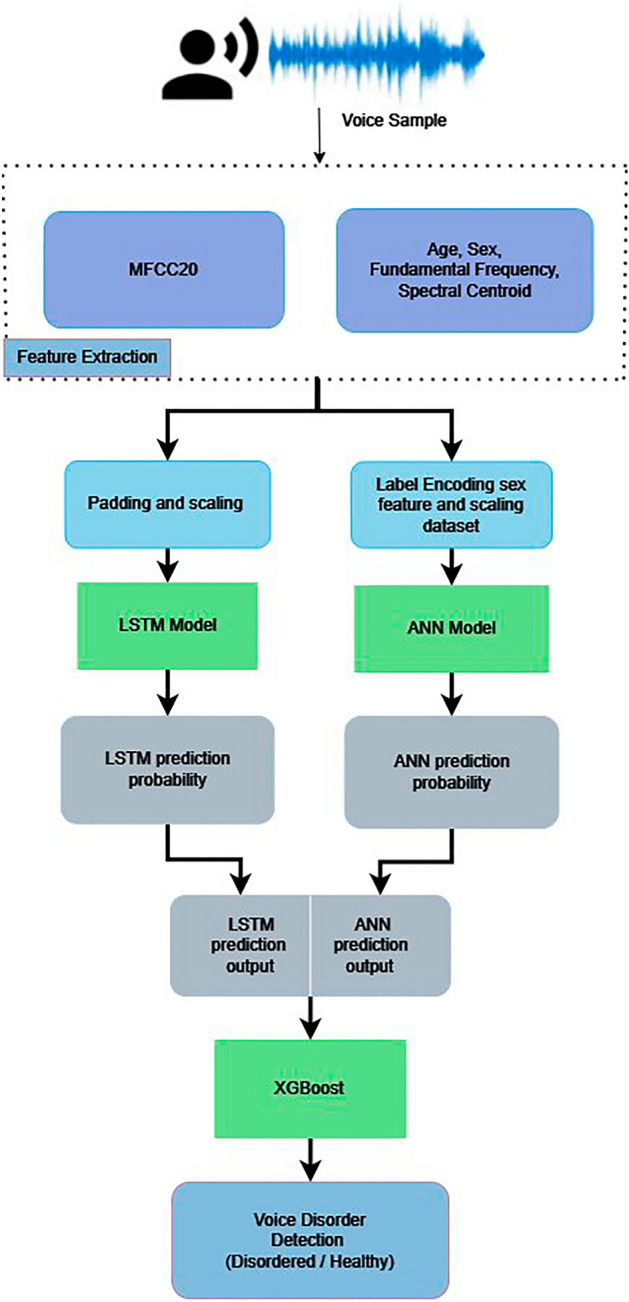
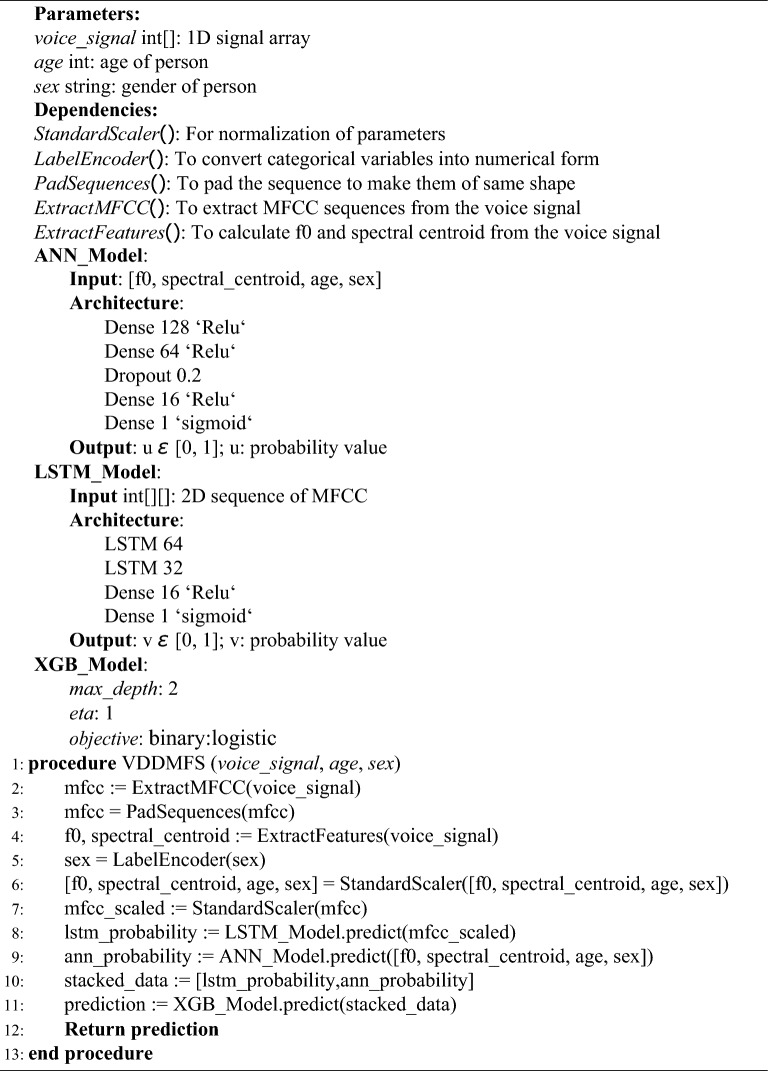
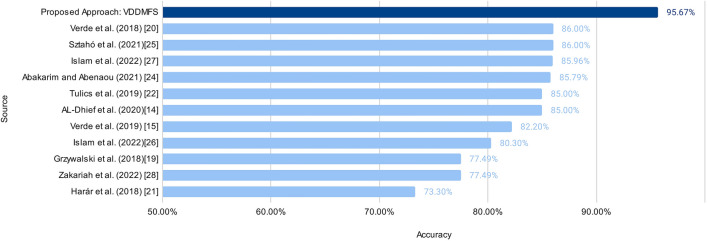
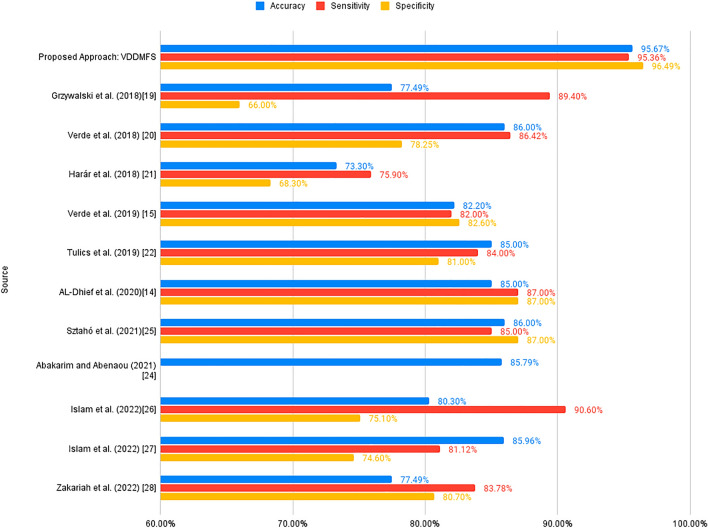
Voice is an essential component of human communication, serving as a fundamental medium for expressing thoughts, emotions, and ideas. Disruptions in vocal fold vibratory patterns can lead to voice disorders, which can have a profound impact on interpersonal interactions. Early detection of voice disorders is crucial for improving voice health and quality of life. This research proposes a novel methodology called VDDMFS [voice disorder detection using MFCC (Mel-frequency cepstral coefficients), fundamental frequency and spectral centroid] which combines an artificial neural network (ANN) trained on acoustic attributes and a long short-term memory (LSTM) model trained on MFCC attributes. Subsequently, the probabilities generated by both the ANN and LSTM models are stacked and used as input for XGBoost, which detects whether a voice is disordered or not, resulting in more accurate voice disorder detection. This approach achieved promising results, with an accuracy of 95.67%, sensitivity of 95.36%, specificity of 96.49% and f1 score of 96.9%, outperforming existing techniques.
Overview
The claims and statistics of this paper haven’t been checked yet.
Free: it reads the open-access text and checks the first 5 claims that cite a source we can check. Create a free account to check every claim.
Integrity signals
Registry
Cites
Statistics
Figures

Verification
Claims the paper makes
The claims and statistics of this paper haven’t been checked yet.
Free: it reads the open-access text and checks the first 5 claims that cite a source we can check. Create a free account to check every claim.
Claims other papers make about this one
Each is checked against this paper’s own text: does it say what the citing paper says it does?
The source backs part of the claim, not all of it — or backs it for a different population, condition or comparison.
In the citing paper
“Similar benefits arise from biologically inspired transforms, including scalograms and gammatonegrams [29,59,60].”
From Diagnostic Accuracy of Artificial Intelligence in Laryngeal Disorders: An Integrative Review (2026) · cites this paper as [60]
Experimental — accuracy not yet measured
Self-check
Percentages, sums and reported differences re-computed from the paper’s own numbers.
The self-check needs the paper’s full text.
Citations
Cites
1 retracted
An Analytical Study of Speech Pathology Detection Based on MFCC and Deep Neural Networks
Zakariah, M., B, R., Ajmi Alotaibi, Y., Guo, Y., Tran-Trung, K., & Elahi, M. M. (2022) · Computational and Mathematical Methods in Medicine · doi:10.1155/2022/7814952 · Cited by 32 · cited 1×
“Zakariah et al. 34 presented a framework that integrated three essential voice characteristics: chroma, mel spectrogram, and mel frequency cepstral coefficient (MFCC).”
BackgroundRetractedDavis, S., & Mermelstein, P. (1980) · IEEE Transactions on Acoustics, Speech, and Signal Processing · doi:10.1109/tassp.1980.1163420 · Cited by 5,465
librosa: Audio and Music Signal Analysis in Python
McFee, B., Raffel, C., Liang, D., Ellis, D., McVicar, M., Battenberg, E., & Nieto, O. (2015) · Proceedings of the Python in Science Conference · doi:10.25080/majora-7b98e3ed-003 · Cited by 3,033 · cited 1×
“Several Python libraries, including TensorFlow, NumPy, scikit-learn, XGBoost, Librosa 65 , Pandas, Matplotlib, WFDB 49,66 and Seaborn, were utilized for various tasks.”
MethodYIN, a fundamental frequency estimator for speech and music
de Cheveigné, A., & Kawahara, H. (2002) · The Journal of the Acoustical Society of America · doi:10.1121/1.1458024 · Cited by 1,920
Acoustic correlates of breathy vocal quality: dysphonic voices and continuous speech.
Hillenbrand, J., & Houde, R. A. (1996) · Journal of Speech, Language, and Hearing Research · doi:10.1044/jshr.3902.311 · Cited by 631
Introducing Parselmouth: A Python interface to Praat
Jadoul, Y., Thompson, B., & de Boer, B. (2018) · Journal of Phonetics · doi:10.1016/j.wocn.2018.07.001 · Cited by 506 · cited 2×
“Additionally, feature extraction is extended to encompass the fundamental frequency (f0) 46 and spectral centroid, which further contribute to understanding voice data 47–49 .”
BackgroundMethodThe prevalence of voice problems among adults in the United States
Bhattacharyya, N. (2014) · The Laryngoscope · doi:10.1002/lary.24740 · Cited by 318
Deepfake Audio Detection via MFCC features using Machine Learning
Hamza, A., Javed, A. R. R., Iqbal, F., Kryvinska, N., Almadhor, A. S., Jalil, Z., & Borghol, R. (2022) · IEEE Access · doi:10.1109/access.2022.3231480 · Cited by 264 · cited 1×
“VOICED used a built-in microphone of a mobile device 39 and an applicable m-health system, Vox4Health 40,41 , to collect a speech signal of vowel ‘a’ in real time.”
MethodFeatures of Mild-to-Moderate COVID-19 Patients With Dysphonia
Lechien, J. R., Chiesa-Estomba, C. M., Cabaraux, P., Mat, Q., Huet, K., Harmegnies, B., Horoi, M., Le Bon, S. D., Rodriguez, A., Dequanter, D., et al. (2022) · Journal of Voice · doi:10.1016/j.jvoice.2020.05.012 · Cited by 173
Objective Voice Analysis for Dysphonic Patients
Yu, P., Ouaknine, M., Revis, J., & Giovanni, A. (2001) · Journal of Voice · doi:10.1016/s0892-1997(01)00053-4 · Cited by 162
Boosting-Based DDoS Detection in Internet of Things Systems
Cvitic, I., Perakovic, D., Gupta, B. B., & Choo, K.-K. R. (2022) · IEEE Internet of Things Journal · doi:10.1109/jiot.2021.3090909 · Cited by 160 · cited 1×
“The state of voice health is estimated by many m-health systems using these signals 20,21 .”
BackgroundSelf-citationVoice Disorder Identification by Using Machine Learning Techniques
Verde, L., De Pietro, G., & Sannino, G. (2018) · IEEE Access · doi:10.1109/access.2018.2816338 · Cited by 156 · cited 2×
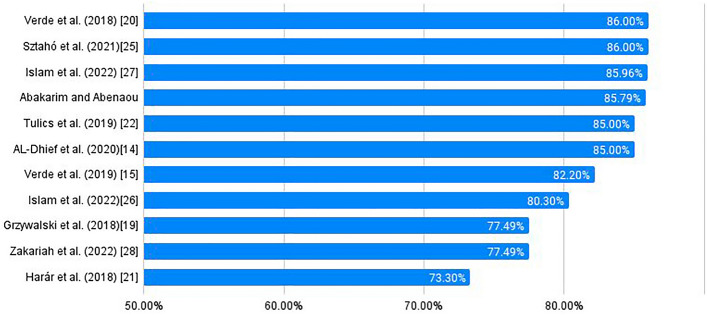
“Verde et al. 25 used the SVD dataset 26 along with support vector machine and decision tree algorithms to attain an accuracy of approximately 86%.”
MethodAn edge-ai based forecasting approach for improving smart microgrid efficiency
Lv, L., Wu, Z., Zhang, L., Gupta, B. B., & Tian, Z. (2022) · IEEE Transactions on Industrial Informatics · doi:10.1109/tii.2022.3163137 · Cited by 155 · cited 1×
“The mentioned studies have notable limitations that warrant attention 35 .”
BackgroundSelf-citationMc-DNN: Fake News Detection Using Multi-Channel Deep Neural Networks
Tembhurne, J. V., Almin, M. M., & Diwan, T. (2022) · International Journal on Semantic Web and Information Systems · doi:10.4018/ijswis.295553 · Cited by 118
Patient State Recognition System for Healthcare Using Speech and Facial Expressions
Hossain, M. S. (2016) · Journal of Medical Systems · doi:10.1007/s10916-016-0627-x · Cited by 112 · cited 1×
“From emotion recognition 14,17 to state recognition in healthcare 13,18,19 , speech and voice signals are used in many applications.”
BackgroundA new database of healthy and pathological voices
Cesari, U., Pietro, G. D., Marciano, E., Niri, C., Sannino, G., & Verde, L. (2018) · Computers & Electrical Engineering · doi:10.1016/j.compeleceng.2018.04.008 · Cited by 109
Ali, Z., Hossain, M. S., Muhammad, G., & Sangaiah, A. K. (2018) · Future Generation Computer Systems · doi:10.1016/j.future.2018.02.021 · Cited by 102 · cited 1×
“The state of voice health is estimated by many m-health systems using these signals 20,21 .”
BackgroundAudio-Visual Emotion Recognition Using Big Data Towards 5G
Hossain, M. S., Muhammad, G., Alhamid, M. F., Song, B., & Al-Mutib, K. N. (2016) · Mobile Networks and Applications · doi:10.1007/s11036-016-0685-9 · Cited by 100 · cited 2×
“MFCC, a powerful tool for acoustic feature extraction 14 , is integrated into the hybrid model to enhance the precision and reliability of voice disorder detection.”
BackgroundMethodMorris, M. A., Meier, S. K., Griffin, J. M., Branda, M. E., & Phelan, S. M. (2015) · Disability and health journal · doi:10.1016/j.dhjo.2015.07.004 · Cited by 93
Byeon, H., & Cha, S. (2020) · Scientific Reports · doi:10.1038/s41598-020-61565-3 · Cited by 87
Li, P., Zhong, H., & Zhang, Z. (2022) · International Journal on Semantic Web and Information Systems · doi:10.4018/ijswis.313190 · Cited by 83
Voice Pathology Detection Using Machine Learning Technique
AL‐Dhief, F. T., Latiff, N. M. A., Malik, N. N. N. A., Sabri, N., Baki, M. M., Albadr, M. A. A., Abbas, A. F., Hussein, Y. M., & Mohammed, M. A. (2020) · IEEE International Symposium on Telecommunication Technologies · doi:10.1109/istt50966.2020.9279346 · Cited by 79 · cited 3×
“They attained an accuracy of 85% using DNN. AL-Dhief et al. 15 introduced a voice pathology detection system based on an online sequential extreme learning machine (OSELM) for classifying voice signals as healthy or pathological, with feature extraction using mel-frequency cepstral coefficients (MFCCs).”
MethodEfficient Loop Unrolling Factor Prediction Algorithm using Machine Learning Models
Singh, I., Singh, S., Singh, R., & Kumar, S. (2022) · International Conference for Emerging Technology (INCET) · doi:10.1109/incet54531.2022.9825092 · Cited by 75 · cited 1×
“• RAM: the system had 30 GB of RAM, which allowed for efficient data handling and model training 64 .”
MethodSelf-citationHarar, P., Galaz, Z., Alonso-Hernandez, J. B., Mekyska, J., Burget, R., & Smekal, Z. (2020) · Neural Computing and Applications · doi:10.1007/s00521-018-3464-7 · Cited by 68
Chui, K. T., Lytras, M. D., & Vasant, P. (2020) · Applied Sciences · doi:10.3390/app10134571 · Cited by 64 · cited 1×
“Chui et al. 29 introduced the CGAN-IFCM model, which combines a conditional generative adversarial network (CGAN) with improved fuzzy C-means (IFCM) clustering for multiclass voice disorder detection.”
MethodSelf-citationAutomated Machine Learning (AutoML): The Future of Computational Intelligence
Mengi, G., Singh, S., Kumar, S., Mahto, D., & Sharma, A. (2023) · Lecture notes in networks and systems · doi:10.1007/978-3-031-22018-0_28 · Cited by 62
Self-citationA Novel Transfer Learning-Based Model for Ultrasound Breast Cancer Image Classification
Gupta, S., Agrawal, S., Singh, S., & Kumar, S. (2023) · Advances in intelligent systems and computing · doi:10.1007/978-981-19-9819-5_37 · Cited by 60
Self-citationMobile Cloud Computing and Sustainable Development
García‐Peñalvo, F. J., Sharma, A., Chhabra, A., Singh, S., Kumar, S., Arya, V., & Gaurav, A. (2022) · International Journal of Cloud Applications and Computing · doi:10.4018/ijcac.312583 · Cited by 56
Self-citationFormant analysis in dysphonic patients and automatic Arabic digit speech recognition
Muhammad, G., Mesallam, T. A., Malki, K. H., Farahat, M., Alsulaiman, M., & Bukhari, M. (2011) · BioMedical Engineering OnLine · doi:10.1186/1475-925x-10-41 · Cited by 56
Sustainable Framework for Metaverse Security and Privacy: Opportunities and Challenges
Singh, M., Singh, S., Kumar, S., Madan, U., & Maan, T. (2023) · Lecture notes in networks and systems · doi:10.1007/978-3-031-22018-0_30 · Cited by 55
Self-citationSustainable Stock Market Prediction Framework Using Machine Learning Models
García‐Peñalvo, F. J., Maan, T., Singh, S., Kumar, S., Arya, V., Chui, K. T., & Singh, G. P. (2022) · International Journal of Software Science and Computational Intelligence · doi:10.4018/ijssci.313593 · Cited by 54 · cited 1×
“VDDMFS achieves an impressive accuracy score, outperforming various ML models commonly applied in the field 62,67 .”
MethodSelf-citationIslam, R., Abdel-Raheem, E., & Tarique, M. (2022) · Computer Methods and Programs in Biomedicine Update · doi:10.1016/j.cmpbup.2022.100074 · Cited by 53 · cited 1×
“Islam et al. 32 introduced a voice pathology detection approach employing convolutional neural networks (CNNs) with electroglottographic (EGG) and speech signals.”
MethodKumar, S., Singh, S., Aggarwal, N., Gupta, B. B., Alhalabi, W., & Band, S. S. (2022) · International Journal of Intelligent Systems · doi:10.1002/int.23062 · Cited by 53 · cited 1×
“This scaling technique standardizes the feature values, placing them on a common scale, which is particularly crucial when employing algorithms that are sensitive to the magnitude of input features 54 .”
MethodSelf-citationSrivastava, A. M., Rotte, P. A., Jain, A., & Prakash, S. (2022) · International Journal on Semantic Web and Information Systems · doi:10.4018/ijswis.297038 · Cited by 52 · cited 1×
“Participants in the study needed to be between 18 and 70 years old and capable of adhering to the anticipated ages of the research procedure 28,37,38 .”
BackgroundDropout-VGG Based Convolutional Neural Network for Traffic Sign Categorization
Singh, I., Singh, S., Kumar, S., & Aggarwal, K. (2022) · Lecture notes on data engineering and communications technologies · doi:10.1007/978-981-16-9416-5_18 · Cited by 50
Self-citationAn Investigation of Vocal Tract Characteristics for Acoustic Discrimination of Pathological Voices
Lee, J.-W., Kang, H.-G., Choi, J.-Y., & Son, Y.-I. (2013) · BioMed Research International · doi:10.1155/2013/758731 · Cited by 47
Cesari, U., Pietro, G. D., Marciano, E., Niri, C., Sannino, G., & Verde, L. (2018) · BioMed Research International · doi:10.1155/2018/8193694 · Cited by 46 · cited 1×
“VOICED used a built-in microphone of a mobile device 39 and an applicable m-health system, Vox4Health 40,41 , to collect a speech signal of vowel ‘a’ in real time.”
MethodGender-related differences in the prevalence of voice disorders and awareness of dysphonia
Marchese, M. R., Longobardi, Y., Cesare, T. D., Mari, G., Terruso, V., Galli, J., & D’Alatri, L. (2022) · Acta Otorhinolaryngologica Italica · doi:10.14639/0392-100x-n2018 · Cited by 46 · cited 1×
“Recognizing the importance of these factors in voice-related research, age and sex data were included with the fundamental frequency and spectral centroid features 43,50–53 .”
BackgroundThe Effect of the MFCC Frame Length in Automatic Voice Pathology Detection
Tirronen, S., Kadiri, S. R., & Alku, P. (2024) · Journal of Voice · doi:10.1016/j.jvoice.2022.03.021 · Cited by 45 · cited 1×
“The core of the feature extraction process centers around the extraction of 20 Mel-frequency cepstral coefficients (MFCCs), a widely used representation for characterizing the spectral content of voice signals 44,45 .”
MethodKumar, S., Singh, S., Aggarwal, N., & Aggarwal, K. (2021) · Journal of Discrete Mathematical Sciences and Cryptography · doi:10.1080/09720529.2021.1951435 · Cited by 43 · cited 1×
“A filter was also applied to each recording during acquisition to remove any noise that might have been accidentally introduced 42 .”
MethodSelf-citationFuzzy Based Clustering of Consumers' Big Data in Industrial Applications
Sharma, A., Singh, S., Badwal, E., Kumar, S., Gupta, B. B., Arya, V., Chui, K. T., & Santaniello, D. (2023) · International Conference on Consumer Electronics · doi:10.1109/icce56470.2023.10043451 · Cited by 43 · cited 1×
“ANNs are known for their capacity to uncover intricate patterns and relationships within data, making them applicable to a wide range of classification problems 59–61 c) XGBoost (extreme gradient boosting): XGBoost is a potent ensemble learning algorithm for classification tasks.”
BackgroundSelf-citationEnhanced Living by Assessing Voice Pathology Using a Co-Occurrence Matrix
Muhammad, G., Alhamid, M. F., Hossain, M. A., Almogren, A., & Vasilakos, A. V. (2017) · Sensors · doi:10.3390/s17020267 · Cited by 42
Souissi, N., & Cherif, A. (2015) · 2015 7th International Conference on Modelling, Identification and Control (ICMIC) · doi:10.1109/icmic.2015.7409479 · Cited by 36 · cited 2×
“Reflux laryngitis: reflux laryngitis is a condition where stomach acid flows back into the throat, irritating the sensitive tissues of the larynx 43 .”
BackgroundMachine-Learning-Based White-Hat Worm Launcher in Botnet Defense System
Pan, X., Yamaguchi, S., Kageyama, T., & Kamilin, M. H. B. (2021) · International Journal of Software Science and Computational Intelligence · doi:10.4018/ijssci.291713 · Cited by 36
Malik, M., Prabha, C., Soni, P., Arya, V., Alhalabi, W., Gupta, B. B., Albeshri, A. A., & Almomani, A. (2023) · International Journal on Semantic Web and Information Systems · doi:10.4018/ijswis.324105 · Cited by 35
Self-citationDysphonia Detection Index (DDI): A New Multi-Parametric Marker to Evaluate Voice Quality
Verde, L., Pietro, G. D., Alrashoud, M. R., Ghoneim, A., Al-Mutib, K. N., & Sannino, G. (2019) · IEEE Access · doi:10.1109/access.2019.2913444 · Cited by 27 · cited 3×
“Verde et al. 25 used the SVD dataset 26 along with support vector machine and decision tree algorithms to attain an accuracy of approximately 86%.”
BackgroundMethodIslam, R., Abdel‐Raheem, E., & Tarique, M. (2022) · Applied Sciences · doi:10.3390/app12052398 · Cited by 27 · cited 1×
“Islam et al. 33 examined two cochlear implant models in their study.”
BackgroundInternational Conference on Smart Systems and Advanced Computing (SysCom 2022)
Nedjah, N., Perez, G. M., & Gupta, B. B. (2025) · Advances in intelligent systems and computing · doi:10.1007/978-3-031-40905-9 · Cited by 27
Self-citationSpeculative Parallelism on Multicore Chip Architecture Strengthen Green Computing Concept: A Survey
Kumar, S., Singh, S., & Aggarwal, N. (2023) · Apple Academic Press eBooks · doi:10.1201/9781003369066-2 · Cited by 24
Self-citationClassification of web pages on attractiveness: A supervised learning approach
Khade, G., Kumar, S., & Bhattacharya, S. (2012) · doi:10.1109/ihci.2012.6481867 · Cited by 22
Self-citationDeep Embedding Learning With Auto-Encoder for Large-Scale Ontology Matching
Khoudja, M. A., Fareh, M., & Bouarfa, H. (2022) · International Journal on Semantic Web and Information Systems · doi:10.4018/ijswis.297042 · Cited by 21
Parameterization of Sequence of MFCCs for DNN-based voice disorder detection
Grzywalski, T., Maciaszek, A., Biniakowski, A., Orwat, J., Drgas, S., Piecuch, M., Belluzzo, R., Joachimiak, K., Niemiec, D., Ptaszynski, J., et al. (2018) · IEEE International Conference on Big Data (BigData) · doi:10.1109/bigdata.2018.8622012 · Cited by 18
SDN-Supported Edge-Cloud Interplay for Next Generation Internet of Things
Sahoo, K. S., Solanki, A., Mishra, S. K., Sahoo, B., & Nayyar, A. (2022) · Chapman & Hall/CRC eBooks · doi:10.1201/9781003213871 · Cited by 13 · cited 2×
“In this paper, a novel hybrid model that combines artificial intelligence and machine learning (AI/ ML) techniques 13 that integrates mel-frequency cepstral coefficients (MFCCs) for voice disorder detection is presented.”
BackgroundMethodBenmoussa, K., Hamdadou, D., & Roukh, Z. E. A. (2021) · International Journal of Software Science and Computational Intelligence · doi:10.4018/ijssci.285592 · Cited by 12
Artificial Neural Network and SVM based Voice Disorder Classification
Tulics, M. G., Szaszák, G., Mészáros, K., & Vicsi, K. (2019) · IEEE International Conference on Cognitive Infocommunications · doi:10.1109/coginfocom47531.2019.9089908 · Cited by 9 · cited 3×
“Participants in the study needed to be between 18 and 70 years old and capable of adhering to the anticipated ages of the research procedure 28,37,38 .”
BackgroundVoices Against Disavowal, Obscurantism, and Exclusion: The Year in Lebanon
Hajj, S. E. (2020) · Biography · doi:10.1353/bio.2020.0019 · Cited by 7
Voice Pathology Detection Using the Adaptive Orthogonal Transform Method, SVM and MLP.
Abakarim, F., & Abenaou, A. (2021) · International Journal of Online and Biomedical Engineering (iJOE) · doi:10.3991/ijoe.v17i14.26701 · Cited by 7 · cited 1×
“Abakarim and Abenaou 30 employed the adaptive orthogonal transform method for feature extraction.”
MethodRanked Deep Web Page Detection Using Reinforcement Learning and Query Optimization
Madan, K., & Bhatia, R. K. (2021) · International Journal on Semantic Web and Information Systems · doi:10.4018/ijswis.2021100106 · Cited by 5 · cited 1×
“Recognizing the importance of these factors in voice-related research, age and sex data were included with the fundamental frequency and spectral centroid features 43,50–53 .”
BackgroundOptimization of MFCC Algorithm for Embedded Voice System
Shi, T., & Zhen, J. (2021) · Lecture notes in electrical engineering · doi:10.1007/978-981-15-8411-4_88 · Cited by 3 · cited 1×
“…each contributing uniquely to enhancing the accuracy and robustness of the classification framework. a) Long short-term memory (LSTM): LSTM, a type of recurrent neural network (RNN), excels in sequence-based classification tasks by retaining and utilizing information from past inputs 55 .”
BackgroundContemporary Islamist Perspectives on International Relations
Baroudi, S. (2022) · Peter Lang eBooks · doi:10.3726/b19175 · Cited by 2 · cited 1×
“Additionally, feature extraction is extended to encompass the fundamental frequency (f0) 46 and spectral centroid, which further contribute to understanding voice data 47–49 .”
BackgroundHeinen, M. M., Eldin, N., O'Dwyer, U., Hayes, C. B., Heavey, P., Lynam, A., O’Brien, J., Daly, L., Murrin, C. M., & Kelleher, C. C. (2015) · International Journal of Epidemiology · doi:10.1093/ije/dyv096.490 · Cited by 1
Research works printed but not linked: 8
- 5. Wang, J. & Jo, C. Performance of gaussian mixture models as a classifier for pathological voice. In Proceedings of the 11th Australian International Conference on Speech Science and Technology, Vol. 107, 122-131 (2006).
- 17. Deveci, M., Pamucar, D., Gokasar, I., Köppen, M. & Gupta, B. B. Personal mobility in metaverse with autonomous vehicles using Q-rung orthopair fuzzy sets based OPA-RAFSI model. IEEE Trans. Intell. Transport. Syst. 20, 20 (2022).
- 22. Ling, Z. & Hao, Z. J. An intrusion detection system based on normalized mutual information antibodies feature selection and adaptive quantum artificial immune system. Int. J. Semant. Web Inf. Syst. 18(1), 1-25 (2022).
- 31. Tulics, M. G., Szaszak, G., Meszaros, K. & Vicsi, K. Artificial neural network and SVM based voice disorder classification. In 2019 10th IEEE International Conference on Cognitive Infocommunications (CogInfoCom). https:// doi. org/ 10. 3390/ app10 134571 (IEEE, 2019). · DOI
- 48. Affeich, A. & Hilal, H. A feminist voice re/written in translation: A case study of the Arabic version of Joumana Haddad's I Killed Scheherazade. New Voices Transl. Stud. 23(1), 60-85 (2020).
- 56. Anil, B. C., Dayananda, P., Nethravathi, B. & Raisinghani, M. S. Efficient local cloud-based solution for liver cancer detection using deep learning. Int. J. Cloud Appl. Comput. 12(1), 1-13 (2022).
- 66. Edition, T. & Moody, G. B. Wfdb applications guide. https:// archi ve. physi onet. org/ physi otools/ wfdb. shtml.
- 69. Dwivedi, R. K. Density-based machine learning scheme for outlier detection in smart forest fire monitoring sensor cloud. Int. J. Cloud Appl. Comput. 12(1), 1-16 (2022).
Cited by
MFCC in audio signal processing for voice disorder: a review
Sidhu, M. S., Latib, N. A. A., & Sidhu, K. K. (2024) · Multimedia Tools and Applications · doi:10.1007/s11042-024-19253-1 · Cited by 54
“Long short sequences (LSTMs) are particularly useful for managing variable-length sequences because they can comprehend and adaptively learn to comprehend input sequences of different lengths [58].”
Rahmatallah, Y., Kemp, A. S., Iyer, A., Pillai, L., Larson‐Prior, L. J., Virmani, T., & Prior, F. (2025) · Scientific Reports · doi:10.1038/s41598-025-92105-6 · Cited by 38
“…been applied to classic voice feature vectors such as cepstral coefficients to generate mel-frequency cepstral coefficients and has shown good performance in speech applications, including the ability to detect voice disorders 28 , depression 29 , amyotrophic lateral sclerosis 30 , and PD 31–35 .”
Next Gen Security With Quantum-Safe Cryptography
Singh, N., Singh, S., Kumar, S., Rawat, Y., Arya, V., Bansal, R., & Chui, K. T. (2024) · Advances in information security, privacy, and ethics book series · doi:10.4018/979-8-3693-5330-1.ch006 · Cited by 21
Self-citationSankaran, A., & Kumar, L. S. (2024) · IEEE Access · doi:10.1109/access.2024.3508884 · Cited by 27
Voice pathology detection on spontaneous speech data using deep learning models
Farazi, S., & Shekofteh, Y. (2024) · International Journal of Speech Technology · doi:10.1007/s10772-024-10134-4 · Cited by 20
“In (Verma et al., 2023), the vowel /a/ sound from the VOICED dataset was used.”
Metadata
- Authors
- Verma, V., Benjwal, A., Chhabra, A., Singh, S. K., Kumar, S., Gupta, B. B., Arya, V., & Chui, K. T.
- Affiliations
- Asia University (TW)
- Hong Kong Metropolitan University (HK)
- Corresponding author
- Kumar, Sudhakar
- Gupta, Brij B.
- Venue
- Scientific Reports
- Published
- 2023-12-20
- Volume
- 13
- Issue
- 1
- Pages
- 22719-22719
- ISSN
- 2045-2322 (ISSN-L)
- PMC
- PMC10733415
- OpenAlex
- W4390007540
- Cited by
- 55
- References
- 61
- Citations by year
- 2026: 13 · 2025: 23 · 2024: 19
- FWCI
- 9.72
- Type
- journal article
- Language
- en
- Open access
- gold
- doi.org
- Licence
- cc-by
- creativecommons.org/licenses/by/4.0 (tdm)
- creativecommons.org/licenses/by/4.0 (vor)
- Locations
- Scientific Reports (publishedVersion, cc-by)
- PubMed Central (publishedVersion, cc-by)
- PubMed (publishedVersion)
- DOAJ (DOAJ: Directory of Open Access Journals) (submittedVersion, cc-by-sa)
- Funders
- Kwok Tai Chui
- Topics
- Health Sciences › Health Professions › Speech and Hearing › Voice and Speech Disorders
- Physical Sciences › Computer Science › Artificial Intelligence › Speech Recognition and Synthesis
- Physical Sciences › Computer Science › Signal Processing › Speech and Audio Processing
- Keywords
- voice disorder detection, Mel-frequency cepstral coefficients, fundamental frequency, spectral centroid, acoustic features, hybrid deep learning model, long short-term memory, XGBoost, vocal fold vibration
- MeSH terms
- Acoustics, Humans, Quality of Life, Speech Acoustics, Voice, Voice Disorders, Voice Quality
About these checks
Registry, retraction, Cites and statistics results are computed, not judged, with one exception: a printed reference that no index lists is read once by a model before it counts as a citation error. Claims are extracted by a model and kept only when their quote appears verbatim in the text; each cited source is then checked, with a model’s help, for whether it says what the claim relies on. Those verdicts can be wrong — read the claim’s quote and the cited source before relying on one.
Statistics and arithmetic are recomputed, not judged.
Confidence bands are shown only for fields calibrated on our annotated test set. None is calibrated yet, so no band is shown.
What counts as a claim ›How we measure confidence ›How we check this ›
Are you an author, or do you see a problem with this page? Request a review
Data sources
Bibliographic data: Semantic Scholar, OpenAlex, Crossref.
Contains information from the Semantic Scholar Academic Graph Datasets, made available under the ODC Attribution License (ODC-BY 1.0).
Semantic Scholar’s data is described in: Kinney, R., et al. (2023). The Semantic Scholar Open Data Platform. arXiv:2301.10140.
