

A novel hybrid model integrating MFCC and acoustic parameters for voice disorder detection
Open accessThe DOI matches its Crossref record; 61 of the 61 references it cites were found in a registry or an index.
Abstract
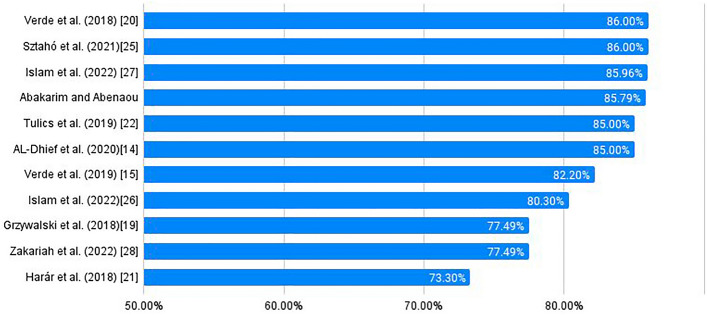
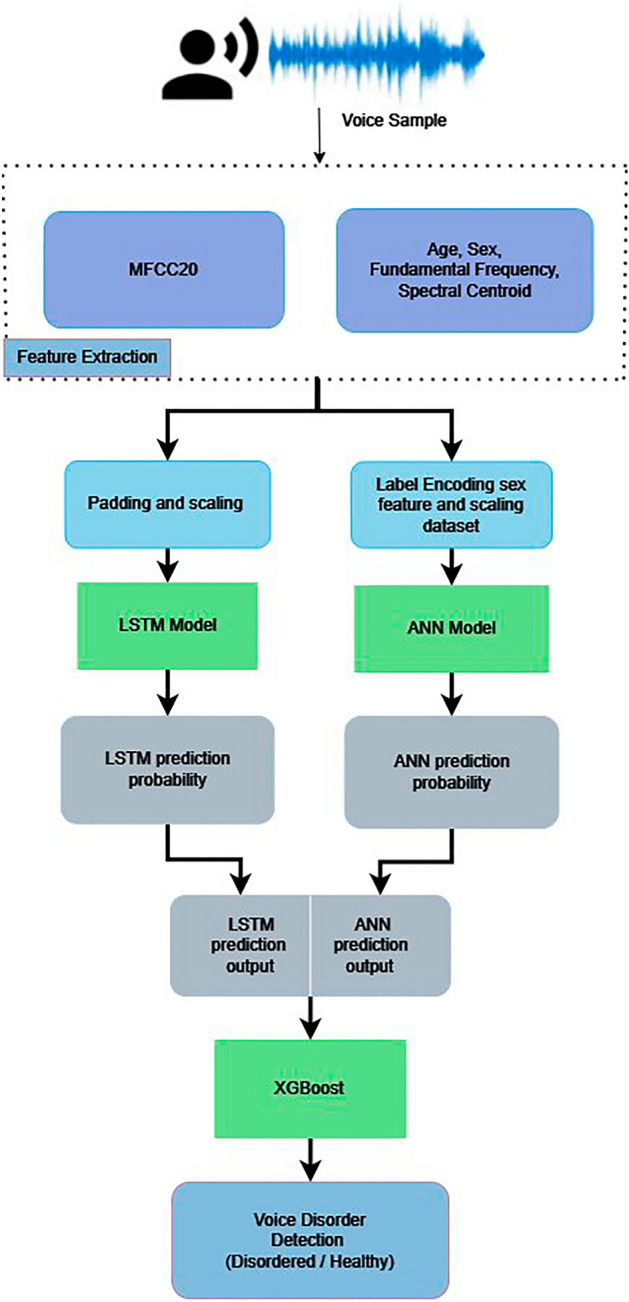
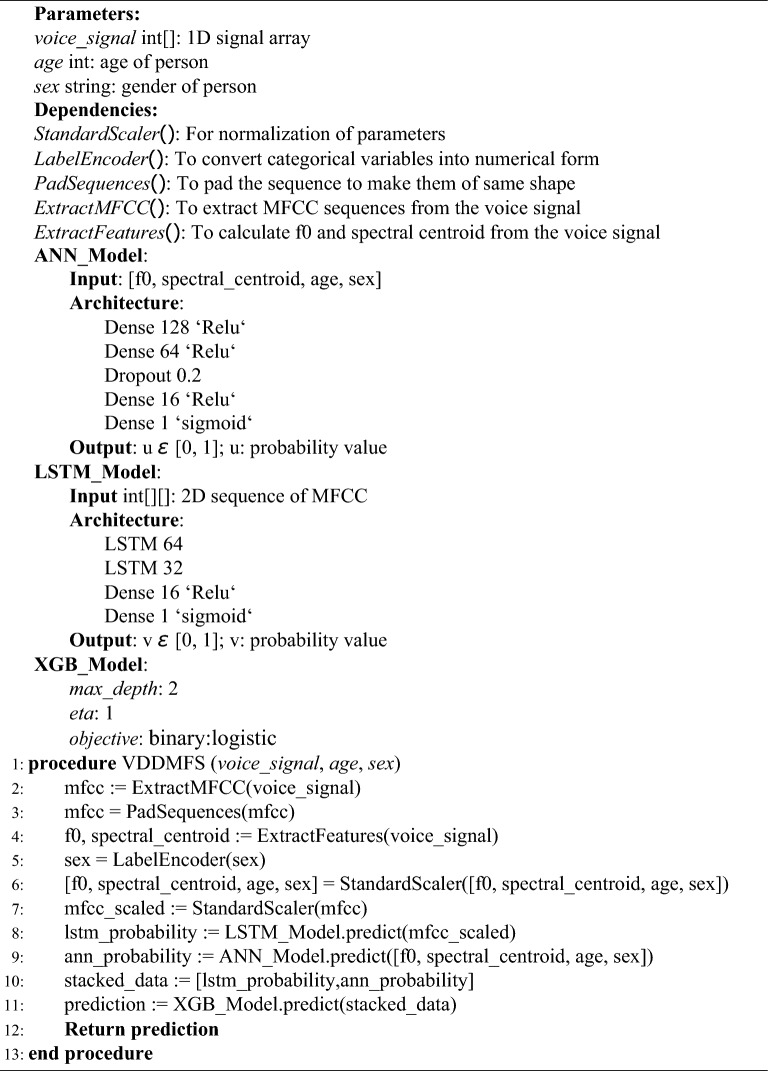
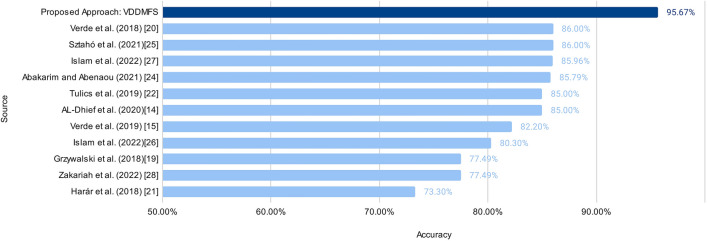
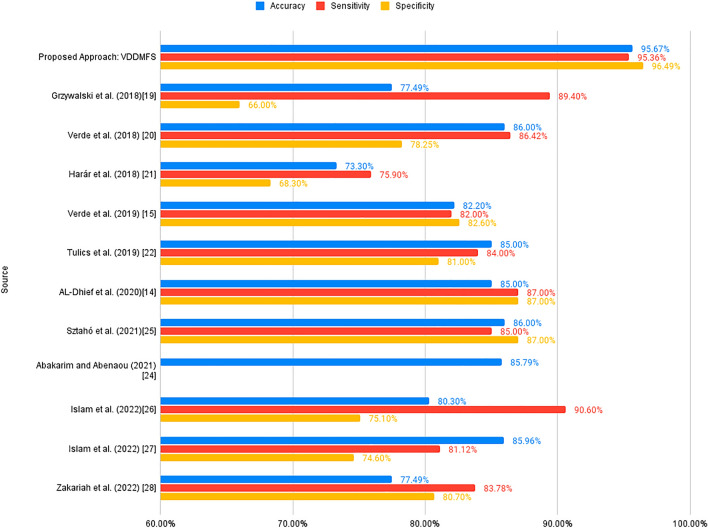
Voice is an essential component of human communication, serving as a fundamental medium for expressing thoughts, emotions, and ideas. Disruptions in vocal fold vibratory patterns can lead to voice disorders, which can have a profound impact on interpersonal interactions. Early detection of voice disorders is crucial for improving voice health and quality of life. This research proposes a novel methodology called VDDMFS [voice disorder detection using MFCC (Mel-frequency cepstral coefficients), fundamental frequency and spectral centroid] which combines an artificial neural network (ANN) trained on acoustic attributes and a long short-term memory (LSTM) model trained on MFCC attributes. Subsequently, the probabilities generated by both the ANN and LSTM models are stacked and used as input for XGBoost, which detects whether a voice is disordered or not, resulting in more accurate voice disorder detection. This approach achieved promising results, with an accuracy of 95.67%, sensitivity of 95.36%, specificity of 96.49% and f1 score of 96.9%, outperforming existing techniques.
Overview
The claims and statistics of this paper haven’t been checked yet.
Free: it reads the open-access text and checks the first 5 claims that cite a source we can check. Create a free account to check every claim.
Integrity signals
Registry
Cites
Statistics
Figures

Verification
Claims the paper makes
The claims and statistics of this paper haven’t been checked yet.
Free: it reads the open-access text and checks the first 5 claims that cite a source we can check. Create a free account to check every claim.
Claims other papers make about this one
Each is checked against this paper’s own text: does it say what the citing paper says it does?
The source backs part of the claim, not all of it — or backs it for a different population, condition or comparison.
In the citing paper
“Similar benefits arise from biologically inspired transforms, including scalograms and gammatonegrams [29,59,60].”
From Diagnostic Accuracy of Artificial Intelligence in Laryngeal Disorders: An Integrative Review (2026) · cites this paper as [60]
Experimental — accuracy not yet measured
Self-check
Percentages, sums and reported differences re-computed from the paper’s own numbers.
The self-check needs the paper’s full text.
Citations
Cites
1 retracted
An Analytical Study of Speech Pathology Detection Based on MFCC and Deep Neural Networks
Zakariah, M., B, R., Ajmi Alotaibi, Y., Guo, Y., Tran-Trung, K., & Elahi, M. M. (2022) · Computational and Mathematical Methods in Medicine · doi:10.1155/2022/7814952 · Cited by 32 · cited 1×
“Zakariah et al. 34 presented a framework that integrated three essential voice characteristics: chroma, mel spectrogram, and mel frequency cepstral coefficient (MFCC).”
BackgroundRetractedDavis, S., & Mermelstein, P. (1980) · IEEE Transactions on Acoustics, Speech, and Signal Processing · doi:10.1109/tassp.1980.1163420 · Cited by 5,465
librosa: Audio and Music Signal Analysis in Python
McFee, B., Raffel, C., Liang, D., Ellis, D., McVicar, M., Battenberg, E., & Nieto, O. (2015) · Proceedings of the Python in Science Conference · doi:10.25080/majora-7b98e3ed-003 · Cited by 3,033 · cited 1×
“Several Python libraries, including TensorFlow, NumPy, scikit-learn, XGBoost, Librosa 65 , Pandas, Matplotlib, WFDB 49,66 and Seaborn, were utilized for various tasks.”
MethodYIN, a fundamental frequency estimator for speech and music
de Cheveigné, A., & Kawahara, H. (2002) · The Journal of the Acoustical Society of America · doi:10.1121/1.1458024 · Cited by 1,920
Acoustic correlates of breathy vocal quality: dysphonic voices and continuous speech.
Hillenbrand, J., & Houde, R. A. (1996) · Journal of Speech, Language, and Hearing Research · doi:10.1044/jshr.3902.311 · Cited by 631
Introducing Parselmouth: A Python interface to Praat
Jadoul, Y., Thompson, B., & de Boer, B. (2018) · Journal of Phonetics · doi:10.1016/j.wocn.2018.07.001 · Cited by 506 · cited 2×
“Additionally, feature extraction is extended to encompass the fundamental frequency (f0) 46 and spectral centroid, which further contribute to understanding voice data 47–49 .”
BackgroundMethodThe prevalence of voice problems among adults in the United States
Bhattacharyya, N. (2014) · The Laryngoscope · doi:10.1002/lary.24740 · Cited by 318
Deepfake Audio Detection via MFCC features using Machine Learning
Hamza, A., Javed, A. R. R., Iqbal, F., Kryvinska, N., Almadhor, A. S., Jalil, Z., & Borghol, R. (2022) · IEEE Access · doi:10.1109/access.2022.3231480 · Cited by 264 · cited 1×
“VOICED used a built-in microphone of a mobile device 39 and an applicable m-health system, Vox4Health 40,41 , to collect a speech signal of vowel ‘a’ in real time.”
MethodFeatures of Mild-to-Moderate COVID-19 Patients With Dysphonia
Lechien, J. R., Chiesa-Estomba, C. M., Cabaraux, P., Mat, Q., Huet, K., Harmegnies, B., Horoi, M., Le Bon, S. D., Rodriguez, A., Dequanter, D., et al. (2022) · Journal of Voice · doi:10.1016/j.jvoice.2020.05.012 · Cited by 173
Objective Voice Analysis for Dysphonic Patients
Yu, P., Ouaknine, M., Revis, J., & Giovanni, A. (2001) · Journal of Voice · doi:10.1016/s0892-1997(01)00053-4 · Cited by 162
Research works printed but not linked: 8
- 5. Wang, J. & Jo, C. Performance of gaussian mixture models as a classifier for pathological voice. In Proceedings of the 11th Australian International Conference on Speech Science and Technology, Vol. 107, 122-131 (2006).
- 17. Deveci, M., Pamucar, D., Gokasar, I., Köppen, M. & Gupta, B. B. Personal mobility in metaverse with autonomous vehicles using Q-rung orthopair fuzzy sets based OPA-RAFSI model. IEEE Trans. Intell. Transport. Syst. 20, 20 (2022).
- 22. Ling, Z. & Hao, Z. J. An intrusion detection system based on normalized mutual information antibodies feature selection and adaptive quantum artificial immune system. Int. J. Semant. Web Inf. Syst. 18(1), 1-25 (2022).
- 31. Tulics, M. G., Szaszak, G., Meszaros, K. & Vicsi, K. Artificial neural network and SVM based voice disorder classification. In 2019 10th IEEE International Conference on Cognitive Infocommunications (CogInfoCom). https:// doi. org/ 10. 3390/ app10 134571 (IEEE, 2019). · DOI
- 48. Affeich, A. & Hilal, H. A feminist voice re/written in translation: A case study of the Arabic version of Joumana Haddad's I Killed Scheherazade. New Voices Transl. Stud. 23(1), 60-85 (2020).
- 56. Anil, B. C., Dayananda, P., Nethravathi, B. & Raisinghani, M. S. Efficient local cloud-based solution for liver cancer detection using deep learning. Int. J. Cloud Appl. Comput. 12(1), 1-13 (2022).
- 66. Edition, T. & Moody, G. B. Wfdb applications guide. https:// archi ve. physi onet. org/ physi otools/ wfdb. shtml.
- 69. Dwivedi, R. K. Density-based machine learning scheme for outlier detection in smart forest fire monitoring sensor cloud. Int. J. Cloud Appl. Comput. 12(1), 1-16 (2022).
Cited by
MFCC in audio signal processing for voice disorder: a review
Sidhu, M. S., Latib, N. A. A., & Sidhu, K. K. (2024) · Multimedia Tools and Applications · doi:10.1007/s11042-024-19253-1 · Cited by 54
“Long short sequences (LSTMs) are particularly useful for managing variable-length sequences because they can comprehend and adaptively learn to comprehend input sequences of different lengths [58].”
Rahmatallah, Y., Kemp, A. S., Iyer, A., Pillai, L., Larson‐Prior, L. J., Virmani, T., & Prior, F. (2025) · Scientific Reports · doi:10.1038/s41598-025-92105-6 · Cited by 38
“…been applied to classic voice feature vectors such as cepstral coefficients to generate mel-frequency cepstral coefficients and has shown good performance in speech applications, including the ability to detect voice disorders 28 , depression 29 , amyotrophic lateral sclerosis 30 , and PD 31–35 .”
Next Gen Security With Quantum-Safe Cryptography
Singh, N., Singh, S., Kumar, S., Rawat, Y., Arya, V., Bansal, R., & Chui, K. T. (2024) · Advances in information security, privacy, and ethics book series · doi:10.4018/979-8-3693-5330-1.ch006 · Cited by 21
Self-citationSankaran, A., & Kumar, L. S. (2024) · IEEE Access · doi:10.1109/access.2024.3508884 · Cited by 27
Voice pathology detection on spontaneous speech data using deep learning models
Farazi, S., & Shekofteh, Y. (2024) · International Journal of Speech Technology · doi:10.1007/s10772-024-10134-4 · Cited by 20
“In (Verma et al., 2023), the vowel /a/ sound from the VOICED dataset was used.”
Metadata
- Authors
- Verma, V., Benjwal, A., Chhabra, A., Singh, S. K., Kumar, S., Gupta, B. B., Arya, V., & Chui, K. T.
- Affiliations
- Asia University (TW)
- Hong Kong Metropolitan University (HK)
- Corresponding author
- Kumar, Sudhakar
- Gupta, Brij B.
- Venue
- Scientific Reports
- Published
- 2023-12-20
- Volume
- 13
- Issue
- 1
- Pages
- 22719-22719
- ISSN
- 2045-2322 (ISSN-L)
- PMC
- PMC10733415
- OpenAlex
- W4390007540
- Semantic Scholar
- 38fe8fb539c3109e82474975ebbdf2fca4a3b2aa
- Cited by
- 55
- References
- 61
- Citations by year
- 2026: 13 · 2025: 23 · 2024: 19
- FWCI
- 9.72
- Type
- journal article
- Language
- en
- Open access
- gold
- doi.org
- Licence
- cc-by
- creativecommons.org/licenses/by/4.0 (tdm)
- creativecommons.org/licenses/by/4.0 (vor)
- Locations
- Scientific Reports (publishedVersion, cc-by)
- PubMed Central (publishedVersion, cc-by)
- PubMed (publishedVersion)
- DOAJ (DOAJ: Directory of Open Access Journals) (submittedVersion, cc-by-sa)
- Funders
- Kwok Tai Chui
- Topics
- Health Sciences › Health Professions › Speech and Hearing › Voice and Speech Disorders
- Physical Sciences › Computer Science › Artificial Intelligence › Speech Recognition and Synthesis
- Physical Sciences › Computer Science › Signal Processing › Speech and Audio Processing
- Keywords
- voice disorder detection, Mel-frequency cepstral coefficients, fundamental frequency, spectral centroid, acoustic features, hybrid deep learning model, long short-term memory, XGBoost, vocal fold vibration
- MeSH terms
- Acoustics, Humans, Quality of Life, Speech Acoustics, Voice, Voice Disorders, Voice Quality
About these checks
Registry, retraction, Cites and statistics results are computed, not judged, with one exception: a printed reference that no index lists is read once by a model before it counts as a citation error. Claims are extracted by a model and kept only when their quote appears verbatim in the text; each cited source is then checked, with a model’s help, for whether it says what the claim relies on. Those verdicts can be wrong — read the claim’s quote and the cited source before relying on one.
Statistics and arithmetic are recomputed, not judged.
Confidence bands are shown only for fields calibrated on our annotated test set. None is calibrated yet, so no band is shown.
What counts as a claim ›How we measure confidence ›How we check this ›
Are you an author, or do you see a problem with this page? Request a review
Data sources
Bibliographic data: Semantic Scholar, OpenAlex, Crossref.
Contains information from the Semantic Scholar Academic Graph Datasets, made available under the ODC Attribution License (ODC-BY 1.0).
Semantic Scholar’s data is described in: Kinney, R., et al. (2023). The Semantic Scholar Open Data Platform. arXiv:2301.10140.
