

Long-term use of anti-cholesterol drugs and cancer risks in a Japanese population
Open accessThe DOI matches its Crossref record; 31 of the 31 references it cites were found in a registry or an index.
Abstract
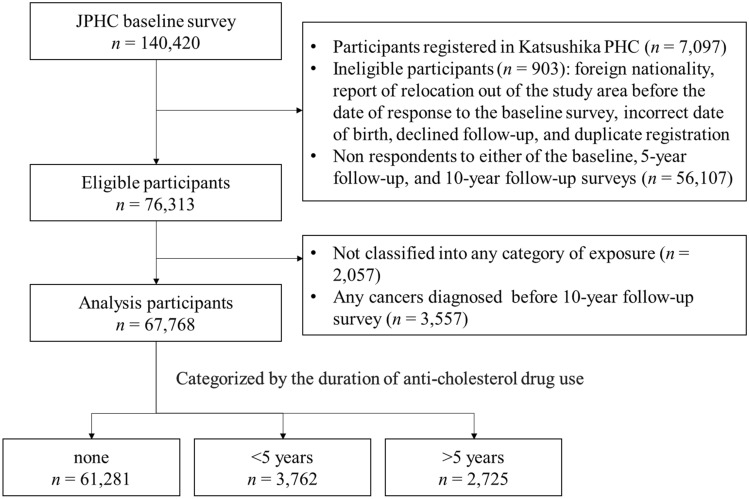
Several studies have investigated the association between the use of anti-cholesterol drugs and cancer risks, of which results have been inconsistent. This study included 67,768 participants from the Japan Public Health Center-based Prospective Study. The data on anti-cholesterol drug use was collected using three questionnaires of the survey conducted every five years. We divided the participants into three groups according to the duration of the anti-cholesterol drug use. Multivariable-adjusted Cox proportional hazard regression models were used to calculate hazard ratios (HR) and 95% confidence intervals (CI). During the 893,009 person-years of follow-up from the 10-year follow-up survey, 8,775 participants (5,387 men and 3,388 women) were newly diagnosed with cancers. The duration of anti-cholesterol drug use was significantly associated with a decreased risk of liver cancer (HR:0.26, 95% CI 0.11–0.64 in > 5 y group) and with an increased risk of pancreatic cancer (HR:1.59, 95% CI 1.03–2.47 in > 5 y group). Moreover, a different trend was observed between men and women in the association with the risk of lung cancer. This study suggested that long-term use of anti-cholesterol drugs may have associations with a decreased incidence of liver cancer and with an increased incidence of pancreatic cancers.
Overview
The claims and statistics of this paper haven’t been checked yet.
Free: it reads the open-access text and checks the first 5 claims that cite a source we can check. Create a free account to check every claim.
Integrity signals
Registry
Cites
Statistics
Figures
Verification
Claims the paper makes
The claims and statistics of this paper haven’t been checked yet.
Free: it reads the open-access text and checks the first 5 claims that cite a source we can check. Create a free account to check every claim.
Claims other papers make about this one
Each is checked against this paper’s own text: does it say what the citing paper says it does?
The source backs part of the claim, not all of it — or backs it for a different population, condition or comparison.
In the citing paper
“Evidence from large population-based cohorts demonstrates mixed results regarding the relationship between statin use and PDAC incidence or survival outcome, with some cohorts showing variable protective effects and others showing a survival benefit of statin exposure, as shown in Table 1”
From The antitumoral effect of statins in pancreatic ductal adenocarcinoma: a scoping review (2026) · cites this paper as Okita et al., 2024
Experimental — accuracy not yet measuredThe source backs part of the claim, not all of it — or backs it for a different population, condition or comparison.
In the citing paper
“The PDAC incidence rate in the >5 years of use was significantly higher with a hazard ratio (HR) of 1.77, and 95% confidence interval (CI) of 1.16–2.70, p = 0.04, which would indicate the long-term statin use as a PDAC development risk factor.”
From The antitumoral effect of statins in pancreatic ductal adenocarcinoma: a scoping review (2026) · cites this paper as Okita et al., 2024
Experimental — accuracy not yet measuredThe source backs part of the claim, not all of it — or backs it for a different population, condition or comparison.
In the citing paper
“The results reported by Okita et al., of a higher PDAC risk after more than 5 years of statin use”
From The antitumoral effect of statins in pancreatic ductal adenocarcinoma: a scoping review (2026) · cites this paper as Okita et al., 2024
Experimental — accuracy not yet measured
Self-check
Percentages, sums and reported differences re-computed from the paper’s own numbers.
The self-check needs the paper’s full text.
Citations
Cites
International Classification of Diseases for Oncology
Trott, P. A. (1977) · Journal of Clinical Pathology · doi:10.1136/jcp.30.8.782-c · Cited by 1,676
Statins and Cancer Risk: A Meta-analysis
Dale, K. M., Coleman, C. I., Henyan, N. N., Kluger, J., & White, C. M. (2006) · JAMA · doi:10.1001/jama.295.1.74 · Cited by 599
Primary Prevention of Cardiovascular Mortality and Events With Statin Treatments
Mills, E. J., Rachlis, B., Wu, P., Devereaux, P. J., Arora, P., & Perri, D. (2008) · Journal of the American College of Cardiology · doi:10.1016/j.jacc.2008.08.039 · Cited by 423
Statins: a repurposed drug to fight cancer
Jiang, W., Hu, J.-W., He, X.-R., Jin, W.-L., & He, X.-Y. (2021) · Journal of Experimental & Clinical Cancer Research · doi:10.1186/s13046-021-02041-2 · Cited by 417 · cited 1×
“Several reports have suggested that the mechanism of action of statins exerts a protective effect against cancers, independently from their effects on lowering cholesterol 7 , and some studies reported statins reduces risk to develop cancers 14,15 .”
BackgroundThe JPHC Study: Design and Some Findings on the Typical Japanese Diet
Tsugane, S., & Sawada, N. (2014) · Japanese Journal of Clinical Oncology · doi:10.1093/jjco/hyu096 · Cited by 387
Self-citationCarcinogenicity of Lipid-Lowering Drugs
Newman, T. B. (1996) · JAMA: The Journal of the American Medical Association · doi:10.1001/jama.1996.03530250059028 · Cited by 380
Statin use and cancer risk: a comprehensive review
Boudreau, D. M., Yu, O., & Johnson, J. (2010) · Expert Opinion on Drug Safety · doi:10.1517/14740331003662620 · Cited by 274 · cited 2×
“Several reports have suggested that the mechanism of action of statins exerts a protective effect against cancers, independently from their effects on lowering cholesterol 7 , and some studies reported statins reduces risk to develop cancers 14,15 .”
BackgroundStatins Reduce the Risk of Lung Cancer in Humans
Khurana, V., Bejjanki, H. R., Caldito, G., & Owens, M. W. (2007) · Chest · doi:10.1378/chest.06-0931 · Cited by 230
Statins and risk of cancer: A systematic review and metaanalysis
Browning, D. R. L., & Martin, R. M. (2007) · International Journal of Cancer · doi:10.1002/ijc.22366 · Cited by 228 · cited 1×
“It has been suggested in preclinical and clinical studies as evidence that statins have effects of the inhibition of tumor growth and the induction of apoptosis in specific cancer cell types 4,5 .”
Background
Cited by
Statins as anti‐tumor agents: A paradigm for repurposed drugs
Tripathi, S., Gupta, E., & Galande, S. (2024) · Cancer Reports · doi:10.1002/cnr2.2078 · Cited by 80
“266,267 Another limitation stems from cohort-specific inferences with limited follow-up data, 268 underscoring the necessity for a population-based analyses and longer-term patient medical records.”
BackgroundKounatidis, D. C., Tentolouris, N., Vallianou, N. G., Mourouzis, I. S., Karampela, Ι., Stratigou, T., Rebelos, E., Kouveletsou, M., Stamatopoulos, V., Tsaroucha, E., et al. (2024) · Metabolites · doi:10.3390/metabo14070388 · Cited by 26
“For instance, a Japanese study of 67,768 participants found that using statins for more than five years was associated with a reduced risk of liver cancer but an increased risk of pancreatic cancer [68].”
BackgroundCholesterol metabolism in pancreatic cancer and associated therapeutic strategies
Daya, T., Breytenbach, A., Gu, L., & Kaur, M. (2024) · Biochimica et Biophysica Acta (BBA) - Molecular and Cell Biology of Lipids · doi:10.1016/j.bbalip.2024.159578 · Cited by 21
Statin use and risk of HCC in patients with MASLD and T2DM: an umbrella review and meta-analysis
Hosseinkhan, N., Najafi, L., Jahangiri, S., Emami, Z., & Khamseh, M. E. (2025) · BMC Cancer · doi:10.1186/s12885-025-14299-2 · Cited by 8
“A longer duration of statin use (> 5 years) has recently been shown to significantly reduce the incidence of liver cancer (HR:0.26, 95% CI: [0.11–0.64]) [76].”
InfluentialCole, A. R., Buj, R., Uboveja, A., Levasseur, E., Tom, A., Wang, H., Kedziora, K. M., Chatoff, A. G., Huacachino, A. A., Marcinkiewicz, M. M., et al. (2026) · Nature Aging · doi:10.1038/s43587-026-01172-5 · Cited by 7
Impact of Statin Use on Immunotherapy Outcomes and Efficacy in Non-Small Cell Lung Cancer Patients
Yakobson, A., Agbarya, A., Dudnik, Y., Gothelf, I., Miari, A., Brenner, R. M., Jama, A. A., Yasin, N. A., Dabah, A. E. N., Meirovitz, A., et al. (2026) · International Journal of Molecular Sciences · doi:10.3390/ijms27031541 · Cited by 4
“Considering this, there has been growing interest in the potential anti-cancer effects of lipid-lowering agents, particularly statins [13–15].”
InfluentialKang, H. S., Kim, J., Kim, H., Lee, J. S., Choi, H. G., Yoo, D. M., Han, K. M., Kim, N. Y., Min, K., & Kwon, M. J. (2025) · Pharmaceuticals · doi:10.3390/ph18081236 · Cited by 3
“A UK study reported a 36% reduction in CRC risk with statin use exceeding one year [22], and a Spanish study showed a similar benefit for up to three years of use (OR = 0.79) [34], corresponding roughly to the intermediate and long-term periods considered in our study.”
InfluentialCorsetti, G., & Pasini, E. (2026) · Nutrients · doi:10.3390/nu18050722 · Cited by 5
“In addition, a study of 67,768 Japanese participants found that longer duration of cholesterol-lowering drug use was significantly associated with a reduced risk of liver cancer and an increased risk of pancreatic cancer, with sex-specific differences observed in lung cancer risk [43].”
Chew, P., & Chew, P. (2025) · doi:10.22541/au.175044409.93440217/v1 · Cited by 3
Multiphasic Venture of Cholesterol Homeostasis: A Perspective on Statin Therapy
Chandra, N. C., Suryan, V., & Chandra, K. (2026) · Journal of Biochemical and Molecular Toxicology · doi:10.1002/jbt.70722 · Cited by 2
“Besides pancreatic abnormality on insulin secretion, a tumour like growth of pancreas is also expected as per our hypothesis on cholesterol induced carcinogenesis described in earlier part of this report [32] and in panel‐”
Chandra, N. C., & Suryan, V. (2025) · Indian Journal of Clinical Biochemistry · doi:10.1007/s12291-025-01326-z · Cited by 1
Choudhury, P. R., Chakravarti, M., Bera, S., Arora, P., Sultana, J., Khan, M. A., Biradar, R., Guha, A., Dhar, S., Ghosh, I., et al. (2026) · Molecular Therapy Oncology · doi:10.1016/j.omton.2026.201250 · Cited by 2
“…use in different cancers including BC, head and neck squamous cell carcinoma (HNSCC), prostate malignancies, renal cell carcinoma (RCC), etc. 12–16 Cholesterol is also the chief constituent of the plasma membrane; it contributes to both antigen presentation 17,18 and T cell-mediated…”
Cham, J., Yang, E., Park, J., White, R. A., Fojo, T., Sigel, K. M., & Bates, S. E. (2026) · Cancer Epidemiology Biomarkers & Prevention · doi:10.1158/1055-9965.epi-26-0062 · Cited by 1
The antitumoral effect of statins in pancreatic ductal adenocarcinoma: a scoping review
Pîntea, A.-I., Croitoru, A. E., Dinu-Pîrvu, C. E., & Dima, S. O. (2026) · Frontiers in Pharmacology · doi:10.3389/fphar.2026.1815366
“…incidence) in subjects not yet diagnosed with cancer, or OS, disease-free survival (DFS)/relapse-free survival (RFS) in cancer patients (including PDAC patients) (Guo et al., 2025; Joliat et al., 2023; Okita et al., 2024; Stoer et al., 2021; Uemura et al., 2023; Xu et al., 2024; Yeh et al., 2021).”
InfluentialSubedi, L., Bamjan, A. D., Phuyal, S., Khadka, B., Chaudhary, M., Kim, K.-T., Kim, K. H., Shim, J., Cho, S., Yu, J. E., et al. (2025) · Pharmaceutics · doi:10.3390/pharmaceutics17070872 · Cited by 1
“The therapeutic potential of DT and AT in oncology has been extensively demonstrated in various clinical studies, particularly with regard to their ability to target cancer-associated risk factors and modulate tumor biology [30–34].”
Bian, C., Wang, H., Zhang, L., & Wang, F. (2025) · International Journal of Surgery · doi:10.1097/js9.0000000000003717
Nouvelles stratégies thérapeutiques dans le traitement du gliome infiltrant du tronc cérébral
Herrault, G. (2024) · theses.fr (ABES) · doi:10.70675/539ee639z4f77z47b3z903ez909ec614384d
Cholesterol and Its Journey Over the Centuries (1769−2025): The Highlights and Challenges
Chandra, K., & Chandra, N. C. (2026) · Cell Biochemistry and Function · doi:10.1002/cbf.70227
“…obesity onset diabetes [153, 156, 209–211]; in carcinogenesis either by carcinogen persuade [184] or through post anti‐cholesterol drug therapy [212]; and hypercholesterolemia related cholesterol influx‐induced cellular storage disorder which could be in lysosome (Niemann‐Pick disease) [213]…”
Metadata
- Authors
- Okita, Y., Sobue, T., Zha, L., Kitamura, T., Iwasaki, M., Inoue, M., Yamaji, T., Tsugane, S., & Sawada, N.
- Affiliations
- The University of Osaka (JP)
- National Cancer Center Institute for Cancer Control (JP)
- National Institute of Biomedical Innovation, Health and Nutrition (JP)
- Corresponding author
- Sobue, Tomotaka
- ORCID
- Venue
- Scientific Reports
- Published
- 2024-02-05
- Volume
- 14
- Issue
- 1
- Pages
- 2896-2896
- ISSN
- 2045-2322 (ISSN-L)
- PMC
- PMC10844312
- OpenAlex
- W4391536186
- Cited by
- 14
- References
- 31
- Citations by year
- 2026: 5 · 2025: 5 · 2024: 4
- FWCI
- 2.80
- Type
- journal article
- Language
- en
- Open access
- gold
- doi.org
- Licence
- cc-by
- creativecommons.org/licenses/by/4.0 (tdm)
- creativecommons.org/licenses/by/4.0 (vor)
- Locations
- Scientific Reports (publishedVersion, cc-by)
- PubMed Central (publishedVersion, cc-by)
- PubMed (publishedVersion)
- DOAJ (DOAJ: Directory of Open Access Journals) (submittedVersion)
- Funders
- Grant-in-Aid for Cancer Research from the Ministry of Health, Labour and Welfare of Japan (19shi-2)
- National Cancer Center Research and Development Fund (23-A-31(toku), 26-A-2, 29-A-4 and 2020-J-4)
- Topics
- Life Sciences › Biochemistry, Genetics and Molecular Biology › Cancer Research › Cancer, Lipids, and Metabolism
- Health Sciences › Medicine › Cardiology and Cardiovascular Medicine › Lipoproteins and Cardiovascular Health
- Health Sciences › Medicine › Pharmacology (medical) › Inflammatory mediators and NSAID effects
- Keywords
- statins, cancer risk, long-term drug use, duration of drug use, liver cancer, pancreatic cancer, lung cancer, sex differences, Japan Public Health Center-based Prospective Study
- MeSH terms
- Female, Humans, Japan, Liver Neoplasms, Male, Pancreatic Neoplasms, Prospective Studies, Risk Factors, Incidence, Proportional Hazards Models
About these checks
Registry, retraction, Cites and statistics results are computed, not judged, with one exception: a printed reference that no index lists is read once by a model before it counts as a citation error. Claims are extracted by a model and kept only when their quote appears verbatim in the text; each cited source is then checked, with a model’s help, for whether it says what the claim relies on. Those verdicts can be wrong — read the claim’s quote and the cited source before relying on one.
Statistics and arithmetic are recomputed, not judged.
Confidence bands are shown only for fields calibrated on our annotated test set. None is calibrated yet, so no band is shown.
What counts as a claim ›How we measure confidence ›How we check this ›
Are you an author, or do you see a problem with this page? Request a review
Data sources
Bibliographic data: Semantic Scholar, OpenAlex, Crossref.
Contains information from the Semantic Scholar Academic Graph Datasets, made available under the ODC Attribution License (ODC-BY 1.0).
Semantic Scholar’s data is described in: Kinney, R., et al. (2023). The Semantic Scholar Open Data Platform. arXiv:2301.10140.
