

Song lyrics have become simpler and more repetitive over the last five decades
Open accessThe DOI matches its Crossref record; 54 of the 54 references it cites were found in a registry or an index; none of the 36 sources its claims cite is checked for support yet.
Abstract
Music is ubiquitous in our everyday lives, and lyrics play an integral role when we listen to music. The complex relationships between lyrical content, its temporal evolution over the last decades, and genre-specific variations, however, are yet to be fully understood. In this work, we investigate the dynamics of English lyrics of Western, popular music over five decades and five genres, using a wide set of lyrics descriptors, including lyrical complexity, structure, emotion, and popularity. We find that pop music lyrics have become simpler and easier to comprehend over time: not only does the lexical complexity of lyrics decrease (for instance, captured by vocabulary richness or readability of lyrics), but we also observe that the structural complexity (for instance, the repetitiveness of lyrics) has decreased. In addition, we confirm previous analyses showing that the emotion described by lyrics has become more negative and that lyrics have become more personal over the last five decades. Finally, a comparison of lyrics view counts and listening counts shows that when it comes to the listeners’ interest in lyrics, for instance, rock fans mostly enjoy lyrics from older songs; country fans are more interested in new songs’ lyrics.
Overview
CoChat Summary
TL;DR
Analyzing 353,320 English-language Western popular songs from 1970–2020 across five genres, the paper finds that lyrics have become simpler, more repetitive, more personal, and more negative over time. It also shows that lyrics view counts, unlike listening counts, vary by genre and release year, with rock fans favoring older lyrics and country fans favoring newer lyrics.
Key findings
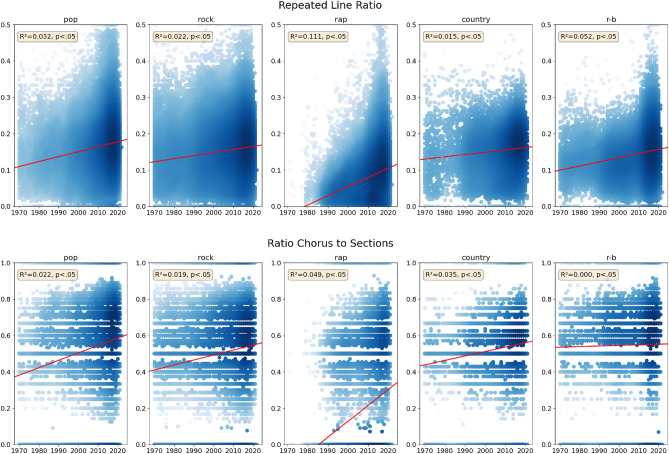
- Lyrics became more repetitive across all five genres: repeated line ratio increased over time, strongest for rap (m=0.002516) and weakest for country (m=0.000640); ratio of chorus to sections also increased for all genres, strongest for rap (m=0.008703) and weakest for R&B (m=0.000325).
- Lyrics became more personal and more negative: pronoun frequency increased for all genres except country (m=-0.000145), strongest for rap (m=0.000926); anger increased across all genres, most for rap (m=0.015996); negative emotion increased across all genres, highest for rap (m=0.021701) and lowest for country (m=0.000606). Positive emotion decreased for pop, rock, country, and R&B, while rap showed a moderate increase (m=0.000129).
- Release-year regression models explained the most variance for rap (adjusted R²=0.32) and R&B (adjusted R²=0.19), and less for country (0.11), pop (0.09), and rock (0.09). Repeated line ratio was the only descriptor with a meaningful positive effect for all genres.
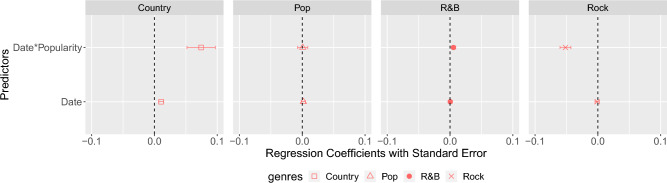
- Lyrics view count had a positive relationship with release year for R&B (β=0.32, p=.003) and a strong negative relationship for rock (β=-1.47, p<.000); multinomial logistic regression showed country-vs-rap odds increased with lyrics view count and year (β=0.07, SE=0.02, z=3.29, p=.0009), while rock-vs-rap odds decreased (β=-0.05, SE=0.01, z=-5.89, p<.0001). Listening counts showed no significant effects.
Methods
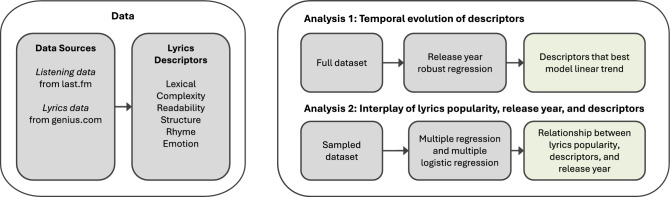
- Data: LFM-2b last.fm listening events enriched with Genius release year, genre, lyrics, and popularity data; 353,320 English songs spanning 1970–2020 across rap, country, pop, R&B, and rock.
- Analysis 1: per-genre Huber M robust regression predicting release year from lyrical descriptors after z-score normalization and VIF-based removal of multicollinear descriptors; descriptor importance assessed via regression coefficients.
- Analysis 2: balanced downsampled dataset of 12,000 songs (2,400 per genre) restricted to 1990–2020; multinomial logistic regression with genre as outcome and popularity × release year predictors, then per-genre multiple linear regression predicting release year from lyrics descriptors and lyrics view count using backward stepwise selection.
Limitations
- The paper states that last.fm and Genius introduce community bias and popularity bias: last.fm users are not representative, skew male, ages 20–30, and are dominated by the US, Russia, Germany, and UK; pre-platform listening and lyrics-view counts underestimate true frequencies, and physical releases may be missing.
- The paper states further limitations: genre assignments on Genius may be malformed; the study is restricted to English lyrics; readability metrics are simple and sentence-based; models assume linear change over time; downsampling may introduce sampling bias, especially for pop and country.
- The text itself makes evident that explanatory power is often low: adjusted R² values are small for several genres, the multinomial model has McFadden pseudo R²=0.01, and the authors note that significant p-values may partly result from the huge sample size and random noise.
Model-written summary. Check it against the paper before relying on it.
Integrity signals
Registry
Cites
Statistics
Figures
Verification
Claims the paper makes
0 Valid · 3 Not valid · 26 Not checked · 87 Own results and interpretations
A result the paper reports from its own data — it cites no other source for it, so there is none to check. The quote shows it is in the paper.
In the paper
“The repeated line ratio increases over time for all five genres, indicating that lyrics are becoming more repetitive.”
§ Song lyrics have become simpler and more repetitive over the last five decades > Results and discussion > Analysis 1: evolution of lyrics and descriptor importance
hedgedstates a cause- Asserted: passes — The authors put it forward as true.
- Checkable: passes — It can be checked against evidence.
- Load-bearing: passes — The paper’s conclusions depend on it.
- Based: passes — The paper gives a reason why it holds.
A result the paper reports from its own data — it cites no other source for it, so there is none to check. The quote shows it is in the paper.
In the paper
“However, the opposite trend is shown for R&B (cf. β=-0.96, in Table 4)”
§ Song lyrics have become simpler and more repetitive over the last five decades > Results and discussion > Analysis 2: interplay of lyrics descriptors, view counts, and release year
plainstates an association- Asserted: passes — The authors put it forward as true.
- Checkable: passes — It can be checked against evidence.
- Load-bearing: passes — The paper’s conclusions depend on it.
- Based: passes — The paper gives a reason why it holds.
A result the paper reports from its own data — it cites no other source for it, so there is none to check. The quote shows it is in the paper.
In the paper
“Concerning complexity, this is displayed by the positive β for compression ratio (essentially capturing the repeatability of lyrics) shown by rap (cf. β=0.70 in Table 4).”
§ Song lyrics have become simpler and more repetitive over the last five decades > Results and discussion > Analysis 2: interplay of lyrics descriptors, view counts, and release year
plainstates an association- Asserted: passes — The authors put it forward as true.
- Checkable: passes — It can be checked against evidence.
- Load-bearing: passes — The paper’s conclusions depend on it.
- Based: passes — The paper gives a reason why it holds.
A result the paper reports from its own data — it cites no other source for it, so there is none to check. The quote shows it is in the paper.
In the paper
“For R&B the results show that the content of the lyrics becomes more negative with time, as shown by the increase in concepts related to anger and a detriment in positive emotions (cf. β=1.91 and β=-0.89, respectively, in Table 4).”
§ Song lyrics have become simpler and more repetitive over the last five decades > Results and discussion > Analysis 2: interplay of lyrics descriptors, view counts, and release year
plainstates a cause- Asserted: passes — The authors put it forward as true.
- Checkable: passes — It can be checked against evidence.
- Load-bearing: unclear — It is unclear whether the paper’s conclusions depend on it.
- Based: passes — The paper gives a reason why it holds.
None of the sources cited for this claim have been checked yet.
In the paper
“we confirm previous analyses showing that the emotion described by lyrics has become more negative and that lyrics have become more personal over the last five decades”
§ Song lyrics have become simpler and more repetitive over the last five decades > Abstract
boostedstates an association- Asserted: passes — The authors put it forward as true.
- Checkable: passes — It can be checked against evidence.
- Load-bearing: passes — The paper’s conclusions depend on it.
- Based: passes — The paper gives a reason why it holds.
42 more claims
Create a free account to see all 116 claims and to verify the 35 references still open.
- It may state two separate claims as one. 50
- Probably not a substantial claim. 32
Statistics recomputed
Every reported test result, recomputed from its test statistic and degrees of freedom. A result shows as not adding up only once an independent check has confirmed it.
- Not confirmedz = 3.29reported p = .0009 · recomputed p = .001
“z=3.29, p = .0009”
- Consistentz = -5.89reported p < .0001 · recomputed p < .001
“z=-5.89, p < .0001”
Self-check
Percentages, sums and reported differences re-computed from the paper’s own numbers.
Each contradiction between two passages listed here was confirmed by an independent check.
Rated major: it would touch a result — a value a result rests on, reported and recomputed p-values on opposite sides of the significance level, two passages that conflict with no sign which is right, or a cited work retracted before this paper was published.
In the paper
§ Song lyrics have become simpler and more repetitive over the last five decades > Results and discussion > Analysis 1: evolution of lyrics and descriptor importance
“Furthermore, our analysis shows that lyrics have become angrier across all genres, with rap showing the most profound increase in anger (m=0.015996).”
§ Song lyrics have become simpler and more repetitive over the last five decades > Results and discussion > Result summary for both studies
“Also, we observe a trend towards angrier lyrics across all genres except for rock.”
Rated minor: it would not touch a result — a value no result rests on, a p-value that stays on the same side of the significance level, or a conflict that is clerical, resolved elsewhere in the paper, or outside its own findings.
In the paper
§ Song lyrics have become simpler and more repetitive over the last five decades > Results and discussion > Analysis 1: evolution of lyrics and descriptor importance
“| 8 | Avg. token lengthL | Dale-Chall readability scoreR | MTLDD | Unique rhyme wordsRh | MTLDD |”
§ Song lyrics have become simpler and more repetitive over the last five decades > Results and discussion > Analysis 1: evolution of lyrics and descriptor importance
“Note: Superscripts denote descriptor categories, with L = lexical, E = emotion, S = structural, Rh = rhyme, Re = readability, and D = diversity.”
Rated minor: it would not touch a result — a value no result rests on, a p-value that stays on the same side of the significance level, or a conflict that is clerical, resolved elsewhere in the paper, or outside its own findings.
In the paper
§ Song lyrics have become simpler and more repetitive over the last five decades > Results and discussion > Analysis 1: evolution of lyrics and descriptor importance
“Four descriptors are featured in the top descriptors of three genres each”
§ Song lyrics have become simpler and more repetitive over the last five decades > Results and discussion > Analysis 1: evolution of lyrics and descriptor importance
“(ratio verses to sections, ratio choruses to sections, average token length, Dugast’s U (modelling the number of token types as a function of the token count), and blank line count.”
Citations
Cites
Matplotlib: a 2D graphics environment
Hunter, J. D. (2007) · Computing in Science & Engineering · doi:10.1109/mcse.2007.55 · Cited by 39,249
SciPy 1.0: fundamental algorithms for scientific computing in Python
Virtanen, P., Gommers, R., Oliphant, T. E., Haberland, M., Reddy, T., Cournapeau, D., Burovski, E., Peterson, P., Weckesser, W., Bright, J., et al. (2020) · Nature Methods · doi:10.1038/s41592-019-0686-2 · Cited by 38,430
Wickham, H. (2016) · Use R! · doi:10.1007/978-3-319-24277-4 · Cited by 33,115
WordNet: a lexical database for English
Miller, G. A. (1995) · Communications of the ACM · doi:10.1145/219717.219748 · Cited by 14,015
Mining and summarizing customer reviews
Hu, M., & Liu, B. (2004) · Proceedings of the tenth ACM SIGKDD international conference on Knowledge discovery and data mining · doi:10.1145/1014052.1014073 · Cited by 7,793
Statsmodels: Econometric and Statistical Modeling with Python
Seabold, S., & Perktold, J. (2010) · Proceedings of the Python in Science Conference · doi:10.25080/majora-92bf1922-011 · Cited by 6,465
The Psychological Meaning of Words: LIWC and Computerized Text Analysis Methods
Tausczik, Y. R., & Pennebaker, J. W. (2010) · Journal of Language and Social Psychology · doi:10.1177/0261927x09351676 · Cited by 5,774 · cited 1×
“Furthermore, we extract emotional descriptors from lyrics by applying the widely used Linguistic Inquiry and Word Count (LIWC) dictionary 39 , which has also been applied to lyrics analyses 18,37,40 .”
Handbook of Emotion Regulation
Lambert, K. G. (2007) · JAMA · doi:10.1001/jama.298.15.1808 · Cited by 4,902
Recognizing contextual polarity in phrase-level sentiment analysis
Wilson, T., Wiebe, J., & Hoffmann, P. (2005) · Proceedings of the conference on Human Language Technology and Empirical Methods in Natural Language Processing - HLT '05 · doi:10.3115/1220575.1220619 · Cited by 3,345
Discovering statistics using R
(2012) · Choice Reviews Online · doi:10.5860/choice.50-2114 · Cited by 2,534
Research works printed but not linked: 8
- Fell, M. Lyrics classification. Master’s Thesis, Saarland University (2014).
- Huber PJ Robust Statistics 2004 John Wiley & Sons
- Pinheiro J Package ‘nlme’ Linear Nonlinear Mixed Effects Models Version 2017 3 274
- Toop, D., Cheney, C. & Kajikawa, L. Rap. In New Grove Music online (Oxford music online).
- Rye, H. Rhythm-and-blues. In New Grove Music online (Oxford music online).
- Middleton, R. Rock. In New Grove Music online (Oxford music online).
- Mass H-D Über den Zusammenhang zwischen Wortschatzumfang und Länge eines Textes Zeitschrift fur Literaturwissenschaft und Linguistik 1972 2 73
- Mohammad SM Turney PD NRC emotion lexicon Natl. Res. Counc. Can. 2013 2 234
Cited by
Patterns of linguistic simplification on social media platforms over time
Marco, N. D., Loru, E., Bonetti, A., Serra, A. O. G., Cinelli, M., & Quattrociocchi, W. (2024) · Proceedings of the National Academy of Sciences · doi:10.1073/pnas.2412105121 · Cited by 66
Data‑Driven Analysis of Text‑Conditioning in AI‑Generated Music: A Case Study with Suno and Udio
Casini, L., Vila, L. C., Dalmazzo, D., Kaila, A.-K., & Sturm, B. L. T. (2026) · Transactions of the International Society for Music Information Retrieval · doi:10.5334/tismir.273 · Cited by 21
The Evolution of Song Lyrics: An NLP-Based Analysis of Popular Music in Germany from 1954 to 2022
Hunke, T., Huber, F., & Steffens, J. (2025) · Music & Science · doi:10.1177/20592043251331155 · Cited by 10
Are groundbreaking science discoveries becoming harder to find?
Matthews, D. (2025) · Nature · doi:10.1038/d41586-025-01548-4 · Cited by 8
Marco, N. D., Loru, E., Galeazzi, A., Cinelli, M., & Quattrociocchi, W. (2026) · Scientific Reports · doi:10.1038/s41598-026-42872-7 · Cited by 8
Charting the Universe of Metal Music Lyrics and Analyzing Their Relation to Perceived Audio Hardness
Czedik-Eysenberg, I., Wieczorek, O., Flexer, A., & Reuter, C. W. (2024) · Transactions of the International Society for Music Information Retrieval · doi:10.5334/tismir.182 · Cited by 7
Double Entendre: Robust Audio-Based AI-Generated Lyrics Detection via Multi-View Fusion
Frohmann, M., Meseguer-Brocal, G., Schedl, M., & Epure, E. V. (2025) · Findings of the Association for Computational Linguistics: ACL (Findings of ACL) · doi:10.18653/v1/2025.findings-acl.98 · Cited by 7
Self-citationRösch, J., & Rauch, M.-J. (2025) · Journal of Cultural Economics · doi:10.1007/s10824-025-09532-6 · Cited by 4
Wang, X., & Wong, E. (2025) · International Journal of Digital Humanities · doi:10.1007/s42803-025-00103-x · Cited by 4
Foramitti, M., Nater, U. M., Lamm, C., & Martins, M. J. D. (2025) · Scientific Reports · doi:10.1038/s41598-025-28327-5 · Cited by 4
Winter-Froemel, E., & KG, W. D. G. G. &. C. (2025) · De Gruyter eBooks · doi:10.1515/9783111553498 · Cited by 4
Hybrid AI for Human-Centric Personalization (HyPer)
Lex, E., Innerebner, K., Tkalčič, M., Kowald, D., & Schedl, M. (2025) · ACM Conference on User Modeling, Adaptation and Personalization (UMAP) · doi:10.1145/3708319.3727563 · Cited by 3
Self-citationThe Importance of Cognitive Biases in the Recommendation EcosystemPreprint
Schedl, M., Lesota, O., Brandl, S., Lotfi, M. M., Ticona, G. E., & Masoudian, S. (2024) · arXiv (Cornell University) · doi:10.48550/arxiv.2408.12492 · Cited by 3
Self-citation197 Di muor yu luk, di les yu si : Wordplay, duplicity, and exclusion in dancehall songs
Clarke, P. (2025) · De Gruyter eBooks · doi:10.1515/9783111553498-008 · Cited by 3
Pagsusuring Pangnilalaman sa mga Piling Orihinal na Pilipinong Musika (OPM): Disenyo ng Aralin
Caipang, M., & Orcullo, C. (2024) · UB Advancing Filipino Research Journal · doi:10.15631/ubafrj.v2i1.212 · Cited by 3
Max, J. I. S. D. (2025) · ELITERATE Journal of English Linguistics and Literature Studies · doi:10.26858/eliterate.v4i3.75313 · Cited by 3
Wang, X. (2025) · Journal of Cultural Analytics · doi:10.22148/001c.144809 · Cited by 2
Psychological Aspects in Retrieval and Recommendation
Schedl, M., Lex, E., & Tkalčič, M. (2025) · International ACM SIGIR Conference on Research and Development in Information Retrieval (SIGIR) · doi:10.1145/3726302.3731691 · Cited by 2
Self-citationNonthasen, N., Samakketwit, S., Srisompak, P., & Laosrirattanachai, P. (2025) · Studies in English Language and Education · doi:10.24815/siele.v12i3.41375 · Cited by 2
Linguistic and Thematic Attributes of German Pop Songs Used at Funerals
Hanser, W. E., Loepthien, T., Mark, R. E., & Vingerhoets, A. J. J. M. (2025) · OMEGA - Journal of Death and Dying · doi:10.1177/00302228251375112 · Cited by 2
Computational Lexical Analysis of Flamenco Genres
Rosillo-Rodes, P., Miguel, M. S., & Sánchez, D. (2025) · Journal on Computing and Cultural Heritage · doi:10.1145/3748729 · Cited by 2
LyricLure: Mining Catchy Hooks in Song Lyrics to Enhance Music Discovery and Recommendation
Sharma, S., Shukla, A., Walimbe, A., Sharma, T., & Delgado, J. (2024) · ACM Conference on Recommender Systems (RecSys) · doi:10.1145/3640457.3688049 · Cited by 1
Involvement drives complexity of language in online debatesPreprint
Amadori, E., Cirulli, D., Martino, E. D., Nudo, J., Sahakyan, M., Sangiorgio, E., Santoro, A., Zollo, S., Galeazzi, A., & Marco, N. D. (2025) · arXiv (Cornell University) · doi:10.48550/arxiv.2506.22098 · Cited by 1
The Sound of Streaming: Globalization and Acoustic Convergence in Popular Music Markets
Wohlrabe, K., & Wolf, G. (2026) · CESifo · doi:10.65864/vo0g3bb8aw · Cited by 1
Pop song Lyrics through the Lens of Sociolinguistics. A case study of Bob Dylan's Lyrics
Garzone, G. (2025) · Lingue e linguaggi · doi:10.1285/i22390359v71p91 · Cited by 1
From prose to pose: lyric readability and performance success at the Sanremo Music Festival
Alfano, V. (2026) · Journal of Cultural Economics · doi:10.1007/s10824-026-09584-2 · Cited by 1
Disc-Cover Complexity Trends in Music Illustrations from Sinatra to Swift
Fracaro, N., Cecconello, S., Conti, M., Marco, N. D., & Galeazzi, A. (2026) · ACM Symposium on Applied Computing · doi:10.1145/3748522.3779759 · Cited by 1
The Aesthetic Interplay Between Music and Literature: From Narrative to Lyricism
Wang, H. (2025) · Cultura · Cited by 1
Brandtzæg, S. G. (2025) · Scandinavian Academic Press eBooks · doi:10.62342/sap.oa.2030 · Cited by 1
From Nicki Minaj to Neuroblastoma: What Rigorous Approaches to Rhythms and Radiomics Have in Common
Safdar, N. M., & Galaria, A. (2024) · Radiology Artificial Intelligence · doi:10.1148/ryai.240350 · Cited by 1
Hopkinson, P., & Niklasson, M. (2025) · Emerald Group Publishing Limited eBooks · doi:10.1108/978-1-83708-380-020251010
Rhetorical Expressions in Banyuwangi Folk Songs as a Reflection of Osing Cultural Identity
Suyitno, I., Fawzi, A., Sulistyorini, D., & Arista, H. D. (2026) · Roczniki Humanistyczne · doi:10.18290/rh257312.19
Understanding and predicting cultural change
Varnum, M. E. W., & Grossmann, I. (2026) · Advances in experimental social psychology · doi:10.1016/bs.aesp.2026.03.004
Predicting Eurovision Song Contest Results: A Hit Song Science Approach
Adamska, K., & Reiss, J. (2025) · Transactions of the International Society for Music Information Retrieval · doi:10.5334/tismir.214
Chang, C.-A. (2025) · Corpus Pragmatics · doi:10.1007/s41701-025-00205-5
Violating the rules: grammatical deviations as a strategy for musicality in modern English songs
Khalifa, T. B. (2026) · Cogent Arts and Humanities · doi:10.1080/23311983.2026.2708578
Logie, C. H., Borek, S. V., Puvaneyshwaran, D., Mackenzie, F., Hasham, A., Mbende, B., Boumba, L. M. A., Linguissi, L. S. G., & Loemba, H. (2026) · International Journal of Qualitative Methods · doi:10.1177/16094069261427274
Heijne, J., Ungruh, R., & Pera, M. S. (2026) · Communications in computer and information science · doi:10.1007/978-3-032-12717-4_5
журнала, С. Р. М. Н.-И. (2026) · Cifra LLC Journals · doi:10.60797/irj.2026.172.28.13
POS-теги с FDR-устойчивым трендом, подтверждённым на уникальных текстах
Р.Д., К., Gibadullin, R. F., & Л.Р., М. (2026) · Cifra LLC Journals · doi:10.60797/irj.2026.172.28.5
Состав аналитической выборки и контроль качества
Р.Д., К., Gibadullin, R. F., & Л.Р., М. (2026) · Cifra LLC Journals · doi:10.60797/irj.2026.172.28.1
Р.Д., К., Gibadullin, R. F., & Л.Р., М. (2026) · Cifra LLC Journals · doi:10.60797/irj.2026.172.28.9
Р.Д., К., Gibadullin, R. F., & Л.Р., М. (2026) · Международный научно-исследовательский журнал · doi:10.60797/irj.2026.172.28
Р.Д., К., Gibadullin, R. F., & Л.Р., М. (2026) · Cifra LLC Journals · doi:10.60797/irj.2026.172.28.7
Р.Д., К., Gibadullin, R. F., & Л.Р., М. (2026) · Cifra LLC Journals · doi:10.60797/irj.2026.172.28.10
Р.Д., К., Gibadullin, R. F., & Л.Р., М. (2026) · Cifra LLC Journals · doi:10.60797/irj.2026.172.28.6
Р.Д., К., Gibadullin, R. F., & Л.Р., М. (2026) · Cifra LLC Journals · doi:10.60797/irj.2026.172.28.8
Корреляции годовой средней повторяемости с основными метриками
Р.Д., К., Gibadullin, R. F., & Л.Р., М. (2026) · Cifra LLC Journals · doi:10.60797/irj.2026.172.28.11
Годовые тренды основных метрик
Р.Д., К., Gibadullin, R. F., & Л.Р., М. (2026) · Cifra LLC Journals · doi:10.60797/irj.2026.172.28.2
Число песен и средний годовой объём текста — ограничения для сопоставления периодов
Р.Д., К., Gibadullin, R. F., & Л.Р., М. (2026) · Cifra LLC Journals · doi:10.60797/irj.2026.172.28.12
Р.Д., К., Gibadullin, R. F., & Л.Р., М. (2026) · Cifra LLC Journals · doi:10.60797/irj.2026.172.28.3
Popescu, A., & Holman, A. C. (2026) · Musicae Scientiae · doi:10.1177/10298649261419790
Semantic homogenization in Italian popular music: a diachronic analysis
Canale, L., Scotta, S., & Messina, A. (2026) · Journal of Computational Social Science · doi:10.1007/s42001-026-00468-1
Heteroevaluación punitiva del desempeño docente en la era de la posverdad: un análisis crítico
Richard, E. (2025) · Revista Ensayos Pedagógicos · doi:10.15359/rep.20-2.6
Song Lyrics That Make Us Cry: Word Use and Meaning
Hanser, W. E., Mark, R. E., & Vingerhoets, A. J. J. M. (2026) · Psihologijske teme
Song Lyrics That Make Us Cry: Word Use and Meaning
Hanser, W. E., Mark, R. E., & Vingerhoets, A. J. J. M. (2026) · Psihologijske teme · doi:10.31820/pt.35.1.3
Длина предложения и слова, Yule’s K и доля первого лица
Р.Д., К., Р.Ф., Г., & Л.Р., М. (2026) · Cifra LLC Journals · doi:10.60797/irj.2026.172.28.4
Evaluation of artistic inspiration by biodiversity in lyrics of Japanese popular songsPreprint
Ishii, N. I. (2024) · SocArXiv (OSF Preprints) · doi:10.31235/osf.io/gsw57
A Multimedia Perspective on the Study of Cognitive Biases in Large Language Models
Schedl, M., Masoudian, S., & Tommasel, A. (2026) · doi:10.1145/3841457.3841518
Self-citationBattle of the Bands: Trying to Identify Contributions to a Collaboration
Cipolli, W., Dalzell, N. M., Bower, R., & Evans, C. (2025) · Journal of Statistics and Data Science Education · doi:10.1080/26939169.2025.2547611
Wang, Y., Wang, L., Xie, F., & Liu, H. (2026) · Digital Scholarship in the Humanities · doi:10.1093/llc/fqaf148
The Era-Dissociation Effect of Lyrics on Music Aesthetics: Evidence from Chinese Popular Music
Gao, Y. (2025) · Research Review · doi:10.52845/cs/2025-5-3-85
Sentiment analysis of popular song lyrics in the US from the 1990s and 2010s
Toomsalu, M. (2024) · DSpace repository (University of Tartu)
Music and Discourse: Theoretical and Empirical Insights
Tommaso, E. B. L., & Maci, S. M. (2025) · Lingue e linguaggi · doi:10.1285/i22390359v71
Predvidevanje kakovosti pesmi iz zvoka in besedila
Dugajlić, M. (2024) · Repository of the University of Primorsk (University of Primorska)
Model Rekomendasi Musik Berbasis Representasi Semantik Lirik Lagu Menggunakan BERT
Zia, D. H., & Fersellia, F. (2026) · JSAI (Journal Scientific and Applied Informatics) · doi:10.36085/jsai.v9i1.9919
The Vocal Eras Tour: Microtiming Trends Across Decades and Genres
Georgieva, E., Fernandes, D., Menezes, E. C., Coelho, V., Fuentes, M., Ripollés, P., & McFee, B. (2026) · Transactions of the International Society for Music Information Retrieval · doi:10.5334/tismir.278
Evolution of moral expression in song lyrics
Preniqi, V., Kaltenbrunner, A., Kalimeri, K., & Saitis, C. (2026) · Scientific Reports · doi:10.1038/s41598-026-53778-9
Schneider, R. (2026) · Language Resources and Evaluation Conference (LREC) · doi:10.63317/4dh6sfnuqcnr
Sanoittamisen vaikuttavuus suomalaisissa sanoitusoppaissa
Lampela, A. (2026) · Jyväskylä University Digital Archive (University of Jyväskylä)
On computational approaches to Pop music culturePreprint
Flexer, A. (2026) · arXiv (Cornell University) · doi:10.48550/arxiv.2608.17812
Aulia, H. L., Kusumawati, F. P., Subandowo, D., & Siagiyanto, B. E. (2026) · Journal of English Education and Enterpreneurship (JEEP) · doi:10.24127/j.v6i2.12830
The Appropriation of the Arts: Folk Song in Advertising, Film, and Beyond
Fernando, H., Larasati, Y. G., Suryati, S., & Sanjaya, R. S. (2025) · Jurnal Mebang Kajian Budaya Musik dan Pendidikan Musik
New Generation Vice in Southeast Nigeria: A Thematic Analysis of Ndi Oke ite Akalia
Ugoala, B. (2025) · LALICO Journal of Languages, Literature, and Communication
Fikriansyah, G., & Hanutomo, D. A. (2026) · International Journal of Social Sciences and Humanities · doi:10.55681/ijssh.v4i3.3807
Huseynova, Ç., & Subatan, S. D. (2026) · Journal of Music Theory and Transcultural Music Studies · doi:10.5281/zenodo.24127377
Metadata
- Authors
- Parada-Cabaleiro, E., Mayerl, M., Brandl, S., Skowron, M., Schedl, M., Lex, E., & Zangerle, E.
- Affiliations
- Universität Innsbruck (AT)
- Austrian Research Institute for Artificial Intelligence (AT)
- Johannes Kepler University of Linz (AT)
- Graz University of Technology (AT)
- Corresponding author
- Zangerle, Eva
- Venue
- Scientific Reports
- Published
- 2024-03-28
- Volume
- 14
- Issue
- 1
- Pages
- 5531-5531
- ISSN
- 2045-2322 (ISSN-L)
- PMC
- PMC10978890
- OpenAlex
- W4393255711
- Semantic Scholar
- b653a1907f6075e806e25c7b371636333d2a27fc
- Cited by
- 73
- References
- 53
- Citations by year
- 2026: 36 · 2025: 28 · 2024: 9
- FWCI
- 108.37
- Type
- journal article
- Language
- en
- Update notices
- correction (2024-05-22)
- Open access
- gold
- doi.org
- Licence
- cc-by
- creativecommons.org/licenses/by/4.0 (tdm)
- creativecommons.org/licenses/by/4.0 (vor)
- Locations
- Scientific Reports (publishedVersion, cc-by)
- PubMed Central (publishedVersion, cc-by)
- PubMed (publishedVersion)
- Digital Library of the University of Innsbruck (University of Innsbruck) (submittedVersion, cc-by)
- DOAJ (DOAJ: Directory of Open Access Journals) (submittedVersion, cc-by-sa)
- Funders
- Austrian Science Fund (DFH-23, P33526)
- Topics
- Social Sciences › Arts and Humanities › Music › Music History and Culture
- Social Sciences › Arts and Humanities › Music › Musicology and Musical Analysis
- Social Sciences › Arts and Humanities › Literature and Literary Theory › Digital Humanities and Scholarship
- Keywords
- song lyrics, lexical complexity, readability, repetition, music genres, popular music, rock music, country music
- MeSH terms
- Emotions, Music, Vocabulary
About these checks
Registry, retraction, Cites and statistics results are computed, not judged, with one exception: a printed reference that no index lists is read once by a model before it counts as a citation error. Claims are extracted by a model and kept only when their quote appears verbatim in the text; each cited source is then checked, with a model’s help, for whether it says what the claim relies on. Those verdicts can be wrong — read the claim’s quote and the cited source before relying on one.
A language model drew the claims from the paper on 2026-11-20, under version 3 of the claim definition (model deepseek-v4.1-flash, prompt extract-v3).
A second model labelled each claim on 2026-11-20 (model jev-1.13-20260917, definition revision gold-guideline-v0.2).
Statistics and arithmetic are recomputed, not judged.
Confidence bands are shown only for fields calibrated on our annotated test set. None is calibrated yet, so no band is shown.
What counts as a claim ›How we measure confidence ›How we check this ›
Are you an author, or do you see a problem with this page? Request a review
Data sources
Bibliographic data: Semantic Scholar, OpenAlex, Crossref.
Contains information from the Semantic Scholar Academic Graph Datasets, made available under the ODC Attribution License (ODC-BY 1.0).
Semantic Scholar’s data is described in: Kinney, R., et al. (2023). The Semantic Scholar Open Data Platform. arXiv:2301.10140.
