

Song lyrics have become simpler and more repetitive over the last five decades
Open accessThe DOI matches its Crossref record; 54 of the 54 references it cites were found in a registry or an index; none of the 36 sources its claims cite is checked for support yet.
Abstract
Music is ubiquitous in our everyday lives, and lyrics play an integral role when we listen to music. The complex relationships between lyrical content, its temporal evolution over the last decades, and genre-specific variations, however, are yet to be fully understood. In this work, we investigate the dynamics of English lyrics of Western, popular music over five decades and five genres, using a wide set of lyrics descriptors, including lyrical complexity, structure, emotion, and popularity. We find that pop music lyrics have become simpler and easier to comprehend over time: not only does the lexical complexity of lyrics decrease (for instance, captured by vocabulary richness or readability of lyrics), but we also observe that the structural complexity (for instance, the repetitiveness of lyrics) has decreased. In addition, we confirm previous analyses showing that the emotion described by lyrics has become more negative and that lyrics have become more personal over the last five decades. Finally, a comparison of lyrics view counts and listening counts shows that when it comes to the listeners’ interest in lyrics, for instance, rock fans mostly enjoy lyrics from older songs; country fans are more interested in new songs’ lyrics.
Overview
CoChat Summary
TL;DR
Analyzing 353,320 English-language Western popular songs from 1970–2020 across five genres, the paper finds that lyrics have become simpler, more repetitive, more personal, and more negative over time. It also shows that lyrics view counts, unlike listening counts, vary by genre and release year, with rock fans favoring older lyrics and country fans favoring newer lyrics.
Key findings
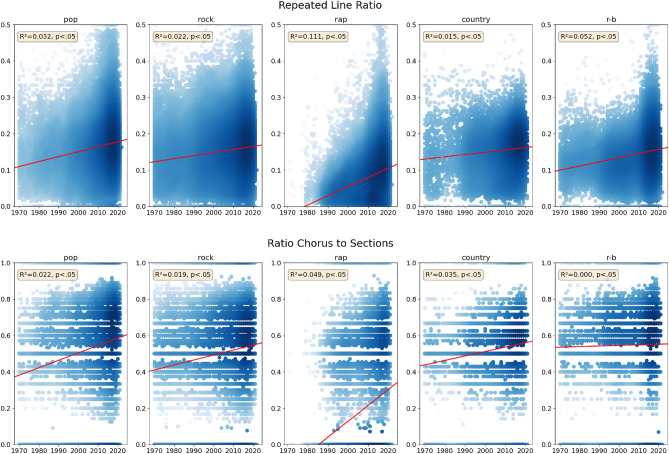
- Lyrics became more repetitive across all five genres: repeated line ratio increased over time, strongest for rap (m=0.002516) and weakest for country (m=0.000640); ratio of chorus to sections also increased for all genres, strongest for rap (m=0.008703) and weakest for R&B (m=0.000325).
- Lyrics became more personal and more negative: pronoun frequency increased for all genres except country (m=-0.000145), strongest for rap (m=0.000926); anger increased across all genres, most for rap (m=0.015996); negative emotion increased across all genres, highest for rap (m=0.021701) and lowest for country (m=0.000606). Positive emotion decreased for pop, rock, country, and R&B, while rap showed a moderate increase (m=0.000129).
- Release-year regression models explained the most variance for rap (adjusted R²=0.32) and R&B (adjusted R²=0.19), and less for country (0.11), pop (0.09), and rock (0.09). Repeated line ratio was the only descriptor with a meaningful positive effect for all genres.
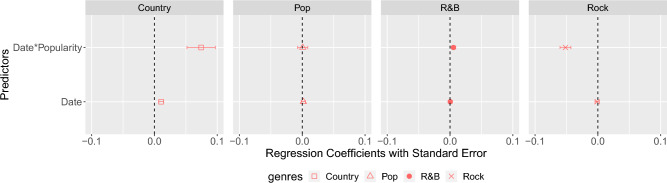
- Lyrics view count had a positive relationship with release year for R&B (β=0.32, p=.003) and a strong negative relationship for rock (β=-1.47, p<.000); multinomial logistic regression showed country-vs-rap odds increased with lyrics view count and year (β=0.07, SE=0.02, z=3.29, p=.0009), while rock-vs-rap odds decreased (β=-0.05, SE=0.01, z=-5.89, p<.0001). Listening counts showed no significant effects.
Methods
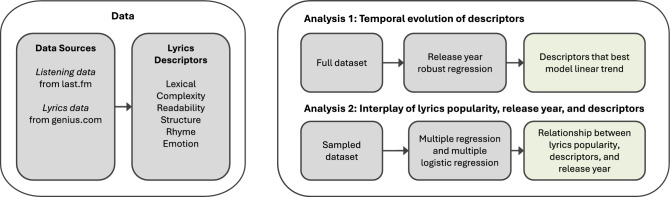
- Data: LFM-2b last.fm listening events enriched with Genius release year, genre, lyrics, and popularity data; 353,320 English songs spanning 1970–2020 across rap, country, pop, R&B, and rock.
- Analysis 1: per-genre Huber M robust regression predicting release year from lyrical descriptors after z-score normalization and VIF-based removal of multicollinear descriptors; descriptor importance assessed via regression coefficients.
- Analysis 2: balanced downsampled dataset of 12,000 songs (2,400 per genre) restricted to 1990–2020; multinomial logistic regression with genre as outcome and popularity × release year predictors, then per-genre multiple linear regression predicting release year from lyrics descriptors and lyrics view count using backward stepwise selection.
Limitations
- The paper states that last.fm and Genius introduce community bias and popularity bias: last.fm users are not representative, skew male, ages 20–30, and are dominated by the US, Russia, Germany, and UK; pre-platform listening and lyrics-view counts underestimate true frequencies, and physical releases may be missing.
- The paper states further limitations: genre assignments on Genius may be malformed; the study is restricted to English lyrics; readability metrics are simple and sentence-based; models assume linear change over time; downsampling may introduce sampling bias, especially for pop and country.
- The text itself makes evident that explanatory power is often low: adjusted R² values are small for several genres, the multinomial model has McFadden pseudo R²=0.01, and the authors note that significant p-values may partly result from the huge sample size and random noise.
Model-written summary. Check it against the paper before relying on it.
Integrity signals
Registry
Cites
Statistics
Figures
Verification
Claims the paper makes
0 Valid · 3 Not valid · 26 Not checked · 87 Own results and interpretations
A result the paper reports from its own data — it cites no other source for it, so there is none to check. The quote shows it is in the paper.
In the paper
“The repeated line ratio increases over time for all five genres, indicating that lyrics are becoming more repetitive.”
§ Song lyrics have become simpler and more repetitive over the last five decades > Results and discussion > Analysis 1: evolution of lyrics and descriptor importance
hedgedstates a cause- Asserted: passes — The authors put it forward as true.
- Checkable: passes — It can be checked against evidence.
- Load-bearing: passes — The paper’s conclusions depend on it.
- Based: passes — The paper gives a reason why it holds.
A result the paper reports from its own data — it cites no other source for it, so there is none to check. The quote shows it is in the paper.
In the paper
“However, the opposite trend is shown for R&B (cf. β=-0.96, in Table 4)”
§ Song lyrics have become simpler and more repetitive over the last five decades > Results and discussion > Analysis 2: interplay of lyrics descriptors, view counts, and release year
plainstates an association- Asserted: passes — The authors put it forward as true.
- Checkable: passes — It can be checked against evidence.
- Load-bearing: passes — The paper’s conclusions depend on it.
- Based: passes — The paper gives a reason why it holds.
A result the paper reports from its own data — it cites no other source for it, so there is none to check. The quote shows it is in the paper.
In the paper
“Concerning complexity, this is displayed by the positive β for compression ratio (essentially capturing the repeatability of lyrics) shown by rap (cf. β=0.70 in Table 4).”
§ Song lyrics have become simpler and more repetitive over the last five decades > Results and discussion > Analysis 2: interplay of lyrics descriptors, view counts, and release year
plainstates an association- Asserted: passes — The authors put it forward as true.
- Checkable: passes — It can be checked against evidence.
- Load-bearing: passes — The paper’s conclusions depend on it.
- Based: passes — The paper gives a reason why it holds.
A result the paper reports from its own data — it cites no other source for it, so there is none to check. The quote shows it is in the paper.
In the paper
“For R&B the results show that the content of the lyrics becomes more negative with time, as shown by the increase in concepts related to anger and a detriment in positive emotions (cf. β=1.91 and β=-0.89, respectively, in Table 4).”
§ Song lyrics have become simpler and more repetitive over the last five decades > Results and discussion > Analysis 2: interplay of lyrics descriptors, view counts, and release year
plainstates a cause- Asserted: passes — The authors put it forward as true.
- Checkable: passes — It can be checked against evidence.
- Load-bearing: unclear — It is unclear whether the paper’s conclusions depend on it.
- Based: passes — The paper gives a reason why it holds.
None of the sources cited for this claim have been checked yet.
In the paper
“we confirm previous analyses showing that the emotion described by lyrics has become more negative and that lyrics have become more personal over the last five decades”
§ Song lyrics have become simpler and more repetitive over the last five decades > Abstract
boostedstates an association- Asserted: passes — The authors put it forward as true.
- Checkable: passes — It can be checked against evidence.
- Load-bearing: passes — The paper’s conclusions depend on it.
- Based: passes — The paper gives a reason why it holds.
42 more claims
Create a free account to see all 116 claims and to verify the 35 references still open.
- It may state two separate claims as one. 50
- Probably not a substantial claim. 32
Statistics recomputed
Every reported test result, recomputed from its test statistic and degrees of freedom. A result shows as not adding up only once an independent check has confirmed it.
- Not confirmedz = 3.29reported p = .0009 · recomputed p = .001
“z=3.29, p = .0009”
- Consistentz = -5.89reported p < .0001 · recomputed p < .001
“z=-5.89, p < .0001”
Self-check
Percentages, sums and reported differences re-computed from the paper’s own numbers.
Each contradiction between two passages listed here was confirmed by an independent check.
Rated major: it would touch a result — a value a result rests on, reported and recomputed p-values on opposite sides of the significance level, two passages that conflict with no sign which is right, or a cited work retracted before this paper was published.
In the paper
§ Song lyrics have become simpler and more repetitive over the last five decades > Results and discussion > Analysis 1: evolution of lyrics and descriptor importance
“Furthermore, our analysis shows that lyrics have become angrier across all genres, with rap showing the most profound increase in anger (m=0.015996).”
§ Song lyrics have become simpler and more repetitive over the last five decades > Results and discussion > Result summary for both studies
“Also, we observe a trend towards angrier lyrics across all genres except for rock.”
Rated minor: it would not touch a result — a value no result rests on, a p-value that stays on the same side of the significance level, or a conflict that is clerical, resolved elsewhere in the paper, or outside its own findings.
In the paper
§ Song lyrics have become simpler and more repetitive over the last five decades > Results and discussion > Analysis 1: evolution of lyrics and descriptor importance
“| 8 | Avg. token lengthL | Dale-Chall readability scoreR | MTLDD | Unique rhyme wordsRh | MTLDD |”
§ Song lyrics have become simpler and more repetitive over the last five decades > Results and discussion > Analysis 1: evolution of lyrics and descriptor importance
“Note: Superscripts denote descriptor categories, with L = lexical, E = emotion, S = structural, Rh = rhyme, Re = readability, and D = diversity.”
Rated minor: it would not touch a result — a value no result rests on, a p-value that stays on the same side of the significance level, or a conflict that is clerical, resolved elsewhere in the paper, or outside its own findings.
In the paper
§ Song lyrics have become simpler and more repetitive over the last five decades > Results and discussion > Analysis 1: evolution of lyrics and descriptor importance
“Four descriptors are featured in the top descriptors of three genres each”
§ Song lyrics have become simpler and more repetitive over the last five decades > Results and discussion > Analysis 1: evolution of lyrics and descriptor importance
“(ratio verses to sections, ratio choruses to sections, average token length, Dugast’s U (modelling the number of token types as a function of the token count), and blank line count.”
Citations
Cites
Matplotlib: a 2D graphics environment
Hunter, J. D. (2007) · Computing in Science & Engineering · doi:10.1109/mcse.2007.55 · Cited by 39,249
SciPy 1.0: fundamental algorithms for scientific computing in Python
Virtanen, P., Gommers, R., Oliphant, T. E., Haberland, M., Reddy, T., Cournapeau, D., Burovski, E., Peterson, P., Weckesser, W., Bright, J., et al. (2020) · Nature Methods · doi:10.1038/s41592-019-0686-2 · Cited by 38,430
Wickham, H. (2016) · Use R! · doi:10.1007/978-3-319-24277-4 · Cited by 33,115
WordNet: a lexical database for English
Miller, G. A. (1995) · Communications of the ACM · doi:10.1145/219717.219748 · Cited by 14,015
Mining and summarizing customer reviews
Hu, M., & Liu, B. (2004) · Proceedings of the tenth ACM SIGKDD international conference on Knowledge discovery and data mining · doi:10.1145/1014052.1014073 · Cited by 7,793
Statsmodels: Econometric and Statistical Modeling with Python
Seabold, S., & Perktold, J. (2010) · Proceedings of the Python in Science Conference · doi:10.25080/majora-92bf1922-011 · Cited by 6,465
The Psychological Meaning of Words: LIWC and Computerized Text Analysis Methods
Tausczik, Y. R., & Pennebaker, J. W. (2010) · Journal of Language and Social Psychology · doi:10.1177/0261927x09351676 · Cited by 5,774 · cited 1×
“Furthermore, we extract emotional descriptors from lyrics by applying the widely used Linguistic Inquiry and Word Count (LIWC) dictionary 39 , which has also been applied to lyrics analyses 18,37,40 .”
Handbook of Emotion Regulation
Lambert, K. G. (2007) · JAMA · doi:10.1001/jama.298.15.1808 · Cited by 4,902
Recognizing contextual polarity in phrase-level sentiment analysis
Wilson, T., Wiebe, J., & Hoffmann, P. (2005) · Proceedings of the conference on Human Language Technology and Empirical Methods in Natural Language Processing - HLT '05 · doi:10.3115/1220575.1220619 · Cited by 3,345
Discovering statistics using R
(2012) · Choice Reviews Online · doi:10.5860/choice.50-2114 · Cited by 2,534
SENTIWORDNET: A Publicly Available Lexical Resource for Opinion Mining
Esuli, A., & Sebastiani, F. (2006) · Language Resources and Evaluation Conference (LREC) · doi:10.63317/54vo5wjya4cw · Cited by 2,480
A survey of modern authorship attribution methods
Stamatatos, E. (2009) · Journal of the American Society for Information Science and Technology · doi:10.1002/asi.21001 · Cited by 1,176 · cited 1×
“Lexical descriptors include, for instance, unique token ratio, repeated token ratio, pronoun frequency, line count, or punctuation counts, but also measures of lexical diversity 33,34 as these have been shown to be well-suited markers for textual style 35 .”
McCarthy, P. M., & Jarvis, S. (2010) · Behavior Research Methods · doi:10.3758/brm.42.2.381 · Cited by 905
Temporal patterns of happiness and information in a global social network: hedonometrics and Twitter
Dodds, P. S., Harris, K. D., Kloumann, I. M., Bliss, C. A., & Danforth, C. M. (2011) · PLoS ONE · doi:10.1371/journal.pone.0026752 · Cited by 809
A new ANEW: Evaluation of a word list for sentiment analysis in microblogs
Nielsen, F. Å. (2011) · arXiv (Cornell University) · doi:10.48550/arxiv.1103.2903 · Cited by 712
The psychological functions of music listening
Schäfer, T., Sedlmeier, P., Städtler, C., & Huron, D. (2013) · Frontiers in Psychology · doi:10.3389/fpsyg.2013.00511 · Cited by 637
Why do we listen to music? A uses and gratifications analysis
Lonsdale, A. J., & North, A. C. (2011) · British Journal of Psychology · doi:10.1348/000712610x506831 · Cited by 501
Improving Sequential Recommendation with Knowledge-Enhanced Memory Networks
Huang, J., Zhao, W. X., Dou, H., Wen, J.-R., & Chang, E. Y. (2018) · The 41st International ACM SIGIR Conference on Research & Development in Information Retrieval · doi:10.1145/3209978.3210017 · Cited by 461
Proceedings of the 13th International Society for Music Information Retrieval Conference, ISMIR 2012
Gouyon, F., Herrera, P., Martins, L. G., & Müller, M. A. (2012) · Cited by 446
How Variable May a Constant be? Measures of Lexical Richness in Perspective
Tweedie, F. J., & Baayen, R. H. (1998) · Computers and the Humanities · doi:10.1023/a:1001749303137 · Cited by 423
Clarke, J., & Lapata, M. (2007) · The Association for Computational Linguistics · Cited by 331
Social Tagging and Music Information Retrieval
Lamere, P. (2008) · Journal of New Music Research · doi:10.1080/09298210802479284 · Cited by 280
Measuring the Happiness of Large-Scale Written Expression: Songs, Blogs, and Presidents
Dodds, P. S., & Danforth, C. M. (2010) · Journal of Happiness Studies · doi:10.1007/s10902-009-9150-9 · Cited by 260
A Functional MRI Study of Happy and Sad Emotions in Music with and without Lyrics
Brattico, E., Alluri, V., Bogert, B., Jacobsen, T., Vartiainen, N., Nieminen, S., & Tervaniemi, M. (2011) · Frontiers in Psychology · doi:10.3389/fpsyg.2011.00308 · Cited by 254
Estimation of Random Utility Models in R: The mlogit Package
Croissant, Y. (2020) · Journal of Statistical Software · doi:10.18637/jss.v095.i11 · Cited by 228
DeWall, C. N., Pond, R. S., Campbell, W. K., & Twenge, J. M. (2011) · Psychology of Aesthetics, Creativity, and the Arts · doi:10.1037/a0023195 · Cited by 211
The LFM-1b Dataset for Music Retrieval and Recommendation
Schedl, M. (2016) · Proceedings of the 2016 ACM on International Conference on Multimedia Retrieval · doi:10.1145/2911996.2912004 · Cited by 192
Self-citationInternational Federation Of The Phonographic Industry
Laing, D. (2010) · Handbook of Transnational Economic Governance Regimes · doi:10.1163/ej.9789004163300.i-1081.503 · Cited by 164
Improving mood classification in music digital libraries by combining lyrics and audio
Hu, X., & Downie, J. S. (2010) · ACM/IEEE Joint Conference on Digital Libraries · doi:10.1145/1816123.1816146 · Cited by 141
Songs and emotions: are lyrics and melodies equal partners?
Ali, S. O., & Peynircioğlu, Z. F. (2006) · Psychology of Music · doi:10.1177/0305735606067168 · Cited by 127
Nunes, J. C., Ordanini, A., & Valsesia, F. (2014) · Journal of Consumer Psychology · doi:10.1016/j.jcps.2014.12.004 · Cited by 122
What is Music, Health, and Wellbeing and Why is it Important?
MacDonald, R., Kreutz, G., & Mitchell, L. (2012) · Music, Health, and Wellbeing · doi:10.1093/acprof:oso/9780199586974.003.0001 · Cited by 102
Emotionally-Relevant Features for Classification and Regression of Music Lyrics
Malheiro, R., Panda, R., Gomes, P. J. S., & Paiva, R. P. (2016) · IEEE Transactions on Affective Computing · doi:10.1109/taffc.2016.2598569 · Cited by 91
Musical trends and predictability of success in contemporary songs in and out of the top charts
Interiano, M., Kazemi, K., Wang, L., Yang, J., Yu, Z., & Komarova, N. L. (2018) · Royal Society Open Science · doi:10.1098/rsos.171274 · Cited by 73
Combination of audio and lyrics features for genre classification in digital audio collections
Mayer, R. L., Neumayer, R., & Rauber, A. (2008) · ACM International Conference on Multimedia (ACM MM) · doi:10.1145/1459359.1459382 · Cited by 71
Are Atypical Things More Popular?
Berger, J., & Packard, G. (2018) · Psychological Science · doi:10.1177/0956797618759465 · Cited by 69
Schedl, M., Brandl, S., Lesota, O., Parada-Cabaleiro, E., Penz, D., & Rekabsaz, N. (2022) · ACM SIGIR Conference on Human Information Interaction and Retrieval · doi:10.1145/3498366.3505791 · Cited by 59
Self-citationPettijohn, T. F., & Sacco, D. F. (2009) · Journal of Language and Social Psychology · doi:10.1177/0261927x09335259 · Cited by 52
Cultural evolution of emotional expression in 50 years of song lyrics
Brand, C. O., Acerbi, A., & Mesoudi, A. (2019) · Evolutionary Human Sciences · doi:10.1017/ehs.2019.11 · Cited by 50
What has America been singing about? Trends in themes in the U.S. top-40 songs: 1960–2010
Christenson, P. G., de Haan-Rietdijk, S., Roberts, D. F., & ter Bogt, T. F. M. (2019) · Psychology of Music · doi:10.1177/0305735617748205 · Cited by 43
Taxonomy-Aware Multi-Hop Reasoning Networks for Sequential Recommendation
Huang, J., Ren, Z., Zhao, W. X., He, G., Wen, J.-R., & Dong, D. (2019) · Proceedings of the Twelfth ACM International Conference on Web Search and Data Mining · doi:10.1145/3289600.3290972 · Cited by 43
Quantitative Sentiment Analysis of Lyrics in Popular Music
Napier, K., & Shamir, L. (2018) · Journal of Popular Music Studies · doi:10.1525/jpms.2018.300411 · Cited by 38
Vocals in Music Matter: the Relevance of Vocals in the Minds of Listeners
Demetriou, A. M., Jansson, A., Kumar, A., & Bittner, R. (2018) · Zenodo (CERN European Organization for Nuclear Research) · doi:10.5281/zenodo.1492464 · Cited by 30
Varnum, M. E. W., Krems, J. A., Morris, C., Wormley, A., & Grossmann, I. (2021) · PLOS ONE · doi:10.1371/journal.pone.0244576 · Cited by 29
Schedl, M. (2017) · International Journal of Multimedia Information Retrieval · doi:10.1007/s13735-017-0118-y · Cited by 29
Self-citationLambert, B., Kontonatsios, G., Mauch, M., Kokkoris, T., Jockers, M., Ananiadou, S., & Leroi, A. M. (2020) · Nature Human Behaviour · doi:10.1038/s41562-019-0802-4 · Cited by 23
Two-Step Robust Diagnostic Method for Identification of Multiple High Leverage Points
Bagheri, Midi, H., & Imon, A. H. M. R. (2009) · Journal of Mathematics and Statistics · doi:10.3844/jmssp.2009.97.106 · Cited by 12
Eastman, J. T., & Pettijohn, T. F. (2015) · Psychology of Popular Media Culture · doi:10.1037/ppm0000019 · Cited by 11
Schedl, M. (2019) · The World Wide Web Conference · doi:10.1145/3308558.3313604 · Cited by 6
Self-citation"Butter lyrics over hominy grit": Comparing audio and psychology-based text features in MIR tasks
Kim, J., Demetriou, A. M., Manolios, S., Tavella, M. S., & Liem, C. C. S. (2020) · Zenodo (CERN European Organization for Nuclear Research) · doi:10.5281/zenodo.4245573 · Cited by 6
A Trend Analysis on Concreteness of Popular Song Lyrics
Choi, K., & Stephen Downie, J. (2019) · 6th International Conference on Digital Libraries for Musicology · doi:10.1145/3358664.3358673 · Cited by 5
Two-Step Robust Diagnostic Method for Identification of Multiple High Leverage Points
Bagheri, A., Midi, H., & Imon, A. H. M. R. (2009) · Journal of Mathematics and Statistics · doi:10.3844/jms2.2009.97.106 · Cited by 2
The Music Listening Histories Dataset.
Vigliensoni, G., & Fujinaga, I. (2017) · Zenodo · doi:10.5281/zenodo.1417498
(1994)
Research works printed but not linked: 8
- Fell, M. Lyrics classification. Master’s Thesis, Saarland University (2014).
- Huber PJ Robust Statistics 2004 John Wiley & Sons
- Pinheiro J Package ‘nlme’ Linear Nonlinear Mixed Effects Models Version 2017 3 274
- Toop, D., Cheney, C. & Kajikawa, L. Rap. In New Grove Music online (Oxford music online).
- Rye, H. Rhythm-and-blues. In New Grove Music online (Oxford music online).
- Middleton, R. Rock. In New Grove Music online (Oxford music online).
- Mass H-D Über den Zusammenhang zwischen Wortschatzumfang und Länge eines Textes Zeitschrift fur Literaturwissenschaft und Linguistik 1972 2 73
- Mohammad SM Turney PD NRC emotion lexicon Natl. Res. Counc. Can. 2013 2 234
Cited by
Patterns of linguistic simplification on social media platforms over time
Marco, N. D., Loru, E., Bonetti, A., Serra, A. O. G., Cinelli, M., & Quattrociocchi, W. (2024) · Proceedings of the National Academy of Sciences · doi:10.1073/pnas.2412105121 · Cited by 66
Data‑Driven Analysis of Text‑Conditioning in AI‑Generated Music: A Case Study with Suno and Udio
Casini, L., Vila, L. C., Dalmazzo, D., Kaila, A.-K., & Sturm, B. L. T. (2026) · Transactions of the International Society for Music Information Retrieval · doi:10.5334/tismir.273 · Cited by 21
The Evolution of Song Lyrics: An NLP-Based Analysis of Popular Music in Germany from 1954 to 2022
Hunke, T., Huber, F., & Steffens, J. (2025) · Music & Science · doi:10.1177/20592043251331155 · Cited by 10
Are groundbreaking science discoveries becoming harder to find?
Matthews, D. (2025) · Nature · doi:10.1038/d41586-025-01548-4 · Cited by 8
Marco, N. D., Loru, E., Galeazzi, A., Cinelli, M., & Quattrociocchi, W. (2026) · Scientific Reports · doi:10.1038/s41598-026-42872-7 · Cited by 8
Metadata
- Authors
- Parada-Cabaleiro, E., Mayerl, M., Brandl, S., Skowron, M., Schedl, M., Lex, E., & Zangerle, E.
- Affiliations
- Universität Innsbruck (AT)
- Austrian Research Institute for Artificial Intelligence (AT)
- Johannes Kepler University of Linz (AT)
- Graz University of Technology (AT)
- Corresponding author
- Zangerle, Eva
- Venue
- Scientific Reports
- Published
- 2024-03-28
- Volume
- 14
- Issue
- 1
- Pages
- 5531-5531
- ISSN
- 2045-2322 (ISSN-L)
- PMC
- PMC10978890
- OpenAlex
- W4393255711
- Semantic Scholar
- b653a1907f6075e806e25c7b371636333d2a27fc
- Cited by
- 73
- References
- 53
- Citations by year
- 2026: 36 · 2025: 28 · 2024: 9
- FWCI
- 108.37
- Type
- journal article
- Language
- en
- Update notices
- correction (2024-05-22)
- Open access
- gold
- doi.org
- Licence
- cc-by
- creativecommons.org/licenses/by/4.0 (tdm)
- creativecommons.org/licenses/by/4.0 (vor)
- Locations
- Scientific Reports (publishedVersion, cc-by)
- PubMed Central (publishedVersion, cc-by)
- PubMed (publishedVersion)
- Digital Library of the University of Innsbruck (University of Innsbruck) (submittedVersion, cc-by)
- DOAJ (DOAJ: Directory of Open Access Journals) (submittedVersion, cc-by-sa)
- Funders
- Austrian Science Fund (DFH-23, P33526)
- Topics
- Social Sciences › Arts and Humanities › Music › Music History and Culture
- Social Sciences › Arts and Humanities › Music › Musicology and Musical Analysis
- Social Sciences › Arts and Humanities › Literature and Literary Theory › Digital Humanities and Scholarship
- Keywords
- song lyrics, lexical complexity, readability, repetition, music genres, popular music, rock music, country music
- MeSH terms
- Emotions, Music, Vocabulary
About these checks
Registry, retraction, Cites and statistics results are computed, not judged, with one exception: a printed reference that no index lists is read once by a model before it counts as a citation error. Claims are extracted by a model and kept only when their quote appears verbatim in the text; each cited source is then checked, with a model’s help, for whether it says what the claim relies on. Those verdicts can be wrong — read the claim’s quote and the cited source before relying on one.
A language model drew the claims from the paper on 2026-11-20, under version 3 of the claim definition (model deepseek-v4.1-flash, prompt extract-v3).
A second model labelled each claim on 2026-11-20 (model jev-1.13-20260917, definition revision gold-guideline-v0.2).
Statistics and arithmetic are recomputed, not judged.
Confidence bands are shown only for fields calibrated on our annotated test set. None is calibrated yet, so no band is shown.
What counts as a claim ›How we measure confidence ›How we check this ›
Are you an author, or do you see a problem with this page? Request a review
Data sources
Bibliographic data: Semantic Scholar, OpenAlex, Crossref.
Contains information from the Semantic Scholar Academic Graph Datasets, made available under the ODC Attribution License (ODC-BY 1.0).
Semantic Scholar’s data is described in: Kinney, R., et al. (2023). The Semantic Scholar Open Data Platform. arXiv:2301.10140.
