

Isobutyric acid enhances the anti-tumour effect of anti-PD-1 antibody
Open accessThe DOI matches its Crossref record; 29 of the 29 references it cites were found in a registry or an index.
Abstract
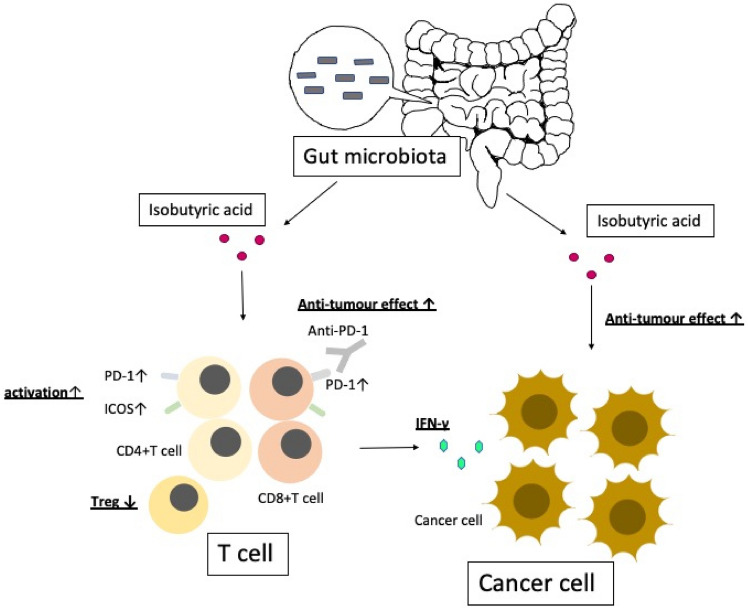
The low response rate of immune checkpoint inhibitors (ICIs) is a challenge. The efficacy of ICIs is influenced by the tumour microenvironment, which is controlled by the gut microbiota. In particular, intestinal bacteria and their metabolites, such as short chain fatty acids (SCFAs), are important regulators of cancer immunity; however, our knowledge on the effects of individual SCFAs remains limited. Here, we show that isobutyric acid has the strongest effect among SCFAs on both immune activity and tumour growth. In vitro, cancer cell numbers were suppressed by approximately 75% in humans and mice compared with those in controls. Oral administration of isobutyric acid to carcinoma-bearing mice enhanced the effect of anti-PD-1 immunotherapy, reducing tumour volume by approximately 80% and 60% compared with those in the control group and anti-PD-1 antibody alone group, respectively. Taken together, these findings may support the development of novel cancer therapies that can improve the response rate to ICIs.
Overview
The claims and statistics of this paper haven’t been checked yet.
Free: it reads the open-access text and checks the first 5 claims that cite a source we can check. Create a free account to check every claim.
Integrity signals
Registry
Cites
Statistics
Figures
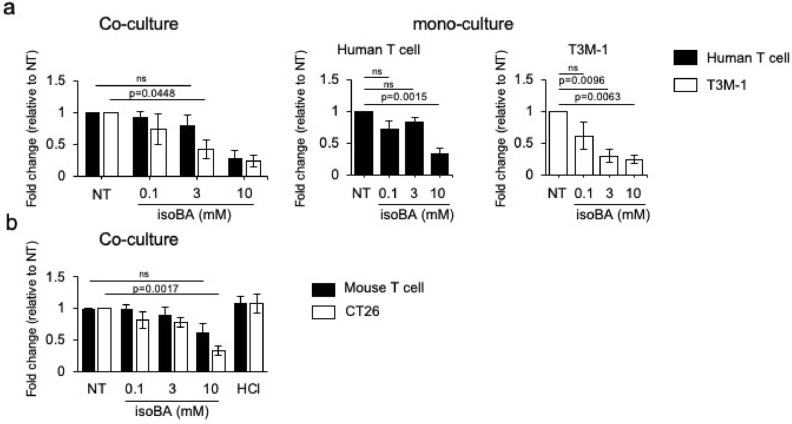
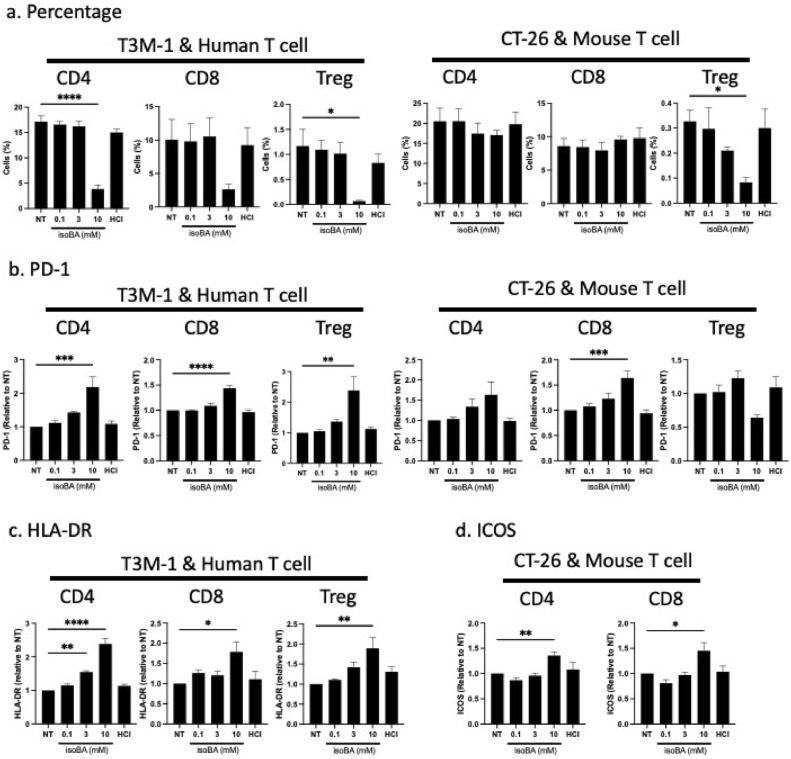
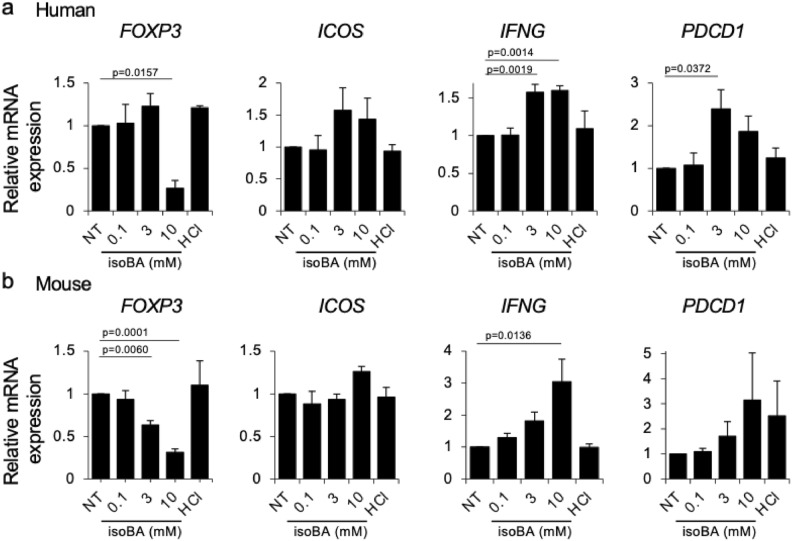
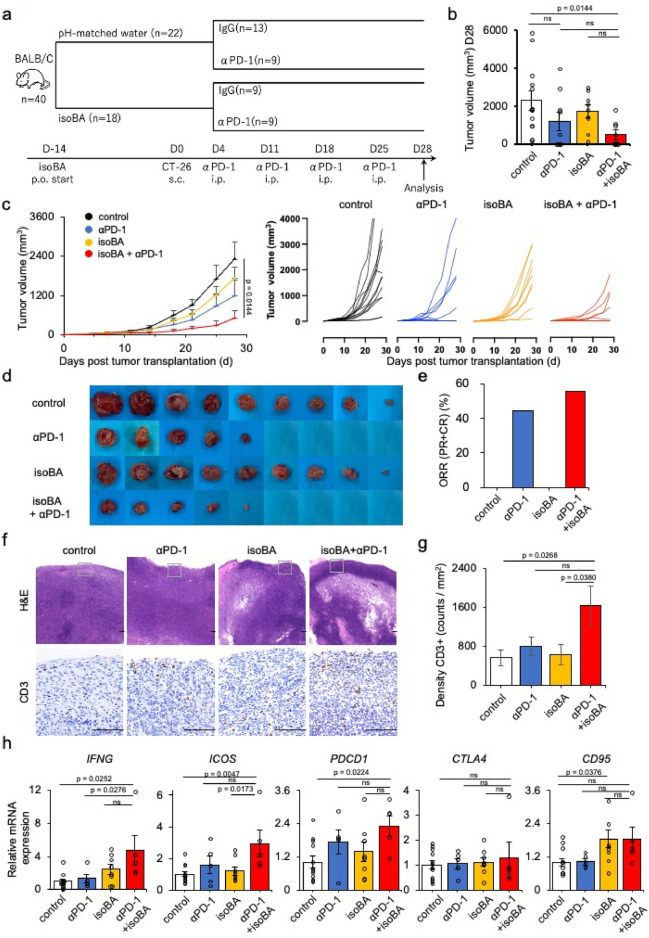
Verification
Claims the paper makes
The claims and statistics of this paper haven’t been checked yet.
Free: it reads the open-access text and checks the first 5 claims that cite a source we can check. Create a free account to check every claim.
Claims other papers make about this one
Each is checked against this paper’s own text: does it say what the citing paper says it does?
The source backs part of the claim, not all of it — or backs it for a different population, condition or comparison.
In the citing paper
“They can enhance PD‑1 blockade when administered orally (drinking water or gavage) at physiologically relevant concentrations.148–150”
From Gut dysbiosis in oncology: a risk factor for immunoresistance (2026) · doi:10.1038/s41422-025-01212-6 · cites this paper as [149]
Experimental — accuracy not yet measured
Self-check
Percentages, sums and reported differences re-computed from the paper’s own numbers.
The self-check needs the paper’s full text.
Citations
Cites
Understanding the tumor immune microenvironment (TIME) for effective therapy
Binnewies, M., Roberts, E. W., Kersten, K., Chan, V., Fearon, D. F., Merad, M., Coussens, L. M., Gabrilovich, D. I., Ostrand-Rosenberg, S., Hedrick, C. C., et al. (2018) · Nature Medicine · doi:10.1038/s41591-018-0014-x · Cited by 6,145
Gut microbiome influences efficacy of PD-1-based immunotherapy against epithelial tumors
Routy, B., Le Chatelier, E., Derosa, L., Duong, C. P. M., Alou, M. T., Daillère, R., Fluckiger, A., Messaoudene, M., Rauber, C., Roberti, M. P., et al. (2018) · Science · doi:10.1126/science.aan3706 · Cited by 5,671
Commensal microbe-derived butyrate induces the differentiation of colonic regulatory T cells
Furusawa, Y., Obata, Y., Fukuda, S., Endo, T. A., Nakato, G., Takahashi, D., Nakanishi, Y., Uetake, C., Kato, K., Kato, T., et al. (2013) · Nature · doi:10.1038/nature12721 · Cited by 5,549
Metabolites produced by commensal bacteria promote peripheral regulatory T-cell generation
Arpaia, N., Campbell, C., Fan, X., Dikiy, S., van der Veeken, J., deRoos, P., Liu, H., Cross, J. R., Pfeffer, K., Coffer, P. J., et al. (2013) · Nature · doi:10.1038/nature12726 · Cited by 4,838
Gut microbiome modulates response to anti-PD-1 immunotherapy in melanoma patients
Gopalakrishnan, V., Spencer, C. N., Nezi, L., Reuben, A., Andrews, M. C., Karpinets, T. V., Prieto, P. A., Vicente, D., Hoffman, K., Wei, S. C., et al. (2018) · Science · doi:10.1126/science.aan4236 · Cited by 4,812
Interaction between microbiota and immunity in health and disease
Zheng, D., Liwinski, T., & Elinav, E. (2020) · Cell Research · doi:10.1038/s41422-020-0332-7 · Cited by 3,947
Commensal Bifidobacterium promotes antitumor immunity and facilitates anti–PD-L1 efficacy
Sivan, A., Corrales, L., Hubert, N., Williams, J. B., Aquino-Michaels, K., Earley, Z. M., Benyamin, F. W., Man Lei, Y., Jabri, B., Alegre, M.-L., et al. (2015) · Science · doi:10.1126/science.aac4255 · Cited by 3,888
Anticancer immunotherapy by CTLA-4 blockade relies on the gut microbiota
Vétizou, M., Pitt, J. M., Daillère, R., Lepage, P., Waldschmitt, N., Flament, C., Rusakiewicz, S., Routy, B., Roberti, M. P., Duong, C. P. M., et al. (2015) · Science · doi:10.1126/science.aad1329 · Cited by 3,488
Gut microbiome and health: mechanistic insights
de Vos, W. M., Tilg, H., Van Hul, M., & Cani, P. D. (2022) · Gut · doi:10.1136/gutjnl-2021-326789 · Cited by 2,388 · cited 1×
“Intestinal bacteria break down undigested host products, such as dietary fibre, to produce short chain fatty acids (SCFAs), which significantly affect host immune function 13 .”
BackgroundBagchi, S., Yuan, R., & Engleman, E. G. (2021) · Annual Review of Pathology: Mechanisms of Disease · doi:10.1146/annurev-pathol-042020-042741 · Cited by 2,189
Fecal microbiota transplant overcomes resistance to anti–PD-1 therapy in melanoma patients
Davar, D., Dzutsev, A. K., McCulloch, J. A., Rodrigues, R. R., Chauvin, J.-M., Morrison, R. M., Deblasio, R. N., Menna, C., Ding, Q., Pagliano, O., et al. (2021) · Science · doi:10.1126/science.abf3363 · Cited by 1,781
Fecal microbiota transplant promotes response in immunotherapy-refractory melanoma patients
Baruch, E. N., Youngster, I., Ben-Betzalel, G., Ortenberg, R., Lahat, A., Katz, L., Adler, K., Dick-Necula, D., Raskin, S., Bloch, N., et al. (2021) · Science · doi:10.1126/science.abb5920 · Cited by 1,757
Le Poul, E., Loison, C., Struyf, S., Springael, J.-Y., Lannoy, V., Decobecq, M.-E., Brezillon, S., Dupriez, V., Vassart, G., Van Damme, J., et al. (2003) · Journal of Biological Chemistry · doi:10.1074/jbc.m301403200 · Cited by 1,651 · cited 1×
“Le Paul et al. reported that isobutyric acid had agonistic effects on GPR41 and GPR43 in a heterologous expression system using HEK293T cells 22 .”
MethodOliphant, K., & Allen-Vercoe, E. (2019) · Microbiome · doi:10.1186/s40168-019-0704-8 · Cited by 1,327
Park, J., Kim, M., Kang, S. G., Jannasch, A. H., Cooper, B., Patterson, J., & Kim, C. H. (2015) · Mucosal Immunology · doi:10.1038/mi.2014.44 · Cited by 1,307 · cited 1×
“For example, acetic acid, propionic acid, and butyric acid activate regulatory T cells and enhance effector T cell function 14–16 .”
BackgroundA defined commensal consortium elicits CD8 T cells and anti-cancer immunity
Tanoue, T., Morita, S., Plichta, D. R., Skelly, A. N., Suda, W., Sugiura, Y., Narushima, S., Vlamakis, H., Motoo, I., Sugita, K., et al. (2019) · Nature · doi:10.1038/s41586-019-0878-z · Cited by 1,145
Luu, M., Riester, Z., Baldrich, A., Reichardt, N., Yuille, S., Busetti, A., Klein, M., Wempe, A., Leister, H., Raifer, H., et al. (2021) · Nature Communications · doi:10.1038/s41467-021-24331-1 · Cited by 771 · cited 14×
“The pEC50 values of isobutyric acid for showing that isobutyric acid had little inhibitory effect on HDAC compared to other SCFAs 17 .”
BackgroundMethodInfluentialNomura, M., Nagatomo, R., Doi, K., Shimizu, J., Baba, K., Saito, T., Matsumoto, S., Inoue, K., & Muto, M. (2020) · JAMA Network Open · doi:10.1001/jamanetworkopen.2020.2895 · Cited by 396 · cited 1×
“Nomura et al. examined the association of faecal and plasma SCFAs with response to anti-PD-1 antibody therapy in solid tumours and found that faecal isobutyric acid concentrations in responders were higher than those in non-responders 24 .”
BackgroundRios-Covian, D., González, S., Nogacka, A. M., Arboleya, S., Salazar, N., Gueimonde, M., & de los Reyes-Gavilán, C. G. (2020) · Frontiers in Microbiology · doi:10.3389/fmicb.2020.00973 · Cited by 316 · cited 1×
“Branched SCFAs are present in smaller amounts in the digestive tract than other SCFAs, and their functions are largely unknown 20 .”
BackgroundAguirre, M., Eck, A., Koenen, M. E., Savelkoul, P. H. M., Budding, A. E., & Venema, K. (2016) · Research in Microbiology · doi:10.1016/j.resmic.2015.09.006 · Cited by 204 · cited 1×
“Aguirre et al. used an in vitro gut model to show that a high-protein diet increases faecal isobutyric acid concentrations 27 .”
BackgroundHald, S., Schioldan, A. G., Moore, M. E., Dige, A., Lærke, H. N., Agnholt, J., Bach Knudsen, K. E., Hermansen, K., Marco, M. L., Gregersen, S., et al. (2016) · PLoS ONE · doi:10.1371/journal.pone.0159223 · Cited by 180
Forty mouse strain survey of water and sodium intake
Tordoff, M. G., Bachmanov, A. A., & Reed, D. R. (2007) · Physiology & Behavior · doi:10.1016/j.physbeh.2007.03.025 · Cited by 90 · cited 1×
“Although mice treated with isobutyric acid drank slightly less water than those treated with pH-matched water (5.7 mL per mouse a day in the control group vs 4.3 mL in the isobutyric acid group), the amount of water intake of each group was within the normal range 21 .”
BackgroundInfluentialValeric Acid Suppresses Liver Cancer Development by Acting as a Novel HDAC Inhibitor
Han, R., Nusbaum, O., Chen, X., & Zhu, Y. L. (2020) · Molecular Therapy — Oncolytics · doi:10.1016/j.omto.2020.08.017 · Cited by 88
Identification of lysine isobutyrylation as a new histone modification mark
Zhu, Z., Han, Z. H., Halabelian, L., Yang, X., Ding, J., Zhang, N., Ngo, L., Song, J., Zeng, H., He, M., et al. (2020) · Nucleic Acids Research · doi:10.1093/nar/gkaa1176 · Cited by 81 · cited 1×
“Recently, Zhu et al. reported that isobutyric acid, like butyric acid, has the potential to modify lysine residues on histones 23 .”
BackgroundWang, Y., Ma, R., Liu, F., Lee, S. A., & Zhang, L. (2018) · Frontiers in Immunology · doi:10.3389/fimmu.2018.00374 · Cited by 71
Shi, F., Li, Y., Han, R., Fu, A., Wang, R., Nusbaum, O., Qin, Q., Chen, X., Hou, L., & Zhu, Y. L. (2021) · Scientific Reports · doi:10.1038/s41598-021-81620-x · Cited by 54 · cited 1×
“In addition, valeric acid augments the anti-tumour effect of cytotoxic T cells 17 and suppresses cancer cell proliferation 18,19 .”
BackgroundSánchez-Alcoholado, L., Laborda-Illanes, A., Otero, A., Ordóñez, R., González-González, A., Plaza-Andrades, I., Ramos-Molina, B., Gómez-Millán, J., & Queipo-Ortuño, M. I. (2021) · International Journal of Molecular Sciences · doi:10.3390/ijms22179549 · Cited by 49 · cited 1×
“In addition, faecal isobutyric acid concentrations were significantly high in colorectal cancer patients who responded to preoperative radiation and chemotherapy 25 .”
BackgroundHAMADA, K., YOSHIMURA, K., HIRASAWA, Y., HOSONUMA, M., MURAYAMA, M., NARIKAWA, Y., ARIIZUMI, H., OHKUMA, R., SHIDA, M., KUBOTA, Y., et al. (2021) · Anticancer Research · doi:10.21873/anticanres.15312 · Cited by 43
Self-citationZiemons, J., Aarnoutse, R., Heuft, A., Hillege, L. E., Waelen, J., de Vos‐Geelen, J., Iersel, L. V., van Hellemond, I. E. G., Creemers, G., Baars, A., et al. (2023) · Clinical and Experimental Medicine · doi:10.1007/s10238-023-01048-7 · Cited by 21
Cited by
Short-chain fatty acids and cancer
Li, S., Duan, Y., Luo, S., Zhou, F., Wu, Q., & Lu, Z. (2024) · Trends in cancer · doi:10.1016/j.trecan.2024.11.003 · Cited by 135
Mechanisms, combination therapy, and biomarkers in cancer immunotherapy resistance
Yang, M., Cui, M., Sun, Y., Liu, S., & Jiang, W. (2024) · Cell Communication and Signaling · doi:10.1186/s12964-024-01711-w · Cited by 110
“The function of branched SCFAs in tumor immunity has been investigated less than that of straight SCFAs, and this study may highlight the significance of the gut microbiota in immunotherapy [164].”
BackgroundMicrobiota-derived metabolites: Key modulators of cancer immunotherapies
Perl, M., Fante, M. A., Herfeld, K., Scherer, J. N., Poeck, H., & Orberg, E. T. (2025) · Med · doi:10.1016/j.medj.2025.100773 · Cited by 66
“…pathways: butyric acid via T reg cell differentiation through HDAC inhibition, 11 propionic acid via enhanced CD8 + T cell persistence in the TME, 12 isobutyric acid via inhibition of cancer cell survival, 86 ICA by protecting and repairing the mucosal barrier, and DAT via IFN-I amplification.”
Gut microbial metabolites in cancer immunomodulation
Liu, H., Xiong, X., Zhu, W., Wang, S., Huang, W.-C., Zhu, G., Xu, H., & Yang, L. (2025) · Molecular Cancer · doi:10.1186/s12943-025-02521-5 · Cited by 62
“Branched SCFAs such as isobutyr-ate show similar potentiation in CT26 [206].”
Gut microbiota–derived metabolites in immunomodulation and gastrointestinal cancer immunotherapy
Luo, W., Li, R., Pan, C., & Luo, C. (2025) · Frontiers in Immunology · doi:10.3389/fimmu.2025.1710880 · Cited by 59
Metadata
- Authors
- Murayama, M., Hosonuma, M., Kuramasu, A., Kobayashi, S., Sasaki, A., Baba, Y., Narikawa, Y., Toyoda, H., Isobe, J., Funayama, E., Tajima, K., Sasaki, A., Maruyama, Y., Yamazaki, Y., Shida, M., Hamada, K., Hirasawa, Y., Tsurui, T., Ariizumi, H., Ishiguro, T., Suzuki, R., Ohkuma, R., Kubota, Y., Horiike, A., Sambe, T., Tsuji, M., Wada, S., Kobayashi, S., Shimane, T., Tsunoda, T., Kobayashi, H., Kiuchi, Y., & Yoshimura, K.
- Affiliations
- SHOWA Medical University (JP)
- Corresponding author
- Yoshimura, Kiyoshi
- ORCID
- Murayama, Masakazu
- Hosonuma, Masahiro
- Kuramasu, Atsuo
- Sasaki, Akiko
- Baba, Yuta
- Tajima, Kohei
- Sasaki, Aya
- Maruyama, Yuki
- Hamada, Kazuyuki
- Hirasawa, Yuya
- Tsurui, Toshiaki
- Ariizumi, Hirotsugu
- Ishiguro, Tomoyuki
- Suzuki, Risako
- Ohkuma, Ryotaro
- Kubota, Yutaro
- Horiike, Atsushi
- Sambe, Takehiko
- Tsuji, Mayumi
- Wada, Satoshi
- Shimane, Toshikazu
- Kobayashi, Hitome
- Kiuchi, Yuji
- Yoshimura, Kiyoshi
- Venue
- Scientific Reports
- Published
- 2024-05-17
- Volume
- 14
- Issue
- 1
- Pages
- 11325-11325
- ISSN
- 2045-2322 (ISSN-L)
- PMC
- PMC11101641
- OpenAlex
- W4397022927
- Cited by
- 41
- References
- 29
- Citations by year
- 2026: 14 · 2025: 22 · 2024: 5
- FWCI
- 7.02
- Type
- journal article
- Language
- en
- Open access
- gold
- doi.org
- Licence
- cc-by
- creativecommons.org/licenses/by/4.0 (tdm)
- creativecommons.org/licenses/by/4.0 (vor)
- Locations
- Scientific Reports (publishedVersion, cc-by)
- PubMed Central (publishedVersion, cc-by)
- PubMed (publishedVersion)
- DOAJ (DOAJ: Directory of Open Access Journals) (submittedVersion)
- Funders
- Grant-in-Aid for Scientific Research (22K09675)
- Topics
- Health Sciences › Medicine › Oncology › Cancer Immunotherapy and Biomarkers
- Life Sciences › Biochemistry, Genetics and Molecular Biology › Molecular Biology › Gut microbiota and health
- Life Sciences › Immunology and Microbiology › Immunology › Immunotherapy and Immune Responses
- Keywords
- isobutyric acid, short-chain fatty acids, anti-PD-1, immune checkpoint inhibitors, cancer immunotherapy, gut microbiota, tumor microenvironment, cancer immunotherapy response, oral administration, tumor growth inhibition
- MeSH terms
- Gastrointestinal Microbiome, Immune Checkpoint Inhibitors, Animals, Drug Synergism, Fatty Acids, Volatile, Female, Humans, Immunotherapy, Neoplasms, Cell Line, Tumor, Mice, Isobutyrates, Tumor Microenvironment, Programmed Cell Death 1 Receptor
About these checks
Registry, retraction, Cites and statistics results are computed, not judged, with one exception: a printed reference that no index lists is read once by a model before it counts as a citation error. Claims are extracted by a model and kept only when their quote appears verbatim in the text; each cited source is then checked, with a model’s help, for whether it says what the claim relies on. Those verdicts can be wrong — read the claim’s quote and the cited source before relying on one.
Statistics and arithmetic are recomputed, not judged.
Confidence bands are shown only for fields calibrated on our annotated test set. None is calibrated yet, so no band is shown.
What counts as a claim ›How we measure confidence ›How we check this ›
Are you an author, or do you see a problem with this page? Request a review
Data sources
Bibliographic data: Semantic Scholar, OpenAlex, Crossref.
Contains information from the Semantic Scholar Academic Graph Datasets, made available under the ODC Attribution License (ODC-BY 1.0).
Semantic Scholar’s data is described in: Kinney, R., et al. (2023). The Semantic Scholar Open Data Platform. arXiv:2301.10140.
