

Comparative analysis of Q-learning, SARSA, and deep Q-network for microgrid energy management
Open accessThe DOI matches its Crossref record; 20 of the 20 references it cites were found in a registry or an index.
Abstract
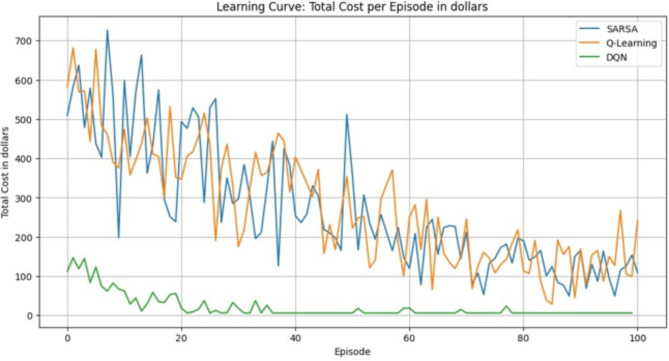
The growing integration of renewable energy sources within microgrids necessitates innovative approaches to optimize energy management. While microgrids offer advantages in energy distribution, reliability, efficiency, and sustainability, the variable nature of renewable energy generation and fluctuating demand pose significant challenges for optimizing energy flow. This research presents a novel application of Reinforcement Learning (RL) algorithms-specifically Q-Learning, SARSA, and Deep Q-Network (DQN)-for optimal energy management in microgrids. Utilizing the PyMGrid simulation framework, this study not only develops intelligent control strategies but also integrates advanced mathematical control techniques, such as Model Predictive Control (MPC) and Kalman filters, within the Markov Decision Process (MDP) framework. The innovative aspect of this research lies in its comparative analysis of these RL algorithms, demonstrating that DQN outperforms Q-Learning and SARSA by 12% and 30%, respectively, while achieving a remarkable 92% improvement over scenarios without an RL agent. This study addresses the unique challenges of energy management in microgrids and provides practical insights into the application of RL techniques, thereby contributing to the advancement of sustainable energy solutions.
Overview
The claims and statistics of this paper haven’t been checked yet.
Free: it reads the open-access text and checks the first 5 claims that cite a source we can check. Create a free account to check every claim.
Integrity signals
Registry
Cites
Statistics
Figures
Verification
Claims the paper makes
The claims and statistics of this paper haven’t been checked yet.
Free: it reads the open-access text and checks the first 5 claims that cite a source we can check. Create a free account to check every claim.
Claims other papers make about this one
Each is checked against this paper’s own text: does it say what the citing paper says it does?
The source backs part of the claim, not all of it — or backs it for a different population, condition or comparison.
In the citing paper
“RL algorithms-ranging from tabular methods to advanced deep RL architectures-have demonstrated the capacity to learn optimal strategies for HVAC control, demand response, and renewable integration [2,3].”
From Explainable AI and Multi-Agent Systems for Energy Management in IoT-Edge Environments: A State of the Art Review (2026) · cites this paper as [3]
Experimental — accuracy not yet measuredThe check wasn’t confident either way, so it gives no verdict — never disputed.
In the citing paper
“Integrating DRL or MARL at the microcontroller level remains challenging due to the high training time requirements [3].”
From Explainable AI and Multi-Agent Systems for Energy Management in IoT-Edge Environments: A State of the Art Review (2026) · cites this paper as [3]
Experimental — accuracy not yet measured
Self-check
Percentages, sums and reported differences re-computed from the paper’s own numbers.
The self-check needs the paper’s full text.
Citations
Cites
Smart grids and renewable energy systems: Perspectives and grid integration challenges
Khalid, M. (2024) · Energy Strategy Reviews · doi:10.1016/j.esr.2024.101299 · Cited by 684
Reinforcement Learning and Its Applications in Modern Power and Energy Systems: A Review
Cao, D., Hu, W., Zhao, J., Zhang, G., Zhang, B., Liu, Z., Chen, Z., & Blaabjerg, F. (2020) · Journal of Modern Power Systems and Clean Energy · doi:10.35833/mpce.2020.000552 · Cited by 460 · cited 1×
“Cao et al. 16 reviews different RL algorithms and their applications in modern power and energy systems.”
Reinforcement learning in sustainable energy and electric systems: a survey
Yang, T., Zhao, L., Li, W., & Zomaya, A. Y. (2020) · Annual Reviews in Control · doi:10.1016/j.arcontrol.2020.03.001 · Cited by 234 · cited 1×
“A research explores Q-Learning and SARSA for sustainable energy 17 .”
Deep Reinforcement Learning for Smart Grid Operations: Algorithms, Applications, and Prospects
Li, Y., Yu, C., Shahidehpour, M., Yang, T., Zeng, Z., & Chai, T. (2023) · Proceedings of the IEEE · doi:10.1109/jproc.2023.3303358 · Cited by 203 · cited 1×
“Similarly, another research employs DRL to enhance smart grid efficiency 14 .”
Resilient Distribution Networks by Microgrid Formation Using Deep Reinforcement Learning
Huang, Y., Li, G., Chen, C., Bian, Y., Qian, T., & Bie, Z. (2022) · IEEE Transactions on Smart Grid · doi:10.1109/tsg.2022.3179593 · Cited by 171
Harrold, D. J. B., Cao, J. H., & Fan, Z. (2022) · Applied Energy · doi:10.1016/j.apenergy.2022.119151 · Cited by 170
Decentralized multi-agent based energy management of microgrid using reinforcement learning
Samadi, E., Badri, A., & Ebrahimpour, R. (2020) · International Journal of Electrical Power & Energy Systems · doi:10.1016/j.ijepes.2020.106211 · Cited by 158
Arwa, E. O., & Folly, K. A. (2020) · IEEE Access · doi:10.1109/access.2020.3038735 · Cited by 146 · cited 2×
“Arwa and Folly 3 have proposed a comprehensive review of different Reinforcement Learning (RL) algorithms used for managing power in microgrids.”
Microgrid energy management using deep Q-network reinforcement learning
Alabdullah, M., & Abido, M. A. (2022) · Alexandria Engineering Journal · doi:10.1016/j.aej.2022.02.042 · Cited by 144
Fusion of Microgrid Control With Model-Free Reinforcement Learning: Review and Vision
She, B., Li, F. F., Cui, H., Zhang, J., & Bo, R. (2022) · IEEE Transactions on Smart Grid · doi:10.1109/tsg.2022.3222323 · Cited by 105 · cited 1×
“Another study integrates Model-Free RL (MFRL) with microgrid control systems 13 .”
Research works printed but not linked: 2
- Somasundaran, N., Radhika, N. & Venkataraman, V. Smart grid test bed based on GSM. Proc. Eng. (2012).
- Sowmya Reddy, V. S., Chandan, K., Nimmy, P., Smitha, T. V. & Nagaraja, K. V. An efficient machine learning model for smart grid stability prediction in our prestigious conference: International Conference on Emerging Technologies in Engineering and Science (ICETES) (2023).
Cited by
A comprehensive review on DC microgrid control and energy management strategies
Sandeep, S. D., Mohanty, S., Mohanty, S. B., & Puhan, P. S. (2025) · Results in Engineering · doi:10.1016/j.rineng.2025.105479 · Cited by 36
Álvarez-López, C., González-Briones, A., & Li, T. (2026) · Electronics · doi:10.3390/electronics15020385 · Cited by 23
Addai, M., & Musílek, P. (2026) · Electronics · doi:10.3390/electronics15030707 · Cited by 22
“Temporal difference learning methods, particularly Q-learning and SARSA, are well-suited to online optimization because they update value estimates after every transition rather than waiting for complete episode trajectories, enabling continuous learning from streaming operational data [89].”
Rosen, J., Russell, J., Kartik, P., & Vella‐Baldacchino, M. (2025) · Journal of Experimental Orthopaedics · doi:10.1002/jeo2.70549 · Cited by 14
A review of microgrid energy management systems: methods, challenges, and future directions
Atef, M., Alahakoon, S., Mumtahina, U., Wolfs, P., Khatib, T., & Uddin, M. (2026) · International Journal of Ambient Energy · doi:10.1080/01430750.2025.2595117 · Cited by 9
Shantanu, K., Choudhary, N. K., Singh, N., & Kumar, K. (2025) · Energy Reports · doi:10.1016/j.egyr.2025.10.047 · Cited by 6
AI-Enabled Energy Management for Sustainable Smart Greenhouses: An Integrated Review
Biswal, S. R., Choudhury, T. R., Panda, B., & Mishra, S. P. (2026) · IEEE Access · doi:10.1109/access.2026.3651685 · Cited by 8
“Comparative studies in microgrid environments further show that while Q learning and SARSA provide feasible scheduling, deep Q networks (DQN) significantly outperform them achieving up to 12% and 30% higher efficiency, and a 92% improvement over baseline non RL strategies [101].”
Shehu, M. A., Talapiden, K., Chau, T. T., Haruna, A., Aly, M., Gali, V., Duc, T., & Alhassan, A. B. (2026) · Engineering Science and Technology an International Journal · doi:10.1016/j.jestch.2026.102288 · Cited by 6
“• Model Predictive Control (MPC) for multi-objective, constraint-handling operation and predictive coordination of DERs and ESS under high RES penetration [3,4,10,27–34].”
InfluentialLuo, F., Xu, T., Li, J., & Xu, F. (2025) · Alexandria Engineering Journal · doi:10.1016/j.aej.2025.04.091 · Cited by 5
Model-Free Reinforcement Learning in Microgrid Control: A Review
Gurbuz, F. B., Karaki, A., Karaki, A., Demirbas, S., & Bayhan, S. (2025) · IEEE Access · doi:10.1109/access.2025.3609317 · Cited by 6
Rabbi, M. F. (2026) · Results in Engineering · doi:10.1016/j.rineng.2026.109744 · Cited by 7
Qin, C., Tang, Y., Li, W., Jiang, A., & Wu, F. (2025) · IEEE Access · doi:10.1109/access.2025.3599215 · Cited by 3
Rana, Y., Aru, V. K., Kanakatharani, S., & Daniel, S. A. (2026) · Engineering Research Express · doi:10.1088/2631-8695/ae351e · Cited by 3
Tănăsescu, A., Bucur, C., Andrei, J. V., Tudorică, B.-G., Paraschiv, D., & Dușmănescu, D. (2025) · Environmental Research Communications · doi:10.1088/2515-7620/adf530 · Cited by 3
Forecasting Cryptocurrency Prices in the DeFi Ecosystem Using Predictive Models
Sruthi, S., Saravanan, D., & Jyotsna, C. (2025) · International Conference on Computing for Sustainability and Intelligent Future (COMP-SIF) · doi:10.1109/comp-sif65618.2025.10969970 · Cited by 3
“Paper [18] demonstrated the applicability of several RL algorithms like DQN, SARSA, and Q-Learning in the context of microgrid energy management.”
Tao, S., Yang, L., Zhang, X., Zhao, S., Liu, K., Tian, X., & Xu, H. (2025) · Sensors · doi:10.3390/s25154785 · Cited by 2
“Based on the action values and rewards, it is continuously updated over time to maximize the cumulative rewards [18,19].”
Pandian, J. A., Thirunavukarasu, R., & Nagarajan, R. (2025) · Scientific Reports · doi:10.1038/s41598-025-23769-3 · Cited by 2
Energy Management With Explainable Hybrid AI Predictive-Reinforcement in Smart Buildings
Dhanraj, J. A., Sriramkumar, R., Lakshmanan, M., Naik, M. N., Pavithra, A., & Rakshita, R. (2025) · International Conference on Communication and Electronics Systems (ICCES) · doi:10.1109/icces67310.2025.11336241 · Cited by 2
“DQN was adopted in this research to learn a policy with the intention to optimize control actions of HVAC, and this was by minimizing the cumulative power required to maintain comfort [18].”
Kavaliauskas, Ž., Milieška, M., Blažiūnas, G., Gecevičius, G., & Zhairabany, H. (2026) · Sustainability · doi:10.3390/su18115443 · Cited by 2
Arshad, S. B., Che, Y., Ahmad, A., & AlAqil, M. A. (2026) · Scientific Reports · doi:10.1038/s41598-026-51702-9 · Cited by 1
Kunda, N. S. S., Kc, P., Pandey, M., & Kumaar, A. A. N. (2025) · Scientific Reports · doi:10.1038/s41598-025-27702-6 · Cited by 2
Mai, V. T., Quan, L. H., Nguyen, T. H., Nguyen-Huy, H., & Tran, T.-N. (2026) · Electric Power Systems Research · doi:10.1016/j.epsr.2026.113178 · Cited by 1
Comparative Analysis of Reinforcement Learning Approaches for Dynamic Pricing of Perishable GoodsPreprint
Panthangi, M. K., & Vasudevan, V. N. (2025) · Research Square · doi:10.21203/rs.3.rs-6756652/v1
A Review on AI-Based Optimisation Approaches for Energy Storage Systems and Microgrids
Ezeobidi, C., Bonaldo, J. P., Muñoz, J., Carnielutti, F. D. M., & Rivera, M. (2025) · Seminar on Power Electronics and Control (SEPOC) · doi:10.1109/sepoc67005.2025.11297716
Chen, S., Agarwal, V., Lele, A., & Tewari, H. (2025) · International Conference on Deep Learning Technologies · doi:10.1109/icdlt66400.2025.11466602
“Nonethe-less, DQN faces challenges such as sample inefficiency, unstable learning in non-stationary environments, and fixed action spaces—critical issues in carbon markets shaped by exogenous shocks and evolving regulation [20] [21].”
Smart Self-Learning Reconfiguration for Partially Shaded PV Arrays
Gautam, A., Kashyap, M., Pathak, D., Verma, G., & Sharma, V. (2026) · IEEE Journal of Emerging and Selected Topics in Industrial Electronics · doi:10.1109/jestie.2026.3698546
“Ramesh et al. [24] and Sharma et al. [25] compare the performance of various RL algorithms, such as Q-learning, state-action-reward-state-action, deep Q-network (DQN).”
Self-citationWang, Z., Xu, T., Song, B., Wang, Y., & Li, L. (2026) · Knowledge-Based Systems · doi:10.1016/j.knosys.2026.116571
Adaptive Ethical Intelligence for Sustainable Signal Processing in Environmental and Energy Systems
Kumar, S. S., Reddy, M. S., Madhurima, V., Bala, B., Kadurka, R. S., Nagesh, Y., & Prasad, M. (2026) · Studies in computational intelligence · doi:10.1007/978-3-032-19543-2_12
Qian, T., Peng, X., Zhang, L., & Cao, M. (2026) · International Conference on Electrical, Control and Information Technology (ECITech) · doi:10.1109/ecitech69277.2026.11601876
Kaldari, J., & Al-Kuwari, S. M. (2026) · Quantum Machine Intelligence · doi:10.1007/s42484-026-00424-2 · Cited by 1
“Hybrid approaches, such as actor-critic methods, combine the strengths of both methods by directly optimizing a policy while using a learned value function to guide and stabilize policy updates [26].”
Anomaly Detection in a Smart Grid Using a Novel Hybrid Deep Learning Approach
Mbey, C. F., Ekemb, G., Souhe, F. G. Y., Kakeu, V. J. F., & Boum, A. T. (2026) · The Journal of Engineering · doi:10.1049/tje2.70216
PC-TD3-based multi-objective adaptive dispatch method for microgrids guided by a meta-policy
Cheng, L., & Liu, B. (2026) · Electric Power Systems Research · doi:10.1016/j.epsr.2026.113960
Shake, R., Parimi, A. M., & You, M. (2026) · IEEE International Conference on Sustainable Energy and Future Electric Transportation (SEFET) · doi:10.1109/sefet69291.2026.11687082
Lin, P., Li, N., & Dong, G. (2026) · SSRN Electronic Journal · doi:10.2139/ssrn.7493738
Global insights into machine learning-enabled smart grids: Challenges and solutions
SOURO, T. A., & Farrok, O. (2026) · Energy Reports · doi:10.1016/j.egyr.2026.109784
Syrlybekkyzy, S., Salem, M., Baimbetov, D., Yerzhanov, K., Tynymbayev, B., & Nazari, M. A. (2026) · International Journal of Energy Research · doi:10.1155/er/6136839
Metadata
- Authors
- Ramesh, S., N, S. B., Sathyavarapu, S. J., Sharma, V., A. A., N. K., & Khanna, M.
- Affiliations
- Amrita Vishwa Vidyapeetham (IN)
- ORCID
- Khanna, Manju
- Venue
- Scientific Reports
- Published
- 2025-01-03
- Volume
- 15
- Issue
- 1
- Pages
- 694-694
- ISSN
- 2045-2322 (ISSN-L)
- PMC
- PMC11698738
- OpenAlex
- W4406024085
- Cited by
- 35
- References
- 20
- Citations by year
- 2026: 20 · 2025: 15
- FWCI
- 12.86
- Type
- journal article
- Language
- en
- Open access
- gold
- doi.org
- Licence
- cc-by-nc-nd
- creativecommons.org/licenses/by-nc-nd/4.0 (tdm)
- creativecommons.org/licenses/by-nc-nd/4.0 (vor)
- Locations
- Scientific Reports (publishedVersion, cc-by-nc-nd)
- PubMed Central (publishedVersion, cc-by-nc-nd)
- PubMed (publishedVersion)
- DOAJ (DOAJ: Directory of Open Access Journals) (submittedVersion, cc-by-sa)
- Topics
- Physical Sciences › Engineering › Control and Systems Engineering › Microgrid Control and Optimization
- Physical Sciences › Engineering › Electrical and Electronic Engineering › Smart Grid Energy Management
- Physical Sciences › Computer Science › Artificial Intelligence › Reinforcement Learning in Robotics
- Keywords
- microgrid energy management, Q-learning, SARSA, deep Q-network, reinforcement learning, model predictive control, Kalman filter, Markov decision process, renewable energy integration, algorithm comparison
About these checks
Registry, retraction, Cites and statistics results are computed, not judged, with one exception: a printed reference that no index lists is read once by a model before it counts as a citation error. Claims are extracted by a model and kept only when their quote appears verbatim in the text; each cited source is then checked, with a model’s help, for whether it says what the claim relies on. Those verdicts can be wrong — read the claim’s quote and the cited source before relying on one.
Statistics and arithmetic are recomputed, not judged.
Confidence bands are shown only for fields calibrated on our annotated test set. None is calibrated yet, so no band is shown.
What counts as a claim ›How we measure confidence ›How we check this ›
Are you an author, or do you see a problem with this page? Request a review
Data sources
Bibliographic data: Semantic Scholar, OpenAlex, Crossref.
Contains information from the Semantic Scholar Academic Graph Datasets, made available under the ODC Attribution License (ODC-BY 1.0).
Semantic Scholar’s data is described in: Kinney, R., et al. (2023). The Semantic Scholar Open Data Platform. arXiv:2301.10140.
