

Comparative analysis of Q-learning, SARSA, and deep Q-network for microgrid energy management
Open accessThe DOI matches its Crossref record; 20 of the 20 references it cites were found in a registry or an index.
Abstract
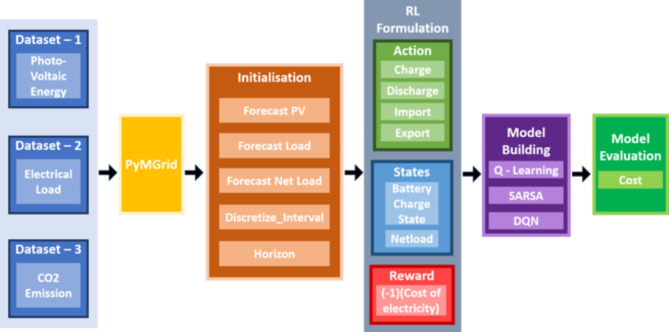
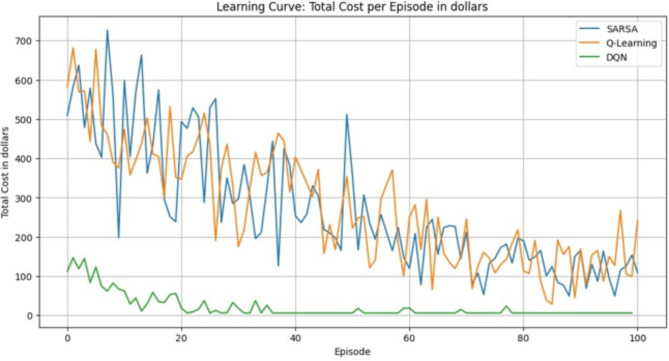
The growing integration of renewable energy sources within microgrids necessitates innovative approaches to optimize energy management. While microgrids offer advantages in energy distribution, reliability, efficiency, and sustainability, the variable nature of renewable energy generation and fluctuating demand pose significant challenges for optimizing energy flow. This research presents a novel application of Reinforcement Learning (RL) algorithms-specifically Q-Learning, SARSA, and Deep Q-Network (DQN)-for optimal energy management in microgrids. Utilizing the PyMGrid simulation framework, this study not only develops intelligent control strategies but also integrates advanced mathematical control techniques, such as Model Predictive Control (MPC) and Kalman filters, within the Markov Decision Process (MDP) framework. The innovative aspect of this research lies in its comparative analysis of these RL algorithms, demonstrating that DQN outperforms Q-Learning and SARSA by 12% and 30%, respectively, while achieving a remarkable 92% improvement over scenarios without an RL agent. This study addresses the unique challenges of energy management in microgrids and provides practical insights into the application of RL techniques, thereby contributing to the advancement of sustainable energy solutions.
Overview
The claims and statistics of this paper haven’t been checked yet.
Free: it reads the open-access text and checks the first 5 claims that cite a source we can check. Create a free account to check every claim.
Integrity signals
Registry
Cites
Statistics
Figures
Verification
Claims the paper makes
The claims and statistics of this paper haven’t been checked yet.
Free: it reads the open-access text and checks the first 5 claims that cite a source we can check. Create a free account to check every claim.
Claims other papers make about this one
Each is checked against this paper’s own text: does it say what the citing paper says it does?
The source backs part of the claim, not all of it — or backs it for a different population, condition or comparison.
In the citing paper
“RL algorithms-ranging from tabular methods to advanced deep RL architectures-have demonstrated the capacity to learn optimal strategies for HVAC control, demand response, and renewable integration [2,3].”
From Explainable AI and Multi-Agent Systems for Energy Management in IoT-Edge Environments: A State of the Art Review (2026) · cites this paper as [3]
Experimental — accuracy not yet measuredThe check wasn’t confident either way, so it gives no verdict — never disputed.
In the citing paper
“Integrating DRL or MARL at the microcontroller level remains challenging due to the high training time requirements [3].”
From Explainable AI and Multi-Agent Systems for Energy Management in IoT-Edge Environments: A State of the Art Review (2026) · cites this paper as [3]
Experimental — accuracy not yet measured
Self-check
Percentages, sums and reported differences re-computed from the paper’s own numbers.
The self-check needs the paper’s full text.
Citations
Cites
Smart grids and renewable energy systems: Perspectives and grid integration challenges
Khalid, M. (2024) · Energy Strategy Reviews · doi:10.1016/j.esr.2024.101299 · Cited by 684
Reinforcement Learning and Its Applications in Modern Power and Energy Systems: A Review
Cao, D., Hu, W., Zhao, J., Zhang, G., Zhang, B., Liu, Z., Chen, Z., & Blaabjerg, F. (2020) · Journal of Modern Power Systems and Clean Energy · doi:10.35833/mpce.2020.000552 · Cited by 460 · cited 1×
“Cao et al. 16 reviews different RL algorithms and their applications in modern power and energy systems.”
Reinforcement learning in sustainable energy and electric systems: a survey
Yang, T., Zhao, L., Li, W., & Zomaya, A. Y. (2020) · Annual Reviews in Control · doi:10.1016/j.arcontrol.2020.03.001 · Cited by 234 · cited 1×
“A research explores Q-Learning and SARSA for sustainable energy 17 .”
Deep Reinforcement Learning for Smart Grid Operations: Algorithms, Applications, and Prospects
Li, Y., Yu, C., Shahidehpour, M., Yang, T., Zeng, Z., & Chai, T. (2023) · Proceedings of the IEEE · doi:10.1109/jproc.2023.3303358 · Cited by 203 · cited 1×
“Similarly, another research employs DRL to enhance smart grid efficiency 14 .”
Resilient Distribution Networks by Microgrid Formation Using Deep Reinforcement Learning
Huang, Y., Li, G., Chen, C., Bian, Y., Qian, T., & Bie, Z. (2022) · IEEE Transactions on Smart Grid · doi:10.1109/tsg.2022.3179593 · Cited by 171
Harrold, D. J. B., Cao, J. H., & Fan, Z. (2022) · Applied Energy · doi:10.1016/j.apenergy.2022.119151 · Cited by 168
Decentralized multi-agent based energy management of microgrid using reinforcement learning
Samadi, E., Badri, A., & Ebrahimpour, R. (2020) · International Journal of Electrical Power & Energy Systems · doi:10.1016/j.ijepes.2020.106211 · Cited by 158
Arwa, E. O., & Folly, K. A. (2020) · IEEE Access · doi:10.1109/access.2020.3038735 · Cited by 146 · cited 2×
“Arwa and Folly 3 have proposed a comprehensive review of different Reinforcement Learning (RL) algorithms used for managing power in microgrids.”
Microgrid energy management using deep Q-network reinforcement learning
Alabdullah, M., & Abido, M. A. (2022) · Alexandria Engineering Journal · doi:10.1016/j.aej.2022.02.042 · Cited by 144
Fusion of Microgrid Control With Model-Free Reinforcement Learning: Review and Vision
She, B., Li, F. F., Cui, H., Zhang, J., & Bo, R. (2022) · IEEE Transactions on Smart Grid · doi:10.1109/tsg.2022.3222323 · Cited by 105 · cited 1×
“Another study integrates Model-Free RL (MFRL) with microgrid control systems 13 .”
Navigating the Landscape of Deep Reinforcement Learning for Power System Stability Control: A Review
Massaoudi, M., Abu‐Rub, H., & Ghrayeb, A. (2023) · IEEE Access · doi:10.1109/access.2023.3337118 · Cited by 83 · cited 1×
“Another study discusses DRL applications for power system stability control 15 .”
Optimising a Microgrid System by Deep Reinforcement Learning Techniques
Domínguez-Barbero, C., García‐González, J., Sanz-Bobi, M. A., & Sánchez-Úbeda, E. F. (2020) · Energies · doi:10.3390/en13112830 · Cited by 69
Xu, J., Li, K., & Abusara, M. A. (2022) · Memetic Computing · doi:10.1007/s12293-022-00357-w · Cited by 60 · cited 1×
“Xu et al. 8 , explore the optimization of multi-microgrid systems in smart grids through a novel approach using preference-based multi-objective reinforcement learning (MORL) algorithms.”
Reinforcement learning for control of flexibility providers in a residential microgrid
Mbuwir, B. V., Geysen, D., Spiessens, F., & Deconinck, G. (2019) · IET Smart Grid · doi:10.1049/iet-stg.2019.0196 · Cited by 48 · cited 1×
“Research compares MARL and single-agent RL methods for battery optimization in residential microgrids 10 .”
Kiran, P., & Chandrakala, K. R. M. V. (2020) · Applied Soft Computing · doi:10.1016/j.asoc.2020.106762 · Cited by 46
Reinforcement Learning Approaches to Power Management in Grid-tied Microgrids: A Review
Arwa, E. O., & Folly, K. A. (2020) · Clemson University Power Systems Conference · doi:10.1109/psc50246.2020.9131138 · Cited by 38
A Novel Deep Reinforcement Approach for IIoT Microgrid Energy Management Systems
Dridi, A., Afifi, H., Moungla, H., & Badosa, J. (2021) · IEEE Transactions on Green Communications and Networking · doi:10.1109/tgcn.2021.3112043 · Cited by 31 · cited 1×
“Another study proposes an RL architecture inspired by time series prediction, utilizing recurrent neural networks instead of traditional frameworks 4 .”
Reinforcement learning based path planning using a topological map for mobile service robot
Kumaar, A. A. N., & Kochuvila, S. (2023) · IEEE International Conference on Electronics, Computing and Communication Technologies (CONECCT) · doi:10.1109/conecct57959.2023.10234766 · Cited by 13 · cited 1×
“Deep Q Network (DQN) integrates deep learning techniques with a traditional reinforcement algorithm known as Q Learning 21,22 .”
Federated deep reinforcement learning for mobile robot navigation
Shivkumar, S., Amudha, J., & Kumaar, A. A. N. (2024) · Journal of Intelligent & Fuzzy Systems · doi:10.3233/jifs-219428 · Cited by 13
Feature Extraction of Time Series Data for Wind Speed Power Generation
Khanna, M., Srinath, N. K., & Mendiratta, J. K. (2016) · IEEE International Conference on Advanced Computing (IACC) · doi:10.1109/iacc.2016.40 · Cited by 3
Self-citation
Research works printed but not linked: 2
- Somasundaran, N., Radhika, N. & Venkataraman, V. Smart grid test bed based on GSM. Proc. Eng. (2012).
- Sowmya Reddy, V. S., Chandan, K., Nimmy, P., Smitha, T. V. & Nagaraja, K. V. An efficient machine learning model for smart grid stability prediction in our prestigious conference: International Conference on Emerging Technologies in Engineering and Science (ICETES) (2023).
Cited by
A comprehensive review on DC microgrid control and energy management strategies
Sandeep, S. D., Mohanty, S., Mohanty, S. B., & Puhan, P. S. (2025) · Results in Engineering · doi:10.1016/j.rineng.2025.105479 · Cited by 36
Álvarez-López, C., González-Briones, A., & Li, T. (2026) · Electronics · doi:10.3390/electronics15020385 · Cited by 23
Addai, M., & Musílek, P. (2026) · Electronics · doi:10.3390/electronics15030707 · Cited by 22
“Temporal difference learning methods, particularly Q-learning and SARSA, are well-suited to online optimization because they update value estimates after every transition rather than waiting for complete episode trajectories, enabling continuous learning from streaming operational data [89].”
Rosen, J., Russell, J., Kartik, P., & Vella‐Baldacchino, M. (2025) · Journal of Experimental Orthopaedics · doi:10.1002/jeo2.70549 · Cited by 14
A review of microgrid energy management systems: methods, challenges, and future directions
Atef, M., Alahakoon, S., Mumtahina, U., Wolfs, P., Khatib, T., & Uddin, M. (2026) · International Journal of Ambient Energy · doi:10.1080/01430750.2025.2595117 · Cited by 9
Metadata
- Authors
- Ramesh, S., N, S. B., Sathyavarapu, S. J., Sharma, V., A. A., N. K., & Khanna, M.
- Affiliations
- Amrita Vishwa Vidyapeetham (IN)
- ORCID
- Khanna, Manju
- Venue
- Scientific Reports
- Published
- 2025-01-03
- Volume
- 15
- Issue
- 1
- Pages
- 694-694
- ISSN
- 2045-2322 (ISSN-L)
- PMC
- PMC11698738
- OpenAlex
- W4406024085
- Cited by
- 35
- References
- 20
- Citations by year
- 2026: 20 · 2025: 15
- FWCI
- 12.86
- Type
- journal article
- Language
- en
- Open access
- gold
- doi.org
- Licence
- cc-by-nc-nd
- creativecommons.org/licenses/by-nc-nd/4.0 (tdm)
- creativecommons.org/licenses/by-nc-nd/4.0 (vor)
- Locations
- Scientific Reports (publishedVersion, cc-by-nc-nd)
- PubMed Central (publishedVersion, cc-by-nc-nd)
- PubMed (publishedVersion)
- DOAJ (DOAJ: Directory of Open Access Journals) (submittedVersion, cc-by-sa)
- Topics
- Physical Sciences › Engineering › Control and Systems Engineering › Microgrid Control and Optimization
- Physical Sciences › Engineering › Electrical and Electronic Engineering › Smart Grid Energy Management
- Physical Sciences › Computer Science › Artificial Intelligence › Reinforcement Learning in Robotics
- Keywords
- microgrid energy management, Q-learning, SARSA, deep Q-network, reinforcement learning, model predictive control, Kalman filter, Markov decision process, renewable energy integration, algorithm comparison
About these checks
Registry, retraction, Cites and statistics results are computed, not judged, with one exception: a printed reference that no index lists is read once by a model before it counts as a citation error. Claims are extracted by a model and kept only when their quote appears verbatim in the text; each cited source is then checked, with a model’s help, for whether it says what the claim relies on. Those verdicts can be wrong — read the claim’s quote and the cited source before relying on one.
Statistics and arithmetic are recomputed, not judged.
Confidence bands are shown only for fields calibrated on our annotated test set. None is calibrated yet, so no band is shown.
What counts as a claim ›How we measure confidence ›How we check this ›
Are you an author, or do you see a problem with this page? Request a review
Data sources
Bibliographic data: Semantic Scholar, OpenAlex, Crossref.
Contains information from the Semantic Scholar Academic Graph Datasets, made available under the ODC Attribution License (ODC-BY 1.0).
Semantic Scholar’s data is described in: Kinney, R., et al. (2023). The Semantic Scholar Open Data Platform. arXiv:2301.10140.
