

The DOI matches its Crossref record; 36 of the 36 references it cites were found in a registry or an index.
Introduction of multiple disulfide bonds increases the thermostability of transglutaminase
Open accessPublished version of a preprint
Abstract
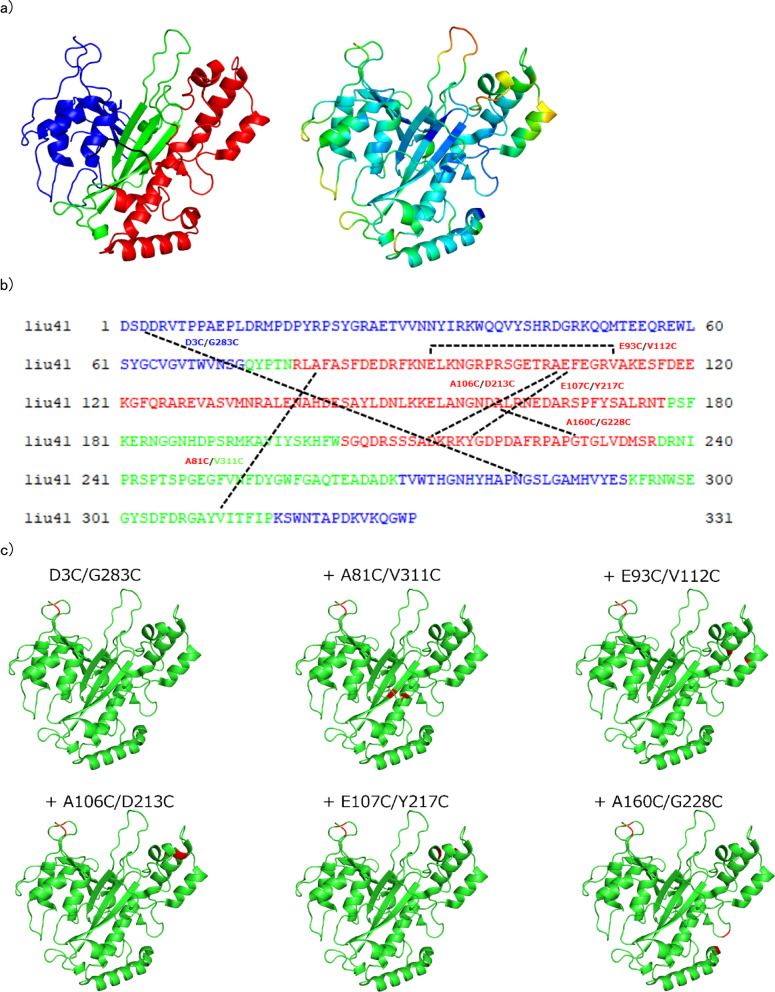
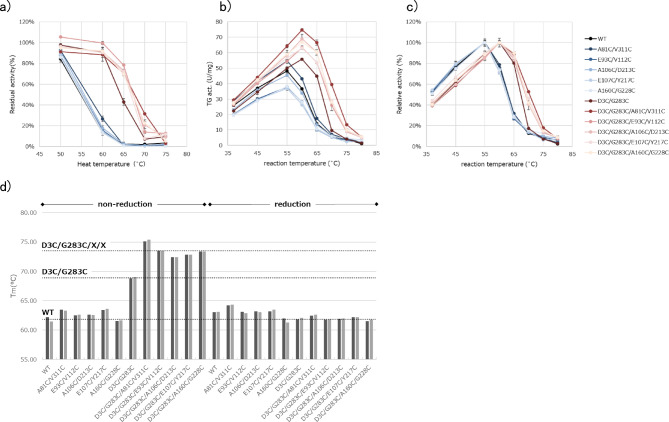
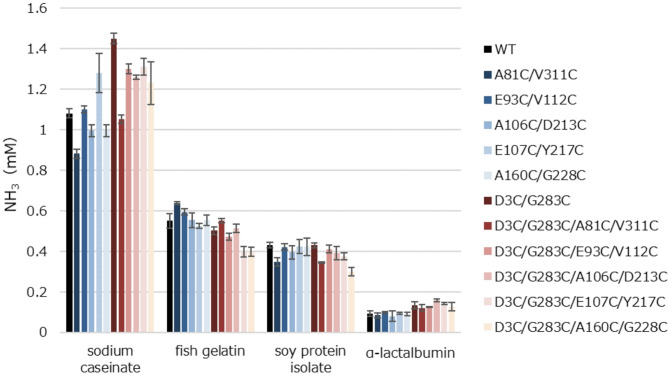
Microbial transglutaminase (MTG) is an enzyme that catalyzes the cross-linking of glutamine and lysine residues in proteins. Because of its ability to modify proteins, MTG has various applications in the medical and food industries. Most studies have aimed to enhance the thermal stability of MTG by focusing only on point mutations. Introducing a disulfide (S-S) bond in the N-terminal region has been found to be effective, whereas S-S bonds in other regions were considered ineffective. Therefore, this study aimed to evaluate the impact of introducing an additional S-S bond on the thermal stability of an MTG mutant. We found that adding S-S bonds to regions other than the N-terminal, in conjunction with the N-terminal S-S bond, significantly enhanced thermal stability. This finding demonstrates the importance of reinforcing the weakest part of the protein first, followed by strengthening other regions for optimal thermal stability. The MTG variant with two S-S bonds retained its catalytic activity and substrate specificity towards protein substrates, making it a promising candidate for industrial applications. Thus, introducing S-S bonds could be an effective strategy to increase thermal stability of MTG and other industrial enzymes, thereby contributing to their potential industrial applications.
Overview
The claims and statistics of this paper haven’t been checked yet.
Run the check — free, no account needed. It reads the open-access text and checks the sources it cites.
Integrity signals
Registry
Cites
Statistics
Figures
Verification
Claims the paper makes
The claims and statistics of this paper haven’t been checked yet.
Run the check — free, no account needed. It reads the open-access text and checks the sources it cites.
Self-check
Percentages, sums and reported differences re-computed from the paper’s own numbers.
The self-check needs the paper’s full text.
Citations
Cites
Highly accurate protein structure prediction with AlphaFold
Jumper, J., Evans, R., Pritzel, A., Green, T., Figurnov, M., Ronneberger, O., Tunyasuvunakool, K., Bates, R., Žídek, A., Potapenko, A., et al. (2021) · Nature · doi:10.1038/s41586-021-03819-2 · Cited by 43,764
WebLogo: A Sequence Logo Generator: Figure 1
Crooks, G. E., Hon, G., Chandonia, J.-M., & Brenner, S. E. (2004) · Genome Research · doi:10.1101/gr.849004 · Cited by 12,386
Sastry, G. M., Adzhigirey, M., Day, T., Annabhimoju, R., & Sherman, W. (2013) · Journal of Computer-Aided Molecular Design · doi:10.1007/s10822-013-9644-8 · Cited by 6,207
Accurate prediction of protein structures and interactions using a 3-track network
Baek, M., DiMaio, F., Anishchenko, I., Dauparas, J., Ovchinnikov, S., Lee, G. R., Wang, J., Cong, Q., Kinch, L. N., Schaeffer, R. D., et al. (2021) · doi:10.1101/2021.06.14.448402 · Cited by 5,549
Folk, J. E. (1980) · Annual Review of Biochemistry · doi:10.1146/annurev.bi.49.070180.002505 · Cited by 835
Properties and applications of microbial transglutaminase
Yokoyama, K., Nio, N., & Kikuchi, Y. (2004) · Applied Microbiology and Biotechnology · doi:10.1007/s00253-003-1539-5 · Cited by 605
Purification and Characteristics of a Novel Transglutaminase Derived from Microorganisms
Ando, H., Adachi, M., Umeda, K., Matsuura, A., Nonaka, M., Uchio, R., Tanaka, H., & Motoki, M. (1989) · Agricultural and Biological Chemistry · doi:10.1080/00021369.1989.10869735 · Cited by 587
Thermophilic Adaptation of Proteins
Sterner, R. H., & Liebl, W. (2001) · Critical Reviews in Biochemistry and Molecular Biology · doi:10.1080/20014091074174 · Cited by 388
Protein stability and enzyme activity at extreme biological temperatures
Feller, G. (2010) · Journal of Physics: Condensed Matter · doi:10.1088/0953-8984/22/32/323101 · Cited by 337
The consensus concept for thermostability engineering of proteins
Lehmann, M., Pasamontes, L., Lassen, S. F., & Wyss, M. (2000) · Biochimica et Biophysica Acta (BBA) - Protein Structure and Molecular Enzymology · doi:10.1016/s0167-4838(00)00238-7 · Cited by 281
Crystal Structure of Microbial Transglutaminase fromStreptoverticillium mobaraense
Kashiwagi, T., Yokoyama, K.-I., Ishikawa, K., Ono, K., Ejima, D., Matsui, H., & Suzuki, E. (2002) · Journal of Biological Chemistry · doi:10.1074/jbc.m203933200 · Cited by 272
Polymerization of Several Proteins by Ca2+-Independent Transglutaminase Derived from Microorganisms
Nonaka, M., Tanaka, H., OKIYAMA, A., Motoki, M., Ando, H., Umeda, K., & Matsuura, A. (1989) · Agricultural and Biological Chemistry · doi:10.1080/00021369.1989.10869736 · Cited by 203
Amino acid sequence of guinea pig liver transglutaminase from its cDNA sequence
Ikura, K., Nasu, T., Yokota, H., Tsuchiya, Y., Sasaki, R., & Chiba, H. (1988) · Biochemistry · doi:10.1021/bi00408a035 · Cited by 174
Novel applications for microbial transglutaminase beyond food processing
Zhu, Y., & TRAMPER, J. (2008) · Trends in biotechnology · doi:10.1016/j.tibtech.2008.06.006 · Cited by 155
Bacterial pro‐transglutaminase from Streptoverticillium mobaraense
Pasternack, R., Dorsch, S., Otterbach, J. T., Robenek, I. R., Wolf, S., & Fuchsbauer, H. (1998) · European Journal of Biochemistry · doi:10.1046/j.1432-1327.1998.2570570.x · Cited by 154
Protein thermostability engineering
Modarres, H. P., Mofrad, M. R. K., & Sanati‐Nezhad, A. (2016) · RSC Advances · doi:10.1039/c6ra16992a · Cited by 153
Kikuchi, Y., Date, M., Yokoyama, K.-I., Umezawa, Y., & Matsui, H. (2003) · Applied and Environmental Microbiology · doi:10.1128/aem.69.1.358-366.2003 · Cited by 137
Structure-based approach to the prediction of disulfide bonds in proteins
Salam, N. K., Adzhigirey, M., Sherman, W., & Pearlman, D. A. (2014) · Protein Engineering Design and Selection · doi:10.1093/protein/gzu017 · Cited by 111
Miwa, N. (2020) · Analytical Biochemistry · doi:10.1016/j.ab.2020.113638 · Cited by 108
An appraisal of the enzyme stability‐activity trade‐off
Miller, S. R. (2017) · Evolution · doi:10.1111/evo.13275 · Cited by 95
Date, M., Yokoyama, K.-I., Umezawa, Y., Matsui, H., & Kikuchi, Y. (2004) · Journal of Biotechnology · doi:10.1016/j.jbiotec.2004.02.011 · Cited by 80
Duarte, L. S., Matte, C. R., Bizarro, C. V., & Ayub, M. A. Z. (2019) · World Journal of Microbiology and Biotechnology · doi:10.1007/s11274-019-2792-9 · Cited by 76
Wang, X., Du, J., Zhao, B., Wang, H., Rao, S., Du, G., Zhou, J., Chen, J., & Liu, S. (2021) · Journal of Agricultural and Food Chemistry · doi:10.1021/acs.jafc.1c05256 · Cited by 73
Transglutaminases: part I—origins, sources, and biotechnological characteristics
Duarte, L. S., Matte, C. R., Bizarro, C. V., & Ayub, M. A. Z. (2020) · World Journal of Microbiology and Biotechnology · doi:10.1007/s11274-019-2791-x · Cited by 65
Yang, P., Wang, X., Ye, J., Rao, S., Zhou, J., Du, G., & Liu, S. (2023) · Journal of Agricultural and Food Chemistry · doi:10.1021/acs.jafc.3c00260 · Cited by 57
Microbiological transglutaminase: Biotechnological application in the food industry
Kolotylo, V., Piwowarek, K., & Kieliszek, M. (2023) · Open Life Sciences · doi:10.1515/biol-2022-0737 · Cited by 46
Continuous enzyme-coupled assay for microbial transglutaminase activity
Oteng-Pabi, S. K., & Keillor, J. W. (2013) · Analytical Biochemistry · doi:10.1016/j.ab.2013.07.014 · Cited by 40
Enzymatic activity and thermoresistance of improved microbial transglutaminase variants
Böhme, B., Moritz, B., Wendler, J., Hertel, T. C., Ihling, C. H., Brandt, W., & Pietzsch, M. (2019) · Amino Acids · doi:10.1007/s00726-019-02764-9 · Cited by 38
Approaching transglutaminase from Streptomyces bacteria over three decades
Fuchsbauer, H. (2021) · FEBS Journal · doi:10.1111/febs.16060 · Cited by 31
Yokoyama, K.-I., Ogaya, D., Utsumi, H., Suzuki, M., Kashiwagi, T., Suzuki, E., & Taguchi, S. (2021) · Applied Microbiology and Biotechnology · doi:10.1007/s00253-021-11200-6 · Cited by 30
In vitro refolding process of urea-denatured microbial transglutaminase without pro-peptide sequence
Yokoyama, K.-I., Ono, K., Ohtsuka, T., Nakamura, N., Seguro, K., & Ejima, D. (2002) · Protein Expression and Purification · doi:10.1016/s1046-5928(02)00536-3 · Cited by 25
Rational design of a disulfide bridge increases the thermostability of microbial transglutaminase
Suzuki, M., Date, M., Kashiwagi, T., Suzuki, E., & Yokoyama, K.-I. (2022) · Applied Microbiology and Biotechnology · doi:10.1007/s00253-022-12024-8 · Cited by 14
Efficient Production of a Thermostable Mutant of Transglutaminase by Streptomyces mobaraensis
Ye, J., Yang, P., Zhou, J., Du, G., & Liu, S. (2024) · Journal of Agricultural and Food Chemistry · doi:10.1021/acs.jafc.3c07621 · Cited by 13
Suzuki, M., Date, M., Kashiwagi, T., Takahashi, K., Nakamura, A., Tanokura, M., Suzuki, E., & Yokoyama, K.-I. (2024) · Applied Microbiology and Biotechnology · doi:10.1007/s00253-024-13304-1 · Cited by 7
Self-citationYuan, F., Li, G., Li, Z., Li, M., Yang, H., & Yu, X. (2024) · International Journal of Biological Macromolecules · doi:10.1016/j.ijbiomac.2024.137733 · Cited by 7
A Back Hydrogen Exchange Procedure via the Acid-Unfolded State for a Large Protein
Suzuki, M., Sakurai, K., Lee, Y., Ikegami, T., Yokoyama, K.-I., & Goto, Y. (2012) · Biochemistry · doi:10.1021/bi300495p · Cited by 6
Metadata
- Authors
- Ono, T., Takahashi, K., Hirao, Y., Mihara, Y., Abe, I., Shirasawa, A., & Sugiki, M.
- Affiliations
- Ajinomoto (Japan) (JP)
- Corresponding author
- Takahashi, Kazutoshi
- Venue
- Scientific Reports
- Published
- 2025-07-01
- Volume
- 15
- Issue
- 1
- Pages
- 21105-21105
- ISSN
- 2045-2322 (ISSN-L)
- PMC
- PMC12214910
- OpenAlex
- W4411871565
- Cited by
- 2
- References
- 36
- Citations by year
- 2026: 2
- FWCI
- 0.60
- Type
- journal article
- Language
- en
- Open access
- gold
- doi.org
- Licence
- cc-by-nc-nd
- creativecommons.org/licenses/by-nc-nd/4.0 (tdm)
- creativecommons.org/licenses/by-nc-nd/4.0 (vor)
- Locations
- Scientific Reports (publishedVersion, cc-by-nc-nd)
- Research Square (acceptedVersion, cc-by)
- PubMed Central (publishedVersion, cc-by-nc-nd)
- PubMed (publishedVersion)
- DOAJ (DOAJ: Directory of Open Access Journals) (submittedVersion, cc-by-sa)
- Funders
- Ajinomoto Co., Inc, Japan
- Topics
- Life Sciences › Biochemistry, Genetics and Molecular Biology › Molecular Biology › Enzyme Catalysis and Immobilization
- Life Sciences › Biochemistry, Genetics and Molecular Biology › Biotechnology › Enzyme Production and Characterization
- Life Sciences › Biochemistry, Genetics and Molecular Biology › Molecular Biology › Protein purification and stability
- Keywords
- microbial transglutaminase, disulfide bonds, thermal stability, protein engineering, protein cross-linking, industrial enzymes, catalytic activity, substrate specificity
- MeSH terms
- Disulfides, Enzyme Stability, Transglutaminases, Substrate Specificity, Temperature
About these checks
Registry, retraction, Cites and statistics results are computed, not judged, with one exception: a printed reference that no index lists is read once by a model before it counts as a citation error. Claims are extracted by a model and kept only when their quote appears verbatim in the text; each cited source is then checked, with a model’s help, for whether it says what the claim relies on. Those verdicts can be wrong — read the claim’s quote and the cited source before relying on one.
Statistics and arithmetic are recomputed, not judged.
Confidence bands are shown only for fields calibrated on our annotated test set. None is calibrated yet, so no band is shown.
What counts as a claim ›How we measure confidence ›How we check this ›
Are you an author, or do you see a problem with this page? Request a review
Data sources
Bibliographic data: Semantic Scholar, OpenAlex, Crossref.
Contains information from the Semantic Scholar Academic Graph Datasets, made available under the ODC Attribution License (ODC-BY 1.0).
Semantic Scholar’s data is described in: Kinney, R., et al. (2023). The Semantic Scholar Open Data Platform. arXiv:2301.10140.
