

The DOI matches its Crossref record; 30 of the 30 references it cites were found in a registry or an index; 14 of the 39 sources its claims cite were checked for support.
Integrating AI-generated content tools in higher education: a comparative analysis of interdisciplinary learning outcomes
Open accessAbstract
This study examines the integration of artificial intelligence-generated content (AIGC) tools across disciplines in higher education settings. Using a mixed-methods approach, we analyzed implementation patterns and learning outcomes across humanities, STEM, and social sciences programs at multiple institutions. Findings revealed a 37% increase in interdisciplinary project outcomes (measured by collaborative problem-solving scores, cross-domain knowledge integration ratings, and peer evaluation metrics) when AIGC tools were strategically implemented, with significant variations in effectiveness based on implementation approach. While these technologies demonstrated substantial value in breaking down disciplinary silos and accommodating diverse learning preferences, challenges emerged regarding algorithmic bias, digital equity, and maintenance of discipline-specific skills. This research contributes to educational theory by proposing a revised framework for AI-human collaboration in knowledge production. We conclude with policy recommendations for governance frameworks that balance innovation with academic integrity, emphasizing faculty co-design approaches and the establishment of cross-disciplinary communities of practice.
Overview
CoChat Summary
TL;DR
This mixed-methods study examines AIGC tool integration across higher education disciplines and reports improved interdisciplinary learning outcomes when tools are strategically implemented. It also identifies challenges involving algorithmic bias, digital equity, critical thinking, and discipline-specific skill maintenance.
Key findings
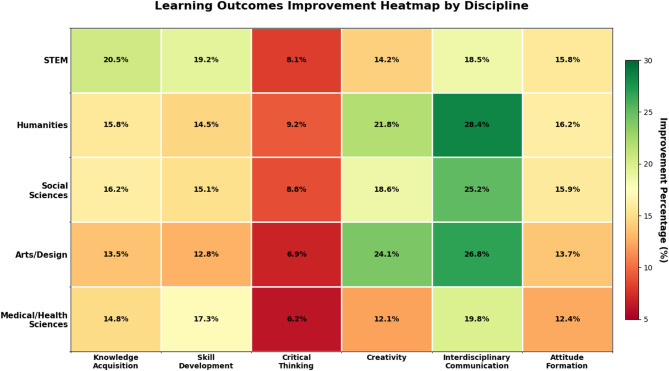
- The abstract and conclusion report a 37% increase in interdisciplinary project outcomes with strategic AIGC implementation. Table 7 shows improvements over traditional teaching: interdisciplinary communication +23.6%, creativity +17.4%, knowledge acquisition +17.2%, skill development +16.0%, attitude formation +14.5%, and critical thinking +7.5%; ANOVA differences were significant at p < 0.01, with effect sizes of d = 1.12 for interdisciplinary communication, d = 0.89 for creativity, d = 0.85 for knowledge acquisition, and d = 0.42 for critical thinking.
- Discipline adoption varied: STEM fields had the highest Technology Acceptance Index (mean TAI = 7.8) while humanities and fine arts were more moderate (mean TAI = 5.2). Table 6 reports STEM at 87% weekly use and 63% curriculum integration, humanities/social sciences at 62% and 58%, business/economics at 79% and 52%, arts/design at 56% and 34%, and medical/health sciences at 41% and 37%.
- Integration challenges included 47% of educators reporting difficulties incorporating AIGC tools into existing learning management systems, and humanities departments experiencing 2.3 times more ethical dilemmas than STEM disciplines. Successful models included a 27% increase in conceptual understanding in STEM laboratory augmentation and a 31% average improvement in decision-making competencies in business simulation enhancement.
- Institutions adhering to four or more universal implementation principles reported 68% higher faculty satisfaction and 54% improved student learning outcomes compared with those implementing fewer principles.
Methods
- Mixed-methods design: quantitative pre-post experimental design with validated instruments measuring learning outcomes (n = 1099), 32-item Likert technology acceptance surveys, and LMS learning analytics; qualitative semi-structured interviews (n = 42), focus groups (n = 8), and classroom observations (86 sessions).
- Sampling covered 15 higher education institutions across four geographical regions using multi-stage stratified random sampling, with 95% confidence level, ±3.5% margin of error, and 20% non-response adjustment. Table 4 reports 252 faculty and 1099 students across STEM, humanities, social sciences, and health sciences.
- Analysis included descriptive statistics, t-tests, ANOVA, structural equation modeling, hierarchical linear modeling, ANCOVA, cluster analysis, and discriminant analysis; qualitative data were coded in NVivo 14.0 using open, axial, and selective coding, with inter-rater reliability via Cohen’s Kappa.
Limitations
- Stated in the paper: the study focused on short-term learning outcomes and rapidly evolving AIGC technologies; the sample from specific disciplines may not fully represent higher education diversity; benefits were not distributed equally across student populations; outcomes depended heavily on prompting sophistication; and critical evaluation skills require careful instructional design.
- Evident from the text: participant and institutional counts are inconsistent across sections—methods report n = 1099 and 15 institutions, data collection reports 428 participants across eight universities, and results report a survey of n = 487 across 26 institutions—which complicates interpretation of the sample and findings.
- Evident from the text: several equations are presented without defined symbols or numeric values, limiting reproducibility of the quantitative models.
Model-written summary. Check it against the paper before relying on it.
Integrity signals
Registry
Cites
Statistics
Figures

Verification
Claims the paper makes
3 Valid · 14 Not valid · 26 Not checked · 51 Own results and interpretations
The cited sources that could be checked couldn’t confirm or dispute this claim.
In the paper
“The educational efficacy of these tools varies substantially across disciplines due to varying knowledge structures, pedagogical approaches, and evaluation metrics6.”
§ Integrating AI-generated content tools in higher education: a comparative analysis of interdisciplinary learning outcomes > Introduction > Research significance and objectives
What the sources say
- Could not verifycites [6] Wang, J., Zhang, Y. & Brown, K. Cross-disciplinary applications of AIGC tools in higher education: A comparative study. Int. J. Educational Technol. High. Educ. 20 (1), 1–18 (2023). sourceExperimental — accuracy not yet measured
The 'Demographic factors: field of study, gender, and year level' section discusses differences in students’ intentions toward technology, and the 'Practical implications' section discusses integrating AI into subject-specific teaching; neither assesses the educational efficacy of AIGC tools. Searches for cross-disciplinary efficacy, knowledge structures, pedagogical approaches, and evaluation metrics found no passage supporting the claimed explanation (page numbers unavailable). (LLM, conf=0.78)
plainstates a cause- Asserted: passes — The authors put it forward as true.
- Checkable: passes — It can be checked against evidence.
- Load-bearing: passes — The paper’s conclusions depend on it.
- Based: passes — The paper gives a reason why it holds.
- Could not verify
The cited sources that could be checked couldn’t confirm or dispute this claim.
In the paper
“A multi-stage stratified random sampling technique was employed to ensure the representativeness of the sample17.”
§ Integrating AI-generated content tools in higher education: a comparative analysis of interdisciplinary learning outcomes > Research methods > Research objects and sampling methods
What the sources say
- Could not verifycites [17] Heitzmann, N. et al. Cross-disciplinary research on learning and instruction – coming to terms. Front. Psychol. 12, 562658 (2021). sourceExperimental — accuracy not yet measured
The Discussion (page unavailable) describes a conceptualization of cross-disciplinary research, while the Team section discusses research-team composition. Searches for multi-stage stratified random sampling and representative samples found no passage saying that the paper employed such a sampling technique. (LLM, conf=0.77)
plainstates a cause- Asserted: passes — The authors put it forward as true.
- Checkable: passes — It can be checked against evidence.
- Load-bearing: passes — The paper’s conclusions depend on it.
- Based: passes — The paper gives a reason why it holds.
- Could not verify
The cited sources that could be checked couldn’t confirm or dispute this claim.
In the paper
“The cross-disciplinary application of AIGC tools showed particularly strong results in collaborative learning environments, with a 37% increase in interdisciplinary project outcomes compared to traditional approaches40.”
§ Integrating AI-generated content tools in higher education: a comparative analysis of interdisciplinary learning outcomes > Conclusion > Summary of key findings
What the sources say
- Could not verifycites [40] Wang, B., Chen, Q. & Wang, Z. Diffusion-based visual Art creation: A survey and new perspectives. ACM Comput. Surveys. 57 (10), 1–37 (2025). sourceExperimental — accuracy not yet measured
Section 3.1.3 mentions a review of AIGC in education, and Section 3.2.3 discusses integrating art into science education. Neither reports results for AIGC tools in collaborative learning or a 37% increase in interdisciplinary project outcomes. Searches for “37%” and interdisciplinary project outcomes found no matching result in our copy. (LLM, conf=0.75)
boostedstates a cause- Asserted: passes — The authors put it forward as true.
- Checkable: passes — It can be checked against evidence.
- Load-bearing: passes — The paper’s conclusions depend on it.
- Based: passes — The paper gives a reason why it holds.
- Could not verify
The cited sources that could be checked couldn’t confirm or dispute this claim.
In the paper
“Engineering and computer science programs demonstrate higher integration rates partially due to technological familiarity and infrastructural readiness18.”
§ Integrating AI-generated content tools in higher education: a comparative analysis of interdisciplinary learning outcomes > Results and discussion > Comparative analysis of AIGC tool applications across academic disciplines
What the sources say
- Could not verifycites [18] Spelt, E. J., Biemans, H. J., Tobi, H., Luning, P. A. & Mulder, M. Teaching and learning in interdisciplinary higher education: A systematic review. Educational Psychol. Rev. 21 (4), 365–378 (2009). sourceExperimental — accuracy not yet measured
The Conclusions and Considerations section discusses conditions for developing interdisciplinary thinking, not rates of technology integration across programs. Searches for engineering and computer science integration rates, technological familiarity, and infrastructural readiness found no passage addressing the claimed comparison or explanation; page numbers were not available in our copy. (LLM, conf=0.75)
boostedstates a possible cause- Asserted: passes — The authors put it forward as true.
- Checkable: passes — It can be checked against evidence.
- Load-bearing: unclear — It is unclear whether the paper’s conclusions depend on it.
- Based: passes — The paper gives a reason why it holds.
- Could not verify
The cited sources support only part of this claim — read each source’s verdict below.
In the paper
“Notably, AIGC tools facilitated improved information synthesis across disciplinary boundaries, enabling students to rapidly integrate concepts from multiple fields23.”
§ Integrating AI-generated content tools in higher education: a comparative analysis of interdisciplinary learning outcomes > Results and discussion > AIGC tools’ impact analysis on interdisciplinary learning outcomes
What the sources say
- Partly supportedcites [23] Kasneci, E. et al. ChatGPT for good? On opportunities and challenges of large language models for education. Learn. Individ. Differ. 103, 102274 (2023). sourceExperimental — accuracy not yet measured
Section 1.1, “Opportunities for Learning” (page unavailable), says language models can help students quickly understand texts through summaries and obtain information on research topics. Section 3 describes answering questions across domains, but refers to integrating digital applications, not students integrating concepts across disciplines. The paper presents these as potential uses; it does not report that AIGC tools improved students’ cross-disciplinary synthesis. (LLM, conf=0.84)
plainstates a cause- Asserted: passes — The authors put it forward as true.
- Checkable: passes — It can be checked against evidence.
- Load-bearing: passes — The paper’s conclusions depend on it.
- Based: passes — The paper gives a reason why it holds.
- Partly supported
53 more claims · 4 with their cited sources checked
Create a free account to see all 94 claims and every source verdict.
- Probably not a substantial claim. 12
- It may state two separate claims as one. 27
Self-check
Percentages, sums and reported differences re-computed from the paper’s own numbers.
Each contradiction between two passages listed here was confirmed by an independent check.
Rated major: it would touch a result — a value a result rests on, reported and recomputed p-values on opposite sides of the significance level, two passages that conflict with no sign which is right, or a cited work retracted before this paper was published.
In the paper
§ Integrating AI-generated content tools in higher education: a comparative analysis of interdisciplinary learning outcomes > Research methods > Research objects and sampling methods
“The research participants were selected from 15 higher education institutions across four geographical regions”
§ Integrating AI-generated content tools in higher education: a comparative analysis of interdisciplinary learning outcomes > Results and discussion > Comparative analysis of AIGC tool applications across academic disciplines
“Our survey data (n = 487) spanning 26 institutions demonstrated significant disciplinary differences in technological acceptance and pedagogical integration of AIGC tools.”
Rated minor: it would not touch a result — a value no result rests on, a p-value that stays on the same side of the significance level, or a conflict that is clerical, resolved elsewhere in the paper, or outside its own findings.
In the paper
§ Integrating AI-generated content tools in higher education: a comparative analysis of interdisciplinary learning outcomes > Introduction > Research significance and objectives
“This study aims to conduct a comparative analysis of AIGC tool integration across five distinct academic disciplines: engineering, humanities, business, life sciences, and fine arts.”
§ Integrating AI-generated content tools in higher education: a comparative analysis of interdisciplinary learning outcomes > Research methods > Research objects and sampling methods
“| STEM | 6 | 87 | 342 | 56:44 | 4.2 ± 0.6 | | Humanities | 4 | 65 | 298 | 42:58 | 3.7 ± 0.8 | | Social Sciences | 3 | 58 | 276 | 47:53 | 3.9 ± 0.7 | | Health Sciences | 2 | 42 | 183 | 39:61 | 3.8 ± 0.5 |”
Citations
Cites
The theory of planned behavior
Ajzen, I. (1991) · Organizational Behavior and Human Decision Processes · doi:10.1016/0749-5978(91)90020-t · Cited by 90,587
Perceived usefulness, perceived ease of use, and user acceptance of information technology
Davis, F. D. (1989) · MIS Quarterly · doi:10.2307/249008 · Cited by 68,483 · cited 2×
“…using a composite index that incorporates learning outcomes, engagement metrics, and skill development: where L represents learning outcome improvement, G denotes engagement gains, S indicates skill development, B represents bias or accuracy concerns, and ω 1 4 are contextual weighting factors 11 .”
User Acceptance of Computer Technology: A Comparison of Two Theoretical Models
Davis, F. D., Bagozzi, R. P., & Warshaw, P. R. (1989) · Management Science · doi:10.1287/mnsc.35.8.982 · Cited by 25,709 · cited 2×
“The effectiveness of technology integration can be expressed through the following relationship: Where α, β, γ, and δ represent weighting factors for Content Knowledge (CK), Pedagogical Knowledge (PK), and Technological Knowledge (TK) respectively 12 .”
A Theoretical Extension of the Technology Acceptance Model: Four Longitudinal Field Studies
Venkatesh, V., & Davis, F. D. (2000) · Management Science · doi:10.1287/mnsc.46.2.186.11926 · Cited by 23,066
Technological Pedagogical Content Knowledge: A Framework for Teacher Knowledge
Mishra, P., & Koehler, M. J. (2006) · Teachers College Record: The Voice of Scholarship in Education · doi:10.1111/j.1467-9620.2006.00684.x · Cited by 12,604
ChatGPT for Good? On Opportunities and Challenges of Large Language Models for Education
Kasneci, E., Seßler, K., Küchemann, S., Bannert, M., Dementieva, D., Fischer, F., Gasser, U., Groh, G., Günnemann, S., Hüllermeier, E., et al. (2023) · doi:10.35542/osf.io/5er8f · Cited by 7,552
ChatGPT for good? On opportunities and challenges of large language models for education
Kasneci, E., Sessler, K., Küchemann, S., Bannert, M., Dementieva, D., Fischer, F., Gasser, U., Groh, G., Günnemann, S., Hüllermeier, E., et al. (2023) · Learning and Individual Differences · doi:10.1016/j.lindif.2023.102274 · Cited by 7,326 · cited 1×
“Notably, AIGC tools facilitated improved information synthesis across disciplinary boundaries, enabling students to rapidly integrate concepts from multiple fields 23 .”
Zawacki-Richter, O., Marín, V. I., Bond, M., & Gouverneur, F. (2019) · International Journal of Educational Technology in Higher Education · doi:10.1186/s41239-019-0171-0 · Cited by 7,242 · cited 1×
“The behavioral intention to use AIGC tools can be modeled as: Where BI represents behavioral intention, and β1 and β2 are regression coefficients 16 .”
What is technological pedagogical content knowledge (TPACK)?
Koehler, M. J., Mishra, P., & Cain, W. (2013) · Journal of Education · doi:10.1177/002205741319300303 · Cited by 2,790
Scherer, R., Siddiq, F., & Tondeur, J. (2019) · Computers & Education · doi:10.1016/j.compedu.2018.09.009 · Cited by 1,923
Research works printed but not linked: 16
- Johnson, M. K., Smith, A. L. & Davis, R. P. Educational technology acceptance in higher education: A framework for AI integration. J. Educational Technol. Res. 28 (3), 145–162 (2023).
- Chen, X., Wang, H. & Liu, Z. AI-generated content tools in Language education: effectiveness and student perceptions. Comput. Educ. 201, 104–118 (2023).
- Martinez, L. A., Rodriguez, C. & Thompson, S. Diffusion models in educational image generation: applications and ethical considerations. Educational Technol. Soc. 26 (2), 89–103 (2023).
- Liu, S., Anderson, P. & Wilson, D. Epistemological traditions and AI adoption in academic disciplines. High. Educ. Res. Dev. 42 (4), 234–251 (2023).
- Thompson, R. & Williams, M. Cross-disciplinary educational technology taxonomy: A framework for comparative analysis. Educational Res. Rev. 38, 100–115 (2023).
- Crompton, H. & Burke, D. The use of technology in learning and teaching: A systematic review of the extant literature. Educational Res. Rev. 40, 100–118 (2023).
- Jalil, S., Myers, T. & Atkinson, I. ChatGPT and the future of digital literacy in higher education: A systematic review. Comput. Hum. Behav. 148, 107–121 (2023).
- Urban, M., Degeling, M. & Koban, L. Artificial intelligence in higher education: A critical examination of benefits and challenges. Eur. J. Educ. 59 (2), 234–251 (2024).
- Nugroho, R. A., Basuki, Y. & Surjono, H. D. The impact of AI writing assistants on academic writing in higher education: A systematic review. Education Tech. Research Dev. 72 (1), 145–167 (2024).
- Zhou, M. & Kim, S. Facilitating complex knowledge comprehension through AI-assisted learning environments. Comput. Educ. 210, 104–119 (2024).
- Sun, Y., Wang, H. & Chen, L. AI-enhanced learning outcomes in interdisciplinary education: A meta-analysis. Educational Res. Rev. 42, 100–116 (2024).
- Roehler, L., Fear, K. & Herrmann, B. Connecting response to literature with the academic disciplines through character analysis: some research implications. Res. Teach. Engl. 32 (2), 201–228 (1998).
- Warren, A. Biodiversity and sustainable development: Decision-making processes. Environ. Manage. 37 (3), 341–353 (2006).
- Escalante, J., Martin, K. & Brown, P. Limitations of AI in educational contexts: A critical analysis. Education Tech. Research Dev. 71 (3), 456–474 (2023).
- Niloy, M. R., Ahmed, S. & Rahman, T. Potential drawbacks of AI integration in learning environments. Comput. Hum. Behav. 142, 107–118 (2023).
- Yang, L., Zhang, W. & Kim, J. Critical evaluation of AI tools in higher education: benefits and risks. High. Educ. 89 (2), 234–251 (2025).
Cited by
Wang, S. I. C., & Liu, E. Z. F. (2025) · Computers and Education Artificial Intelligence · doi:10.1016/j.caeai.2025.100488 · Cited by 19
Almenara, J. C., Goyeneche, C. E. P., Fredy-Montes, J., & Palacios‐Rodríguez, A. (2025) · Revista Electrónica Interuniversitaria de Formación del Profesorado · doi:10.6018/reifop.690971 · Cited by 5
Yang, J., Öge, K., von Mühlenen, A., Akbulut, A. B., Carey, T. S., & Okorro, C. (2026) · Education Sciences · doi:10.3390/educsci16060838 · Cited by 8
“These contextual forces shape not only access and capability, but also how staff interpret the risks, responsibilities, and opportunities associated with GenAI.”
Deep Gamification and Artificial Intelligence as Catalysts of Educational Transformation
Barriga, D. M. P., Sánchez, A. D. V., & Vizarreta, P. V. (2025) · F1000Research · doi:10.12688/f1000research.171453.2 · Cited by 1
Vehapi, S., & Ziberi, B. (2026) · Discover Education · doi:10.1007/s44217-026-01399-9 · Cited by 3
Metadata
- Authors
- Yan, Z., & Qianjun, T.
- Venue
- Scientific Reports
- Published
- 2025-07-16
- Volume
- 15
- Issue
- 1
- Pages
- 25802-25802
- ISSN
- 2045-2322 (ISSN-L)
- PMC
- PMC12267416
- OpenAlex
- W4412478578
- Cited by
- 21
- References
- 23
- Citations by year
- 2026: 15 · 2025: 6
- FWCI
- 21.67
- Type
- journal article
- Language
- en
- Open access
- gold
- doi.org
- Licence
- cc-by
- creativecommons.org/licenses/by/4.0 (tdm)
- creativecommons.org/licenses/by/4.0 (vor)
- Locations
- Scientific Reports (publishedVersion, cc-by)
- PubMed Central (publishedVersion, cc-by)
- PubMed (publishedVersion)
- DOAJ (DOAJ: Directory of Open Access Journals) (submittedVersion, cc-by-sa)
- Funders
- American Indian Graduate Center
- Topics
- Social Sciences › Education › Artificial Intelligence in Education
- Health Sciences › Medicine › Health Informatics › Artificial Intelligence in Healthcare and Education
- Social Sciences › Education › Educational Technology in Learning
- Keywords
- AI-generated content, interdisciplinary learning, learning outcomes, collaborative problem solving, algorithmic bias, digital equity, human-AI collaboration, academic integrity, AI governance, communities of practice, disciplinary silos
About these checks
Registry, retraction, Cites and statistics results are computed, not judged, with one exception: a printed reference that no index lists is read once by a model before it counts as a citation error. Claims are extracted by a model and kept only when their quote appears verbatim in the text; each cited source is then checked, with a model’s help, for whether it says what the claim relies on. Those verdicts can be wrong — read the claim’s quote and the cited source before relying on one.
The claim verdicts this report counts are experimental: their accuracy is not yet measured.
A language model drew the claims from the paper on 2026-10-10, under version 3 of the claim definition (model deepseek-v4.1-flash, prompt extract-v3).
A second model labelled each claim on 2026-10-10 (model jev-1.13-20260917, definition revision gold-guideline-v0.2).
Cited sources are checked with a language model’s help (gpt-6-sol).
Statistics and arithmetic are recomputed, not judged.
Confidence bands are shown only for fields calibrated on our annotated test set. None is calibrated yet, so no band is shown.
What counts as a claim ›How we measure confidence ›How we check this ›
Are you an author, or do you see a problem with this page? Request a review
How to cite
Cite CoChat for the checks on this page, and the paper for its own findings.
- This page
- CoChat. (2026). Citation check: Integrating AI-generated content tools in higher education: a comparative analysis of interdisciplinary learning outcomes. https://app.cochat.ai/papers/10.1038/s41598-025-10941-y
- The paper
- Yan, Z., & Qianjun, T. (2025). Integrating AI-generated content tools in higher education: a comparative analysis of interdisciplinary learning outcomes. Scientific Reports. https://doi.org/10.1038/s41598-025-10941-y
Data sources
Bibliographic data: Semantic Scholar, OpenAlex, Crossref.
Contains information from the Semantic Scholar Academic Graph Datasets, made available under the ODC Attribution License (ODC-BY 1.0).
Semantic Scholar’s data is described in: Kinney, R., et al. (2023). The Semantic Scholar Open Data Platform. arXiv:2301.10140.
