

Direct FFT oversampling without zero-padding
Open accessThe DOI matches its Crossref record; 20 of the 20 references it cites were found in a registry or an index.
Abstract
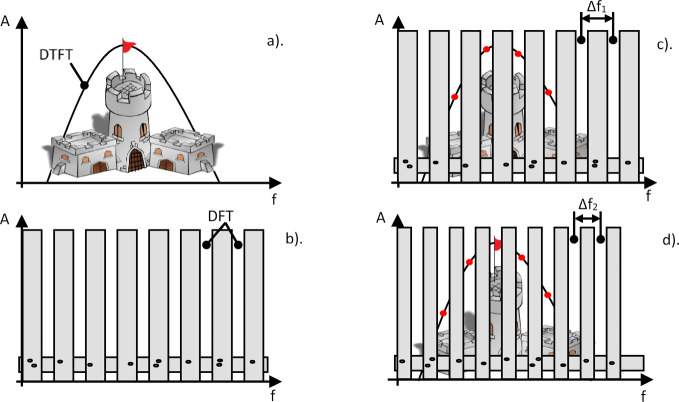
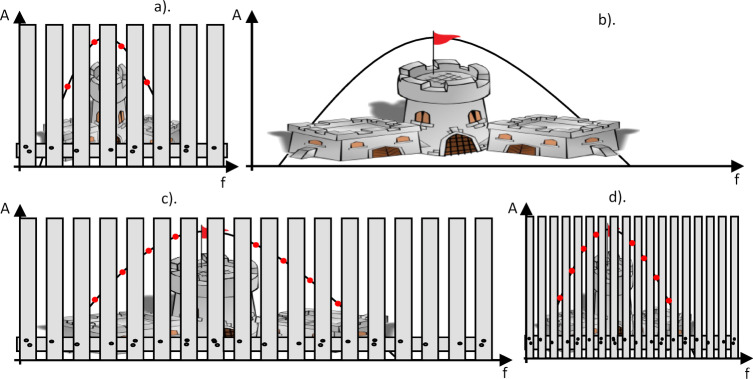
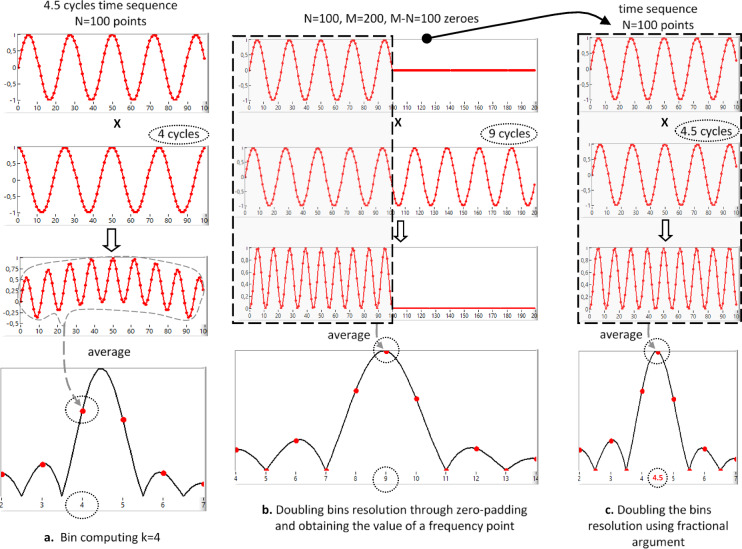
The Fast Fourier Transform (FFT) is the most powerful and widely used method for transforming signals from the time domain to the frequency domain, being employed in cutting-edge research fields. Achieving high-accuracy FFT involves increasing the number of frequency points through frequency oversampling, typically by extending the time-domain signal with zeros (zero-padding) and applying the FFT to the extended signal. While increasing the number of zeros enhances the precision of the results, it also substantially raises the computational load. To address the high computational demands associated with traditional frequency oversampling, this paper proposes a direct oversampling method. By employing a non-integer number of cycles within the FFT kernel, the method achieves spectral analysis results identical to those obtained with zero-padded oversampling but with a significantly lower computational cost. Specifically, it reduces the complexity from O(Mlog 2 M) to O(Mlog 2 N), where N is the original signal length and M is the oversampled frequency resolution. This approach eliminates zero-padding altogether, providing a mathematically equivalent and more efficient alternative for applications requiring high spectral resolution.
Overview
CoChat Summary
TL;DR
The paper proposes FIN-FFT, a direct frequency-oversampling method that evaluates the DFT at non-integer frequency indices, avoiding zero-padding while producing the same spectrum as a zero-padded FFT. It reports reduced complexity from O(M log₂ M) to O(M log₂ N) and demonstrates mathematical equivalence, with initial FPGA synthesis benchmarking.
Key findings
- FIN-FFT computes M frequency bins directly from an N-point sequence by repeating FFTs with fractional twiddle factors, without appending M−N zeros; the paper proves this is mathematically equivalent to zero-padded FFT (Eq. 11).
- The computational complexity is reduced from O(M log₂ M) to O(M log₂ N), with the gain growing with the oversampling ratio M/N; for M ≫ N this is described as a significant efficiency advantage.
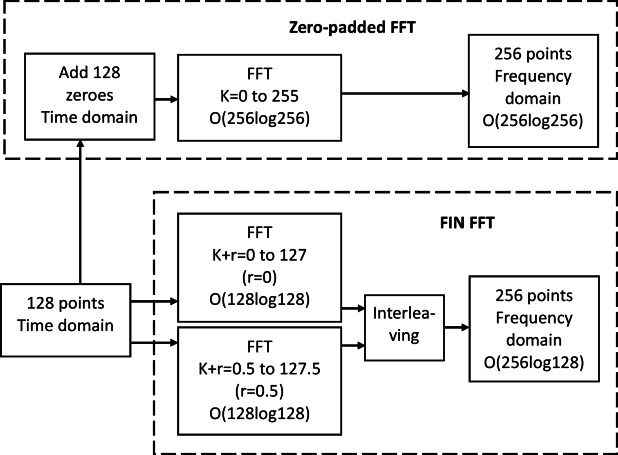
- In the worked example, N = 128 and M = 256 (oversampling rate 2, step 0.5): zero-padding would add M−N = 128 zeros, while FIN-FFT applies the FFT twice to the same 128-point sequence, first with r = 0 and then with r = 0.5.
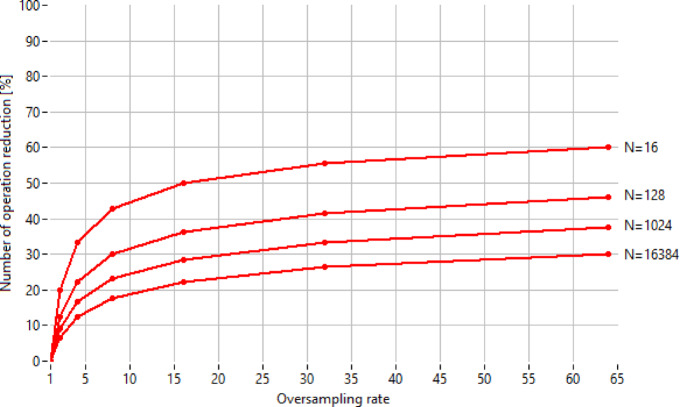
- Table 1 positions FIN-FFT as full-spectrum, non-integer-bin, preprocessing-free, O(M log N), and real-time ready, unlike zero-padded FFT, IpDFT, Zoom FFT, Chirp-Z, and pruned FFT; Fig. 7 reports percentage reduction in operation count for N = 16, 128, 1024, and 16,384, increasing with oversampling rate.
Methods
- Theoretical derivation: the DFT is extended to non-integer arguments, and the paper proves equivalence between a zero-padded FFT of length M = s·N and FIN-FFT evaluated at fractional index (k + r).
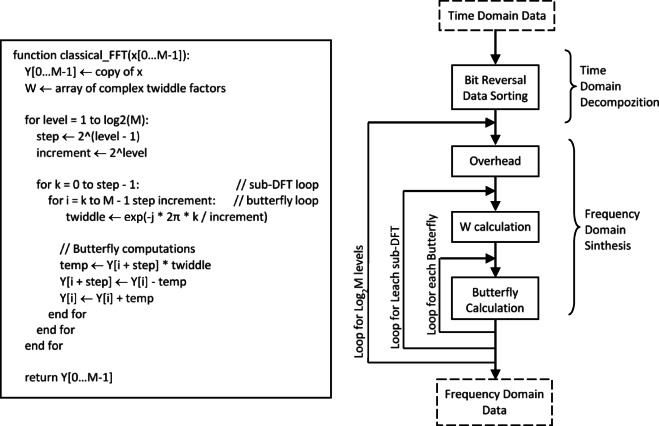
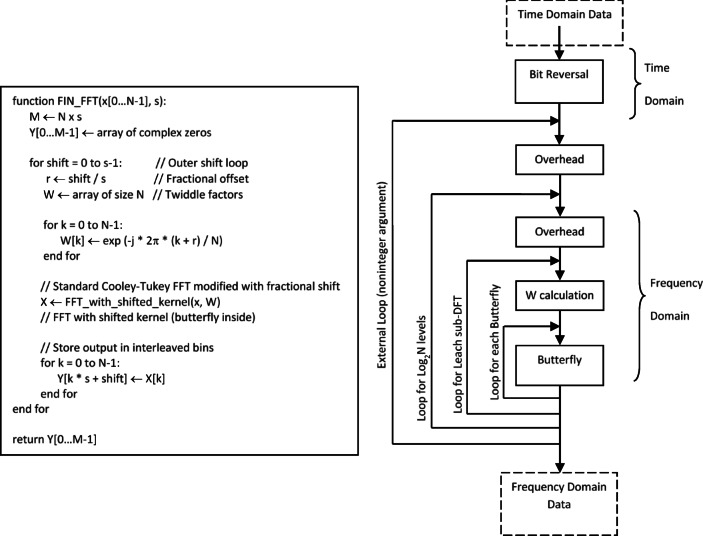
- Algorithm design: standard FFT structure is modified with an additional outer loop executed M/N times, replacing the kernel argument k with (k + r), where r starts at 0 and increments by the oversampling step N/M; outputs are interleaved to produce an M-length oversampled spectrum.
- Evaluation: an illustrative N = 128, M = 256 example, complexity analysis, a qualitative feature comparison table, and mention of initial FPGA synthesis benchmarking; no real-world dataset or quantitative spectral-error experiment is described.
Limitations
- Stated: the method is formulated for integer oversampling factors, which may limit flexibility for arbitrary frequency resolution; future work is proposed for rational or adaptive oversampling.
- Stated: a systematic analysis of numerical stability under finite-precision conditions, especially for high-resolution or real-time implementations, remains to be done.
- Stated: benchmarking has so far been conducted through FPGA synthesis only; evaluation on CPUs, GPUs, and embedded platforms is needed. Evident from the text: no quantitative spectral accuracy or error results are reported, and the comparison with existing methods is qualitative rather than benchmarked.
Model-written summary. Check it against the paper before relying on it.
Integrity signals
Registry
Cites
Statistics
Figures
Verification
Claims the paper makes
0 Valid · 0 Not valid · 0 Not checked · 19 Own results and interpretations
A result the paper states — it cites no source for it, so there is none to check. The quote shows it is in the paper.
In the paper
“Specifically, it reduces the complexity from O(Mlog2M) to O(Mlog2N), where N is the original signal length and M is the oversampled frequency resolution.”
- Also stated in: § Discussions · plain
“The computational complexity is thereby reduced from O(Mlog2M) to O(Mlog2N), compared to the classical zero-padding approach, yielding a computational gain that grows with the oversampling ratio M/N.”
- Also stated in: § Discussions · boosted
“Quantitative results confirm that the proposed method consistently reduces computational effort compared to the traditional zero-padding approach.”
§ Direct FFT oversampling without zero-padding > Abstract
boostedstates a cause- Asserted: passes — The authors put it forward as true.
- Checkable: passes — It can be checked against evidence.
- Load-bearing: passes — The paper’s conclusions depend on it.
- Based: passes — The paper gives a reason why it holds.
- Rests on an assumption not shown here.
- Also stated in: § Discussions · plain
A result the paper states — it cites no source for it, so there is none to check. The quote shows it is in the paper.
In the paper
“The algorithm computes the M frequency points (bins) in MlogN operations while yielding identical spectral results to those obtained via conventional zero-padding.”
- Also stated in: § Non-integer argument method · plain
“The implementation of this DFT with non-integer argument into a FFT with non-integer argument (FIN-FFT) will allow obtaining a frequency spectrum with M frequency points, using only MlogN operations, instead of MlogM operations required by the traditional zero-padded FFT methods.”
§ Direct FFT oversampling without zero-padding > Introduction
plainstates a cause- Asserted: passes — The authors put it forward as true.
- Checkable: passes — It can be checked against evidence.
- Load-bearing: passes — The paper’s conclusions depend on it.
- Based: passes — The paper gives a reason why it holds.
- Rests on an assumption not shown here.
- Also stated in: § Non-integer argument method · plain
A result the paper states — it cites no source for it, so there is none to check. The quote shows it is in the paper.
In the paper
“Hence, the FIN-FFT method computes the same spectral components without explicitly extending the time-domain signal with zeros.”
§ Direct FFT oversampling without zero-padding > Equivalence between zero-padded FFT and the proposed FIN-FFT method
plain- Asserted: passes — The authors put it forward as true.
- Checkable: passes — It can be checked against evidence.
- Load-bearing: passes — The paper’s conclusions depend on it.
- Based: passes — The paper gives a reason why it holds.
A result the paper states — it cites no source for it, so there is none to check. The quote shows it is in the paper.
In the paper
“This confirms that evaluating the DFT at fractional index (k + r) in the FIN-FFT is mathematically equivalent to evaluating DFT at index m in a zero-padded FFT approach.”
§ Direct FFT oversampling without zero-padding > Equivalence between zero-padded FFT and the proposed FIN-FFT method
boosted- Asserted: passes — The authors put it forward as true.
- Checkable: passes — It can be checked against evidence.
- Load-bearing: passes — The paper’s conclusions depend on it.
- Based: passes — The paper gives a reason why it holds.
A result the paper states — it cites no source for it, so there is none to check. The quote shows it is in the paper.
In the paper
“This approach eliminates zero-padding altogether, providing a mathematically equivalent and more efficient alternative for applications requiring high spectral resolution.”
- Also stated in: § Conclusions · plain
“This study presents FIN-FFT, an alternative formulation of frequency-domain oversampling that eliminates the need for zero-padding by directly evaluating the Discrete Fourier Transform at non-integer frequency indices.”
§ Direct FFT oversampling without zero-padding > Abstract
plain- Asserted: passes — The authors put it forward as true.
- Checkable: passes — It can be checked against evidence.
- Load-bearing: passes — The paper’s conclusions depend on it.
- Based: passes — The paper gives a reason why it holds.
- Also stated in: § Conclusions · plain
8 more claims
Create a free account to see all 19 claims and every source verdict.
- It may state two separate claims as one. 5
- Probably not a substantial claim. 1
Self-check
Percentages, sums and reported differences re-computed from the paper’s own numbers.
Each contradiction between two passages listed here was confirmed by an independent check.
Rated major: it would touch a result — a value a result rests on, reported and recomputed p-values on opposite sides of the significance level, two passages that conflict with no sign which is right, or a cited work retracted before this paper was published.
In the paper
§ Direct FFT oversampling without zero-padding > Introduction
“the Chirp Z algorithm, requiring (M + N)log(M + N) operations17”
§ Direct FFT oversampling without zero-padding > Comparison with existing oversampling techniques
“| Chirp-Z | Yes | Yes | No | O(MN) | No | Complex convolution-based |”
Citations
Cites
An algorithm for the machine calculation of complex Fourier series
Cooley, J. W., & Tukey, J. W. (1965) · Mathematics of Computation · doi:10.1090/s0025-5718-1965-0178586-1 · Cited by 13,154
On the use of windows for harmonic analysis with the discrete Fourier transform
Harris, F. J. (1978) · Proceedings of the IEEE · doi:10.1109/proc.1978.10837 · Cited by 7,326 · cited 1×
“In these conditions, the 9th bin is obtained by multiplying the sequence with kernel signals which contain an integer number of cycles (9 cycles).”
The Chirp z-Transform Algorithm and Its Application
Rabiner, L. R., Schafer, R. W., & Rader, C. M. (1969) · Bell System Technical Journal · doi:10.1002/j.1538-7305.1969.tb04268.x · Cited by 344 · cited 1×
“The resulting M points can be computed via several methods: the Z-Transform, requiring M*N operations 16 ; the Chirp Z algorithm, requiring (M + N)log(M + N) operations 17 ; or the FFT, which achieves this in MlogM operations.”
Analysis and synthesis of sampled-data control systems
Jury, E. I. (1954) · Transactions of the American Institute of Electrical Engineers, Part I: Communication and Electronics · doi:10.1109/tce.1954.6372164 · Cited by 213 · cited 1×
“The resulting M points can be computed via several methods: the Z-Transform, requiring M*N operations 16 ; the Chirp Z algorithm, requiring (M + N)log(M + N) operations 17 ; or the FFT, which achieves this in MlogM operations.”
A 2D ferroelectric vortex pattern in twisted BaTiO3 freestanding layers
Sánchez-Santolino, G., Rouco, V., Puebla, S., Aramberri, H., Zamora, V., Cabero, M., Cuellar, F. A., Munuera, C., Mompean, F., Garcia-Hernandez, M., et al. (2024) · Nature · doi:10.1038/s41586-023-06978-6 · Cited by 189
The dynamics of pattern matching in camouflaging cuttlefish
Woo, T., Liang, X., Evans, D. A., Fernandez, O., Kretschmer, F., Reiter, S., & Laurent, G. (2023) · Nature · doi:10.1038/s41586-023-06259-2 · Cited by 98
Determining structures of RNA conformers using AFM and deep neural networks
Degenhardt, M. F. S., Degenhardt, H. F., Bhandari, Y. R., Lee, Y.-T., Ding, J., Yu, P., Heinz, W. F., Stagno, J. R., Schwieters, C. D., Watts, N. R., et al. (2025) · Nature · doi:10.1038/s41586-024-07559-x · Cited by 56
Accurate Frequency Estimator of Sinusoid Based on Interpolation of FFT and DTFT
Fan, L., Qi, G., Xing, J., et al. (2020) · IEEE Access · doi:10.1109/access.2020.2977978 · Cited by 46
Compact dark objects in neutron star mergers
Bauswein, A., Guo, G., Lien, J.-H., et al. (2023) · Physical review. D/Physical review. D. · doi:10.1103/physrevd.107.083002 · Cited by 46
Exploring new horizons in neuroscience disease detection through innovative visual signal analysis
Amer, N. S., & Belhouari, S. B. (2024) · Scientific Reports · doi:10.1038/s41598-024-54416-y · Cited by 27
Cited by
Zeng, B., Zhu, H., Liu, J., et al. (2026) · International Seminar on Artificial Intelligence, Networking and Information Technology (AINIT) · doi:10.1109/ainit70033.2026.11557710
“The Fourier Transform (FFT) is a commonly used technique for obtaining signal spectra [19-22] .”
Rehman, R., Baruah, D., & Bora, P. K. (2026) · Journal of Seismology · doi:10.1007/s10950-026-10443-y · Cited by 1
“FFT converts time domain signal into its frequency domain representation, capturing the distribution of spectral energy across frequency components (Donciu et al. 2025).”
Hidayat, S., Rochim, F. P., Budianto, R., Ristanto, R. D., Khaira, M., Aryza, F. N., & Mustahibah, H. A. (2026) · International Electronics Symposium (IES) · doi:10.1109/ies71033.2026.11702598
Metadata
- Authors
- Donciu, C., Temneanu, M. C., & Serea, E.
- Affiliations
- Gheorghe Asachi Technical University of Iași (RO)
- Corresponding author
- Serea, Elena
- Venue
- Scientific Reports
- Published
- 2025-10-24
- Volume
- 15
- Issue
- 1
- Pages
- 37269-37269
- ISSN
- 2045-2322 (ISSN-L)
- PMC
- PMC12552708
- OpenAlex
- W4415502789
- Cited by
- 3
- References
- 20
- Citations by year
- 2026: 3
- FWCI
- 1.39
- Type
- journal article
- Language
- en
- Open access
- gold
- doi.org
- Licence
- cc-by-nc-nd
- creativecommons.org/licenses/by-nc-nd/4.0 (tdm)
- creativecommons.org/licenses/by-nc-nd/4.0 (vor)
- Locations
- Scientific Reports (publishedVersion, cc-by-nc-nd)
- Europe PMC (PubMed Central) (publishedVersion, cc-by-nc-nd)
- PubMed (publishedVersion)
- DOAJ (DOAJ: Directory of Open Access Journals) (submittedVersion, cc-by-sa)
- Topics
- Physical Sciences › Computer Science › Signal Processing › Digital Filter Design and Implementation
- Physical Sciences › Engineering › Electrical and Electronic Engineering › Advanced Electrical Measurement Techniques
- Physical Sciences › Mathematics › Applied Mathematics › Mathematical Analysis and Transform Methods
- Keywords
- fast Fourier transform, zero-padding, computational complexity reduction, spectral resolution, frequency-domain signal analysis
About these checks
Registry, retraction, Cites and statistics results are computed, not judged, with one exception: a printed reference that no index lists is read once by a model before it counts as a citation error. Claims are extracted by a model and kept only when their quote appears verbatim in the text; each cited source is then checked, with a model’s help, for whether it says what the claim relies on. Those verdicts can be wrong — read the claim’s quote and the cited source before relying on one.
A language model drew the claims from the paper on 2026-10-10, under version 3 of the claim definition (model deepseek-v4.1-flash, prompt extract-v3).
A second model labelled each claim on 2026-10-10 (model jev-1.13-20260917, definition revision gold-guideline-v0.2).
Statistics and arithmetic are recomputed, not judged.
Confidence bands are shown only for fields calibrated on our annotated test set. None is calibrated yet, so no band is shown.
What counts as a claim ›How we measure confidence ›How we check this ›
Are you an author, or do you see a problem with this page? Request a review
How to cite
Cite CoChat for the checks on this page, and the paper for its own findings.
- This page
- CoChat. (2026). Citation check: Direct FFT oversampling without zero-padding. https://app.cochat.ai/papers/10.1038/s41598-025-21270-5
- The paper
- Donciu, C., Temneanu, M. C., & Serea, E. (2025). Direct FFT oversampling without zero-padding. Scientific Reports. https://doi.org/10.1038/s41598-025-21270-5
Data sources
Bibliographic data: Semantic Scholar, OpenAlex, Crossref.
Contains information from the Semantic Scholar Academic Graph Datasets, made available under the ODC Attribution License (ODC-BY 1.0).
Semantic Scholar’s data is described in: Kinney, R., et al. (2023). The Semantic Scholar Open Data Platform. arXiv:2301.10140.
