

Predicting academic procrastination of students based on academic self-efficacy and emotional regulation difficulties
Open accessThe DOI matches its Crossref record; 32 of the 32 references it cites were found in a registry or an index.
Abstract
Academic procrastination is one of the major factors that can be a serious obstacle for students to achieve academic progress and success. This research aimed to investigate and predict academic procrastination based on academic self-efficacy and emotional regulation difficulties of students of one of the medical sciences universities in southern Iran in 2024. This descriptive-analytical cross-sectional study was conducted on 290 students of different fields in the south of Iran between January and April 2024. Data was collected using standard questionnaires of academic procrastination, academic self-efficacy, and difficulty in emotional regulation. Descriptive statistics, t-test, ANOVA, Pearson's correlation coefficient, and multiple linear regression were employed to examine the data using SPSS 23 software. A significant level of 0.05 was considered. The average score of academic procrastination, academic self-efficacy, and difficulty in emotional regulation of the studied students was 66.21 ± 4.06 (out of 108), 59.58 ± 5.84 (out of 120), and 121.42 ± 6.88 (out of 180), respectively, which indicates a moderate level of academic self-efficacy and academic procrastination and a high level of difficulty in emotional regulation. A statistically significant correlation was observed between students' academic procrastination and academic self-efficacy (r = -0.648, p < 0.001) and the difficulty in emotional regulation (r = 0.701, p < 0.001). Based on the results of multiple linear regression, components of academic self-efficacy, including effort, talent, and context, as well as components of difficulty in emotion regulation, including difficulty in performing purposeful behavior, lack of emotional awareness, limited access to emotional regulation strategies, non-acceptance of emotional responses, difficulty in impulse control, and lack of emotional clarity, were identified as predictors of academic procrastination (p < 0.05). Considering the students' academic procrastination and the effect of academic self-efficacy and difficulty in emotional regulation on it, it is suggested that university administrators provide the field of improvement and promotion of students' academic self-efficacy and emotional regulation through holding related courses and workshops so that in this way procrastination can be reduced.
Overview
CoChat Summary
## TL;DR
This cross-sectional study of 290 students at a medical sciences university in southern Iran found that academic procrastination was moderately associated with lower academic self-efficacy and higher emotional regulation difficulties. Multiple regression identified specific self-efficacy and emotion-regulation components as predictors of procrastination, and the authors recommend interventions to strengthen both.
## Key findings
- The mean scores were 66.21 ± 4.06 /108 for academic procrastination, 59.58 ± 5.84 /120 for academic self-efficacy, and 121.42 ± 6.88 /180 for difficulty in emotional regulation; the authors interpret these as moderate procrastination, moderate self-efficacy, and high emotional regulation difficulty.
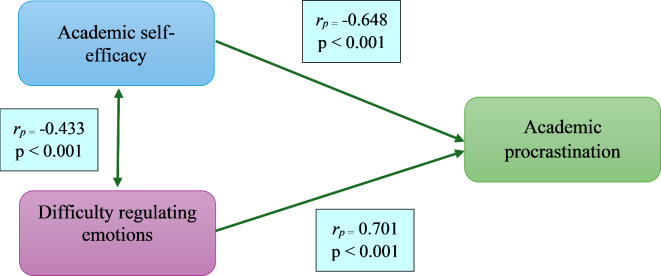
- Academic procrastination correlated negatively with academic self-efficacy (r = -0.648, p < 0.001) and positively with difficulty in emotional regulation (r = 0.701, p < 0.001).
- In multiple linear regression, the academic self-efficacy components effort, talent, and context and the emotion-regulation difficulty components difficulty in performing purposeful behavior, lack of emotional awareness, limited access to emotional regulation strategies, non-acceptance of emotional responses, difficulty in impulse control, and lack of emotional clarity were identified as predictors of academic procrastination (p < 0.05).
- The adjusted model explained 68% and 74% of the variation in students’ academic procrastination scores for the models based on academic self-efficacy and difficulty in emotional regulation, respectively.
## Methods
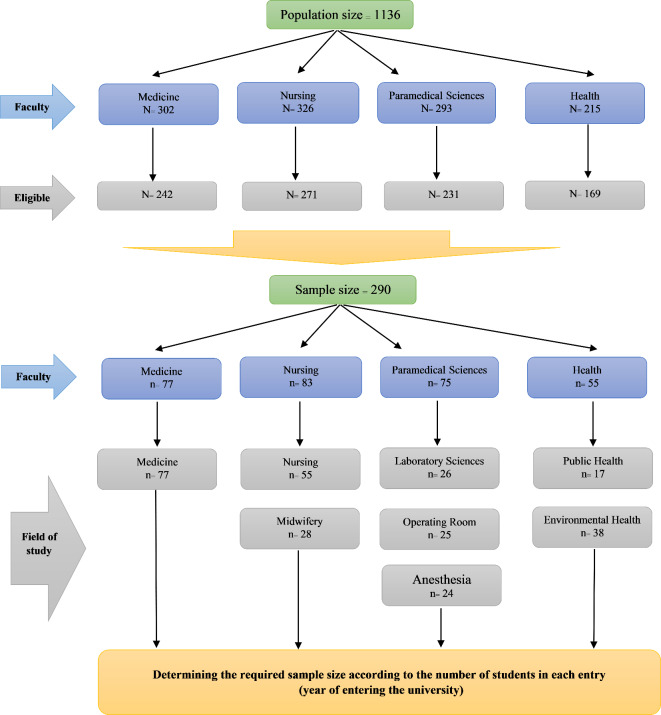
- Design/sample: Descriptive-analytical cross-sectional study of 290 students from a medical sciences university in southern Iran, conducted January–April 2024; population size was 1136 students across medicine, nursing, health, and paramedical sciences.
- Data collection/tools: Four-part questionnaire covering demographics, Solomon & Rothblum academic procrastination (27 items), Morgan-Jinks academic self-efficacy (30 items), and Gratz & Roemer emotion regulation difficulties (36 items).
- Analysis: Data analyzed in SPSS 23 using descriptive statistics, t-test, ANOVA, Pearson correlation, and multiple linear regression; STROBE guidelines were followed.
## Limitations
- The paper explicitly states that the study’s cross-sectional nature may affect generalizability.
- The paper explicitly notes self-reported data, response bias, sensitivity to questions, and the sample being from one university/field context as limitations.
- Evident from the text: the study is restricted to one medical sciences university in southern Iran, so broader generalization to other universities or disciplines is limited (this is implied by the sample description and the authors’ call for studies in other fields).
Model-written summary. Check it against the paper before relying on it.
Integrity signals
Registry
Cites
Statistics
Figures
Verification
Claims the paper makes
0 Valid · 0 Not valid · 0 Not checked · 26 Own results and interpretations
A result the paper reports from its own data — it cites no other source for it, so there is none to check. The quote shows it is in the paper.
In the paper
“the average score of academic self-efficacy in female students (60.81 ± 5.55 out of 120), in the professional doctorate level (61.27 ± 5.37 out of 120), non-employed (60.74 ± 5.61 out of 120), and medical students (61.27 ± 5.37 out of 120) is higher than others”
§ Predicting academic procrastination of students based on academic self-efficacy and emotional regulation difficulties > Results
plainstates an association- Asserted: passes — The authors put it forward as true.
- Checkable: passes — It can be checked against evidence.
- Load-bearing: unclear — It is unclear whether the paper’s conclusions depend on it.
- Based: passes — The paper gives a reason why it holds.
A result the paper reports from its own data — it cites no other source for it, so there is none to check. The quote shows it is in the paper.
In the paper
“It showed a moderate level of academic self-efficacy and academic procrastination and a high level of difficulty in students’ emotional regulation”
§ Predicting academic procrastination of students based on academic self-efficacy and emotional regulation difficulties > Results
plain- Asserted: passes — The authors put it forward as true.
- Checkable: passes — It can be checked against evidence.
- Load-bearing: unclear — It is unclear whether the paper’s conclusions depend on it.
- Based: passes — The paper gives a reason why it holds.
A result the paper reports from its own data — it cites no other source for it, so there is none to check. The quote shows it is in the paper.
In the paper
“the average score of students’ academic self-efficacy was significantly different based on the variables of gender (p = 0.03), education level (p = 0.01), field of study (p = 0.02) and employment status (p = 0.04)”
§ Predicting academic procrastination of students based on academic self-efficacy and emotional regulation difficulties > Results
plainstates an association- Asserted: passes — The authors put it forward as true.
- Checkable: passes — It can be checked against evidence.
- Load-bearing: unclear — It is unclear whether the paper’s conclusions depend on it.
- Based: passes — The paper gives a reason why it holds.
A result the paper reports from its own data — it cites no other source for it, so there is none to check. The quote shows it is in the paper.
In the paper
““effort, talent, and context” for the academic self-efficacy and “difficulty in performing purposeful behavior, lack of emotional awareness, limited access to emotional regulation strategies, non-acceptance of emotional responses, difficulty in impulse control, and lack of emotional clarity” for emotion regulation difficulties”
- Also stated in: § Abstract · plain
“components of academic self-efficacy, including effort, talent, and context, as well as components of difficulty in emotion regulation, including difficulty in performing purposeful behavior, lack of emotional awareness, limited access to emotional regulation strategies, non-acceptance of emotional responses, difficulty in impulse control, and lack of emotional clarity, were identified as predic”
§ Predicting academic procrastination of students based on academic self-efficacy and emotional regulation difficulties > Results
plainstates an association- Asserted: passes — The authors put it forward as true.
- Checkable: passes — It can be checked against evidence.
- Load-bearing: passes — The paper’s conclusions depend on it.
- Based: passes — The paper gives a reason why it holds.
- Also stated in: § Abstract · plain
A result the paper reports from its own data — it cites no other source for it, so there is none to check. The quote shows it is in the paper.
In the paper
“It showed a moderate level of academic self-efficacy and academic procrastination and a high level of difficulty in students’ emotional regulation”
§ Predicting academic procrastination of students based on academic self-efficacy and emotional regulation difficulties > Results
plain- Asserted: passes — The authors put it forward as true.
- Checkable: passes — It can be checked against evidence.
- Load-bearing: unclear — It is unclear whether the paper’s conclusions depend on it.
- Based: passes — The paper gives a reason why it holds.
19 more claims
Create a free account to see all 26 claims and every source verdict.
- It may state two separate claims as one. 1
- The quote only partly states this claim. 2
Citations
Cites
Self-efficacy: Toward a unifying theory of behavioral change
Bandura, A. (1978) · Advances in Behaviour Research and Therapy · doi:10.1016/0146-6402(78)90002-4 · Cited by 10,586
Gratz, K. L., & Roemer, L. (2004) · Journal of Psychopathology and Behavioral Assessment · doi:10.1023/b:joba.0000007455.08539.94 · Cited by 8,942
Expectancy-value theory of achievement motivation
Wigfield, A., & Eccles, J. S. (2000) · Contemporary Educational Psychology · doi:10.1006/ceps.1999.1015 · Cited by 7,383
The relationship between procrastination and academic performance: A meta-analysis
Kim, K. R., & Seo, E. H. (2015) · Personality and Individual Differences · doi:10.1016/j.paid.2015.02.038 · Cited by 786
Integrating Theories of Motivation
Steel, P., & König, C. J. (2006) · Academy of Management Review · doi:10.5465/amr.2006.22527462 · Cited by 776
The structure of common emotion regulation strategies: A meta-analytic examination
Naragon-Gainey, K., McMahon, T. P., & Chacko, T. P. (2017) · Psychological Bulletin · doi:10.1037/bul0000093 · Cited by 588
Risk Factors for Gastric Cancer: A Systematic Review
(2018) · Europe PMC (PubMed Central) · doi:10.22034/apjcp.2018.19.3.591 · Cited by 422
Self-citationFeraco, T., Resnati, D., Fregonese, D., Spoto, A., & Meneghetti, C. (2023) · European Journal of Psychology of Education · doi:10.1007/s10212-022-00601-4 · Cited by 207
Przepiórka, A., Błachnio, A., & Siu, N. Y.-F. (2019) · Chronobiology International · doi:10.1080/07420528.2019.1607370 · Cited by 129
Ziegler, N., & Opdenakker, M.-C. (2018) · Learning and Individual Differences · doi:10.1016/j.lindif.2018.04.009 · Cited by 126
Research works printed but not linked: 20
- Tavakoli, M. A. A study of the prevalence of academic procrasination among students and its relationship with demographic characteristics, prefrences of study time, and purpose of entering university. Q. Educ. Psychol. 9 (28), 99–121 (2013).
- Nasri, S., Shahrokhi, M. & Ebrahim Damavandi, M. The prediction of academic procrastination on perfectionism and test anxiety education and learning 1(11), 25–37 (2013).
- Fatehi, Y., Abdkhodaee, M. S. & Porgholami, F. Relationship between procrastination with perfectionism and self-efficacy in public hospitals’ staff of Farashband City. Soc. Psychol. Res. 2 (6), 39–53 (2012).
- Tamadoni, M., Hatami, M. & Hashemi Razini, H. G. General self-efficacy, academic procrastination and students’ academic progress. Educ. Psychol. Q. 6 (17), 66–86 (2010).
- Sheykhi, M., Fathabadi, J. & Heidari, M. The relations of anxiety, self-efficacy and perfectionism to dissertation procrastination. Evol. Psychol. Iran. Psychol. 9 (35), 283–295 (2014).
- Asghari, F., Saadat, S., Atefi Karajvandani, S. & Janalizadeh Kokaneh, S. The relationship between academic self-efficacy and Psychological Well-Being, Family Cohesion, and Spiritual Health among students of Kharazmi University. Iran. J. Med. Educ. 14 (7), 581–593 (2014).
- Ge, C., Li, C. & Li, S. Study on the relationship between the junior high school students’ self-efficacy and academic procrastination. J. Zhoukou Norm Univ. 35, 146–152 (2018).
- Jamali, M., Noroozi, A. & Tahmasebi, R. Factors affecting academic self-efficacy and its Association with academic achievement among students of Bushehr University Medical Sciences 2012–13. Iran. J. Med. Educ. 13 (8), 629–641 (2013).
- Ghasemi, H., Birami, M. & Vahedi, S. The role of emotion regulation difficulty components in predicting academic procrastination. New. Achiev. Humanit. Stud. 3 (27), 116–122 (2019).
- Zarei, L. & Khoshouei, M. S. The relationship between academic procrastination and metacognitive beliefs, emotion regulation and uncertainty tolerance in students. J. Res. Plan. High. Educ. 22 (2), 113–130 (2015).
- Menbari, Z., karimi, Q. & yar ahmadi, Y. Developing a causal model of non-productive academic behaviors based on difficulty in regulating emotions and academic self-discipline in students with the mediating role of academic self-concept. Educ. Strategy Med. Sci. 16 (5), 498–510 (2023).
- Valizadeh, Z., Ahadi, H., Heidari, M., Mazaheri, M. M. & Kajbaf, M. B. Prediction of College Students’ academic procrastination based on cognitive, emotional and motivational factors and gender. Knowl. Res. Appl. Psychol. 15 (3), 92–100 (2014).
- Tamannaifar, M., Sedighi Arfaee, F. & Moghaddasin, Z. Explanation of the academic procrastination based on adaptive and maladaptive dimensions of perfectionism and locus of control. New. Educ. Approach. 7 (2), 141–168 (2012).
- Saadat, S., Asghari, F. & Jazayeri, R. The relationship between academic self-efficacy with perceived stress, coping strategies and perceived social support among students of University of Guilan. Iran. J. Med. Educ. 15, 67–78 (2015).
- Rahimi h. The study of relationship between thinking skills with academic self- efficacy in students at universities of Kashan and Medical sciences. Bimon. Educ. Strateg. Med. Sci. 11 (2), 91–96 (2018).
- Afra, A., Seneysel Bachari, S. & Rahimi, V. Investigation of the relationship between self-efficacy and academic enthusiasm among operating Room Technology Students. Bimon. Educ. Strateg. Med. Sci. 17 (2), 186–198 (2024).
- Afra, A., Bachari, S., Ban, M., Darari, F. & Shahrokhi, S. Relationship between self-efficacy and academic motivation in the operating room students. Bimon. Educ. Strateg. Med. Sci. 14 (6), 405–412 (2022).
- Ghasemi Gudarzi, M., Taghvaee Yazdi, M. & Heydari, S. H. Investigating and evaluating the state of academic self-efficacy with the desirability technique (a case study of Mazandaran University of Science and Technology). A new approach to children’s education 5(3), 34–44 (2023).
- Cheraghi, A. & Yousefi, F. The investigation of mediating role of academic motivation in the relationship between self-efficacy and academic procrastination. Knowl. Res. Appl. Psychol. 20 (2), 34–47 (2019).
- Sabzevari, F., Ghasemi Ahmadabadi, L., Salehian Dehkordi, N., Barghamadi, F. S. & Abbasi, M. The role of difficulty in emotion regulation, self-differentiation, and coping styles in predicting referral thinking in adolescents with a history of drug use. Rooyesh e Ravanshenasi J. RRJ 11 (2), 229–242 (2022).
Cited by
Bai, Y., & Wang, S. (2025) · Scientific Reports · doi:10.1038/s41598-025-08697-6 · Cited by 86
Zhang, Y., Liu, J., Wang, X., Cheng, J., Wang, X., Zheng, C., Liu, Q., & Li, W. (2025) · Psychology Research and Behavior Management · doi:10.2147/prbm.s531311 · Cited by 6
Çayir, E., & Kahveci, H. (2025) · Osmangazi Journal of Educational Research · doi:10.59409/ojer.1620174 · Cited by 4
The Relationship Between Stress, Academic Motivation, and Subjective Vitality Among Nursing Students
Sabaliauskas, S., Ingelevič, K., Misiūnienė, O., & Jakavonytė-Akstinienė, A. (2025) · Nursing Reports · doi:10.3390/nursrep15080300 · Cited by 16
“However, it is important to note that academic self-perception may be associated with better academic performance as well as increased expectations and self-critical pressure during exams, thus indirectly increasing stress intensity [64,76].”
Işıkgöz, M. E., Sezan, T., Yüksel, A., & Öztunç, M. (2025) · SAGE Open · doi:10.1177/21582440251376854 · Cited by 6
“Research has shown that higher AS_E is significantly associated with lower levels of AP, as students who are more confident in their academic abilities are more likely to use effective learning strategies and persevere in the face of difficulty (Bishmi & Anto, 2024; Rad et al., 2025).”
InfluentialSingerin, S., Yafie, E., Nugroho, A., Pratiwi, A. D., Krobo, A., & Marhadi, N. (2025) · Participatory Educational Research · doi:10.17275/per.25.90.12.6 · Cited by 5
“In conjunction with this finding, the similar studies conducted with university students (Bytamar et al., 2020; Duru et al., 2024; Rad et al., 2025) indicated DER as a positive predictor of academic procrastination.”
Kara, F. İ. (2025) · Participatory Educational Research · doi:10.17275/per.25.79.12.6 · Cited by 2
Zhang, J., & Zhou, Y. (2026) · Interactive Learning Environments · doi:10.1080/10494820.2026.2689107 · Cited by 3
武, 炜. (2025) · Advances in Psychology · doi:10.12677/ap.2025.158458 · Cited by 1
Exploring Different Types of Academic Procrastination in Adolescents: A Latent Profile Analysis
Ciminli, A. (2025) · School Mental Health · doi:10.1007/s12310-025-09815-5 · Cited by 2
“In this case, the individual's procrastination behavior emerges as a reflection of his/her perception of self-efficacy (Farhadi Rad et al., 2025).”
Muhammed Harshad, K., Nabeela, P. K., Fathimath Zahra, B., & Ajwa Azeez, P. (2025) · Adabuna Jurnal Pendidikan dan Pemikiran · doi:10.38073/adabuna.v5i1.3662 · Cited by 1
Dong, D., Liang, X., Ge, J., Zhang, J., Li, S., & Hu, W. (2026) · BMC Public Health · doi:10.1186/s12889-025-26125-2 · Cited by 4
“Most studies address SEC regarding AB or AP separately, overlooking its potential role in the comorbidity [53, 88].”
Academic Performance in Times of Change: The Role of Emotional Intelligence
Castro-López, A., Cervero, A., Blanco, L. Á., & Galve-González, C. (2026) · Technology Knowledge and Learning · doi:10.1007/s10758-026-09964-9 · Cited by 4
Simulación en anestesia dental y autoeficacia en la preclínica de Odontopediatría
del Solar, C. I. Q., Rivas-Almonte, U. O., Ramírez, C. M. G., et al. (2026) · Más Vita · doi:10.47606/acven/mv0317 · Cited by 1
Fear of failure, procrastination, and academic performance in higher education
Aldhi, I. F., Suhariadi, F., Rahmawati, E., Supriharyanti, E., Hardaningtyas, D., Sugiarti, R., Abbas, A., & Trihantoyo, S. (2026) · Humanities and Social Sciences Communications · doi:10.1057/s41599-026-07088-0 · Cited by 7
“…are central to sustaining academic engagement; when compromised, avoidance and delay are reinforced (Schunk & DiBenedetto, 2020), and lower academic self ‑ ef fi cacy/perceived control is associated with greater procrastination (Yuan et al. 2024; Rad et al. 2025), supporting: Hypothesis 1 (H1).”
Sobar, M. A., Fatoni, A., & Febriani, E. (2026) · ETDC Indonesian Journal of Research and Educational Review · doi:10.51574/ijrer.v5i3.4883 · Cited by 1
Fernandez-Chero, K. Y., Daza-Albor, A. C., Valle, A. C. M.-D., Fernández-Mallma, I., & Villar-Guevara, M. (2026) · Frontiers in Education · doi:10.3389/feduc.2026.1857179 · Cited by 4
Díaz‐Guerra, D. D., Hernández-Lugo, M. D. L. C., Ramos-Galarza, C., Broche‐Pérez, Y., Arias-Flores, H., Reinado, K. V. C., & Castillo, E. F. (2026) · Frontiers in Psychology · doi:10.3389/fpsyg.2026.1906868 · Cited by 1
“…may be associated with not exclusively on the capacity to reflect and inhibit impulses, but also on the emotional stability with which the student approaches the choice and on the attentional resources they are able to mobilize to evaluate alternatives (Sun et al., 2026; Rad et al., 2025).”
Psychometrické vlastnosti škály akademickej sebaúčinnosti
Kuviková, B., & Sollár, T. (2025) · Pomáhajúce profesie · doi:10.17846/pp.2025.8.1.37-45
Otomasi Pembelajaran IPS di Sekolah Dasar Pelita Hati Jember
Nugroho, P. A., Hutama, F. S., Suhatiningsih, S., Anis, F., Nurdianasari, N., & Sa'i, M. (2025) · Jurnal Riset Madrasah Ibtidaiyah (JURMIA) · doi:10.32665/jurmia.v5i2.5029 · Cited by 2
The Impact of Learning Environment on Students' Procrastination Behavior and Learning Efficiency
Yu, M. (2025) · Transactions on Materials Biotechnology and Life Sciences · doi:10.62051/g2ykr082
“Some researchers have also studied the self-efficacy of learning and related concepts, exploring the correlation between motivation and procrastination [7].”
Nuzum, T. T., Tasnim, S., Simran, T. R., Halder, N., Islam, A., & Amin, M. A. (2025) · IEEE Student Conference on Research and Development (SCOReD) · doi:10.1109/scored68498.2025.11398912
“Beyond ML models, statistical approaches were also explored, including Pearson correlation, t-test, ANOVA, and multiple linear regression to analyze procrastination, self-efficacy, and emotional regulation [15].”
Çoban, S. S. Y., ŞAHİN, M., & Yüzbaşı, D. V. (2026) · Dokuz Eylül Üniversitesi Sosyal Bilimler Enstitüsü Dergisi · doi:10.16953/deusosbil.1641626
Gülünay, Y. İ. (2026) · International Journal Of Eurasia Social Sciences · doi:10.70736/ijoess.2095
Quantitative Analysis of Academic Procrastination and Its Impact on University Students' Performance
Mirza, Q. U. A. Z. Z., Kanwal, R., Ashraf, H., Jhanjhi, N., & Junfithrana, A. P. (2025) · International Conference on Mathematics, Actuarial Science, Computer Science and Statistics (MACS) · doi:10.1109/macs68476.2025.11453354
“Having a predictive model, Farhadi Rad et al. [17] found that challenges related to emotional regulation and low academic self-efficacy were highly correlated with procrastination risks and that these theories are in line with the theoretical assumptions of [1] and [14].”
Datu, J. A. D., Jiahong, Z., & Fincham, F. D. (2026) · Revista de Psicodidáctica (English ed ) · doi:10.1016/j.psicoe.2026.500188 · Cited by 1
Setiorini, F., & Soleh, A. (2026) · Human Psychology & Behavior · doi:10.58920/humpsycholbehav0101565
Li, H., Guan, R. M., Zhao, H., Han, H., Li, X., & Cui, Z. (2026) · Frontiers in Psychology · doi:10.3389/fpsyg.2026.1732350 · Cited by 1
“Lower self-efficacy implies individuals lack confidence and a sense of control in learning, making them more prone to maladaptive behaviors such as avoidance and procrastination (Rad et al., 2025).”
Моторная, С. (2026) · Современные наукоемкие технологии (Modern High Technologies) · doi:10.17513/snt.40754
Datu, J. A. D., Zhang, J., & Fincham, F. D. (2026) · Revista de Psicodidáctica · doi:10.1016/j.psicod.2026.500188
Öz Güven ve Akademik Erteleme Davranışı İlişkisinde Psikolojik Sağlamlığın Aracı Rolü
Yıldırım, L. N., & Alptekin, H. D. (2026) · Gelişim ve Psikoloji Dergisi · doi:10.51503/gpd.1937360
Acero-Zevallos, D. D. C., Cunza-Aranzábal, D. F., & Quispe, W. V. (2026) · Frontiers in Education · doi:10.3389/feduc.2026.1858876
Dhivya, P., Narayanan, V., Raja Velu, M., Vinoth Kumar, G., & Sundara Moorthy, M. (2026) · International Conference on Inventive Research in Computing Applications (ICIRCA) · doi:10.1109/icirca69024.2026.11570358
Khan, H., Gul, A., Alam, S., Khan, D., Bukhari, S. J., & Orakzai, S. (2026) · The Healer Journal of Physiotherapy and Rehabilitation Sciences · doi:10.55735/zeppn393
Kumar, A., & Shelly (2026) · Integrated Journal for Research in Arts and Humanities · doi:10.55544/ijrah.6.4.26
Mousavi, D., Rief, W., & Wilhelm, M. (2026) · Psychotherapy and Psychosomatics · doi:10.1159/pps/aemag001
Meng, J., Wen, Z., Liu, L., Peng, M., & Liu, X. (2026) · Journal of Adult Development · doi:10.1007/s10804-026-09573-x
ChatGPT Use and Abuse: A 3 Year Look at Undergraduate Perceptions and Usage in the Classroom
Ehrlich, A. C., Groves, C. L., Tacke, L. J., Flees, J., Rogers, M. P., & Hillberg, H. (2026) · Education Sciences · doi:10.3390/educsci16081341
“When students have low academic self-efficacy, they tend to procrastinate their work more, leading to increased stress and inevitable time pressures as due dates approach at the end of an academic semester (Farhadi Rad et al., 2025; García-Ros et al., 2023; Zhang et al., 2024; Zhou et al., 2025).”
Altın, R., & Ak, N. Y. (2026) · Current Psychology · doi:10.1007/s12144-026-09958-x
“…aligns with research suggesting that procrastination is closely tied to emotional processes and mood management, often functioning as a short-term mood-repair strategy in which individuals avoid tasks to reduce discomfort (Li et al., 2024; Rad et al., 2025; Sirois & Pychyl, 2013; Sirois, 2023).”
InfluentialWu, H., Ni, H., He, J., & Wee, E. H. (2026) · Australian Journal of Psychology · doi:10.1080/00049530.2026.2721637 · Cited by 1
“Recent evidence links academic self-efficacy and emotion-regulation difficulties with procrastination (Rad et al., 2025), while academic self-efficacy and stress are associated with problematic AI use (Zhang et al., 2024).”
Hao, X., Li, J., Huang, H., & Hao, B. (2026) · Sustainability · doi:10.3390/su18179084 · Cited by 1
Kırksekiz, A., İŞBULAN, O., ÇAM, E., & Kıyıcı, M. (2026) · Research Square · doi:10.21203/rs.3.rs-9968475/v1
Khan, K., Akhter, N., Ahmed, S., Imran, S. S., Ramzan, M., & Khan, L. (2026) · Journal of Rehman Medical Institute · doi:10.52442/jrmi.v12i3.1105
Academic procrastination as a transversal phenomenon across academic areas and learning contexts
Cuya-Zevallos, C., Villanueva-Paredes, G. X., Paredes, K. S. V., Zegarra-Gago, H., & Machaca, E. S. M. (2026) · Social Sciences & Humanities Open · doi:10.1016/j.ssaho.2026.103764
Metadata
- Authors
- Rad, H. F., Bordbar, S., Bahmaei, J., Vejdani, M., & Yusefi, A. R.
- Affiliations
- University of Jiroft (IR)
- Shiraz University of Medical Sciences (IR)
- Sabzevar University of Medical Sciences (IR)
- Corresponding author
- Yusefi, Ali Reza
- Venue
- Scientific Reports
- Published
- 2025-01-23
- Volume
- 15
- Issue
- 1
- Pages
- 3003-3003
- ISSN
- 2045-2322 (ISSN-L)
- PMC
- PMC11758087
- OpenAlex
- W4406757139
- Cited by
- 47
- References
- 24
- Citations by year
- 2026: 32 · 2025: 15
- FWCI
- 55.30
- Type
- journal article
- Language
- en
- Open access
- gold
- doi.org
- Licence
- cc-by-nc-nd
- creativecommons.org/licenses/by-nc-nd/4.0 (tdm)
- creativecommons.org/licenses/by-nc-nd/4.0 (vor)
- Locations
- Scientific Reports (publishedVersion, cc-by-nc-nd)
- PubMed Central (publishedVersion, cc-by-nc-nd)
- PubMed (publishedVersion)
- DOAJ (DOAJ: Directory of Open Access Journals) (submittedVersion, cc-by-sa)
- Funders
- University of Jiroft
- Topics
- Social Sciences › Psychology › Clinical Psychology › Perfectionism, Procrastination, Anxiety Studies
- Social Sciences › Psychology › Developmental and Educational Psychology › Student Stress and Coping
- Social Sciences › Psychology › Developmental and Educational Psychology › Education, Achievement, and Giftedness
- Keywords
- academic procrastination, academic self-efficacy, emotional dysregulation, university students, medical students, emotional awareness, emotion regulation strategies, impulse control, emotional clarity, predictors of procrastination
- MeSH terms
- Procrastination, Emotional Regulation, Adult, Cross-Sectional Studies, Emotions, Female, Humans, Iran, Male, Surveys and Questionnaires, Students, Students, Medical, Universities, Self Efficacy, Young Adult
About these checks
Registry, retraction, Cites and statistics results are computed, not judged, with one exception: a printed reference that no index lists is read once by a model before it counts as a citation error. Claims are extracted by a model and kept only when their quote appears verbatim in the text; each cited source is then checked, with a model’s help, for whether it says what the claim relies on. Those verdicts can be wrong — read the claim’s quote and the cited source before relying on one.
A language model drew the claims from the paper on 2026-10-09, under version 3 of the claim definition (model deepseek-v4.1-flash, prompt extract-v3).
A second model labelled each claim on 2026-10-09 (model jev-1.13-20260917, definition revision gold-guideline-v0.2).
Statistics and arithmetic are recomputed, not judged.
Confidence bands are shown only for fields calibrated on our annotated test set. None is calibrated yet, so no band is shown.
What counts as a claim ›How we measure confidence ›How we check this ›
Are you an author, or do you see a problem with this page? Request a review
Data sources
Bibliographic data: Semantic Scholar, OpenAlex, Crossref.
Contains information from the Semantic Scholar Academic Graph Datasets, made available under the ODC Attribution License (ODC-BY 1.0).
Semantic Scholar’s data is described in: Kinney, R., et al. (2023). The Semantic Scholar Open Data Platform. arXiv:2301.10140.
