

Exploring the acceptance of e-learning in health professions education in Iran based on the technology acceptance model (TAM)
Open accessThe DOI matches its Crossref record; 48 of the 48 references it cites were found in a registry or an index.
Abstract
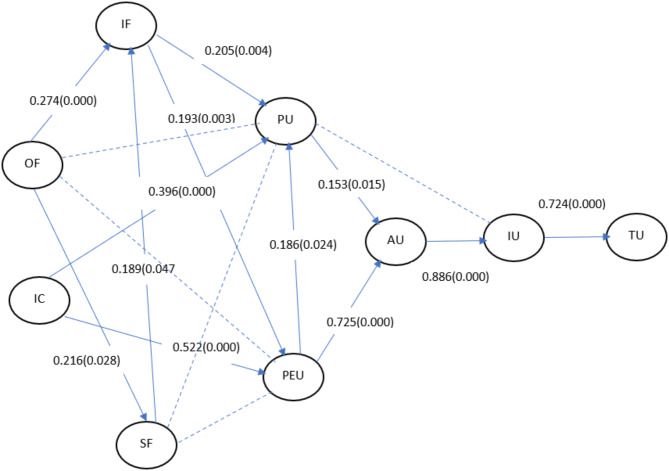
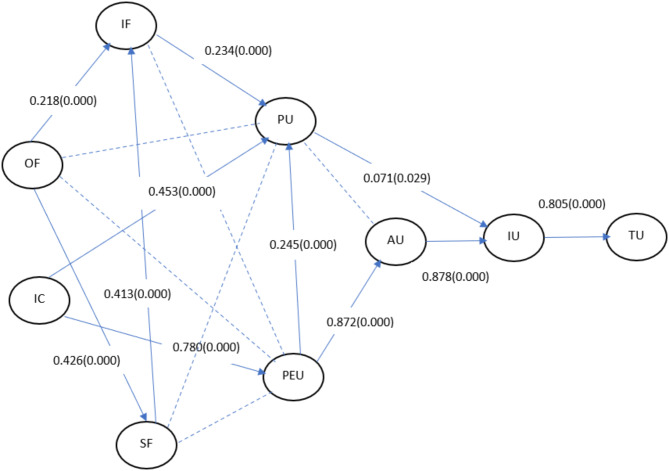
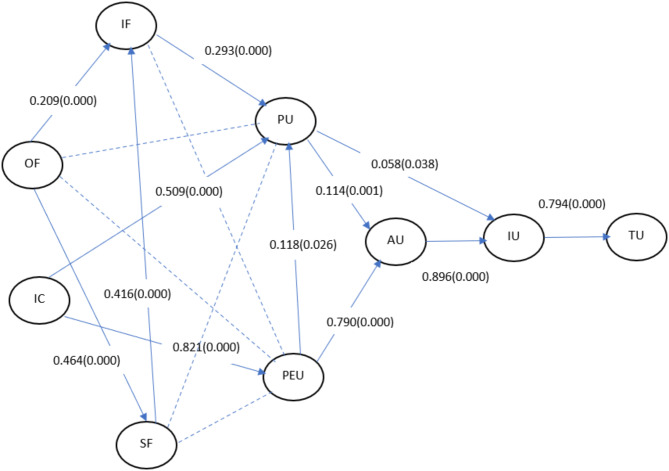
The COVID-19 pandemic has rapidly accelerated the adoption of e-learning across educational institutions worldwide, especially in health professions education. This study explored the factors influencing e-learning acceptance among health professions students and faculty members in Iran using an extended Technology Acceptance Model (TAM). A descriptive cross-sectional study was conducted among 932 participants, including faculty members, postgraduates, and undergraduates at Mashhad University of Medical Sciences, one of the top five universities in Iran. Data were collected through an online survey from August 1 to August 31, 2020. The TAM was extended by incorporating innovation, social, and organizational characteristics. Partial least squares structural equation modeling was used to analyze the relationships between constructs, including perceived ease of use (PEU), perceived usefulness (PU), and intention to use e-learning. The findings revealed that PEU and PU were pivotal in shaping e-learning acceptance, underscoring the need for user-friendly and effective platforms. Attitude toward e-learning significantly influenced participants' intention to use e-learning platforms, with PEU emerging as the most influential factor. PU had a more substantial impact on faculty members and undergraduate students, while postgraduates placed less emphasis on usefulness. Organizational factors only indirectly affected e-learning acceptance, mediated by individual characteristics. This study underscores the importance of usability, technological infrastructure, and digital literacy training in promoting e-learning acceptance among health professions students and faculty members. These findings significantly impact policymakers, educators, and administrators in designing more user-centered e-learning platforms. Future research should explore the longitudinal effects of technological advancements and institutional policies on e-learning adoption.
Overview
The claims and statistics of this paper haven’t been checked yet.
Free: it reads the open-access text and checks the first 5 claims that cite a source we can check. Create a free account to check every claim.
Integrity signals
Registry
Cites
Statistics
Figures
Verification
Claims the paper makes
The claims and statistics of this paper haven’t been checked yet.
Free: it reads the open-access text and checks the first 5 claims that cite a source we can check. Create a free account to check every claim.
Self-check
Percentages, sums and reported differences re-computed from the paper’s own numbers.
The self-check needs the paper’s full text.
Citations
Cites
Evaluating structural equation models with unobservable variables and measurement error
Fornell, C., & Larcker, D. F. (1981) · Journal of Marketing Research · doi:10.1177/002224378101800104 · Cited by 109,190
Perceived usefulness, perceived ease of use, and user acceptance of information technology
Davis, F. D. (1989) · MIS Quarterly · doi:10.2307/249008 · Cited by 68,483
Principles and Practice of Structural Equation Modeling
Tabri, N., & Elliott, C. M. (2012) · Canadian Graduate Journal of Sociology and Criminology · doi:10.15353/cgjsc-rcessc.v1i1.25 · Cited by 38,891
On the Evaluation of Structural Equation Models
Bagozzi, R. P., & Yi, Y. (1988) · Journal of the Academy of Marketing Science · doi:10.1007/bf02723327 · Cited by 26,163
The Use of Cronbach’s Alpha When Developing and Reporting Research Instruments in Science Education
Taber, K. S. (2018) · Research in Science Education · doi:10.1007/s11165-016-9602-2 · Cited by 10,679
Technology Acceptance Model 3 and a Research Agenda on Interventions
Venkatesh, V., & Bala, H. (2008) · Decision Sciences · doi:10.1111/j.1540-5915.2008.00192.x · Cited by 8,159
The Technology Acceptance Model: Its past and its future in health care
Holden, R. J., & Karsh, B.-T. (2010) · Journal of Biomedical Informatics · doi:10.1016/j.jbi.2009.07.002 · Cited by 2,669
Technology acceptance model: a literature review from 1986 to 2013
Marangunić, N., & Granić, A. (2015) · Universal Access in the Information Society · doi:10.1007/s10209-014-0348-1 · Cited by 2,458
Intraclass Reliability Estimates: Testing Structural Assumptions
Werts, C. E., Linn, R. L., & Jöreskog, K. G. (1974) · Educational and Psychological Measurement · doi:10.1177/001316447403400104 · Cited by 1,655
An extension of the technology acceptance model in an ERP implementation environment
Amoako-Gyampah, K., & Salam, A. F. (2004) · Information & Management · doi:10.1016/j.im.2003.08.010 · Cited by 1,170
An Empirical Assessment of a Modified Technology Acceptance Model
Chau, P. Y. K. (1996) · Journal of Management Information Systems · doi:10.1080/07421222.1996.11518128 · Cited by 1,078
Abdullah, F., & Ward, R. (2016) · Computers in Human Behavior · doi:10.1016/j.chb.2015.11.036 · Cited by 986
Maatuk, A. M., Elberkawi, E. K., Aljawarneh, S., Rashaideh, H., & Alharbi, H. (2022) · Journal of Computing in Higher Education · doi:10.1007/s12528-021-09274-2 · Cited by 753
Regmi, K., & Jones, L. (2020) · BMC Medical Education · doi:10.1186/s12909-020-02007-6 · Cited by 751
Technology Acceptance Model in M-learning context: A systematic review
Al-Emran, M., Mezhuyev, V., & Kamaludin, A. (2018) · Computers & Education · doi:10.1016/j.compedu.2018.06.008 · Cited by 628
It's all about attitude: revisiting the technology acceptance model
Yang, H.-D., & Yoo, Y. (2004) · Decision Support Systems · doi:10.1016/s0167-9236(03)00062-9 · Cited by 578
Empirical investigation of e-learning acceptance and assimilation: A structural equation model
Al-Gahtani, S. S. (2016) · Applied Computing and Informatics · doi:10.1016/j.aci.2014.09.001 · Cited by 471
Alfadda, H. A., & Mahdi, H. S. (2021) · Journal of Psycholinguistic Research · doi:10.1007/s10936-020-09752-1 · Cited by 438 · cited 1×
“A significant correlation between behavioral intention and technology use has been declared 11 .”
Saif, N., Khan, S. U., Shaheen, I., ALotaibi, F. A., Alnfiai, M. M., & Arif, M. (2024) · Computers in Human Behavior · doi:10.1016/j.chb.2023.108097 · Cited by 301
Tarhini, A., Hone, K., & Liu, X. (2014) · Computers in Human Behavior · doi:10.1016/j.chb.2014.09.020 · Cited by 285
Natasia, S. R., Wiranti, Y. T., & Parastika, A. (2022) · Procedia Computer Science · doi:10.1016/j.procs.2021.12.168 · Cited by 278
Students’ acceptance and readiness for E-learning in Northeastern Thailand
Ngampornchai, A., & Adams, J. (2016) · International Journal of Educational Technology in Higher Education · doi:10.1186/s41239-016-0034-x · Cited by 273
Using virtual reality for dynamic learning: an extended technology acceptance model
Fussell, S. G., & Truong, D. (2022) · Virtual Reality · doi:10.1007/s10055-021-00554-x · Cited by 261
Factors affecting the E-learning acceptance: A case study from UAE
Salloum, S. A., Al-Emran, M., Shaalan, K., & Tarhini, A. (2019) · Education and Information Technologies · doi:10.1007/s10639-018-9786-3 · Cited by 252
Tao, D., Wang, T., Wang, T., Zhang, T., Zhang, X., & Qu, X. (2020) · Computers in Human Behavior · doi:10.1016/j.chb.2019.09.023 · Cited by 219
Vorm, E. S., & Combs, D. J. Y. (2022) · International Journal of Human–Computer Interaction · doi:10.1080/10447318.2022.2070107 · Cited by 197
E-learning acceptance based on technology acceptance model (TAM)
Ibrahim, R., Leng, N. S., Yusoff, R. C. M., Samy, G. N., Masrom, S., & Rizman, Z. I. (2018) · Journal of Fundamental and Applied Sciences · doi:10.4314/jfas.v9i4s.50 · Cited by 179
Do knowledge acquisition and knowledge sharing really affect e-learning adoption? An empirical study
Al-Emran, M., & Teo, T. (2020) · Education and Information Technologies · doi:10.1007/s10639-019-10062-w · Cited by 172
An Empirical Assessment of a Technology Acceptance Model for Apps in Medical Education
Briz-Ponce, L., & García‐Peñalvo, F. J. (2015) · Journal of Medical Systems · doi:10.1007/s10916-015-0352-x · Cited by 168
Al-Rahmi, A. M., Shamsuddin, A., Alturki, U., Aldraiweesh, A., Yusof, F. M., Al-Rahmi, W. M., & Aljeraiwi, A. A. (2021) · Sustainability · doi:10.3390/su13147770 · Cited by 160
Abuhassna, H., Yahaya, N., Zakaria, M. A. Z. M., Zaid, N. M., Samah, N. A., Awae, F., Chee, K. N., & Alsharif, A. H. (2023) · International Journal of Information and Education Technology · doi:10.18178/ijiet.2023.13.1.1788 · Cited by 149
Development and validation of the E-learning Acceptance Measure (ElAM)
Teo, T. P. (2010) · The Internet and Higher Education · doi:10.1016/j.iheduc.2010.02.001 · Cited by 145
Mobile Learning Adoption: A Systematic Review of the Technology Acceptance Model from 2017 to 2020
Alsharida, R. A. F., Hammood, M. M., & Al‐Emran, M. (2021) · International Journal of Emerging Technologies in Learning (iJET) · doi:10.3991/ijet.v16i05.18093 · Cited by 139
Factors of the Technology Acceptance Model for Construction IT
Park, E. S., & Park, M. S. (2020) · Applied Sciences · doi:10.3390/app10228299 · Cited by 133
Fauzi, A., Wandira, R., Sepri, D., & Hafid, A. (2021) · The Electronic Journal of e-Learning · doi:10.34190/ejel.19.4.2348 · Cited by 124
Mustafa, A. S., & Garcia, M. B. (2021) · Conference on Online Teaching for Mobile Education (OT4ME) · doi:10.1109/ot4me53559.2021.9638934 · Cited by 121
Al‐Emran, M. (2021) · International Journal of Human-Computer Interaction · doi:10.1080/10447318.2021.1921481 · Cited by 109
Improving the information society skills: Is knowledge accessible for all?
Fonseca, D., Conde, M. Á., & García‐Peñalvo, F. J. (2017) · Universal Access in the Information Society · doi:10.1007/s10209-017-0548-6 · Cited by 107
Recent Advances in Technology Acceptance Models and Theories
(2021) · Studies in systems, decision and control · doi:10.1007/978-3-030-64987-6 · Cited by 74
Huang, T.-H., Liu, F., Chen, L.-C., & Tsai, C.-C. (2021) · PLOS ONE · doi:10.1371/journal.pone.0247819 · Cited by 37
Mastour, H., Dehghani, T., Moradi, E., & Eslami, S. (2023) · Heliyon · doi:10.1016/j.heliyon.2023.e18248 · Cited by 36
Self-citationTeo, T. P. (2010) · International Journal of Information and Communication Technology Education · doi:10.4018/jicte.2010100101 · Cited by 35
Emadzadeh, A., EidiBaygi, H., Mohammadi, S., Etezadpour, M., Yavari, M., & Mastour, H. (2023) · Medical Science Educator · doi:10.1007/s40670-023-01867-z · Cited by 23
Self-citationDrivers of iPad use by undergraduate medical students: the Technology Acceptance Model perspective
Do, D. H., Lakhal, S., Bernier, M., Bisson, J., Bergeron, L., & St‐Onge, C. (2022) · BMC Medical Education · doi:10.1186/s12909-022-03152-w · Cited by 16
Tabet, S. M., Lambie, G. W., Jahani, S., & Rasoolimanesh, S. M. (2019) · Assessment · doi:10.1177/1073191119834653 · Cited by 12
Medical Students' Attitude Toward E-learning During the COVID-19 Pandemic
Niroumand, S., Mastour, H., Ghalibaf, A. M., Shamshirian, A., & Moghadasin, M. (2022) · Shiraz E-Medical Journal · doi:10.5812/semj-121340 · Cited by 10
Self-citationOgla, R., & Rahma, A. M. S. (2019) · journal of the college of basic education · doi:10.35950/cbej.v25i104.4682 · Cited by 1
(1994)
Research works printed but not linked: 15
- Lazim, C., Ismail, N. D. B. & Tazilah, M. Application of technology acceptance model (TAM) towards online learning during covid-19 pandemic: Accounting students perspective. Int. J. Bus. Econ. Law 24 (1), 13–20 (2021).
- Rodríguez-Sabiote, C., Valerio-Peña, A. T., Batista-Almonte, R. A. & Úbeda-Sánchez, Á. M. Perceived utility and learning by dominican university students in virtual teaching–learning environments: An analysis of multiple serial mediation based on the extended technology acceptance model. Int. Rev. Res. Open Distrib. Learn. 25 (2), 20–40 (2024).
- Yong Varela, L. A., Rivas Tovar, L. A. & Chaparro, J. Technological acceptance model (TAM): A study of the influence of the national culture and of the user profile in the use of ICTS. Innovar 20 (36), 187–203 (2010).
- Nazarpoori, A. & Tabarsa, G. Considering effective factors on electronic learning system acceptance (ELS) according to technology acceptance model (TAM). Technol. Educ. J. (TEJ). 9 (1), 33–40 (2014).
- Rosita, T. & Fatmasari, R. Acceptance of distance learning technology in technology-based learning management. Al-Tanzim J. Manaj. Pendidik. Islam 7 (4), 1191–1201 (2023).
- Almulla, M. Technology acceptance model (TAM) and e-learning system use for education sustainability. Acad. Strateg. Manag. J. 20 (4), 1–13 (2021).
- Handy, J., Whiddett, R. & Hunter, I. A technology acceptance model for inter-organisational electronic medical records systems. Aust. J. Inf. Syst. 9 (1), 39–50 (2001).
- Ghorbani Piralidehi, F. & Ali, B. A. Examining the acceptance model of IPM technology among gardeners in Dalahoo. Ext. Res. Agric. Educ. 6 (4), 107–123 (2014).
- Hair, J. F., Black, W. C., Babin, B. J., Anderson, R. E. & Tatham, R. L. Multivariate data analysis 6th Edition. Pearson Prentice Hall New Jersey humans. Crit. Reform. J. Abnorm. Psychol. 87, 49–74 (2006).
- Chin, W. W. The partial least squares approach to structural equation modeling. Mod. Methods Bus. Res. 295 (2), 295–336 (1998).
- Gliem, J. A. & Gliem, R. R. (eds.). Calculating, Interpreting, and Reporting CRONBACH’S Alpha Reliability Coefficient for Likert-Type Scales2003: Midwest Research-to-Practice Conference in Adult, Continuing, and Community ….
- Gefen, D., Straub, D. & Boudreau, M.-C. Structural equation modeling and regression: Guidelines for research practice. Commun. Assoc. Inf. Syst. 4 (1), 7 (2000).
- Falk, R. F. & Miller, N. B. A Primer for Soft Modeling (University of Akron Press, 1992).
- Surendran, P. Technology acceptance model: A survey of literature. Int. J. Bus. Soc. Res. 2 (4), 175–178 (2012).
- Averweg, U. R. Information technology acceptance in South Africa: An investigation of perceived usefulness, perceived ease of use, and actual system use constructs. Afr. J. Inf. Syst. 1 (1), 4 (2008).
Cited by
Ebihara, H., Kasai, H., Shimizu, I., Shikino, K., Tajima, H., Kimura, Y., & Ito, S. (2025) · JMIR Medical Education · doi:10.2196/76702 · Cited by 10
“This framework enabled a structured interpretation of students’experiences and the acceptance of the AI-based mentoring tool consistent with previous applications of the TAM in medical education and e-learning contexts [35-37].”
Metadata
- Authors
- Mastour, H., Yousefi, R., & Niroumand, S.
- Affiliations
- Mashhad University of Medical Sciences (IR)
- Corresponding author
- Niroumand, Shabnam
- Venue
- Scientific Reports
- Published
- 2025-03-10
- Volume
- 15
- Issue
- 1
- Pages
- 8178-8178
- ISSN
- 2045-2322 (ISSN-L)
- PMC
- PMC11894139
- OpenAlex
- W4408272411
- Cited by
- 41
- References
- 48
- Citations by year
- 2026: 22 · 2025: 19
- FWCI
- 40.82
- Type
- journal article
- Language
- en
- Open access
- gold
- doi.org
- Licence
- cc-by-nc-nd
- creativecommons.org/licenses/by-nc-nd/4.0 (tdm)
- creativecommons.org/licenses/by-nc-nd/4.0 (vor)
- Locations
- Scientific Reports (publishedVersion, cc-by-nc-nd)
- Europe PMC (PubMed Central) (publishedVersion, cc-by-nc-nd)
- PubMed Central (publishedVersion, cc-by-nc-nd)
- PubMed (publishedVersion)
- DOAJ (DOAJ: Directory of Open Access Journals) (submittedVersion, cc-by-sa)
- Topics
- Social Sciences › Decision Sciences › Information Systems and Management › Technology Adoption and User Behaviour
- Social Sciences › Education › Technology-Enhanced Education Studies
- Social Sciences › Education › Innovations in Medical Education
- Keywords
- e-learning acceptance, health professions education, technology acceptance model, perceived ease of use, perceived usefulness, intention to use, organizational factors, social factors, innovation drivers, medical students, university faculty, graduate students, digital literacy, COVID-19 pandemic, Iran
- MeSH terms
- COVID-19, SARS-CoV-2, Adult, Cross-Sectional Studies, Faculty, Female, Health Occupations, Humans, Iran, Male, Middle Aged, Surveys and Questionnaires, Education, Distance, Young Adult
About these checks
Registry, retraction, Cites and statistics results are computed, not judged, with one exception: a printed reference that no index lists is read once by a model before it counts as a citation error. Claims are extracted by a model and kept only when their quote appears verbatim in the text; each cited source is then checked, with a model’s help, for whether it says what the claim relies on. Those verdicts can be wrong — read the claim’s quote and the cited source before relying on one.
Statistics and arithmetic are recomputed, not judged.
Confidence bands are shown only for fields calibrated on our annotated test set. None is calibrated yet, so no band is shown.
What counts as a claim ›How we measure confidence ›How we check this ›
Are you an author, or do you see a problem with this page? Request a review
Data sources
Bibliographic data: Semantic Scholar, OpenAlex, Crossref.
Contains information from the Semantic Scholar Academic Graph Datasets, made available under the ODC Attribution License (ODC-BY 1.0).
Semantic Scholar’s data is described in: Kinney, R., et al. (2023). The Semantic Scholar Open Data Platform. arXiv:2301.10140.
