

AI tutoring outperforms in-class active learning: an RCT introducing a novel research-based design in an authentic educational setting
Open accessPublished version of a preprint
The DOI matches its Crossref record; 34 of the 34 references it cites were found in a registry or an index; 7 of the 28 sources its claims cite were checked for support.
Abstract
Advances in generative artificial intelligence show great potential for improving education. Yet little is known about how this new technology should be used and how effective it can be compared to current best practices. Here we report a randomized, controlled trial measuring college students' learning and their perceptions when content is presented through an AI-powered tutor compared with an active learning class. The novel design of the custom AI tutor is informed by the same pedagogical best practices as employed in the in-class lessons. We find that students learn significantly more in less time when using the AI tutor, compared with the in-class active learning. They also feel more engaged and more motivated. These findings offer empirical evidence for the efficacy of a widely accessible AI-powered pedagogy in significantly enhancing learning outcomes, presenting a compelling case for its broad adoption in learning environments.
Overview
CoChat Summary
TL;DR
In a randomized crossover trial in an undergraduate physics course, students learned more from a custom AI tutor than from an in-class active learning lesson on identical content. The AI condition also produced higher engagement and motivation, while taking less time on task.
Key findings
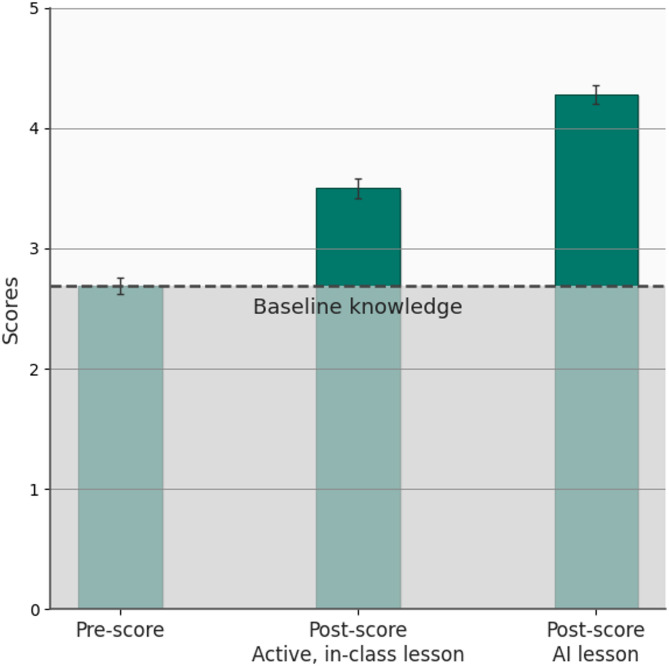
- Students in the AI-tutored group had higher median post-test scores than the in-class active learning group: 4.5 (N = 142) vs 3.5 (N = 174), compared with a pre-test baseline median of 2.75 (N = 316).
- The post-test difference between AI tutoring and in-class active learning was statistically significant: z = -5.6, p < 10–8.
- In the linear regression model controlling for pre-test score, midterm exam, Force Concept Inventory, prior ChatGPT experience, topic, test version, and time on task, the AI group still performed substantially better; the paper reports p < 10–8 and an effect size estimate of 0.63, with a quantile-regression estimate of 0.73 to 1.3 standard deviations.
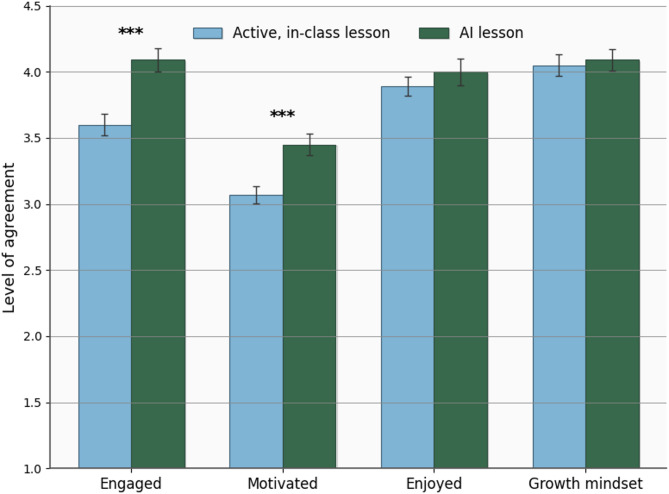
- Students in the AI group reported higher engagement (4.1 vs 3.6; t(311) = -4.5, p < 0.0001) and motivation (3.4 vs 3.1; t(311) = -3.4, p < 0.001); enjoyment and growth mindset were not significantly different.
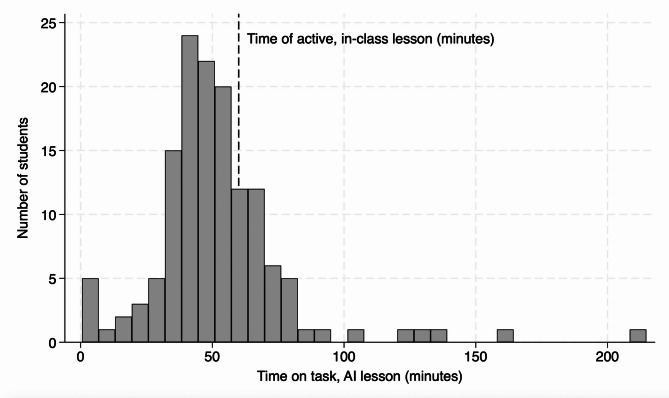
- For time on task, the AI group had a median of 49 minutes; 70% spent less than 60 minutes and 30% more than 60 minutes. The paper reports no correlation between time on task and post-test scores.
Methods
- Randomized, controlled crossover design in Harvard’s introductory physics course (PS2) during Fall 2023; each of the 194 eligible students experienced both conditions across two lessons in consecutive weeks.
- Two lesson topics were used: surface tension and fluid flow; students took pre-tests and post-tests around each lesson, and the control and experimental conditions used identical content/worksheets, differing only in delivery (in-class active learning vs AI tutor “PS2 Pal”).
- Main analysis compared post-test scores using a two-sample rank-sum (Mann–Whitney) test and a linear regression model with clustering at the student level and controls for prior knowledge, prior course performance, FCI, ChatGPT experience, topic, test version, and time on task.
Limitations
- The paper states that the AI tutor’s success may depend on several contextual factors: a heterogeneous student population, high-quality instructional videos, a GPT-4-capable model, expert-crafted prompts, a carefully structured scaffold, and content that lends itself to this format.
- The authors explicitly say they do not presume structured AI tutoring will always outperform in-class active learning in all contexts, especially those requiring complex synthesis of multiple concepts and higher-order critical thinking.
- Evident from the text: the study was conducted in a single course at one institution and on two physics topics, so generalizability beyond that setting is not directly tested here.
Model-written summary. Check it against the paper before relying on it.
Integrity signals
Registry
Cites
Statistics
Figures
Verification
Claims the paper makes
3 Valid · 2 Not valid · 11 Not checked · 43 Own results and interpretations
The cited sources support only part of this claim — read each source’s verdict below.
In the paper
“Although passive lectures are among the least effective modes of instruction, they remain in wide use in science, technology, engineering, and mathematics (STEM) courses6–8.”
§ AI tutoring outperforms in-class active learning: an RCT introducing a novel research-based design in an authentic educational setting > Introduction With their human-like conversational style and knowledge drawn from extremely large data sets, generative artificial intelligence (GAI) chatbots have inspired visions of expert tutors available on demand through every smartphone1. The President of the United States, at the time of this investigation in 2023, pledged to “shape AI’s potential to transform education by creating resources to support educators deploying AI-enabled educational tools, such as personalized tutoring in schools.”1 Despite this recent excitement, previous studies show mixed results on the effectiveness of learning, even with the most advanced AI models2,3. While these models can answer technical questions, their unguided use lets students complete assignments without engaging in critical thinking. After all, AI chatbots are generally designed to be helpful, not to promote learning. They are not trained to follow pedagogical best practices (e.g., facilitating active learning, managing cognitive load4,1 and promoting a growth mindset).2 Another well-known flaw of AI tutors is their uncanny confidence when giving an incorrect answer or when marking a correct reply as incorrect5.3 As reported here, a carefully designed AI tutoring system, using the best current GAI technology and deployed appropriately, can not only overcome these challenges but also address significant known pedagogical challenges in an accessible way that can offer world-class education to any community or learning environment with an internet connection. Although passive lectures are among the least effective modes of instruction, they remain in wide use in science, technology, engineering, and mathematics (STEM) courses6–8. Passive lectures have several long-known issues: 1. They move too quickly for some students and too slowly for others because the teacher controls the pace of instruction; 2. Students do not receive personalized feedback to their questions as they arise; and 3. They fail to maintain consistent student engagement. Active learning pedagogies,4 such as peer instruction, small-group activities, or a flipped classroom structure, have demonstrated significant improvements over passive lectures9–14. However, any approach that involves one teacher working with many students will suffer, at least in part, from the same three problems that plague passive lectures. Working with an expert personal tutor is generally regarded as the most efficient form of education15. A tutor can guide the student while providing personalized feedback and answering questions as they arise. Expert tutors will adapt their approach to a student’s individual ability, pace, and specific needs. They offer a more focused and efficient learning experience, managing the student’s cognitive load. In addition, personalized instruction can foster a growth mindset, which has been shown to promote students’ persistence in the face of difficulties16,17. While the advantages of personalized instruction are clear, this model of education cannot scale to meet the needs of a large number of students15. What if an AI tutor could mimic the learning experience one would get from an expert (human) tutor? It could address the unique needs of each individual through timely feedback while adopting what is known from the science of how students learn best. This is the focus of our work. Through a design that involves targeted, content-rich prompt engineering, we developed an online tutor that uses GAI and best practices from pedagogy and educational psychology to promote learning in undergraduate science education. We conducted a randomized controlled experiment in a large undergraduate physics course (N = 194) at Harvard University, with a student population broadly representative of those found across a range of institutions, to measure the difference between 1) how much students learn and 2) students’ perceptions of the learning experience when identical material is presented through an AI tutor compared with an active learning classroom.
What the sources say
- Partly supportedcites [6] Henderson, C. & Dancy, M. H. Barriers to the use of research-based instructional strategies: The influence of both individual and situational characteristics. Phys. Rev. Spec. Top.-Phys. Educ. Res. 3 (2), 020102 (2007). sourceExperimental — accuracy not yet measured
The Introduction (page unavailable) says instructors are encouraged to adopt research-based strategies because students will learn more, and the Practices section classifies one-sided discourse with passive students as traditional instruction. The paper does not rank passive lectures among the least effective modes of instruction. (LLM, conf=0.82)
- Partly supportedcites [7] Stains, M. et al. Anatomy of STEM teaching in North American universities. Science 359 (6383), 1468–1470 (2018). 29599232 PMC6310123 sourceExperimental — accuracy not yet measured
The paper’s concluding discussion (page unavailable) describes lecturing and other teacher-centered practices as having limited impact. That supports the claim’s general point, but the paper does not rank passive lectures among the least effective modes of instruction. (LLM, conf=0.84)
- Not checked — no full text of the sourcecites [8] Handelsman, J. et al. Scientific teaching. Science 304, 521–522 (2004). 15105480 source
plain- Asserted: passes — The authors put it forward as true.
- Checkable: passes — It can be checked against evidence.
- Load-bearing: passes — The paper’s conclusions depend on it.
- Based: passes — The paper gives a reason why it holds.
- Partly supported
The cited sources that could be checked couldn’t confirm or dispute this claim.
In the paper
“These previous approaches did not adhere to the same research-based best practices that informed our approach.”
§ AI tutoring outperforms in-class active learning: an RCT introducing a novel research-based design in an authentic educational setting > Discussion > Designing successful student-AI interactions
What the sources say
- Not matchedcites Krupp et al. (2023)
An author–year citation the paper’s reference list doesn’t settle. We don’t search these by name.
- Could not verifycites Forero (2023) matched to “ChatGPT in the Classroom: Boon or Bane for Physics Students' Academic Performance?” (2023) sourceExperimental — accuracy not yet measured
Our copy of Forero & Herrera-Suárez (2023) contains no assessment of whether previous studies or approaches on AI-powered instruction adhered to research-based best practices. The nearest statement is in the Introduction (Section I): 'there are very few studies available to assess how student learning and performance are affected by the use of new AI-based technology like ChatGPT [25]' — a claim of scarcity, not of methodological deficiency, and the paper also only lists differing published positions [20]-[23] (including a news report on the NYC ChatGPT ban) without critiquing their practices. Likewise, Materials and Methods (Section II) describes its own design (same lecturer, identical topics/sequence, conventional pedagogy plus ChatGPT 3.5 introduction) but never frames it as informed by 'research-based best practices'. Searched: 'did not adhere to research-based best practices', 'limitations of prior research / methodological shortcomings', 'prior literature lacking rigorous experimental design', 'pedagogical principles / evidence-based instructional design'. (LLM, conf=0.68)
plain- Asserted: passes — The authors put it forward as true.
- Checkable: passes — It can be checked against evidence.
- Load-bearing: passes — The paper’s conclusions depend on it.
- Based: passes — The paper gives a reason why it holds.
- Not matched
The cited sources that could be checked couldn’t confirm or dispute this claim.
In the paper
“They are not trained to follow pedagogical best practices (e.g., facilitating active learning, managing cognitive load4,1 and promoting a growth mindset).2”
§ AI tutoring outperforms in-class active learning: an RCT introducing a novel research-based design in an authentic educational setting > Introduction With their human-like conversational style and knowledge drawn from extremely large data sets, generative artificial intelligence (GAI) chatbots have inspired visions of expert tutors available on demand through every smartphone1. The President of the United States, at the time of this investigation in 2023, pledged to “shape AI’s potential to transform education by creating resources to support educators deploying AI-enabled educational tools, such as personalized tutoring in schools.”1 Despite this recent excitement, previous studies show mixed results on the effectiveness of learning, even with the most advanced AI models2,3. While these models can answer technical questions, their unguided use lets students complete assignments without engaging in critical thinking. After all, AI chatbots are generally designed to be helpful, not to promote learning. They are not trained to follow pedagogical best practices (e.g., facilitating active learning, managing cognitive load4,1 and promoting a growth mindset).2 Another well-known flaw of AI tutors is their uncanny confidence when giving an incorrect answer or when marking a correct reply as incorrect5.3 As reported here, a carefully designed AI tutoring system, using the best current GAI technology and deployed appropriately, can not only overcome these challenges but also address significant known pedagogical challenges in an accessible way that can offer world-class education to any community or learning environment with an internet connection. Although passive lectures are among the least effective modes of instruction, they remain in wide use in science, technology, engineering, and mathematics (STEM) courses6–8. Passive lectures have several long-known issues: 1. They move too quickly for some students and too slowly for others because the teacher controls the pace of instruction; 2. Students do not receive personalized feedback to their questions as they arise; and 3. They fail to maintain consistent student engagement. Active learning pedagogies,4 such as peer instruction, small-group activities, or a flipped classroom structure, have demonstrated significant improvements over passive lectures9–14. However, any approach that involves one teacher working with many students will suffer, at least in part, from the same three problems that plague passive lectures. Working with an expert personal tutor is generally regarded as the most efficient form of education15. A tutor can guide the student while providing personalized feedback and answering questions as they arise. Expert tutors will adapt their approach to a student’s individual ability, pace, and specific needs. They offer a more focused and efficient learning experience, managing the student’s cognitive load. In addition, personalized instruction can foster a growth mindset, which has been shown to promote students’ persistence in the face of difficulties16,17. While the advantages of personalized instruction are clear, this model of education cannot scale to meet the needs of a large number of students15. What if an AI tutor could mimic the learning experience one would get from an expert (human) tutor? It could address the unique needs of each individual through timely feedback while adopting what is known from the science of how students learn best. This is the focus of our work. Through a design that involves targeted, content-rich prompt engineering, we developed an online tutor that uses GAI and best practices from pedagogy and educational psychology to promote learning in undergraduate science education. We conducted a randomized controlled experiment in a large undergraduate physics course (N = 194) at Harvard University, with a student population broadly representative of those found across a range of institutions, to measure the difference between 1) how much students learn and 2) students’ perceptions of the learning experience when identical material is presented through an AI tutor compared with an active learning classroom.
What the sources say
- Not checked — no full text of the sourcecites [4] Sweller, J. Cognitive load theory. In The Psychology of Learning and Motivation: Cognition in Education (eds Mestre, J. P. & Ross, B. H.) 37–76 (Elsevier Academic Press, 2011). source
- Not matchedcites [1] Singer, N. Will chatbots teach your children? New York Times https://www.nytimes.com/2024/01/11/technology/ai-chatbots-khan-education-tutoring.html (2024).
We searched by its title and found no matching paper.
- Could not verifycites [2] Forero, M. G. & Herrera-Suárez, H. J. ChatGPT in the classroom: boon or bane for physics students’ academic performance? Preprint at arXiv:2312.02422 (2023). sourceExperimental — accuracy not yet measured
Our copy of Forero & Herrera-Suárez (2023) never addresses how chatbots were trained with respect to pedagogy. Section I only describes ChatGPT as 'a language model based on GPT (Generative Pre-trained Transformer) that performs conversational tasks' trained 'to generate relevant and coherent text sequences based on a prompt'; the Discussion (Sec. IV) limits itself to student-survey outcomes (reduced critical/independent thinking in ~30%, dissatisfaction with accuracy/explanations in >10%) and to the general points that such tools 'are not replacements for teachers' and should be used reflectively. Searched: 'not trained to follow pedagogical best practices', cognitive load / active learning / growth mindset, 'not designed for educational purposes', training objective — no passage states or contradicts the claim, so it cannot be judged from this source. (LLM, conf=0.70)
plain- Asserted: passes — The authors put it forward as true.
- Checkable: passes — It can be checked against evidence.
- Load-bearing: passes — The paper’s conclusions depend on it.
- Based: passes — The paper gives a reason why it holds.
The cited sources support only part of this claim — read each source’s verdict below.
In the paper
“Active learning pedagogies,4 such as peer instruction, small-group activities, or a flipped classroom structure, have demonstrated significant improvements over passive lectures9–14.”
§ AI tutoring outperforms in-class active learning: an RCT introducing a novel research-based design in an authentic educational setting > Introduction With their human-like conversational style and knowledge drawn from extremely large data sets, generative artificial intelligence (GAI) chatbots have inspired visions of expert tutors available on demand through every smartphone1. The President of the United States, at the time of this investigation in 2023, pledged to “shape AI’s potential to transform education by creating resources to support educators deploying AI-enabled educational tools, such as personalized tutoring in schools.”1 Despite this recent excitement, previous studies show mixed results on the effectiveness of learning, even with the most advanced AI models2,3. While these models can answer technical questions, their unguided use lets students complete assignments without engaging in critical thinking. After all, AI chatbots are generally designed to be helpful, not to promote learning. They are not trained to follow pedagogical best practices (e.g., facilitating active learning, managing cognitive load4,1 and promoting a growth mindset).2 Another well-known flaw of AI tutors is their uncanny confidence when giving an incorrect answer or when marking a correct reply as incorrect5.3 As reported here, a carefully designed AI tutoring system, using the best current GAI technology and deployed appropriately, can not only overcome these challenges but also address significant known pedagogical challenges in an accessible way that can offer world-class education to any community or learning environment with an internet connection. Although passive lectures are among the least effective modes of instruction, they remain in wide use in science, technology, engineering, and mathematics (STEM) courses6–8. Passive lectures have several long-known issues: 1. They move too quickly for some students and too slowly for others because the teacher controls the pace of instruction; 2. Students do not receive personalized feedback to their questions as they arise; and 3. They fail to maintain consistent student engagement. Active learning pedagogies,4 such as peer instruction, small-group activities, or a flipped classroom structure, have demonstrated significant improvements over passive lectures9–14. However, any approach that involves one teacher working with many students will suffer, at least in part, from the same three problems that plague passive lectures. Working with an expert personal tutor is generally regarded as the most efficient form of education15. A tutor can guide the student while providing personalized feedback and answering questions as they arise. Expert tutors will adapt their approach to a student’s individual ability, pace, and specific needs. They offer a more focused and efficient learning experience, managing the student’s cognitive load. In addition, personalized instruction can foster a growth mindset, which has been shown to promote students’ persistence in the face of difficulties16,17. While the advantages of personalized instruction are clear, this model of education cannot scale to meet the needs of a large number of students15. What if an AI tutor could mimic the learning experience one would get from an expert (human) tutor? It could address the unique needs of each individual through timely feedback while adopting what is known from the science of how students learn best. This is the focus of our work. Through a design that involves targeted, content-rich prompt engineering, we developed an online tutor that uses GAI and best practices from pedagogy and educational psychology to promote learning in undergraduate science education. We conducted a randomized controlled experiment in a large undergraduate physics course (N = 194) at Harvard University, with a student population broadly representative of those found across a range of institutions, to measure the difference between 1) how much students learn and 2) students’ perceptions of the learning experience when identical material is presented through an AI tutor compared with an active learning classroom.
What the sources say
- Not checked — no full text of the sourcecites [9] Hake, R. R. Interactive-engagement vs. traditional methods: A six-thousand-student survey of mechanics test data for introductory physics courses. Am. J. Phys. 66, 64–74 (1998). source
- Not checked — no full text of the sourcecites [10] Crouch, C. H. & Mazur, E. Peer instruction: Ten years of experience and results. Am. J. Phys. 69, 970–977 (2001). source
- Not checked — no full text of the sourcecites [11] Deslauriers, L., Schelew, E., & Wieman, C. Improved learning in a large-enrollment physics class. Science 332, 862–864 (2011). 21566198 source
- Not checked — no full text of the sourcecites [12] Freeman, S. et al. Active learning increases student performance in science, engineering, and mathematics. Proc. Natl. Acad. Sci. U.S.A. 111, 8410–8415 (2014). 24821756 PMC4060654 source
- Supportedcites [13] Fraser, J. M. et al. Teaching and physics education research: Bridging the gap. Rep. Prog. Phys. 77, 032401 (2014). 24595011 source
The Introduction (p. 1) states plainly that 'the evidence for significantly higher conceptual understanding gains in active learning environments over passive ones is hard to overlook', and that 'the bulk of this research indicates that students taught interactively have considerably better conceptual understanding and problem-solving skills than students taught with lecture'. The same section quantifies it via Hake's (1998) meta-analysis (normalized gain 0.48 ± 0.14 for 48 interactive-engagement classes vs 0.23 ± 0.04 for 14 traditional courses) and Crouch & Mazur's Peer Instruction comparison, which covers the citing sentence's exemplars (peer instruction, small-group/hands-on activities). The 'flipped classroom' example is the citing authors' own illustrative list rather than something attributed here, and the comparative-improvement claim itself is what this citation supports. (LLM, conf=0.90)
- Partly supportedcites [14] Thornton, R. K., Kuhl, D., Cummings, K. & Marx, J. Comparing the force and motion conceptual evaluation and the force concept inventory. Phys. Rev. ST Phys. Educ. Res. 5, 010105 (2009). sourceExperimental — accuracy not yet measured
Thornton et al. (2009) do report a large advantage for research-based instruction over traditional lecture-type teaching: Table I in Sec. III B (Normalized gains on the FMCE) gives 63±6% average normalized gain for 2494 students in research-based classes versus 15±3% for 926 students in traditional classes across ten institutions, and Sec. IV (Final Thoughts and Conclusions) restates this as 'about 15%' versus 'about 60%'. However, the paper frames the contrast as 'traditional instruction' vs 'research-based methods or materials' in introductory college physics mechanics, assessed with the FMCE, and the table is offered as a reference range rather than a tested comparison of pedagogies — it reports no significance statistics for 'improvements over passive lectures'. The specific examples the claim carries are also only partly covered: Sec. III B lists cooperative-group problem solving, Interactive Lecture Demonstrations, peer instruction, tutorials, RealTime Physics, studio physics and workshop physics, but nothing on a flipped-classroom structure, which the source does not address. (LLM, conf=0.72)
boostedstates a cause- Asserted: passes — The authors put it forward as true.
- Checkable: passes — It can be checked against evidence.
- Load-bearing: passes — The paper’s conclusions depend on it.
- Based: passes — The paper gives a reason why it holds.
A result the paper reports from its own data — it cites no other source for it, so there is none to check. The quote shows it is in the paper.
In the paper
“The median learning gains for students, relative to the pre-test baseline (M = 2.75, N = 316), in the AI-tutored group were over double5 those for students in the in-class active learning group.”
§ AI tutoring outperforms in-class active learning: an RCT introducing a novel research-based design in an authentic educational setting > Results > Learning gains: post-test scores
plainstates a causen = 316- Asserted: passes — The authors put it forward as true.
- Checkable: passes — It can be checked against evidence.
- Load-bearing: passes — The paper’s conclusions depend on it.
- Based: passes — The paper gives a reason why it holds.
18 more claims
Create a free account to see all 59 claims and to verify the 3 references still open.
- Probably not a substantial claim. 26
- It may state two separate claims as one. 14
- The quote only partly states this claim. 1
Claims other papers make about this one
Each is checked against this paper’s own text: does it say what the citing paper says it does?
The cited source says what the claim attributes to it.
In the citing paper
“while some studies suggest genAI can offer effective instruction [10-13]”
From AI tutoring can safely and effectively support students: An exploratory RCT in UK classrooms (2025) · cites this paper as [11]
The cited source says what the claim attributes to it.
In the citing paper
“Third, in many designs students choose how much time to spend on the task (e.g., Kazemitabaar et al., 2023; Kestin et al., 2025; Kreijkes et al., 2026), so the estimated effects combine the two margins: time allocation and learning productivity.”
From Experimental Evidence on the Learning Impact of Generative AI (2026) · cites this paper as Kestin et al., 2025
The cited source says what the claim attributes to it.
In the citing paper
“It was further demonstrated by Kestin et al. (2025) that AI pedagogically designed to require active pedagogical work outperformed conventional instructional contrasts on learning outcomes.”
From Effects of Partial vs. Full Cognitive Offloading with Generative AI on Learning Retention (2026) · cites this paper as Kestin et al., 2025
Statistics recomputed
Every reported test result, recomputed from its test statistic and degrees of freedom. A result shows as not adding up only once an independent check has confirmed it.
- Consistentt(311) = -4.5reported p < .0001 · recomputed p < .001
“t(311) = − 4.5, p < .0001”
- Consistentt(311) = -3.4reported p < .001 · recomputed p < .001
“t(311) = -3.4, p < .001”
Self-check
Percentages, sums and reported differences re-computed from the paper’s own numbers.
Self-check results appear here once an independent check has confirmed them.
Citations
Cites
School Engagement: Potential of the Concept, State of the Evidence
Fredricks, J. A., Blumenfeld, P. C., & Paris, A. H. (2004) · Review of Educational Research · doi:10.3102/00346543074001059 · Cited by 12,581 · cited 1×
“Key practices include (i) facilitating active learning 11,19 , (ii) managing cognitive load 4 , (iii) promoting a growth mindset 15,16 , (iv) scaffolding content 20 , (v) ensuring accuracy of information and feedback, (vi) delivering such feedback and information in a targeted and timely fashion 21…”
Active learning increases student performance in science, engineering, and mathematics
Freeman, S., Eddy, S. L., McDonough, M., Smith, M. K., Okoroafor, N., Jordt, H., & Wenderoth, M. P. (2014) · Proceedings of the National Academy of Sciences · doi:10.1073/pnas.1319030111 · Cited by 9,787
THE ROLE OF TUTORING IN PROBLEM SOLVING *
Wood, D., Bruner, J. S., & Ross, G. (1976) · Journal of Child Psychology and Psychiatry · doi:10.1111/j.1469-7610.1976.tb00381.x · Cited by 8,851 · cited 1×
“…include (i) facilitating active learning 11,19 , (ii) managing cognitive load 4 , (iii) promoting a growth mindset 15,16 , (iv) scaffolding content 20 , (v) ensuring accuracy of information and feedback, (vi) delivering such feedback and information in a targeted and timely fashion 21 , and (vii)…”
Mindset: The New Psychology of Success
(2006) · Choice Reviews Online · doi:10.5860/choice.44-2397 · Cited by 7,804
Hake, R. R. (1998) · American Journal of Physics · doi:10.1119/1.18809 · Cited by 6,072 · cited 1×
“Typical pre-instruction FCI scores in educational institutions range from aproximately 30% to 50% 30 .”
Sweller, J., Ayres, P., & Kalyuga, S. (2011) · doi:10.1007/978-1-4419-8126-4 · Cited by 5,531
Sweller, J. (2011) · Psychology of Learning and Motivation · doi:10.1016/b978-0-12-387691-1.00002-8 · Cited by 4,856
Shute, V. J. (2008) · Review of Educational Research · doi:10.3102/0034654307313795 · Cited by 4,631
Sweller, J. (2012) · Encyclopedia of the Sciences of Learning · doi:10.1007/978-1-4419-1428-6_446 · Cited by 4,405
Hestenes, D., Wells, M., & Swackhamer, G. (1992) · The Physics Teacher · doi:10.1119/1.2343497 · Cited by 3,235
Research works printed but not linked: 2
- Hake, R. R. Interactive-engagement versus traditional methods: A six-thousand-student survey of mechanics test data for introductory physics courses. Am. J. Phys. 66, 64–74 (1998). · DOI · Paper page
- Freeman, S. et al. Active learning increases student performance in science, engineering, and mathematics. Proc. Natl. Acad. Sci. 111 (23), 8410–8415 (2014). 24821756 PMC4060654 · DOI · Paper page
Cited by
Nasr, N. R., Tu, C.-H., Werner, J., Bauer, T., Yen, C.-J., & Sujo-Montes, L. (2025) · Education Sciences · doi:10.3390/educsci15091198 · Cited by 75
“When thoughtfully integrated, as suggested by prior research, ChatGPT can become a catalyst for analysis and synthesis (Wang & Fan, 2025); without scaffolds, it risks becoming a shortcut around deep critical thinking (Kestin et al., 2025; Larson et al., 2024).”
Tromp, J. G., Schofield, D., Parvari, P. R., Poyade, M., Eaglesham, C., Torres, J. C., Johnson, T., Jürivete, T., Lauer, N., Reyes‐Lecuona, A., et al. (2025) · Applied Sciences · doi:10.3390/app15147973 · Cited by 39
Omirali, A., Kozhakhmet, K., & Zhumaliyeva, R. (2025) · Sustainability · doi:10.3390/su17177567 · Cited by 29
Generative AI in Self-Directed Learning: a thematic scoping review
Roe, J., & Perkins, M. (2025) · Interactive Learning Environments · doi:10.1080/10494820.2025.2603431 · Cited by 68
Melanou, C., & Beege, M. (2026) · Education Sciences · doi:10.3390/educsci16040651 · Cited by 12
Universities are embracing AI: will students get smarter or stop thinking?
Pearson, H. (2025) · Nature · doi:10.1038/d41586-025-03340-w · Cited by 10
Learning against the machine: the double edged sword of (Gen)AI in STEM education
Wulff, P., & Kubsch, M. (2025) · International Journal of STEM Education · doi:10.1186/s40594-025-00588-6 · Cited by 23
“…can be successfully used to support learning on the micro level in numerous ways, e.g., by providing individualized and personalized feedback (Kestin et al., 2025; Li et al., 2025; Wang & Fan, 2025) or building individualized text-books (Martín et al., 2025), a plethora of pitfalls has also…”
AI or human? Exploring the effects of user awareness in conversational dynamics with virtual avatars
Kober, S. E., Streit, S., & Wood, G. M. D. O. (2026) · Computers in Human Behavior · doi:10.1016/j.chb.2026.108984 · Cited by 10
AI-supported data analysis boosts student motivation and reduces stress in physics education
Henze, J., Lademann, J., Becker, S., & Bresges, A. (2026) · Frontiers in Education · doi:10.3389/feduc.2026.1719670 · Cited by 21
A Preliminary Set of Principles to Support Learning in the Context of Generative AI
Cooper, M. M. (2025) · Journal of Chemical Education · doi:10.1021/acs.jchemed.5c01413 · Cited by 13
Creating a customisable Socratic AI physics tutor
Tufino, E., & Gregorcic, B. (2025) · Physics Education · doi:10.1088/1361-6552/ae0d23 · Cited by 21
AI Gem: Context-Aware Transformer Agents as Digital Twin Tutors for Adaptive Learning
Kővári, A. (2025) · Computers · doi:10.3390/computers14090367 · Cited by 10
“Early evidence suggests that such multi-signal perception, as implemented in the agent loop, explains a substantial portion of the observed learning gains in vocabulary acquisition studies using GPT-4-based tutoring agents [20].”
Koukaras, C., Stavrinides, S. G., Hatzikraniotis, E., Mitsiaki, M., Koukaras, P., & Tjortjis, C. (2026) · Telecom · doi:10.3390/telecom7010002 · Cited by 15
“Likewise, many outcome trials of tutoring, affect, and GenAI-based learning assistance are single-cohort investigations of short durations (generally one semester or several weeks), and are narrowly focused on specified areas of knowledge ([51,57,69,82,98]).”
ARIA: Toward Human-Centered Embodied AI Instruction in Real-Time Augmented Reality
Mohammed, A. M., McCarthy, M., Neumann, C., Bruder, G., Reiners, D., & Cruz‐Neira, C. (2026) · ACM International Conference on Intelligent User Interfaces (IUI) · doi:10.1145/3742413.3789163 · Cited by 4
Adayilo, D. M., Oyefolahan, I. O., Ndunagu, J. N., Otuya, C., Malcalm, E., & Twabu, K. Y. (2025) · Journal of Future Artificial Intelligence and Technologies · doi:10.62411/faith.3048-3719-290 · Cited by 15
AI chatbots in higher education: Comparing expectations to evidence
Thoeni, A., & Fryer, L. K. (2026) · Computers in Human Behavior Reports · doi:10.1016/j.chbr.2026.101061 · Cited by 12
Joshi, D. R., Khanal, B. P., Chapai, K. P. S., & Singh, A. B. (2026) · Social Sciences & Humanities Open · doi:10.1016/j.ssaho.2025.102235 · Cited by 12
Ben-Zion, Y., Carroll, T., West, C. G., Wong, J., & Finkelstein, N. D. (2026) · Physical Review Physics Education Research · doi:10.1103/s8dy-kqy5 · Cited by 11
Boolzen, C., Kühn, J., Flegr, S., Rott, E.-M., Stausberg, N., & Küchemann, S. (2026) · Artificial Intelligence Review · doi:10.1007/s10462-026-11665-9 · Cited by 19
A DEMATEL-ANP-Based Evaluation of AI-Assisted Learning in Higher Education
Ilieva, G., Yankova, T., Ruseva, M., & Klisarova-Belcheva, S. (2026) · Computers · doi:10.3390/computers15020079 · Cited by 3
“LE1—Interactivity: Level and quality of two-way learner–AI interaction that supports active learning (dialogue, prompting, guided problem-solving, adaptive questioning), beyond one-directional content delivery [40,44].”
InfluentialHao, X., Li, J., Huang, H., & Hao, B. (2026) · Sustainability · doi:10.3390/su18020727 · Cited by 4
Kao, S., Grant, P., & Woltering, S. (2025) · Research Square · doi:10.21203/rs.3.rs-8118546/v1 · Cited by 3
Martin, P. P., Kubsch, M., Yik, B. J., Burlingham, B. T., & Graulich, N. (2025) · Science Education · doi:10.1002/sce.70042 · Cited by 7
Rizvi, S. W. F., Yankouskaya, A., Alshakhsi, S. A. A., Al‐Thani, D., & Ali, R. (2025) · International Conference on Foundation and Large Language Models (FLLM) · doi:10.1109/fllm67465.2025.11391082 · Cited by 2
“Moreover, a randomized controlled trial found that AI tutoring outperformed in-class active learning, with students demonstrating higher motivation and improved learning outcomes [20].”
Tacit knowledge in large language models
Lu, J. (2025) · The Review of Austrian Economics · doi:10.1007/s11138-025-00710-5 · Cited by 7
Dialogic vs. Structured AI in Physics Education: Theoretical Frameworks and Pedagogical Implications
Kotsis, K. Τ. (2025) · European Journal of Contemporary Education and E-Learning · doi:10.59324/ejceel.2025.3(5).02 · Cited by 2
“Kestin et al. (2025) illustrate that the utilization of ChatGPT by educators in crafting inquiry-based assignments redirects focus from mere memorization to enhancing students' scientific thinking and problem-solving abilities.”
Pseudo-Consciousness in AI: Bridging the Gap Between Narrow AI and True AGIPreprint
Prestes, J. A. D. L. (2025) · SSRN Electronic Journal · doi:10.2139/ssrn.5147424 · Cited by 5
Generative AI and Learning Dynamics in Higher Education: A Longitudinal Empirical Study
Melanou, C., Beege, M., & Kimmig, M. (2026) · Journal of Computer Assisted Learning · doi:10.1002/jcal.70322 · Cited by 2
Generative AI in higher education: A systematic review of empirical uses, outcomes, and risks
Hawi, N. S., & Samaha, M. (2026) · International Journal of Educational Research Open · doi:10.1016/j.ijedro.2026.100584 · Cited by 2
Digital Vulnerabilities in the Age of AI: A Multi-Level Analysis
Hine, E., & Floridi, L. (2026) · Philosophy & Technology · doi:10.1007/s13347-026-01150-0 · Cited by 2
Pietrusky, S. (2026) · MedienPädagogik Zeitschrift für Theorie und Praxis der Medienbildung · doi:10.21240/mpaed/jb23/2026.07.29.x · Cited by 1
Gazis, A., Chamalidou, E., Ntaoulas, N., & Vavouras, T. (2026) · Academia AI and Applications · doi:10.20935/acadai8365 · Cited by 1
The impact of an AI Digital Teacher on human-AI collaborative learning in higher education
Sun, Y., & Liu, F. (2026) · Smart Learning Environments · doi:10.1186/s40561-026-00454-0 · Cited by 4
“Many recent studies explicitly state that robust experimental evidence on the effectiveness of AI tutors remains scarce (Kestin et al. 2025).”
Does AI help economics students learn or just finish? A classroom field study
Mask, J. (2026) · International Review of Economics Education · doi:10.1016/j.iree.2026.100350 · Cited by 5
Insights on the Pedagogical Abilities of AI-Powered Tutors in Math Dialogues
Parra, V., Corica, A. R., & Godoy, D. L. (2026) · Information · doi:10.3390/info17010051 · Cited by 3
Relying on LLMs: Student Practices and Instructor Norms are Changing in Computer Science EducationPreprint
Lin, X., Huang, H., Shi, S., Zhou, Y., & Vines, J. (2026) · SSRN Electronic Journal · doi:10.2139/ssrn.6627298 · Cited by 1
The Impact of Artificial Intelligence Tools on Human Cognitive Abilities: A Comprehensive Review
Rao, S. (2025) · INNOVAPATH · doi:10.63501/hsdq5611 · Cited by 8
“Implementation design is particularly crucial, as AI systems that incorporate scaffolding, hints, and requirements for active engagement produce dramatically different outcomes than those that provide direct solutions (Bastani et al., 2024; Kestin et al., 2025).”
Gao, N. (2025) · International Conference on Artificial Intelligence and Future Education (AIFE) · doi:10.1145/3785987.3786039 · Cited by 1
Takahashi, R., Wãda, K., & Suzuki, Y. (2025) · IEEE International Conference on E-Learning in Industrial Electronics (ICELIE) · doi:10.1109/icelie64733.2025.11244615 · Cited by 2
Carli, M. (2025) · European Journal of Physics · doi:10.1088/1361-6404/adf785 · Cited by 1
Gorji, K., & SaeedKandezy, R. (2025) · Preprints.org · doi:10.20944/preprints202507.1784.v1 · Cited by 1
Industry and occupational employment projections overview and highlights, 2024–34
Rieley, M. J., & Colato, J. (2013) · Monthly labor review · doi:10.21916/mlr.2026.1 · Cited by 2
Ding, H., Shen, Y., Chen, J., & Wang, P. (2026) · Information Processing & Management · doi:10.1016/j.ipm.2026.105046 · Cited by 6
AI tutoring can safely and effectively support students: An exploratory RCT in UK classrooms
LearnLM Team, Eedi, :, Wang, A., Rysbek, A., Huber, A., Nambiar, A., Kenolty, A., Caulfield, B., Lilley-Draper, B., et al. (2025) · arXiv · doi:10.48550/arxiv.2512.23633 · Cited by 1
A metacognitive approach to learning and performance in human-AI interaction
Fan, Y., Yan, L., Molenaar, I., Greiff, S., & Gašević, D. (2026) · Communications Psychology · doi:10.1038/s44271-026-00548-y · Cited by 1
Chauncey, S. A. (2026) · Frontiers in Computer Science · doi:10.3389/fcomp.2026.1947835 · Cited by 1
Benchmarking Observable Platform Dynamics Beyond Persistence in Three Open Educational Datasets
Li, H., Liu, X., & Gao, M. (2026) · Education Sciences · doi:10.3390/educsci16091572
Wu, Y., & Lu, X. (2026) · Assessment in Education Principles Policy and Practice · doi:10.1080/0969594x.2026.2736632 · Cited by 1
Öksüz, H. İ., Afyoncu, T., Gök, S., Yıldırım, T., & Yıldırım, K. (2026) · Interactive Learning Environments · doi:10.1080/10494820.2026.2734314
Milner‐Bolotin, M. (2026) · Education Sciences · doi:10.3390/educsci16091561
Kővári, A. (2026) · Computers · doi:10.3390/computers15090633 · Cited by 3
Educational Paradigm Shifts in the Integration of Questioning and Prompting
Konstantinos, K. C., & Kotsanis, Y. (2026) · AI for Society · doi:10.3390/aisoc1010005
Evaluation of the Effectiveness of AI-Based STEM Learning Program
Adiyono, A., Muhtadin, M., Rahayu, A. P., Endarwati, R., & Hanur, B. S. (2026) · Advances in computational intelligence and robotics book series · doi:10.4018/979-8-2600-0383-1.ch010
Soni, D., Sankathala, S., & Das, S. (2026) · Advances in computational intelligence and robotics book series · doi:10.4018/979-8-2600-0383-1.ch002
Guo, Z., Li, W., Chen, L. L., Liang, Q., & Wu, Y. (2026) · Computers and Education Artificial Intelligence · doi:10.1016/j.caeai.2026.100679 · Cited by 2
When AI outperforms humans, who bears the burden of proof?
Aeon, B., & Gruda, D. (2026) · AI & Society · doi:10.1007/s00146-026-03375-1 · Cited by 2
The Hurdles of Virtual Reality and Generative Artificial Intelligence in Education
Vasser, M., Rozgonjuk, D., & Aru, J. (2026) · Sustainability · doi:10.3390/su18189368
Zurita, A. E. C., Domínguez, J. A. V., & Ramos, A. P. T. (2026) · Frontiers in Education · doi:10.3389/feduc.2026.1938135
Lüttke, J.-P., & Beutner, M. (2026) · Lecture notes in networks and systems · doi:10.1007/978-3-032-32729-1_18
Agentivism: a learning theory for the age of artificial intelligence
Yan, L., & Gašević, D. (2026) · Computers and Education Artificial Intelligence · doi:10.1016/j.caeai.2026.100684 · Cited by 5
Singh, M. I., Pradhan, S., Naveen, S., & Vinod, L. (2026) · Discover Education · doi:10.1007/s44217-026-02090-9 · Cited by 1
“Future studies may additionally investigate how different forms of AI-supported feedback, adaptive tutoring, and personalised learning systems influence trust calibration and self-regulated learning over longer educational periods [32, 55, 63].”
Zhu, W., Yang, Y. P., & Yang, Y. (2026) · Computers and Education Artificial Intelligence · doi:10.1016/j.caeai.2026.100669 · Cited by 3
Asli, S., Assadi, N., & Hugerat, M. (2026) · Journal of Chemical Education · doi:10.1021/acs.jchemed.6c00681 · Cited by 1
Touza, I. (2026) · Canadian Journal of Artificial Intelligence for Learning and Engineering Innovation · doi:10.65269/5p09zq79
Intelligent Digital Mentors for Student Autonomy Through Adaptive Learning Systems
Aguilar-Ortíz, J., Díaz-Parra, O., Ruíz-Vanoye, J. A., Vera-Jiménez, M. A., Zamudio-García, V. M., Trejo-Macotela, F. R., & Domínguez-Mayorga, C. R. (2026) · Advances in computational intelligence and robotics book series · doi:10.4018/979-8-3373-7225-9.ch007
Salah, M., Al-Busaidi, R. S., Al-Ghawi, A. S., & Shawky, W. M. (2026) · Frontiers in Education · doi:10.3389/feduc.2026.1902833 · Cited by 7
Barth, M. G., Thorgeirsson, S., Etemadi, K., Leinonen, J., Cotrini, C., & Su, Z. (2026) · ACM Conference on International Computing Education Research (ICER) · doi:10.1145/3765964.3811656
Jia, C., Li, H., Wu, L., Xu, Z., Shen, L., Liu, Y., & Wang, D. (2026) · BMC Psychology · doi:10.1186/s40359-026-05339-y
“A controlled experiment has shown that AI tutoring systems, compared with classroom learning, enable students to acquire more knowledge in less time while significantly enhancing engagement and motivation [30].”
A Mixed-Methods Feasibility Pilot Study of Medimon for High School Endocrine Education
Svoboda-Powell, S., Mitchell, S., Bordeaux, C., Ferguson, E., Coad, J., Silalahi, A., Bowman, C., Holte, J., Kosmulski, P., & Bland, T. (2026) · Multimodal Technologies and Interaction · doi:10.3390/mti10080084
“Research on intelligent tutoring systems suggests that adaptive computer-based tutoring can improve learning outcomes relative to conventional instruction, although effectiveness varies by implementation and context [38–40].”
The institutional stack: Realigning U.S. AI governance
Khan, M. S., Poyer, A., & Khan, M. J. (2026) · Telecommunications Policy · doi:10.1016/j.telpol.2026.103294 · Cited by 1
Alulema, D., & Montenegro, E. (2026) · Applied Sciences · doi:10.3390/app16157774
Zambrano, M. F. G., Cevallos-Torres, L., & Rumbaut-Rangel, D. (2026) · Innova Science Journal · doi:10.63618/omd/isj/v4/n3/326
Prompting for Independent Learning: An Evaluation of Tutoring Behaviors in GenAI
Hartley, K., Sáez-Delgado, F., & Mella-Norambuena, J. (2026) · Future Internet · doi:10.3390/fi18080397 · Cited by 1
KI als Tutor – ist das der Traum aller Didaktiker?
Friederichs, H. (2026) · doi:10.59350/371r5-vy630
KI als Tutor – ist das der Traum aller Didaktiker?
Friederichs, H. (2026) · doi:10.59350/rf2kn-60m50
Critical Thinking and Student Satisfaction: An Empirical Study in Undergraduate Education
Pedraja-Rejas, L., Muñoz-Fritis, C. P., Rodríguez-Ponce, E., & Laroze, D. (2026) · Active Learning in Higher Education · doi:10.1177/14697874261467044
Lernen mit KI – Krücke oder Sparringspartner?
Friederichs, H. (2026) · doi:10.59350/xtyzv-e5f66
Lernen mit KI – Krücke oder Sparringspartner?
Friederichs, H. (2026) · doi:10.59350/97g5z-p0v65
ADAPTIC: Adapting Dialog and Pragmatic Traits in Context
Spillner, L., Rockstroh, J., Goerke, P., Jensen, J., Skardelly, S., Winterpacht, L., Wermter, J., Zargham, N., & Malaka, R. (2026) · ACM Conference on Conversational User Interfaces (CUI) · doi:10.1145/3816046.3816324
Evaluation of Generative AI Tools for Process Modeling with Educational Purposes
Rădăcină, A.-C., Cernian, A. S., Gugulea, I. D., & Ioniţă, A. D. (2026) · Lecture notes in computer science · doi:10.1007/978-3-032-32115-2_13
LeTendre, G. (2026) · The Conversation · doi:10.64628/aai.a6ttnsygg
Kurtuluş, M. A. (2026) · Education and human development · doi:10.5772/intechopen.1014893
Community-Centered AI Integration with Students as Co-Designers and Co-Builders
Sturdivant, B., Brown, R., & Nelson, G. L. (2026) · ACM Conference on Innovation and Technology in Computer Science Education (ITiCSE) · doi:10.1145/3803400.3809399
“Most existing research on tools in computing education, while demonstrating positive outcomes in personalized tutoring and code generation [5, 14, 24], focuses on individual student-AI interactions [8, 29].”
Stagnant No More? Artificial Intelligence and Higher Education’s Cost Disease
Gross, J. P. K. (2026) · Change The Magazine of Higher Learning · doi:10.1080/00091383.2026.2706431
Förster, F., Ibrahim, J., Maack, A., Landwehr, J., Kaiser, L., & Bursac, N. (2026) · Proceedings of the Design Society · doi:10.1017/pds.2026.10652
“Recent studies indicate that AI-based systems, specifically interactive tutors and chatbots, address this gap by providing tailored guidance for complex tasks, achieving results comparable or even superior to traditional active learning in certain STEM contexts (Kestin et al., 2025).”
Anonymous, Chen, X., Xiong, Y., Xu, S., Li, Q., & Zhou, S. (2026) · Physical Review Physics Education Research · doi:10.1103/9t5b-twsb
Brender, J., El‐Hamamsy, L., Uittenhove, K. L., Pérez, A., Jermann, P., Francesco Mondada, C., & Bumbacher, E. W. (2026) · Lecture notes in computer science · doi:10.1007/978-3-032-29763-1_37 · Cited by 4
“Rather than providing direct solutions, the tutor generates open-ended, reflective questions that prompt students to clarify their understanding and advance their reasoning toward a solution [11,16,30].”
Anonymous, & Bentley, I. (2026) · Physical Review Physics Education Research · doi:10.1103/bdl1-6bn4 · Cited by 1
Evaluating Interactivity: Toward Automated Assessment of AI-Generated Explorable Explanations
Wang, X., Wang, Z., & Wen, H. (2026) · Lecture notes in computer science · doi:10.1007/978-3-032-29755-6_9 · Cited by 1
“Empirical studies show engagement and efficiency in AI-generated tutoring and content delivery [8, 17], while XR-based platforms integrate generative models into learning environments [10, 33].”
Abbas, U., Khalid, M. U., Tanveer, M., Arshad, F., Musawwir, U. A., Hasan, S. M., & Hussain, N. (2026) · Discover Artificial Intelligence · doi:10.1007/s44163-026-01650-0 · Cited by 1
“Recent evidence suggests that AI-supported tutoring systems can achieve learning outcomes comparable to, or even exceeding, traditional instructional methods when implemented effectively [41].”
I Want an Assistant: Generative AI, Women’s Leadership, and the Redistribution of Invisible Labor
Kostihová, M., & Makarevitch, I. (2026) · Merits · doi:10.3390/merits6020017
Integrating GPT in undergraduate management education and its impact on performance and perception
Damodaran, A., Aswani, R., & Sajith, S. (2026) · Discover Sustainability · doi:10.1007/s43621-026-03462-9 · Cited by 1
“…context, though, Chat-GPT has been widely recognised as a helpful tool that helps students with quality academic writing, including better grammar and vocabulary [4], comprehend and work with deeper and complex discipline-specific ideas [5], and problem-solving across disciplines/subjects [6].”
Braßler, M., & Krys, S. (2026) · Discover Psychology · doi:10.1007/s44202-026-00753-0 · Cited by 5
Georgiou, G. P. (2026) · Algorithms · doi:10.3390/a19060441 · Cited by 3
Pham, T., & Ngo, T. T. A. (2026) · Telematics and Informatics Reports · doi:10.1016/j.teler.2026.100344 · Cited by 2
Jiang, M., Yang, D., So, C. C., Loh, A. W.-K., Chau, C. P., & Yung, S. P. (2026) · International Conference on Distance Education and Learning (ICDEL) · doi:10.1109/icdel70250.2026.11663629
“This interpretation aligns with recent meta-analytic evidence suggesting that generative AI tools can enhance learning efficiency or cognitive engagement without producing consistent gains in test performance [22], [26].”
Eureka in the Age of Agentic AI: Educational Foundations for Creative Futures
Andreadakis, Z. (2026) · Advances in computational intelligence and robotics book series · doi:10.4018/979-8-3373-6471-1.ch009
Prompt Matters: How Pedagogical Engineering Shapes Behavior and Engagement with AI Tutors
Miller, K. (2026) · Technology Knowledge and Learning · doi:10.1007/s10758-026-09983-6
Self-citationWidmer, J. F., Silva, L. C., Grahofer, A., Zanolari, P., Unger, L., Lutz, B., Schüpbach, G., & Nathues, H. (2026) · doi:10.2196/preprints.102422 · Cited by 1
Metadata
- Authors
- Kestin, G., Miller, K., Klales, A., Milbourne, T., & Ponti, G.
- Affiliations
- Harvard University (US)
- Corresponding author
- Kestin, Greg
- Venue
- Scientific Reports
- Published
- 2025-06-03
- Volume
- 15
- Issue
- 1
- Pages
- 17458-17458
- ISSN
- 2045-2322 (ISSN-L)
- PMC
- PMC12179260
- OpenAlex
- W4411505840
- Semantic Scholar
- 23c1bcb0c0450d79abbe0a1c2a9b4a3b60b6fe03
- Cited by
- 214
- References
- 31
- Citations by year
- 2026: 162 · 2025: 51
- FWCI
- 84.76
- Type
- journal article
- Language
- en
- Open access
- gold
- doi.org
- Licence
- cc-by-nc-nd
- creativecommons.org/licenses/by-nc-nd/4.0 (tdm)
- creativecommons.org/licenses/by-nc-nd/4.0 (vor)
- Locations
- Scientific Reports (publishedVersion, cc-by-nc-nd)
- Research Square (acceptedVersion, cc-by)
- PubMed Central (publishedVersion, cc-by-nc-nd)
- PubMed (publishedVersion)
- DOAJ (DOAJ: Directory of Open Access Journals) (submittedVersion, cc-by-sa)
- Funders
- Harvard University
- Topics
- Physical Sciences › Computer Science › Artificial Intelligence › Intelligent Tutoring Systems and Adaptive Learning
- Social Sciences › Education › Artificial Intelligence in Education
- Health Sciences › Medicine › Health Informatics › Artificial Intelligence in Healthcare and Education
- Keywords
- AI tutoring, generative AI in education, active learning, university students, learning outcomes, student engagement, student motivation, personalized learning
- MeSH terms
- Adult, Artificial Intelligence, Female, Humans, Learning, Male, Students, Universities, Problem-Based Learning, Young Adult
About these checks
Registry, retraction, Cites and statistics results are computed, not judged, with one exception: a printed reference that no index lists is read once by a model before it counts as a citation error. Claims are extracted by a model and kept only when their quote appears verbatim in the text; each cited source is then checked, with a model’s help, for whether it says what the claim relies on. Those verdicts can be wrong — read the claim’s quote and the cited source before relying on one.
The claim verdicts this report counts are experimental: their accuracy is not yet measured.
A language model drew the claims from the paper on 2026-10-10, under version 3 of the claim definition (model deepseek-v4.1-flash, prompt extract-v3).
A second model labelled each claim on 2026-10-10 (model jev-1.13-20260917, definition revision gold-guideline-v0.2).
Cited sources are checked with a language model’s help (gpt-6-sol and qwen3.8-omni-flash).
Statistics and arithmetic are recomputed, not judged.
Confidence bands are shown only for fields calibrated on our annotated test set. None is calibrated yet, so no band is shown.
What counts as a claim ›How we measure confidence ›How we check this ›
Are you an author, or do you see a problem with this page? Request a review
Data sources
Bibliographic data: Semantic Scholar, OpenAlex, Crossref.
Contains information from the Semantic Scholar Academic Graph Datasets, made available under the ODC Attribution License (ODC-BY 1.0).
Semantic Scholar’s data is described in: Kinney, R., et al. (2023). The Semantic Scholar Open Data Platform. arXiv:2301.10140.
