

Temporally consistent low-light face video enhancement via video-to-video conditional diffusion
Open accessThe DOI matches its Crossref record; 36 of the 38 references it cites were found in a registry or an index; 8 of the 20 sources its claims cite were checked for support.
Abstract
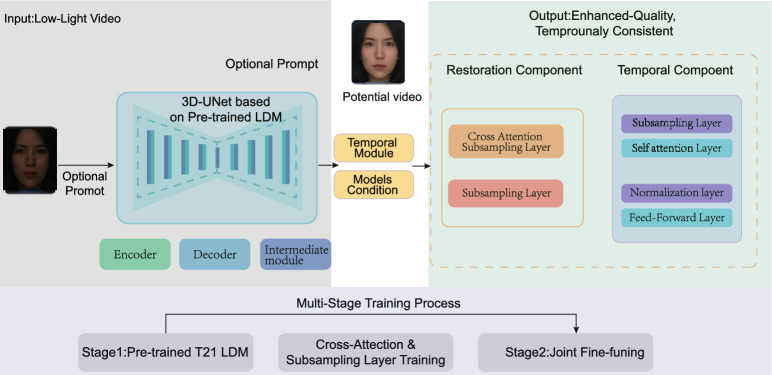
Low-light face videos suffer from severe noise and detail loss, limiting their use in surveillance and photography applications. To address these challenges, this paper proposes DL-Diff, a novel low-light face video enhancement framework that formulates this task as a conditional video-to-video (V2V) generation problem based on pre-trained Latent Diffusion Models (LDMs). DL-Diff extends pre-trained text-to-video models through three components: a pseudo-3D UNet backbone, a restoration component for spatial detail recovery, and a temporal component for inter-frame consistency. A multi-stage training strategy enables efficient domain adaptation from images to videos. Experiments on DID and SDSD datasets demonstrate that DL-Diff achieves superior performance in both perceptual quality (FID: 41.29, LPIPS: 0.17) and temporal consistency (AB(Var): 25.40, MABD: 0.08), significantly outperforming existing methods. The framework produces high-quality videos with realistic visual effects and no flickering artifacts, particularly excelling in extremely dark scenarios. This work demonstrates the potential of leveraging pre-trained diffusion models for video enhancement tasks.
Overview
CoChat Summary
TL;DR
DL-Diff reformulates low-light face video enhancement as conditional video-to-video generation using a pre-trained latent diffusion model, adding a restoration component and a temporal component to a pseudo-3D UNet. It reports strong perceptual quality and temporal consistency on DID and SDSD, with higher inference cost than feed-forward baselines.
Key findings
- On DID, DL-Diff reports FID 41.29, LPIPS 0.17, PSNR 22.92 dB, SSIM 0.72, AB(Var) 25.40, and MABD 0.08.
- Ablation: full multi-stage training raises PSNR from 18.96 to 22.92 dB and SSIM from 0.44 to 0.72; removing the temporal component worsens AB(Var) to 27.77 and MABD to 0.10, recovering to 25.40 and 0.08 when restored.
- On DID, DL-Diff ranks first in both temporal metrics, with AB(Var) 9.06 lower than MBLLEVEN and MABD 0.03 lower than StableLIVE; on SDSD it is second-best, behind the SDSD-trained method.
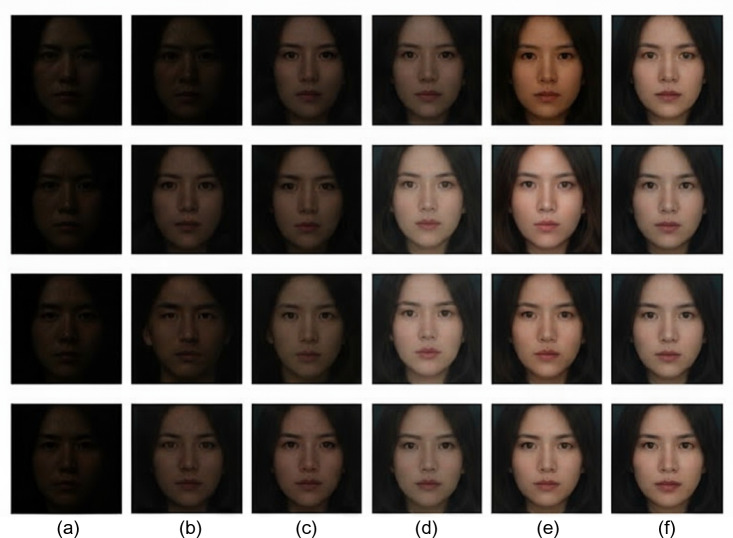
- Qualitative results claim better color restoration and detail in extremely dark scenes, with no flickering artifacts, but inference takes about 45 seconds per 16-frame 256×256 clip on an NVIDIA A100 with 100 DDIM steps versus 0.5–1.2 seconds for traditional methods.
Methods
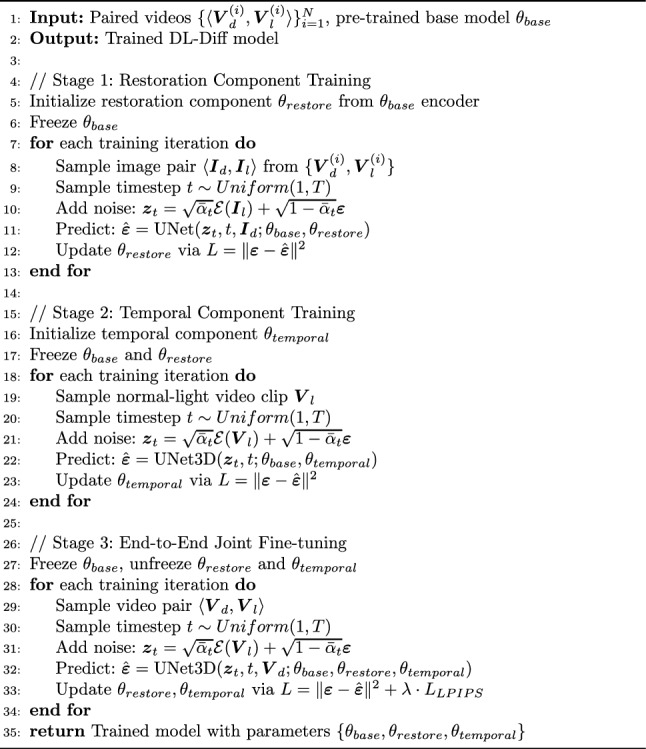
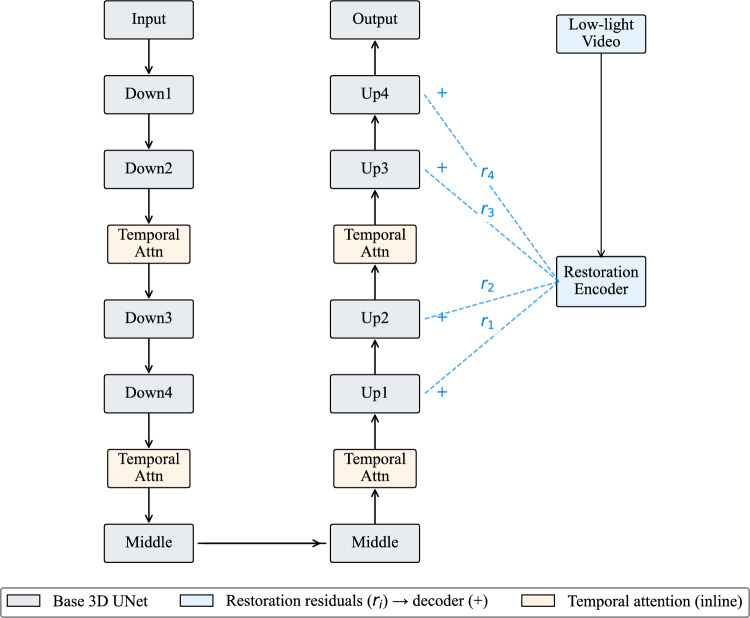
- DL-Diff builds on frozen Stable Diffusion v1.5 (~860M parameters), extends its 2D UNet to a pseudo-3D UNet, and trains a ControlNet-like restoration component (~370M parameters) plus an AnimateDiff-like temporal component (~85M parameters), totaling ~455M trainable parameters.
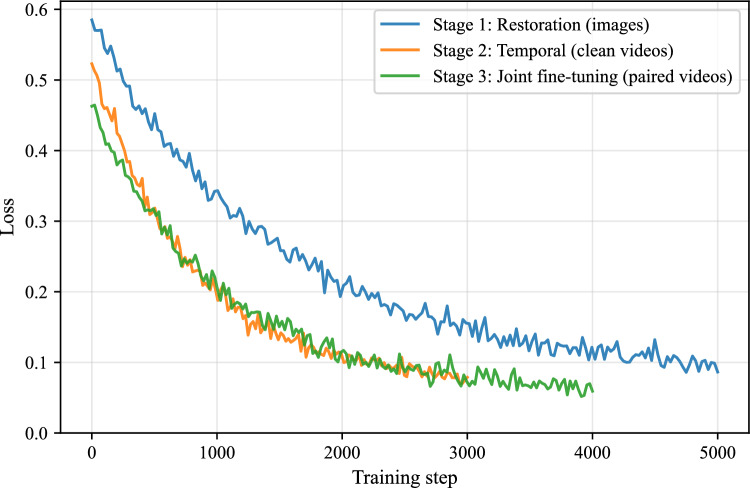
- Training uses a three-stage pipeline: Stage 1 trains the restoration component on randomly sampled low-light/normal-light image pairs; Stage 2 trains the temporal component on normal-light 16-frame video clips; Stage 3 jointly fine-tunes both components on paired low-light/normal-light videos. Training is at 256×256 resolution with T=1000 diffusion steps and 100 DDIM inference steps.
- Evaluation uses DID (413 aligned low-light/normal-light video pairs, up to 2560×1440) and SDSD (150 video pairs, 70 indoor and 80 outdoor, 100–300 frames at 1920×1080, non-aligned), with FID, LPIPS, PSNR, SSIM, AB(Var), and MABD metrics plus ablations.
Limitations
- Stated: diffusion inference cost remains higher than traditional methods; PSNR does not consistently surpass all baselines, reflecting a trade-off between perceptual quality and pixel-level reconstruction; the framework focuses on face videos, and extending to complex general scenes would require additional architectural considerations.
- Evident from the text: inference is about 45 seconds per 16-frame 256×256 clip on an A100 with 100 DDIM steps, so it is not real-time; evaluation is limited to DID and SDSD face-video settings.
- Evident from reported comparisons: some baselines exceed DL-Diff on pixel-level metrics on DID, e.g., MBLLEVEN reports PSNR 24.82 dB and FlowIE reports SSIM 0.92, while DL-Diff reports PSNR 22.92 dB and SSIM 0.72.
Model-written summary. Check it against the paper before relying on it.
Integrity signals
Registry
Cites
Statistics
Figures

Verification
Claims the paper makes
2 Valid · 1 Not valid · 5 Not checked · 78 Own results and interpretations
The cited sources that could be checked couldn’t confirm or dispute this claim.
In the paper
“Second, a pronounced domain gap exists between images and videos21–23.”
§ Temporally consistent low-light face video enhancement via video-to-video conditional diffusion > Introduction
What the sources say
- Could not verifycites [21] Li, Y. et al. Zero-shot medical image translation via frequency-guided diffusion models. IEEE Trans. Med. Imaging 43 (3), 980–993. 10.1109/TMI.2023.3325703 (2024). 37851552 PMC11000254 sourceExperimental — accuracy not yet measured
The Limitations and Medical Image Translation sections discuss differences between medical-image domains, such as CBCT and CT, not a gap between images and videos. Searches for “domain gap between images and videos,” video-related terms, and “videos” found no passage addressing the claimed comparison; page numbers were unavailable in our copy. (LLM, conf=0.76)
- Could not verifycites [22] Peng, Y. et al. Top-level design and simulated performance of the first portable CT-MR scanner. IEEE Access 10, 102325–102333. 10.1109/ACCESS.2022.3208278 (2022). sourceExperimental — accuracy not yet measured
Our copy of Peng et al. (2022) is a top-level design and simulation study of a portable CT-MR scanner; its Introduction (I. INTRODUCTION) only notes that imaging modalities differ in spatial/temporal resolution and SNR, and its Discussions (III. DISCUSSIONS) concern joint CT-MRI reconstruction and ultra-low-field SNR. No passage addresses images-versus-videos domain shift or transfer between the two: searches for 'domain gap between images and videos' and 'video data transfer learning image model' returned only CT/MR reconstruction and phantom-imaging passages. The references list (References) contains no video-related work either. Nothing in our copy supports or contradicts the attributed claim. (LLM, conf=0.70)
- Could not verifycites [23] Zhao, K. et al. MRI super-resolution with partial diffusion models. IEEE Trans. Med. Imaging 44 (3), 1194–1205. 10.1109/TMI.2024.3483109 (2025). 39418139 PMC11913589 sourceExperimental — accuracy not yet measured
The Introduction describes a statistical disparity between low- and high-resolution image latents, not a domain gap between images and videos. A search for an image–video domain gap and related terms found no passage in our copy addressing that claim; page numbers were unavailable. (LLM, conf=0.76)
- Asserted: passes — The authors put it forward as true.
- Checkable: passes — It can be checked against evidence.
- Load-bearing: passes — The paper’s conclusions depend on it.
- Based: passes — The paper gives a reason why it holds.
- Could not verify
None of the sources cited for this claim have been checked yet.
In the paper
“First, temporal inconsistency naturally emerges when enhancement is performed on a frame-by-frame basis, as such paradigms neglect inter-frame dependencies and readily introduce brightness fluctuations and structural jitter18–20.”
§ Temporally consistent low-light face video enhancement via video-to-video conditional diffusion > Introduction
What the sources say
- Not checked yetcites [18] Chen, Z., Long, F., Qiu, Z. et al Learning spatial adaptation and temporal coherence in diffusion models for video super-resolution. In 2024 IEEE/CVF Conference on Computer Vision and Pattern Recognition (CVPR). 9232–9241. 10.1109/CVPR52733.2024.00882 (2024). source
Checked before — its earlier verdict is held back until a new check runs.
- Could not verifycites [19] Liu, J., Anirudh, R., Thiagarajan, J.J. et al Dolce: A model-based probabilistic diffusion framework for limited-angle CT reconstruction. In 2023 IEEE/CVF International Conference on Computer Vision (ICCV). 10464–10474. 10.1109/ICCV51070.2023.00963 (2023). sourceExperimental — accuracy not yet measured
Section 4.2 (p. 4) discusses consistency between a CT reconstruction and its limited-angle sinogram, not consistency between video frames. Searches for frame-by-frame enhancement, inter-frame dependencies, brightness fluctuations, and structural jitter found no passage addressing the claim. (LLM, conf=0.78)
- Could not verifycites [20] Zhang, R., Isola, P., Efros, A.A. et al The unreasonable effectiveness of deep features as a perceptual metric. In 2018 IEEE/CVF Conference on Computer Vision and Pattern Recognition. 586–595. 10.1109/CVPR.2018.00068 (2018). sourceExperimental — accuracy not yet measured
Section 2.1, pp. 3–4, lists photometric and spatial distortions and describes sampling patches from frame-interpolation and video-deblurring outputs. It does not say that frame-by-frame enhancement neglects inter-frame dependencies or causes brightness fluctuations and structural jitter. Searches for temporal inconsistency, frame-by-frame enhancement, flickering, and temporal coherence found no passage addressing that claim. (LLM, conf=0.75)
plainstates a cause- Asserted: passes — The authors put it forward as true.
- Checkable: passes — It can be checked against evidence.
- Load-bearing: passes — The paper’s conclusions depend on it.
- Based: passes — The paper gives a reason why it holds.
- Not checked yet
The cited sources support only part of this claim — read each source’s verdict below.
In the paper
“Although some LLFVE methods have attempted to handle temporal information by introducing 3D convolutions7,24 or optical flow25,26, they often exhibit limited capability in modeling complex dynamics or handling severe noise.”
§ Temporally consistent low-light face video enhancement via video-to-video conditional diffusion > Introduction
What the sources say
- Not checked — no full text of the sourcecites [7] Duan, J. et al. A survey of embodied AI: From simulators to research tasks. IEEE Trans. Emerg. Top. Comput. Intell. 6 (2), 230–244. 10.1109/TETCI.2022.3141105 (2022). source
- Not checked yetcites [24] Wang, Y., Yang, W., Chen, X. et al Sinsr: Diffusion-based image super-resolution in a single step. In 2024 IEEE/CVF Conference on Computer Vision and Pattern Recognition (CVPR). 25796–25805. 10.1109/CVPR52733.2024.02437 (2024). source
Checked before — its earlier verdict is held back until a new check runs.
- Could not verifycites [25] Ancuti C.O., Ancuti, C. & Timofte, R. Nh-haze: An image dehazing benchmark with non-homogeneous hazy and haze-free images. In 2020 IEEE/CVF Conference on Computer Vision and Pattern Recognition Workshops (CVPRW). 1798–1805. 10.1109/CVPRW50498.2020.00230 (2020). sourceExperimental — accuracy not yet measured
Section 5 (p. 6) discusses noise amplification by some image-dehazing methods, but not low-light face video enhancement or the modeling of temporal dynamics. Searches for 3D convolutions, optical flow, face video, and temporal information found no passage addressing the attributed claim. (LLM, conf=0.76)
- Partly supportedcites [26] Blattmann, A., Rombach, R., Ling, H. et al Align your latents: High-resolution video synthesis with latent diffusion models. In 2023 IEEE/CVF Conference on Computer Vision and Pattern Recognition (CVPR). 22563–22575. 10.1109/CVPR52729.2023.02161 (2023). sourceExperimental — accuracy not yet measured
Section 3.1 (p. 4) says the paper uses residual blocks based on 3D convolutions to process video over time. But it studies video synthesis, not low-light face video enhancement, and does not establish the claimed limitations in modeling complex dynamics or handling severe noise. (LLM, conf=0.82)
plainstates a cause- Asserted: passes — The authors put it forward as true.
- Checkable: passes — It can be checked against evidence.
- Load-bearing: passes — The paper’s conclusions depend on it.
- Based: passes — The paper gives a reason why it holds.
A result the paper reports from its own data — it cites no other source for it, so there is none to check. The quote shows it is in the paper.
In the paper
“DL-Diff achieves top performance in temporal consistency.”
§ Temporally consistent low-light face video enhancement via video-to-video conditional diffusion > Experiments and results analysis > Quantitative evaluation
plain- Asserted: passes — The authors put it forward as true.
- Checkable: passes — It can be checked against evidence.
- Load-bearing: passes — The paper’s conclusions depend on it.
- Based: passes — The paper gives a reason why it holds.
A result the paper reports from its own data — it cites no other source for it, so there is none to check. The quote shows it is in the paper.
In the paper
“Figure 4 shows the training loss curves across the three stages, demonstrating stable convergence of the multi-stage strategy.”
§ Temporally consistent low-light face video enhancement via video-to-video conditional diffusion > Experiments and results analysis > Ablation studies
boostedstates a cause- Asserted: passes — The authors put it forward as true.
- Checkable: passes — It can be checked against evidence.
- Load-bearing: unclear — It is unclear whether the paper’s conclusions depend on it.
- Based: passes — The paper gives a reason why it holds.
32 more claims
Create a free account to see all 86 claims and to verify the 6 references still open.
- It may state two separate claims as one. 42
- Probably not a substantial claim. 10
Self-check
Percentages, sums and reported differences re-computed from the paper’s own numbers.
Each contradiction between two passages listed here was confirmed by an independent check.
Rated major: it would touch a result — a value a result rests on, reported and recomputed p-values on opposite sides of the significance level, two passages that conflict with no sign which is right, or a cited work retracted before this paper was published.
In the paper
§ Temporally consistent low-light face video enhancement via video-to-video conditional diffusion > Research methods > Multi-stage training pipeline
“Training data consists of paired video clips \documentclass[12pt]{minimal} \usepackage{amsmath} \usepackage{wasysym} \usepackage{amsfonts} \usepackage{amssymb} \usepackage{amsbsy} \usepackage{mathrsfs} \usepackage{upgreek} \setlength{\oddsidemargin}{-69pt} \begin{document}$$\langle \boldsymbol{V}_d, \boldsymbol{V}_l, c \rangle$$\end{document}, where c is an empty text prompt.”
§ Temporally consistent low-light face video enhancement via video-to-video conditional diffusion > Experiments and results analysis > Experimental setup
“we employ a neutral default text prompt: ”A detailed professional high-quality image/video shot under normal illumination”.”
Rated major: it would touch a result — a value a result rests on, reported and recomputed p-values on opposite sides of the significance level, two passages that conflict with no sign which is right, or a cited work retracted before this paper was published.
In the paper
§ Temporally consistent low-light face video enhancement via video-to-video conditional diffusion > Experiments and results analysis > Experimental setup
“the framework utilizes the pre-trained VAE from Stable Diffusion v1.5, which remains frozen throughout all training stages.”
§ Temporally consistent low-light face video enhancement via video-to-video conditional diffusion > Experiments and results analysis > Quantitative evaluation
“Particularly in the fine-tuning stage, combining LPIPS loss with MSE loss enhances the VAE decoder’s recovery mapping capability, leading to an exceptionally strong LPIPS metric”
Rated minor: it would not touch a result — a value no result rests on, a p-value that stays on the same side of the significance level, or a conflict that is clerical, resolved elsewhere in the paper, or outside its own findings.
In the paper
§ Temporally consistent low-light face video enhancement via video-to-video conditional diffusion > Experiments and results analysis > Experimental setup
“mapping input frames from \documentclass[12pt]{minimal} \usepackage{amsmath} \usepackage{wasysym} \usepackage{amsfonts} \usepackage{amssymb} \usepackage{amsbsy} \usepackage{mathrsfs} \usepackage{upgreek} \setlength{\oddsidemargin}{-69pt} \begin{document}$$256 \times 256 \times 3$$\end{document} pixel space to \documentclass[12pt]{minimal}”
§ Temporally consistent low-light face video enhancement via video-to-video conditional diffusion > Experiments and results analysis > Experimental setup
“four residual blocks with channel dimensions [128, 256, 512, 512] and spatial downsampling by a factor of 2 at each stage”
Citations
Cites
The Unreasonable Effectiveness of Deep Features as a Perceptual Metric
Zhang, R., Isola, P., Efros, A. A., Shechtman, E., & Wang, O. (2018) · 2018 IEEE/CVF Conference on Computer Vision and Pattern Recognition · doi:10.1109/cvpr.2018.00068 · Cited by 14,623
Deep Learning Face Attributes in the Wild
Liu, Z., Luo, P., Wang, X., & Tang, X. (2015) · 2015 IEEE International Conference on Computer Vision (ICCV) · doi:10.1109/iccv.2015.425 · Cited by 7,747
NTIRE 2017 Challenge on Single Image Super-Resolution: Dataset and Study
Agustsson, E., & Timofte, R. (2017) · 2017 IEEE Conference on Computer Vision and Pattern Recognition Workshops (CVPRW) · doi:10.1109/cvprw.2017.150 · Cited by 4,295
Image Super-Resolution Via Iterative Refinement
Saharia, C., Ho, J., Chan, W., Salimans, T., Fleet, D. J., & Norouzi, M. (2022) · IEEE Transactions on Pattern Analysis and Machine Intelligence · doi:10.1109/tpami.2022.3204461 · Cited by 1,829
Liu, J., Fan, X., Huang, Z., Wu, G., Liu, R., Zhong, W., & Luo, Z. (2022) · 2022 IEEE/CVF Conference on Computer Vision and Pattern Recognition (CVPR) · doi:10.1109/cvpr52688.2022.00571 · Cited by 1,336
Align Your Latents: High-Resolution Video Synthesis with Latent Diffusion Models
Blattmann, A., Rombach, R., Ling, H., Dockhorn, T., Kim, S. W., Fidler, S., & Kreis, K. (2023) · 2023 IEEE/CVF Conference on Computer Vision and Pattern Recognition (CVPR) · doi:10.1109/cvpr52729.2023.02161 · Cited by 724 · cited 1×
“Although some LLFVE methods have attempted to handle temporal information by introducing 3D convolutions 7,24 or optical flow 25,26 , they often exhibit limited capability in modeling complex dynamics or handling severe noise.”
Fully Dense UNet for 2-D Sparse Photoacoustic Tomography Artifact Removal
Guan, S., Khan, A. A., Sikdar, S., & Chitnis, P. V. (2020) · IEEE Journal of Biomedical and Health Informatics · doi:10.1109/jbhi.2019.2912935 · Cited by 538 · cited 1×
“To process video data, we first extend the original 2D UNet architecture 28 in the base model to a pseudo-3D UNet architecture capable of handling temporal information.”
NH-HAZE: An Image Dehazing Benchmark with Non-Homogeneous Hazy and Haze-Free Images
Ancuti, C. O., Ancuti, C., & Timofte, R. (2020) · 2020 IEEE/CVF Conference on Computer Vision and Pattern Recognition Workshops (CVPRW) · doi:10.1109/cvprw50498.2020.00230 · Cited by 517 · cited 1×
“Although some LLFVE methods have attempted to handle temporal information by introducing 3D convolutions 7,24 or optical flow 25,26 , they often exhibit limited capability in modeling complex dynamics or handling severe noise.”
DDFM: Denoising Diffusion Model for Multi-Modality Image Fusion
Zhao, Z., Bai, H., Zhu, Y., Zhang, J., Xu, S., Zhang, Y., Zhang, K., Meng, D., Timofte, R., & Van Gool, L. (2023) · 2023 IEEE/CVF International Conference on Computer Vision (ICCV) · doi:10.1109/iccv51070.2023.00742 · Cited by 431
Structural similarity index (SSIM) revisited: A data-driven approach
Bakurov, I., Buzzelli, M., Schettini, R., Castelli, M., & Vanneschi, L. (2022) · Expert Systems with Applications · doi:10.1016/j.eswa.2021.116087 · Cited by 421 · cited 5×
“As shown in Table 1, after adopting the complete multi-stage training pipeline, the model’s reconstruction quality improves dramatically, with PSNR increasing from 18.96 to 22.92 dB and SSIM from 0.44 to 0.72.”
InfluentialA Survey of Embodied AI: From Simulators to Research Tasks
Duan, J., Yu, S., Tan, H. L., Zhu, H., & Tan, C. (2022) · IEEE Transactions on Emerging Topics in Computational Intelligence · doi:10.1109/tetci.2022.3141105 · Cited by 420
DiffIR: Efficient Diffusion Model for Image Restoration
Xia, B., Zhang, Y., Wang, S., Wang, Y., Wu, X., Tian, Y., Yang, W., & Van Gool, L. (2023) · 2023 IEEE/CVF International Conference on Computer Vision (ICCV) · doi:10.1109/iccv51070.2023.01204 · Cited by 412
Shen, Z., Wang, W., Lu, X., Shen, J., Ling, H., Xu, T., & Shao, L. (2019) · 2019 IEEE/CVF International Conference on Computer Vision (ICCV) · doi:10.1109/iccv.2019.00567 · Cited by 359
Global Structure-Aware Diffusion Process for Low-light Image Enhancement
Hou, J., Zhu, Z., Hou, J., Liu, H., Zeng, H., & Yuan, H. (2023) · neural information processing systems · doi:10.52202/075280-3490 · Cited by 340
Diff-Retinex: Rethinking Low-light Image Enhancement with A Generative Diffusion Model
Yi, X., Xu, H., Zhang, H., Tang, L., & Ma, J. (2023) · 2023 IEEE/CVF International Conference on Computer Vision (ICCV) · doi:10.1109/iccv51070.2023.01130 · Cited by 305
Dif-Fusion: Toward High Color Fidelity in Infrared and Visible Image Fusion With Diffusion Models
Yue, J., Fang, L., Xia, S., Deng, Y., & Ma, J. (2023) · IEEE Transactions on Image Processing · doi:10.1109/tip.2023.3322046 · Cited by 304
SinSR: Diffusion-Based Image Super-Resolution in a Single Step
Wang, Y., Yang, W., Chen, X., Wang, Y., Guo, L., Chau, L.-P., Liu, Z., Qiao, Y., Kot, A. C., & Wen, B. (2024) · 2024 IEEE/CVF Conference on Computer Vision and Pattern Recognition (CVPR) · doi:10.1109/cvpr52733.2024.02437 · Cited by 196 · cited 1×
“Although some LLFVE methods have attempted to handle temporal information by introducing 3D convolutions 7,24 or optical flow 25,26 , they often exhibit limited capability in modeling complex dynamics or handling severe noise.”
Seeing Dynamic Scene in the Dark: A High-Quality Video Dataset with Mechatronic Alignment
Wang, R., Xu, X., Fu, C.-W., Lu, J., Yu, B., & Jia, J. (2021) · 2021 IEEE/CVF International Conference on Computer Vision (ICCV) · doi:10.1109/iccv48922.2021.00956 · Cited by 145 · cited 1×
“SDSD dataset 30 : this dataset contains 150 video sequence pairs, with 70 indoor and 80 outdoor scenes.”
Scaling Up to Excellence: Practicing Model Scaling for Photo-Realistic Image Restoration In the Wild
Yu, F., Gu, J., Li, Z., Hu, J., Kong, X., Wang, X., He, J., Qiao, Y., & Dong, C. (2024) · 2024 IEEE/CVF Conference on Computer Vision and Pattern Recognition (CVPR) · doi:10.1109/cvpr52733.2024.02425 · Cited by 143
Diffusion Models, Image Super-Resolution, and Everything: A Survey
Moser, B. B., Shanbhag, A. S., Raue, F., Frolov, S., Palacio, S., & Dengel, A. (2025) · IEEE Transactions on Neural Networks and Learning Systems · doi:10.1109/tnnls.2024.3476671 · Cited by 117
Zero-Shot Medical Image Translation via Frequency-Guided Diffusion Models
Li, Y., Shao, H.-C., Liang, X., Chen, L., Li, R., Jiang, S., Wang, J., & Zhang, Y. (2024) · IEEE Transactions on Medical Imaging · doi:10.1109/tmi.2023.3325703 · Cited by 111
DOLCE: A Model-Based Probabilistic Diffusion Framework for Limited-Angle CT Reconstruction
Liu, J., Anirudh, R., Thiagarajan, J. J., He, S., Mohan, K. A., Kamilov, U. S., & Kim, H. (2023) · 2023 IEEE/CVF International Conference on Computer Vision (ICCV) · doi:10.1109/iccv51070.2023.00963 · Cited by 106
Dual degradation image inpainting method via adaptive feature fusion and U-net network
Chen, Y., Xia, R., Yang, K., & Zou, K. (2025) · Applied Soft Computing · doi:10.1016/j.asoc.2025.113010 · Cited by 85
A Study of the Perceptually Weighted Peak Signal-To-Noise Ratio (WPSNR) for Image Compression
Erfurt, J., Helmrich, C. R., Bosse, S., Schwarz, H., Marpe, D., & Wiegand, T. (2019) · Proceedings - International Conference on Image Processing · doi:10.1109/icip.2019.8803307 · Cited by 76 · cited 6×
“As shown in Table 1, after adopting the complete multi-stage training pipeline, the model’s reconstruction quality improves dramatically, with PSNR increasing from 18.96 to 22.92 dB and SSIM from 0.44 to 0.72.”
InfluentialFlowIE: Efficient Image Enhancement via Rectified Flow
Zhu, Y., Zhao, W., Li, A., Tang, Y., Zhou, J., & Lu, J. (2024) · IEEE Computer Society Conference on Computer Vision and Pattern Recognition/Proceedings - IEEE Computer Society Conference on Computer Vision and Pattern Recognition/Proceedings · doi:10.1109/cvpr52733.2024.00010 · Cited by 68
Low-Light Video Enhancement with Synthetic Event Guidance
Liu, L., An, J., Liu, J., Yuan, S., Chen, X., Zhou, W., Li, H., Wang, Y. F., & Tian, Q. C. (2023) · Proceedings of the AAAI Conference on Artificial Intelligence · doi:10.1609/aaai.v37i2.25257 · Cited by 65
DM-Fusion: Deep Model-Driven Network for Heterogeneous Image Fusion
Xu, G., He, C., Wang, H., Zhu, H., & Ding, W. (2024) · IEEE Transactions on Neural Networks and Learning Systems · doi:10.1109/tnnls.2023.3238511 · Cited by 57
HQG-Net: Unpaired Medical Image Enhancement With High-Quality Guidance
He, C., Li, K., Xu, G., Yan, J., Tang, L., Zhang, Y., Wang, Y., & Li, X. (2024) · IEEE Transactions on Neural Networks and Learning Systems · doi:10.1109/tnnls.2023.3315307 · Cited by 54
Fréchet AutoEncoder Distance: A new approach for evaluation of Generative Adversarial Networks
Buzuti, L. F., & Thomaz, C. E. (2023) · Computer Vision and Image Understanding · doi:10.1016/j.cviu.2023.103768 · Cited by 40 · cited 4×
“On both datasets, its FID and DL-Diff exhibits strong competitiveness in reconstruction quality.”
InfluentialDegradation-Resistant Unfolding Network for Heterogeneous Image Fusion
He, C., Li, K., Xu, G., Zhang, Y., Hu, R., Guo, Z., & Li, X. (2023) · 2023 IEEE/CVF International Conference on Computer Vision (ICCV) · doi:10.1109/iccv51070.2023.01159 · Cited by 37
MRI Super-Resolution With Partial Diffusion Models
Zhao, K., Pang, K., Hung, A. L. Y., Zheng, H., Yan, R., & Sung, K. (2025) · IEEE Transactions on Medical Imaging · doi:10.1109/tmi.2024.3483109 · Cited by 36
Dancing in the Dark: A Benchmark towards General Low-light Video Enhancement
Fu, H., Zheng, W., Wang, X., Wang, J., Zhang, H., & Ma, H. (2023) · 2023 IEEE/CVF International Conference on Computer Vision (ICCV) · doi:10.1109/iccv51070.2023.01183 · Cited by 33 · cited 1×
“DID dataset 29 : a high-quality dynamic video dataset characterized by significant camera and object motion.”
CAAT: Image super-resolution algorithm via channel attention and transformer
Chen, Y., Chen, L., Xia, R., Yang, K., & Zou, K. (2025) · Array · doi:10.1016/j.array.2025.100628 · Cited by 29 · cited 1×
“In the context of spatial detail recovery, channel attention mechanisms combined with Transformer architectures 27 have shown promise for lightweight yet effective feature extraction, which is particularly relevant for preserving fine-grained facial details in low-light scenarios.”
Learning Spatial Adaptation and Temporal Coherence in Diffusion Models for Video Super-Resolution
Chen, Z., Long, F., Qiu, Z., Yao, T., Zhou, W., Luo, J., & Mei, T. (2024) · 2024 IEEE/CVF Conference on Computer Vision and Pattern Recognition (CVPR) · doi:10.1109/cvpr52733.2024.00882 · Cited by 27
Inflation with Diffusion: Efficient Temporal Adaptation for Text-to-Video Super-Resolution
Yuan, X., Baek, J., Xu, K., Tov, O., & Fei, H. (2024) · 2024 IEEE/CVF Winter Conference on Applications of Computer Vision Workshops (WACVW) · doi:10.1109/wacvw60836.2024.00059 · Cited by 14
Top-Level Design and Simulated Performance of the First Portable CT-MR Scanner
Peng, Y., Li, M., Grandinetti, J., Wang, G., & Jia, X. (2022) · IEEE Access · doi:10.1109/access.2022.3208278 · Cited by 4
Low-Light Video Enhancement via Spatial-Temporal Consistent DecompositionPreprint
Xu, X., Zhou, K., Hu, T., et al. (2024) · arXiv (Cornell University) · doi:10.48550/arxiv.2405.15660
Research works printed but not linked: 1
- Dosovitskiy, A. & Brox, T. Generating images with perceptual similarity metrics based on deep networks. Adv. Neural Inf. Process. Syst.29 (2016).
Metadata
- Authors
- Ding, X., He, K., Sun, H., & Yang, J.
- Affiliations
- Sichuan University Jinjiang College (CN)
- Sichuan Railway College (CN)
- Corresponding author
- Ding, Xiaofeng
- ORCID
- Ding, Xiaofeng
- Venue
- Scientific Reports
- Published
- 2026-03-18
- Volume
- 16
- Issue
- 1
- ISSN
- 2045-2322 (ISSN-L)
- PMC
- PMC13136428
- OpenAlex
- W7139019837
- Semantic Scholar
- d95be280ef20e9eea886cebc2782ce85a0f67f85
- Cited by
- 0
- References
- 36
- FWCI
- 0.00
- Type
- journal article
- Language
- en
- Open access
- gold
- doi.org
- Licence
- cc-by-nc-nd
- creativecommons.org/licenses/by-nc-nd/4.0 (tdm)
- creativecommons.org/licenses/by-nc-nd/4.0 (vor, 47 d)
- Locations
- Scientific Reports (publishedVersion, cc-by-nc-nd)
- PubMed Central (publishedVersion, cc-by-nc-nd)
- PubMed (publishedVersion)
- DOAJ (DOAJ: Directory of Open Access Journals) (submittedVersion, cc-by-sa)
- Topics
- Physical Sciences › Computer Science › Computer Vision and Pattern Recognition › Image Enhancement Techniques
- Physical Sciences › Computer Science › Computer Vision and Pattern Recognition › Generative Adversarial Networks and Image Synthesis
- Physical Sciences › Computer Science › Computer Vision and Pattern Recognition › Advanced Image Processing Techniques
- Keywords
- latent diffusion models, temporal coherence, text-to-video diffusion models
About these checks
Registry, retraction, Cites and statistics results are computed, not judged, with one exception: a printed reference that no index lists is read once by a model before it counts as a citation error. Claims are extracted by a model and kept only when their quote appears verbatim in the text; each cited source is then checked, with a model’s help, for whether it says what the claim relies on. Those verdicts can be wrong — read the claim’s quote and the cited source before relying on one.
The claim verdicts this report counts are experimental: their accuracy is not yet measured.
A language model drew the claims from the paper on 2026-10-10, under version 3 of the claim definition (model deepseek-v4.1-flash, prompt extract-v3).
A second model labelled each claim on 2026-10-10 (model jev-1.13-20260917, definition revision gold-guideline-v0.2).
Cited sources are checked with a language model’s help (gpt-6-sol and qwen3.8-omni-flash).
Statistics and arithmetic are recomputed, not judged.
Confidence bands are shown only for fields calibrated on our annotated test set. None is calibrated yet, so no band is shown.
What counts as a claim ›How we measure confidence ›How we check this ›
Are you an author, or do you see a problem with this page? Request a review
Data sources
Bibliographic data: Semantic Scholar, OpenAlex, Crossref.
Contains information from the Semantic Scholar Academic Graph Datasets, made available under the ODC Attribution License (ODC-BY 1.0).
Semantic Scholar’s data is described in: Kinney, R., et al. (2023). The Semantic Scholar Open Data Platform. arXiv:2301.10140.
