

Taphonomy and early diagenesis of a semi-articulated dinosaur tail from the late maastrichtian of southwestern Europe
Open accessThe DOI matches its Crossref record; 37 of the 37 references it cites were found in a registry or an index; none of the 54 sources its claims cite is checked for support yet.
Abstract
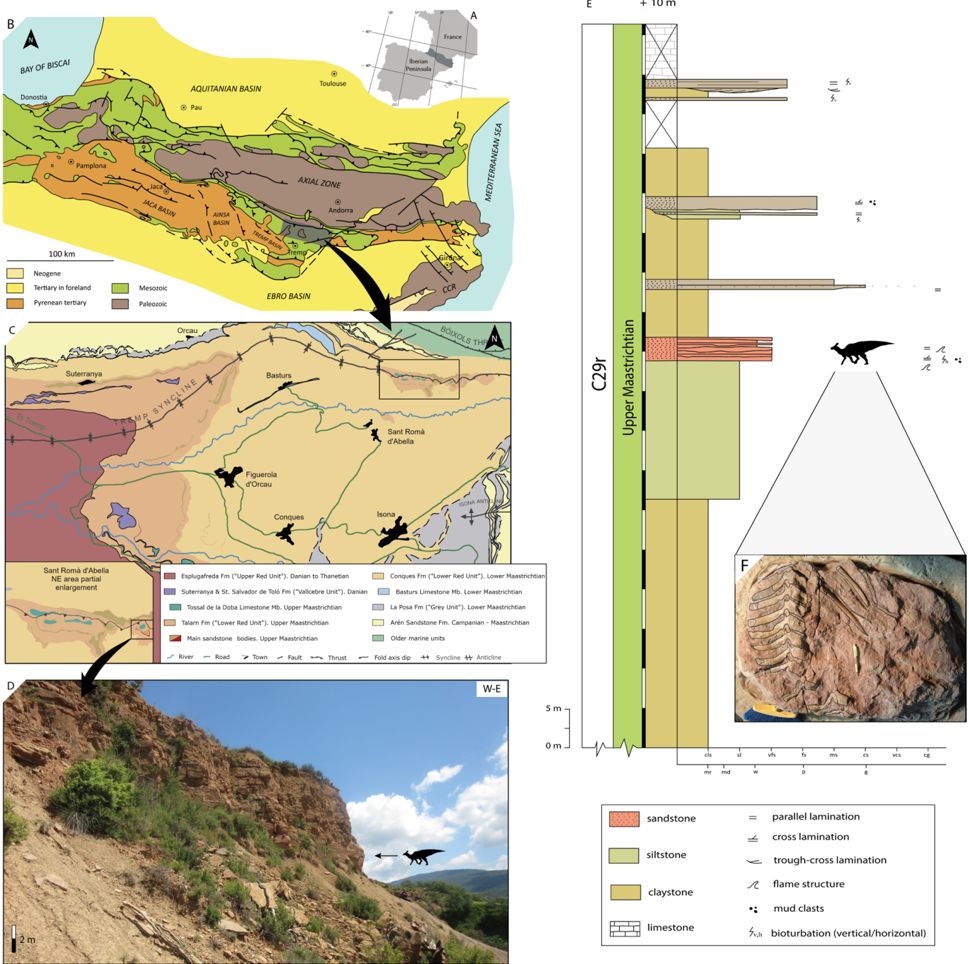
Articulated dinosaur remains are extremely rare in Upper Cretaceous alluvial deposits of southwestern Europe, limiting detailed reconstructions of post-mortem processes in these settings. We present a taphonomic, sedimentological, and early diagenetic analysis of a semi-articulated mid-caudal segment of a lambeosaurine hadrosaurid, recovered as a detached sandstone block from the Planta del Mestre locality (Late Maastrichtian Tremp Basin, South-Central Pyrenees). The specimen comprises eleven middle caudal vertebrae and associated neural spines and four haemal arches preserved in close anatomical association. Semi-articulated arrangement, lack of abrasion, and mineralized intervertebral fibrocartilage indicate short residence time following minimal transport. Stage 2 subaerial weathering on centra and stepped displacement of distal elements reflect differential exposure during partial entombment and post-depositional settling. Parallel grooves on neural and haemal spines record early biological interaction by a medium-sized ziphodont theropod, likely an abelisaurid, during initial decay stages. Petrographic analysis reveals early ferruginous impregnation under oxidizing conditions promoted sediment stabilization and sealing bone pores, preserving delicate structures against decay. Associated planktonic foraminifera suggest episodic marine influence within the floodplain. These results highlight the role of localized geochemical pathways in generating high-fidelity preservation within otherwise unfavourable floodplain taphonomic settings.
Overview
CoChat Summary
TL;DR
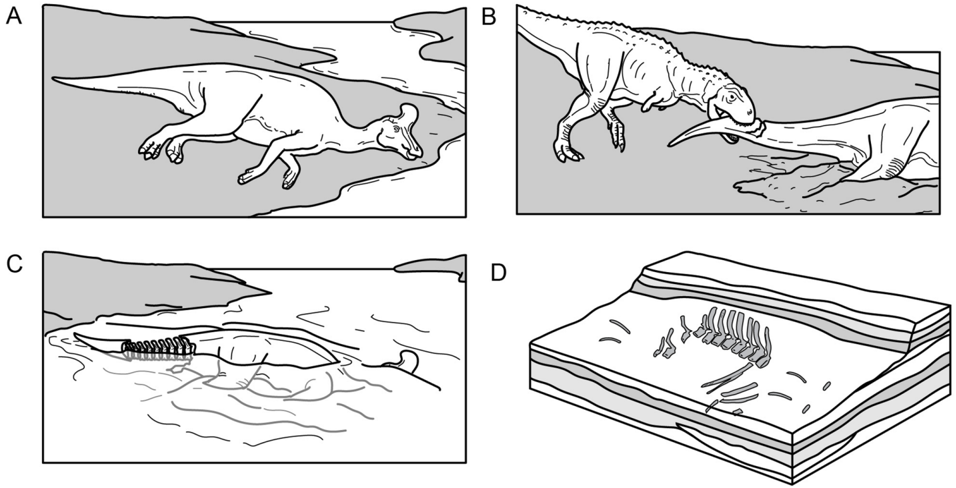
The paper describes a semi-articulated mid-caudal segment of a lambeosaurine hadrosaurid (MCD-15507) from the Late Maastrichtian Planta del Mestre locality, Tremp Basin, preserved in a detached reddish sandstone block. It reconstructs a taphonomic history of minimal transport, partial burial in a crevasse-splay floodplain, early ziphodont theropod tooth marks, and early ferruginous impregnation that aided high-fidelity preservation.
Key findings
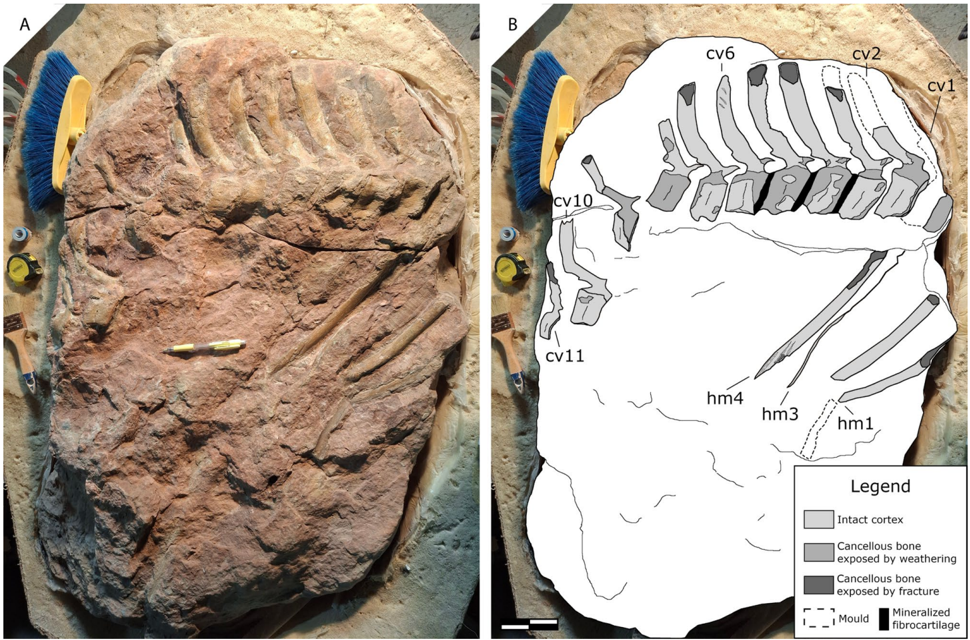
- MCD-15507 comprises eleven middle caudal vertebrae and four haemal arches; centra average 47 mm in length and are dorsoventrally taller than long, anterior neural spines exceed twice centrum height, posterior spines are slightly over twice centrum height, and haemal arches have a mean dorsoventral length of 300 mm. Mineralized intervertebral fibrocartilage between cv3–cv6 preserves a physiological spacing of approximately 10 mm.
- Taphonomy indicates high articulation from cv1–cv8, minimal intervertebral spaces, no abrasion or plastic deformation, Stage 2 subaerial weathering on centra, and stepped ventral displacement of cv9–cv11; these are interpreted as minimal transport, partial entombment, and post-depositional settling.
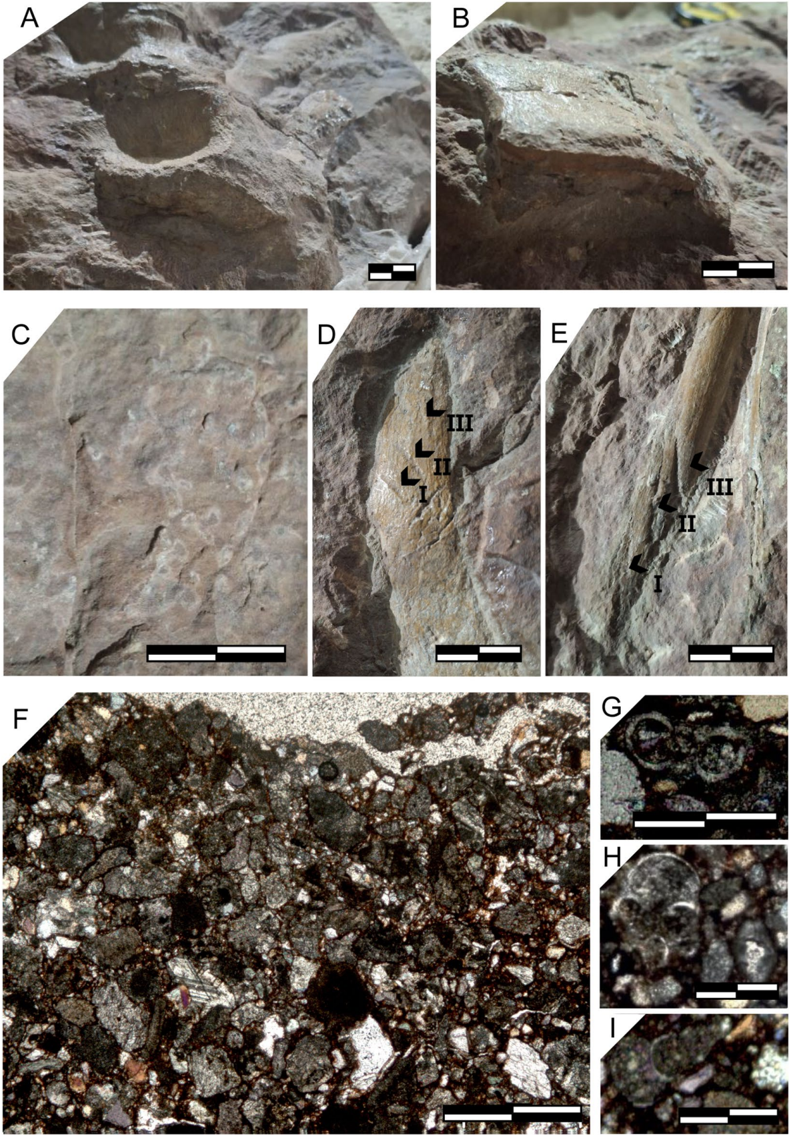
- Two clusters of parallel grooves occur on the neural spine of cv6 and haemal arch hm4; Cluster 1 traces measure 11.10, 16.20, and 13.58 mm long, while Cluster 2 traces measure 46.60, 44.98, and 31.70 mm long. They are interpreted as early post-mortem tooth traces by a medium-sized ziphodont theropod, likely an abelisaurid.
- Petrography of the host sandstone shows fine- to very fine-grained muddy sandstone with pervasive iron-oxide impregnation (likely hematite) and early ferruginous coatings; planktonic foraminifera indicate episodic marine influence, and early ferruginous impregnation is inferred to have promoted sediment stabilization and pore sealing, preserving delicate structures.
Methods
- Specimen MCD-15507 from Planta del Mestre, Tremp Basin, is embedded in a reddish sandstone block of approximately 0.65 m² and curated at the Museu de la Conca Dellà. Documentation used photography, mapping, and Structure from Motion photogrammetry (Agisoft Metashape Professional v.2.1.2, validated in Blender v.3.5.1), with morphometric measurements taken using a tape and digital caliper.
- Stratigraphic and sedimentological analysis involved detailed logging, facies analysis, and fluvial architecture characterization; petrographic analysis used a ~30 μm thin section of the fossil-bearing sandstone examined with a polarized light microscope.
- Taphonomic analysis followed the Fiorillo and Eberth framework, evaluating preservation state and articulation, bone spatial distribution and orientation, anatomical completeness, skeletal integrity and fracture patterns, abrasion and weathering, bioerosive traces, and mineralization/diagenesis via petrography. No direct chemical analysis was performed on the fossil remains.
Limitations
- Stated in the paper: no direct chemical analysis was performed on the fossil remains; the block was detached from its original outcrop, so the broader spatial distribution of skeletal elements is unknown; precise positional identity of individual caudal elements cannot be determined; some features remain obscured by matrix; no dental crowns were recovered and diagnostic denticle striations are absent; direct extrapolation from tooth spacing to skull size is unreliable; other coeval archosaur lineages cannot be strictly ruled out; and the precise mechanisms and timing of mineralization remain to be constrained by targeted geochemical analyses.
- Evident from the text: this is a single-specimen case study, and the taxonomic attribution to a lambeosaurine hadrosaurid and mid-caudal position rests on morphological comparison rather than independent geochemical or phylogenetic analysis. The taphonomic reconstruction is partly inferential because the block is detached, adjacent elements are missing, and some haemal arches are not visible or absent from the preserved series.
- Also evident: recent fractures and weathering of the enclosing block affect the specimen, and the absence of dental crowns or diagnostic denticle striations limits the confidence of the theropod identification.
Model-written summary. Check it against the paper before relying on it.
Integrity signals
Registry
Cites
Statistics
Figures
Verification
Claims the paper makes
0 Valid · 0 Not valid · 30 Not checked · 97 Own results and interpretations
A result the paper reports from its own data — it cites no other source for it, so there is none to check. The quote shows it is in the paper.
In the paper
“In contrast, the neural and haemal spines retain an intact cortex.”
§ Taphonomy and early diagenesis of a semiarticulated dinosaur tail from the late maastrichtian of southwestern Europe > Physical integrity
plainSingle case- Asserted: passes — The authors put it forward as true.
- Checkable: passes — It can be checked against evidence.
- Load-bearing: unclear — It is unclear whether the paper’s conclusions depend on it.
- Based: passes — The paper gives a reason why it holds.
A result the paper reports from its own data — it cites no other source for it, so there is none to check. The quote shows it is in the paper.
In the paper
“Morphological features support its attribution to the middle caudal region of a lambeosaurine hadrosaurid, while the degree of articulation and overall physical integrity indicate limited transport and relatively rapid burial within a low-energy continental setting.”
§ Taphonomy and early diagenesis of a semiarticulated dinosaur tail from the late maastrichtian of southwestern Europe > Conclusions
plainstates an associationSingle case- Asserted: passes — The authors put it forward as true.
- Checkable: passes — It can be checked against evidence.
- Load-bearing: passes — The paper’s conclusions depend on it.
- Based: passes — The paper gives a reason why it holds.
A result the paper reports from its own data — it cites no other source for it, so there is none to check. The quote shows it is in the paper.
In the paper
“No carbonate crusts or mineral coatings were observed on the bone surfaces.”
§ Taphonomy and early diagenesis of a semiarticulated dinosaur tail from the late maastrichtian of southwestern Europe > Physical integrity
plainSingle case- Asserted: passes — The authors put it forward as true.
- Checkable: passes — It can be checked against evidence.
- Load-bearing: unclear — It is unclear whether the paper’s conclusions depend on it.
- Based: passes — The paper gives a reason why it holds.
A result the paper reports from its own data — it cites no other source for it, so there is none to check. The quote shows it is in the paper.
In the paper
“The caudal series MCD-15,507 represents a well-constrained example of a partially articulated lambeosaurine tail segment from the Tremp Basin, integrating anatomical, taphonomic, sedimentological, and diagenetic evidence.”
§ Taphonomy and early diagenesis of a semiarticulated dinosaur tail from the late maastrichtian of southwestern Europe > Conclusions
boostedSingle case- Asserted: passes — The authors put it forward as true.
- Checkable: passes — It can be checked against evidence.
- Load-bearing: passes — The paper’s conclusions depend on it.
- Based: passes — The paper gives a reason why it holds.
A result the paper reports from its own data — it cites no other source for it, so there is none to check. The quote shows it is in the paper.
In the paper
“The missing ventral portion of hm1 (preserved only as a natural mold) is noticeably tilted relative to the remaining arch, indicating taphonomic rotation.”
§ Taphonomy and early diagenesis of a semiarticulated dinosaur tail from the late maastrichtian of southwestern Europe > Spatial arrangement
hedgedstates a causeSingle case- Asserted: passes — The authors put it forward as true.
- Checkable: passes — It can be checked against evidence.
- Load-bearing: unclear — It is unclear whether the paper’s conclusions depend on it.
- Based: passes — The paper gives a reason why it holds.
66 more claims
Create a free account to see all 127 claims and every source verdict.
- It may state two separate claims as one. 54
- The quote only partly states this claim. 1
- Probably not a substantial claim. 3
Self-check
Percentages, sums and reported differences re-computed from the paper’s own numbers.
Each contradiction between two passages listed here was confirmed by an independent check.
Rated minor: it would not touch a result — a value no result rests on, a p-value that stays on the same side of the significance level, or a conflict that is clerical, resolved elsewhere in the paper, or outside its own findings.
In the paper
§ Taphonomy and early diagenesis of a semiarticulated dinosaur tail from the late maastrichtian of southwestern Europe > Morphological description
“the posterior vertebrae (cv8-cv11) possess proportionally shorter spines (slightly over twice the centrum height)”
§ Taphonomy and early diagenesis of a semiarticulated dinosaur tail from the late maastrichtian of southwestern Europe > Taphonomic analysis
“| cv11 | 60 | 63 | 52 | 110 |”
Citations
Cites
The FAIR Guiding Principles for scientific data management and stewardship
Wilkinson, M. D., Dumontier, M., Aalbersberg, I. J., Appleton, G., Axton, M., Baak, A., Blomberg, N., Boiten, J.-W., da Silva Santos, L. B., Bourne, P. E., et al. (2016) · Scientific Data · doi:10.1038/sdata.2016.18 · Cited by 18,423
Taphonomic and ecologic information from bone weathering
Behrensmeyer, A. K. (1978) · Paleobiology · doi:10.1017/s0094837300005820 · Cited by 2,235
Evidence of carnivore gnawing on Pleistocene and Recent mammalian bones
Haynes, G. (1980) · Paleobiology · doi:10.1017/s0094837300006849 · Cited by 474
The Ansó transect of the southern Pyrenees: basement and cover thrust geometries
Teixell, A. (1996) · Journal of the Geological Society · doi:10.1144/gsjgs.153.2.0301 · Cited by 268
Open data and digital morphology
Davies, T. G., Rahman, I. A., Lautenschlager, S., Cunningham, J. A., Asher, R. J., Barrett, P. M., Bates, K. T., Bengtson, S., Benson, R. B. J., Boyer, D. M., et al. (2017) · Proceedings of the Royal Society B: Biological Sciences · doi:10.1098/rspb.2017.0194 · Cited by 181
Macromamíferos neógenos de la fosa de Alfambra-Teruel
Martínez, L. A. (1994) · Dialnet (Universidad de la Rioja) · Cited by 169
López‐Martínez, N., Canudo, J. I., Ardèvol, L., Suberbiola, X. P., Orue-Etxebarría, X., Cuenca‐Bescós, G., Ruiz-Omeñaca, J. I., Murelaga, X., & Feist, M. (2001) · Cretaceous Research · doi:10.1006/cres.2000.0236 · Cited by 141
The end-Cretaceous dinosaur succession in Europe: The Tremp Basin record (Spain)
Riera, V., Oms, O., Gaete, R., & Galobart, À. (2009) · Palaeogeography Palaeoclimatology Palaeoecology · doi:10.1016/j.palaeo.2009.09.018 · Cited by 126
Suberbiola, X. P., Canudo, J. I., Cruzado‐Caballero, P., Barco, J. L., López‐Martínez, N., Oms, O., & Ruiz-Omeñaca, J. I. (2009) · Comptes Rendus Palevol · doi:10.1016/j.crpv.2009.05.002 · Cited by 119
A role for iron and oxygen chemistry in preserving soft tissues, cells and molecules from deep time
Schweitzer, M. H., Zheng, W., Cleland, T. P., Goodwin, M. B., Boatman, E., Theil, E., Marcus, M. A., & Fakra, S. C. (2014) · Proceedings of the Royal Society B: Biological Sciences · doi:10.1098/rspb.2013.2741 · Cited by 112
Research works printed but not linked: 5
- Pereda-Suberbiola, X., Astibia, H., Murelaga, X., Elorza, J. & Gómez-Alday, J. J. Taphonomy of the Late Cretaceous dinosaur-bearing beds of the Laño quarry (Iberian Peninsula). Palaeogeogr Palaeoclimatol Palaeoecol. 157 (3-4), 247- 275 (2000). https://doi.org/10.1038/s41598-026-76308-z
- Hill, A. Early postmortem damage to the remains of some contemporary East African mammals. In Fossils in the Making: Vertebrate Taphonomy and Paleoecology (eds (eds Behrensmeyer, A. K. & Hill, A. P.) 131-152. University of Chicago Press (1980).
- Dalla Vecchia, F. M. The unusual tail of Tethyshadros insularis (Dinosauria, Hadrosauroidea) from the adriatic island of the european archipelago. Riv Ital. Paleontol. Stratigr. 123 (6), 583-628 (2020). https://doi.org/10.1038/s41598-026-76308-z
- Romer, A. S. Osteology of Reptiles 3rd edn (University of Chicago Press, 1976).
- Ramírez-Velasco, A. A. & Alvarado Ortega, J. Guía osteológica de los dinosaurios hadrosauroideos (Ornithopoda, Hadrosauroidea), primera parte: esqueleto postcraneano. Bol. Inst. Geol. 124 (1), 1-43 (2022).
Cited by
Still being checked.
Metadata
- Authors
- Torrent, M., Parra, S., & Sellés, A.
- Affiliations
- Universitat Autònoma de Barcelona (ES)
- Consejo Superior de Investigaciones Científicas (ES)
- Corresponding author
- Sellés, Albert
- Venue
- Scientific Reports
- Published
- 2026-10-24
- ISSN
- 2045-2322 (ISSN-L)
- OpenAlex
- W7223463810
- Semantic Scholar
- fcfaba3216e6af027183222f5a8bed833e697ef9
- Cited by
- 0
- References
- 37
- FWCI
- 0.00
- Type
- journal article
- Language
- en
- Open access
- gold
- doi.org
- Licence
- cc-by-nc-nd
- creativecommons.org/licenses/by-nc-nd/4.0 (tdm)
- creativecommons.org/licenses/by-nc-nd/4.0 (am)
- Locations
- Scientific Reports (publishedVersion, cc-by-nc-nd)
- Funders
- Centres de Recerca de Catalunya
- Ministerio de Ciencia e Innovación (R+D+i/PID2020-119811GB-I00)
- Departament de Cultura, Generalitat de Catalunya, Spain (ARQ001SOL-173-2022)
- Topics
- Physical Sciences › Earth and Planetary Sciences › Paleontology › Paleontology and Evolutionary Biology
- Physical Sciences › Earth and Planetary Sciences › Paleontology › Paleontology and Stratigraphy of Fossils
- Physical Sciences › Earth and Planetary Sciences › Earth-Surface Processes › Geological formations and processes
- Keywords
- taphonomy, early diagenesis, hadrosaurids, Lambeosaurinae, Late Maastrichtian, Tremp Basin, subaerial weathering, planktonic foraminifera, floodplain deposits, bone preservation
About these checks
Registry, retraction, Cites and statistics results are computed, not judged, with one exception: a printed reference that no index lists is read once by a model before it counts as a citation error. Claims are extracted by a model and kept only when their quote appears verbatim in the text; each cited source is then checked, with a model’s help, for whether it says what the claim relies on. Those verdicts can be wrong — read the claim’s quote and the cited source before relying on one.
A language model drew the claims from the paper on 2026-11-24, under version 3 of the claim definition (model deepseek-v4.1-flash, prompt extract-v3).
A second model labelled each claim on 2026-11-24 (model jev-1.13-20260917, definition revision gold-guideline-v0.2).
Statistics and arithmetic are recomputed, not judged.
Confidence bands are shown only for fields calibrated on our annotated test set. None is calibrated yet, so no band is shown.
What counts as a claim ›How we measure confidence ›How we check this ›
Are you an author, or do you see a problem with this page? Request a review
How to cite
Cite CoChat for the checks on this page, and the paper for its own findings.
- This page
- CoChat. (2026). Citation check: Taphonomy and early diagenesis of a semi-articulated dinosaur tail from the late maastrichtian of southwestern Europe. https://app.cochat.ai/papers/10.1038/s41598-026-76308-z
- The paper
- Torrent, M., Parra, S., & Sellés, A. (2026). Taphonomy and early diagenesis of a semi-articulated dinosaur tail from the late maastrichtian of southwestern Europe. Scientific Reports. https://doi.org/10.1038/s41598-026-76308-z
Data sources
Bibliographic data: Semantic Scholar, OpenAlex, Crossref.
Contains information from the Semantic Scholar Academic Graph Datasets, made available under the ODC Attribution License (ODC-BY 1.0).
Semantic Scholar’s data is described in: Kinney, R., et al. (2023). The Semantic Scholar Open Data Platform. arXiv:2301.10140.
