

Response of surface ozone over the continental United States to UV radiation declines from the expected recovery of stratospheric ozone
Open accessThe DOI matches its Crossref record; 38 of the 38 references it cites were found in a registry or an index.
Abstract
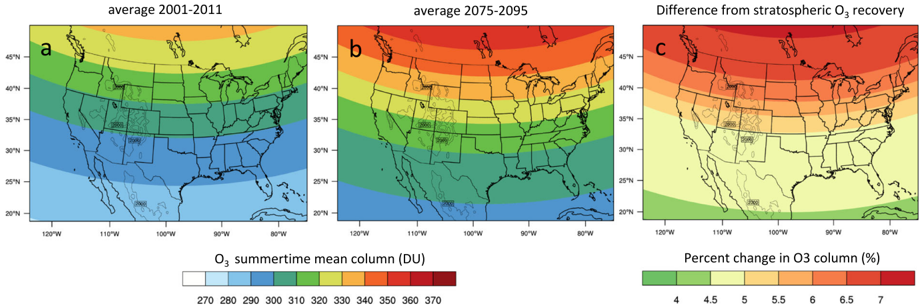
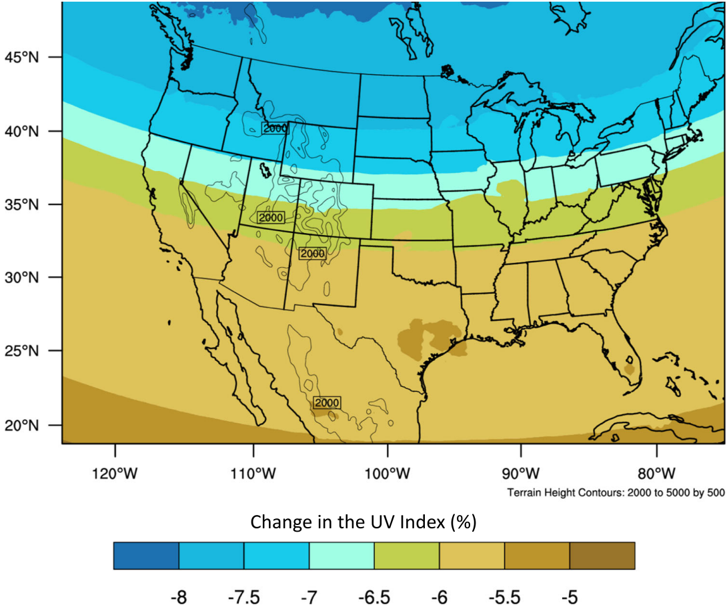
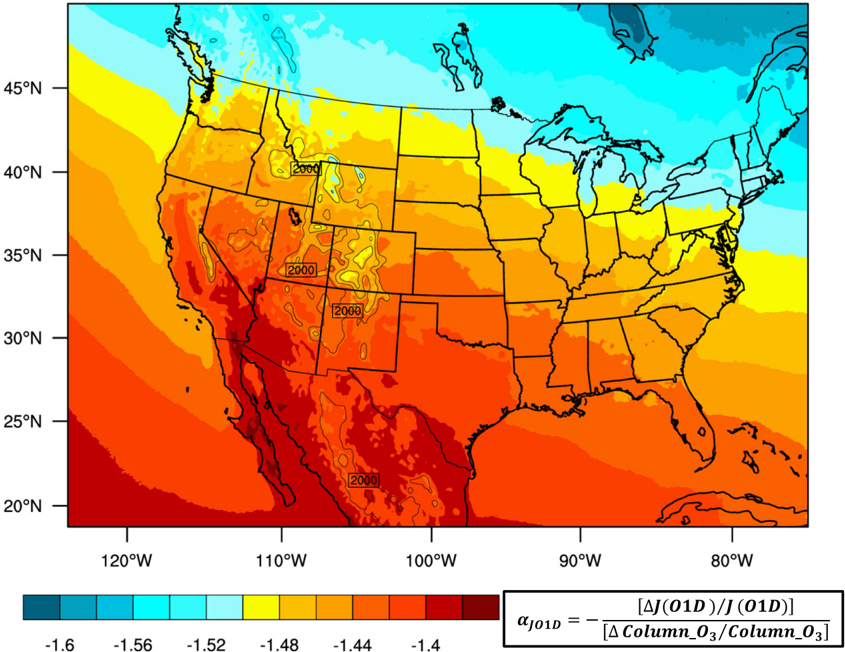
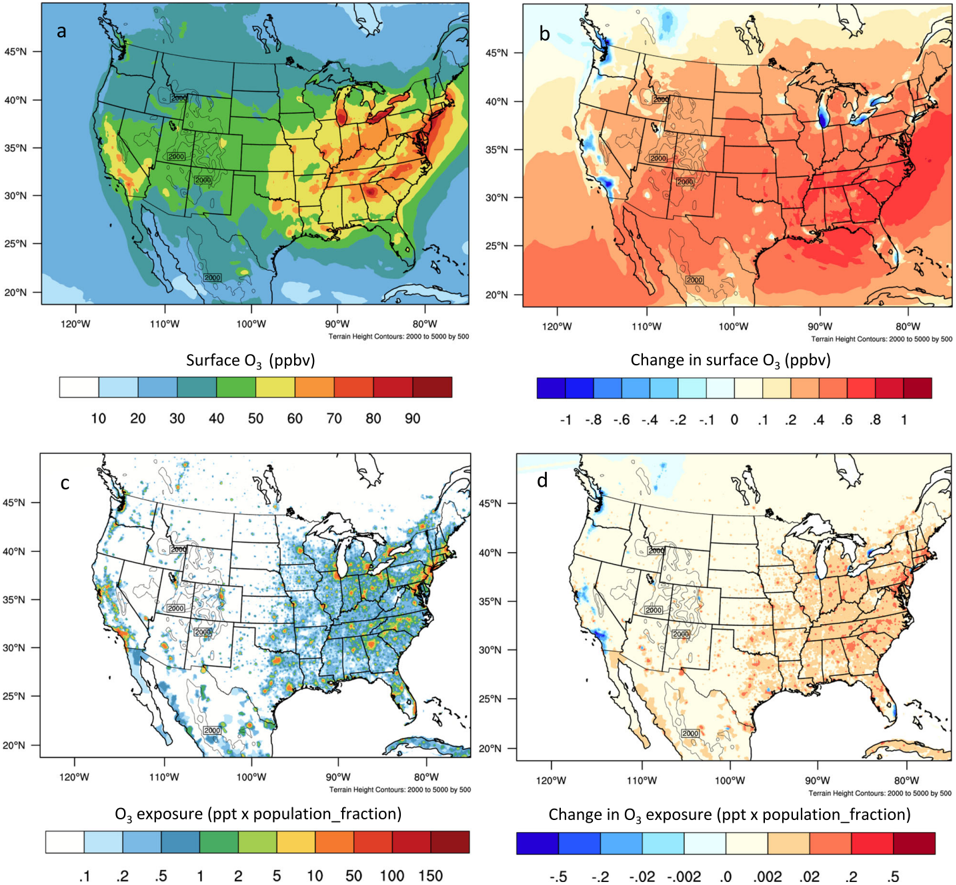
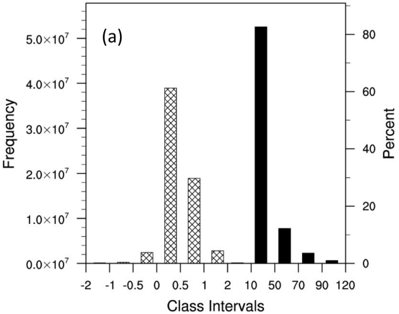
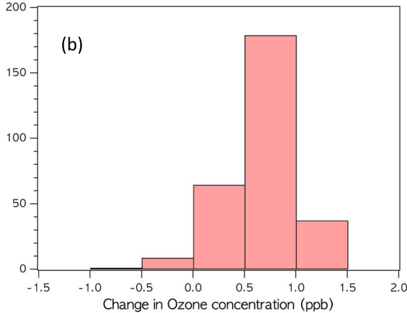
The response of surface ozone concentrations to decreases in ultraviolet (UV) radiation that are expected from the recovery of stratospheric ozone by the end of the twenty-first century is examined with the regional WRF–Chem model. The study is performed over the continental United States for the summer of 2010 at 12 km horizontal resolution which, compared to previous studies, allows a better separation of chemical regimes that exhibit opposite responses to UV radiation changes. Our results show that on the regional scale, surface ozone is expected to increase by 0.5 to 1 ppb due to its slower destruction, while the opposite can be seen in the vicinity of some urban centers where ozone concentrations could decrease by up to 1 ppb due to its slower photochemical production. Geographic overlay with population shows however a relatively small net increase in exposure of ~ 0.4 ppb, with an asymmetric distribution characterized by some disbenefit to the majority of the US population and a benefit to a relatively small fraction (~4%) of population.
Overview
The claims and statistics of this paper haven’t been checked yet.
Free: it reads the open-access text and checks the first 5 claims that cite a source we can check. Create a free account to check every claim.
Integrity signals
Registry
Cites
Statistics
Figures

Verification
Claims the paper makes
The claims and statistics of this paper haven’t been checked yet.
Free: it reads the open-access text and checks the first 5 claims that cite a source we can check. Create a free account to check every claim.
Claims other papers make about this one
Each is checked against this paper’s own text: does it say what the citing paper says it does?
The source backs part of the claim, not all of it — or backs it for a different population, condition or comparison.
In the citing paper
“Under these scenarios, the changes in tropospheric O3 (urban declines and regional increases) would be about three times greater than those estimated for recovery limited to 1980 levels [14, 15].”
From Changes in tropospheric air quality related to the protection of stratospheric ozone in a changing climate (2023) · cites this paper as [15]
Experimental — accuracy not yet measuredThe source backs part of the claim, not all of it — or backs it for a different population, condition or comparison.
In the citing paper
“The recovery of stratospheric O3 to 1980 levels is expected to contribute 1–2 µg m−3 to ground-level O3 outside major urban areas [14, 15, 36]”
From Changes in tropospheric air quality related to the protection of stratospheric ozone in a changing climate (2023) · cites this paper as [15]
Experimental — accuracy not yet measuredThe cited source says what the claim attributes to it.
In the citing paper
“The possibility that ground-level O3 can be affected by changes in UV related to depletion of stratospheric ozone was first pointed out by Liu and Trainer [12] and has since been confirmed by several studies using numerical models [13–17], as well as observations at the South Pole [18] and at mid-latitudes [19].”
From Changes in tropospheric air quality related to the protection of stratospheric ozone in a changing climate (2023) · cites this paper as [15]
In the citing paper
“The decreases in UV radiation at the surface, expected from the recovery of stratospheric O3, to 1980 levels are estimated to have only a small impact on ambient O3, as reported previously [14, 15], since reductions of O3 at mid-latitudes have been limited to only a few percent (relative to a 1980 baseline).”
From Changes in tropospheric air quality related to the protection of stratospheric ozone in a changing climate (2023) · cites this paper as [15]
Self-check
Percentages, sums and reported differences re-computed from the paper’s own numbers.
The self-check needs the paper’s full text.
Citations
Cites
Lim, S. S., Vos, T., Flaxman, A. D., Danaei, G., Shibuya, K., Adair-Rohani, H., AlMazroa, M. A., Amann, M., Anderson, H. R., Andrews, K. G., et al. (2012) · The Lancet · doi:10.1016/s0140-6736(12)61766-8 · Cited by 11,805
Iacono, M. J., Delamere, J. S., Mlawer, E. J., Shephard, M. W., Clough, S. A., & Collins, W. D. (2008) · Journal of Geophysical Research: Atmospheres · doi:10.1029/2008jd009944 · Cited by 5,738
Guenther, A., Karl, T., Harley, P., Wiedinmyer, C., Palmer, P. I., & Geron, C. (2006) · Atmospheric Chemistry and Physics · doi:10.5194/acp-6-3181-2006 · Cited by 4,603
Morrison, H., Thompson, G., & Tatarskii, V. (2009) · Monthly Weather Review · doi:10.1175/2008mwr2556.1 · Cited by 2,438
Chemistry of the Upper and Lower Atmosphere
(2000) · Elsevier eBooks · doi:10.1016/b978-0-12-257060-5.x5000-x · Cited by 1,796
Nonsingular implementation of the Mellor-Yamada level 2.5 scheme in the NCEP Meso model
Janić, Z. I. (2001) · Cited by 1,650
Grell, G. A., & Freitas, S. R. (2014) · Atmospheric Chemistry and Physics · doi:10.5194/acp-14-5233-2014 · Cited by 1,217
Does Increasing Horizontal Resolution Produce More Skillful Forecasts?
Mass, C. F., Ovens, D., Westrick, K., & Colle, B. A. (2002) · Bulletin of the American Meteorological Society · doi:10.1175/1520-0477(2002)083<0407:dihrpm>2.3.co;2 · Cited by 731
Threat to future global food security from climate change and ozone air pollution
Tai, A. P. K., Martin, M. V., & Heald, C. L. (2014) · Nature Climate Change · doi:10.1038/nclimate2317 · Cited by 633
Ozone depletion and climate change: impacts on UV radiation
McKenzie, R. L., Aucamp, P. J., Bais, A. F., Björn, L. O., Ilyas, M., & Madronich, S. (2011) · Photochemical & Photobiological Sciences · doi:10.1039/c0pp90034f · Cited by 609
Self-citationWhy do models overestimate surface ozone in the Southeast United States?
Travis, K. R., Jacob, D. J., Fisher, J. A., Kim, P. S., Marais, E. A., Zhu, L., Yu, K., Miller, C. C., Yantosca, R. M., Sulprizio, M. P., et al. (2016) · Atmospheric Chemistry and Physics · doi:10.5194/acp-16-13561-2016 · Cited by 470
Review of the global models used within phase 1 of the Chemistry–Climate Model Initiative (CCMI)
Morgenstern, O., Hegglin, M. I., Rozanov, E., O'Connor, F. M., Abraham, N. L., Akiyoshi, H., Archibald, A. T., Bekki, S., Butchart, N., Chipperfield, M. P., et al. (2017) · Geoscientific Model Development · doi:10.5194/gmd-10-639-2017 · Cited by 401
Ozone depletion and climate change: impacts on UV radiation
Bais, A. F., McKenzie, R. L., Bernhard, G., Aucamp, P. J., Ilyas, M., Madronich, S., & Tourpali, K. (2014) · Photochemical & Photobiological Sciences · doi:10.1039/c4pp90032d · Cited by 326
Self-citationSimulation of semi-explicit mechanisms of SOA formation from glyoxal in aerosol in a 3-D model
Knote, C., Hodzic, A., Jimenez, J. L., Volkamer, R., Orlando, J. J., Baidar, S., Brioude, J., Fast, J., Gentner, D. R., Goldstein, A. H., et al. (2014) · Atmospheric Chemistry and Physics · doi:10.5194/acp-14-6213-2014 · Cited by 250
Im, U., Bianconi, R., Solazzo, E., Kioutsioukis, I., Badia, A., Balzarini, A., Baró, R., Bellasio, R., Brunner, D., Chemel, C., et al. (2015) · Atmospheric Environment · doi:10.1016/j.atmosenv.2014.09.042 · Cited by 246
Ozone Formation in Photochemical Oxidation of Organic Substances
Haagen-Smit, A. J., & Fox, M. M. (1956) · Industrial & Engineering Chemistry · doi:10.1021/ie51400a033 · Cited by 221 · cited 1×
“Ground-level ozone (O3) is one product of this chemistry, formed when mixtures of nitrogen oxides (NOX) and volatile organic compounds (VOCs) are exposed to solar UV radiation.(1,2) The health effects from exposure to ozone are widely recognized(3,4) and have led to regulation that improved air quality in some locatio…”
BackgroundAir quality progress in North American megacities: A review
Parrish, D. D., Singh, H. B., Molina, L., & Madronich, S. (2011) · Atmospheric Environment · doi:10.1016/j.atmosenv.2011.09.039 · Cited by 214
Self-citationRECENT CHANGES IN FROST DAYS AND THE FROST-FREE SEASON IN THE UNITED STATES
Easterling, D. R. (2002) · Bulletin of the American Meteorological Society · doi:10.1175/1520-0477-83.9.1327 · Cited by 202
Ozone Formation in Photochemical Oxidation of Organic Substances
Haagen-Smit, A. J., Bradley, C. E., & Fox, M. M. (1953) · Industrial & Engineering Chemistry · doi:10.1021/ie50525a044 · Cited by 187
Noah land surface model modifications to improve snowpack prediction in the Colorado Rocky Mountains
Barlage, M., Chen, F., Tewari, M., Ikeda, K., Gochis, D., Dudhia, J., Rasmussen, R., Livneh, B., Ek, M., & Mitchell, K. (2010) · Journal of Geophysical Research: Atmospheres · doi:10.1029/2009jd013470 · Cited by 168
Sensitivity of surface ozone over China to 2000–2050 global changes of climate and emissions
Wang, Y., Shen, L., Wu, S., Mickley, L. J., He, J., & Hao, J. (2013) · Atmospheric Environment · doi:10.1016/j.atmosenv.2013.04.045 · Cited by 157
Human exposure to ultraviolet radiation.
Diffey, B. L. (1990) · PubMed · Cited by 127
Production of O(¹D) from photolysis of O3
Michelsen, H. A., Salawitch, R. J., Wennberg, P. O., & Anderson, J. G. (1994) · Geophysical Research Letters · doi:10.1029/94gl02052 · Cited by 118
Tie, X., Brasseur, G. P., & Ying, Z. (2010) · Atmospheric chemistry and physics · doi:10.5194/acp-10-8983-2010 · Cited by 115
Madronich, S., & Granier, C. (1992) · Geophysical Research Letters · doi:10.1029/92gl00378 · Cited by 112
Self-citationOzone and NO x chemistry in the eastern US: evaluation of CMAQ/CB05 with satellite (OMI) data
Canty, T. P., Hembeck, L., Vinciguerra, T., Anderson, D. C., Goldberg, D. L., Carpenter, S. F., Allen, D. J., Loughner, C. P., Salawitch, R. J., & Dickerson, R. R. (2015) · Atmospheric chemistry and physics · doi:10.5194/acp-15-10965-2015 · Cited by 110
Shen, L., Mickley, L. J., & Tai, A. P. K. (2015) · Atmospheric Chemistry and Physics · doi:10.5194/acp-15-10925-2015 · Cited by 108
Isoprene emission from a subarctic peatland under enhanced UV‐B radiation
Tiiva, P., Rinnan, R., Faubert, P., Räsänen, J., Holopainen, T., Kyrö, E., & Holopainen, J. K. (2007) · New Phytologist · doi:10.1111/j.1469-8137.2007.02164.x · Cited by 104
Sensitivity of tropospheric oxidants to global chemical and climate change
Thompson, A. M., Stewart, R. W., Owens, M. A., & Herwehe, J. A. (1989) · Atmospheric Environment (1967) · doi:10.1016/0004-6981(89)90001-2 · Cited by 102
Impact of stratospheric ozone recovery on tropospheric ozone and its budget
Zeng, G., Morgenstern, O., Braesicke, P., & Pyle, J. A. (2010) · Geophysical Research Letters · doi:10.1029/2010gl042812 · Cited by 93
Responses of the tropospheric ozone and odd hydrogen radicals to column ozone change
Liu, S. C., & Trainer, M. (1988) · Journal of Atmospheric Chemistry · doi:10.1007/bf00053857 · Cited by 92
Shetter, R. E., Cantrell, C. A., Lantz, K., Flocke, S. J., Orlando, J. J., Tyndall, G. S., Gilpin, T. M., Fischer, C. A., Madronich, S., Calvert, J. G., et al. (1996) · Journal of Geophysical Research Atmospheres · doi:10.1029/96jd00211 · Cited by 82
Self-citationFuglestvedt, J. S., Jonson, J. E., & Isaksen, I. S. A. (1994) · Tellus B: Chemical and Physical Meteorology · doi:10.3402/tellusb.v46i3.15790 · Cited by 78
FUGLESTVED, J. S., Jonson, J. E., & Isaksen, I. S. A. (1994) · Tellus B · doi:10.1034/j.1600-0889.1992.t01-3-00001.x-i1 · Cited by 73
Harley, P. C., DEEM, G., Flint, S. D., & Caldwell, M. M. (1996) · Global Change Biology · doi:10.1111/j.1365-2486.1996.tb00060.x · Cited by 68
Ryu, Y., Hodžić, A., Barré, J., Descombes, G., & Minnis, P. (2018) · Atmospheric chemistry and physics · doi:10.5194/acp-18-7509-2018 · Cited by 40
Effects of stratospheric ozone recovery on photochemistry and ozone air quality in the troposphere
Zhang, H., Wu, S., Huang, Y., & Wang, Y. (2014) · Atmospheric Chemistry and Physics · doi:10.5194/acp-14-4079-2014 · Cited by 33
BVOC emission from Populus × canadensis saplings in response to acute UV‐A radiation
Pallozzi, E., Fortunati, A., Marino, G., Loreto, F., Agati, G., & Centritto, M. (2012) · Physiologia Plantarum · doi:10.1111/j.1399-3054.2012.01687.x · Cited by 18
Research works printed but not linked: 3
- NRC, National Research Council. Rethinking the Ozone Problem in Urban and Regional Air Pollution (The National Academies Press, Washington, 1991).
- WMO, Assessment for Decision-Makers, Scientific Assessment of Ozone Depletion: 2014, World Meteorological Organization and United Nations Environment Pro- gramme, WMO Global Ozone Research and Monitoring Project-Report No. 56 (Geneva, preprint for public release, 2014).
- Granier, C. & Shine, K. P. Chapter 10: Climate effects of ozone and haolcarbon changes, in Scientific Assessment of Ozone Depletion, 1998, WMO Global Ozone Research and Monitoring Project-Report 44 (Geneva, 1999).
Cited by
The Whole Atmosphere Community Climate Model Version 6 (WACCM6)
Gettelman, A., Mills, M. J., Kinnison, D. E., Garcia, R. R., Smith, A. K., Marsh, D. R., Tilmes, S., Vitt, F., Bardeen, C. G., McInerny, J., et al. (2019) · Journal of Geophysical Research: Atmospheres · doi:10.1029/2019jd030943 · Cited by 786
Ozone depletion, ultraviolet radiation, climate change and prospects for a sustainable future
Barnes, P. W., Williamson, C. E., Lucas, R. M., Robinson, S. A., Madronich, S., Paul, N. D., Bornman, J. F., Bais, A. F., Sulzberger, B., Wilson, S. R., et al. (2019) · Nature Sustainability · doi:10.1038/s41893-019-0314-2 · Cited by 360
Self-citationWilson, S. R., Madronich, S., Longstreth, J. D., & Solomon, K. R. (2019) · Photochemical & Photobiological Sciences · doi:10.1039/c8pp90064g · Cited by 68
Self-citationMadronich, S., Sulzberger, B., Longstreth, J. D., Schikowski, T., Andersen, M. P. S., Solomon, K. R., & Wilson, S. R. (2023) · Photochemical & Photobiological Sciences · doi:10.1007/s43630-023-00369-6 · Cited by 64
“Under these scenarios, the changes in tropospheric O3 (urban declines and regional increases) would be about three times greater than those estimated for recovery limited to 1980 levels [14, 15].”
BackgroundSelf-citationMao, J., Yan, F., Zheng, L., You, Y., Wang, W., Jia, S., Liao, W., Wang, X., & Chen, W. (2021) · The Science of The Total Environment · doi:10.1016/j.scitotenv.2021.151883 · Cited by 45
Metadata
- Authors
- Hodzic, A., & Madronich, S.
- Affiliations
- NSF National Center for Atmospheric Research (US)
- ORCID
- Madronich, S.
- Venue
- npj Climate and Atmospheric Science
- Published
- 2018-10-04
- Volume
- 1
- Issue
- 1
- ISSN
- 2397-3722 (ISSN-L)
- OpenAlex
- W2894218444
- Cited by
- 16
- References
- 37
- Citations by year
- 2026: 1 · 2025: 2 · 2023: 2 · 2022: 3 · 2021: 2 · 2020: 2 · 2019: 3 · 2018: 1
- FWCI
- 0.97
- Type
- journal article
- Language
- en
- Open access
- gold
- doi.org
- Licence
- cc-by
- creativecommons.org/licenses/by/4.0 (tdm)
- creativecommons.org/licenses/by/4.0 (vor)
- Locations
- npj Climate and Atmospheric Science (publishedVersion, cc-by)
- DOAJ (DOAJ: Directory of Open Access Journals) (submittedVersion)
- Funders
- National Aeronautics and Space Administration (NASA NNX15AE38G)
- Topics
- Physical Sciences › Earth and Planetary Sciences › Atmospheric Science › Atmospheric Ozone and Climate
- Physical Sciences › Earth and Planetary Sciences › Atmospheric Science › Atmospheric chemistry and aerosols
- Physical Sciences › Environmental Science › Global and Planetary Change › Atmospheric aerosols and clouds
- Keywords
- surface ozone, ultraviolet radiation, stratospheric ozone recovery, photochemical ozone formation, ozone degradation, urban ozone, population exposure, continental United States, WRF-Chem
About these checks
Registry, retraction, Cites and statistics results are computed, not judged, with one exception: a printed reference that no index lists is read once by a model before it counts as a citation error. Claims are extracted by a model and kept only when their quote appears verbatim in the text; each cited source is then checked, with a model’s help, for whether it says what the claim relies on. Those verdicts can be wrong — read the claim’s quote and the cited source before relying on one.
Statistics and arithmetic are recomputed, not judged.
Confidence bands are shown only for fields calibrated on our annotated test set. None is calibrated yet, so no band is shown.
What counts as a claim ›How we measure confidence ›How we check this ›
Are you an author, or do you see a problem with this page? Request a review
Data sources
Bibliographic data: Semantic Scholar, OpenAlex, Crossref.
Contains information from the Semantic Scholar Academic Graph Datasets, made available under the ODC Attribution License (ODC-BY 1.0).
Semantic Scholar’s data is described in: Kinney, R., et al. (2023). The Semantic Scholar Open Data Platform. arXiv:2301.10140.
