

Exploiting convergent phenotypes to derive a pan-cancer cisplatin response gene expression signature
Open accessPublished version of a preprint
The DOI matches its Crossref record; 47 of the 47 references it cites were found in a registry or an index; 24 of the 34 sources its claims cite were checked for support.
Abstract
Precision medicine offers remarkable potential for the treatment of cancer, but is largely focused on tumors that harbor actionable mutations. Gene expression signatures can expand the scope of precision medicine by predicting response to traditional (cytotoxic) chemotherapy agents without relying on changes in mutational status. We present a new signature extraction method, inspired by the principle of convergent phenotypes, which states that tumors with disparate genetic backgrounds may evolve similar phenotypes independently. This evolutionary-informed method can be utilized to produce consensus signatures predictive of response to over 200 chemotherapeutic drugs found in the Genomics of Drug Sensitivity in Cancer (GDSC) Database. Here, we demonstrate its use by extracting the Cisplatin Response Signature (CisSig). We show that this signature can predict cisplatin response within carcinoma-based cell lines from the GDSC database, and expression of the signatures aligns with clinical trends seen in independent datasets of tumor samples from The Cancer Genome Atlas (TCGA) and Total Cancer Care (TCC) database. Finally, we demonstrate preliminary validation of CisSig for use in muscle-invasive bladder cancer, predicting overall survival in a small cohort of patients who undergo cisplatin-containing chemotherapy. This methodology can be used to produce robust signatures that, with further clinical validation, may be used for the prediction of traditional chemotherapeutic response, dramatically increasing the reach of personalized medicine in cancer.
Overview
CoChat Summary
## TL;DR
The paper derives CisSig, a 19-gene cisplatin response expression signature, by combining differential expression in 429 epithelial cancer cell lines from GDSC with co-expression filtering in TCGA tumor/normal data. CisSig predicts cisplatin sensitivity in GDSC, aligns with cisplatin use patterns across TCGA and Total Cancer Care, and shows preliminary survival stratification in two muscle-invasive bladder cancer cohorts.
## Key findings
- CisSig was derived from 429 epithelial-based cancer cell lines in GDSC; the authors used five 20% data partitions (each with 343 or 344 cell lines) to find genes consistent across folds.
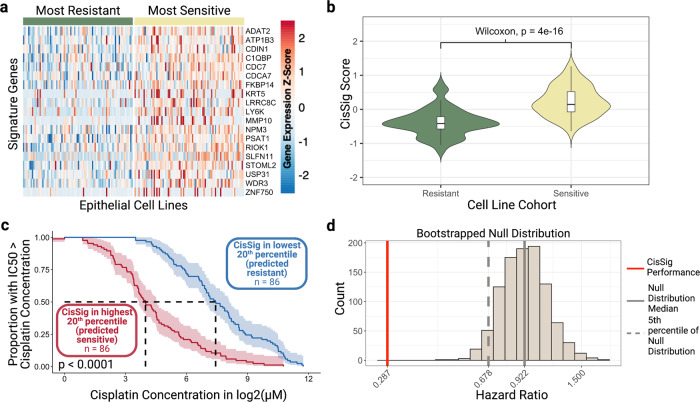
- In GDSC, the median CisSig score was higher in cisplatin-sensitive than resistant cell lines; for the “Cell Line Persistence Curve,” the median IC50 was 3.98 log2(µM) in the high-CisSig cohort versus 7.93 log2(µM) in the low-CisSig cohort.
- CisSig was not strongly associated with common DNA damage response mutation status: among 16 genes examined, only PTEN showed a significant relationship with CisSig score after multiple-testing correction (p = 0.042).
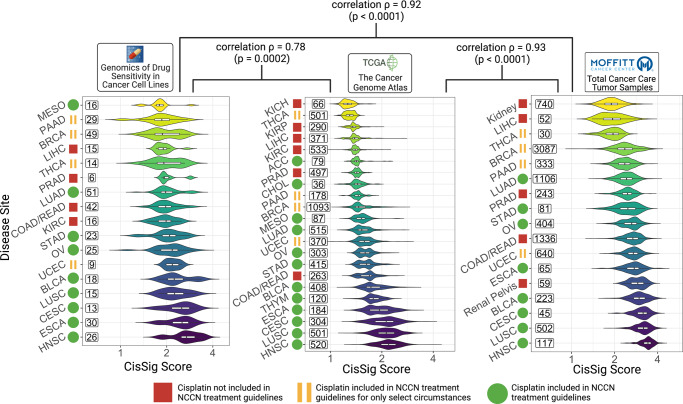
- Disease-site ranking by CisSig was concordant across datasets: Spearman’s r was 0.78 for GDSC vs TCGA, 0.92 for GDSC vs TCC, and 0.93 for TCGA vs TCC; higher CisSig generally aligned with disease sites where cisplatin appears in NCCN guidelines.
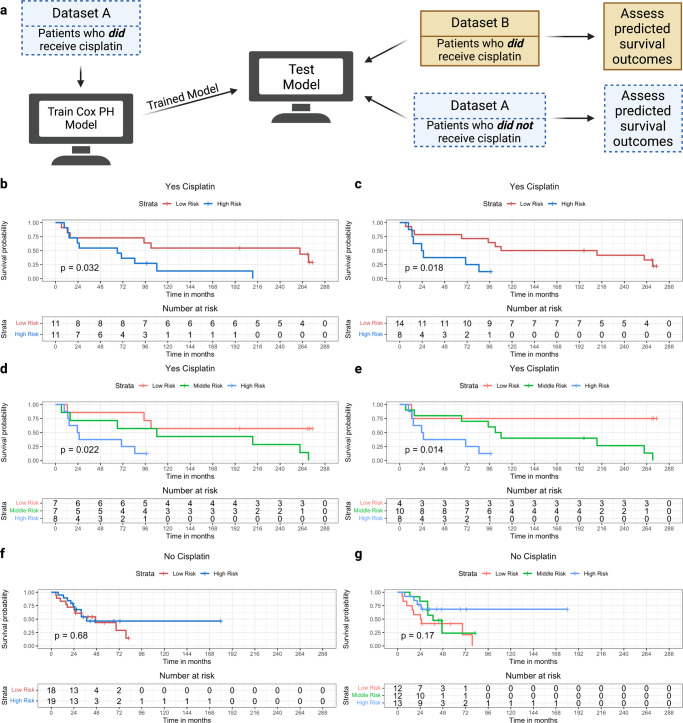
- In MIBC, a CisSig-trained Cox model separated patients receiving cisplatin-containing chemotherapy into worse- vs better-survival groups, but the paper describes this as preliminary validation in a small cohort.
## Methods
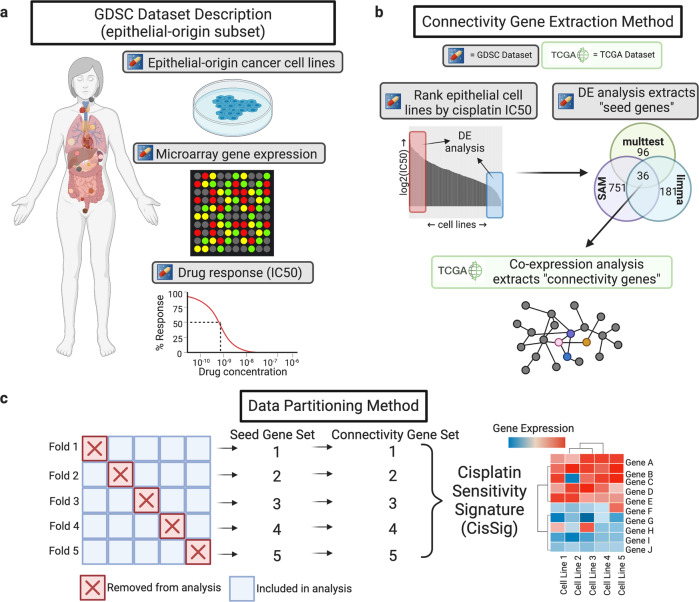
- The signature was built from GDSC microarray expression and cisplatin response data, using differential expression between the top and bottom 20% of IC50 responders with SAM, limma, and multtest, then intersecting genes upregulated in sensitive lines across all three methods.
- The seed genes were refined with co-expression analysis in TCGA epithelial tumor/normal RNA-seq data; genes in the top 5% of affinity scores contributed to connectivity, and the final CisSig included genes present in at least 3 of 5 partitions.
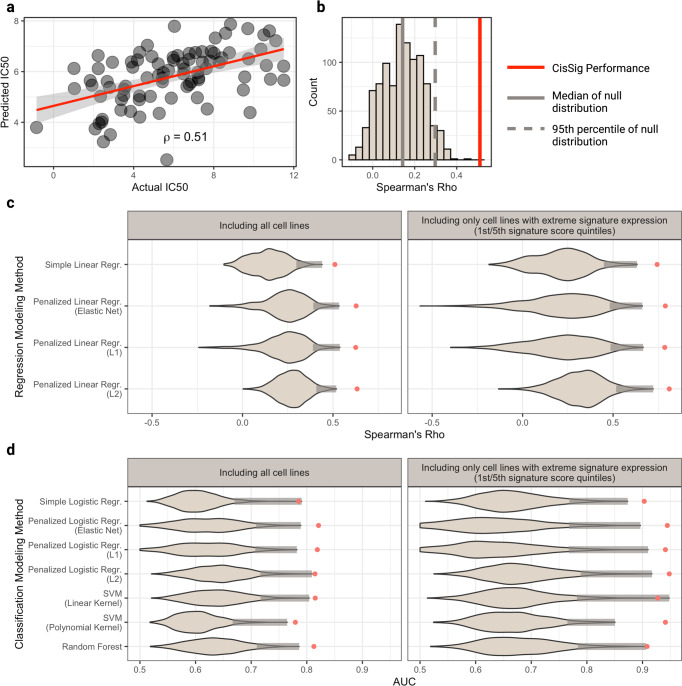
- Performance was tested with five-fold cross-validation in GDSC using simple and penalized regression, SVM, random forest, and survival-style “cell line persistence” analyses; external checks used TCGA, TCC, and two MIBC datasets.
## Limitations
- The authors state that a single tumor sample may not capture intratumoral heterogeneity relevant to drug response.
- They state that although the signature was designed for pan-cancer epithelial tumors, clinical validation must occur within individual disease sites, and site-specific trimming may be needed.
- They explicitly note that the MIBC validation is preliminary because the sample sizes were relatively small, and that complete validation requires additional samples.
- Evident from the text: the clinical survival analysis is limited by the fact that the authors could not always know which patients actually received cisplatin in external datasets, so some validation is based on treatment-assigned subsets and guideline concordance rather than direct, uniformly annotated response data.
Model-written summary. Check it against the paper before relying on it.
Integrity signals
Registry
Cites
Statistics
Figures
Verification
Claims the paper makes
11 Valid · 2 Not valid · 3 Not checked · 62 Own results and interpretations
The cited sources support only part of this claim — read each source’s verdict below.
In the paper
“Yet, unlike with cell lines, high throughput characterization of drug response (i.e., IC50, AUC, etc.) in clinical tumor samples is not feasible29.”
§ Exploiting convergent phenotypes to derive a pan-cancer cisplatin response gene expression signature > Discussion
What the sources say
- Partly supportedcites [29] Azuaje F Computational models for predicting drug responses in cancer research Brief. Bioinforma. 2017 18 820 829 PMC5862310 27444372 sourceExperimental — accuracy not yet measured
The Public data resources section describes large-scale drug-sensitivity testing in cell lines, and Oncology application domains contrasts IC50 values in cell lines with disease-control categories in patients. It does not state that high-throughput IC50 or AUC characterization of clinical tumor samples is infeasible; that categorical part of the claim goes beyond the source. (LLM, conf=0.82)
plain- Asserted: passes — The authors put it forward as true.
- Checkable: passes — It can be checked against evidence.
- Load-bearing: passes — The paper’s conclusions depend on it.
- Based: passes — The paper gives a reason why it holds.
- Partly supported
The cited sources support only part of this claim — read each source’s verdict below.
In the paper
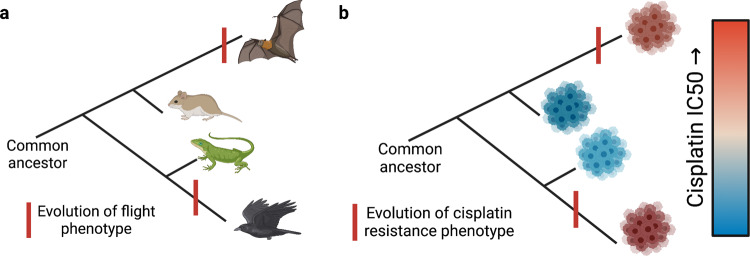
“As seen in experimental and natural evolution, a variety of evolutionary trajectories can lead to the same phenotype11–14.”
§ Exploiting convergent phenotypes to derive a pan-cancer cisplatin response gene expression signature > Introduction
What the sources say
- Supportedcites [11] Nichol D Antibiotic collateral sensitivity is contingent on the repeatability of evolution Nat. Commun. 2019 10 1 10 10.1038/s41467-018-08098-6 30659188 PMC6338734 source
The Introduction (page unavailable) says the paper demonstrates multiple trajectories in experimental E. coli evolution and links different mutations to those trajectories. It also describes multiple evolutionary trajectories to drug resistance, supporting the claim that different paths can produce the same resistance phenotype. (LLM, conf=0.88)
- Partly supportedcites [12] Scarborough JA Identifying states of collateral sensitivity during the evolution of therapeutic resistance in Ewing’s sarcoma Iscience 2020 23 101293 10.1016/j.isci.2020.101293 32623338 PMC7334607 sourceExperimental — accuracy not yet measured
The Results (‘Surveying the Stochasticity of Evolution’; page unavailable) report that experimental replicates consistently acquired resistance to some drugs while diverging in their responses to others. This is consistent with different evolutionary outcomes accompanying a shared resistance phenotype, but the paper does not establish that distinct trajectories produced that same phenotype in natural evolution. (LLM, conf=0.78)
- Could not verifycites [13] Dhawan A Collateral sensitivity networks reveal evolutionary instability and novel treatment strategies in ALK mutated non-small cell lung cancer Sci. Rep. 2017 7 1 9 10.1038/s41598-017-00791-8 28450729 PMC5430816 sourceExperimental — accuracy not yet measured
The Introduction discusses stochastic evolution of drug resistance and variation in phenotypes, but does not say that different evolutionary trajectories lead to the same phenotype. The Discussion says that testing the repeatability of resistance patterns would require multiple biological replicates. Searches for evolutionary trajectories and phenotype found no passage establishing the attributed claim. (LLM, conf=0.70)
- Not checked yetcites [14] Blount ZD Lenski RE Losos JB Contingency and determinism in evolution: replaying life’s tape Science 2018 362 eaam5979 10.1126/science.aam5979 30409860 source
Checked before — its earlier verdict is held back until a new check runs.
plainstates a cause- Asserted: passes — The authors put it forward as true.
- Checkable: passes — It can be checked against evidence.
- Load-bearing: passes — The paper’s conclusions depend on it.
- Based: passes — The paper gives a reason why it holds.
- Supported
The cited sources support only part of this claim — read each source’s verdict below.
In the paper
“In a 2019 manuscript by Mucaki et al., the authors produce a cisplatin response signature from breast cancer cell lines in the GDSC dataset; however, their approach only includes genes with a known relationship to cisplatin response (none of which overlap with the genes in CisSig)16. Therefore, their final cisplatin response signature does not contain any CisSig genes.”
§ Exploiting convergent phenotypes to derive a pan-cancer cisplatin response gene expression signature > Discussion
What the sources say
- Partly supportedcites [16] Mucaki EJ Zhao JZ Lizotte DJ Rogan PK Predicting responses to platin chemotherapy agents with biochemically-inspired machine learning Signal Transduct. Target. Ther. 2019 4 1 12 10.1038/s41392-018-0034-5 30652029 PMC6329797 sourceExperimental — accuracy not yet measured
The Results (Selection of platin drug-related genes; page unavailable) and Materials and methods (Data and preprocessing; page unavailable) support that Mucaki et al. developed cisplatin signatures from breast cancer cell lines, starting with genes previously associated with drug response. The paper identifies its GDSC cell lines as bladder, not breast, and does not discuss CisSig or establish that its signatures have no CisSig genes. (LLM, conf=0.86)
plain- Asserted: passes — The authors put it forward as true.
- Checkable: passes — It can be checked against evidence.
- Load-bearing: unclear — It is unclear whether the paper’s conclusions depend on it.
- Based: passes — The paper gives a reason why it holds.
- Partly supported
The cited sources support only part of this claim — read each source’s verdict below.
In the paper
“Another cisplatin response signature, extracted from 26 head and neck cancer patients with complete clinical response or non-response to cisplatin and 5-FU contains 10 genes that do not overlap with CisSig34.”
§ Exploiting convergent phenotypes to derive a pan-cancer cisplatin response gene expression signature > Discussion
What the sources say
- Partly supportedcites [34] Tomkiewicz C A head and neck cancer tumor response-specific gene signature for cisplatin, 5-fluorouracil induction chemotherapy fails with added taxanes PLoS One 2012 7 e47170 10.1371/journal.pone.0047170 23056603 PMC3467249 sourceExperimental — accuracy not yet measured
The Results section, “A Gene Signature for Response to Cisplatin/5-fluorouracil Induction” (page not provided), reports a ten-gene signature derived from biopsies of 23 patients treated with cisplatin and 5-FU, not 26. It distinguishes complete clinical responders from non-responders. Our copy does not address whether those genes overlap with CisSig. (LLM, conf=0.89)
plain- Asserted: passes — The authors put it forward as true.
- Checkable: passes — It can be checked against evidence.
- Load-bearing: unclear — It is unclear whether the paper’s conclusions depend on it.
- Based: passes — The paper gives a reason why it holds.
- Partly supported
The cited sources support only part of this claim — read each source’s verdict below.
In the paper
“Fitting models to all dose–response series leads to improved robustness for more accurate IC50 and AUC estimates.”
§ Exploiting convergent phenotypes to derive a pan-cancer cisplatin response gene expression signature > Methods > GDSC drug response data
What the sources say
- Partly supportedcites [38] Vis DJ Multilevel models improve precision and speed of IC50 estimates Pharmacogenomics 2016 17 691 700 10.2217/pgs.16.15 27180993 PMC6455999 sourceExperimental — accuracy not yet measured
The Introduction and Discussion say that fitting dose-response curves together borrows information across the screen, reduces extreme estimates, and improves the accuracy of IC50 estimates. The Results section (“Concordance and precision”; page not available) reports that AUC estimates correlate well with those from a Bayesian model, but does not establish that this approach makes AUC estimates more accurate. (LLM, conf=0.84)
plainstates a cause- Asserted: passes — The authors put it forward as true.
- Checkable: passes — It can be checked against evidence.
- Load-bearing: passes — The paper’s conclusions depend on it.
- Based: passes — The paper gives a reason why it holds.
- Partly supported
42 more claims
Create a free account to see all 78 claims and to verify the 3 references still open.
- Probably not a substantial claim. 23
- It may state two separate claims as one. 12
- The quote only partly states this claim. 1
Self-check
Percentages, sums and reported differences re-computed from the paper’s own numbers.
Each contradiction between two passages listed here was confirmed by an independent check.
Rated minor: it would not touch a result — a value no result rests on, a p-value that stays on the same side of the significance level, or a conflict that is clerical, resolved elsewhere in the paper, or outside its own findings.
In the paper
§ Exploiting convergent phenotypes to derive a pan-cancer cisplatin response gene expression signature > Results > CisSig Score is not related to status of most common DNA damage response genes
“In Supplementary Fig. 4, we show a heatmap of mutation status for 16 genes across all epithelial-based cell lines in the GDSC dataset.”
§ Exploiting convergent phenotypes to derive a pan-cancer cisplatin response gene expression signature > Methods > Comparing mutation status and CisSig score
“For each of the 17 DNA damage response genes shown in Supplementary Fig. 4, a chi-square test compared the presence of a mutation in cell lines with high or low CisSig score.”
Citations
Cites
limma powers differential expression analyses for RNA-sequencing and microarray studies
Ritchie, M. E., Phipson, B., Wu, D., Hu, Y., Law, C. W., Shi, W., & Smyth, G. K. (2015) · Nucleic Acids Research · doi:10.1093/nar/gkv007 · Cited by 40,458 · cited 1×
“With no pre-fi ltering of genes, differential gene expression (DE) analysis using limma 23 , SAM 24 , and multtest 25 methods was performed between the top and bottom 20% of responders (i.e., cell lines with the highest and lowest 20% of IC50 values).”
In silico prediction of protein-protein interactions in human macrophages
Souiai, O., Guerfali, F., Ben Miled, S., Brun, C., & Benkahla, A. (2014) · BMC Research Notes · doi:10.1186/1756-0500-7-157 · Cited by 10,803
Exploration, normalization, and summaries of high density oligonucleotide array probe level data
Irizarry, R. A. (2003) · Biostatistics · doi:10.1093/biostatistics/4.2.249 · Cited by 10,603
Significance analysis of microarrays applied to the ionizing radiation response
Tusher, V. G., Tibshirani, R., & Chu, G. (2001) · Proceedings of the National Academy of Sciences · doi:10.1073/pnas.091062498 · Cited by 10,568
Yang, W., Soares, J., Greninger, P., Edelman, E. J., Lightfoot, H., Forbes, S., Bindal, N., Beare, D., Smith, J. A., Thompson, I. R., et al. (2012) · Nucleic Acids Research · doi:10.1093/nar/gks1111 · Cited by 4,051
Lung cancer: current therapies and new targeted treatments
Hirsch, F. R., Scagliotti, G. V., Mulshine, J. L., Kwon, R., Curran, W. J., Wu, Y.-L., & Paz-Ares, L. (2017) · The Lancet · doi:10.1016/s0140-6736(16)30958-8 · Cited by 3,283
First-Line Crizotinib versus Chemotherapy in ALK -Positive Lung Cancer
Solomon, B. J., Mok, T., Kim, D.-W., Wu, Y.-L., Nakagawa, K., Mekhail, T., Felip, E., Cappuzzo, F., Paolini, J., Usari, T., et al. (2014) · New England Journal of Medicine · doi:10.1056/nejmoa1408440 · Cited by 3,190 · cited 1×
“Results of the DE analysis for each fold are summarized in Supplementary Table 7, and lists of differentially expressed genes from each method, for each fold can be found in Supplementary Files 1 and 2.”
Adjuvant Chemotherapy Guided by a 21-Gene Expression Assay in Breast Cancer
Sparano, J. A., Gray, R. J., Makower, D. F., Pritchard, K. I., Albain, K. S., Hayes, D. F., Geyer, C. E., Dees, E. C., Goetz, M. P., Olson, J. A., et al. (2018) · New England Journal of Medicine · doi:10.1056/nejmoa1804710 · Cited by 2,397 · cited 2×
“De fi ned as a set of genes (typically fewer than 100) whose expression covaries with a particular trait, certain gene expression signatures have already been incorporated into standard-of-care and clinical decision-making algorithms (e.g., OncotypeDx 5 , Mammaprint 6 ).”
A Landscape of Pharmacogenomic Interactions in Cancer
Iorio, F., Knijnenburg, T. A., Vis, D. J., Bignell, G. R., Menden, M. P., Schubert, M., Aben, N., Gonçalves, E., Barthorpe, S., Lightfoot, H., et al. (2016) · Cell · doi:10.1016/j.cell.2016.06.017 · Cited by 2,090
Contingency and determinism in evolution: Replaying life’s tape
Blount, Z. D., Lenski, R. E., & Losos, J. B. (2018) · Science · doi:10.1126/science.aam5979 · Cited by 590 · cited 1×
“As seen in experimental and natural evolution, a variety of evolutionary trajectories can lead to the same phenotype 11 – 14 .”
Most Random Gene Expression Signatures Are Significantly Associated with Breast Cancer Outcome
Venet, D., Dumont, J. E., & Detours, V. (2011) · PLoS Computational Biology · doi:10.1371/journal.pcbi.1002240 · Cited by 586 · cited 1×
“Created with BioRender.com. survival outcomes than random gene signatures of the same length 28 .”
Buffa, F. M., Harris, A. L., West, C. M., & Miller, C. J. (2010) · British Journal of Cancer · doi:10.1038/sj.bjc.6605450 · Cited by 556 · cited 1×
“This work employs a seed gene approach, inspired by Buffa et al., where previously identi fi ed hypoxia-regulated genes became seeds in a co-expression network, and highly connected genes formed a hypoxia metagene (gene signature) 20 .”
InfluentialA genome-based model for adjusting radiotherapy dose (GARD): a retrospective, cohort-based study
Scott, J. G., Berglund, A., Schell, M. J., Mihaylov, I., Fulp, W. J., Yue, B., Welsh, E., Caudell, J. J., Ahmed, K., Strom, T. S., et al. (2017) · The Lancet Oncology · doi:10.1016/s1470-2045(16)30648-9 · Cited by 474 · cited 6×
“In addition, signatures of radiosensitivity have been developed and have achieved level 1 evidentiary status for archival tissue 7 – 10 .”
InfluentialSelf-citationThe high price of anticancer drugs: origins, implications, barriers, solutions
Prasad, V., De Jesús, K., & Mailankody, S. (2017) · Nature Reviews Clinical Oncology · doi:10.1038/nrclinonc.2017.31 · Cited by 442 · cited 1×
“These therapies have produced some inspiring successes, extending the lives of patients with targetable mutations by months to years 1 – 3 .”
Inducing and exploiting vulnerabilities for the treatment of liver cancer
Wang, C., Vegna, S., Jin, H., Benedict, B., Lieftink, C., Ramirez, C., de Oliveira, R. L., Morris, B., Gadiot, J., Wang, W., et al. (2019) · Nature · doi:10.1038/s41586-019-1607-3 · Cited by 427 · cited 1×
“Furthermore, many of the genes have been denoted as possible therapeutic targets in a variety of epithelial-based cancers, such as CDC7 in oral squamous carcinoma 30 and liver cancer 31 , ATP1B3 in gastric cancer 32 , and FKBP14 in ovarian cancer 33 .”
Eschrich, S. A., Pramana, J., Zhang, H., Zhao, H., Boulware, D., Lee, J.-H., Bloom, G., Rocha-Lima, C., Kelley, S., Calvin, D. P., et al. (2009) · International Journal of Radiation Oncology*Biology*Physics · doi:10.1016/j.ijrobp.2009.06.014 · Cited by 360 · cited 2×
“For both models, the coef fi cients and their standard errors can be found in Supplementary Tables 9 and 10.”
Self-citation(2000) · CrossRef Listing of Deleted DOIs · doi:10.1016/j.ypdi.2015.02.054 · Cited by 353
Barr, M. P., Gray, S. G., Hoffmann, A. C., Hilger, R. A., Thomale, J., O’Flaherty, J. D., Fennell, D. A., Richard, D., O’Leary, J. J., & O’Byrne, K. J. (2020) · PLOS ONE · doi:10.1371/journal.pone.0233739 · Cited by 269
Eustace, A., Mani, N., Span, P. N., Irlam, J. J., Taylor, J., Betts, G. N. J., Denley, H., Miller, C. J., Homer, J. J., Rojas, A. M., et al. (2013) · Clinical Cancer Research · doi:10.1158/1078-0432.ccr-13-0542 · Cited by 240 · cited 1×
“By extracting genes that are highly co-expressed with biologically signi fi cant genes, Buffa et al. produced a robust hypoxia gene signature which was prognostic, even in multivariate analysis and across multiple tissue types 21,22 .”
Multiple Testing Procedures: the multtest Package and Applications to Genomics
Pollard, K. S., Dudoit, S., & van der Laan, M. J. (2005) · Statistics for Biology and Health · doi:10.1007/0-387-29362-0_15 · Cited by 230
Predicting responses to platin chemotherapy agents with biochemically-inspired machine learning
Mucaki, E. J., Zhao, J. Z. L., Lizotte, D. J., & Rogan, P. K. (2019) · Signal Transduction and Targeted Therapy · doi:10.1038/s41392-018-0034-5 · Cited by 200
Antibiotic collateral sensitivity is contingent on the repeatability of evolution
Nichol, D., Rutter, J., Bryant, C., Hujer, A. M., Lek, S., Adams, M. D., Jeavons, P., Anderson, A. R. A., Bonomo, R. A., & Scott, J. G. (2019) · Nature Communications · doi:10.1038/s41467-018-08098-6 · Cited by 174 · cited 1×
“As seen in experimental and natural evolution, a variety of evolutionary trajectories can lead to the same phenotype 11 – 14 .”
Self-citationRTCGAToolbox: A New Tool for Exporting TCGA Firehose Data
Samur, M. K. (2014) · PLoS ONE · doi:10.1371/journal.pone.0106397 · Cited by 161 · cited 1×
“…data RNA-Seq by Expectation Maximization (RSEM) normalized gene expression for epithelial-based cancers and normal tissue was downloaded from The Cancer Genome Atlas (TCGA) database, which was accessed through the Firebrowse database using the ‘ RTCGAToolbox ’ package (version 2.20.0) 39 in R.”
InfluentialScott, J. G., Sedor, G., Ellsworth, P., Scarborough, J. A., Ahmed, K. A., Oliver, D. E., Eschrich, S. A., Kattan, M. W., & Torres-Roca, J. F. (2021) · The Lancet Oncology · doi:10.1016/s1470-2045(21)00347-8 · Cited by 158
Self-citationImplementing Personalized Medicine in a Cancer Center
Fenstermacher, D. A., Wenham, R. M., Rollison, D. E., & Dalton, W. S. (2011) · The Cancer Journal · doi:10.1097/ppo.0b013e318238216e · Cited by 149 · cited 1×
“The Total Cancer Care Dataset is collected by the H. Lee Mof fi tt Cancer Center and Research Institute using protocols described in Fenstermacher et al. 40,41 .”
Kim, H. K., Choi, I. J., Kim, C. G., Kim, H. S., Oshima, A., Michalowski, A., & Green, J. E. (2011) · PLoS ONE · doi:10.1371/journal.pone.0016694 · Cited by 135
Iterative rank-order normalization of gene expression microarray data
Welsh, E. A., Eschrich, S. A., Berglund, A. E., & Fenstermacher, D. A. (2013) · BMC Bioinformatics · doi:10.1186/1471-2105-14-153 · Cited by 134 · cited 1×
“Chips were normalized using iterative rank-order normalization 42 .”
Self-citationYang, L., Taylor, J., Eustace, A., Irlam, J. J., Denley, H., Hoskin, P. J., Alsner, J., Buffa, F. M., Harris, A. L., Choudhury, A., et al. (2017) · Clinical Cancer Research · doi:10.1158/1078-0432.ccr-17-0038 · Cited by 123 · cited 1×
“By extracting genes that are highly co-expressed with biologically signi fi cant genes, Buffa et al. produced a robust hypoxia gene signature which was prognostic, even in multivariate analysis and across multiple tissue types 21,22 .”
Haslam, A., Kim, M. S., & Prasad, V. (2021) · Annals of Oncology · doi:10.1016/j.annonc.2021.04.003 · Cited by 97 · cited 1×
“In fact, it was estimated that in 2020, just 7.04% of cancer patients in the United States could bene fi t from genome-driven care 4 .”
InfluentialTorres-Roca, J. F. (2012) · Personalized Medicine · doi:10.2217/pme.12.55 · Cited by 81 · cited 2×
“For both models, the coef fi cients and their standard errors can be found in Supplementary Tables 9 and 10.”
Self-citationDhawan, A., Nichol, D., Kinose, F., Abazeed, M. E., Marusyk, A., Haura, E. B., & Scott, J. G. (2017) · Scientific Reports · doi:10.1038/s41598-017-00791-8 · Cited by 79
Self-citationBaccarella, A., Williams, C. R., Parrish, J. Z., & Kim, C. C. (2018) · BMC Bioinformatics · doi:10.1186/s12859-018-2445-2 · Cited by 72
Multilevel models Improve precision and Speed of IC 50 Estimates
Vis, D. J., Bombardelli, L., Lightfoot, H., Iorio, F., Garnett, M. J., & Wessels, L. F. (2016) · Pharmacogenomics · doi:10.2217/pgs.16.15 · Cited by 71 · cited 1×
“Additional information regarding dose – response curve fi tting may be found at Vis et al. 38 .”
MammaPrint guides treatment decisions in breast Cancer: results of the IMPACt trial
Soliman, H., Shah, V., Srkalovic, G., Mahtani, R., Levine, E., Mavromatis, B., Srinivasiah, J., Kassar, M., Gabordi, R., Qamar, R., et al. (2020) · BMC Cancer · doi:10.1186/s12885-020-6534-z · Cited by 65 · cited 3×
“De fi ned as a set of genes (typically fewer than 100) whose expression covaries with a particular trait, certain gene expression signatures have already been incorporated into standard-of-care and clinical decision-making algorithms (e.g., OncotypeDx 5 , Mammaprint 6 ).”
Computational models for predicting drug responses in cancer research
Azuaje, F. (2016) · Briefings in Bioinformatics · doi:10.1093/bib/bbw065 · Cited by 59
Li, L., Feng, R., Xu, Q., Zhang, F., Liu, T., Cao, J., & Fei, S. (2017) · Oncotarget · doi:10.18632/oncotarget.20894 · Cited by 41 · cited 1×
“Furthermore, many of the genes have been denoted as possible therapeutic targets in a variety of epithelial-based cancers, such as CDC7 in oral squamous carcinoma 30 and liver cancer 31 , ATP1B3 in gastric cancer 32 , and FKBP14 in ovarian cancer 33 .”
Scarborough, J. A., McClure, E., Anderson, P., Dhawan, A., Durmaz, A., Lessnick, S. L., Hitomi, M., & Scott, J. G. (2020) · iScience · doi:10.1016/j.isci.2020.101293 · Cited by 38
Self-citationGuidelines for using sigQC for systematic evaluation of gene signatures
Dhawan, A., Barberis, A., Cheng, W.-C., Domingo, E., West, C., Maughan, T., Scott, J. G., Harris, A. L., & Buffa, F. M. (2019) · Nature Protocols · doi:10.1038/s41596-019-0136-8 · Cited by 31 · cited 2×
“In order to examine how CisSig compares to the original differential gene expression results and ensure portability to novel datasets, we perform a quality control analysis within the TCGA dataset using the ‘ sigQC ’ R package 26 (Version 0.1.22) with methodology as in Dhawan et al. 27 .”
InfluentialSelf-citationSun, J., Bao, S., Xu, D., Zhang, Y., Su, J., Liu, J., Hao, D., & Zhou, M. (2019) · Cell Death & Disease · doi:10.1038/s41419-019-1874-9 · Cited by 23 · cited 1×
“…its widespread use, it comes as no surprise that prior work has assessed the utility of mutational and transcriptomic signatures in predicting response to this drug; yet, to the best knowledge of these authors, none of these advancements have been translated into routine clinical care 15 – 19 .”
Barr, M. P., Gray, S. G., Hoffmann, A. C., Hilger, R. A., Thomale, J., O’Flaherty, J. D., Fennell, D. A., Richard, D., O’Leary, J. J., & O’Byrne, K. J. (2013) · PLoS ONE · doi:10.1371/journal.pone.0054193 · Cited by 19 · cited 1×
“…its widespread use, it comes as no surprise that prior work has assessed the utility of mutational and transcriptomic signatures in predicting response to this drug; yet, to the best knowledge of these authors, none of these advancements have been translated into routine clinical care 15 – 19 .”
Jin, S., Ma, H., Yang, W., Ju, H., Wang, L., & Zhang, Z. (2018) · Journal of Molecular Medicine · doi:10.1007/s00109-018-1636-7 · Cited by 18 · cited 1×
“Furthermore, many of the genes have been denoted as possible therapeutic targets in a variety of epithelial-based cancers, such as CDC7 in oral squamous carcinoma 30 and liver cancer 31 , ATP1B3 in gastric cancer 32 , and FKBP14 in ovarian cancer 33 .”
RNAi-Mediated Downregulation of FKBP14 Suppresses the Growth of Human Ovarian Cancer Cells
Lu, M., Miao, Y., Qi, L., Bai, M., Zhang, J., & Feng, Y. (2016) · Oncology Research Featuring Preclinical and Clinical Cancer Therapeutics · doi:10.3727/096504016x14549667333963 · Cited by 15 · cited 1×
“Furthermore, many of the genes have been denoted as possible therapeutic targets in a variety of epithelial-based cancers, such as CDC7 in oral squamous carcinoma 30 and liver cancer 31 , ATP1B3 in gastric cancer 32 , and FKBP14 in ovarian cancer 33 .”
The “Total Cancer Care” Concept: Linking Technology and Health Care
Dalton, W. S. (2005) · Cancer Control · doi:10.1177/107327480501200211 · Cited by 11 · cited 1×
“The Total Cancer Care Dataset is collected by the H. Lee Mof fi tt Cancer Center and Research Institute using protocols described in Fenstermacher et al. 40,41 .”
Tomkiewicz, C., Hans, S., Mucchielli, M. H., Agier, N., Delacroix, H., Marisa, L., Brasnu, D., Aggerbeck, L. P., Badoual, C., Barouki, R., et al. (2012) · PLoS ONE · doi:10.1371/journal.pone.0047170 · Cited by 10 · cited 1×
“Another cisplatin response signature, extracted from 26 head and neck cancer patients with complete clinical response or non-response to cisplatin and 5-FU contains 10 genes that do not overlap with CisSig 34 .”
Scarborough, J. A., McClure, E., Anderson, P. M., et al. (2020) · bioRxiv (Cold Spring Harbor Laboratory) · doi:10.1101/2020.02.11.943936 · Cited by 7
Self-citationWei, R., Dai, H., Zhang, J., Shih, D. J. H., Liang, Y., Xiao, P., McGrail, D. J., & Lin, S.-Y. (2021) · International Journal of Molecular Sciences · doi:10.3390/ijms22095008 · Cited by 4
sigQC: Quality Control Metrics for Gene Signatures
Dhawan, A., Barberis, A., Cheng, W.-C., & Buffa, F. (2017) · CRAN: Contributed Packages · doi:10.32614/cran.package.sigqc · Cited by 1
Self-citation
Cited by
Zhao, X., Singhal, A., Park, S., Kong, J., Bachelder, R. E., & Ideker, T. (2024) · Cancer Discovery · doi:10.1158/2159-8290.cd-23-0641 · Cited by 40
Evolution-Informed Strategies for Combating Drug Resistance in Cancer
Lin‐Rahardja, K., Weaver, D. T., Scarborough, J. A., & Scott, J. G. (2023) · International Journal of Molecular Sciences · doi:10.3390/ijms24076738 · Cited by 25
Self-citationCell-cell fusion in cancer: The next cancer hallmark?
Shultes, P. V., Weaver, D. T., Tadele, D. S., Barker-Clarke, R. J., & Scott, J. G. (2024) · The International Journal of Biochemistry & Cell Biology · doi:10.1016/j.biocel.2024.106649 · Cited by 24
Self-citationPersonalized treatment in HPV+ oropharynx cancer using genomic adjusted radiation dose
Ho, E., Cecco, L. D., Eschrich, S. A., Cavalieri, S., Sedor, G., Hoebers, F. J. P., Brakenhoff, R. H., Scheckenbach, K., Poli, T., Yang, K., et al. (2025) · Journal of Clinical Investigation · doi:10.1172/jci194073 · Cited by 13
“Further work on chemotherapy sensitivity (17) and balancing toxicity with tumor control (15) could also inform future iterations of these trials, most of which include cisplatin as a radiosensitizer (18).”
Self-citationLiang, C., Long, Z., Lei, M., Ding, R., & Chen, M. (2025) · Molecular Carcinogenesis · doi:10.1002/mc.23886 · Cited by 6
“We utilized the Genomic Data Sharing Consortium (GDSC) platform to gather information on drug responses and targeted pathways in cancer therapy [30].”
Metadata
- Authors
- Scarborough, J. A., Eschrich, S. A., Torres-Roca, J., Dhawan, A., & Scott, J. G.
- Affiliations
- Cleveland Clinic (US)
- Moffitt Cancer Center (US)
- Corresponding author
- Dhawan, Andrew
- Scott, Jacob G.
- Venue
- npj Precision Oncology
- Published
- 2023-04-19
- Volume
- 7
- Issue
- 1
- Pages
- 38-38
- ISSN
- 2397-768X (ISSN-L)
- PMC
- PMC10115855
- OpenAlex
- W4366439897
- Cited by
- 14
- References
- 47
- Citations by year
- 2026: 1 · 2025: 6 · 2024: 5 · 2023: 2
- FWCI
- 1.24
- Type
- journal article
- Language
- en
- Open access
- gold
- doi.org
- Licence
- cc-by
- creativecommons.org/licenses/by/4.0 (tdm)
- creativecommons.org/licenses/by/4.0 (vor)
- Locations
- npj Precision Oncology (publishedVersion, cc-by)
- Research Square (acceptedVersion, cc-by)
- PubMed Central (publishedVersion, cc-by)
- PubMed (publishedVersion)
- DOAJ (DOAJ: Directory of Open Access Journals) (submittedVersion, cc-by-sa)
- Funders
- Foundation for the National Institutes of Health (5R37CA244613-02, 1F30CA257076, T32GM007250)
- American Cancer Society (RSG-20-096-01)
- Topics
- Life Sciences › Biochemistry, Genetics and Molecular Biology › Molecular Biology › Gene expression and cancer classification
- Life Sciences › Biochemistry, Genetics and Molecular Biology › Cancer Research › Breast Cancer Treatment Studies
- Life Sciences › Pharmacology, Toxicology and Pharmaceutics › Drug Discovery › Computational Drug Discovery Methods
- Keywords
- cisplatin response, gene expression signatures, pan-cancer, chemotherapy response prediction, drug sensitivity, GDSC, TCGA, muscle-invasive bladder cancer, overall survival, precision oncology
About these checks
Registry, retraction, Cites and statistics results are computed, not judged, with one exception: a printed reference that no index lists is read once by a model before it counts as a citation error. Claims are extracted by a model and kept only when their quote appears verbatim in the text; each cited source is then checked, with a model’s help, for whether it says what the claim relies on. Those verdicts can be wrong — read the claim’s quote and the cited source before relying on one.
The claim verdicts this report counts are experimental: their accuracy is not yet measured.
A language model drew the claims from the paper on 2026-10-10, under version 3 of the claim definition (model deepseek-v4.1-flash, prompt extract-v3).
A second model labelled each claim on 2026-10-10 (model jev-1.13-20260917, definition revision gold-guideline-v0.2).
Cited sources are checked with a language model’s help (gpt-6-sol).
Statistics and arithmetic are recomputed, not judged.
Confidence bands are shown only for fields calibrated on our annotated test set. None is calibrated yet, so no band is shown.
What counts as a claim ›How we measure confidence ›How we check this ›
Are you an author, or do you see a problem with this page? Request a review
Data sources
Bibliographic data: Semantic Scholar, OpenAlex, Crossref.
Contains information from the Semantic Scholar Academic Graph Datasets, made available under the ODC Attribution License (ODC-BY 1.0).
Semantic Scholar’s data is described in: Kinney, R., et al. (2023). The Semantic Scholar Open Data Platform. arXiv:2301.10140.
