

Randomized controlled trial of a 12-week digital care program in improving low back pain
Open accessThe DOI matches its Crossref record; 38 of the 38 references it cites were found in a registry or an index.
Abstract
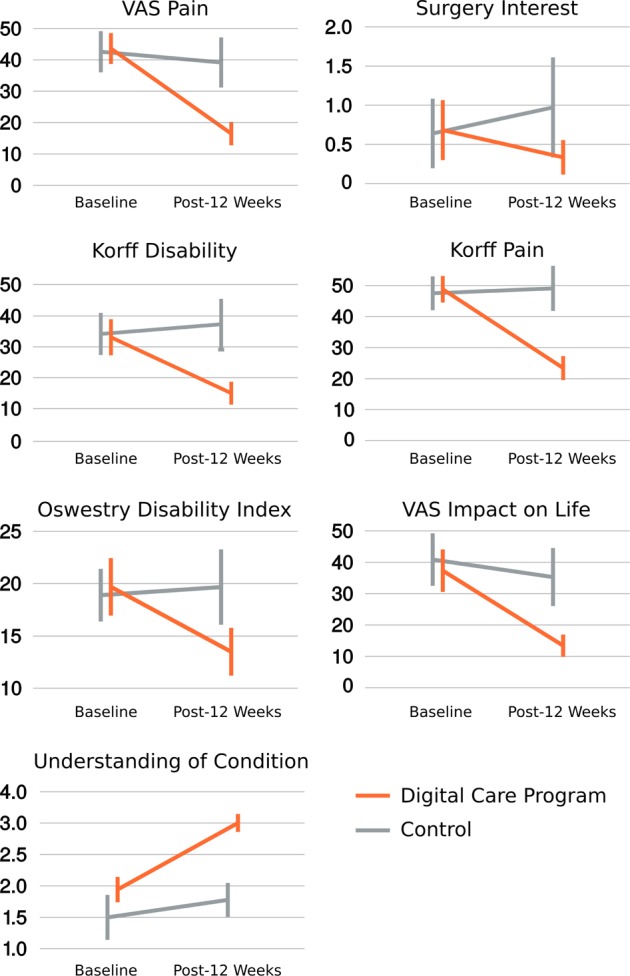
Low back pain (LBP) is the leading cause of disability throughout the world and is economically burdensome. The recommended first line treatment for non-specific LBP is non-invasive care. A digital care program (DCP) delivering evidence-based non-invasive treatment for LBP can aid self-management by engaging patients and scales personalized therapy for patient-specific needs. We assessed the efficacy of a 12-week DCP for LBP in a two-armed, pre-registered, randomized, controlled trial (RCT). Participants were included based on self-reported duration of LBP, but those with surgery or injury to the lower back in the previous three months were excluded. The treatment group (DCP) received the 12-week DCP, consisting of sensor-guided exercise therapy, education, cognitive behavioral therapy, team and individual behavioral coaching, activity tracking, and symptom tracking – all administered remotely via an app. The control group received three digital education articles only. All participants maintained access to treatment-as-usual. At 12 weeks, an intention-to-treat analysis showed each primary outcome—Oswestry Disability Index ( p < 0.001), Korff Pain ( p < 0.001) and Korff Disability ( p < 0.001)—as well as each secondary outcome improved more for participants in the DCP group compared to control group. For participants who completed the DCP (per protocol), average improvement in pain outcomes ranged 52-64% (Korff: 48.8–23.4, VAS: 43.6–16.5, VAS impact on daily life: 37.3–13.4; p < 0.01 for all) and average improvement in disability outcomes ranged 31–55% (Korff: 33.1–15, ODI: 19.7–13.5; p < 0.01 for both). Surgical interest significantly reduced in the DCP group. Participants that completed the DCP had an average engagement, each week, of 90%. Future studies will further explore the effectiveness of the DCP for long-term outcomes beyond 12 weeks and for a LBP patient population with possibly greater baseline pain and disability. In conclusion, the DCP resulted in improved LBP outcomes compared to treatment-as-usual and has potential to scale personalized evidence-based non-invasive treatment for LBP patients.
Overview
The claims and statistics of this paper haven’t been checked yet.
Free: it reads the open-access text and checks the first 5 claims that cite a source we can check. Create a free account to check every claim.
Integrity signals
Registry
Cites
Statistics
Figures
Verification
Claims the paper makes
The claims and statistics of this paper haven’t been checked yet.
Free: it reads the open-access text and checks the first 5 claims that cite a source we can check. Create a free account to check every claim.
Claims other papers make about this one
Each is checked against this paper’s own text: does it say what the citing paper says it does?
The check wasn’t confident either way, so it gives no verdict — never disputed.
In the citing paper
“In fact, DL has the ability to enhance human lives by providing additional accuracy in diagnosis, including estimating natural disasters [40], the discovery of new drugs [41], and cancer diagnosis [42–44].”
From Review of deep learning: concepts, CNN architectures, challenges, applications, future directions (2021) · cites this paper as [44]
Experimental — accuracy not yet measuredThe check wasn’t confident either way, so it gives no verdict — never disputed.
In the citing paper
“Furthermore, in grading prostate cancer, US board-certified general pathologists achieved an average accuracy of 61%, while the Google AI [44] outperformed these specialists by achieving an average accuracy of 70%.”
From Review of deep learning: concepts, CNN architectures, challenges, applications, future directions (2021) · cites this paper as [44]
Experimental — accuracy not yet measuredThe check wasn’t confident either way, so it gives no verdict — never disputed.
In the citing paper
“Finally, the application of DHT sensor-outcomes to monitor RA during daily life remains yet to be validated against standard in-clinic administered assessments of RA impact24.”
From Digital health technologies and machine learning augment patient reported outcomes to remotely characterise rheumatoid arthritis (2024) · cites this paper as [24]
Experimental — accuracy not yet measuredThe check wasn’t confident either way, so it gives no verdict — never disputed.
In the citing paper
“Particular issues are presented by the use of published data, which can be unvalidated or incomplete due to selective reporting26,27.”
From Machine intelligence in healthcare—perspectives on trustworthiness, explainability, usability, and transparency (2020) · cites this paper as [26]
Experimental — accuracy not yet measured
Self-check
Percentages, sums and reported differences re-computed from the paper’s own numbers.
The self-check needs the paper’s full text.
Citations
Cites
Fitting Linear Mixed-Effects Models Using lme4
Bates, D., Mächler, M., Bolker, B., & Walker, S. (2015) · Journal of Statistical Software · doi:10.18637/jss.v067.i01 · Cited by 86,835
Vos, T., Abajobir, A. A., Abate, K. H., Abbafati, C., Abbas, K. M., Abd-Allah, F., Abdulkader, R. S., Abdulle, A. M., Abebo, T. A., Abera, S. F., et al. (2017) · The Lancet · doi:10.1016/s0140-6736(17)32154-2 · Cited by 13,220
‘Small Changes' to Diet and Physical Activity Behaviors for Weight Management
Hills, A. P., Byrne, N. M., Lindstrom, R., & Hill, J. O. (2013) · Obesity Facts · doi:10.1159/000345030 · Cited by 9,493
Fairbank, J. C. T., & Pynsent, P. B. (2000) · Spine · doi:10.1097/00007632-200011150-00017 · Cited by 5,851
Qaseem, A., Wilt, T. J., McLean, R. M., Forciea, M. A., & for the Clinical Guidelines Committee of the American College of Physicians* (2017) · Annals of Internal Medicine · doi:10.7326/m16-2367 · Cited by 3,234
Epidemiological features of chronic low-back pain
Andersson, G. B. (1999) · The Lancet · doi:10.1016/s0140-6736(99)01312-4 · Cited by 3,181
Prevention and treatment of low back pain: evidence, challenges, and promising directions
Foster, N. E., Anema, J. R., Cherkin, D., Chou, R., Cohen, S. P., Gross, D. P., Ferreira, P. H., Fritz, J. M., Koes, B. W., Peul, W., et al. (2018) · The Lancet · doi:10.1016/s0140-6736(18)30489-6 · Cited by 2,398
Ostelo, R. W. J. G., Deyo, R. A., Stratford, P., Waddell, G., Croft, P., Von Korff, M., Bouter, L. M., & de Vet, H. C. (2008) · Spine · doi:10.1097/brs.0b013e31815e3a10 · Cited by 2,009
Lumbar Disc Disorders and Low-Back Pain: Socioeconomic Factors and Consequences
Katz, J. N. (2006) · Journal of Bone and Joint Surgery · doi:10.2106/jbjs.e.01273 · Cited by 1,645
A primary care back pain screening tool: identifying patient subgroups for initial treatment
Hill, J. C., Dunn, K. M., Lewis, M., Mullis, R., Main, C. J., Foster, N. E., & Hay, E. M. (2008) · Arthritis Care & Research · doi:10.1002/art.23563 · Cited by 1,052
Greene, J., & Hibbard, J. H. (2012) · Journal of General Internal Medicine · doi:10.1007/s11606-011-1931-2 · Cited by 1,028
Social-cognitive predictors of health behavior: Action self-efficacy and coping self-efficacy.
Schwarzer, R., & Renner, B. (2000) · Health Psychology · doi:10.1037/0278-6133.19.5.487 · Cited by 883
Epidemiology and Risk Factors for Spine Pain
Rubin, D. I. (2007) · Neurologic Clinics · doi:10.1016/j.ncl.2007.01.004 · Cited by 796
Multidisciplinary biopsychosocial rehabilitation for chronic low back pain
Kamper, S. J., Apeldoorn, A. T., Chiarotto, A., Smeets, R. J. E. M., Ostelo, R. W., Guzman, J., & van Tulder, M. W. (2014) · Cochrane Database of Systematic Reviews · doi:10.1002/14651858.cd000963.pub3 · Cited by 629
Searle, A., Spink, M., Ho, A., & Chuter, V. (2015) · Clinical Rehabilitation · doi:10.1177/0269215515570379 · Cited by 555
Exercise therapy for chronic nonspecific low-back pain
van Middelkoop, M., Rubinstein, S. M., Verhagen, A. P., Ostelo, R. W., Koes, B. W., & van Tulder, M. W. (2010) · Best Practice & Research Clinical Rheumatology · doi:10.1016/j.berh.2010.01.002 · Cited by 513
Chou, R., Baisden, J., Carragee, E. J., Resnick, D. K., Shaffer, W. O., & Loeser, J. D. (2009) · Spine · doi:10.1097/brs.0b013e3181a105fc · Cited by 456
Epidemiology of back disorders: prevalence, risk factors, and prognosis
Manek, N. J., & MacGregor, A. J. (2005) · Current Opinion in Internal Medicine · doi:10.1097/01.bor.0000154215.08986.06 · Cited by 387 · cited 1×
“Clinical diagnosis of LBP is difficult due to its multifactorial etiology and in turn, 90% of cases are designated as non-specific with no clear underlying cause.(4,5) Given the uncertainties in diagnoses, localized LBP is treated with a broad variety of interventions including activity modification, physical therapy,…”
Backgroundvan Tulder, M., Koes, B., & Bombardier, C. (2002) · Best Practice & Research Clinical Rheumatology · doi:10.1053/berh.2002.0267 · Cited by 360
Biofeedback in medicine: who, when, why and how?
Frank, D. L., Khorshid, L., Kiffer, J., Moravec, C. S., & McKee, M. G. (2010) · PubMed · Cited by 356
A Mind-Body Program for Older Adults With Chronic Low Back Pain: A Randomized Clinical Trial
Morone, N. E., Greco, C. M., Moore, C. G., Rollman, B. L., Lane, B., Morrow, L. A., Glynn, N. W., & Weiner, D. K. (2016) · JAMA Internal Medicine · doi:10.1001/jamainternmed.2015.8033 · Cited by 258
Leisure Time Exercise Questionnaire
Godin, G., & Shephard, R. J. (2015) · PsycTESTS Dataset · doi:10.1037/t31334-000 · Cited by 256
Shiri, R., Coggon, D., & Falah‐Hassani, K. (2017) · American Journal of Epidemiology · doi:10.1093/aje/kwx337 · Cited by 205
Digital Support Interventions for the Self-Management of Low Back Pain: A Systematic Review
Nicholl, B. I., Sandal, L. F., Stochkendahl, M. J., McCallum, M., Suresh, N., Vasseljen, O., Hartvigsen, J., Mork, P. J., Kjaer, P., Søgaard, K., et al. (2017) · Journal of Medical Internet Research · doi:10.2196/jmir.7290 · Cited by 182
An Online Self-help CBT Intervention for Chronic Lower Back Pain
Carpenter, K. M., Stoner, S. A., Mundt, J. M., & Stoelb, B. (2012) · The Clinical Journal of Pain · doi:10.1097/ajp.0b013e31822363db · Cited by 157
Chou, R., Côté, P., Randhawa, K., Torres, P., Yu, H., Nordin, M., Hurwitz, E. L., Haldeman, S., & Cedraschi, C. (2018) · European Spine Journal · doi:10.1007/s00586-017-5433-8 · Cited by 155 · cited 1×
“While exercise, rehabilitation, and cognitive behavioral therapy are among the most effective non-pharmacological conservative care treatments for ameliorating LBP symptoms, implementations of such care from a traditional clinical model has, so far, revealed inconsistent results.(9,10) This is likely due to the high d…”
BackgroundEvaluation of Two Time-Specific Back Pain Outcome Measures
Underwood, M. R., Barnett, A. G., & Vickers, M. R. (1999) · Spine · doi:10.1097/00007632-199906010-00010 · Cited by 152
Hansson, T. H., & Hansson, E. K. (2000) · Spine · doi:10.1097/00007632-200012010-00013 · Cited by 147
Lamb, S., Lall, R., Hansen, Z., Castelnuovo, E., Withers, E., Nichols, V, Griffiths, F., Potter, R., Szczepura, A., & Underwood, M. (2010) · Health Technology Assessment · doi:10.3310/hta14410 · Cited by 140
Wälti, P., Kool, J., & Luomajoki, H. (2015) · BMC Musculoskeletal Disorders · doi:10.1186/s12891-015-0533-2 · Cited by 99
Mecklenburg, G., Smittenaar, P., Erhart-Hledik, J. C., Perez, D. A., & Hunter, S. (2018) · Journal of Medical Internet Research · doi:10.2196/jmir.9667 · Cited by 98
Self-citationTreatment of Low Back Pain with a Digital Multidisciplinary Pain Treatment App: Short-Term Results
Huber, S., Priebe, J. A., Baumann, K.-M., Plidschun, A., Schiessl, C., & Tölle, T. R. (2017) · JMIR Rehabilitation and Assistive Technologies · doi:10.2196/rehab.9032 · Cited by 83
Value-based Care in the Management of Spinal Disorders: A Systematic Review of Cost-utility Analysis
Indrakanti, S. S., Weber, M. H., Takemoto, S. K., Hu, S. S., Polly, D. W., & Berven, S. (2011) · Clinical Orthopaedics and Related Research · doi:10.1007/s11999-011-2141-2 · Cited by 78
Wright, B., Galtieri, N., & Fell, M. (2014) · Journal of Rehabilitation Medicine · doi:10.2340/16501977-1241 · Cited by 62
Smittenaar, P., Erhart-Hledik, J. C., Kinsella, R., Hunter, S., Mecklenburg, G., & Perez, D. (2017) · JMIR Rehabilitation and Assistive Technologies · doi:10.2196/rehab.7258 · Cited by 34
Self-citationHaines, T. P., & Bowles, K. (2017) · BMC Musculoskeletal Disorders · doi:10.1186/s12891-016-1371-6 · Cited by 28
Wahl, A. K., Opseth, G., Nolte, S., Osborne, R. H., Bjørke, G., & Mengshoel, A. M. (2018) · Musculoskeletal Science and Practice · doi:10.1016/j.msksp.2018.04.008 · Cited by 26
Wang, L., Guo, Q., Lu, X., & Ni, B. (2016) · Journal of Back and Musculoskeletal Rehabilitation · doi:10.3233/bmr-150632 · Cited by 14
Cited by
Review of deep learning: concepts, CNN architectures, challenges, applications, future directions
Alzubaidi, L., Zhang, J., Humaidi, A. J., Al-Dujaili, A., Duan, Y., Al-Shamma, O., Santamaría, J., Fadhel, M. A., Al-Amidie, M., & Farhan, L. (2021) · Journal of Big Data · doi:10.1186/s40537-021-00444-8 · Cited by 7,906
Use of AI-based tools for healthcare purposes: a survey study from consumers’ perspectives
Esmaeilzadeh, P. (2020) · BMC Medical Informatics and Decision Making · doi:10.1186/s12911-020-01191-1 · Cited by 507
Real-world data: A brief review of the methods, applications, challenges and opportunities
Liu, F., & Panagiotakos, D. (2022) · BMC Medical Research Methodology · doi:10.1186/s12874-022-01768-6 · Cited by 496
Exercise therapy for chronic low back pain
Hayden, J. A., Ellis, J., Ogilvie, R., Malmivaara, A., & van Tulder, M. W. (2021) · Cochrane Database of Systematic Reviews · doi:10.1002/14651858.cd009790.pub2 · Cited by 589
Cutillo, C. M., Sharma, K. R., Foschini, L., Kundu, S., Mackintosh, M., Mandl, K. D., MI in Healthcare Workshop Working Group, Beck, T., Collier, E., Colvis, C., et al. (2020) · npj Digital Medicine · doi:10.1038/s41746-020-0254-2 · Cited by 337
Metadata
- Authors
- Shebib, R., Bailey, J. F., Smittenaar, P., Perez, D. A., Mecklenburg, G., & Hunter, S.
- Affiliations
- Kaiser Permanente (US)
- University of California, San Francisco (US)
- Hinge Health (US)
- Corresponding author
- Shebib, Raad
- Venue
- npj Digital Medicine
- Published
- 2019-01-07
- Volume
- 2
- Issue
- 1
- Pages
- 1-1
- ISSN
- 2398-6352 (ISSN-L)
- PMC
- PMC6550254
- OpenAlex
- W2907378463
- Cited by
- 341
- References
- 38
- Citations by year
- 2026: 14 · 2025: 32 · 2024: 52 · 2023: 63 · 2022: 67 · 2021: 61 · 2020: 44 · 2019: 7
- FWCI
- 18.07
- Type
- journal article
- Language
- en
- Open access
- gold
- doi.org
- Licence
- cc-by
- creativecommons.org/licenses/by/4.0 (tdm)
- creativecommons.org/licenses/by/4.0 (vor)
- Locations
- npj Digital Medicine (publishedVersion, cc-by)
- Europe PMC (PubMed Central) (publishedVersion, cc-by)
- PubMed Central (publishedVersion, cc-by)
- PubMed (publishedVersion)
- DOAJ (DOAJ: Directory of Open Access Journals) (submittedVersion)
- eScholarship (California Digital Library) (submittedVersion, cc-by)
- Topics
- Health Sciences › Health Professions › Physical Therapy, Sports Therapy and Rehabilitation › Musculoskeletal pain and rehabilitation
- Health Sciences › Health Professions › General Health Professions › Mobile Health and mHealth Applications
- Social Sciences › Psychology › Applied Psychology › Digital Mental Health Interventions
- Keywords
- low back pain, non-specific low back pain, mobile health apps, cognitive behavioral therapy, behavioral coaching, self-management, Oswestry Disability Index, disability, patient engagement, non-invasive treatment
About these checks
Registry, retraction, Cites and statistics results are computed, not judged, with one exception: a printed reference that no index lists is read once by a model before it counts as a citation error. Claims are extracted by a model and kept only when their quote appears verbatim in the text; each cited source is then checked, with a model’s help, for whether it says what the claim relies on. Those verdicts can be wrong — read the claim’s quote and the cited source before relying on one.
Statistics and arithmetic are recomputed, not judged.
Confidence bands are shown only for fields calibrated on our annotated test set. None is calibrated yet, so no band is shown.
What counts as a claim ›How we measure confidence ›How we check this ›
Are you an author, or do you see a problem with this page? Request a review
Data sources
Bibliographic data: Semantic Scholar, OpenAlex, Crossref.
Contains information from the Semantic Scholar Academic Graph Datasets, made available under the ODC Attribution License (ODC-BY 1.0).
Semantic Scholar’s data is described in: Kinney, R., et al. (2023). The Semantic Scholar Open Data Platform. arXiv:2301.10140.
