

The DOI matches its Crossref record; 23 of the 23 references it cites were found in a registry or an index.
Using science to sell apps: Evaluation of mental health app store quality claims
Open accessAbstract
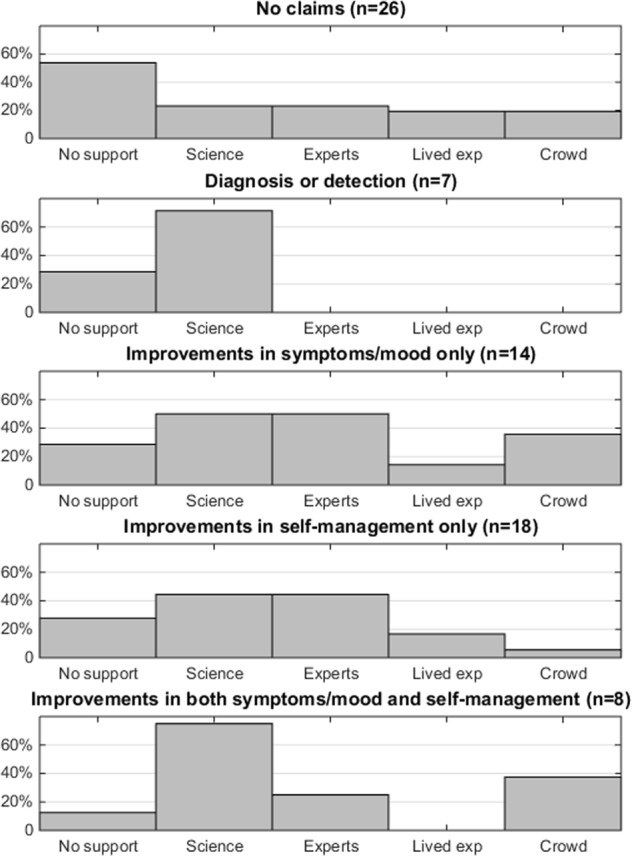
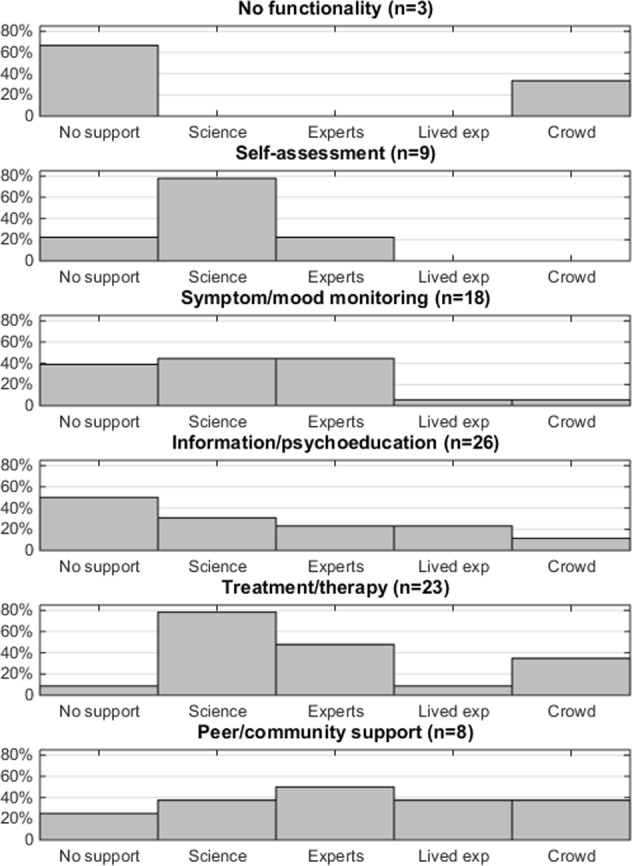
Despite the emergence of curated app libraries for mental health apps, personal searches by consumers remain a common method for discovering apps. App store descriptions therefore represent a key channel to inform consumer choice. This study examined the claims invoked through these app store descriptions, the extent to which scientific language is used to support such claims, and the corresponding evidence in the literature. Google Play and iTunes were searched for apps related to depression, self-harm, substance use, anxiety, and schizophrenia. The descriptions of the top-ranking, consumer-focused apps were coded to identify claims of acceptability and effectiveness, and forms of supporting statement. For apps which invoked ostensibly scientific principles, a literature search was conducted to assess their credibility. Seventy-three apps were coded, and the majority (64%) claimed effectiveness at diagnosing a mental health condition, or improving symptoms, mood or self-management. Scientific language was most frequently used to support these effectiveness claims (44%), although this included techniques not validated by literature searches (8/24 = 33%). Two apps described low-quality, primary evidence to support the use of the app. Only one app included a citation to published literature. A minority of apps (14%) described design or development involving lived experience, and none referenced certification or accreditation processes such as app libraries. Scientific language was the most frequently invoked form of support for use of mental health apps; however, high-quality evidence is not commonly described. Improved knowledge translation strategies may improve the adoption of other strategies, such as certification or lived experience co-design.
Overview
The claims and statistics of this paper haven’t been checked yet.
Run the check — free, no account needed. It reads the open-access text and checks the sources it cites.
Integrity signals
Registry
Cites
Statistics
Figures
Verification
Claims the paper makes
The claims and statistics of this paper haven’t been checked yet.
Run the check — free, no account needed. It reads the open-access text and checks the sources it cites.
Claims other papers make about this one
Each is checked against this paper’s own text: does it say what the citing paper says it does?
The source backs part of the claim, not all of it — or backs it for a different population, condition or comparison.
In the citing paper
“Other reviews have evaluated mental health apps more broadly, concluding that the quality of evidence supporting their efficacy is insufficient (Larsen et al. 2019; Wisniewski et al. 2019)”
From Evaluating the quality, safety, and functionality of commonly used smartphone apps for bipolar disorder mood and sleep self-management (2022) · cites this paper as Larsen et al. 2019
Experimental — accuracy not yet measuredThe source backs part of the claim, not all of it — or backs it for a different population, condition or comparison.
In the citing paper
“Whilst reviews of the broader BD app landscape report very low incidence of scientific evidence for available apps (Larsen et al. 2019), 55% of the apps most commonly used by individuals with BD have published evidence (albeit, with the limitations discussed above).”
From Evaluating the quality, safety, and functionality of commonly used smartphone apps for bipolar disorder mood and sleep self-management (2022) · cites this paper as Larsen et al. 2019
Experimental — accuracy not yet measured
Self-check
Percentages, sums and reported differences re-computed from the paper’s own numbers.
The self-check needs the paper’s full text.
Citations
Cites
The empirical status of cognitive-behavioral therapy: A review of meta-analyses
Butler, A. C., Chapman, J. E., Forman, E. M., & Beck, A. T. (2006) · Clinical Psychology Review · doi:10.1016/j.cpr.2005.07.003 · Cited by 3,215
Estimating the true global burden of mental illness
Vigo, D., Thornicroft, G., & Atun, R. (2016) · The Lancet Psychiatry · doi:10.1016/s2215-0366(15)00505-2 · Cited by 2,494
Plummer, F., Manea, L., Trepel, D., & McMillan, D. (2016) · General Hospital Psychiatry · doi:10.1016/j.genhosppsych.2015.11.005 · Cited by 1,882
Gilbody, S., Richards, D., Brealey, S., & Hewitt, C. (2007) · Journal of General Internal Medicine · doi:10.1007/s11606-007-0333-y · Cited by 1,290
Firth, J., Torous, J., Nicholas, J., Carney, R., Pratap, A., Rosenbaum, S., & Sarris, J. (2017) · World Psychiatry · doi:10.1002/wps.20472 · Cited by 1,097
Self-citationTorous, J., Nicholas, J., Larsen, M. E., Firth, J., & Christensen, H. (2018) · Evidence Based Mental Health · doi:10.1136/eb-2018-102891 · Cited by 790
Self-citationFirth, J., Torous, J., Nicholas, J., Carney, R., Rosenbaum, S., & Sarris, J. (2017) · Journal of Affective Disorders · doi:10.1016/j.jad.2017.04.046 · Cited by 675
Self-citationMobile Apps for Bipolar Disorder: A Systematic Review of Features and Content Quality
Nicholas, J., Larsen, M. E., Proudfoot, J., & Christensen, H. (2015) · Journal of Medical Internet Research · doi:10.2196/jmir.4581 · Cited by 438
Self-citationMohr, D. C., Lyon, A. R., Lattie, E. G., Reddy, M., & Schueller, S. M. (2017) · Journal of Medical Internet Research · doi:10.2196/jmir.7725 · Cited by 432
A Systematic Review of Cognitive Behavioral Therapy and Behavioral Activation Apps for Depression
Huguet, A., Rao, S., McGrath, P. J., Wozney, L., Wheaton, M., Conrod, J., & Rozario, S. (2016) · PLOS ONE · doi:10.1371/journal.pone.0154248 · Cited by 328
Research works printed but not linked: 1
- OCEBM Levels of Evidence Working Group. The Oxford Levels of Evidence 2 https://www.cebm.net/index.aspx?o=5653 (2016).
Cited by
Sorted by citations
Items 201–300 of 333
Fisher, L. B., Curreri, A. J., Tan, E., & Sprich, S. E. (2023) · Current clinical psychiatry · doi:10.1007/978-3-031-29368-9_3 · Cited by 5
Weight Loss App Descriptors in App Stores: A Qualitative Analysis of the Spanish Market
Martín-Vicario, L., Díaz, J. B., & Nicolás-Sans, R. (2023) · Human Behavior and Emerging Technologies · doi:10.1155/2023/4104229 · Cited by 4
Bisconti, N., Odier, M., Becker, M. A., & Bullock, K. D. (2024) · JMIR Mental Health · doi:10.2196/52369 · Cited by 4
“A recent study by Larsen et al [24] showed that in the description of the top 73 mental health apps, 44% used general scientific language such as evidence-based treatment while only 2 apps cited low-quality primary evidence and 1 app included a citation to published literature [24].”
MethodKohl, S. H., Henn, A. T., Fendel, J. C., Luttermann, A., van Noort, B. M., & Konrad, K. (2024) · Zeitschrift für Kinder- und Jugendpsychiatrie und Psychotherapie · doi:10.1024/1422-4917/a000989 · Cited by 5
Wüllner, S., Hecker, T., Flottmann, P., & Hermenau, K. (2025) · PLOS mental health. · doi:10.1371/journal.pmen.0000270 · Cited by 3
“Additionally, there is a high discrepancy between evidence-based and available e-mental health tools [23–25].”
Behavior change techniques in mobile apps targeting self-harm in young people: a systematic review
Panagiotopoulou, E., Peiris, C., & Hayes, D. (2021) · Translational Behavioral Medicine · doi:10.1093/tbm/ibaa131 · Cited by 5
Überblick über Digitale Gesundheitsanwendungen mit Fokus Depression
Haaf, R., Machleid, F., & Köhler, S. (2023) · Nervenheilkunde · doi:10.1055/a-2103-4557 · Cited by 4
Schick, A., Paetzold, I., Rauschenberg, C., Hirjak, D., Banaschewski, T., Meyer‐Lindenberg, A., Boehnke, J. R., Boecking, B., & Reininghaus, U. (2020) · doi:10.31234/osf.io/5qhdv · Cited by 4
Haferkamp, A., Frey, L. J., Duwe, G., Börner, J. H., Hunfeld, C., Brocker, K. A., Troilo, S., Lehmacher, W., Papp, C. P., Miller, K., et al. (2025) · The Lancet Digital Health · doi:10.1016/j.landig.2025.100935 · Cited by 3
Exploring the Effect of Social Media on Post-Partum Depression
Ye, Z. (2023) · Lecture Notes in Education Psychology and Public Media · doi:10.54254/2753-7048/29/20231401 · Cited by 3
On misempowerment & mobile health
Gray, J., & Mertes, H. (2025) · Medicine Health Care and Philosophy · doi:10.1007/s11019-025-10277-4 · Cited by 3
“But this does not match the scientific language that often accompanies these devices and is designed to per-suade users that the product is clinically validated, despite developers knowing that no such evidence base exists (Larsen et al. 2019).”
An Analysis of Privacy Language in the Scholarly Literature on Mental Health Apps
Ebben, M., & Murphy, J. S. (2020) · Advances in information security, privacy, and ethics book series · doi:10.4018/978-1-7998-3487-8.ch009 · Cited by 3
de Almeida, R. S. (2021) · Advances in psychology, mental health, and behavioral studies (APMHBS) book series · doi:10.4018/978-1-7998-8634-1.ch001 · Cited by 3
Barisch‐Fritz, B., Nigg, C. R., Barisch, M., & Wöll, A. (2023) · Frontiers in Sports and Active Living · doi:10.3389/fspor.2022.1012239 · Cited by 3
“For example, Larsen et al. (11) found only one app that included a reference to published literature in the case of mental health apps.”
BackgroundHenry, L. M., & Compas, B. E. (2023) · JAACAP Open · doi:10.1016/j.jaacop.2023.09.006 · Cited by 6
Using science as a differentiator in a crowded digital mental health market
Huberty, J., Beatty, C. C., & Yourell, J. (2024) · Frontiers in Digital Health · doi:10.3389/fdgth.2023.1306527 · Cited by 3
“For wavering buyers, science may be a signi fi cant deciding factor (23).”
BackgroundRedeł, A., Binkowska, A. A., Obarska, K., Marcowski, P., Szymczak, K., Lewczuk, K., Sollich, K., Banaszak, M., Woronowicz, B. T., Nowicka, M., et al. (2024) · Frontiers in Psychiatry · doi:10.3389/fpsyt.2024.1335105 · Cited by 3
“Despite many of these applications employing scienti fi c terminology to substantiate their bene fi ts, the evidence supporting them is frequently of poor quality or altogether absent (40).”
MethodThe growing need to integrate digital mental health into psychiatric and medical education
López‐Castromán, J., Artés-Rodrı́guez, A., Courtet, P., Hanon, C., Gondek, T. M., Baca‐García, E., & Volpe, U. (2024) · European Psychiatry · doi:10.1192/j.eurpsy.2024.1802 · Cited by 3
“Leading mental health apps today offer psychoeducation, therapy techniques, mood monitoring, self-assessment, and community support [8].”
Skoge, M., & Hidalgo‐Mazzei, D. (2025) · European Neuropsychopharmacology · doi:10.1016/j.euroneuro.2025.02.013 · Cited by 3
The Promise and Peril of Mental Health Apps
Kushlev, K., Moon, K., Harris, M., & Falgoust, G. (2025) · Policy Insights from the Behavioral and Brain Sciences · doi:10.1177/23727322251405255 · Cited by 3
“Yet, one analysis found that while 64% of mental health apps available to consumers made claims about their effectiveness, and 44% used scien-ti fi c language to make those claims, only one app provided a citation for their claims (Larsen et al., 2019).”
Digital Mental Health Interventions
Shelton, C. R., Kotsiou, A., & Hetzel‐Riggin, M. D. (2021) · Advances in human and social aspects of technology book series · doi:10.4018/978-1-7998-6453-0.ch008 · Cited by 3
Training the next generation of behavioral medicine scientists to accelerate digital health
Castro, C. M., Kaye, L., Alabduljabbar, M., & Myers, V. H. (2022) · Translational Behavioral Medicine · doi:10.1093/tbm/ibac050 · Cited by 3
Wasil, A. R., Malhotra, T., Tuteja, N., Nandakumar, N., Pandole, L., DeRubeis, R. J., Lorenzo‐Luaces, L., Naslund, J. A., & Bhatia, A. (2020) · PsyArXiv (OSF Preprints) · doi:10.31234/osf.io/q8krz · Cited by 3
Dietel, F. A., & Buhlmann, U. (2023) · Journal of Obsessive-Compulsive and Related Disorders · doi:10.1016/j.jocrd.2023.100847 · Cited by 2
Kadirvelu, B., Bel, T. B., Freccero, A., Simplicio, M. C. D., Nicholls, D., & Faisal, A. A. (2025) · doi:10.2196/preprints.72501 · Cited by 3
Domínguez, M., Sánchez‐Balcells, S., Vila‐Badia, R., Bergadà‐Sánchez, E., Vilaplana, M., Ochoa, S., Huerta‐Ramos, M. E., Cacho, N. D., Usall, J., Peláez, T., et al. (2023) · Early Intervention in Psychiatry · doi:10.1111/eip.13468 · Cited by 2
“…Sez-gin (2021) highlighted the difficulties of implementing apps in mental health settings, as they should be backed by scientific evidence (Larsen et al., 2019), but also because given the economic difficulty of conducting long-term observations, many of the created applications have not…”
BackgroundAraújo, A. I., Pereira, A. T., Duarte, I. C., Cardoso, R., Castelo-Branco, M. S., & Macedo, A. (2025) · Actas Españolas de Psiquiatría · doi:10.62641/aep.v53i1.1715 · Cited by 2
“Thus, customization of the existing clinical instruments (e.g., educational resources, intervention programs, and self-reported questionnaires) for smart-phone adaptation should be a priority for clinicians and developers, as the currently available options are very limited [12,28].”
Morenigbade, H., Aljaber, T., Gordon, N. A., & Eke, G. (2025) · PLoS ONE · doi:10.1371/journal.pone.0319828 · Cited by 2
“Existing systems focus primarily on generalised criteria such as popularity, user ratings, and broad-spectrum quality factors, which do not consider individual health needs in their evaluations [8].”
Tael‐Öeren, M., Jordan, I., Coughlin, D., & Turnbull, S. (2022) · JMIR Formative Research · doi:10.2196/25715 · Cited by 2
“Our qualitative findings in this study suggested that not everyone was aware of the app’s objective when they downloaded it (ie, a focus on improving mental well-being) and providing a clear description of the app in social media and in the App Store and Google Play is “a key channel to inform consumer choice” [66].”
BackgroundE-mental health interventions for men: an urgent call for cohesive Australian policy and investment
Opozda, M. J., Drummond, M., Gupta, H., Petersen, J. M., & Smith, J. A. (2024) · Health Promotion International · doi:10.1093/heapro/daae033 · Cited by 2
“…mental health apps are accessible online, the vast majority have little or no evidence supporting their effectiveness (Torous et al ., 2018; Larsen et al ., 2019), and men’s reportedly low uptake of eMH suggests that many existing programmes do not suit their preferences or needs…”
BackgroundOld data in new media? Problematic popularity of digital health data and consumer devices
Lämmerhirt, D., & Schubert, C. (2025) · Information Communication & Society · doi:10.1080/1369118x.2025.2464098 · Cited by 2
“Wearables and apps use bio-physical measures (Williams et al., 2020), claims of efficacy (Larsen et al., 2019), and discourses of individual empowerment (Maslen & Lup-ton, 2020) to garner public attention, especially on social media platforms.”
Graham, A. K., Ortega, A., Rooper, I. R., & Smith, A. C. (2025) · FOCUS The Journal of Lifelong Learning in Psychiatry · doi:10.1176/appi.focus.20250001 · Cited by 2
Josifovski, N., Rochesson, S. E. D., Wong, Q. J. J., Han, J., Larsen, M. E., & Torok, M. H. (2025) · International Journal of Social Psychiatry · doi:10.1177/00207640251358109 · Cited by 2
“Many publicly available interventions contain little to no theory-driven, therapeutic content (Larsen et al., 2019) and without understanding what role ‘science’ plays in the efficacy of digital interventions, we cannot know if such interventions are likely to be helping or hindering those with…”
Self-citationAungst, T. D., Gobin, N., Jung, R., & Seed, S. M. (2020) · Journal of Travel Medicine · doi:10.1093/jtm/taaa140 · Cited by 2
Mande, A., Moore, S. L., Banaei‐Kashani, F., Kaizer, A. M., Echalier, B., Bull, S. S., & Rosenberg, M. A. (2022) · JMIR Formative Research · doi:10.2196/34827 · Cited by 2
“A similar lack of scientific support for commercially available mental health–targeted [37-39] and pain [25,40] apps has been reported by other investigators.”
ResultLeveraging Causal Inference to Measure the Impact of a Mental Health App on Users’ Well-being
de Villa, A. R., Sottocornola, G., Çoba, L., Maffei, G., Lucchesi, F., Guerreiro, J., & Skorulski, B. (2023) · ACM Conference on User Modeling, Adaptation and Personalization (UMAP) · doi:10.1145/3565472.3592967 · Cited by 2
“Whilst some of them have shown positive effects [10, 22, 33], there are lots of concerns regarding the level of credibility and robustness of evidence underlying the majority of them [10, 25].”
BackgroundA Review of the Design of Multimedia Patient Educational Materials in Low Back Pain Research
Oirschot, G. V., & Doherty, C. (2024) · Physical Therapy Research · doi:10.1298/ptr.r0032 · Cited by 1
Digital Media Use in Transitional-Age Youth: Challenges and Opportunities
Weigle, P. E., Kaliebe, K., Dalope, K. A., Asamoah, T., & Shafi, R. M. A. (2021) · Springer eBooks · doi:10.1007/978-3-030-62113-1_18 · Cited by 3
Personality and Individual Differences
Ellis, D. A. (2020) · Cambridge University Press eBooks · doi:10.1017/9781108671408.006 · Cited by 2
Ellis, D. A. (2020) · Cambridge University Press eBooks · doi:10.1017/9781108671408.003 · Cited by 2
Gasteiger, N., Dowding, D., Norman, G., McGarrigle, L., Eost‐Telling, C., Jones, D. J., Vercell, A., Ali, S. M., & O’Connor, S. (2023) · Research Square · doi:10.21203/rs.3.rs-2647200/v1 · Cited by 2
Waaler, P. N., Bongo, L. A., Rolandsen, C., & Lorem, G. F. (2023) · medRxiv · doi:10.1101/2023.05.25.23290511 · Cited by 2
Boni, R. B. D., da Mota, J. C., Duncan, M. S., Linconl, L., Costa, G. L. A., Pimentel, S., Sales, K. P., Gaspar, F., Britto, F. A., Schuch, F. B., et al. (2025) · Digital Health · doi:10.1177/20552076251316719 · Cited by 2
Lessons Learned or Forgotten? Future Direction of Global Digital Mental Health Care
Mucić, D., Shore, J. H., Hilty, D. M., Krzystanek, M., & Krysta, K. (2024) · Springer eBooks · doi:10.1007/978-3-031-59936-1_19 · Cited by 1
Ozturk, C. S., & Demir, K. (2025) · Current Psychiatry Reports · doi:10.1007/s11920-025-01613-9 · Cited by 2
“Strong scientific data does not support mHealth apps developed specifically for children [ 30, 48].”
InfluentialVitale, F. (2025) · International Journal of Engineering Technologies and Management Research · doi:10.29121/ijetmr.v12.i6.2025.1620 · Cited by 1
Zych, M. M., Bond, R., Mulvenna, M. D., Bai, L., Carracedo, J. M., & Leigh, S. (2025) · JMIR mhealth and uhealth · doi:10.2196/57279 · Cited by 1
Darko, A. P., Zhang, B., Agbodah, K., Antwi, C. O., Asamoah, K. O., Ren, K., & Ren, J. (2025) · Humanities and Social Sciences Communications · doi:10.1057/s41599-025-05625-x · Cited by 1
“However, independent assessments show signi fi cant clinical validity, privacy protections, and long-term user engagement differences (Babu and Joseph, 2025; Larsen et al. 2019).”
Alam, M. A., Smaron, J. M. S.-U. I., Islam, M. R., Halder, N., Islam, A., & Amin, M. A. (2025) · International Conference on Emerging Smart Technologies and Applications (eSmarTA) · doi:10.1109/esmarta66764.2025.11132226 · Cited by 1
“However, they might not stick to the essential principles of these therapies and may struggle to establish their efficacy [7].”
Krokos, O., Brandhorst, I., Gawrilow, C., & Löchner, J. (2025) · Internet Interventions · doi:10.1016/j.invent.2025.100874 · Cited by 1
“Although mHealth interventions offer numerous advantages and app downloads and usage have continued to increase, empirical evidence on the feasibility and effectiveness of mHealth interventions remains limited (Larsen et al., 2019).”
Digital Mental Health Treatments for Depression
Ramos, G., Karyotaki, E., Mohr, D. C., & Schueller, S. M. (2025) · Psychiatric Clinics of North America · doi:10.1016/j.psc.2025.08.023 · Cited by 1
di Bona, K., Ijaz, K., & Ahmadpour, N. (2025) · Australian Conference on Human-Computer Interaction (OzCHI) · doi:10.1145/3764687.3764704 · Cited by 2
State of the Science in Clinical Practice: Digital Mental Health Interventions
Ramos, G., Taylor, M. E., Tabak, N. T., Poola, N., & Schueller, S. M. (2026) · Cognitive and Behavioral Practice · doi:10.1016/j.cbpra.2026.03.001 · Cited by 1
Developing an App to Screen for Dual Disorders: A Tool for Improving Treatment Services in Mexico
Marín-Navarrete, R., Torrens, M., Toledo-Fernández, A., Mestre-Pintó, J. I., Sánchez-Domínguez, R., Pérez-López, A., Saracco-Álvarez, R. A., León, E. Á. M.-D., & Szerman, N. (2021) · Frontiers in Psychiatry · doi:10.3389/fpsyt.2021.697598 · Cited by 1
“Moreover, it has been reported that about half the applications found in stores (App Store and Google Play) make claims about their effectiveness, although the evidence they present is based mainly on bibliographic searches with little methodological rigor or on personal involvement in their development (14).”
BackgroundInformatics Technologies in the Diagnosis and Treatment of Mental Health Conditions
Ingram, W. M., Khanna, R., & Weston, C. L. (2021) · Health informatics · doi:10.1007/978-3-030-70558-9_17 · Cited by 1
“…mental health applications currently available, almost none provide scientific evidence that their systems properly diagnosis or improve outcomes among users [148–151], and there is evidence that consumers will largely not continue to use the apps when not enrolled in a clinical trial [152, 153].”
BackgroundDigital interventions for mental health
Hariman, K. W. (2022) · Oxford University Press eBooks · doi:10.1093/med/9780198861478.003.0055 · Cited by 1
Gasteiger, N., Norman, G., Grainger, R., Eost‐Telling, C., Jones, D. J., Ali, S. M., van der Veer, S. N., Ford, C., Hall, A., Law, K., et al. (2024) · BMJ Open · doi:10.1136/bmjopen-2023-083364 · Cited by 1
An Ecological Momentary Intervention Using Self-Compassionate Writing to Reduce Stress
Chishima, Y., Sugawara, D., & Mizuno, M. (2025) · Mindfulness · doi:10.1007/s12671-024-02503-6 · Cited by 1
“However, most applications incorporate tasks to improve mental health without evidence-based assessments (Kertz et al., 2017; Larsen et al., 2019).”
The academic-industry divide in health communication: A call for increased partnership
Blanch‐Hartigan, D., Yule, J. A., Cummings, K. H., Smith, V., & Mast, M. S. (2019) · Patient Education and Counseling · doi:10.1016/j.pec.2019.09.008 · Cited by 1
Montgomery, R. M., Brandysky, L., Neary, M., Eikey, E. V., Mark, G. J., Schneider, M. L., Stadnick, N. A., Zheng, K., Mukamel, D. B., Sorkin, D. H., et al. (2021) · Psychiatric Services · doi:10.1176/appi.ps.202000803 · Cited by 2
“Sifting through this multitude of apps often leaves consumers and clinicians overwhelmed, unsatisfied, and in many cases without a useful or effective resource (2).”
BackgroundHow to Evaluate a Mobile App and Advise Your Patient About It?
Aungst, T. D. (2023) · Springer eBooks · doi:10.1007/978-3-031-10698-9_9 · Cited by 1
Social Interaction and Interpersonal Relationships
Ellis, D. A. (2020) · Cambridge University Press eBooks · doi:10.1017/9781108671408.005 · Cited by 1
Addressing the undertreatment of mood disorders in Australian youth
Connor, J. P., Scott, J. G., Hall, W., & Thai, P. K. (2025) · Australian & New Zealand Journal of Psychiatry · doi:10.1177/00048674241312795 · Cited by 1
Kaizer, A. M., Moore, S. L., Banaei‐Kashani, F., Bull, S. S., & Rosenberg, M. A. (2020) · medRxiv · doi:10.1101/2020.04.28.20082339
Emerging Role for Technology in Positive Psychiatry Interventions
Treichler, E. B. H., Lee, E., & Jeste, D. V. (2021) · Oxford University Press eBooks · doi:10.1093/med/9780197506271.003.0013
Shaw, J. (2021) · Open Access Victoria University of Wellington | Te Herenga Waka (Figshare) · doi:10.26686/wgtn.14471310.v1
Kudyba, S. P., Perry, T. L., Getter, A., & Steele, A. (2021) · Population Health Management · doi:10.1089/pop.2021.0111
“29 As previously discussed, there are studies that illustrate how digital technologies can increase compliance, engagement, and adherence.”
Myin‐Germeys, I., de Thurah, L., Weermeijer, J. D. M., Bonnier, R., van Aubel, E., & Kiekens, G. (2022) · Tijdschrift voor Geneeskunde · doi:10.47671/tvg.77.21.188
Ellis, D. A. (2020) · Cambridge University Press eBooks · doi:10.1017/9781108671408.008
Ellis, D. A. (2020) · Cambridge University Press eBooks · doi:10.1017/9781108671408.001
Ellis, D. A. (2020) · Cambridge University Press eBooks · doi:10.1017/9781108671408.004
Ellis, D. A. (2020) · Cambridge University Press eBooks · doi:10.1017/9781108671408.002
Ellis, D. A. (2020) · Cambridge University Press eBooks · doi:10.1017/9781108671408.009
Ellis, D. A. (2020) · Cambridge University Press eBooks · doi:10.1017/9781108671408.007
An Analysis of Privacy Language in the Scholarly Literature on Mental Health Apps
Ebben, M., & Murphy, J. S. (2021) · IGI Global eBooks · doi:10.4018/978-1-7998-8954-0.ch012
Privacy Language in Scholarly Literature on Mental Health Apps: Systematic Review (Preprint)Preprint
Ebben, M., & Murphy, J. S. (2020) · doi:10.2196/preprints.19248
Ellis, D. A. (2020) · Cambridge University Press eBooks · doi:10.1017/9781108671408.010
Mental Wellness Portal: PsychCafe
Sarode, V. (2022) · International Journal for Research in Applied Science and Engineering Technology · doi:10.22214/ijraset.2022.44038
Sukalla, F., & Karnowski, V. (2022) · European Journal of Health Communication · doi:10.47368/ejhc.2022.104
Teaching and Evaluating Professionalism
DeJong, S. M. (2022) · Springer eBooks · doi:10.1007/978-3-031-00836-8_14
Kosasih, F. R., Yee, V. T. S., Toh, S. H. Y., & Sündermann, O. (2022) · medRxiv · doi:10.1101/2022.07.25.22278034
“97 98 Despite promising evidence on the effectiveness of mHealth apps on improving anxiety, 99 especially for mild symptom severity, there is still a limited number of applications with 100 reported effectiveness (17,18), quality (19), and evidence-based components (20).”
BackgroundDagistan, E. (2022) · Mental Health Global Challenges Journal · doi:10.56508/mhgcj.v5i2.141
“For instance, a study from 2019 showed that top-mental health apps tend to use scientific language to evoke population, without the lack of adequate evidence on their effectiveness (Larsen et al., 2019).”
BackgroundPerakslis, E. D., & Quintana, Y. (2022) · doi:10.2196/preprints.43174
A Transparency Framework for App Store Descriptions
Alhejaili, A., & Blustein, J. (2023) · Communications in computer and information science · doi:10.1007/978-3-031-35989-7_56
Users’ Sophisticated Information Search Behaviour
Alhejaili, A., & Blustein, J. (2023) · Lecture notes in computer science · doi:10.1007/978-3-031-35921-7_1
Krokos, O., Brandhorst, I., Seitzer, L., Gawrilow, C., & Löchner, J. (2023) · SSRN Electronic Journal · doi:10.2139/ssrn.4586047
Vallely, P. (2023) · Open Access Victoria University of Wellington | Te Herenga Waka (Figshare) · doi:10.26686/wgtn.24647856
Verbeke, K., Jain, C., Shpendi, A., & Borry, P. (2024) · Neuroethics · doi:10.1007/s12152-024-09543-8
“Safer”: Design and Development of a Supportive Assistant for Emotion Regulation
Diano, F., Ponticorvo, M., & Sica, L. S. (2023) · IEEE International Conference on Metrology for eXtended Reality, Artificial Intelligence and Neural Engineering (MetroXRAINE) · doi:10.1109/metroxraine58569.2023.10405747
“Their features include mindfulness, assessment, crisis management, and more, based on the referenced therapeutic model [57, 58].”
BackgroundWaaler, P. N., Bongo, L. A., Rolandsen, C., & Lorem, G. F. (2024) · Scientific Reports · doi:10.1038/s41598-024-53275-x
“Finally, current lifestyle apps tend to lack a proper scientific basis 33 , and thus miss an opportunity to utilise the vast amounts of research on the relationship between lifestyle factors and health outcomes which could lead to more effective strategies for improving health if incorporated.”
BackgroundTales From the Past: Adapting App Repositories to App Store Dynamics
Stach, M., Schickler, M., Reichert, M., & Pryss, R. C. (2023) · Congress in Computer Science, Computer Engineering, and Applied Computing (CSCE) · doi:10.1109/csce60160.2023.00225
“The latter is a major problem [33] [34] and could be improved by automated evaluations.”
BackgroundAraújo, A. I., Pereira, A. T., Duarte, I. C., Cardoso, R., Castelo-Branco, M. S., & Macedo, A. (2024) · Research Square · doi:10.21203/rs.3.rs-4433162/v1
McCabe, M., Byrne, M. L., Gullifer, J., Smart, I., Chang, C., Singh, S., Khara, G., & Cornish, K. M. (2024) · doi:10.2196/preprints.66775
di Bona, K., Ijaz, K., & Ahmadpour, N. (2024) · doi:10.2196/preprints.69833
Mental Health Apps Available in App Stores for Indian Users: Protocol for a Systematic Review
Mehrotra, S., Tripathi, R., Sengupta, P., Karishiddimath, A., Francis, A., Sharma, P., Sudhir, P. M., Srikanth, T. K., Rao, G. N., & Sagar, R. (2025) · JMIR Research Protocols · doi:10.2196/71071
“It has been observed that many apps in commercial app stores, including low-quality ones, make it difficult for users to identify a suitable app for various mental health conditions, and evidence-based is often lacking, even for top-rated apps in app stores [28,29].”
Attoe, C., Szekely, R., Vega, M. O., Browne, E., Thomas, R., Kwan, T., Altchouler, P., De, A., Hariharan, N., Clay, G., et al. (2025) · doi:10.2196/preprints.73963
Sakera Application as an Effort to Assess Mental Health and Self-Potential in Adolescents
Fakhriyani, D. V., Fitriyah, L., Laily, N. F. R., & Hasby, K. U. (2025) · Al Musyrif Jurnal Bimbingan dan Konseling Islam · doi:10.38073/almusyrif.v8i1.2484
Attoe, C., Szekely, R., Vega, M. O., Browne, E., Thomas, R., Kwan, C. W. T., Altchouler, P., De, A., Hariharan, N., Clay, G., et al. (2025) · doi:10.2196/preprints.81498
Digital Mental Health: Bridging Gaps in Adolescent Mental Health Services
Chatterjee, S., Dindarian, A., & Rengaraju, U. (2025) · Apress eBooks · doi:10.1007/979-8-8688-1186-9_3
Chandran, N., Beniwal, R. P., Sahu, A., Hawk, M. E., RajanBabu, A., & Deshpande, S. N. (2025) · Indian Journal of Psychological Medicine · doi:10.1177/02537176251361710
“21,22 Hence, we aimed to assess the perceived acceptability, needs, and barriers of using mobile applications designed to increase medication adherence among people with SZ and their CG.”
Metadata
- Authors
- Larsen, M. E., Huckvale, K., Nicholas, J., Torous, J., Birrell, L., Li, E., & Reda, B.
- Affiliations
- Black Dog Institute (AU)
- Northwestern University (US)
- Beth Israel Deaconess Medical Center (US)
- UNSW Sydney (AU)
- Corresponding author
- Larsen, Mark Erik
- Venue
- npj Digital Medicine
- Published
- 2019-03-22
- Volume
- 2
- Issue
- 1
- Pages
- 18-18
- ISSN
- 2398-6352 (ISSN-L)
- PMC
- PMC6550255
- OpenAlex
- W2925166053
- Cited by
- 334
- References
- 23
- Citations by year
- 2026: 16 · 2025: 53 · 2024: 42 · 2023: 48 · 2022: 47 · 2021: 60 · 2020: 54 · 2019: 14
- FWCI
- 49.43
- Type
- journal article
- Language
- en
- Open access
- gold
- doi.org
- Locations
- npj Digital Medicine (publishedVersion, cc-by)
- Europe PMC (PubMed Central) (publishedVersion, cc-by)
- PubMed Central (publishedVersion, cc-by)
- PubMed (publishedVersion)
- Minerva Access (University of Melbourne) (submittedVersion, cc-by)
- DOAJ (DOAJ: Directory of Open Access Journals) (submittedVersion)
- Topics
- Social Sciences › Psychology › Applied Psychology › Digital Mental Health Interventions
- Health Sciences › Health Professions › General Health Professions › Mobile Health and mHealth Applications
- Health Sciences › Health Professions › Health Information Management › Health, Technology, Consumer Behavior
- Keywords
- mental health apps, scientific language, quality of evidence, consumer choice, knowledge translation, depression, anxiety, schizophrenia, substance use, self-harm, Google Play Store, iTunes
About these checks
Registry, retraction, Cites and statistics results are computed, not judged, with one exception: a printed reference that no index lists is read once by a model before it counts as a citation error. Claims are extracted by a model and kept only when their quote appears verbatim in the text; each cited source is then checked, with a model’s help, for whether it says what the claim relies on. Those verdicts can be wrong — read the claim’s quote and the cited source before relying on one.
Statistics and arithmetic are recomputed, not judged.
Confidence bands are shown only for fields calibrated on our annotated test set. None is calibrated yet, so no band is shown.
What counts as a claim ›How we measure confidence ›How we check this ›
Are you an author, or do you see a problem with this page? Request a review
