

Deep learning versus human graders for classifying diabetic retinopathy severity in a nationwide screening program
Open accessThe DOI matches its Crossref record; 20 of the 21 references it cites were found in a registry or an index.
Abstract
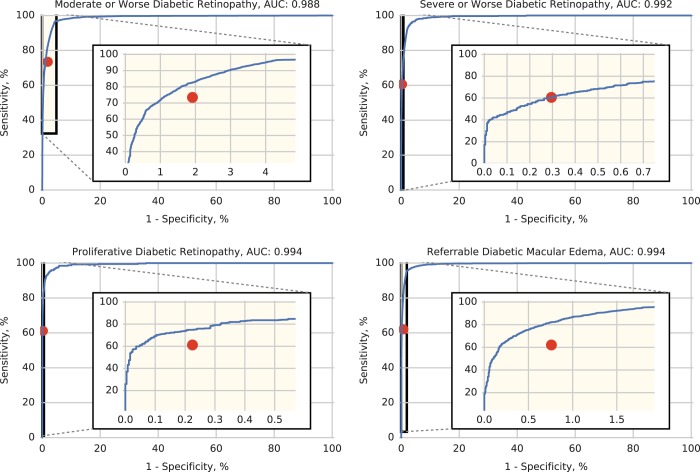
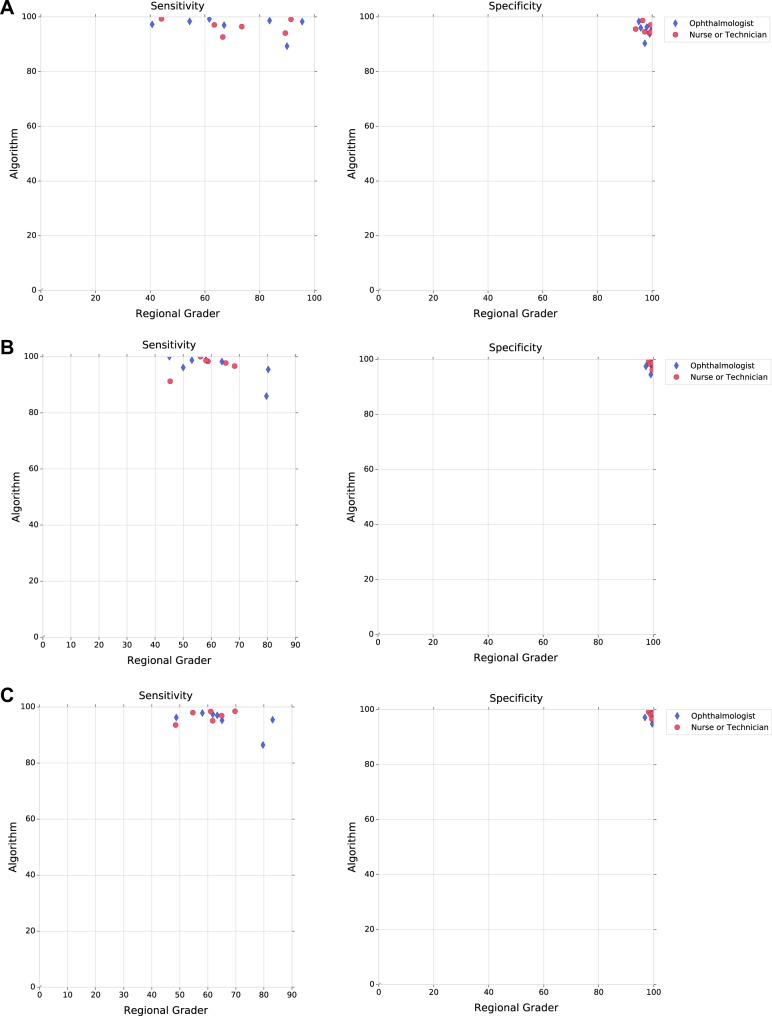
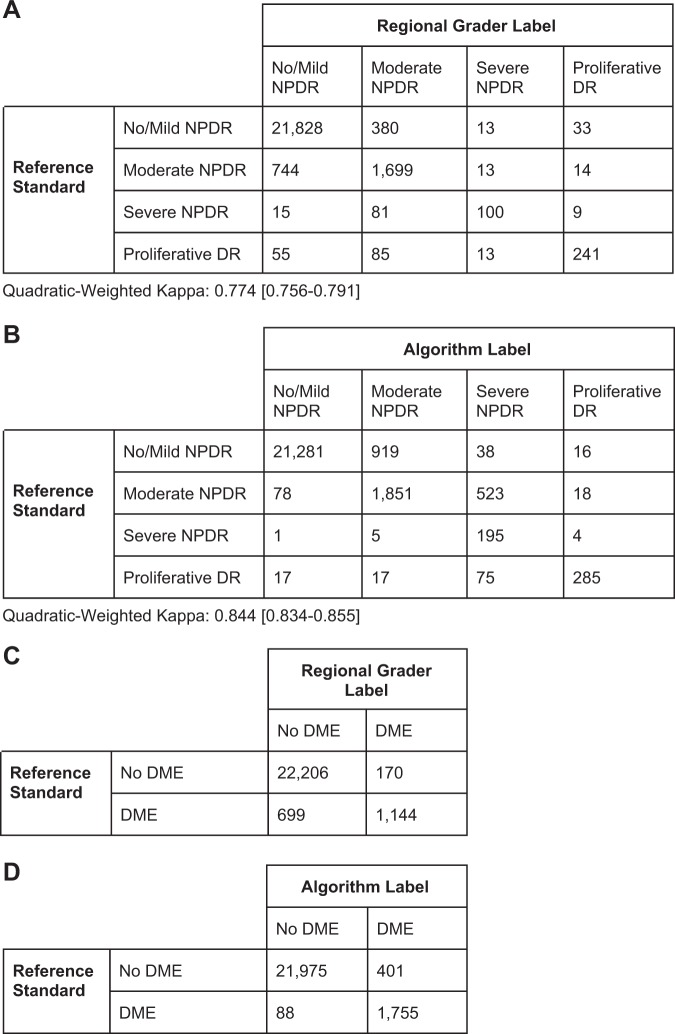
Deep learning algorithms have been used to detect diabetic retinopathy (DR) with specialist-level accuracy. This study aims to validate one such algorithm on a large-scale clinical population, and compare the algorithm performance with that of human graders. A total of 25,326 gradable retinal images of patients with diabetes from the community-based, nationwide screening program of DR in Thailand were analyzed for DR severity and referable diabetic macular edema (DME). Grades adjudicated by a panel of international retinal specialists served as the reference standard. Relative to human graders, for detecting referable DR (moderate NPDR or worse), the deep learning algorithm had significantly higher sensitivity (0.97 vs. 0.74, p < 0.001), and a slightly lower specificity (0.96 vs. 0.98, p < 0.001). Higher sensitivity of the algorithm was also observed for each of the categories of severe or worse NPDR, PDR, and DME ( p < 0.001 for all comparisons). The quadratic-weighted kappa for determination of DR severity levels by the algorithm and human graders was 0.85 and 0.78 respectively ( p < 0.001 for the difference). Across different severity levels of DR for determining referable disease, deep learning significantly reduced the false negative rate (by 23%) at the cost of slightly higher false positive rates (2%). Deep learning algorithms may serve as a valuable tool for DR screening.
Overview
The claims and statistics of this paper haven’t been checked yet.
Free: it reads the open-access text and checks the first 5 claims that cite a source we can check. Create a free account to check every claim.
Integrity signals
Registry
Cites
Statistics
Figures
Verification
Claims the paper makes
The claims and statistics of this paper haven’t been checked yet.
Free: it reads the open-access text and checks the first 5 claims that cite a source we can check. Create a free account to check every claim.
Claims other papers make about this one
Each is checked against this paper’s own text: does it say what the citing paper says it does?
The cited source says what the claim attributes to it.
In the citing paper
“Twenty-five studies17,28,29,35,37,39,40,44–61 compared algorithm performance against healthcare professionals.”
From Diagnostic accuracy of deep learning in medical imaging: a systematic review and meta-analysis (2021) · cites this paper as [39]
In the citing paper
“CNNs consistently demonstrate physician-level grading from fundus photographs [104][105][106][107] , which has led to a recent US FDA-cleared system 108 .”
From Deep learning-enabled medical computer vision (2021) · cites this paper as [105]
Self-check
Percentages, sums and reported differences re-computed from the paper’s own numbers.
The self-check needs the paper’s full text.
Citations
Cites
Gulshan, V., Peng, L., Coram, M., Stumpe, M. C., Wu, D., Narayanaswamy, A., Venugopalan, S., Widner, K., Madams, T., Cuadros, J., et al. (2016) · JAMA · doi:10.1001/jama.2016.17216 · Cited by 7,697
Self-citationInception-v4, Inception-ResNet and the Impact of Residual Connections on Learning
Szegedy, C., Ioffe, S., Vanhoucke, V., & Alemi, A. (2017) · Proceedings of the AAAI Conference on Artificial Intelligence · doi:10.1609/aaai.v31i1.11231 · Cited by 4,636
Ting, D. S. W., Cheung, C. Y.-L., Lim, G., Tan, G. S. W., Quang, N. D., Gan, A., Hamzah, H., Garcia-Franco, R., San Yeo, I. Y., Lee, S. Y., et al. (2017) · JAMA · doi:10.1001/jama.2017.18152 · Cited by 2,402
Guidelines on Diabetic Eye Care
Wong, T. Y., Sun, J., Kawasaki, R., Ruamviboonsuk, P., Gupta, N., Lansingh, V. C., Maia, M., Mathenge, W., Moreker, S., Muqit, M. M. K., et al. (2018) · Ophthalmology · doi:10.1016/j.ophtha.2018.04.007 · Cited by 839
Self-citationKrause, J., Gulshan, V., Rahimy, E., Karth, P., Widner, K., Corrado, G. S., Peng, L., & Webster, D. R. (2018) · Ophthalmology · doi:10.1016/j.ophtha.2018.01.034 · Cited by 564
Self-citationVirgili, G., Menchini, F., Casazza, G., Hogg, R., Das, R. R., Wang, X., & Michelessi, M. (2015) · Cochrane Database of Systematic Reviews · doi:10.1002/14651858.cd008081.pub3 · Cited by 265 · cited 1×
“be ideal.(22) Lastly, DR screening programs generally also refer patients at high suspicion for other non-DR eye diseases such as AMD or glaucoma.”
BackgroundCost-effectiveness of a National Telemedicine Diabetic Retinopathy Screening Program in Singapore
Nguyen, H. V., Tan, G. S. W., Tapp, R. J., Mital, S., Ting, D. S. W., Wong, H. T., Tan, C. S., Laude, A., Tai, E. S., Tan, N. C., et al. (2016) · Ophthalmology · doi:10.1016/j.ophtha.2016.08.021 · Cited by 218
Bresnick, G. H., Mukamel, D. B., Dickinson, J. C., & Cole, D. R. (2000) · Ophthalmology · doi:10.1016/s0161-6420(99)00010-x · Cited by 163
Telehealth Practice Recommendations for Diabetic Retinopathy, Second Edition
Li, H. K., Horton, M., Bursell, S.-E., Cavallerano, J., Zimmer-Galler, I., Tennant, M., Abramoff, M., Chaum, E., DeBuc, D. C., Leonard-Martin, T., et al. (2011) · Telemedicine and e-Health · doi:10.1089/tmj.2011.0075 · Cited by 121
Diabetic retinopathy management guidelines
Chakrabarti, R., Harper, C. A., & Keeffe, J. E. (2012) · Expert Review of Ophthalmology · doi:10.1586/eop.12.52 · Cited by 112
Research works printed but not linked: 1
- Jenchitr, W. et al. The national survey of blindness low vision and visual impairment in thailand 2006-2007. Thai. J. Pub. Hlth. Ophthalmol. 21, 10 (2007).
Cited by
Items 201–282 of 282
Au, S. C. L., Shum, G. T. H., Steffi, S. Y. C., & Ko, C. K. L. (2024) · Hong Kong Journal of Ophthalmology · doi:10.12809/hkjo-v27n2-367 · Cited by 2
"Break the Mask Barrier": An AU-based Rehabilitation Training System for Parkinson's Hypomimia
Cai, X., Xu, Y., Zhou, Z., Xue, M., Li, Z., Weng, C., Luo, W. F., Yao, C., Lin, B., & Yin, J. (2025) · CHI Conference Extended Abstracts on Human Factors in Computing Systems (CHI EA) · doi:10.1145/3706599.3719706 · Cited by 2
Using artificial intelligence in diabetic retinopathy
Mohan, S., Gaur, R., & Raman, R. (2022) · IHOPE Journal of Ophthalmology · doi:10.25259/ihopejo_20_2022 · Cited by 2
Self-citationDayanandan, K., Kumar, N., Sinha, A., & Lall, B. (2024) · arXiv (Cornell University) · doi:10.48550/arxiv.2406.06967 · Cited by 2
“Deep learning models have outperformed human vision in many tasks that require the analysis of finer patterns [96, 43, 90, 99], and performance on these tasks can be improved with scaling [44] (for example, the biggest improvements have been made in figure ground, camouflage and similarity which…”
Future Trends in Artificial Intelligence for Medical Applications
Chaudhuri, T., & Ghosh, J. (2025) · Advances in medical diagnosis, treatment, and care (AMDTC) book series · doi:10.4018/979-8-3693-9816-6.ch020 · Cited by 1
Neural Networks and Computer Vision
Yoon, A. P., & Chung, K. C. (2025) · Hand Clinics · doi:10.1016/j.hcl.2025.08.006 · Cited by 1
Minghui, 陈. C., Ziang, 王. W., Jiayu, 李. L., Zixuan, 殷. Y., Jiahui, 叶. Y., & Zhensheng, 辜. G. (2026) · Laser & Optoelectronics Progress · doi:10.3788/lop251367 · Cited by 1
Four Aspirations for Evaluating AI-Infused Technologies: A Narrative Review
Morey, D. A., Jalaeian, M., Reynolds, M. E., McGeorge, N., Oldham, H. K., & Rayo, M. F. (2026) · Journal of Cognitive Engineering and Decision Making · doi:10.1177/15553434261443032 · Cited by 1
“For example, a promising AI algorithm (Gulshan et al., 2016) which performed better than human specialists in isolation (Ruamviboonsuk et al., 2019) was found to perform substantially worse in practice while also burdening practitioners with extra work (Beede et al., 2020).”
Wu, Z., & Li, L. (2026) · Frontiers in Medicine · doi:10.3389/fmed.2026.1778534 · Cited by 1
Torregroza, A. L., Rodríguez, E. A., Gutiérrez, K. V., & Bonfante, M. C. (2026) · Computer and Electronic Sciences Theory and Applications · doi:10.17981/cesta.07.01.2026.08 · Cited by 1
Liu, Y., Yang, L., Phene, S., & Peng, L. H. (2020) · Elsevier eBooks · doi:10.1016/b978-0-12-821259-2.00013-2 · Cited by 1
Self-citationYip, M. Y. T., Wang, Z., Gutiérrez, L., Foo, V. H. X., Lim, J., Lim, G., Gunasekeran, D. V., Wong, T. Y., & Ting, D. S. W. (2022) · Royal Society of Chemistry eBooks · doi:10.1039/9781839165498-00305 · Cited by 1
Artificial Intelligence in the Management of Diabetic Macular Edema
CAI, L. Z., Jin, A., Hinkle, J. W., Xu, D. S., & Kuriyan, A. E. (2022) · Springer eBooks · doi:10.1007/978-981-19-7307-9_15 · Cited by 1
Shahsuvaryan, M. L. (2023) · Revista Brasileira de Oftalmologia · doi:10.37039/1982.8551.20230045 · Cited by 1
“( 16-37 Gulshan et al. (24) mtmDR 88.9-92.1 92.2-95.2 Bellemo et al. (25) Ruamviboonsuk et al. (26) mtmDR 97 96 Natarajan et al. (27) mtmDR 100 88.4 Bhuiyan et al. (28) mtmDR 92.3 94.8 González-Gonzalo et al. (29) mtmDR 92 92.1 Scheetz et al. (30) mtmDR 96.9 87.7 Heydon et al. (31) mtmDR 95.7 54 Lee et al. (32) mtmDR…”
InfluentialLam, C., Wong, Y. L., Tang, Z., Hu, X., Nguyen, T. X., Yang, D., Zhang, S., Ding, J., Szeto, S., Ran, A. R., et al. (2024) · doi:10.2337/figshare.24518287 · Cited by 1
Automated Screening System for Grading of Retinal Abnormalities
Jaafar, H. F., Shaker, M., Abdulridha, H. M., & Khalaf, A. J. (2024) · Revue d intelligence artificielle · doi:10.18280/ria.380330 · Cited by 1
Deshpande, A. H., Borkar, S. S., & Baheti, J. (2025) · Algorithms for intelligent systems · doi:10.1007/978-981-96-3648-8_3 · Cited by 1
Sadjadi, R. (2021) · Preprints.org · doi:10.20944/preprints202108.0030.v1 · Cited by 1
“The following datasets or sources were used for external validation: primary care practices (1), mobile screening units(2), E-ophtha (4, 17), Messidor-2 (4, 5), EyePACS (4, 12, 16, 19, 21), national eye studies (6), outpatient services (8), tertiary care diabetes hospital (13), Kaggle (14), general hospitals (15), the…”
BackgroundMethodInfluentialLam, C., Wong, Y. L., Tang, Z., Hu, X., Nguyen, T. X., Yang, D., Zhang, S., Ding, J., Szeto, S., Ran, A. R., et al. (2024) · doi:10.2337/figshare.24518287.v1 · Cited by 1
Xu, Y., Cai, X., Zhou, Z., Xue, M., Wang, B., Wang, H., Li, Z., Weng, C., Luo, W. F., Yao, C., et al. (2024) · arXiv (Cornell University) · doi:10.48550/arxiv.2410.09772 · Cited by 1
KANKARIA, A., Duggal, M., Kernohan, A., Chauhan, A., Verma, P., Bryant, A., Miglani, V., Chadda, N., Syal, P., Jaiswal, N., et al. (2023) · Research Square · doi:10.21203/rs.3.rs-3149178/v1 · Cited by 1
Kim, H., Jonas, R. A., Ninomiya, T., Hong, R., Sitnilska, V., Howaldt, A., Ong, A. Y., Grün, M., Poschkamp, B., Zhou, Y., et al. (2026) · Research Square · doi:10.21203/rs.3.rs-9848475/v1 · Cited by 2
Artificial Intelligence in the Assessment of Macular Disorders
Ruamviboonsuk, P., Semturs, C., Raman, R., Nganthavee, V., & Chotcomwongse, P. (2020) · Springer eBooks · doi:10.1007/978-981-15-7644-7_7
Self-citationHong, N., Park, Y., You, S. C., & Rhee, Y. (2021) · Springer eBooks · doi:10.1007/978-3-030-58080-3_328-1
Automated segmentation of the left atrium from MRI cardiac images
Presmanes, J. R. (2021) · RECERCAT (Consorci de Serveis Universitaris de Catalunya)
Technical Aspects of Deep Learning in Ophthalmology
Chen, Z., & Ishikawa, H. (2021) · Springer eBooks · doi:10.1007/978-3-030-78601-4_5
Hong, N., Park, Y., You, S. C., & Rhee, Y. (2022) · Springer eBooks · doi:10.1007/978-3-030-64573-1_328
Radenković, D., Zhavoronkov, A. A., & Bischof, E. Y. (2022) · Springer eBooks · doi:10.1007/978-3-030-64573-1_248
Artificial Intelligence Aiding Medical Diagnosis Focusing on Diabetic Retinopathy
Juneja, S., Bali, A., & Bali, N. (2022) · Advances in medical diagnosis, treatment, and care (AMDTC) book series · doi:10.4018/978-1-6684-2304-2.ch003
Ophthalmic Telemedicine in the Pandemic–Endemic World: Present and Future Perspectives
Biran, A., Loewenstein, A., Mezad-Koursh, D., Iglicki, M., & Zur, D. (2022) · touchREVIEWS in Ophthalmology · doi:10.17925/usor.2022.16.1.17
Role of RWD / RWE in health technology assessment
Borovskaya, V. G., & Kurylev, A. A. (2023) · Real-World Data & Evidence · doi:10.37489/2782-3784-myrwd-26
Evidenz zur Qualität von Telemedizin
Eichelberg, M., Flägel, K., Graeber, J., Illig, H., Kidholm, K., Muche‐Borowski, C., Ruppel, T., Wagner, H.-O., Waschkau, A., & Wewetzer, L. (2021) · Elsevier eBooks · doi:10.1016/b978-3-437-23545-0.00002-7
KI in der Medizin: Begrifflichkeiten, Chancen und Risiken
Widmer, C. (2024) · InFo Hämatologie + Onkologie · doi:10.1007/s15004-024-0567-4
Is ChatGPT a Useful Tool for Ophthalmology Practice?
Yavrum, F., & Kocabaş, D. Ö. (2024) · Acta Medica Alanya · doi:10.30565/medalanya.1531790
AI Advancements in Tailored Healthcare for Neurodevelopmental Disorders
Malviya, R., Kumar, S., Solanke, A. S., Goyal, P., & Chauhan, K. (2025) · Wiley eBooks · doi:10.1002/9781394347537.ch8
Threats to the Validity of the Predictive System Performance for Ophthalmology
Woźniak, M., & Grzybowski, A. E. (2025) · Springer eBooks · doi:10.1007/978-3-031-83756-2_6
Overview of Artificial Intelligence Systems in Ophthalmology
Kaothanthong, N., Arjkongharn, N., Vongsa, N., Ruamviboonsuk, V., & Ruamviboonsuk, P. (2025) · Springer eBooks · doi:10.1007/978-3-031-83756-2_3
Self-citationPotla, R. T. (2025) · Research Square · doi:10.21203/rs.3.rs-7179215/v1
Decoding Diabetic Retinopathy: A Comprehensive Analysis Through Diverse Deep Learning Algorithms
Thummalakunta, P. B., Patil, S., Supekar, B., Phule, V. V., & Ranjane, A. (2025) · Lecture notes in networks and systems · doi:10.1007/978-981-96-4008-9_5
AN OVERVIEW ON IMPORTANCE OF ARTIFICIAL INTELLIGENCE IN THE MAINTENANCE OF HUMAN HEALTH
Shankar Murthy, K., Thanuja, D. S., & Maruthi, K. R. (2025) · International Journal of Innovative Research in Technology · doi:10.64643/ijirtv12i6-186641-459
Antes, A. L., Burrous, S., Sisk, B. A., Schuelke, M. J., Keune, J. D., & DuBois, J. M. (2021) · Figshare · doi:10.6084/m9.figshare.15026439
Antes, A. L., Burrous, S., Sisk, B. A., Schuelke, M. J., Keune, J. D., & DuBois, J. M. (2021) · Figshare · doi:10.6084/m9.figshare.15026430
Antes, A. L., Burrous, S., Sisk, B. A., Schuelke, M. J., Keune, J. D., & DuBois, J. M. (2021) · Figshare · doi:10.6084/m9.figshare.15026436
Antes, A. L., Burrous, S., Sisk, B. A., Schuelke, M. J., Keune, J. D., & DuBois, J. M. (2021) · Figshare · doi:10.6084/m9.figshare.15026433
Current Status and Prospects of Artificial Intelligence in Glaucoma Applications
白, 天. (2025) · Advances in Clinical Medicine · doi:10.12677/acm.2025.1592655
Disentanglement and Assessment of Shortcuts on Ophthalmological Retinal Imaging Exams
Fernandes, L. J. D. S. (2025) · Portuguese National Funding Agency for Science, Research and Technology (RCAAP Project by FCT)
High-Accuracy, Low-Cost DR Classification: MobileNetV2 Enhanced by Lesion-Aware Teacher Distillation
Kumar, M. P., & Khanaa, V. (2025) · International Conference on Sustainable Communication Networks and Application (ICSCNA) · doi:10.1109/icscn67106.2025.11308694
“Seminal studies by Gargeya and Leng [6] and Arcadu et al. [2] showcased the high accuracy achievable with deep learning models, often rivaling or exceeding human graders in specific tasks [10, 15].”
Transforming Health Care Management Through Artificial Intelligence
Lenka, R. M., Deshpande, R., & Singh, V. (2026) · Springer eBooks · doi:10.1007/978-3-031-98141-8_11
Singh, G. (2026) · International Journal of Innovative Science and Research Technology (IJISRT) · doi:10.38124/ijisrt/26jan012
AI and Diabetic Retinopathy: Methods and Results
Esserkassi, B., Eddarouich, S., & Bourouhou, A. (2026) · Lecture notes in networks and systems · doi:10.1007/978-3-032-14430-0_12
Aokage, K., Ukita, J., Miura, M., Ogaki, K., Kataoka, T., Mitome, N., Isaka, M., Yotsukura, M., Watanabe, S.-I., & Tsuboi, M. (2026) · JTCVS Open · doi:10.1016/j.xjon.2026.101742
“For threshold-dependent metrics, the decision threshold was determined by maximizing the Youden index using only the bootstrap sample within each iteration and was then applied unchanged to the corresponding out-of-bag sample for evaluation, thereby minimizing optimism bias due to threshold tuning.”
Découverte de nouveaux clusters thermoélectriques assistée par machine learning
Chantrenne, I. (2022) · theses.fr (ABES) · doi:10.70675/00fab420z8064z45c9zad10z65c7a349e552
Enhancing Diagnosis and Treatment of Retinal Diseases Through Artificial Intelligence
Espaillat, A. (2026) · Springer eBooks · doi:10.1007/978-3-032-19336-0_9
Ferreira, A. C. M., de Freitas, M. A. C., Perillo, R. D., Amaral, C. E. M., & Santos, A. D. F. (2026) · Telemedicine Journal and e-Health · doi:10.1177/15305627261454208 · Cited by 1
“12,13,23 Kappa values above 0.80 are considered the “ gold standard ” of desirability for clinical application, indicating that Eyer Maps ® operates with a robustness comparable to experienced specialists, even when facing the real-world variability of primary care.”
InfluentialMendes, R. A. (2023) · International Journal of Endocrinology Research · doi:10.33545/26646579.2023.v5.i1a.56
Kılıç, M. Ö., Kaplan, E., & Korkmaz, F. (2026) · BMC Nursing · doi:10.1186/s12912-026-04926-z
Automatic classification of Diabetic Retinopathy using Artificial Intelligence models
Alvarenga, M. Y., Ferraz, E. C., de Aguiar, N. A. O., Schlink, A. B. D. N., Suzuki, A. H., dos Santos, B. F., & Kobayashi, P. C. (2026) · Derecho y cambio social. · doi:10.54899/dcs.v23i91.5800
Advancements and Strategies in Predicting and Managing Clinical Drug-Drug Interactions
(2026) · Frontiers research topics · doi:10.3389/978-2-8325-8231-2
Babić, T., Tomić, M., Vukojević, N., Dumić-Čule, I., Jandroković, S., & Čaljkušić‐Mance, T. (2026) · Medicina · doi:10.3390/medicina62071251
“…India, and several European pilot sites have generally confirmed high sensitivity for referable DR, though specificity in operational settings tends to be lower than in validation studies, a pattern attributable to differences in image quality, patient demographics, and disease spectrum [43,44].”
Generative adversarial networks (GAN) for pre-dilation retinal photograph quality enhancement
Goh, J. H. L., Tan, M., Lei, X., Li, S., Tan, S. S. H., Hamzah, H., Yang, G. D., Soh, Z. D., Rim, T. H., Tan, G. S. W., et al. (2026) · Eye · doi:10.1038/s41433-026-04767-9
“Recent prospective studies evaluating AI model performance in actual clinical workflows have reported significant degradation in diagnostic accuracy, along with high image rejection rates (i.e. where images with suboptimal quality are unreadable by the AI systems) [12–15].”
Kumar, M. P., & Khanaa, V. (2026) · Genetics and Molecular Research · doi:10.4238/k1zkz567
Maayah, G. R., AbuNasser, R. J., Ali, M. Z., Suganthan, P. N., Jararweh, Y., & Ali, T. Z. (2026) · Computers in Biology and Medicine · doi:10.1016/j.compbiomed.2026.111891
Shalash, F. A., & Alshagrawi, S. S. (2026) · Health Policy and Technology · doi:10.1016/j.hlpt.2026.101303 · Cited by 1
小澤, 信. (2021) · Institutional Repositories DataBase (IRDB)
Multimodal AI in retinal disease: from images to decisions and real-world endpoints
Jin, K., & Grzybowski, A. E. (2026) · International Ophthalmology · doi:10.1007/s10792-026-04254-w · Cited by 1
“Early landmark studies established that deep learning can identify referable diabetic retinopathy from fundus photographs [1] and can be assessed at national screening scale [2].”
Rifasanti, A. S., Lestari, H., & Zuhdi, A. N. (2026) · Oftalmologi Jurnal Kesehatan Mata Indonesia · doi:10.11594/ojkmi.v8i2.105
Tiwari, R., Sawhney, R., Widner, K., Ramasamy, K., Padmanabhan, R., Ruamviboonsuk, P., Turner, A., Nayar, J., Williams, J., Hammel, N., et al. (2026) · Nature Medicine · doi:10.1038/s41591-026-04643-9
Self-citationArtificial Intelligence and Its Impact on Digital Health Development and Decision-Making
Alhassar, I. A. I., Almarzoouq, A. A., Alsalem, A. H. A., Almarhoun, M. A., al., A. A. H. A. E., alsaffar, A. S., Hawidi, F. A. H., Mudaifa, H. A. M. A., Abu Aziz Hussain Ali, A., Alawami, M. S. A., et al. (2024) · Evolutionary Studies in Imaginative Culture
Patil, P., Sarwate, D. R., Mishra, A. K., & Goyal, H. R. (2023) · International Journal of Intelligent Systems and Applications in Engineering
Assess Knowledge of Healthcare Technologies and informatics enabled by Artificial Intelligence
Altamimi, A. S. (2024) · Journal of Propulsion Technology
Artificial Intelligence in Diabetic Retinopathy-A Schematic Review
Kalyani Chakkarai, L. K. (2023) · Journal of chemical health risks
โรงพยาบาลราชวิถี ครบรอบ 72 ปี (พ.ศ. 2494-2566)
จินดาวิจักษณ์, ส., ทุ่งวชิรกุล, ว., เยาวพลกุล, ด., ธนะมัย, น., กันจีน๊ะ, อ., คงศักดิ์ศรี, อ., วิทยประไพพันธ์, ศ., นำรอดภัย, ก., เชาว์อมรภัทร, ส., สุสัณฐิตพงษ์, ฤ., et al. (2023) · Journal of The Department of Medical Services
Al-Dossary, S. K. (2025) · Pakistan Heart Journal
Jin, K., & Grzybowski, A. E. (2026) · Asia-Pacific Journal of Ophthalmology · doi:10.1016/j.apjo.2026.100382
Deobhakta, A. A., & Rosen, R. B. (2026) · JMIR Medical Informatics · doi:10.2196/101576
Muluk, N. B. (2026) · Personalized Medicine · doi:10.1080/17410541.2026.2753744
Rathore, H., & Rodriguez, R. (2026) · doi:10.2196/preprints.115523
Risk-Aware Ordinal Deep Learning for Diabetic Retinopathy Severity Classification
Bhagat, S., Adamuthe, A., & Kalmani, V. (2026) · doi:10.1109/icoicet68875.2026.11761533
Alshehri, Y. A. S., Alshehri, S., Alziyad, Y. A., Alshabab, S. Q. A., Alshehri, A. A. G., Alshmrani, L. S., Alqahtani, R. E. M., Alsharif, R. A. S., Alnami, A. A. A., Alghamdi, T. A. A., et al. (2026) · Acta Innovations · doi:10.62441/actainnovations.vi.3202
Wang, M., Li, X., Feng, M., & Li, Y. (2026) · Frontiers in Medicine · doi:10.3389/fmed.2026.2011576
Beyond the foundation model: A practical framework for adaptation in ophthalmology
Giuliano, F., Zheng, Y., Giuliano, E., Romano, V., Ferrara, M., & Romano, M. R. (2026) · Acta Ophthalmologica · doi:10.1111/aos.70276
Metadata
- Authors
- Ruamviboonsuk, P., Krause, J., Chotcomwongse, P., Sayres, R., Raman, R., Widner, K., Campana, B. J. L., Phene, S., Hemarat, K., Tadarati, M., Silpa-Archa, S., Limwattanayingyong, J., Rao, C., Kuruvilla, O., Jung, J., Tan, J., Orprayoon, S., Kangwanwongpaisan, C., Sukumalpaiboon, R., Luengchaichawang, C., Fuangkaew, J., Kongsap, P., Chualinpha, L., Saree, S., Kawinpanitan, S., Mitvongsa, K., Lawanasakol, S., Thepchatri, C., Wongpichedchai, L., Corrado, G. S., Peng, L., & Webster, D. R.
- Affiliations
- Rajavithi Hospital (TH)
- Google (United States) (US)
- Sankara Nethralaya (IN)
- Vajira Hospital (TH)
- University of California, San Francisco (US)
- University of Southern California (US)
- Lamphun Hospital (TH)
- Somdejphrajaotaksin Maharaj Hospital (TH)
- Sawanpracharak Hospital (TH)
- Photharam Hospital (TH)
- Prapokklao Hospital (TH)
- Mahasarakham Hospital (TH)
- Suratthani Hospital (TH)
- Bangkok Metropolitan Administration (TH)
- Corresponding author
- Peng, Lily
- ORCID
- Venue
- npj Digital Medicine
- Published
- 2019-04-10
- Volume
- 2
- Issue
- 1
- Pages
- 25-25
- ISSN
- 2398-6352 (ISSN-L)
- PMC
- PMC6550283
- OpenAlex
- W2935900679
- Cited by
- 233
- References
- 21
- Citations by year
- 2026: 25 · 2025: 25 · 2024: 32 · 2023: 36 · 2022: 29 · 2021: 46 · 2020: 30 · 2019: 9
- FWCI
- 18.81
- Type
- journal article
- Language
- en
- Update notices
- correction (2019-07-23)
- Open access
- gold
- doi.org
- Licence
- cc-by
- creativecommons.org/licenses/by/4.0 (tdm)
- creativecommons.org/licenses/by/4.0 (vor)
- Locations
- npj Digital Medicine (publishedVersion, cc-by)
- Europe PMC (PubMed Central) (publishedVersion, cc-by)
- PubMed Central (publishedVersion, cc-by)
- PubMed (publishedVersion)
- DOAJ (DOAJ: Directory of Open Access Journals) (submittedVersion)
- Greater South Information System
- Topics
- Health Sciences › Medicine › Radiology, Nuclear Medicine and Imaging › Retinal Imaging and Analysis
- Health Sciences › Medicine › Ophthalmology › Retinal Diseases and Treatments
- Health Sciences › Medicine › Ophthalmology › Ophthalmology and Visual Health Research
- Keywords
- diabetic retinopathy, diabetic macular edema, deep learning, diabetic retinopathy grading, referable diabetic retinopathy, diabetic retinopathy screening, fundus images, sensitivity and specificity
About these checks
Registry, retraction, Cites and statistics results are computed, not judged, with one exception: a printed reference that no index lists is read once by a model before it counts as a citation error. Claims are extracted by a model and kept only when their quote appears verbatim in the text; each cited source is then checked, with a model’s help, for whether it says what the claim relies on. Those verdicts can be wrong — read the claim’s quote and the cited source before relying on one.
Statistics and arithmetic are recomputed, not judged.
Confidence bands are shown only for fields calibrated on our annotated test set. None is calibrated yet, so no band is shown.
What counts as a claim ›How we measure confidence ›How we check this ›
Are you an author, or do you see a problem with this page? Request a review
Data sources
Bibliographic data: Semantic Scholar, OpenAlex, Crossref.
Contains information from the Semantic Scholar Academic Graph Datasets, made available under the ODC Attribution License (ODC-BY 1.0).
Semantic Scholar’s data is described in: Kinney, R., et al. (2023). The Semantic Scholar Open Data Platform. arXiv:2301.10140.
