

Capturing sleep–wake cycles by using day-to-day smartphone touchscreen interactions
Open accessPublished version of a preprint
The DOI matches its Crossref record; 25 of the 25 references it cites were found in a registry or an index.
Abstract
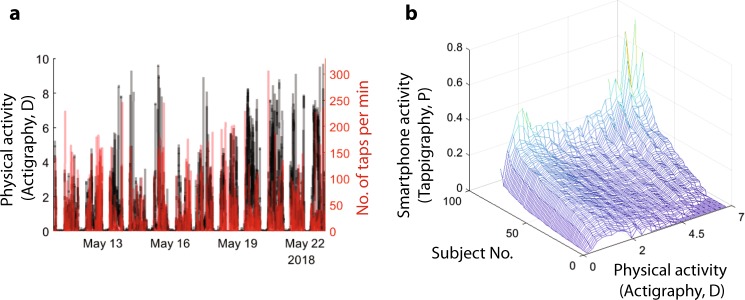
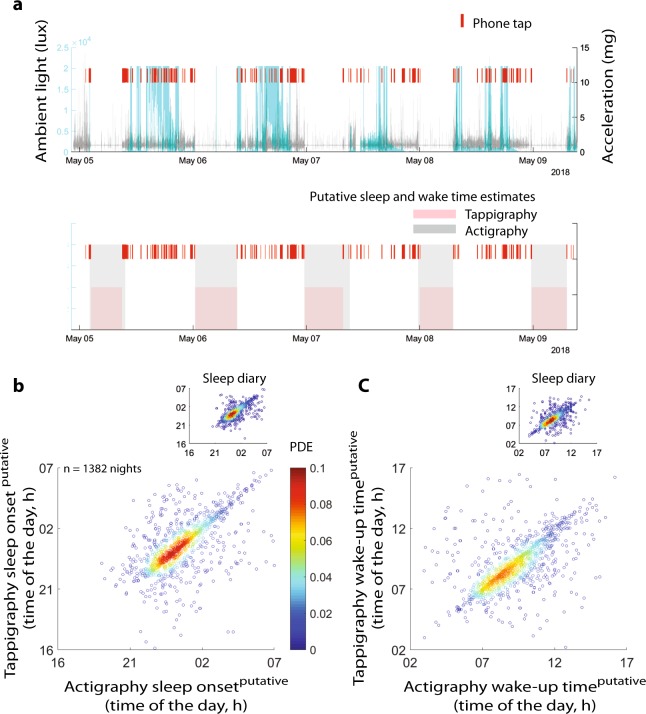
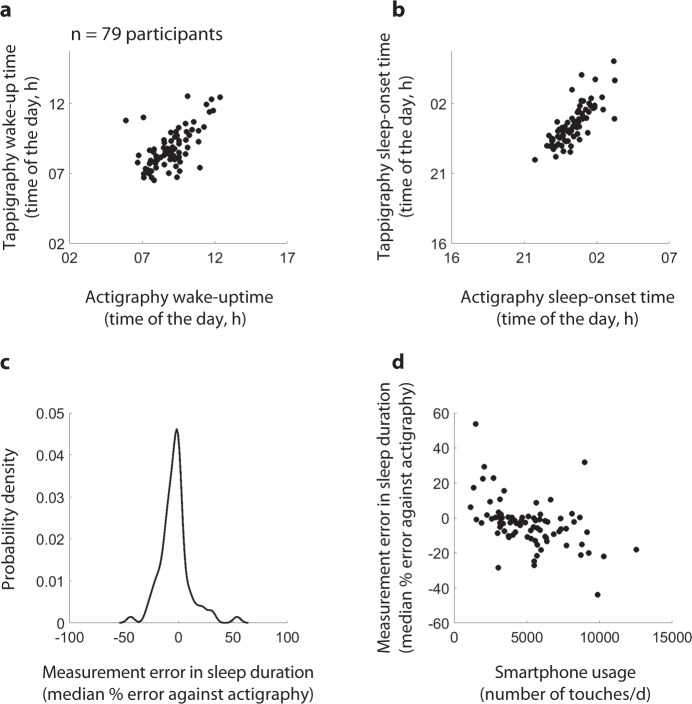
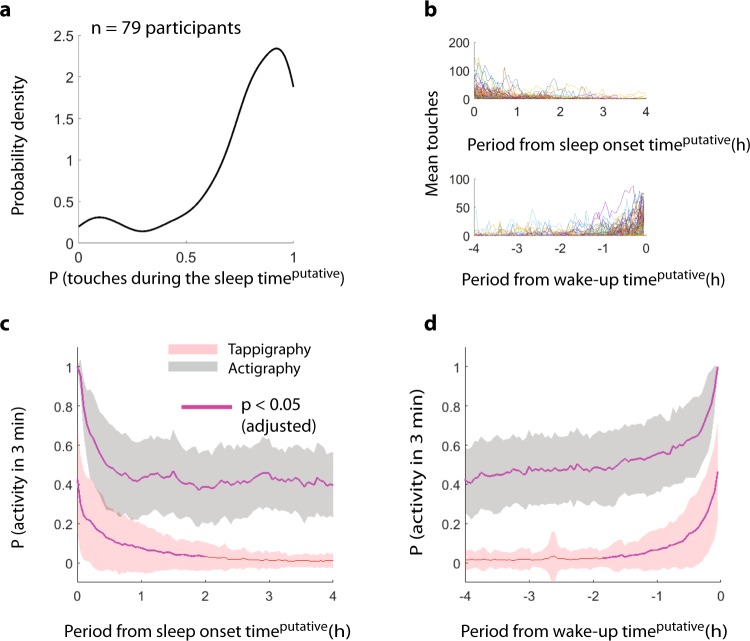
Body movements drop with sleep, and this behavioural signature is widely exploited to infer sleep duration. However, a reduction in body movements may also occur in periods of intense cognitive activity, and the ubiquitous use of smartphones may capture these wakeful periods otherwise hidden in the standard measures of sleep. Here, we continuously captured the gross body movements using standard wrist-worn accelerometers to quantify sleep (actigraphy) and logged the timing of the day-to-day touchscreen events (‘tappigraphy’). Using these measures, we addressed how the gross body movements overlap with the cognitively engaging digital behaviour (from n = 79 individuals, accumulating ~1400 nights). We find that smartphone use was distributed across a broad spectrum of physical activity levels, but consistently peaked at rest. We estimated the putative sleep onset and wake-up times from the actigraphy data to find that these times were well correlated to the estimates from tappigraphy (R 2 = 0.9 for sleep-onset time and wake-up time). However, actigraphy overestimated sleep as virtually all of the users used their phones during the putative sleep period. Interestingly, the probability of touches remained greater than zero for ~2 h after the putative sleep onset, and ~2 h before the putative wake-up time. Our findings suggest that touchscreen interactions are widely integrated into modern sleeping habits—surrounding both sleep onset and waking-up periods—yielding a new approach to measuring sleep. Smartphone interactions can be leveraged to update the behavioural signatures of sleep with these peculiarities of modern digital behaviour.
Overview
The claims and statistics of this paper haven’t been checked yet.
Free: it reads the open-access text and checks the first 5 claims that cite a source we can check. Create a free account to check every claim.
Integrity signals
Registry
Cites
Statistics
Figures
Verification
Claims the paper makes
The claims and statistics of this paper haven’t been checked yet.
Free: it reads the open-access text and checks the first 5 claims that cite a source we can check. Create a free account to check every claim.
Claims other papers make about this one
Each is checked against this paper’s own text: does it say what the citing paper says it does?
The source backs part of the claim, not all of it — or backs it for a different population, condition or comparison.
In the citing paper
“Mobile phones offer a wide range of sensors, such as gyroscopes, microphones and accelerometers, that can be used to monitor sleep patterns66.”
From The future of sleep health: a data-driven revolution in sleep science and medicine (2020) · cites this paper as [66]
Experimental — accuracy not yet measured
Self-check
Percentages, sums and reported differences re-computed from the paper’s own numbers.
The self-check needs the paper’s full text.
Citations
Cites
Health benefits of physical activity: the evidence
Warburton, D. E. R. (2006) · Canadian Medical Association Journal · doi:10.1503/cmaj.051351 · Cited by 8,007
Automatic Sleep/Wake Identification From Wrist Activity
Cole, R. J., Kripke, D. F., Gruen, W., Mullaney, D. J., & Gillin, J. C. (1992) · Sleep · doi:10.1093/sleep/15.5.461 · Cited by 1,941
Methods for cosinor-rhythmometry.
Nelson, W. E., Tong, Y. L., Lee, J. K., & Franz Halberg, A. (1979) · PubMed · Cited by 1,701
Lemola, S., Perkinson-Gloor, N., Brand, S., Dewald-Kaufmann, J. F., & Grob, A. (2015) · Journal of Youth and Adolescence · doi:10.1007/s10964-014-0176-x · Cited by 940
The Role of Actigraphy in the Evaluation of Sleep Disorders
Sadeh, A., Hauri, P. J., Kripke, D. F., & Lavie, P. (1995) · Sleep · doi:10.1093/sleep/18.4.288 · Cited by 909
Use of sleep hygiene in the treatment of insomnia
Stepanski, E. J., & Wyatt, J. K. (2003) · Sleep Medicine Reviews · doi:10.1053/smrv.2001.0246 · Cited by 733
Martin, J. L., & Hakim, A. D. (2011) · Chest · doi:10.1378/chest.10-1872 · Cited by 603
Further Validation of Actigraphy for Sleep Studies
de Souza, L., Benedito-Silva, A. A., Pires, M. L. N., Poyares, D., Tufik, S., & Calil, H. M. (2003) · Sleep · doi:10.1093/sleep/26.1.81 · Cited by 587
Beccuti, G., & Pannain, S. (2011) · Current Opinion in Clinical Nutrition and Metabolic Care · doi:10.1097/mco.0b013e3283479109 · Cited by 507 · cited 2×
“Similarly, there are a plethora of clinical conditions – from obesity to arthritis – where fine movements are sufficiently preserved for smartphone interactions but the overall mobility is diminished 14,15 .”
BackgroundResultVAN DE WATER, A. T. M., HOLMES, A., & HURLEY, D. A. (2011) · Journal of Sleep Research · doi:10.1111/j.1365-2869.2009.00814.x · Cited by 447
Cited by
The future of sleep health: a data-driven revolution in sleep science and medicine
Perez-Pozuelo, I., Zhai, B., Palotti, J., Mall, R., Aupetit, M., Garcia-Gomez, J. M., Taheri, S., Guan, Y., & Fernandez-Luque, L. (2020) · npj Digital Medicine · doi:10.1038/s41746-020-0244-4 · Cited by 311
Understanding the Need for Sleep to Improve Cognition
Leong, R. L. F., & Chee, M. W. L. (2022) · Annual Review of Psychology · doi:10.1146/annurev-psych-032620-034127 · Cited by 110
Qin, S., Leong, R. L. F., Ong, J. L., & Chee, M. W. L. (2022) · Sleep Medicine Reviews · doi:10.1016/j.smrv.2022.101734 · Cited by 109
Early morning university classes are associated with impaired sleep and academic performance
Yeo, S. C., Lai, C. K., Tan, J., Lim, S., Chandramoghan, Y., Tan, T. K., & Gooley, J. J. (2023) · Nature Human Behaviour · doi:10.1038/s41562-023-01531-x · Cited by 72
Aalbers, G., Hendrickson, A. T., Abeele, M. V., & Keijsers, L. (2023) · JMIR mhealth and uhealth · doi:10.2196/37469 · Cited by 54
Schoedel, R., Pargent, F., Au, Q., Völkel, S. T., Schuwerk, T., Bühner, M., & Stachl, C. (2020) · European Journal of Personality · doi:10.1002/per.2258 · Cited by 53
“Borger et al. (2019) have shown that indicators for sleep onset and offset derived via actigraphy and smartphone touch interactions are highly correlated.”
BackgroundDejenie, T. A., Medhin, M. T. G., Admasu, F. T., Adella, G. A., Enyew, E. F., Kifle, Z. D., Seid, M. A., Mengstie, M. A., & Abebe, E. C. (2022) · Frontiers in Endocrinology · doi:10.3389/fendo.2022.1064969 · Cited by 48
“Frontiers in Endocrinology 03 wake time with a small wrist-worn monitor and can more conveniently capture information (33).”
BackgroundLiang, Z., & Martell, M. A. C. (2021) · Frontiers in Digital Health · doi:10.3389/fdgth.2021.665946 · Cited by 45
“A variety of ubiquitous sleep tracking systems have been developed, including bed sensors (1, 2), wireless EEG (3, 4), smartphone apps (5, 6), and wearable activity trackers (7).”
BackgroundCurrent and Future Roles of Consumer Sleep Technologies in Sleep Medicine
Goldstein, C. A. (2020) · Sleep Medicine Clinics · doi:10.1016/j.jsmc.2020.05.001 · Cited by 36
Quality of Sleep Data Validation From the Xiaomi Mi Band 5 Against Polysomnography: Comparison Study
Concheiro-Moscoso, P., Groba, B., Álvarez-Estévez, D., Miranda-Duro, M. D. C., Pousada, T., Nieto-Riveiro, L., Mejuto-Muiño, F. J., & Pereira, J. (2023) · Journal of Medical Internet Research · doi:10.2196/42073 · Cited by 34
“Thus, the use of wristbands not only aims to monitor sleep patterns but also contributes to make the population more aware of sleep relevance [11,12].”
Massar, S. A. A., Chua, X. Y., Soon, C. S., Ng, A., Ong, J. L., Chee, N. I. Y. N., Lee, T.-S. W., Ghosh, A., & Chee, M. W. L. (2021) · npj Digital Medicine · doi:10.1038/s41746-021-00466-9 · Cited by 36
Self-citationAlamoudi, D., Breeze, E., Crawley, E. M., & Nabney, I. T. (2023) · JMIR mhealth and uhealth · doi:10.2196/44123 · Cited by 32
“A “tappigraphy” sensor has also been used to measure sleeping patterns [29].”
BackgroundMethodQuantifying daily rhythms with non-negative matrix factorization applied to mobile phone data
Aledavood, T., Kivimäki, I., Lehmann, S., & Saramäki, J. (2022) · Scientific Reports · doi:10.1038/s41598-022-09273-y · Cited by 36
“In chronobiology, people are commonly divided into three categories referred to as “chronotypes” 9 according to the difference in the phase of circadian rhythms and their tendency to sleep at different hours.”
BackgroundLarge cognitive fluctuations surrounding sleep in daily living
Huber, R., & Ghosh, A. (2021) · iScience · doi:10.1016/j.isci.2021.102159 · Cited by 20
Self-citationArtificial neural network trained on smartphone behavior can trace epileptiform activity in epilepsy
Duckrow, R. B., Ceolini, E., Zaveri, H. P., Brooks, C., & Ghosh, A. (2021) · iScience · doi:10.1016/j.isci.2021.102538 · Cited by 21
“The other extreme of the inter-event probability distribution—the long gaps in smartphone usage—is indicative of sleep (Borger et al., 2019).”
BackgroundSelf-citationLin, C., Chen, I., Chuang, H., Wang, Z.-W., Lin, H.-H., & Lin, Y. (2023) · Journal of Medical Internet Research · doi:10.2196/48044 · Cited by 21
“Furthermore, none of the previous studies estimating sleep-wake patterns from the time stamps of screen events assessed circadian rhythm indicators such as RA, interdaily stability (IS), and intradaily variability (IV) [10,14].”
InfluentialCeolini, E., Kock, R., Band, G. P. H., Stoet, G., & Ghosh, A. (2022) · iScience · doi:10.1016/j.isci.2022.104791 · Cited by 19
“14).”
BackgroundSelf-citationWang, T., Seiger, A., Markowetz, A., Andone, I., Błaszkiewicz, K., & Penzel, T. (2025) · Journal of Medical Internet Research · doi:10.2196/60423 · Cited by 19
“In 2019, a study conducted in the Netherlands reported a strong correlation ( R 2 =0.9) between smartphone touch data and traditional sleep measurement methods, enabling accurate predictions of sleep onset and wake times [28].”
InfluentialTamschick, R., Navarini, A. A., Strobel, W. M., & Müller, S. (2021) · Clinics in Dermatology · doi:10.1016/j.clindermatol.2021.09.001 · Cited by 18
Impact of Electronic Device Usage Before Bedtime on Sleep and Attention in Adolescents
de Oliveira, M. L. C., Júnior, F. W. N. H., Valdéz, P., de Almondes, K. M., & de Azevedo, C. V. M. (2020) · Mind Brain and Education · doi:10.1111/mbe.12260 · Cited by 15
New Paths in Respiratory Sleep Medicine
Penzel, T., Dietz-Terjung, S., Woehrle, H., & Schöbel, C. (2021) · Sleep Medicine Clinics · doi:10.1016/j.jsmc.2021.08.006 · Cited by 13
Common multi-day rhythms in smartphone behavior
Ceolini, E., & Ghosh, A. (2023) · npj Digital Medicine · doi:10.1038/s41746-023-00799-7 · Cited by 17
Self-citationSpeCamX: mobile app that turns unmodified smartphones into multispectral imagers
He, Q., Li, W., Shi, Y., Yu, Y., Geng, W., Sun, Z., & Wang, R. K. (2023) · Biomedical Optics Express · doi:10.1364/boe.497602 · Cited by 11
Ceolini, E., Brunner, I. C., Bunschoten, J. W., Majoie, M., Thijs, R. D., & Ghosh, A. (2022) · iScience · doi:10.1016/j.isci.2022.104792 · Cited by 11
“The time series of smartphone touchscreen interactions (tappigraphy) contains information on sleep, diurnal rhythms, the brain’s reward pathways, sensorimotor process, and abnormal brain events in epilepsy (Balerna and Ghosh, 2018; Borger et al., 2019; Duckrow et al., 2021; Huber and Ghosh, 2021; Westbrook et al., 202…”
BackgroundSelf-citationKnights, J., Shen, J., Mysliwiec, V., & DuBois, H. (2023) · SLEEP Advances · doi:10.1093/sleepadvances/zpad027 · Cited by 13
“The importance of sleep health, which includes sleep duration, timing or regularity, and efficiency, for both physical and mental wellbeing, is increasingly recognized throughout society [13].”
BackgroundMethodInfluentialAlamoudi, D., Nabney, I. T., & Crawley, E. M. (2024) · Sensors · doi:10.3390/s24030722 · Cited by 11
“Tappigraphy [25], a sensor measuring touchscreen events, shows promise in estimating sleep-onset and wake-up times comparable to actigraphy.”
BackgroundTappigraphy: continuous ambulatory assessment and analysis of in-situ map app use behaviour
Reichenbacher, T., Aliakbarian, M., Ghosh, A., & Fabrikant, S. I. (2022) · Journal of Location Based Services · doi:10.1080/17489725.2022.2105410 · Cited by 10
“The map app data showcased below in our first case study of map app use is a secondary use example of smartphone tappigraphy data (Balerna and Ghosh 2018; Borger, Huber, and Ghosh 2019; Ghosh, Pfister, and Cook 2017; Huber and Ghosh 2021).”
BackgroundMethodSelf-citationChuang, H., Lin, C., Lee, L., Chang, H., She, G.-J., & Lin, Y. (2024) · Journal of Medical Internet Research · doi:10.2196/50149 · Cited by 10
“In recent years, digital footprints, such as human-smartphone interactions, have emerged as a new way to observe human circadian rhythms [11,12].”
BackgroundInfluentialSleep well, worry less: A co-design study for the development of the SMILE app
Cormier, M., Orr, M., Käser, A., MacDonald, H., Chorney, J. M. L., & Meier, S. M. (2024) · Digital Health · doi:10.1177/20552076241283242 · Cited by 8
“20 Mobile sensing can also help uncover maladaptive behaviors that could contribute to anxiety and sleep problems.”
Chen, I., Lin, C., She, G.-J., Chang, H., Chuang, H., Chen, T., & Lin, Y. (2025) · Depression and Anxiety · doi:10.1155/da/2617282 · Cited by 7
“In recent years, the explosion of digital footprints, especially through human – smartphone interactions, has opened new avenues in the study of circadian rhythms [23, 24].”
Later bedtimes predict President Trump’s performance
Almond, D. V., & Du, X. (2020) · Economics Letters · doi:10.1016/j.econlet.2020.109590 · Cited by 8
Seol, J., Iwagami, M., Kayamare, M. C. T., & Yanagisawa, M. (2025) · Journal of Medical Internet Research · doi:10.2196/64749 · Cited by 8
“In the future, integrating alternative methods, such as tappigraphy for sleep-wake rhythms, actigraphy, or in-home electroencephalogram devices could provide more objective evaluations [13-15].”
Real‐world smartphone data can trace the behavioural impact of epilepsy: A case study
Amerongen, A. R. V. N., Meppelink, A. M., Ghosh, A., & Thijs, R. D. (2024) · European Journal of Neurology · doi:10.1111/ene.16433 · Cited by 6
“We applied a previously validated sleep and rise time detection algorithm to separate the touchscreen interactions per study day [6 ].”
MethodSelf-citationRemote Sleep Monitoring and 5G
Radhakrishnan, B., Kirubakaran, E., Ebenezer, V., Belfin, R. V., & Ting, D. I.-H. (2021) · EAI/Springer Innovations in Communication and Computing · doi:10.1007/978-3-030-79766-9_11 · Cited by 6
Aalbers, G., Costanzo, A., Jagesar, R. R., Lamers, F., Kas, M. J., & Penninx, B. W. J. H. (2025) · JMIR Mental Health · doi:10.2196/80765 · Cited by 7
“Similarly, smartphone app use might be relevant as it captures information about a person’s social activity (eg, time spent on communication apps such as WhatsApp) [16] and sleep patterns [17,18], both of which are altered in depression/anxiety.”
Smartphone Mediated Tracking and Analysis of Sleep Patterns in Indian College Students
Vaghela, M., & Sasidhar, K. (2022) · Human-Centric Intelligent Systems · doi:10.1007/s44230-022-00014-y · Cited by 7
“2019 [13] Sleep Smartwatch, wrist watch – Designed model to predict sleepwake cycle during the night”
MethodAge-related behavioral resilience in smartphone touchscreen interaction dynamics
Ceolini, E., Ridderinkhof, K. R., & Ghosh, A. (2024) · Proceedings of the National Academy of Sciences · doi:10.1073/pnas.2311865121 · Cited by 5
Self-citationKirshenbaum, J. S., Crowley, R. N., Latham, M. D., Pagliaccio, D., Auerbach, R. P., & Allen, N. B. (2025) · JMIR Formative Research · doi:10.2196/67455 · Cited by 4
“…a comparison between actigraphy and the TapCounter smartphone app (QuantActions) showed a strong correlation for sleep onset and wake-up times [11] and a study of college students showed that average sleep duration (using the mindLAMP app; The Division of Digital Psychiatry at Beth Israel…”
Screen use, sleep, and circadian disruption
Reichenberger, D., Snyder, C. K., & Chang, A. (2025) · Elsevier eBooks · doi:10.1016/b978-0-443-13954-3.00018-8 · Cited by 6
Smartphone deprivation alters cortical sensorimotor processing of the handPreprint
Ghosh, A. (2021) · bioRxiv (Cold Spring Harbor Laboratory) · doi:10.1101/2021.03.04.433898 · Cited by 4
Self-citationShah, A., Hooshyar, D., & Tomberg, V. (2026) · ACM Transactions on Computing for Healthcare · doi:10.1145/3797877 · Cited by 5
Smolders, K. C. H. J., de Woestijne, G. D.-V., Meijer, K. A., McConchie, H., & de Kort, Y. A. W. (2023) · Journal of Medical Internet Research · doi:10.2196/38066 · Cited by 3
“Earlier studies also reported average discrepancies of 30 minutes between smartphone-based estimates and self-reported or actimetry-based proxies of sleep-wake timing [29-31 , 56].”
InfluentialMahir, A., Luong, N., Baryshnikov, I., Martikkala, A., Isometsä, E. T., & Aledavood, T. (2025) · JMIR mhealth and uhealth · doi:10.2196/82465 · Cited by 3
“Using smartphones at bedtime, a behavior more common in younger participants, can decrease agreement between smartphone and actigraphy estimates because actigraphy may register sleep while the smartphone detects ongoing wakefulness [28].”
Marin-Dragu, S., Orr, M., Corkum, P. V., Rusak, B., Bagnell, A. L., & Meier, S. M. (2025) · Cyberpsychology Journal of Psychosocial Research on Cyberspace · doi:10.5817/cp2025-5-3 · Cited by 2
“…measure sleep (Ancoli-Israel et al., 2003), in the context of this study the outlined method of determining sleep based on screen interactions seemed preferable as actigraphy was observed to misclassify bedtime screen use as a period of sleep (Borger et al., 2019; Otte Andersen et al., 2022).”
Bourke, M., Sippel, F., & Fortnum, K. (2026) · Journal of Psychiatric Research · doi:10.1016/j.jpsychires.2026.04.033 · Cited by 2
Baker, A. E., Cooper, R. E., Buysse, D. J., Chien, A. T., González, R., Levenson, J. C., Miller, T., Rivero-Conil, S., Seo, D., Visweswaran, S., et al. (2026) · BMC Pediatrics · doi:10.1186/s12887-026-07253-z · Cited by 2
How Do People with Late Bedtimes use Social Media?Preprint
Wang, S., Xu, Y., Tian, X., Song, Y., Luo, Y., & Zhu, M. (2022) · Research Square · doi:10.21203/rs.3.rs-1133832/v1 · Cited by 4
Wang, Y., Chang, H., Lin, C., Lin, Y., & Chen, T. (2025) · Journal of Sleep Research · doi:10.1111/jsr.70157 · Cited by 1
Ross, M. K., Tulabandhula, T., Nguyen, T. M., Ning, E., Kabir, S., Cladek, A. T., Barve, A., Kennelly, E., Hussain, F., Duffecy, J. L., et al. (2026) · Cognitive Computation · doi:10.1007/s12559-026-10549-y · Cited by 1
Zingaro, D., Savino, G.-L., Reichenbacher, T., Schöning, J., & Fabrikant, S. I. (2024) · SSRN Electronic Journal · doi:10.2139/ssrn.4768783 · Cited by 1
Coveney, C. M., Greaney, M., Hsu, E. L., Meadows, R. P., & Williams, S. J. (2023) · Springer eBooks · doi:10.1007/978-3-031-30599-3_3
Neue Verfahren in der respiratorischen Schlafmedizin
Dietz-Terjung, S., Wildenauer, A., Eggert, T., Schulte, T., Braun, M., Sutharsan, S., Welsner, M., Straßburg, S., Schöbel, C., & Hienzsch, A. (2023) · Pneumo News · doi:10.1007/s15033-023-3560-y
Smartphone behavior is suppressed during bursts of wake slow wavesPreprint
Kock, R., Hof, D., Huber, R., & Ghosh, A. (2025) · bioRxiv (Cold Spring Harbor Laboratory) · doi:10.1101/2025.10.06.680725
Self-citationMahmood, R., David, A., Hu, D., Alshurafa, N. I., Haux, L. M., Hester, J. D., Kiselica, A. M., Liu, S., Qiu, C., Wu, C.-Y., et al. (2026) · JMIR Formative Research · doi:10.2196/84618 · Cited by 2
“In young adults, late-night and irregular device use has been associated with disrupted sleep and depressive symptoms [97-99], while broader patterns of messaging, app engagement, and disengagement have been linked to mood, social well-being, and cognitive function [89,100-104].”
Lopaczynski, A., Merranko, J. A., Mak, J., Gill, M. K., Goldstein, T. R., Fedor, J., Low, C. A., Levenson, J. C., Birmaher, B. B., & Hafeman, D. (2026) · Psychiatry Research · doi:10.1016/j.psychres.2026.117434
Gabarrón, E., Massicot, N., & Denecke, K. (2026) · JMIR Mental Health · doi:10.2196/95374
“The observed daily pattern may also mirror the typical circadian fluctuations of alertness, as described in technology usage patterns, with low activity at night, increasing after waking, peaking in the afternoon, and declining in the evening [35,36].”
Kirshenbaum, J. S., Pagliaccio, D., Trivedi, E., Galfalvy, H., Joyce, K. J., Durham, K., Porta, G., Bloom, P. A., Tse, T., Blanchard, A. M., et al. (2026) · JAACAP Open · doi:10.1016/j.jaacop.2026.06.001
“Although the sleep metrics examined in this study—namely, time in bed and bedtime—have been validated with self-report and actigraphy, 14,47,57–59 other sleep metrics (eg, onset latency, wake after sleep onset, sleep efficiency) measured with smartphones have not shown such alignment.”
Precision Sleep Signatures to Predict Mental Health Outcomes in Youth
Soehner, A. M., McMakin, D. L., Jalbrzikowski, M., & Wallace, M. L. (2026) · Biological Psychiatry Cognitive Neuroscience and Neuroimaging · doi:10.1016/j.bpsc.2026.07.017 · Cited by 1
Zingaro, D., Reichenbacher, T., & Fabrikant, S. I. (2026) · ACM Transactions on Spatial Algorithms and Systems · doi:10.1145/3844502
Lin, C., Chuang, H., Chang, H., Chen, I., Chen, T., & Lin, Y. (2026) · Chronobiology International · doi:10.1080/07420528.2026.2723200
Amadei, M., Reichenberger, D., Tung, D., Gannon, H., Gorovoy, S. B., Diaz-Pacheco, A., & Grandner, M. A. (2026) · Arteriosclerosis Thrombosis and Vascular Biology · doi:10.1161/atvbaha.126.322875
Ren, Q., Chi, J., Li, Y., Zhao, P., Luo, M., Sun, J., He, Y., Liu, J., Luo, L., & Wu, Y. (2026) · Journal of Medical Internet Research · doi:10.2196/101329
Metadata
- Authors
- Borger, J. N., Huber, R., & Ghosh, A.
- Affiliations
- Leiden University (NL)
- University of Zurich (CH)
- Corresponding author
- Ghosh, Arko
- Venue
- npj Digital Medicine
- Published
- 2019-07-29
- Volume
- 2
- Issue
- 1
- Pages
- 73-73
- ISSN
- 2398-6352 (ISSN-L)
- PMC
- PMC6662846
- OpenAlex
- W2966243784
- Semantic Scholar
- 9b292ebb57547b35a0ad22cdaa83ba38b21ebec0
- Cited by
- 64
- References
- 25
- Citations by year
- 2026: 12 · 2025: 9 · 2024: 8 · 2023: 9 · 2022: 12 · 2021: 8 · 2020: 6
- FWCI
- 7.66
- Type
- journal article
- Language
- en
- Open access
- gold
- doi.org
- Licence
- cc-by
- creativecommons.org/licenses/by/4.0 (tdm)
- creativecommons.org/licenses/by/4.0 (vor)
- Locations
- npj Digital Medicine (publishedVersion, cc-by)
- bioRxiv (Cold Spring Harbor Laboratory) (acceptedVersion)
- PubMed Central (publishedVersion, cc-by)
- PubMed (publishedVersion)
- Zurich Open Repository and Archive (University of Zurich) (acceptedVersion, cc-by)
- Leiden Repository (Leiden University) (submittedVersion)
- DOAJ (DOAJ: Directory of Open Access Journals) (submittedVersion)
- Zurich Open Repository and Archive (University of Zurich) (submittedVersion, cc-by)
- Data Archiving and Networked Services (DANS) (submittedVersion, other-oa)
- Zurich Open Repository and Archive (University of Zurich)
- Funders
- Schweizerischer Nationalfonds zur Förderung der Wissenschaftlichen Forschung
- Topics
- Social Sciences › Psychology › Experimental and Cognitive Psychology › Sleep and related disorders
- Physical Sciences › Computer Science › Computer Vision and Pattern Recognition › Context-Aware Activity Recognition Systems
- Life Sciences › Neuroscience › Endocrine and Autonomic Systems › Circadian rhythm and melatonin
- Keywords
- sleep-wake cycle, actigraphy, sleep duration estimation, sleep onset, wake-up time, digital behavior, body movement, sleep assessment
About these checks
Registry, retraction, Cites and statistics results are computed, not judged, with one exception: a printed reference that no index lists is read once by a model before it counts as a citation error. Claims are extracted by a model and kept only when their quote appears verbatim in the text; each cited source is then checked, with a model’s help, for whether it says what the claim relies on. Those verdicts can be wrong — read the claim’s quote and the cited source before relying on one.
Statistics and arithmetic are recomputed, not judged.
Confidence bands are shown only for fields calibrated on our annotated test set. None is calibrated yet, so no band is shown.
What counts as a claim ›How we measure confidence ›How we check this ›
Are you an author, or do you see a problem with this page? Request a review
Data sources
Bibliographic data: Semantic Scholar, OpenAlex, Crossref.
Contains information from the Semantic Scholar Academic Graph Datasets, made available under the ODC Attribution License (ODC-BY 1.0).
Semantic Scholar’s data is described in: Kinney, R., et al. (2023). The Semantic Scholar Open Data Platform. arXiv:2301.10140.
