

The DOI matches its Crossref record; 29 of the 29 references it cites were found in a registry or an index.
A randomized controlled trial of a smoking cessation smartphone application with a carbon monoxide checker
Open accessAbstract
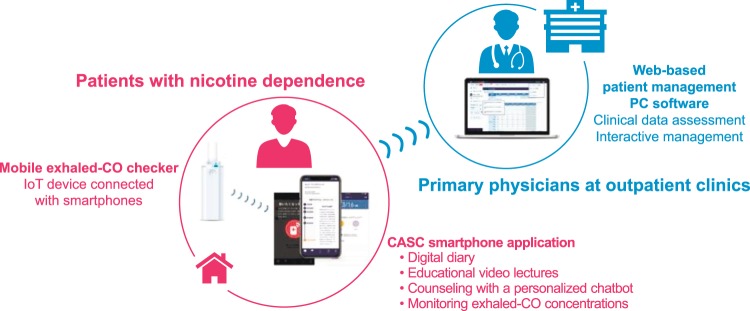
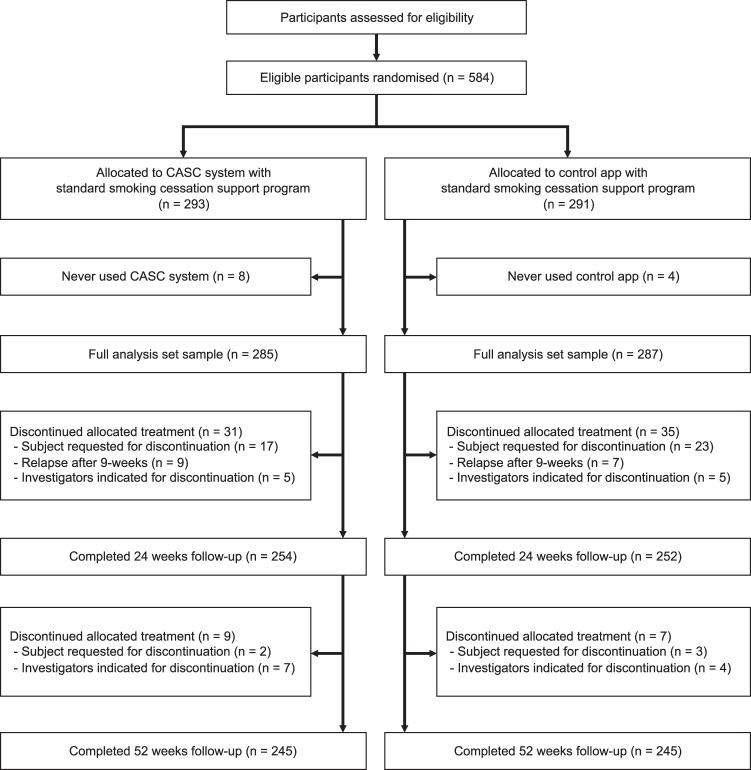
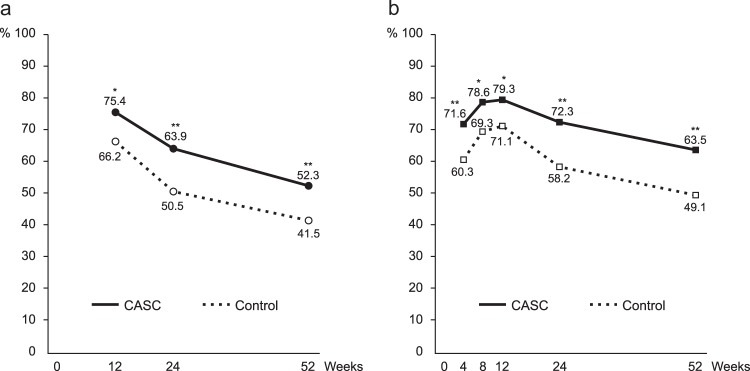
Abstract Evidence of the long-term efficacy of digital therapies for smoking cessation that include a smartphone application (app) is limited. In this multi-center randomized controlled trial, we tested the efficacy of a novel digital therapy for smoking cessation: the “CureApp Smoking Cessation (CASC)” system, including a CASC smartphone app, a web-based patient management PC software for primary physicians, and a mobile exhaled carbon monoxide (CO) checker. A total of 584 participants with nicotine dependence were recruited from October 2017 to January 2018, and allocated 1:1 to the CASC intervention group or the control group. Both groups received a standard smoking cessation treatment with pharmacotherapy and counseling for 12 weeks. Meanwhile, the intervention group used the CASC system, and the control group used a control-app without a mobile CO checker, each for 24 weeks. The primary outcome was the biochemically validated continuous abstinence rate (CAR) from weeks 9 to 24. The main secondary outcome was an extended CAR from weeks 9 to 52. Except for 12 participants who did not download or use the apps, 285 participants were assigned to the intervention group, and 287, to the control. CAR from weeks 9 to 24 in the intervention group was significantly higher than that in the control group (63.9% vs. 50.5%; odds ratio [OR], 1.73; 95% confidence interval [CI], 1.24 to 2.42; P = 0.001). The CAR from weeks 9 to 52 was also higher in the intervention group than that in the control group (52.3% vs. 41.5%; OR, 1.55; 95% CI, 1.11 to 2.16; P = 0.010). No specific adverse events caused by the CASC system were reported. Augmenting standard face-to-face counseling and pharmacotherapy with a novel smartphone app, the CASC system significantly improved long-term CARs compared to standard treatment and a minimally supportive control app.
Overview
The claims and statistics of this paper haven’t been checked yet.
Run the check — free, no account needed. It reads the open-access text and checks the sources it cites.
Integrity signals
Registry
Cites
Statistics
Figures
Verification
Claims the paper makes
The claims and statistics of this paper haven’t been checked yet.
Run the check — free, no account needed. It reads the open-access text and checks the sources it cites.
Claims other papers make about this one
Each is checked against this paper’s own text: does it say what the citing paper says it does?
The cited source says what the claim attributes to it.
In the citing paper
“Masaki et al. (2020), in a study comparing a pharmacotherapy and counseling intervention combined with an App (CASC App) with a control group that received the same treatment with an App that had only the basic functions of the CASC App found that the experimental group had higher continuous abstinence rates than the control group from week 9 to 24 (63.9 % vs. 50.5 %, respectively) and from week 9”
From Evaluation of effectiveness and acceptability of a psychological treatment for smoking cessation combined with a smartphone App: A pilot study (2024) · cites this paper as Masaki et al., 2020
The cited source says what the claim attributes to it.
In the citing paper
“Some studies have shown evidence supporting the effect of m-Health on different fields of health [33–35].”
Self-check
Percentages, sums and reported differences re-computed from the paper’s own numbers.
The self-check needs the paper’s full text.
Citations
Cites
Forouzanfar, M. H., Afshin, A., Alexander, L. T., Anderson, H. R., Bhutta, Z. A., Biryukov, S., Brauer, M., Burnett, R., Cercy, K., Charlson, F. J., et al. (2016) · The Lancet · doi:10.1016/s0140-6736(16)31679-8 · Cited by 7,698
Forouzanfar, M. H., Alexander, L., Anderson, H. R., Bachman, V. F., Biryukov, S., Brauer, M., Burnett, R., Casey, D., Coates, M. M., Cohen, A., et al. (2015) · The Lancet · doi:10.1016/s0140-6736(15)00128-2 · Cited by 2,701
Outcome criteria in smoking cessation trials: proposal for a common standard
West, R., Hajek, P., Stead, L., & Stapleton, J. (2005) · Addiction · doi:10.1111/j.1360-0443.2004.00995.x · Cited by 1,285
What has made the population of Japan healthy?
Ikeda, N., Saito, E., Kondo, N., Inoue, M., Ikeda, S., Satoh, T., Wada, K., Stickley, A., Katanoda, K., Mizoue, T., et al. (2011) · The Lancet · doi:10.1016/s0140-6736(11)61055-6 · Cited by 675
Tonstad, S. (2006) · JAMA · doi:10.1001/jama.296.1.64 · Cited by 660
Mobile phone text messaging and app-based interventions for smoking cessation
Whittaker, R., McRobbie, H., Bullen, C., Rodgers, A., Gu, Y., & Dobson, R. (2019) · Cochrane Database of Systematic Reviews · doi:10.1002/14651858.cd006611.pub5 · Cited by 452
Bricker, J. B., Mull, K. E., Kientz, J. A., Vilardaga, R., Mercer, L. D., Akioka, K. J., & Heffner, J. L. (2014) · Drug and Alcohol Dependence · doi:10.1016/j.drugalcdep.2014.07.006 · Cited by 340
Evaluation of the mood and physical symptoms scale (MPSS) to assess cigarette withdrawal
West, R., & Hájek, P. (2004) · Psychopharmacology · doi:10.1007/s00213-004-1923-6 · Cited by 257
Ikeda, N., Inoue, M., Iso, H., Ikeda, S., Satoh, T., Noda, M., Mizoue, T., Imano, H., Saito, E., Katanoda, K., et al. (2012) · PLoS Medicine · doi:10.1371/journal.pmed.1001160 · Cited by 240
Cited by
Sorted by citations
Items 101–105 of 105
Royo, J. M. P., Arribas, J. C., Marcos, P. J. T., Domenech, N. R., Lopez-Gil, J. F., Rillo, X. L., Mayoral, R. G., & Lopez, P. J. T. (2026) · Medicina de Familia SEMERGEN · doi:10.1016/j.semerg.2026.102795
Neuropharmacology of Nicotine Addiction and Therapeutic Strategies for Smoking Cessation
Hefny, A. A., Karuturi, R. C., Kalyaanamoorthy, S., Rao, P. P. N., & Ganesan, A. (2026) · Biology · doi:10.3390/biology15161412
Walicka, M., Russo, C., Ceriello, A., George, J., Campagna, D., Misra, A., Rosa, G. R. M. L., Sammut, R., & Polosa, R. (2026) · Diabetes Research and Clinical Practice · doi:10.1016/j.diabres.2026.113528
Hwang, I., Huh, K. Y., Yu, K.-S., & Lee, S. W. (2026) · Healthcare · doi:10.3390/healthcare14213604
Metadata
- Authors
- Masaki, K., Tateno, H., Nomura, A., Muto, T., Suzuki, S., Satake, K., Hida, E., & Fukunaga, K.
- Affiliations
- Keio University (JP)
- Kanazawa University (JP)
- The University of Osaka (JP)
- Corresponding author
- Tateno, Hiroki
- ORCID
- Venue
- npj Digital Medicine
- Published
- 2020-03-12
- Volume
- 3
- Issue
- 1
- Pages
- 35-35
- ISSN
- 2398-6352 (ISSN-L)
- PMC
- PMC7067789
- OpenAlex
- W3010960582
- Cited by
- 102
- References
- 29
- Citations by year
- 2026: 10 · 2025: 22 · 2024: 19 · 2023: 24 · 2022: 13 · 2021: 8 · 2020: 6
- FWCI
- 7.67
- Type
- journal article
- Language
- en
- Open access
- gold
- doi.org
- Locations
- npj Digital Medicine (publishedVersion, cc-by)
- Europe PMC (PubMed Central) (publishedVersion, cc-by)
- PubMed Central (publishedVersion, cc-by)
- PubMed (publishedVersion)
- DOAJ (DOAJ: Directory of Open Access Journals) (submittedVersion, cc-by-sa)
- Funders
- Keio University
- China Aerospace Science and Technology Corporation
- Topics
- Health Sciences › Medicine › Public Health, Environmental and Occupational Health › Smoking Behavior and Cessation
- Health Sciences › Health Professions › General Health Professions › Mobile Health and mHealth Applications
- Health Sciences › Medicine › Epidemiology › Substance Abuse Treatment and Outcomes
- Keywords
- smoking cessation, mobile application, digital therapy, exhaled carbon monoxide, nicotine dependence, continuous abstinence rate, long-term abstinence, pharmacotherapy, counseling
About these checks
Registry, retraction, Cites and statistics results are computed, not judged, with one exception: a printed reference that no index lists is read once by a model before it counts as a citation error. Claims are extracted by a model and kept only when their quote appears verbatim in the text; each cited source is then checked, with a model’s help, for whether it says what the claim relies on. Those verdicts can be wrong — read the claim’s quote and the cited source before relying on one.
Statistics and arithmetic are recomputed, not judged.
Confidence bands are shown only for fields calibrated on our annotated test set. None is calibrated yet, so no band is shown.
What counts as a claim ›How we measure confidence ›How we check this ›
Are you an author, or do you see a problem with this page? Request a review
