

The DOI matches its Crossref record; 22 of the 22 references it cites were found in a registry or an index.
Artificial intelligence for the diagnosis of heart failure
Open accessAbstract
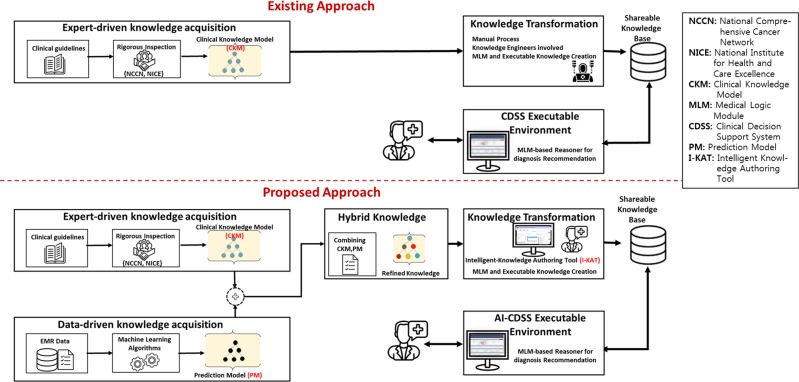
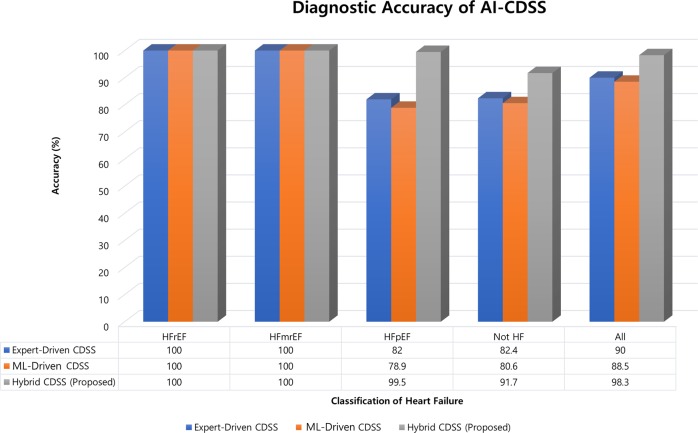
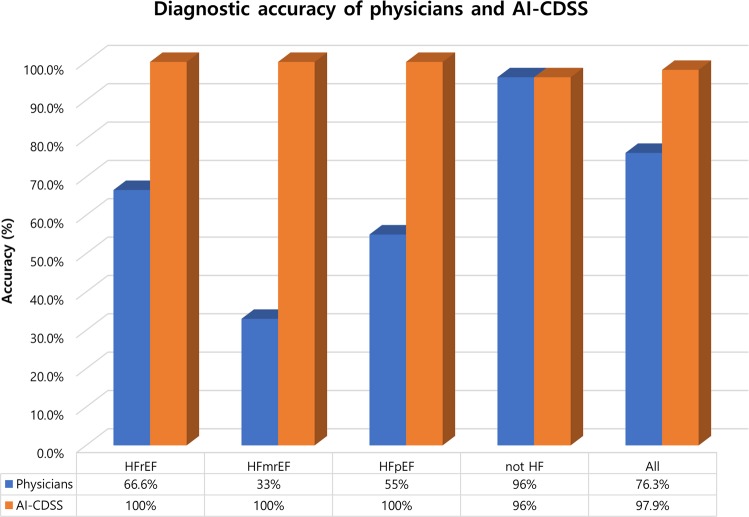
The diagnosis of heart failure can be difficult, even for heart failure specialists. Artificial Intelligence-Clinical Decision Support System (AI-CDSS) has the potential to assist physicians in heart failure diagnosis. The aim of this work was to evaluate the diagnostic accuracy of an AI-CDSS for heart failure. AI-CDSS for cardiology was developed with a hybrid (expert-driven and machine-learning-driven) approach of knowledge acquisition to evolve the knowledge base with heart failure diagnosis. A retrospective cohort of 1198 patients with and without heart failure was used for the development of AI-CDSS (training dataset, n = 600) and to test the performance (test dataset, n = 598). A prospective clinical pilot study of 97 patients with dyspnea was used to assess the diagnostic accuracy of AI-CDSS compared with that of non-heart failure specialists. The concordance rate between AI-CDSS and heart failure specialists was evaluated. In retrospective cohort, the concordance rate was 98.3% in the test dataset. The concordance rate for patients with heart failure with reduced ejection fraction, heart failure with mid-range ejection fraction, heart failure with preserved ejection fraction, and no heart failure was 100%, 100%, 99.6%, and 91.7%, respectively. In a prospective pilot study of 97 patients presenting with dyspnea to the outpatient clinic, 44% had heart failure. The concordance rate between AI-CDSS and heart failure specialists was 98%, whereas that between non-heart failure specialists and heart failure specialists was 76%. In conclusion, AI-CDSS showed a high diagnostic accuracy for heart failure. Therefore, AI-CDSS may be useful for the diagnosis of heart failure, especially when heart failure specialists are not available.
Overview
The claims and statistics of this paper haven’t been checked yet.
Run the check — free, no account needed. It reads the open-access text and checks the sources it cites.
Integrity signals
Registry
Cites
Statistics
Figures
Verification
Claims the paper makes
The claims and statistics of this paper haven’t been checked yet.
Run the check — free, no account needed. It reads the open-access text and checks the sources it cites.
Claims other papers make about this one
Each is checked against this paper’s own text: does it say what the citing paper says it does?
The cited source says what the claim attributes to it.
In the citing paper
“By integrating and analyzing patient symptoms, medical history, test results, and other risk factors, CDSS have the capability to support disease detection and identification [214,215], such as the subtle or ambiguous patterns that clinicians often overlook [216,217].”
From Toward Safer Diagnoses: A SEIPS-Based Narrative Review of Diagnostic Errors (2026) · cites this paper as [217]
Self-check
Percentages, sums and reported differences re-computed from the paper’s own numbers.
The self-check needs the paper’s full text.
Citations
Cites
McDonagh, T. A., Metra, M., Adamo, M., Gardner, R. S., Baumbach, A., Böhm, M., Burri, H., Butler, J., Čelutkienė, J., Chioncel, O. D., et al. (2021) · PubMed · doi:10.1093/eurheartj/ehab670 · Cited by 20,604
Lang, R. M., Badano, L. P., Mor-Avi, V., Afilalo, J., Armstrong, A., Ernande, L., Flachskampf, F. A., Foster, E., Goldstein, S. A., Kuznetsova, T., et al. (2015) · Journal of the American Society of Echocardiography · doi:10.1016/j.echo.2014.10.003 · Cited by 12,362
2016 ESC Guidelines for the Diagnosis and Treatment of Acute and Chronic Heart Failure
Ponikowski, P., Voors, A. A., Anker, S. D., Bueno, H., Cleland, J. G. F., Coats, A. J. S., Falk, V., González-Juanatey, J. R., Harjola, V.-P., Jankowska, E. A., et al. (2016) · European Journal of Heart Failure · doi:10.1002/ejhf.592 · Cited by 5,866
Burden of Systolic and Diastolic Ventricular Dysfunction in the Community
Redfield, M. M., Jacobsen, S. J., Burnett, J. C. J., Mahoney, D. W., Bailey, K. R., & Rodeheffer, R. J. (2003) · JAMA · doi:10.1001/jama.289.2.194 · Cited by 2,989
Artificial intelligence in cardiology
Johnson, K. W., Torres Soto, J., Glicksberg, B. S., Shameer, K., Miotto, R., Ali, M., Ashley, E., & Dudley, J. T. (2018) · Journal of the American College of Cardiology · doi:10.1016/j.jacc.2018.03.521 · Cited by 1,202
Bleumink, G. S., KNETSCH, A., Sturkenboom, M., Straus, S. E., Albert Hofman, D., Deckers, J. W., Witteman, J. C. M., & Stricker, B. H. C. (2004) · European Heart Journal · doi:10.1016/j.ehj.2004.06.038 · Cited by 1,165
More ‘Malignant’ Than Cancer? Five-Year Survival Following a First Admission for Heart Failure
Stewart, S., Macintyre, K., Hole, D. J., Capewell, S., & McMurray, J. J. V. (2001) · European Journal of Heart Failure · doi:10.1016/s1388-9842(00)00141-0 · Cited by 1,064
Reasoning Foundations of Medical Diagnosis
Ledley, R. S., & Lusted, L. B. (1959) · Science · doi:10.1126/science.130.3366.9 · Cited by 998
Electronic Alerts to Prevent Venous Thromboembolism among Hospitalized Patients
Kucher, N., Koo, S., Quiroz, R., Cooper, J. M., Paterno, M. D., Soukonnikov, B., & Goldhaber, S. Z. (2005) · New England Journal of Medicine · doi:10.1056/nejmoa041533 · Cited by 944
Clinical decision support in the era of artificial intelligence
Shortliffe, E. H., & Sepúlveda, M. J. (2018) · JAMA · doi:10.1001/jama.2018.17163 · Cited by 920
Cited by
Sorted by citations
Harnessing the Power of Clinical Decision Support Systems: Challenges and Opportunities
Chen, Z., Liang, N., Zhang, H., Li, H., Yang, Y., Zong, X., Chen, Y., Wang, Y., & Shi, N. (2023) · Open Heart · doi:10.1136/openhrt-2023-002432 · Cited by 244
Yasmin, F., Shah, S. M. I., Naeem, A., Shujauddin, S. M., Jabeen, A., Kazmi, S., Siddiqui, S. A., Kumar, P., Salman, S., Hassan, S. A., et al. (2021) · Reviews in Cardiovascular Medicine · doi:10.31083/j.rcm2204121 · Cited by 178
Artificial intelligence in cardiovascular medicine: clinical applications
Lüscher, T. F., Wenzl, F. A., D’Ascenzo, F., Friedman, P. A., & Antoniades, C. (2024) · European Heart Journal · doi:10.1093/eurheartj/ehae465 · Cited by 160
Li, X., Zhao, Y., Zhang, D., Kuang, L., Huang, H., Chen, W., Fu, X., Wu, Y., Li, T.-Z., Zhang, J., et al. (2022) · Chemosphere · doi:10.1016/j.chemosphere.2022.137039 · Cited by 135
Atualização de Tópicos Emergentes da Diretriz Brasileira de Insuficiência Cardíaca – 2021
Marcondes‐Braga, F. G., Moura, L. Z., Issa, V. S., Vieira, J. L., Rohde, L. E. P., Simões, M. V., Fernandes-Silva, M. M., Rassi, S., Martins, S. M., de Albuquerque, D. C., et al. (2021) · Arquivos Brasileiros de Cardiologia · doi:10.36660/abc.20210367 · Cited by 169
Metadata
- Authors
- Choi, D.-J., Park, J. J., Ali, T., & Lee, S.
- Affiliations
- Seoul National University (KR)
- Kyung Hee University (KR)
- Corresponding author
- Choi, Dong-Ju
- Lee, Sungyoung
- Venue
- npj Digital Medicine
- Published
- 2020-04-08
- Volume
- 3
- Issue
- 1
- Pages
- 54-54
- ISSN
- 2398-6352 (ISSN-L)
- PMC
- PMC7142093
- OpenAlex
- W3015932015
- Cited by
- 163
- References
- 22
- Citations by year
- 2026: 19 · 2025: 34 · 2024: 39 · 2023: 23 · 2022: 21 · 2021: 21 · 2020: 6
- FWCI
- 15.59
- Type
- journal article
- Language
- en
- Open access
- gold
- doi.org
- Locations
- npj Digital Medicine (publishedVersion, cc-by)
- PubMed Central (publishedVersion, cc-by)
- PubMed (publishedVersion)
- DOAJ (DOAJ: Directory of Open Access Journals) (submittedVersion, cc-by-sa)
- Funders
- Iran Telecommunication Research Center (IITP-2017-0-01629)
- Ministry of Science and ICT, South Korea (IITP-2017-0-01629)
- Institute for Information and Communications Technology Promotion (IITP-2017-0-01629)
- Topics
- Health Sciences › Health Professions › Health Information Management › Artificial Intelligence in Healthcare
- Health Sciences › Medicine › Health Informatics › Artificial Intelligence in Healthcare and Education
- Health Sciences › Medicine › Cardiology and Cardiovascular Medicine › Heart Failure Treatment and Management
- Keywords
- heart failure diagnosis, artificial intelligence, clinical decision support systems, diagnostic accuracy, dyspnea, heart failure with preserved ejection fraction, heart failure with reduced ejection fraction, mid-range ejection fraction
About these checks
Registry, retraction, Cites and statistics results are computed, not judged, with one exception: a printed reference that no index lists is read once by a model before it counts as a citation error. Claims are extracted by a model and kept only when their quote appears verbatim in the text; each cited source is then checked, with a model’s help, for whether it says what the claim relies on. Those verdicts can be wrong — read the claim’s quote and the cited source before relying on one.
Statistics and arithmetic are recomputed, not judged.
Confidence bands are shown only for fields calibrated on our annotated test set. None is calibrated yet, so no band is shown.
What counts as a claim ›How we measure confidence ›How we check this ›
Are you an author, or do you see a problem with this page? Request a review
