

Chatbots in the fight against the COVID-19 pandemic
Open accessThe DOI matches its Crossref record; 23 of the 23 references it cites were found in a registry or an index; 17 of the 51 sources its claims cite were checked for support.
Abstract
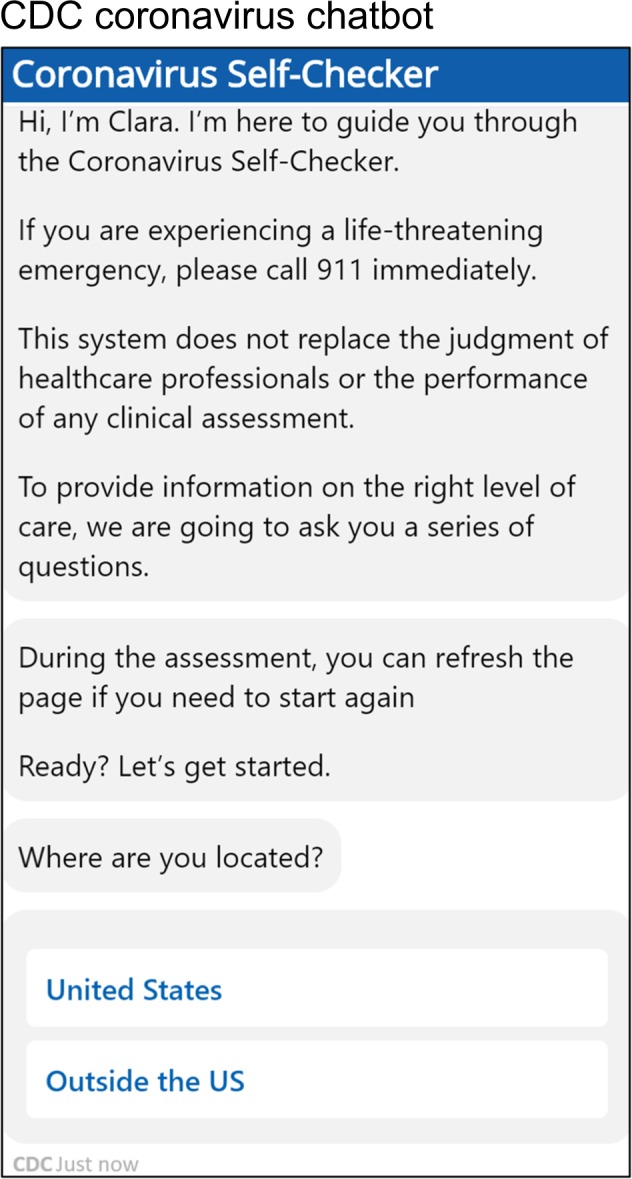
During the novel coronavirus (COVID-19) pandemic, institutions like the Centers for Disease Control and Prevention (CDC) and the World Health Organization (WHO) have begun utilizing chatbots to share information, suggest behavior, and offer emotional support 1 , 2 . The CDC has named theirs “Clara” (Fig. 1 ). Chatbots are software programs that talk with people through voice or text in their natural language 3 , 4 . Some well-known examples include “Alexa” from Amazon, “Siri” from Apple, and “Cortana” from Microsoft. They often come pre-installed on smartphones or home-based smart speakers 5 . In recent years, chatbot use for health-related purposes has increased considerably, from supporting clinicians with clinical interviews and diagnosis to aiding consumers in self-managing chronic conditions 6 . While promising, the use of chatbots may pose safety risks. Chatbots have varied widely in their responses to questions about physical health, suicide, intimate partner violence, substance abuse, and other sensitive conversations 4 , 6 , 7 , 8 , 9 . In one study, about a third (29%) of chatbot responses to health questions could have caused harm, and about half of those (16%) could have resulted in death if acted upon 9 . The COVID-19 pandemic puts in stark relief the potential for chatbots to help save lives.
Overview
CoChat Summary
TL;DR
Chatbots, if effectively designed and deployed, could help fight the COVID-19 pandemic by disseminating up-to-date information, encouraging health-protective behaviors, and mitigating the psychological harm of fear and isolation. However, the risk of amplifying misinformation and the lack of prior effectiveness research in pandemic contexts are serious concerns requiring immediate collaboration among healthcare workers, companies, academics, and governments.
Key findings
This is a perspective/commentary piece, not an empirical study, so it reports no original data; its claims are supported by cited literature.
- Chatbots may be uniquely suited to pandemic response across four functions: information dissemination, symptom monitoring, behavior change support, and mental health support.
- Prior research cited suggests people are more willing to disclose sensitive personal symptom information to a chatbot than to a human, which could improve triage and population-level infection estimates.
- Safety concerns are documented from prior work: in one cited study, about a third (29%) of chatbot responses to health questions could have caused harm, and about half of those (16%) could have resulted in death if acted upon.
- Cited evidence on pandemic mental health harm: the 2003 SARS outbreak produced a "mental health catastrophe" in which 59% of a hospitalized cohort developed a diagnosable psychiatric disorder, and after 30 months less than half had psychologically recovered.
Methods
Not stated in the paper (no empirical design, sample, or analysis); this is a narrative perspective article synthesizing cited literature and current chatbot deployments.
- Draws on cited studies of chatbot health responses, disclosure behavior, and pandemic psychology, plus examples of deployed COVID-19 chatbots (CDC's "Clara," WHO's WhatsApp health alert, and corporate/government chatbots).
- Organizes the argument around pandemic challenges, special features of pandemics, four chatbot affordances, and corresponding challenges.
Limitations
Stated by the paper: chatbots are untested in pandemics and have demonstrated limits in health crisis detection and response; long-term mental health outcomes of chatbot use are unclear and worthy of future investigation; challenges addressed only in real time during a crisis may lead to erroneous outputs from lack of testing; developers must decide whose voice to amplify amid conflicting global/local advice; third-party "skills" raise data-sharing concerns with unknown consequences; symptom screening tests constitutional and regulatory boundaries (e.g., reported digital contact tracing exploration in the US and Israel).
- Evident from the text: the article presents no original data or evaluation, so its claims about chatbot effectiveness rest on extrapolation from non-pandemic contexts and cited prior work.
Model-written summary. Check it against the paper before relying on it.
Integrity signals
Registry
Cites
Statistics
Figures
Verification
Claims the paper makes
8 Valid · 0 Not valid · 24 Not checked · 15 Own results and interpretations
The cited sources support only part of this claim — read each source’s verdict below.
In the paper
“Fourth, infection countermeasures (e.g., social distancing and quarantine) are psychologically damaging13.”
§ Chatbots in the fight against the COVID-19 pandemic > Challenges posed by pandemics
What the sources say
- Partly supportedcites [13] Brooks SK The psychological impact of quarantine and how to reduce it: rapid review of the evidence Lancet 2020 395 912 920 10.1016/S0140-6736(20)30460-8 32112714 PMC7158942 sourceExperimental — accuracy not yet measured
The review’s Conclusion says the psychological impact of quarantine can be substantial and long-lasting, supporting the quarantine part of the claim. But “What we do not know” treats social distancing as a separate measure whose relative effects need further research; the review does not establish that social distancing is psychologically damaging. (LLM, conf=0.88)
plainstates a cause- Asserted: passes — The authors put it forward as true.
- Checkable: passes — It can be checked against evidence.
- Load-bearing: unclear — It is unclear whether the paper’s conclusions depend on it.
- Based: passes — The paper gives a reason why it holds.
- Partly supported
The cited sources support only part of this claim — read each source’s verdict below.
In the paper
“Chatbots have varied widely in their responses to questions about physical health, suicide, intimate partner violence, substance abuse, and other sensitive conversations4,6–9.”
§ Chatbots in the fight against the COVID-19 pandemic > Introduction
What the sources say
- Partly supportedcites [4] Miner AS Smartphone-based conversational agents and responses to questions about mental health, interpersonal violence, and physical health JAMA Intern. Med. 2016 176 619 625 10.1001/jamainternmed.2016.0400 26974260 PMC4996669 sourceExperimental — accuracy not yet measured
The Results and Discussion report inconsistent responses to questions about physical health, suicide, and intimate partner violence. The Methods describe nine questions across mental health, interpersonal violence, and physical health, but our copy does not report testing responses to substance-abuse questions; that part of the claim is unsupported. (LLM, conf=0.88)
- Partly supportedcites [6] Laranjo L Conversational agents in healthcare: a systematic review J. Am. Med. Inform. Assoc. 2018 25 1248 1258 10.1093/jamia/ocy072 30010941 PMC6118869 sourceExperimental — accuracy not yet measured
The Results (Evaluation measures; page unavailable) mention inappropriate responses to suicide statements. The Discussion (Implications for healthcare, public health, and future research; page unavailable) reports that smartphone conversational agents often failed to recognize or respond appropriately to serious health concerns. Our copy does not establish that responses varied widely across the specific topics of intimate partner violence and substance abuse. (LLM, conf=0.83)
- Supportedcites [7] Nobles AL Responses to addiction help-seeking from Alexa, Siri, Google Assistant, Cortana, and Bixby intelligent virtual assistants NPJ Digit. Med. 2020 3 11 10.1038/s41746-019-0215-9 32025572 PMC6989668 source
The Results and Discussion report varied responses from five virtual assistants to substance-use help-seeking queries: most produced no singular response, while a few offered an app, a retailer, or a definition. This supports the substance-abuse portion of the sentence; the other topics are covered by the sentence’s other citations. (LLM, conf=0.91)
- Supportedcites [8] Kocaballi AB Responses of conversational agents to health and lifestyle prompts: investigation of appropriateness and presentation structures J. Med. Internet Res. 2020 22 e15823 10.2196/15823 32039810 PMC7055771 source
The Methods (Pilot Study; page unavailable) list prompts about suicide, partner assault, physical symptoms, drinking, and smoking. The Results (Appropriate Responses; page unavailable) and Discussion (Comparison With Prior Work; page unavailable) describe differing response rates and inconsistent answers across agents, platforms, and prompts, supporting the claim that responses varied across these sensitive topics. (LLM, conf=0.90)
- Supportedcites [9] Bickmore TW Patient and consumer safety risks when using conversational assistants for medical information: an observational study of Siri, Alexa, and Google assistant J. Med. Internet Res. 2018 20 e11510 10.2196/11510 30181110 PMC6231817 source
The Results section (“Differences by Conversational Assistants”; page unavailable) reports substantially different task-failure rates for Alexa, Siri, and Google Assistant when users sought medical information. This supports the physical-health portion of the sentence for which this paper is one of several citations. (LLM, conf=0.90)
plain- Asserted: passes — The authors put it forward as true.
- Checkable: passes — It can be checked against evidence.
- Load-bearing: passes — The paper’s conclusions depend on it.
- Based: passes — The paper gives a reason why it holds.
- Partly supported
Every source the paper cites for this claim was checked and supports it.
In the paper
“Although global and national health bodies highlight the importance of mental health in a pandemic, COVID-19 mental health needs have reportedly been under-addressed24.”
§ Chatbots in the fight against the COVID-19 pandemic > Special features of pandemics > Mental health support
What the sources say
- Supportedcites [24] Xiang YT Timely mental health care for the 2019 novel coronavirus outbreak is urgently needed Lancet Psychiatry 2020 7 228 229 10.1016/S2215-0366(20)30046-8 32032543 PMC7128153 source
The paper explicitly states that mental health care for patients and health professionals directly affected by the 2019-nCoV epidemic had been under-addressed, despite a Chinese national notification on psychological crisis intervention. This supports the cited claim about under-addressed COVID-19 mental health needs in the outbreak context the paper discusses. (LLM, conf=0.94)
hedged- Asserted: passes — The authors put it forward as true.
- Checkable: passes — It can be checked against evidence.
- Load-bearing: passes — The paper’s conclusions depend on it.
- Based: passes — The paper gives a reason why it holds.
- Supported
The cited sources support only part of this claim — read each source’s verdict below.
In the paper
“With more than a billion voice searches per month, any health-related mistakes, such as misidentifying key symptoms, would be amplified with extensive harmful repercussions4,9.”
§ Chatbots in the fight against the COVID-19 pandemic > Challenges
What the sources say
- Partly supportedcites [4] Miner AS Smartphone-based conversational agents and responses to questions about mental health, interpersonal violence, and physical health JAMA Intern. Med. 2016 176 619 625 10.1001/jamainternmed.2016.0400 26974260 PMC4996669 sourceExperimental — accuracy not yet measured
The Results and Discussion (page unavailable) document failures to recognize health concerns and distinguish their seriousness. The paper does not report more than a billion voice searches per month or establish that such errors would be amplified with extensive harmful repercussions. (LLM, conf=0.85)
- Partly supportedcites [9] Bickmore TW Patient and consumer safety risks when using conversational assistants for medical information: an observational study of Siri, Alexa, and Google assistant J. Med. Internet Res. 2018 20 e11510 10.2196/11510 30181110 PMC6231817 sourceExperimental — accuracy not yet measured
The Introduction (Background; page unavailable) reports over a billion voice searches per month and warns that incorrect medical information could cause harm if users act on it. The Discussion (Principal Findings; page unavailable) reports simulated outcomes that could have caused harm or death. The paper does not show that errors are amplified across those searches or establish the extensive real-world repercussions asserted in the claim. (LLM, conf=0.84)
hedgedstates a cause- Asserted: passes — The authors put it forward as true.
- Checkable: passes — It can be checked against evidence.
- Load-bearing: unclear — It is unclear whether the paper’s conclusions depend on it.
- Based: passes — The paper gives a reason why it holds.
- Partly supported
Every source the paper cites for this claim was checked and supports it.
In the paper
“Simply disclosing concerns and receiving emotionally supportive responses can have positive value in some contexts25.”
§ Chatbots in the fight against the COVID-19 pandemic > Special features of pandemics > Mental health support
What the sources say
- Supportedcites [25] Ho A Hancock J Miner AS Psychological, relational, and emotional effects of self-disclosure after conversations with a chatbot J. Commun. 2018 68 712 733 10.1093/joc/jqy026 30100620 PMC6074615 source
Methods (Training and Procedure; page not provided) describe conversations in which participants disclosed emotions and received validating, empathetic responses. Results (Overview; page not provided) report stronger emotional, relational, and psychological benefits after emotional than factual disclosure, supporting the claim's qualified statement that this can have positive value. (LLM, conf=0.92)
plainstates a possible cause- Asserted: passes — The authors put it forward as true.
- Checkable: passes — It can be checked against evidence.
- Load-bearing: passes — The paper’s conclusions depend on it.
- Based: passes — The paper gives a reason why it holds.
- Supported
16 more claims
Create a free account to see all 47 claims and to verify the 34 references still open.
- Probably not a substantial claim. 15
- It may state two separate claims as one. 14
Claims other papers make about this one
Each is checked against this paper’s own text: does it say what the citing paper says it does?
In the citing paper
“Chatbots and other artificial intelligence (AI) systems have become increasingly popular in recent years for providing information and assistance to users in online spaces (3)”
From Using ChatGPT to evaluate cancer myths and misconceptions: artificial intelligence and cancer information (2023) · cites this paper as [3]
Citations
Cites
The Psychological Impact of Quarantine and How to Reduce It: Rapid Review of the Evidence
Brooks, S. K., Webster, R. K., Smith, L. E., Woodland, L., Wessely, S., Greenberg, N., & Rubin, G. J. (2020) · doi:10.2139/ssrn.3532534 · Cited by 16,394
The psychological impact of quarantine and how to reduce it: Rapid review of the evidence
Brooks, S. K., Webster, R. K., Smith, L. E., Woodland, L., Wessely, S., Greenberg, N., & Rubin, G. J. (2020) · The Lancet · doi:10.1016/s0140-6736(20)30460-8 · Cited by 16,378
The spread of true and false news online
Vosoughi, S., Roy, D., & Aral, S. (2018) · Science · doi:10.1126/science.aap9559 · Cited by 8,847
Timely mental health care for the 2019 novel coronavirus outbreak is urgently needed
Xiang, Y.-T., Yang, Y., Li, W., Zhang, L., Zhang, Q., Cheung, T., & Ng, C. H. (2020) · The Lancet Psychiatry · doi:10.1016/s2215-0366(20)30046-8 · Cited by 3,598
Report of the WHO-China Joint Mission on Coronavirus Disease 2019 (COVID-19)
Gomes, C. A. (2020) · LA Referencia (Red Federada de Repositorios Institucionales de Publicaciones Científicas) · Cited by 2,134
Conversational agents in healthcare: a systematic review
Laranjo, L., Dunn, A. G., Tong, H. L., Kocaballi, A. B., Chen, J., Bashir, R., Surian, D., Gallego, B., Magrabi, F., Lau, A. Y. S., et al. (2018) · Journal of the American Medical Informatics Association · doi:10.1093/jamia/ocy072 · Cited by 1,388
Self-citationChatbots and Conversational Agents in Mental Health: A Review of the Psychiatric Landscape
Vaidyam, A. N., Wisniewski, H., Halamka, J. D., Kashavan, M. S., & Torous, J. B. (2019) · The Canadian Journal of Psychiatry · doi:10.1177/0706743719828977 · Cited by 1,048
Long-term psychiatric morbidities among SARS survivors
Mak, I. W. C., Chu, C. M., Pan, P. C., Yiu, M. G. C., & Chan, V. L. (2009) · General Hospital Psychiatry · doi:10.1016/j.genhosppsych.2009.03.001 · Cited by 1,018
It's only a computer: virtual humans increase willingness to disclose
Lucas, G. M., Gratch, J., King, A., & Morency, L.-P. (2014) · Computers in Human Behavior · doi:10.1016/j.chb.2014.04.043 · Cited by 977
Ho, A., Hancock, J., & Miner, A. S. (2018) · Journal of Communication · doi:10.1093/joc/jqy026 · Cited by 629
Self-citation
Cited by
Items 101–200 of 393
Building a Chatbot for Supporting the Admission of Universities
Nguyen, M.-T., Tran-Tien, M., Viet, A. P., Vu, H.-T., & Nguyen, V.-H. (2021) · International Conference on Knowledge and Systems Engineering/Proceedings · doi:10.1109/kse53942.2021.9648677 · Cited by 27
Integration of Federated Learning and Blockchain in Healthcare: A TutorialPreprint
Shahsavari, Y., Dambri, O. A., Baseri, Y., Hafid, A. S., & Makrakis, D. (2024) · TechRxiv · doi:10.36227/techrxiv.171340632.25905526/v1 · Cited by 27
Yang, L., Lu, S., & Zhou, L. (2024) · China CDC Weekly · doi:10.46234/ccdcw2024.192 · Cited by 26
Navarrete, W. S. E., Fiallos, G. P. G., Betancourt, C. C., & Sánchez, I. (2020) · IEEE Annual Information Technology, Electronics and Mobile Communication Conference (IEMCON) · doi:10.1109/iemcon51383.2020.9284846 · Cited by 26
Srivastava, B. (2021) · Patterns · doi:10.1016/j.patter.2021.100308 · Cited by 16
User Experience of COVID-19 Chatbots: Scoping Review
White, B. K., Martin, A., & White, J. A. (2022) · Journal of Medical Internet Research · doi:10.2196/35903 · Cited by 26
Fusion of AI techniques to tackle COVID-19 pandemic: models, incidence rates, and future trends
Shah, H., Shah, S., Tanwar, S., Gupta, R., & Kumar, N. (2021) · Multimedia Systems · doi:10.1007/s00530-021-00818-1 · Cited by 26
BIRD-QA: A BERT-based Information Retrieval Approach to Domain Specific Question Answering
Chen, Y., & Zulkernine, F. H. (2021) · IEEE International Conference on Big Data (BigData) · doi:10.1109/bigdata52589.2021.9671523 · Cited by 25
Development of Intelligent Telegram Chatbot Using Natural Language Processing
Gunawan, T. S., Balla, A., Ismail, N., & Effendi, M. R. (2021) · International Conference on Wireless and Telematics (ICWT) · doi:10.1109/icwt52862.2021.9678471 · Cited by 25
Sustainable Development Goal 3 in Healthcare
Chiu, W.-K., & Fong, B. Y. F. (2023) · Sustainable development goals series · doi:10.1007/978-981-99-1564-4_3 · Cited by 24
Bridging the Health Disparity of African Americans Through Conversational Agents
Kim, J., Park, S. Y., & Robert, L. (2020) · Digital Government Research and Practice · doi:10.1145/3428122 · Cited by 24
Almalki, M. (2021) · Medical Archives · doi:10.5455/medarh.2021.75.50-55 · Cited by 24
Soubutts, E., Ayobi, A., Eardley, R., McNaney, R., Cater, K., & O'Kane, A. A. (2022) · Proceedings of the ACM on Human-Computer Interaction · doi:10.1145/3555193 · Cited by 23
Era of Generalist Conversational Artificial Intelligence to Support Public Health Communications
Sezgın, E., & Kocaballi, A. B. (2025) · Journal of Medical Internet Research · doi:10.2196/69007 · Cited by 24
Self-citationApplications of telemedicine in the supply and distribution of COVID-19 vaccines in Africa
Okereke, M., Babatunde, A. O., Samuel, S. T., Ogunkola, I. O., Mogessie, Y. G., & Lucero‐Prisno, D. E. (2021) · Journal of Global Health · doi:10.7189/jogh.11.03039 · Cited by 23
Diabetes and conversational agents: the AIDA project case study
Alloatti, F., Bosca, A., Di, L., & Pieraccini, F. (2021) · Discover Artificial Intelligence · doi:10.1007/s44163-021-00005-1 · Cited by 24
Chase Away the Virus: A Character-Based Chatbot for COVID-19
Hefny, W. E., Bolock, A. E., Herbert, C., & Abdennadher, S. (2021) · SeGAH ... IEEE ... International Conference on Serious Games and Applications for Health/IEEE International Conference on Serious Games and Applications for Health · doi:10.1109/segah52098.2021.9551895 · Cited by 24
What is the impact of artificial intelligence-based chatbots on infodemic management?
Morita, P. P., Lotto, M., Kaur, J., Chumachenko, D., Oetomo, A., Espiritu, K. D., & Hussain, I. Z. (2024) · Frontiers in Public Health · doi:10.3389/fpubh.2024.1310437 · Cited by 22
Micro-foundations of Artificial Intelligence Adoption in Business: Making the Shift
Kushwaha, A. K., & Kar, A. K. (2020) · IFIP advances in information and communication technology · doi:10.1007/978-3-030-64849-7_22 · Cited by 22
Shah, I., Doshi, C., Patel, M. M., Tanwar, S., Hong, W., & Sharma, R. (2022) · Medicina · doi:10.3390/medicina58020311 · Cited by 22
Initial Experience with a COVID-19 Screening Chatbot Before Radiology Appointments
Wang, W. T., Tan, N., Hanson, J. A., Crubaugh, C. A., & Hara, A. K. (2022) · Journal of Imaging Informatics in Medicine · doi:10.1007/s10278-022-00650-7 · Cited by 22
Bank, W. (2021) · World Bank, Washington, DC eBooks · doi:10.1596/35619 · Cited by 22
Development of Conversational Artificial Intelligence for Pandemic Healthcare Query Support
Woo, W. L., Gao, B., Al-Nima, R. R. O., & Ling, B. W. (2020) · International Journal of Automation Artificial Intelligence and Machine Learning · doi:10.61797/ijaaiml.v1i1.35 · Cited by 22
Eiselt, A.-K., Kirkendall, S., Xiong, E., Langner, D., & Goldfarb, M. B. (2026) · Frontiers in Digital Health · doi:10.3389/fdgth.2025.1713334 · Cited by 21
Trzebiński, W., Claessens, T., Buhmann, J., Waele, A. D., Hendrickx, G., Damme, P. V., Daelemans, W. M. P., & Poels, K. (2023) · JMIR Formative Research · doi:10.2196/41148 · Cited by 21
Talking Abortion (Mis)information with ChatGPT on TikTok
Sharevski, F., Loop, J. V., Jachim, P., Devine, A., & Pieroni, E. (2023) · IEEE European Symposium on Security and Privacy Workshops (EuroS&PW) · doi:10.1109/eurospw59978.2023.00071 · Cited by 21
ChatGPT and retinal disease: a cross-sectional study on AI comprehension of clinical guidelines
Balas, M., Mandelcorn, E. D., Yan, P., Ing, E. B., Crawford, S. A., & Arjmand, P. (2024) · Canadian Journal of Ophthalmology · doi:10.1016/j.jcjo.2024.06.001 · Cited by 20
Chatbot como herramienta comunicativa durante la crisis sanitaria COVID-19 en España
Daimiel, G. B., Barrero, N. P., & Estrella, E. C. M. (2021) · Comhumanitas · doi:10.31207/rch.v11i3.270 · Cited by 21
Shan, Y., Ji, M., Xie, W., Zhang, X., Qian, X., Li, R., & Hao, T. (2022) · JMIR Human Factors · doi:10.2196/36831 · Cited by 20
MedLingua: A conceptual framework for a multilingual medical conversational agent
Himel, G. M. S., Hasan, M. S., Salsabil, U. S., & Islam, M. M. (2024) · MethodsX · doi:10.1016/j.mex.2024.102614 · Cited by 19
Evaluation of COVID-19 Information Provided by Digital Voice Assistants
Goh, A. S. Y., Wong, L. L., & Yap, K. Y. (2021) · International Journal of Digital Health · doi:10.29337/ijdh.25 · Cited by 19
Yang, H. Y., Zhang, S., Liu, R., Krall, A., Wang, Y., Ventura, M. J., & DeFlitch, C. J. (2022) · Springer proceedings in business and economics · doi:10.1007/978-3-030-75166-1_1 · Cited by 19
Epstein, R., Lee, V., Mohr, R., & Zankich, V. R. (2022) · PLoS ONE · doi:10.1371/journal.pone.0268081 · Cited by 19
Wang, R., Lyu, H., Lu, Z., Huang, X., Wu, H., Xiong, J., & Yang, G. (2023) · JMIR Human Factors · doi:10.2196/42870 · Cited by 19
Technological and analytical review of contact tracing apps for COVID-19 management
Gupta, R., Pandey, G., Chaudhary, P., & Pal, S. K. (2021) · Journal of Location Based Services · doi:10.1080/17489725.2021.1899319 · Cited by 18
Developing Intelligent Interviewers to Collect the Medical History: Lessons Learned and Guidelines
Gashi, F., Regli, S. F., May, R., Tschopp, P., & Denecke, K. (2021) · Studies in health technology and informatics · doi:10.3233/shti210083 · Cited by 18
A predictive internet-based model for COVID-19 hospitalization census
Turk, P. J., Tran, T. P., Rose, G. A., & McWilliams, A. D. (2021) · Scientific Reports · doi:10.1038/s41598-021-84091-2 · Cited by 18
Multilingual Framework for Risk Assessment and Symptom Tracking (MRAST)
Šafran, V., Lin, S. M., Nateqi, J., Martin, A. G., Smrke, U., Ariöz, U., Plohl, N., Rojc, M., Bēma, D., Chávez, M., et al. (2024) · Sensors · doi:10.3390/s24041101 · Cited by 17
Testing behaviour change with an artificial intelligence chatbot in a randomized controlled study
van Baal, S. T., Le, S. T. T., Fatehi, F., Verdejo‐García, A., & Hohwy, J. (2024) · Journal of Public Health Policy · doi:10.1057/s41271-024-00500-6 · Cited by 18
Customizability in conversational agents and their impact on health engagement
Paul, S. C., Bartmann, N., & Clark, J. (2021) · Human Behavior and Emerging Technologies · doi:10.1002/hbe2.320 · Cited by 17
A Study of BERT-Based Classification Performance of Text-Based Health Counseling Data
Sung, Y. W., Park, D. S., & Kim, C. G. (2022) · Computer Modeling in Engineering & Sciences · doi:10.32604/cmes.2022.022465 · Cited by 17
Robotics and Automation: The Rescuers of COVID Era
Chauhan, A. (2021) · Studies in systems, decision and control · doi:10.1007/978-3-030-69744-0_8 · Cited by 17
Nhemachena, A. (2021) · Journal of Black Studies · doi:10.1177/00219347211026012 · Cited by 16
A Review of Arabic Intelligent Chatbots: Developments and Challenges
Al-Irhayim, Y. F. M., & Abdulkader, Z. N. (2022) · Maǧallaẗ al-handasaẗ al-rāfidayn · doi:10.33899/rengj.2022.132550.1148 · Cited by 16
Ali, H., Patel, P., Obaitan, I., Mohan, B. P., Sohail, A. H., Smith-Martinez, L., Lambert, K., Gangwani, M. K., Easler, J. J., & Adler, D. G. (2023) · iGIE · doi:10.1016/j.igie.2023.10.001 · Cited by 15
“17 ChatGPT can support healthcare providers by generating responses to routine patient inquiries, potentially saving time for more complex cases.”
Large Language Models in Healthcare: A Review
Zou, S., & He, J. (2023) · International Symposium on Computer Science and Intelligent Control (ISCSIC) · doi:10.1109/iscsic60498.2023.00038 · Cited by 15
Applying the Character-Based Chatbots Generation Framework in Education and Healthcare
Hefny, W. E., Bolock, A. E., Herbert, C., & Abdennadher, S. (2021) · International Conference on Human-Agent Interaction (HAI) · doi:10.1145/3472307.3484172 · Cited by 15
Interactive Search on the Web: The Story So Far
Aghaei, S., Angele, K., Huaman, E., Bushati, G., Schiestl, M., & Fensel, A. (2022) · Information · doi:10.3390/info13070324 · Cited by 15
A privacy-preserving dialogue system based on argumentation
Fazzinga, B., Galassi, A., & Torroni, P. (2022) · Intelligent Systems with Applications · doi:10.1016/j.iswa.2022.200113 · Cited by 15
The Accuracy of Artificial Intelligence (AI) Chatbots in Telemedicine
Swick, R. K. (2021) · Journal of the South Carolina Academy of Science · Cited by 14
Liu, A. W., Odisho, A. Y., Brown, W., Gonzales, R., Neinstein, A. B., & Judson, T. J. (2022) · JMIR Human Factors · doi:10.2196/40064 · Cited by 14
Smart Solutions to Keep Your Mental Balance
Gîfu, D., & Pop, E. (2022) · Procedia Computer Science · doi:10.1016/j.procs.2022.11.205 · Cited by 14
Perceived Utilities of COVID-19 Related Chatbots in Saudi Arabia: a Cross-sectional Study
Almalki, M. (2020) · Acta Informatica Medica · doi:10.5455/aim.2020.28.219-224 · Cited by 14
The Role of Conversational Agents for Substance Use Disorder in Social Distancing Contexts
Su, Z., Schneider, J. A., & Young, S. D. (2021) · Substance Use & Misuse · doi:10.1080/10826084.2021.1949609 · Cited by 14
Yücel, Y., & Rızvanoğlu, K. (2022) · IEEE International Conference on e-Business Engineering (ICEBE) · doi:10.1109/icebe55470.2022.00059 · Cited by 13
On the Usage of Smart Speakers During the Covid-19 Coronavirus Lockdown
Furini, M., Mirri, S., Montangero, M., & Prandi, C. (2020) · EAI International Conference on Smart Objects and Technologies for Social Good (GOODTECHS) · doi:10.1145/3411170.3411260 · Cited by 13
Population subgroup differences in the use of a COVID-19 chatbot
Schubel, L., Wesley, D. B., Booker, E. A., Lock, J., & Ratwani, R. M. (2021) · npj Digital Medicine · doi:10.1038/s41746-021-00405-8 · Cited by 13
Jormanainen, V. J., & Soininen, L. (2021) · Studies in health technology and informatics · doi:10.3233/shti210270 · Cited by 13
BotCovid: Development and Evaluation of a Chatbot to Combat Misinformation about COVID-19 in Brazil
Roque, G. D. S. L., Cavalcanti, A. R. D. S., do Nascimento, J. W. A., de Souza, R. R., & Queiroz, S. (2021) · Conference proceedings/Conference proceedings - IEEE International Conference on Systems, Man, and Cybernetics · doi:10.1109/smc52423.2021.9658693 · Cited by 13
Al‐Tawfiq, J. A., Jamal, A. A., Rodriguez-Morales, A. J., & Temsah, M.-H. A. (2023) · New Microbes and New Infections · doi:10.1016/j.nmni.2023.101153 · Cited by 13
Pandey, V. K., Munshi, A., Mohanti, B. K., Bansal, K., & Rastogi, K. (2024) · Cancer/Radiothérapie · doi:10.1016/j.canrad.2023.11.005 · Cited by 12
ETHICS of AI Adoption and Deployment in Health Care: Progress, Challenges, and Next Steps
Oleribe, O. O., Taylor-Robinson, A. W., Chimezie, C., & Taylor-Robinson, S. D. (2025) · JMIR AI · doi:10.2196/67626 · Cited by 12
Un chatbot para asistir a las necesidades de información en tiempos de COVID-19
Peña-Torres, J. A., Alegría, S. A. G., Pastrana, C. A. A., & Bucheli, V. (2021) · Ingeniería y Competitividad · doi:10.25100/iyc.v24i1.11004 · Cited by 12
Chatbot for Public Relations and Customer Service in Indonesia: A Diffusion Innovation Study
Nasikhah, N., Wijaya, G., & Rahayu, T. P. (2022) · Jurnal Sosioteknologi · doi:10.5614/sostek.itbj.2022.21.3.5 · Cited by 12
Swastiko, L., & Fauzi, A. (2023) · Jurnal Akuntansi dan Manajemen Bisnis · doi:10.56127/jaman.v3i1.664 · Cited by 12
Liu, X., & Zhang, Z.-R. (2024) · World Journal of Psychiatry · doi:10.5498/wjp.v14.i3.334 · Cited by 13
Mining the Chatbot Brain to Improve COVID-19 Bot Response Accuracy
Ghaleb, M., Almurtadha, Y., Algarni, F., Abdullah, M., Felemban, E. A., Alsharafi, A. M., Othman, M. O., & Ghilan, K. (2021) · Computers, materials & continua/Computers, materials & continua (Print) · doi:10.32604/cmc.2022.020358 · Cited by 12
Judson, T. J., Pierce, L., Tutman, A., Mourad, M., Neinstein, A. B., Shuler, G., Gonzales, R., & Odisho, A. Y. (2022) · Journal of the American Medical Informatics Association · doi:10.1093/jamia/ocac161 · Cited by 12
Cheng, Y. (2025) · Online Information Review · doi:10.1108/oir-07-2024-0425 · Cited by 11
Design Validation of a Relational Agent by COVID-19 Patients: Mixed Methods Study
Islam, A., & Chaudry, B. (2023) · JMIR Human Factors · doi:10.2196/42740 · Cited by 11
Liu, F. (2022) · Journal of Promotion Management · doi:10.1080/10496491.2022.2163031 · Cited by 11
COVID-19 Vaccine Equity and Access: Case Study for Health Care Chatbots
Perez-Ramos, J. G., León-Thomas, M., Smith, S. L., Silverman, L. B., Pérez-Torres, C., Hall, W. C., & Iadarola, S. (2022) · JMIR Formative Research · doi:10.2196/39045 · Cited by 11
A Smart Virtual Assistant Answering Questions About COVID-19
Uğurlu, Y., Karabulut, M., & Mayda, İ. (2020) · International Symposium on Multidisciplinary Studies and Innovative Technologies (ISMSIT) · doi:10.1109/ismsit50672.2020.9254350 · Cited by 11
Chatbots for the Detection of Covid-19: A Systematic Review of the Literature
Albites-Tapia, A., Gamboa-Cruzado, J., Almeyda-Ortiz, J., & Lázaro, A. M. (2022) · International Journal of Advanced Computer Science and Applications · doi:10.14569/ijacsa.2022.01304113 · Cited by 12
Li, L., Wang, T., Wang, Y., Wang, Y., & Zeng, X. (2026) · International Journal of Human-Computer Interaction · doi:10.1080/10447318.2026.2618563 · Cited by 10
Leveraging the Rhetorical Energies of Machines: COVID-19, Misinformation, and Persuasive Labor
Coleman, M. C. (2021) · Human-Machine Communication · doi:10.30658/hmc.3.2 · Cited by 10
Factors influencing the adoption of chatbots by healthcare users
Bermeo-Giraldo, M. C., Patiño-Toro, O. N., Valencia-Arías, A., & Rodríguez-Correa, P. A. (2023) · Journal of Innovation Management · doi:10.24840/2183-0606_011.003_0004 · Cited by 10
Lede, D. A. R., Inda, D., Rosa, J. M., Zin, Y., Tentoni, N., Médici, M. M., Castaño, J. M., Gambarte, M. L., López, G. E., Merli, M., et al. (2022) · Studies in health technology and informatics · doi:10.3233/shti220083 · Cited by 10
In the era of long COVID, can we seek new techniques for better rehabilitation?
He, J., & Yang, T. (2022) · Chronic Diseases and Translational Medicine · doi:10.1002/cdt3.42 · Cited by 10
Healbot: NLP-based Health Care Assistant for Global Pandemics
Anushka, S., & Thelijjagoda, S. (2022) · International Research Conference on Smart Computing and Systems Engineering (SCSE) · doi:10.1109/scse56529.2022.9905107 · Cited by 10
Developing a chatbot/intelligent system for neurological diagnosis and management
Das, A., Sen, V., & Rose, A. C. (2022) · Elsevier eBooks · doi:10.1016/b978-0-323-90037-9.00010-2 · Cited by 10
Cognitive User Interface for Portfolio Optimization
He, Y., Romanko, O., Sienkiewicz, A., Seidman, R., & Kwon, R. H. (2021) · Journal of risk and financial management · doi:10.3390/jrfm14040180 · Cited by 9
Peran Chatbot dalam Menangani Masalah Kesehatan Mental selama Pandemi COVID-19: Tinjauan Mini
Hisan, U. K., & Amri, M. M. (2022) · Bincang Sains dan Teknologi · doi:10.56741/bst.v1i01.33 · Cited by 9
Ryoo, Y., Halfacre, V., Kim, E. A., & Yoon, H. J. (2025) · International Journal of Advertising · doi:10.1080/02650487.2025.2452048 · Cited by 9
Insights and lessons learned from trialling a mental health chatbot in the wild
Potts, C., Bond, R., Mulvenna, M. D., Ennis, E., Bickerdike, A., Coughlan, E. K., Broderick, T., Burns, C., McTear, M., Kuosmanen, L., et al. (2021) · IEEE Symposium on Computers and Communications (ISCC) · doi:10.1109/iscc53001.2021.9631395 · Cited by 9
The implications of the COVID-19 pandemic for long term care facilities
Yen, M., Schwartz, J. R. L., & Hsueh, P. (2022) · Current Opinion in Infectious Diseases · doi:10.1097/qco.0000000000000849 · Cited by 9
Exploiting artificial intelligence for combating COVID-19: a review and appraisal
Sharma, R., Pandey, H., & Agarwal, A. K. (2023) · Bulletin of Electrical Engineering and Informatics · doi:10.11591/eei.v12i1.4366 · Cited by 9
Coronabot: A Conversational AI System for Tackling Misinformation
Gunson, N., Sieińska, W., Yu, Y., García, D. H., Part, J. L., Dondrup, C., & Lemon, O. (2021) · International Conference on Information Technology for Social Good (GoodIT) · doi:10.1145/3462203.3475874 · Cited by 9
National and foreign experience in providing emergency psychological assistance to the population
Ulyanina, O. A., Gayazova, L. A., Faizullina, K. A., Nikiforova, E. A., & Семенова, К. Г. (2022) · Journal of Modern Foreign Psychology · doi:10.17759/jmfp.2022110311 · Cited by 9
How the Wakamola chatbot studied a university community’s lifestyle during the COVID-19 confinement
Cuesta, S. A., Blanes-Selva, V., Portolés, M. G., Conejero, J. A., & Garcia-Gomez, J. M. (2021) · Health Informatics Journal · doi:10.1177/14604582211017944 · Cited by 9
Neurological history both twinned and queried by generative artificial intelligence
Lee, J.-H., Choi, E., Angulo, S. L., McDougal, R. A., & Lytton, W. W. (2025) · Frontiers in Medicine · doi:10.3389/fmed.2024.1496866 · Cited by 8
de Almeida, R. S., & da Silva, T. P. (2021) · Advances in psychology, mental health, and behavioral studies (APMHBS) book series · doi:10.4018/978-1-7998-8634-1.ch011 · Cited by 8
Mafra, M. G. S., Nunes, K., Castro, A., Lopes, A., Oran, A. C., Bráz, G., de Almeida, J. D. S., de Paiva, A. C., Silva, A. C., da Rocha, S. V., et al. (2022) · Lecture notes in computer science · doi:10.1007/978-3-031-05412-9_33 · Cited by 9
Maldonato, N. M., Chiodi, A., Bottone, M., Scandurra, C., de Lucia, S., Duval, M., Lipardi, A., Continisio, G. I., Luccarelli, V., & Muzii, B. (2020) · IEEE International Conference on Cognitive Infocommunications · doi:10.1109/coginfocom50765.2020.9237827 · Cited by 8
A Novel Smart Healthcare System Design for Internet of Health Things
Jain, P., & Chawla, P. (2021) · International Conference on Innovative Computing, Intelligent Communication and Smart Electrical Systems (ICSES) · doi:10.1109/icses52305.2021.9633869 · Cited by 8
A Natural Language Understanding Model COVID-19 based for chatbots
Santos, V. O. D., Branco, J. A. C., de Oliveira, M. A., da Silva, T. L. C., Cruz, L. A., & Magalhães, R. P. (2021) · IEEE International Conference on Bioinformatics and Bioengineering (BIBE) · doi:10.1109/bibe52308.2021.9635248 · Cited by 9
Bhola, C., Afzal, F., & Kumar, V. (2023) · Indian Journal of Science and Technology · doi:10.17485/ijst/v16i32.1003 · Cited by 8
Liu, H., Han, X., Li, S., Lin, W., & Zhang, M. (2025) · Aslib Journal of Information Management · doi:10.1108/ajim-12-2024-0957 · Cited by 8
Persuasive Conversational Agents for Environmental Sustainability: A Survey
Giudici, M., Crovari, P., & Garzotto, F. (2025) · ACM Computing Surveys · doi:10.1145/3774751 · Cited by 7
Metadata
- Authors
- Miner, A. S., Laranjo, L., & Kocaballi, A. B.
- Affiliations
- Stanford University (US)
- Macquarie University (AU)
- University of Technology Sydney (AU)
- Corresponding author
- Miner, Adam S.
- Venue
- npj Digital Medicine
- Published
- 2020-05-04
- Volume
- 3
- Issue
- 1
- Pages
- 65-65
- ISSN
- 2398-6352 (ISSN-L)
- PMC
- PMC7198587
- OpenAlex
- W3021999948
- Semantic Scholar
- 13499e956aa73121806315a6bf0a1e1067b1667f
- Cited by
- 322
- References
- 22
- Citations by year
- 2026: 26 · 2025: 28 · 2024: 38 · 2023: 47 · 2022: 79 · 2021: 82 · 2020: 22
- FWCI
- 16.92
- Type
- journal article
- Language
- en
- Open access
- gold
- doi.org
- Licence
- cc-by
- creativecommons.org/licenses/by/4.0 (tdm)
- creativecommons.org/licenses/by/4.0 (vor)
- Locations
- npj Digital Medicine (publishedVersion, cc-by)
- PubMed Central (publishedVersion, cc-by)
- PubMed (publishedVersion)
- DOAJ (DOAJ: Directory of Open Access Journals) (submittedVersion, cc-by-sa)
- UTS ePRESS (University of Technology Sydney) (submittedVersion, other-oa)
- Funders
- National Institutes of Health (KL2TR001083, UL1TR001085, UL1TR003142, KL2TR003143)
- National Center for Advancing Translational Sciences
- Topics
- Health Sciences › Medicine › Health Informatics › Artificial Intelligence in Healthcare and Education
- Social Sciences › Psychology › Applied Psychology › Digital Mental Health Interventions
- Health Sciences › Health Professions › General Health Professions › Mobile Health and mHealth Applications
- Keywords
- chatbots, COVID-19 pandemic, health data sharing, emotional support, chatbot safety, suicide prevention, intimate partner violence, substance abuse, clinical decision support
About these checks
Registry, retraction, Cites and statistics results are computed, not judged, with one exception: a printed reference that no index lists is read once by a model before it counts as a citation error. Claims are extracted by a model and kept only when their quote appears verbatim in the text; each cited source is then checked, with a model’s help, for whether it says what the claim relies on. Those verdicts can be wrong — read the claim’s quote and the cited source before relying on one.
The claim verdicts this report counts are experimental: their accuracy is not yet measured.
A language model drew the claims from the paper on 2026-10-05, under version 3 of the claim definition (model deepseek-v4.1-flash, prompt extract-v3).
A second model labelled each claim on 2026-10-05 (model jev-1.13-20260917, definition revision gold-guideline-v0.2).
Cited sources are checked with a language model’s help (gpt-6-sol).
Statistics and arithmetic are recomputed, not judged.
Confidence bands are shown only for fields calibrated on our annotated test set. None is calibrated yet, so no band is shown.
What counts as a claim ›How we measure confidence ›How we check this ›
Are you an author, or do you see a problem with this page? Request a review
Data sources
Bibliographic data: Semantic Scholar, OpenAlex, Crossref.
Contains information from the Semantic Scholar Academic Graph Datasets, made available under the ODC Attribution License (ODC-BY 1.0).
Semantic Scholar’s data is described in: Kinney, R., et al. (2023). The Semantic Scholar Open Data Platform. arXiv:2301.10140.
