

Chatbots in the fight against the COVID-19 pandemic
Open accessThe DOI matches its Crossref record; 23 of the 23 references it cites were found in a registry or an index; 17 of the 51 sources its claims cite were checked for support.
Abstract
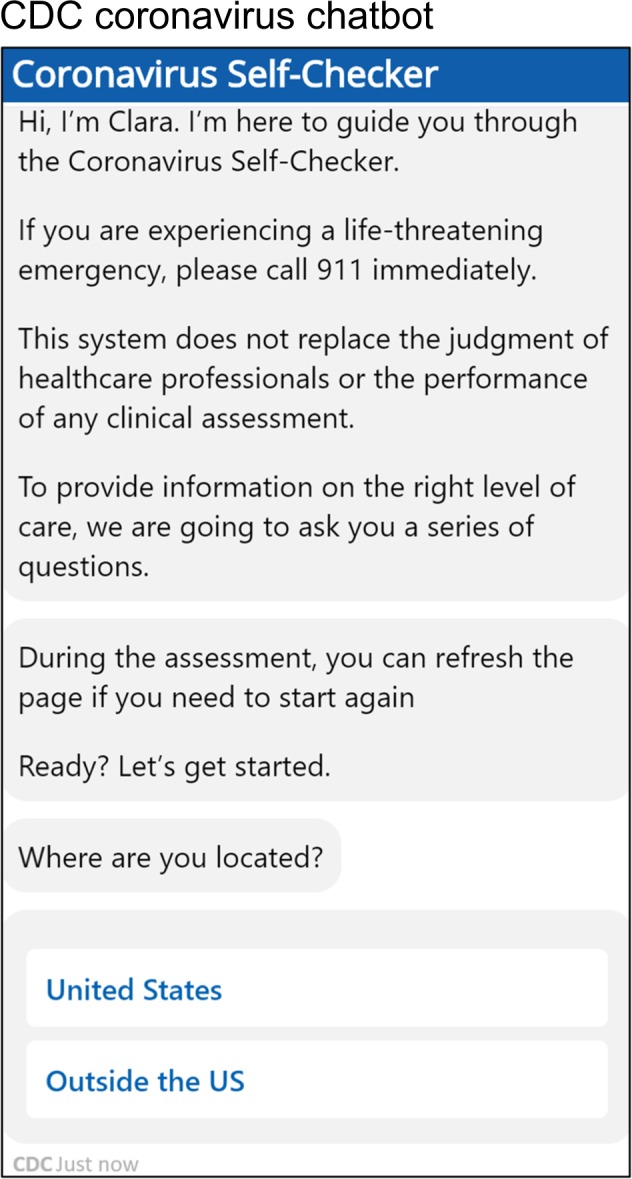
During the novel coronavirus (COVID-19) pandemic, institutions like the Centers for Disease Control and Prevention (CDC) and the World Health Organization (WHO) have begun utilizing chatbots to share information, suggest behavior, and offer emotional support 1 , 2 . The CDC has named theirs “Clara” (Fig. 1 ). Chatbots are software programs that talk with people through voice or text in their natural language 3 , 4 . Some well-known examples include “Alexa” from Amazon, “Siri” from Apple, and “Cortana” from Microsoft. They often come pre-installed on smartphones or home-based smart speakers 5 . In recent years, chatbot use for health-related purposes has increased considerably, from supporting clinicians with clinical interviews and diagnosis to aiding consumers in self-managing chronic conditions 6 . While promising, the use of chatbots may pose safety risks. Chatbots have varied widely in their responses to questions about physical health, suicide, intimate partner violence, substance abuse, and other sensitive conversations 4 , 6 , 7 , 8 , 9 . In one study, about a third (29%) of chatbot responses to health questions could have caused harm, and about half of those (16%) could have resulted in death if acted upon 9 . The COVID-19 pandemic puts in stark relief the potential for chatbots to help save lives.
Overview
CoChat Summary
TL;DR
Chatbots, if effectively designed and deployed, could help fight the COVID-19 pandemic by disseminating up-to-date information, encouraging health-protective behaviors, and mitigating the psychological harm of fear and isolation. However, the risk of amplifying misinformation and the lack of prior effectiveness research in pandemic contexts are serious concerns requiring immediate collaboration among healthcare workers, companies, academics, and governments.
Key findings
This is a perspective/commentary piece, not an empirical study, so it reports no original data; its claims are supported by cited literature.
- Chatbots may be uniquely suited to pandemic response across four functions: information dissemination, symptom monitoring, behavior change support, and mental health support.
- Prior research cited suggests people are more willing to disclose sensitive personal symptom information to a chatbot than to a human, which could improve triage and population-level infection estimates.
- Safety concerns are documented from prior work: in one cited study, about a third (29%) of chatbot responses to health questions could have caused harm, and about half of those (16%) could have resulted in death if acted upon.
- Cited evidence on pandemic mental health harm: the 2003 SARS outbreak produced a "mental health catastrophe" in which 59% of a hospitalized cohort developed a diagnosable psychiatric disorder, and after 30 months less than half had psychologically recovered.
Methods
Not stated in the paper (no empirical design, sample, or analysis); this is a narrative perspective article synthesizing cited literature and current chatbot deployments.
- Draws on cited studies of chatbot health responses, disclosure behavior, and pandemic psychology, plus examples of deployed COVID-19 chatbots (CDC's "Clara," WHO's WhatsApp health alert, and corporate/government chatbots).
- Organizes the argument around pandemic challenges, special features of pandemics, four chatbot affordances, and corresponding challenges.
Limitations
Stated by the paper: chatbots are untested in pandemics and have demonstrated limits in health crisis detection and response; long-term mental health outcomes of chatbot use are unclear and worthy of future investigation; challenges addressed only in real time during a crisis may lead to erroneous outputs from lack of testing; developers must decide whose voice to amplify amid conflicting global/local advice; third-party "skills" raise data-sharing concerns with unknown consequences; symptom screening tests constitutional and regulatory boundaries (e.g., reported digital contact tracing exploration in the US and Israel).
- Evident from the text: the article presents no original data or evaluation, so its claims about chatbot effectiveness rest on extrapolation from non-pandemic contexts and cited prior work.
Model-written summary. Check it against the paper before relying on it.
Integrity signals
Registry
Cites
Statistics
Figures
Verification
Claims the paper makes
8 Valid · 0 Not valid · 24 Not checked · 15 Own results and interpretations
The cited sources support only part of this claim — read each source’s verdict below.
In the paper
“Fourth, infection countermeasures (e.g., social distancing and quarantine) are psychologically damaging13.”
§ Chatbots in the fight against the COVID-19 pandemic > Challenges posed by pandemics
What the sources say
- Partly supportedcites [13] Brooks SK The psychological impact of quarantine and how to reduce it: rapid review of the evidence Lancet 2020 395 912 920 10.1016/S0140-6736(20)30460-8 32112714 PMC7158942 sourceExperimental — accuracy not yet measured
The review’s Conclusion says the psychological impact of quarantine can be substantial and long-lasting, supporting the quarantine part of the claim. But “What we do not know” treats social distancing as a separate measure whose relative effects need further research; the review does not establish that social distancing is psychologically damaging. (LLM, conf=0.88)
plainstates a cause- Asserted: passes — The authors put it forward as true.
- Checkable: passes — It can be checked against evidence.
- Load-bearing: unclear — It is unclear whether the paper’s conclusions depend on it.
- Based: passes — The paper gives a reason why it holds.
- Partly supported
The cited sources support only part of this claim — read each source’s verdict below.
In the paper
“Chatbots have varied widely in their responses to questions about physical health, suicide, intimate partner violence, substance abuse, and other sensitive conversations4,6–9.”
§ Chatbots in the fight against the COVID-19 pandemic > Introduction
What the sources say
- Partly supportedcites [4] Miner AS Smartphone-based conversational agents and responses to questions about mental health, interpersonal violence, and physical health JAMA Intern. Med. 2016 176 619 625 10.1001/jamainternmed.2016.0400 26974260 PMC4996669 sourceExperimental — accuracy not yet measured
The Results and Discussion report inconsistent responses to questions about physical health, suicide, and intimate partner violence. The Methods describe nine questions across mental health, interpersonal violence, and physical health, but our copy does not report testing responses to substance-abuse questions; that part of the claim is unsupported. (LLM, conf=0.88)
- Partly supportedcites [6] Laranjo L Conversational agents in healthcare: a systematic review J. Am. Med. Inform. Assoc. 2018 25 1248 1258 10.1093/jamia/ocy072 30010941 PMC6118869 sourceExperimental — accuracy not yet measured
The Results (Evaluation measures; page unavailable) mention inappropriate responses to suicide statements. The Discussion (Implications for healthcare, public health, and future research; page unavailable) reports that smartphone conversational agents often failed to recognize or respond appropriately to serious health concerns. Our copy does not establish that responses varied widely across the specific topics of intimate partner violence and substance abuse. (LLM, conf=0.83)
- Supportedcites [7] Nobles AL Responses to addiction help-seeking from Alexa, Siri, Google Assistant, Cortana, and Bixby intelligent virtual assistants NPJ Digit. Med. 2020 3 11 10.1038/s41746-019-0215-9 32025572 PMC6989668 source
The Results and Discussion report varied responses from five virtual assistants to substance-use help-seeking queries: most produced no singular response, while a few offered an app, a retailer, or a definition. This supports the substance-abuse portion of the sentence; the other topics are covered by the sentence’s other citations. (LLM, conf=0.91)
- Supportedcites [8] Kocaballi AB Responses of conversational agents to health and lifestyle prompts: investigation of appropriateness and presentation structures J. Med. Internet Res. 2020 22 e15823 10.2196/15823 32039810 PMC7055771 source
The Methods (Pilot Study; page unavailable) list prompts about suicide, partner assault, physical symptoms, drinking, and smoking. The Results (Appropriate Responses; page unavailable) and Discussion (Comparison With Prior Work; page unavailable) describe differing response rates and inconsistent answers across agents, platforms, and prompts, supporting the claim that responses varied across these sensitive topics. (LLM, conf=0.90)
- Supportedcites [9] Bickmore TW Patient and consumer safety risks when using conversational assistants for medical information: an observational study of Siri, Alexa, and Google assistant J. Med. Internet Res. 2018 20 e11510 10.2196/11510 30181110 PMC6231817 source
The Results section (“Differences by Conversational Assistants”; page unavailable) reports substantially different task-failure rates for Alexa, Siri, and Google Assistant when users sought medical information. This supports the physical-health portion of the sentence for which this paper is one of several citations. (LLM, conf=0.90)
plain- Asserted: passes — The authors put it forward as true.
- Checkable: passes — It can be checked against evidence.
- Load-bearing: passes — The paper’s conclusions depend on it.
- Based: passes — The paper gives a reason why it holds.
- Partly supported
Every source the paper cites for this claim was checked and supports it.
In the paper
“Although global and national health bodies highlight the importance of mental health in a pandemic, COVID-19 mental health needs have reportedly been under-addressed24.”
§ Chatbots in the fight against the COVID-19 pandemic > Special features of pandemics > Mental health support
What the sources say
- Supportedcites [24] Xiang YT Timely mental health care for the 2019 novel coronavirus outbreak is urgently needed Lancet Psychiatry 2020 7 228 229 10.1016/S2215-0366(20)30046-8 32032543 PMC7128153 source
The paper explicitly states that mental health care for patients and health professionals directly affected by the 2019-nCoV epidemic had been under-addressed, despite a Chinese national notification on psychological crisis intervention. This supports the cited claim about under-addressed COVID-19 mental health needs in the outbreak context the paper discusses. (LLM, conf=0.94)
hedged- Asserted: passes — The authors put it forward as true.
- Checkable: passes — It can be checked against evidence.
- Load-bearing: passes — The paper’s conclusions depend on it.
- Based: passes — The paper gives a reason why it holds.
- Supported
The cited sources support only part of this claim — read each source’s verdict below.
In the paper
“With more than a billion voice searches per month, any health-related mistakes, such as misidentifying key symptoms, would be amplified with extensive harmful repercussions4,9.”
§ Chatbots in the fight against the COVID-19 pandemic > Challenges
What the sources say
- Partly supportedcites [4] Miner AS Smartphone-based conversational agents and responses to questions about mental health, interpersonal violence, and physical health JAMA Intern. Med. 2016 176 619 625 10.1001/jamainternmed.2016.0400 26974260 PMC4996669 sourceExperimental — accuracy not yet measured
The Results and Discussion (page unavailable) document failures to recognize health concerns and distinguish their seriousness. The paper does not report more than a billion voice searches per month or establish that such errors would be amplified with extensive harmful repercussions. (LLM, conf=0.85)
- Partly supportedcites [9] Bickmore TW Patient and consumer safety risks when using conversational assistants for medical information: an observational study of Siri, Alexa, and Google assistant J. Med. Internet Res. 2018 20 e11510 10.2196/11510 30181110 PMC6231817 sourceExperimental — accuracy not yet measured
The Introduction (Background; page unavailable) reports over a billion voice searches per month and warns that incorrect medical information could cause harm if users act on it. The Discussion (Principal Findings; page unavailable) reports simulated outcomes that could have caused harm or death. The paper does not show that errors are amplified across those searches or establish the extensive real-world repercussions asserted in the claim. (LLM, conf=0.84)
hedgedstates a cause- Asserted: passes — The authors put it forward as true.
- Checkable: passes — It can be checked against evidence.
- Load-bearing: unclear — It is unclear whether the paper’s conclusions depend on it.
- Based: passes — The paper gives a reason why it holds.
- Partly supported
Every source the paper cites for this claim was checked and supports it.
In the paper
“Simply disclosing concerns and receiving emotionally supportive responses can have positive value in some contexts25.”
§ Chatbots in the fight against the COVID-19 pandemic > Special features of pandemics > Mental health support
What the sources say
- Supportedcites [25] Ho A Hancock J Miner AS Psychological, relational, and emotional effects of self-disclosure after conversations with a chatbot J. Commun. 2018 68 712 733 10.1093/joc/jqy026 30100620 PMC6074615 source
Methods (Training and Procedure; page not provided) describe conversations in which participants disclosed emotions and received validating, empathetic responses. Results (Overview; page not provided) report stronger emotional, relational, and psychological benefits after emotional than factual disclosure, supporting the claim's qualified statement that this can have positive value. (LLM, conf=0.92)
plainstates a possible cause- Asserted: passes — The authors put it forward as true.
- Checkable: passes — It can be checked against evidence.
- Load-bearing: passes — The paper’s conclusions depend on it.
- Based: passes — The paper gives a reason why it holds.
- Supported
16 more claims
Create a free account to see all 47 claims and to verify the 34 references still open.
- Probably not a substantial claim. 15
- It may state two separate claims as one. 14
Claims other papers make about this one
Each is checked against this paper’s own text: does it say what the citing paper says it does?
In the citing paper
“Chatbots and other artificial intelligence (AI) systems have become increasingly popular in recent years for providing information and assistance to users in online spaces (3)”
From Using ChatGPT to evaluate cancer myths and misconceptions: artificial intelligence and cancer information (2023) · cites this paper as [3]
Citations
Cites
The Psychological Impact of Quarantine and How to Reduce It: Rapid Review of the Evidence
Brooks, S. K., Webster, R. K., Smith, L. E., Woodland, L., Wessely, S., Greenberg, N., & Rubin, G. J. (2020) · doi:10.2139/ssrn.3532534 · Cited by 16,394
The psychological impact of quarantine and how to reduce it: Rapid review of the evidence
Brooks, S. K., Webster, R. K., Smith, L. E., Woodland, L., Wessely, S., Greenberg, N., & Rubin, G. J. (2020) · The Lancet · doi:10.1016/s0140-6736(20)30460-8 · Cited by 16,378
The spread of true and false news online
Vosoughi, S., Roy, D., & Aral, S. (2018) · Science · doi:10.1126/science.aap9559 · Cited by 8,847
Timely mental health care for the 2019 novel coronavirus outbreak is urgently needed
Xiang, Y.-T., Yang, Y., Li, W., Zhang, L., Zhang, Q., Cheung, T., & Ng, C. H. (2020) · The Lancet Psychiatry · doi:10.1016/s2215-0366(20)30046-8 · Cited by 3,598
Report of the WHO-China Joint Mission on Coronavirus Disease 2019 (COVID-19)
Gomes, C. A. (2020) · LA Referencia (Red Federada de Repositorios Institucionales de Publicaciones Científicas) · Cited by 2,134
Conversational agents in healthcare: a systematic review
Laranjo, L., Dunn, A. G., Tong, H. L., Kocaballi, A. B., Chen, J., Bashir, R., Surian, D., Gallego, B., Magrabi, F., Lau, A. Y. S., et al. (2018) · Journal of the American Medical Informatics Association · doi:10.1093/jamia/ocy072 · Cited by 1,388
Self-citationChatbots and Conversational Agents in Mental Health: A Review of the Psychiatric Landscape
Vaidyam, A. N., Wisniewski, H., Halamka, J. D., Kashavan, M. S., & Torous, J. B. (2019) · The Canadian Journal of Psychiatry · doi:10.1177/0706743719828977 · Cited by 1,048
Long-term psychiatric morbidities among SARS survivors
Mak, I. W. C., Chu, C. M., Pan, P. C., Yiu, M. G. C., & Chan, V. L. (2009) · General Hospital Psychiatry · doi:10.1016/j.genhosppsych.2009.03.001 · Cited by 1,018
It's only a computer: virtual humans increase willingness to disclose
Lucas, G. M., Gratch, J., King, A., & Morency, L.-P. (2014) · Computers in Human Behavior · doi:10.1016/j.chb.2014.04.043 · Cited by 977
Ho, A., Hancock, J., & Miner, A. S. (2018) · Journal of Communication · doi:10.1093/joc/jqy026 · Cited by 629
Self-citation
Cited by
Xu, L., Sanders, L., Li, K., & Chow, J. C. L. (2021) · JMIR Cancer · doi:10.2196/27850 · Cited by 571
“They have the potential to prevent misinformation, detect symptoms, and lessen the mental health burden during global pandemics [111].”
Zhang, J., Oh, Y. J., Lange, P., Yu, Z., & Fukuoka, Y. (2020) · Journal of Medical Internet Research · doi:10.2196/22845 · Cited by 363
“For instance, in April 2020, the World Health Organization launched a chatbot on Facebook Messenger to combat misinformation and to offer instant and accurate information about COVID-19 [21].”
BackgroundMenon, D., & Shilpa, K. (2023) · Heliyon · doi:10.1016/j.heliyon.2023.e20962 · Cited by 359
Johnson, S. B., King, A. J., Warner, E. L., Aneja, S., Kann, B. H., & Bylund, C. L. (2023) · JNCI Cancer Spectrum · doi:10.1093/jncics/pkad015 · Cited by 289
“spaces (3); recently, 1 such AI system receiving a lot of public and”
BackgroundOh, Y. J., Zhang, J., Fang, M.-L., & Fukuoka, Y. (2021) · International Journal of Behavioral Nutrition and Physical Activity · doi:10.1186/s12966-021-01224-6 · Cited by 278
Chatbots: Security, privacy, data protection, and social aspects
Hasal, M., Nowaková, J., Ahmed Saghair, K., Abdulla, H., Snášel, V., & Ogiela, L. (2021) · Concurrency and Computation: Practice and Experience · doi:10.1002/cpe.6426 · Cited by 249
He, Y., Yang, L., Zhu, X., Wu, B., Zhang, S., Qian, C., & Tian, T. (2022) · Journal of Medical Internet Research · doi:10.2196/40719 · Cited by 178
“Chatbots in mental health are nascent [22], and although chatbots have demonstrated feasibility to provide mental health treatment, more high-quality evidence regarding the effectiveness and acceptability of mental health chatbots is needed [23], particularly during the COVID-19 pandemic [24].”
Chan, E. Y., & Saqib, N. U. (2021) · Computers in Human Behavior · doi:10.1016/j.chb.2021.106718 · Cited by 178
COVID-19 Detection System using Recurrent Neural Networks
Hassan, A., Shahin, I., & Alsabek, M. B. (2020) · 2020 International Conference on Communications, Computing, Cybersecurity, and Informatics (CCCI) · doi:10.1109/ccci49893.2020.9256562 · Cited by 155
Cortés-Cediel, M. E., Segura-Tinoco, A., Cantador, I., & Bolívar, M. P. R. (2023) · Government Information Quarterly · doi:10.1016/j.giq.2023.101877 · Cited by 172
AI-driven healthcare: A review on ensuring fairness and mitigating bias
Chinta, S. V., Wang, Z., Palikhe, A., Zhang, X., Kashif, A., Smith, M. A., Liu, J., & Zhang, W. (2025) · PLOS Digital Health · doi:10.1371/journal.pdig.0000864 · Cited by 171
“AI-powered AI-powered chatbots and virtual assistants are streamlining patient intake and symptom assessment [55,56].”
Chin, H., Song, H., Baek, G., Shin, M., Jung, C., Cha, M., Choi, J., & Cha, C. (2023) · Journal of Medical Internet Research · doi:10.2196/51712 · Cited by 167
“Digital health interventions delivered through mobile device–based chatbots offer the advantages of low medical costs and 24/7 accessibility [57,58].”
Cesaro, A., Hoffman, S. C., Das, P., & de la Fuente‐Núñez, C. (2025) · npj Antimicrobials and Resistance · doi:10.1038/s44259-024-00068-x · Cited by 168
What Does it Mean for a Language Model to Preserve Privacy?
Brown, H., Lee, K., Mireshghallah, F., Shokri, R., & Tramèr, F. (2022) · 2022 ACM Conference on Fairness Accountability and Transparency · doi:10.1145/3531146.3534642 · Cited by 165
“For example, work has been done to assess how appropriately chatbots respond to delicate situations, such as responding to sexual harassment [14], discussions of suicidal intent or other mental health issues [66, 72], and mentions of violence or physical danger [49, 66].”
BackgroundChatbot use cases in the Covid-19 public health response
Amiri, P., & Karahanna, E. (2022) · Journal of the American Medical Informatics Association · doi:10.1093/jamia/ocac014 · Cited by 129
An overview of mental health during the COVID-19 pandemic
Chen, P. J., Pusica, Y., Sohaei, D., Prassas, I., & Diamandis, E. P. (2021) · Diagnosis · doi:10.1515/dx-2021-0046 · Cited by 159
Readiness for voice assistants to support healthcare delivery during a health crisis and pandemic
Sezgin, E., Huang, Y., Ramtekkar, U., & Lin, S. (2020) · npj Digital Medicine · doi:10.1038/s41746-020-00332-0 · Cited by 155
Platform-independent and curriculum-oriented intelligent assistant for higher education
Sajja, R., Sermet, Y., Cwiertny, D., & Demir, I. (2023) · International Journal of Educational Technology in Higher Education · doi:10.1186/s41239-023-00412-7 · Cited by 153
AI chatbots cannot replace human interactions in the pursuit of more inclusive mental healthcare
Brown, J. E. H., & Halpern, J. (2021) · SSM - Mental Health · doi:10.1016/j.ssmmh.2021.100017 · Cited by 139
Progress in robotics for combating infectious diseases
Gao, A., Murphy, R. R., Chen, W., Dagnino, G., Fischer, P., Gutierrez, M. G., Kundrat, D., Nelson, B. J., Shamsudhin, N., Su, H., et al. (2021) · Science Robotics · doi:10.1126/scirobotics.abf1462 · Cited by 140
Christophe, C., Kanithi, P., Munjal, P., Raha, T., Hayat, N., Rajan, R., Mahrooqi, A. A., Gupta, A., Salman, M., Gosal, G., et al. (2024) · arXiv (Cornell University) · doi:10.48550/arxiv.2404.14779 · Cited by 139
Cai, M., Luo, H., Meng, X., Cui, Y., & Wang, W. (2022) · Information Processing & Management · doi:10.1016/j.ipm.2022.103197 · Cited by 128
The Role of Artificial Intelligence in Tackling COVID-19
Arora, N., Banerjee, A. K., & Narasu, M. L. (2020) · Future Virology · doi:10.2217/fvl-2020-0130 · Cited by 127
Understanding Chatbot Adoption in Local Governments: A Review and Framework
Senadheera, S., Yiğitcanlar, T., Desouza, K. C., Mossberger, K., Corchado, J. M., Mehmood, R., Li, R. Y. M., & Cheong, P. H. (2024) · Journal of Urban Technology · doi:10.1080/10630732.2023.2297665 · Cited by 125
Older adults’ intention to use voice assistants: Usability and emotional needs
Liu, M., Wang, C., & Hu, J. (2023) · Heliyon · doi:10.1016/j.heliyon.2023.e21932 · Cited by 123
An Overview on Audio, Signal, Speech, & Language Processing for COVID-19
Deshpande, G., & Schuller, B. W. (2020) · arXiv (Cornell University) · doi:10.48550/arxiv.2005.08579 · Cited by 68
MarkBot – A Language Model-Driven Chatbot for Interactive Marketing in Post-Modern World
Kushwaha, A. K., & Kar, A. K. (2021) · Information Systems Frontiers · doi:10.1007/s10796-021-10184-y · Cited by 119
Bin Sawad, A., Narayan, B., Alnefaie, A., Maqbool, A., Mckie, I., Smith, J., Yuksel, B., Puthal, D., Prasad, M., & Kocaballi, A. B. (2022) · Sensors · doi:10.3390/s22072625 · Cited by 113
“They can also help in completing specific tasks such as self‐monitoring and overcoming obstacles for self‐management, which is important in chronic disease management and in the fight against pandemics [6,16].”
BackgroundSelf-citationHealth-focused conversational agents in person-centered care: a review of apps
Parmar, P., Ryu, J., Pandya, S., Sedoc, J., & Agarwal, S. (2022) · npj Digital Medicine · doi:10.1038/s41746-022-00560-6 · Cited by 113
Shi, W., Liu, D., Yang, J., Zhang, J., Wen, S., & Su, J. (2020) · International Journal of Environmental Research and Public Health · doi:10.3390/ijerph17228701 · Cited by 91
Ruggiano, N., Brown, E. L., Roberts, L., Framil Suarez, C. V., Luo, Y., Hao, Z., & Hristidis, V. (2021) · Journal of Medical Internet Research · doi:10.2196/25006 · Cited by 100
“The potential for chatbots for socially isolated populations has been particularly evident during the COVID-19 pandemic, where the Center for Disease Control and Prevention launched its Clara Bot app as an interactive way to educate the public and provide emotional support [42].”
The World with Future Technologies (Post-COVID-19): Open Issues, Challenges, and the Road Ahead
Madhav, A. V. S., & Tyagi, A. K. (2021) · Springer eBooks · doi:10.1007/978-981-16-6542-4_22 · Cited by 96
Kaushal, V., & Yadav, R. (2022) · Concurrency and Computation Practice and Experience · doi:10.1002/cpe.7450 · Cited by 93
Park, G., Chung, J., & Lee, S. (2024) · Current Psychology · doi:10.1007/s12144-023-04653-7 · Cited by 84
Shahid, O., Nasajpour, M., Pouriyeh, S., Parizi, R. M., Han, M., Valero, M., Li, F., Aledhari, M., & Sheng, Q. Z. (2021) · Journal of Biomedical Informatics · doi:10.1016/j.jbi.2021.103751 · Cited by 84
Jo, H. (2022) · Heliyon · doi:10.1016/j.heliyon.2022.e10662 · Cited by 84
Validity of Chatbot Use for Mental Health Assessment: Experimental Study
Schick, A., Feine, J., Morana, S., Maedche, A., & Reininghaus, U. (2022) · JMIR mHealth and uHealth · doi:10.2196/28082 · Cited by 58
Chatbot features for anxiety and depression: a scoping review
Ahmed, A., Hassan, A., Aziz, S., Abd-alrazaq, A. A., Ali, N., Alzubaidi, M., Al-Thani, D., Elhusein, B., Siddig, M. A., Ahmed, M., et al. (2023) · Health Informatics Journal · doi:10.1177/14604582221146719 · Cited by 82
“organisations are also promoting usage of such apps,(11) whilst technology companies are actively working to improve techniques.(12) Chatbots have been used in various fields such as customer services for some time now and have seen an increased use in the medical field, including mental health.”
BackgroundData-Driven Decision-Making in COVID-19 Response: A Survey
Yu, S., Qing, Q., Zhang, C., Shehzad, A. H., Oatley, G., & Xia, F. (2021) · IEEE Transactions on Computational Social Systems · doi:10.1109/tcss.2021.3075955 · Cited by 80
Kocaballi, A. B., Sezgin, E., Clark, L., Carroll, J. M., Huang, Y., Huh-Yoo, J., Kim, J., Kocielnik, R., Lee, Y.-C., Mamykina, L., et al. (2022) · Journal of Medical Internet Research · doi:10.2196/38525 · Cited by 62
Self-citationKim, H. K. (2024) · Healthcare · doi:10.3390/healthcare12050534 · Cited by 78
A Medical Ethics Framework for Conversational Artificial Intelligence
Fournier-Tombs, E., & McHardy, J. (2023) · Journal of Medical Internet Research · doi:10.2196/43068 · Cited by 62
Mao, B., Jia, X., & Huang, Q. E. (2022) · Journal of Information Science · doi:10.1177/01655515221118047 · Cited by 73
Jain, G., Pareek, S., & Carlbring, P. (2024) · Internet Interventions · doi:10.1016/j.invent.2024.100745 · Cited by 74
Health Apps for Combating COVID-19: Descriptive Review and Taxonomy
Almalki, M., & Giannicchi, A. (2021) · JMIR mHealth and uHealth · doi:10.2196/24322 · Cited by 71
Uncovering the Results of AI Chatbot Use in the Public Sector: Evidence from US State Governments
Chen, T., & Gascó‐Hernández, M. (2024) · Public Performance & Management Review · doi:10.1080/15309576.2024.2389864 · Cited by 73
Chin, H., Lima, G., Shin, M., Zhunis, A., Cha, C., Choi, J., & Cha, M. (2023) · Journal of Medical Internet Research · doi:10.2196/40922 · Cited by 49
Visit Types in Primary Care With Telehealth Use During the COVID-19 Pandemic: Systematic Review
Ward, K., Vagholkar, S., Sakur, F., Khatri, N. N., & Lau, A. Y. S. (2022) · JMIR Medical Informatics · doi:10.2196/40469 · Cited by 68
A Semantic Web Framework for Automated Smart Assistants: A Case Study for Public Health
Sermet, Y., & Demir, I. (2021) · Big Data and Cognitive Computing · doi:10.3390/bdcc5040057 · Cited by 59
Robotic Telemedicine for Mental Health: A Multimodal Approach to Improve Human-Robot Engagement
Lima, M. R., Wairagkar, M., Natarajan, N., Vaitheswaran, S., & Vaidyanathan, R. (2021) · Frontiers in Robotics and AI · doi:10.3389/frobt.2021.618866 · Cited by 64
Wang, X., Luo, R., Liu, Y., Chen, P., Tao, Y., & He, Y. (2023) · Information Processing & Management · doi:10.1016/j.ipm.2023.103444 · Cited by 63
Cao, L., & Liu, Q. (2024) · ACM Computing Surveys · doi:10.1145/3686150 · Cited by 61
He, L., Balaji, D., Wiers, R. W. H. J., Antheunis, M. L., & Krahmer, E. (2022) · Nicotine & Tobacco Research · doi:10.1093/ntr/ntac281 · Cited by 62
Vilaza, G. N., & McCashin, D. (2021) · Frontiers in Digital Health · doi:10.3389/fdgth.2021.689736 · Cited by 60
User reactions to COVID-19 screening chatbots from reputable providers
Dennis, A. R., Kim, A., Raimi, R., & Ayabakan, S. (2020) · Journal of the American Medical Informatics Association · doi:10.1093/jamia/ocaa167 · Cited by 59
Powering an AI Chatbot with Expert Sourcing to Support Credible Health Information Access
Xiao, Z., Liao, Q. V., Zhou, M., Grandison, T., & Li, Y. (2023) · Proceedings of the 28th International Conference on Intelligent User Interfaces · doi:10.1145/3581641.3584031 · Cited by 59
Performance of AI chatbots on controversial topics in oral medicine, pathology, and radiology
Mohammad‐Rahimi, H., Khoury, Z. H., Alamdari, M. I., Rokhshad, R., Motie, P., Parsa, A., Tavares, T., Sciubba, J. J., Price, J. B., & Sultan, A. S. (2024) · Oral Surgery Oral Medicine Oral Pathology and Oral Radiology · doi:10.1016/j.oooo.2024.01.015 · Cited by 57
Responsible CVD screening with a blockchain assisted chatbot powered by explainable AI
Muneer, S., Abbas, S., Shah, A. A., Alharbi, M., Aldossary, H., Fatima, A., Ghazal, T. M., & Khan, M. A. (2025) · Scientific Reports · doi:10.1038/s41598-025-96715-y · Cited by 55
Odone, A., Barbati, C., Amadasi, S., Schultz, T., & Resnik, D. B. (2025) · The Lancet Infectious Diseases · doi:10.1016/s1473-3099(25)00412-8 · Cited by 56
Kumar, V., Singh, D., Kaur, M., & Damaševičius, R. (2021) · PeerJ Computer Science · doi:10.7717/peerj-cs.564 · Cited by 54
A Proposed Chatbot Framework for COVID-19
Amer, E., Hazem, A., Farouk, O., Louca, A., Mohamed, Y. H., & Ashraf, M. (2021) · International Mobile, Intelligent, and Ubiquitous Computing Conference (MIUCC) · doi:10.1109/miucc52538.2021.9447652 · Cited by 52
Governing Complexity: Design Principles for the Governance of Complex Global Catastrophic Risks
Kreienkamp, J., & Pegram, T. (2020) · International Studies Review · doi:10.1093/isr/viaa074 · Cited by 55
Zhao, X., Chen, L., Jin, Y., & Zhang, X. (2022) · Information Processing & Management · doi:10.1016/j.ipm.2022.103203 · Cited by 51
Liang, K.-H., Shi, W., Oh, Y. J., Wang, H., Zhang, J., & Yu, Z. (2024) · Proceedings of the ACM on Human-Computer Interaction · doi:10.1145/3653691 · Cited by 50
The Role of AI-Based Chatbots in Public Health Emergencies: A Narrative Review
Branda, F., Stella, M., Ceccarelli, C., Cabitza, F., Ceccarelli, G., Maruotti, A., Ciccozzi, M., & Scarpa, F. (2025) · Future Internet · doi:10.3390/fi17040145 · Cited by 51
Cao, L., & Liu, Q. (2022) · doi:10.1101/2022.08.22.22279022 · Cited by 49
Mallory, F. (2023) · Ergo an Open Access Journal of Philosophy · doi:10.3998/ergo.4668 · Cited by 44
Interventions in Chinese Undergraduate Students’ Mental Health: Systematic Review
Shan, Y., Ji, M., Xie, W., Li, R., Qian, X., Zhang, X., & Hao, T. (2022) · Interactive Journal of Medical Research · doi:10.2196/38249 · Cited by 44
Chagas, B. A., Pagano, A. S., Prates, R. O., Praes, E. C., Ferreguetti, K., Vaz, H., Reis, Z. S. N., Ribeiro, L. B., Ribeiro, A. L. P., Pedroso, T. M., et al. (2023) · JMIR Human Factors · doi:10.2196/43135 · Cited by 43
Yang, L. W. Y., Ng, W. Y., Lei, X., Tan, S. C. Y., Wang, Z., Yan, M. G., Pargi, M. K., Zhang, X., Lim, J. S., Gunasekeran, D. V., et al. (2023) · Frontiers in Public Health · doi:10.3389/fpubh.2023.1063466 · Cited by 44
Understanding the Benefits and Design of Chatbots to Meet the Healthcare Needs of Migrant Workers
Tseng, Y., Jarupreechachan, W., & Lee, T.-H. (2023) · Proceedings of the ACM on Human-Computer Interaction · doi:10.1145/3610106 · Cited by 43
Damij, N., & Bhattacharya, S. D. (2022) · IEEE Technology and Engineering Management Conference (TEMSCON) · doi:10.1109/temsconeurope54743.2022.9801962 · Cited by 41
Development and validation of the conversational AI dependence scale for Chinese college students
Chen, Y., Wang, M., Yuan, S., & Zhao, Y. (2025) · Frontiers in Psychology · doi:10.3389/fpsyg.2025.1621540 · Cited by 41
Weeks, R., Sangha, P., Cooper, L., Sedoc, J., White, S., Gretz, S., Toledo, A., Lahav, D., Hartner, A.-M., Martin, N., et al. (2022) · JMIR Human Factors · doi:10.2196/40533 · Cited by 40
Zhang, D., & Zhao, X. (2024) · Computers in Human Behavior · doi:10.1016/j.chb.2024.108359 · Cited by 40
Managing patients using telerheumatology: Lessons from a pandemic
Bateman, J., & Cleaton, N. (2021) · Best Practice & Research Clinical Rheumatology · doi:10.1016/j.berh.2021.101662 · Cited by 39
AI-powered drug repurposing for developing COVID-19 treatments
Liu, Z., Chen, X., Carter, W., Moruf, A., Komatsu, T. E., Pahwa, S., Chan‐Tack, K. M., Snyder, K., Petrick, N., Cha, K., et al. (2022) · Elsevier eBooks · doi:10.1016/b978-0-12-824010-6.00005-8 · Cited by 39
Leveraging conversational technology to answer common COVID-19 questions
McKillop, M. M., South, B. R., Preininger, A. M., Mason, M., & Jackson, G. P. (2021) · Journal of the American Medical Informatics Association · doi:10.1093/jamia/ocaa316 · Cited by 39
Understanding the Impact of COVID-19 on Online Mental Health Forums
Biester, L., Matton, K., Rajendran, J., Provost, E. M., & Mihalcea, R. F. (2021) · ACM Transactions on Management Information Systems · doi:10.1145/3458770 · Cited by 38
Ramzy, M., & Ibrahim, B. (2024) · Information Processing & Management · doi:10.1016/j.ipm.2024.103644 · Cited by 38
Cosma, C., Radi, A., Cattano, R., Zanobini, P., Bonaccorsi, G., Lorini, C., & Riccio, M. D. (2024) · Vaccine · doi:10.1016/j.vaccine.2024.126559 · Cited by 37
Evaluating the scientific reliability of ChatGPT as a source of information on asthma
Høj, S., Thomsen, S. F., Ulrik, C. S., Meteran, H., Sigsgaard, T., & Meteran, H. (2024) · Journal of Allergy and Clinical Immunology Global · doi:10.1016/j.jacig.2024.100330 · Cited by 35
Towards a Set of Heuristics for Evaluating Chatbots
Sánchez-Adame, L. M., Mendoza, S., Urquiza-Yllescas, J. F., Rodríguez, J., & Meneses‐Viveros, A. (2021) · IEEE Latin America Transactions · doi:10.1109/tla.2021.9480145 · Cited by 35
Hypocrisy Induction: Using Chatbots to Promote COVID-19 Social Distancing
Kim, W., & Ryoo, Y. (2022) · Cyberpsychology, Behavior, and Social Networking · doi:10.1089/cyber.2021.0057 · Cited by 31
Cheng, Y., Wang, Y., & Lee, J. (2024) · International Journal of Human-Computer Interaction · doi:10.1080/10447318.2024.2344149 · Cited by 34
Weeks, R., Cooper, L., Sangha, P., Sedoc, J., White, S., Toledo, A., Gretz, S., Lahav, D., Martin, N., Michel, A. E., et al. (2022) · Journal of Medical Internet Research · doi:10.2196/38418 · Cited by 33
Audio, Speech, Language, & Signal Processing for COVID-19: A Comprehensive OverviewPreprint
Deshpande, G., & Schuller, B. W. (2020) · arXiv · doi:10.48550/arxiv.2011.14445 · Cited by 34
Multi-Omics Approach in the Identification of Potential Therapeutic Biomolecule for COVID-19
Singh, R., Singh, P. K., Kumar, R., Kabir, M. T., Kamal, M. A., Rauf, A., Albadrani, G. M., Sayed, A. A., Mousa, S. A., Abdel‐Daim, M. M., et al. (2021) · Frontiers in Pharmacology · doi:10.3389/fphar.2021.652335 · Cited by 32
Heralding the Digitalization of Life in Post-Pandemic East Asian Societies
Ho, C. W.-L., Caals, K., & Zhang, H. (2020) · Journal of Bioethical Inquiry · doi:10.1007/s11673-020-10050-7 · Cited by 32
Hu, X., Niemann, M., Kienzle, A., Braun, K. F., Back, D. A., Gwinner, C., Renz, N., Stoeckle, U., Trampuž, A., & Meller, S. (2024) · Digital Health · doi:10.1177/20552076241272620 · Cited by 32
An Argumentative Dialogue System for COVID-19 Vaccine Information
Fazzinga, B., Galassi, A., & Torroni, P. (2021) · Lecture notes in computer science · doi:10.1007/978-3-030-89391-0_27 · Cited by 31
Learning from Each Other—A Bibliometric Review of Research on Information Disorders
Bran, R. A., Țîru, L. G., Grosseck, G., Holotescu, C., & Maliţa, L. (2021) · Sustainability · doi:10.3390/su131810094 · Cited by 31
Shahsavari, Y., Baseri, Y., Hafid, A. S., Dambri, O. A., & Makrakis, D. (2026) · Journal of Medical Internet Research · doi:10.2196/80178 · Cited by 31
Moriuchi, E. (2022) · Journal of Technology in Behavioral Science · doi:10.1007/s41347-022-00277-z · Cited by 30
Chatbots as Cognitive, Educational, Advisory & Coaching Systems
Karyotaki, M., Drigas, A., & Skianis, C. (2022) · Technium Social Sciences Journal · doi:10.47577/tssj.v30i1.6277 · Cited by 29
Islam, A., Islam, M., Uzir, M. U. H., Wahab, S. A., & Latiff, A. S. A. (2020) · International Journal of Scientific Research and Management (IJSRM) · doi:10.18535/ijsrm/v8i12.em02 · Cited by 29
Makasi, T., Nili, A., Desouza, K. C., & Tate, M. (2022) · Hawaii International Conference on System Sciences (HICSS) · doi:10.24251/hicss.2022.292 · Cited by 29
Communication and Personality: how COVID-19 government chatbots express themselves
de Melo, D. N. A., & Monteiro, I. T. (2021) · Brazilian Symposium on Human Factors in Computing Systems (IHC) · doi:10.1145/3472301.3484362 · Cited by 28
METHODOLOGICAL PRINCIPLES OF EDUCATIONAL AND PSYCHOLOGICAL CHATBOT DEVELOPMENT
Панок, В. Г., Shevchenko, A. I., Nazar, M., Starkov, D., Мещеряков, Д. С., & Shevtsov, A. (2025) · Information Technologies and Learning Tools · doi:10.33407/itlt.v106i2.5872 · Cited by 28
Siedlikowski, S., Noël, L.-P., Moynihan, S. A., & Robin, M. R. (2021) · Journal of Medical Internet Research · doi:10.2196/27283 · Cited by 27
Metadata
- Authors
- Miner, A. S., Laranjo, L., & Kocaballi, A. B.
- Affiliations
- Stanford University (US)
- Macquarie University (AU)
- University of Technology Sydney (AU)
- Corresponding author
- Miner, Adam S.
- Venue
- npj Digital Medicine
- Published
- 2020-05-04
- Volume
- 3
- Issue
- 1
- Pages
- 65-65
- ISSN
- 2398-6352 (ISSN-L)
- PMC
- PMC7198587
- OpenAlex
- W3021999948
- Semantic Scholar
- 13499e956aa73121806315a6bf0a1e1067b1667f
- Cited by
- 322
- References
- 22
- Citations by year
- 2026: 26 · 2025: 28 · 2024: 38 · 2023: 47 · 2022: 79 · 2021: 82 · 2020: 22
- FWCI
- 16.92
- Type
- journal article
- Language
- en
- Open access
- gold
- doi.org
- Licence
- cc-by
- creativecommons.org/licenses/by/4.0 (tdm)
- creativecommons.org/licenses/by/4.0 (vor)
- Locations
- npj Digital Medicine (publishedVersion, cc-by)
- PubMed Central (publishedVersion, cc-by)
- PubMed (publishedVersion)
- DOAJ (DOAJ: Directory of Open Access Journals) (submittedVersion, cc-by-sa)
- UTS ePRESS (University of Technology Sydney) (submittedVersion, other-oa)
- Funders
- National Institutes of Health (KL2TR001083, UL1TR001085, UL1TR003142, KL2TR003143)
- National Center for Advancing Translational Sciences
- Topics
- Health Sciences › Medicine › Health Informatics › Artificial Intelligence in Healthcare and Education
- Social Sciences › Psychology › Applied Psychology › Digital Mental Health Interventions
- Health Sciences › Health Professions › General Health Professions › Mobile Health and mHealth Applications
- Keywords
- chatbots, COVID-19 pandemic, health data sharing, emotional support, chatbot safety, suicide prevention, intimate partner violence, substance abuse, clinical decision support
About these checks
Registry, retraction, Cites and statistics results are computed, not judged, with one exception: a printed reference that no index lists is read once by a model before it counts as a citation error. Claims are extracted by a model and kept only when their quote appears verbatim in the text; each cited source is then checked, with a model’s help, for whether it says what the claim relies on. Those verdicts can be wrong — read the claim’s quote and the cited source before relying on one.
The claim verdicts this report counts are experimental: their accuracy is not yet measured.
A language model drew the claims from the paper on 2026-10-05, under version 3 of the claim definition (model deepseek-v4.1-flash, prompt extract-v3).
A second model labelled each claim on 2026-10-05 (model jev-1.13-20260917, definition revision gold-guideline-v0.2).
Cited sources are checked with a language model’s help (gpt-6-sol).
Statistics and arithmetic are recomputed, not judged.
Confidence bands are shown only for fields calibrated on our annotated test set. None is calibrated yet, so no band is shown.
What counts as a claim ›How we measure confidence ›How we check this ›
Are you an author, or do you see a problem with this page? Request a review
Data sources
Bibliographic data: Semantic Scholar, OpenAlex, Crossref.
Contains information from the Semantic Scholar Academic Graph Datasets, made available under the ODC Attribution License (ODC-BY 1.0).
Semantic Scholar’s data is described in: Kinney, R., et al. (2023). The Semantic Scholar Open Data Platform. arXiv:2301.10140.
