

Digital inclusion as a social determinant of health
Open accessThe DOI matches its Crossref record; 21 of the 21 references it cites were found in a registry or an index.
Abstract
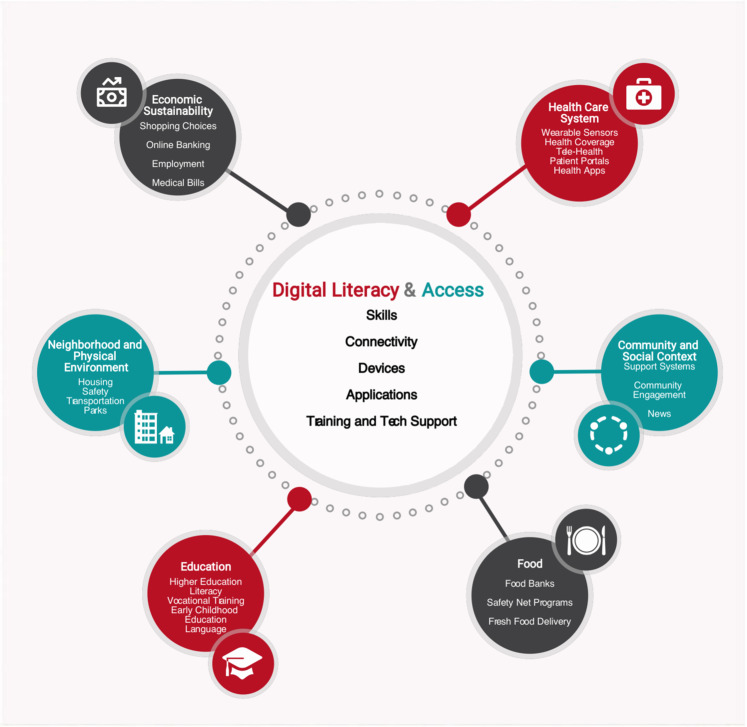
The use of digital tools and applications is steadily increasing and can support a range of health information needs 1 , 2 , 3 . As tools such as patient portals, health trackers, and remote monitoring devices see greater use, research suggests that tools such as health apps and patient portals can foster greater patient engagement, better support for patients outside of the clinic visit, and can improve health outcomes 3 , 4 , 5 , 6 , 7 , 8 , 9 . However, greater reliance on digital tools has the potential to increase disparities between those who have skills and access to digital tools and those who do not and thereby existing health disparities.
Overview
The claims and statistics of this paper haven’t been checked yet.
Free: it reads the open-access text and checks the first 5 claims that cite a source we can check. Create a free account to check every claim.
Integrity signals
Registry
Cites
Statistics
Figures
Verification
Claims the paper makes
The claims and statistics of this paper haven’t been checked yet.
Free: it reads the open-access text and checks the first 5 claims that cite a source we can check. Create a free account to check every claim.
Claims other papers make about this one
Each is checked against this paper’s own text: does it say what the citing paper says it does?
The source backs part of the claim, not all of it — or backs it for a different population, condition or comparison.
In the citing paper
“Research shows that social determinants of health (SDoHs)24 could potentially affect the acceptability of technology usage among racial and ethnic minority populations.”
From Association of Demographic and Socioeconomic Indicators With the Use of Wearable Devices Among Children (2023) · cites this paper as [24]
Experimental — accuracy not yet measured
Self-check
Percentages, sums and reported differences re-computed from the paper’s own numbers.
The self-check needs the paper’s full text.
Citations
Cites
Whitehead, L., & Seaton, P. (2016) · Journal of Medical Internet Research · doi:10.2196/jmir.4883 · Cited by 743
Beyond validation: getting health apps into clinical practice
Gordon, W. J., Landman, A., Zhang, H., & Bates, D. W. (2020) · npj Digital Medicine · doi:10.1038/s41746-019-0212-z · Cited by 326
Interventions to increase patient portal use in vulnerable populations: a systematic review
Grossman, L. V., Masterson Creber, R. M., Benda, N. C., Wright, D., Vawdrey, D. K., & Ancker, J. S. (2019) · Journal of the American Medical Informatics Association · doi:10.1093/jamia/ocz023 · Cited by 251
Self-citationPatient portals and broadband internet inequality
Perzynski, A. T., Roach, M. J., Shick, S., Callahan, B., Gunzler, D., Cebul, R., Kaelber, D. C., Huml, A., Thornton, J. D., & Einstadter, D. (2017) · Journal of the American Medical Informatics Association · doi:10.1093/jamia/ocx020 · Cited by 222
Self-citationPromise of and potential for patient-facing technologies to enable meaningful use
Ahern, D. K., Woods, S. S., Lightowler, M. C., Finley, S. W., & Houston, T. K. (2011) · American Journal of Preventive Medicine · doi:10.1016/j.amepre.2011.01.005 · Cited by 189
Alessa, T., Abdi, S., Hawley, M. S., & de Witte, L. (2018) · JMIR mhealth and uhealth · doi:10.2196/10723 · Cited by 160
Digital health technology and diabetes management: 数字化医疗技术与糖尿病管理
Cahn, A., Akirov, A., & Raz, I. (2018) · Journal of Diabetes · doi:10.1111/1753-0407.12606 · Cited by 102
Zhang, X., Hailu, B., Tabor, D. C., Gold, R., Sayre, M. H., Sim, I., Jean-Francois, B., Casnoff, C. A., Cullen, T., Thomas, V. A., et al. (2019) · Medical Care · doi:10.1097/mlr.0000000000001092 · Cited by 64
Sheon, A. R., Bolen, S. D., Callahan, B., Shick, S., & Perzynski, A. T. (2017) · JMIR Diabetes · doi:10.2196/diabetes.6751 · Cited by 62
Self-citationMcAlearney, A. S., Sieck, C. J., Hefner, J. L., Aldrich, A. M., Walker, D. M., Rizer, M. K., Moffatt-Bruce, S. D., & Huerta, T. R. (2016) · JMIR Research Protocols · doi:10.2196/resprot.6355 · Cited by 50
Self-citationEmpowering Patients during Hospitalization: Perspectives on Inpatient Portal Use
McAlearney, A. S., Fareed, N., Gaughan, A. A., MacEwan, S. R., Volney, J., & Sieck, C. J. (2019) · Applied Clinical Informatics · doi:10.1055/s-0039-1677722 · Cited by 50
Self-citationShimada, S. L., Hogan, T. P., Rao, S. R., Allison, J. J., Quill, A. L., Feng, H., Phillips, B. D., Nazi, K. M., Haidary, S. T., & Houston, T. K. (2013) · Medical Care · doi:10.1097/mlr.0b013e3182780917 · Cited by 45
Digital prosperity: how broadband can deliver health and equity to all communities
Tomer, A., Fishbane, L., Siefer, A., & Callahan, B. (2020) · Cited by 43
Self-citationDigital health technology and diabetes management
(2018) · BDJ · doi:10.1038/sj.bdj.2018.249 · Cited by 40
Why Aren't Our Digital Solutions Working for Everyone?
Winkle, B. V., Carpenter, N., & Moscucci, M. M. (2017) · The AMA Journal of Ethic · doi:10.1001/journalofethics.2017.19.11.stas2-1711 · Cited by 36
Cahn, A., Akirov, A., & Raz, I. (2017) · Journal of Diabetes · Cited by 32
Harris, K., Jacobs, G., & Reeder, J. (2019) · HLRP: Health Literacy Research and Practice · doi:10.3928/24748307-20190325-02 · Cited by 31
Mattingly, T. J., Tom, S. E., Stuart, B., & Onukwugha, E. (2016) · Aging Clinical and Experimental Research · doi:10.1007/s40520-016-0600-z · Cited by 20
Cottrell, E., Cox, T., O’Connell, P., & Chambers, R. M. (2015) · BMJ Open · doi:10.1136/bmjopen-2014-007270 · Cited by 18
A Patient With COVID-19 Is Left Behind As Care Goes Virtual
Sundar, K. R. (2020) · Health Affairs · doi:10.1377/hlthaff.2020.00447 · Cited by 11
Reforming the lifeline program: Regulatory federalism in action?
Jayakar, K., & Park, E.-A. (2018) · Telecommunications Policy · doi:10.1016/j.telpol.2018.04.001 · Cited by 2
Research works printed but not linked: 1
- Gibbons, C. Digital Access Disparities: Policy and Practice Overview. Panel Discussion, Digital Skills and Connectivity as Social Determinants of Health. Sheon, A Conference Report: Digital Skills: A Hidden “Super” Social Determinant of Health: Interdisciplinary Association for Population Health Science. (2018).
Cited by
A framework for digital health equity
Richardson, S., Lawrence, K., Schoenthaler, A. M., & Mann, D. (2022) · npj Digital Medicine · doi:10.1038/s41746-022-00663-0 · Cited by 607
“For example, low-income households are more likely to share devices and to operate in connection with others 11 .”
BackgroundDigital health literacy as a super determinant of health: More than simply the sum of its parts
van Kessel, R., Wong, B. L. H., Clemens, T., & Brand, H. (2022) · Internet Interventions · doi:10.1016/j.invent.2022.100500 · Cited by 358
“Digital health literacy and internet connectivity have recently been acknowledged as “ super social determinants of health ” in that they have implications for the wider social determinants of health (Sieck et al., 2021).”
BackgroundWhitehead, L., Talevski, J., Fatehi, F., & Beauchamp, A. (2023) · Journal of Medical Internet Research · doi:10.2196/42719 · Cited by 261
“Disparities in digital health literacy may lead to further widening of existing health inequalities, and there is a need to ensure that digital technologies are accessible and usable by all [10,65].”
Focusing on Digital Health Equity
Lyles, C. R., Wachter, R. M., & Sarkar, U. (2021) · JAMA · doi:10.1001/jama.2021.18459 · Cited by 232
An introduction to digital determinants of health
Chidambaram, S., Jain, B., Jain, U., Mwavu, R., Baru, R., Thomas, B., Greaves, F., Jayakumar, S., Jain, P., Rojo, M., et al. (2024) · PLOS Digital Health · doi:10.1371/journal.pdig.0000346 · Cited by 175
Metadata
- Authors
- Sieck, C. J., Sheon, A., Ancker, J. S., Castek, J., Callahan, B., & Siefer, A.
- Affiliations
- The Ohio State University Wexner Medical Center (US)
- Case Western Reserve University (US)
- Weill Cornell Medicine (US)
- University of Arizona (US)
- Corresponding author
- Sieck, Cynthia J.
- Venue
- npj Digital Medicine
- Published
- 2021-03-17
- Volume
- 4
- Issue
- 1
- Pages
- 52-52
- ISSN
- 2398-6352 (ISSN-L)
- PMC
- PMC7969595
- OpenAlex
- W3136595486
- Cited by
- 597
- References
- 21
- Citations by year
- 2026: 117 · 2025: 140 · 2024: 134 · 2023: 124 · 2022: 60 · 2021: 21
- FWCI
- 95.23
- Type
- journal article
- Language
- en
- Open access
- gold
- doi.org
- Licence
- cc-by
- creativecommons.org/licenses/by/4.0 (tdm)
- creativecommons.org/licenses/by/4.0 (vor)
- Locations
- npj Digital Medicine (publishedVersion, cc-by)
- PubMed Central (publishedVersion, cc-by)
- PubMed (publishedVersion)
- DOAJ (DOAJ: Directory of Open Access Journals) (submittedVersion, cc-by-sa)
- Topics
- Health Sciences › Health Professions › General Health Professions › Health Literacy and Information Accessibility
- Health Sciences › Medicine › Geriatrics and Gerontology › Technology Use by Older Adults
- Social Sciences › Health › Health disparities and outcomes
- Keywords
- digital inclusion, social determinants of health, health disparities, digital divide, health apps, patient portals, remote monitoring, patient engagement, digital health equity
About these checks
Registry, retraction, Cites and statistics results are computed, not judged, with one exception: a printed reference that no index lists is read once by a model before it counts as a citation error. Claims are extracted by a model and kept only when their quote appears verbatim in the text; each cited source is then checked, with a model’s help, for whether it says what the claim relies on. Those verdicts can be wrong — read the claim’s quote and the cited source before relying on one.
Statistics and arithmetic are recomputed, not judged.
Confidence bands are shown only for fields calibrated on our annotated test set. None is calibrated yet, so no band is shown.
What counts as a claim ›How we measure confidence ›How we check this ›
Are you an author, or do you see a problem with this page? Request a review
Data sources
Bibliographic data: Semantic Scholar, OpenAlex, Crossref.
Contains information from the Semantic Scholar Academic Graph Datasets, made available under the ODC Attribution License (ODC-BY 1.0).
Semantic Scholar’s data is described in: Kinney, R., et al. (2023). The Semantic Scholar Open Data Platform. arXiv:2301.10140.
