

The DOI matches its Crossref record; 178 of the 178 references it cites were found in a registry or an index.
Cultural adaptation of internet- and mobile-based interventions for mental disorders: a systematic review
Open accessAbstract
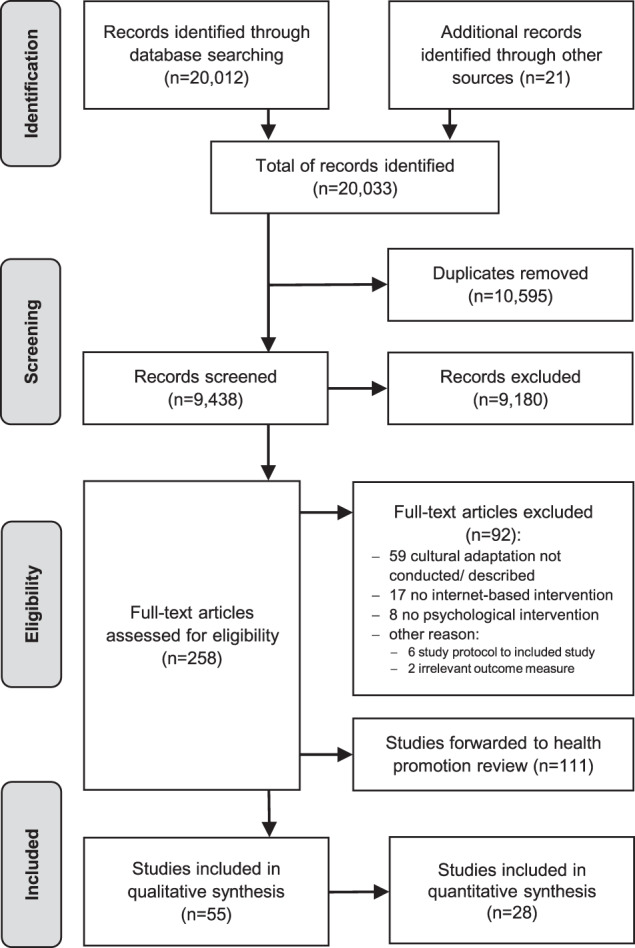
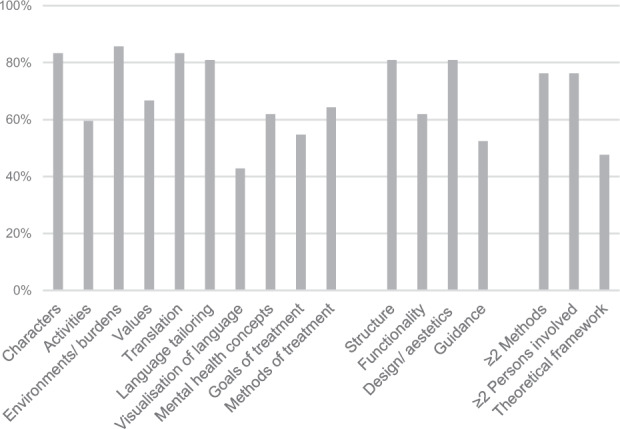
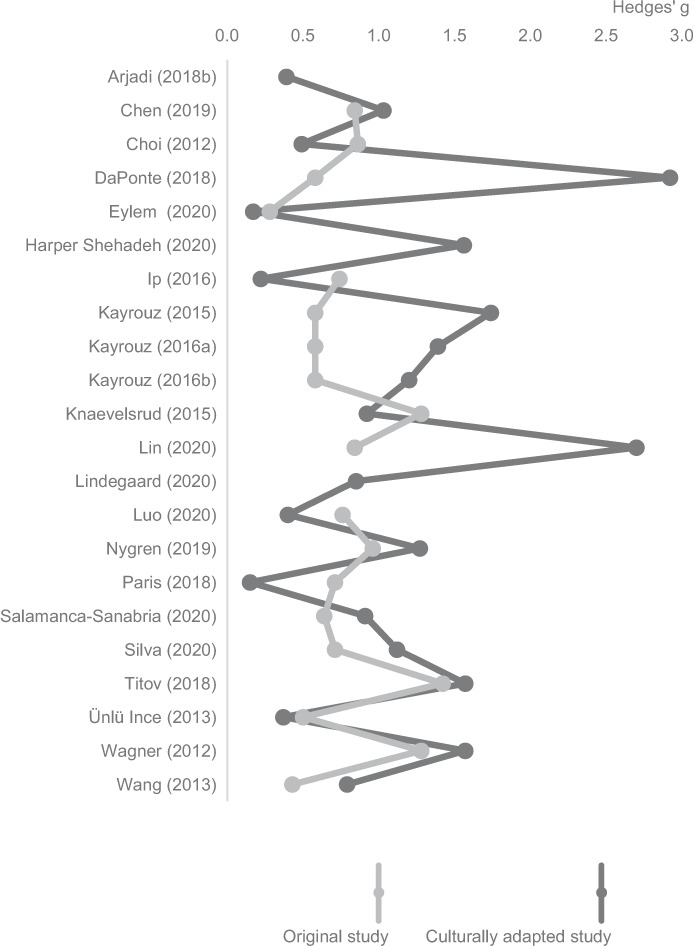
Providing accessible and effective healthcare solutions for people living in low- and middle-income countries, migrants, and indigenous people is central to reduce the global mental health treatment gap. Internet- and mobile-based interventions (IMI) are considered scalable psychological interventions to reduce the burden of mental disorders and are culturally adapted for implementation in these target groups. In October 2020, the databases PsycInfo, MEDLINE, Embase, Cochrane Central Register of Controlled Trials, and Web of Science were systematically searched for studies that culturally adapted IMI for mental disorders. Among 9438 screened records, we identified 55 eligible articles. We extracted 17 content, methodological, and procedural components of culturally adapting IMI, aiming to consider specific situations and perspectives of the target populations. Adherence and effectiveness of the adapted IMI seemed similar to the original IMI; yet, no included study conducted a direct comparison. The presented taxonomy of cultural adaptation of IMI for mental disorders provides a basis for future studies investigating the relevance and necessity of their cultural adaptation.PROSPERO registration number: CRD42019142320.
Overview
The claims and statistics of this paper haven’t been checked yet.
Run the check — free, no account needed. It reads the open-access text and checks the sources it cites.
Integrity signals
Registry
Cites
Statistics
Figures
Verification
Claims the paper makes
The claims and statistics of this paper haven’t been checked yet.
Run the check — free, no account needed. It reads the open-access text and checks the sources it cites.
Claims other papers make about this one
Each is checked against this paper’s own text: does it say what the citing paper says it does?
The source backs part of the claim, not all of it — or backs it for a different population, condition or comparison.
In the citing paper
“Currently available smartphone-delivered interventions differ widely in their cultural and contextual adaptations (Spanhel et al., 2021) and in their treatment approach and range of indications (e.g., targeting one specific problem vs. a transdiagnostic approach).”
From Smartphone-delivered mental health care interventions for refugees: A systematic review of the literature (2023) · cites this paper as Spanhel et al., 2021
Experimental — accuracy not yet measuredThe source backs part of the claim, not all of it — or backs it for a different population, condition or comparison.
In the citing paper
“Previous culturally adapted ICBT trials targeting adult non-western immigrant and refugee participants have overall demonstrated treatment effects, and adherence similar to standard ICBT interventions (Spanhel et al., 2021)”
From Investigating the potential of a novel internet-based cognitive behavioural intervention for Dari and Farsi speaking refugee youth: A feasibility study (2022) · cites this paper as Spanhel et al., 2021
Experimental — accuracy not yet measuredThe cited source says what the claim attributes to it.
In the citing paper
“The participation of the seven countries has led to cultural adaptations in language and materials, following the recommendations of the literature on this topic (Spanhel et al., 2021).”
From Internet-based self-administered intervention to reduce anxiety and depression symptomatology and improve well-being in 7 countries: protocol of a randomized control trial (2024) · cites this paper as Spanhel et al., 2021
The cited source says what the claim attributes to it.
In the citing paper
“Spanhel et al. (2021) conducted a systematic review on cultural adaptation of internet-based interventions for marginalized groups worldwide, and identified 17 components regarding content, methods, and procedural components eligible for cultural adaptation in the context of internet- and mobile-based mental health interventions.”
From Smartphone-delivered mental health care interventions for refugees: A systematic review of the literature (2023) · cites this paper as Spanhel et al., 2021
The cited source says what the claim attributes to it.
In the citing paper
“These interventions offer several advantages over traditional formats of assistance, including greater temporal and local independency, anonymity, accessibility, and flexible delivery [6]”
From The Efficacy of Be a Mom, a Web-Based Intervention to Prevent Postpartum Depression: Examining Mechanisms of Change in a Randomized Controlled Trial (2023) · cites this paper as [6]
The cited source says what the claim attributes to it.
In the citing paper
“A recent review of cultural adaptation of internet-based interventions found no significant associations between the extent of adaptation and the efficacy or adherence to the intervention (Spanhel et al., 2021).”
From Investigating the potential of a novel internet-based cognitive behavioural intervention for Dari and Farsi speaking refugee youth: A feasibility study (2022) · cites this paper as Spanhel et al., 2021
Self-check
Percentages, sums and reported differences re-computed from the paper’s own numbers.
The self-check needs the paper’s full text.
Citations
Cites
The Measurement of Observer Agreement for Categorical Data
Landis, J. R., & Koch, G. G. (1977) · Biometrics · doi:10.2307/2529310 · Cited by 81,148
The CES-D Scale: A Self-Report Depression Scale for Research in the General Population
Radloff, L. S. (1977) · Applied Psychological Measurement · doi:10.1177/014662167700100306 · Cited by 53,267
A Coefficient of Agreement for Nominal Scales
Cohen, J. (1960) · Educational and Psychological Measurement · doi:10.1177/001316446002000104 · Cited by 42,398
An inventory for measuring depression
BECK, A. T. (1961) · Archives of General Psychiatry · doi:10.1001/archpsyc.1961.01710120031004 · Cited by 38,032
The Pittsburgh Sleep Quality Index: a new instrument for psychiatric practice and research
Buysse, D. J., Reynolds, C. F., Monk, T. H., Berman, S. R., & Kupfer, D. J. (1989) · Psychiatry Research · doi:10.1016/0165-1781(89)90047-4 · Cited by 35,234
A Brief Measure for Assessing Generalized Anxiety Disorder: The GAD-7
Spitzer, R. L., Kroenke, K., Williams, J. B. W., & Löwe, B. (2006) · Archives of Internal Medicine · doi:10.1001/archinte.166.10.1092 · Cited by 31,765
Liberati, A., Altman, D. G., Tetzlaff, J., Mulrow, C., Gøtzsche, P. C., Ioannidis, J. P. A., Clarke, M., Devereaux, P. J., Kleijnen, J., & Moher, D. (2009) · PLoS Medicine · doi:10.1371/journal.pmed.1000100 · Cited by 28,164
Dermyshi, E., Wang, Y., Yan, C., Hong, W., Qiu, G., Gong, X., & Zhang, T. (2017) · Neonatology · doi:10.1159/000454668 · Cited by 24,586
Liberati, A., Altman, D. G., Tetzlaff, J., Mulrow, C., Gøtzsche, P. C., Ioannidis, J. P. A., Clarke, M., Devereaux, P. J., Kleijnen, J., & Moher, D. (2009) · Journal of Clinical Epidemiology · doi:10.1016/j.jclinepi.2009.06.006 · Cited by 10,578
KESSLER, R. C., ANDREWS, G., COLPE, L. J., HIRIPI, E., MROCZEK, D. K., NORMAND, S.-L. T., WALTERS, E. E., & ZASLAVSKY, A. M. (2002) · Psychological Medicine · doi:10.1017/s0033291702006074 · Cited by 10,327
Research works printed but not linked: 2
- Covidence. Covidence systematic review software, Veritas Health Innovation, Melbourne, Australia. Available at www.covidence.org.
- Hedges, L. & Olkin, I. Statistical Methods for Meta-analysis (Academic Press, 1985).
Cited by
Sorted by citations
Torous, J., Linardon, J., Goldberg, S. B., Sun, S., Bell, I., Nicholas, J., Hassan, L., Hua, Y., Milton, A., & Firth, J. (2025) · World Psychiatry · doi:10.1002/wps.21299 · Cited by 323
Cultural and Contextual Adaptation of Digital Health Interventions: Narrative Review
Naderbagi, A., Loblay, V., Zahed, I. U. M., Ekambareshwar, M., Poulsen, A., Song, Y. J. C., Ospina‐Pinillos, L., Krausz, M. R., Kamel, M. M., Hickie, I. B., et al. (2024) · Journal of Medical Internet Research · doi:10.2196/55130 · Cited by 160
Digital interventions in mental health: An overview and future perspectives
Löchner, J., Carlbring, P., Schuller, B. W., Torous, J. B., & Sander, L. (2025) · Internet Interventions · doi:10.1016/j.invent.2025.100824 · Cited by 182
Hornstein, S., Zantvoort, K., Lueken, U., Funk, B., & Hilbert, K. (2023) · Frontiers in Digital Health · doi:10.3389/fdgth.2023.1170002 · Cited by 134
Yeo, G., Reich, S. M., Liaw, N. A., & Chia, E. Y. M. (2023) · Journal of Medical Internet Research · doi:10.2196/51268 · Cited by 143
Metadata
- Authors
- Spanhel, K., Balci, S., Feldhahn, F., Bengel, J., Baumeister, H., & Sander, L. B.
- Affiliations
- University of Freiburg (DE)
- Universität Ulm (DE)
- Corresponding author
- Spanhel, Kerstin
- Venue
- npj Digital Medicine
- Published
- 2021-08-25
- Volume
- 4
- Issue
- 1
- Pages
- 128-128
- ISSN
- 2398-6352 (ISSN-L)
- PMC
- PMC8387403
- OpenAlex
- W3196086198
- Cited by
- 178
- References
- 178
- Citations by year
- 2026: 32 · 2025: 37 · 2024: 46 · 2023: 34 · 2022: 27 · 2021: 2
- FWCI
- 4.38
- Type
- journal article
- Language
- en
- Open access
- gold
- doi.org
- Locations
- npj Digital Medicine (publishedVersion, cc-by)
- Europe PMC (PubMed Central) (publishedVersion, other-oa)
- PubMed Central (publishedVersion, cc-by)
- PubMed (publishedVersion)
- Informationszentrum Lebenswissenschaften (ZB MED) (submittedVersion, cc-by)
- DOAJ (DOAJ: Directory of Open Access Journals) (submittedVersion, cc-by-sa)
- Funders
- German Academic Scholarship Foundation
- Scholarship granted by the Ministry of Education, Turkey
- Topics
- Social Sciences › Psychology › Applied Psychology › Digital Mental Health Interventions
- Health Sciences › Medicine › Psychiatry and Mental health › Mental Health Treatment and Access
- Health Sciences › Health Professions › General Health Professions › Mobile Health and mHealth Applications
- Keywords
- cultural adaptation, online intervention, mobile-based interventions, mental illness, low- and middle-income countries, migrants, indigenous peoples, adherence, intervention effectiveness
About these checks
Registry, retraction, Cites and statistics results are computed, not judged, with one exception: a printed reference that no index lists is read once by a model before it counts as a citation error. Claims are extracted by a model and kept only when their quote appears verbatim in the text; each cited source is then checked, with a model’s help, for whether it says what the claim relies on. Those verdicts can be wrong — read the claim’s quote and the cited source before relying on one.
Statistics and arithmetic are recomputed, not judged.
Confidence bands are shown only for fields calibrated on our annotated test set. None is calibrated yet, so no band is shown.
What counts as a claim ›How we measure confidence ›How we check this ›
Are you an author, or do you see a problem with this page? Request a review
