

The DOI matches its Crossref record; 47 of the 47 references it cites were found in a registry or an index.
Imputation of missing values for electronic health record laboratory data
Open accessAbstract
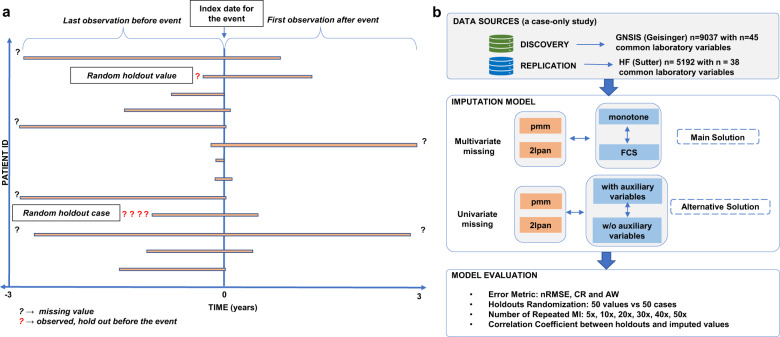
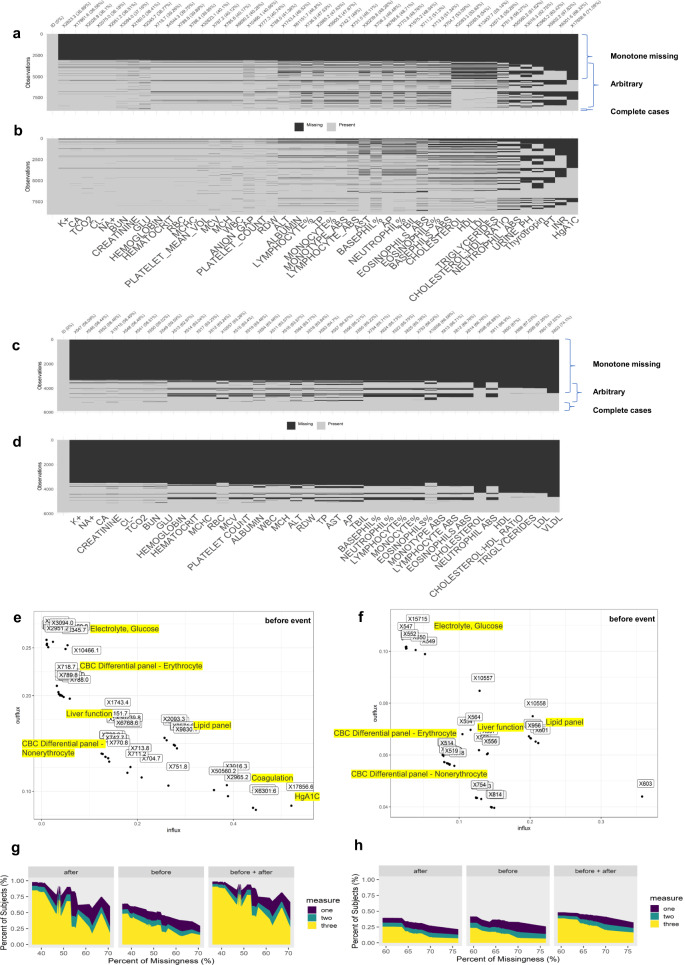
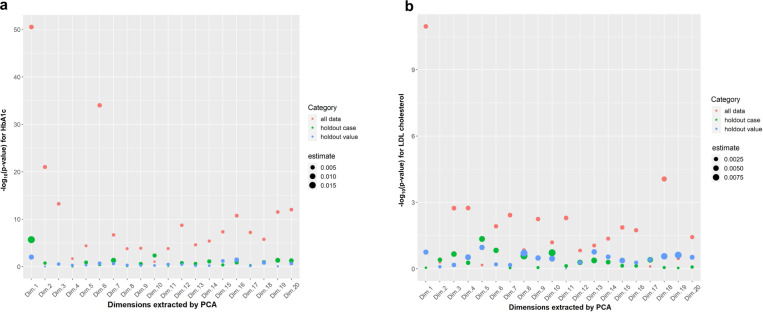
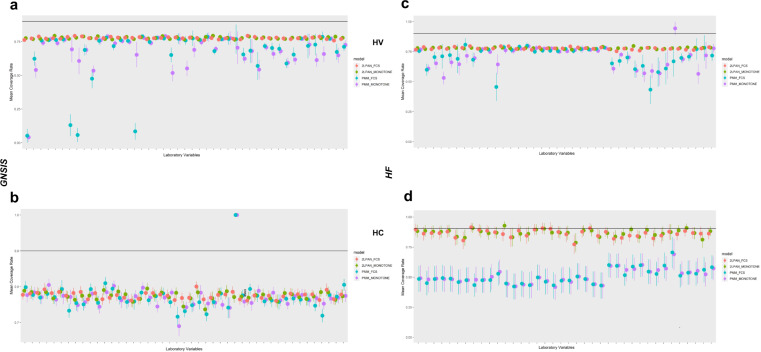
Laboratory data from Electronic Health Records (EHR) are often used in prediction models where estimation bias and model performance from missingness can be mitigated using imputation methods. We demonstrate the utility of imputation in two real-world EHR-derived cohorts of ischemic stroke from Geisinger and of heart failure from Sutter Health to: (1) characterize the patterns of missingness in laboratory variables; (2) simulate two missing mechanisms, arbitrary and monotone; (3) compare cross-sectional and multi-level multivariate missing imputation algorithms applied to laboratory data; (4) assess whether incorporation of latent information, derived from comorbidity data, can improve the performance of the algorithms. The latter was based on a case study of hemoglobin A1c under a univariate missing imputation framework. Overall, the pattern of missingness in EHR laboratory variables was not at random and was highly associated with patients’ comorbidity data; and the multi-level imputation algorithm showed smaller imputation error than the cross-sectional method.
Overview
The claims and statistics of this paper haven’t been checked yet.
Run the check — free, no account needed. It reads the open-access text and checks the sources it cites.
Integrity signals
Registry
Cites
Statistics
Figures
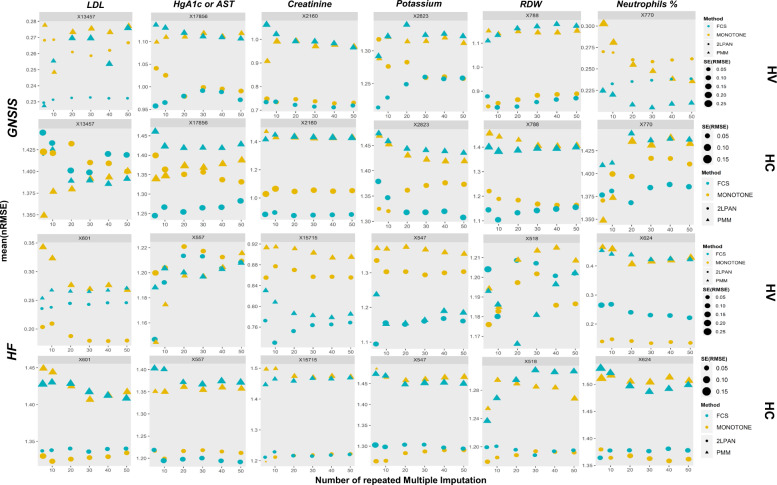
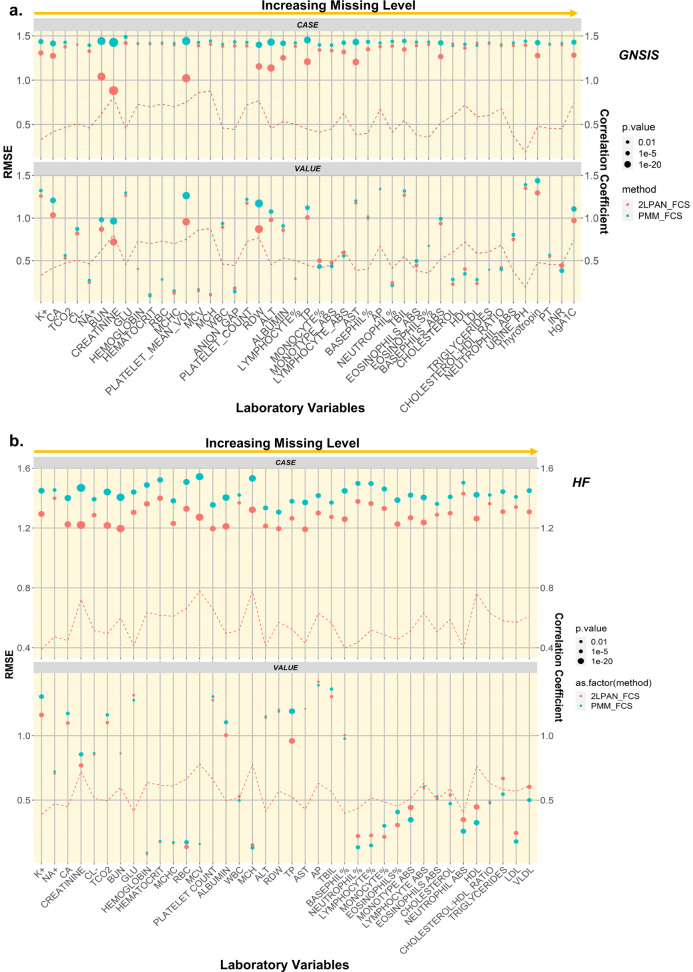
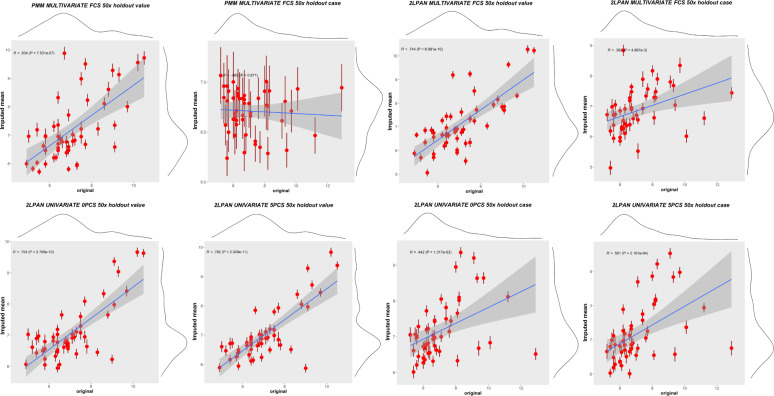
Verification
Claims the paper makes
The claims and statistics of this paper haven’t been checked yet.
Run the check — free, no account needed. It reads the open-access text and checks the sources it cites.
Self-check
Percentages, sums and reported differences re-computed from the paper’s own numbers.
The self-check needs the paper’s full text.
Citations
Cites
Maximum Likelihood from Incomplete Data Via the EM Algorithm
Dempster, A. P., Laird, N. M., & Rubin, D. B. (1977) · Journal of the Royal Statistical Society Series B: Statistical Methodology · doi:10.1111/j.2517-6161.1977.tb01600.x · Cited by 50,444
Multiple Imputation for Nonresponse in Surveys
Rubin, D. B. (1987) · Wiley Series in Probability and Statistics · doi:10.1002/9780470316696 · Cited by 20,701
mice: Multivariate Imputation by Chained Equations in R
Buuren, S. V., & Groothuis-Oudshoorn, K. (2011) · Journal of Statistical Software · doi:10.18637/jss.v045.i03 · Cited by 13,870
Grundy, S. M., Cleeman, J. I., Daniels, S. R., Donato, K. A., Eckel, R. H., Franklin, B. A., Gordon, D. J., Krauss, R. M., Savage, P. J., Smith, S. C., et al. (2005) · Circulation · doi:10.1161/circulationaha.105.169404 · Cited by 11,961
RUBIN, D. B. (1976) · Biometrika · doi:10.1093/biomet/63.3.581 · Cited by 9,925
Analysis of Incomplete Multivariate Data
Schafer, J. L. (1997) · doi:10.1201/9781439821862 · Cited by 6,012
Analysis of Incomplete Multivariate Data
Booth, D. E., & Schafer, J. L. (2000) · Technometrics · doi:10.2307/1271466 · Cited by 5,627
Multiple imputation of discrete and continuous data by fully conditional specification
van Buuren, S. (2007) · Statistical Methods in Medical Research · doi:10.1177/0962280206074463 · Cited by 2,827
Flexible Imputation of Missing Data, Second Edition
van Buuren, S. (2018) · doi:10.1201/9780429492259 · Cited by 2,273
A multivariate technique for multiply imputing missing values using a sequence of regression models
Raghunathan, T. E., Lepkowski, J. M., Hoewyk, J. V., & Solenberger, P. W. (2001) · Survey methodology · Cited by 1,981
Research works printed but not linked: 2
- Ford, B. in Incomplete Data in Sample Surveys, Theory and Bibliographies Vol. 2 (Part IV) (eds. W. Madow, H. Nisselson, & I. Olkin) 185–207 (Academic Press, 1983).
- Van Buuren, S. & Groothuis-Oudshoorn, K. mice: multivariate imputation by chained equations in R. J. Stat. Softw. 45, 67 (2011). · DOI · Paper page
Cited by
Sorted by citations
Items 101–133 of 133
Bourguignon, L., Lukas, L. P., Guest, J. D., Geisler, F. H., Noonan, V., Curt, A. E. P., Brüningk, S. C., & Jutzeler, C. R. (2024) · Figshare · doi:10.6084/m9.figshare.26664049
Bourguignon, L., Lukas, L. P., Guest, J. D., Geisler, F. H., Noonan, V., Curt, A. E. P., Brüningk, S. C., & Jutzeler, C. R. (2024) · Figshare · doi:10.6084/m9.figshare.26664037
Bourguignon, L., Lukas, L. P., Guest, J. D., Geisler, F. H., Noonan, V., Curt, A. E. P., Brüningk, S. C., & Jutzeler, C. R. (2024) · Figshare · doi:10.6084/m9.figshare.26664016
Bourguignon, L., Lukas, L. P., Guest, J. D., Geisler, F. H., Noonan, V., Curt, A. E. P., Brüningk, S. C., & Jutzeler, C. R. (2024) · Figshare · doi:10.6084/m9.figshare.26664040
Bourguignon, L., Lukas, L. P., Guest, J. D., Geisler, F. H., Noonan, V., Curt, A. E. P., Brüningk, S. C., & Jutzeler, C. R. (2024) · Figshare · doi:10.6084/m9.figshare.26664034
Bourguignon, L., Lukas, L. P., Guest, J. D., Geisler, F. H., Noonan, V., Curt, A. E. P., Brüningk, S. C., & Jutzeler, C. R. (2024) · Figshare · doi:10.6084/m9.figshare.26664043
Bourguignon, L., Lukas, L. P., Guest, J. D., Geisler, F. H., Noonan, V., Curt, A. E. P., Brüningk, S. C., & Jutzeler, C. R. (2024) · Figshare · doi:10.6084/m9.figshare.26664019
Bourguignon, L., Lukas, L. P., Guest, J. D., Geisler, F. H., Noonan, V., Curt, A. E. P., Brüningk, S. C., & Jutzeler, C. R. (2024) · Figshare · doi:10.6084/m9.figshare.26664028
Bourguignon, L., Lukas, L. P., Guest, J. D., Geisler, F. H., Noonan, V., Curt, A. E. P., Brüningk, S. C., & Jutzeler, C. R. (2024) · Figshare · doi:10.6084/m9.figshare.26664046
Bourguignon, L., Lukas, L. P., Guest, J. D., Geisler, F. H., Noonan, V., Curt, A. E. P., Brüningk, S. C., & Jutzeler, C. R. (2024) · Figshare · doi:10.6084/m9.figshare.24954552
Bourguignon, L., Lukas, L. P., Guest, J. D., Geisler, F. H., Noonan, V., Curt, A. E. P., Brüningk, S. C., & Jutzeler, C. R. (2024) · Figshare · doi:10.6084/m9.figshare.24954495
Bourguignon, L., Lukas, L. P., Guest, J. D., Geisler, F. H., Noonan, V., Curt, A. E. P., Brüningk, S. C., & Jutzeler, C. R. (2024) · Figshare · doi:10.6084/m9.figshare.26664010
GA-RLImpute: A Genetic Algorithm with Reinforcement Learning for Imputation of Medical Tabular Data
Yang, X.-W., Xun, D., You, L., Yao, Y., Hu, L., & Hu, P.-W. (2025) · IEEE International Conference on Bioinformatics and Biomedicine · doi:10.1109/bibm66473.2025.11356977
van Egeraat, J. W. A., van Geloven, N., Hageman, S. H. J., Bonten, T. N., Cahn, W., Vos, R. C., Kist, J. M., Mairuhu, A. T. A., & van Os, H. J. A. (2026) · Open Heart · doi:10.1136/openhrt-2025-003882
LiverWise: An AI-Powered Machine Learning System for Liver Disease Detection and Health Management
Kumar, M. K., Sravanthi, T. L., Srihitha, D. V. S., & Rakesh, K. (2026) · International Conference on Sentiment Analysis and Deep Learning (ICSADL) · doi:10.1109/icsadl67539.2026.11452117
Adaptive clustering-driven imputation with A Priori suitability estimation for unlabeled data
Sebastian, A. M., Peter, D., & Sebastian, R. A. (2026) · Knowledge-Based Systems · doi:10.1016/j.knosys.2026.116043
Sycz, A., Dabrowski, M. I., Marciniak, K., Jurczuk, A., Meryn, A., Konopelko, M., Dudziński, M., Markiewicz, M., Homenda, W., Sobas, M., et al. (2026) · Cancers · doi:10.3390/cancers18101618
Adaptive Hybrid Rule Based and Model Based Imputation for Incomplete Medical Surveillance Data
Wakuma, A. F., Siahaan, D., Purwitasari, D., Saikhu, A., & Tareke, K. G. (2026) · International Conference on Advances in Electrical, Electronics and Computing Technology (EECT) · doi:10.1109/eect68756.2026.11517654
Clustering-based federated causal discovery for multicenter clinical data analysis
Zhang, M., Wang, H., Zhao, J., & Wu, L. (2026) · Journal of Biomedical Informatics · doi:10.1016/j.jbi.2026.105066
Salvatore, M., Kundu, R., Du, J., Friese, C. R., Mondul, A. M., Hanauer, D., Lu, H., Pearce, C. L., & Mukherjee, B. (2026) · Genetic Epidemiology · doi:10.1002/gepi.70047
Informative Missingness to Generate Irregular Clinical Time Series
Mehdizavareh, H., Santangelo, G., Nicora, G., Cichosz, S. L., Dagliati, A., Khan, A., & Bellazzi, R. (2026) · Lecture notes in computer science · doi:10.1007/978-3-032-30813-9_37
Feiler, M. O., Yucel, R. M., Dzomba, B. J., & Jones, R. M. (2026) · BMC Infectious Diseases · doi:10.1186/s12879-026-13994-0
Cacao, G. F., Du, D., & Nair, N. (2026) · The International Journal of Artificial Organs · doi:10.1177/03913988261463234
Willis, C., Goodin, D. A., Miller, H. A., Suliman, S. H., & Frieboes, H. B. (2026) · Computer Methods and Programs in Biomedicine Update · doi:10.1016/j.cmpbup.2026.100263
Systematic assessment of mixed imputation methods and explainable machine learning
Li, J.-Y., & Zhao, Y. (2026) · World Journal of Gastrointestinal Surgery · doi:10.4240/wjgs.v18.i7.119087
Self-citationÇırağ, B., Acar, R., Yağanoğlu, M., & Şengül, S. (2026) · Stochastic Environmental Research and Risk Assessment · doi:10.1007/s00477-026-03324-w
Elizondo, M., Amante, D. J., & Tešić, J. (2026) · ACM International Conference on Bioinformatics, Computational Biology, and Health Informatics (ACM-BCB) · doi:10.1145/3807503.3819383
Machine Learning for Early Detection and Prevention of Disease Using Electronic Health Records
Huo, Z., & Wu, J. (2026) · Methods in molecular biology · doi:10.1007/978-1-0716-5408-8_5
Zhang, J., Dai, J., & Lyu, Q. (2026) · Research Square · doi:10.21203/rs.3.rs-10529143/v1
Mun, Y., Ahn, J. H., Lee, C. Y., Ahn, B., Huh, J. W., & Chung, K. S. (2026) · Journal of the American Medical Informatics Association · doi:10.1093/jamia/ocag124
Structured missingness in biomedical research
Rehak-Bucova, B., Fraza, C., Lemvigh, C. K., Flaaten, C. B., Sæther, L. S., Cattarinussi, G., Ambrosen, K. S., Andreassen, O. A., Westlye, L. T., Beckmann, C. F., et al. (2026) · Communications AI & Computing · doi:10.1038/s44488-026-00025-9
Zheng, F., Lin, L., & Chen, R. (2026) · Digital Health · doi:10.1177/20552076261496524
Mapping Clinical Laboratory Signatures from Electronic Health Records in the Estonian BiobankPreprint
Nurm, M., Reigo, A., Ottas, A., Annilo, T., Oja, M., Tamm, S., & Haller, T. (2026) · medRxiv · doi:10.64898/2026.10.16.26365128
Metadata
- Authors
- Li, J., Yan, X. S., Chaudhary, D., Avula, V., Mudiganti, S., Husby, H., Shahjouei, S., Afshar, A., Stewart, W. F., Yeasin, M., Zand, R., & Abedi, V.
- Affiliations
- Geisinger Health System (US)
- Sutter Health (US)
- Georgia Institute of Technology (US)
- University of Memphis (US)
- Pennsylvania State University (US)
- Corresponding author
- Abedi, Vida
- ORCID
- Venue
- npj Digital Medicine
- Published
- 2021-10-11
- Volume
- 4
- Issue
- 1
- Pages
- 147-147
- ISSN
- 2398-6352 (ISSN-L)
- PMC
- PMC8505441
- OpenAlex
- W3205484571
- Cited by
- 133
- References
- 47
- Citations by year
- 2026: 30 · 2025: 35 · 2024: 33 · 2023: 23 · 2022: 11 · 2021: 1
- FWCI
- 12.68
- Type
- journal article
- Language
- en
- Open access
- gold
- doi.org
- Locations
- npj Digital Medicine (publishedVersion, cc-by)
- Europe PMC (PubMed Central) (publishedVersion, other-oa)
- PubMed Central (publishedVersion, cc-by)
- PubMed (publishedVersion)
- DOAJ (DOAJ: Directory of Open Access Journals) (submittedVersion, cc-by-sa)
- Funders
- U.S. Department of Health & Human Services | NIH | Center for Information Technology (R56HL116832)
- Topics
- Physical Sciences › Mathematics › Statistics and Probability › Statistical Methods and Bayesian Inference
- Physical Sciences › Computer Science › Artificial Intelligence › Machine Learning in Healthcare
- Health Sciences › Health Professions › Health Information Management › Artificial Intelligence in Healthcare
- Keywords
- missing data imputation, electronic health records, laboratory findings, ischemic stroke, heart failure, missingness patterns, comorbidities, HbA1c, imputation error
About these checks
Registry, retraction, Cites and statistics results are computed, not judged, with one exception: a printed reference that no index lists is read once by a model before it counts as a citation error. Claims are extracted by a model and kept only when their quote appears verbatim in the text; each cited source is then checked, with a model’s help, for whether it says what the claim relies on. Those verdicts can be wrong — read the claim’s quote and the cited source before relying on one.
Statistics and arithmetic are recomputed, not judged.
Confidence bands are shown only for fields calibrated on our annotated test set. None is calibrated yet, so no band is shown.
What counts as a claim ›How we measure confidence ›How we check this ›
Are you an author, or do you see a problem with this page? Request a review
