

Mobile devices and wearable technology for measuring patient outcomes after surgery: a systematic review
Open accessThe DOI matches its Crossref record; 111 of the 112 references it cites were found in a registry or an index.
Abstract
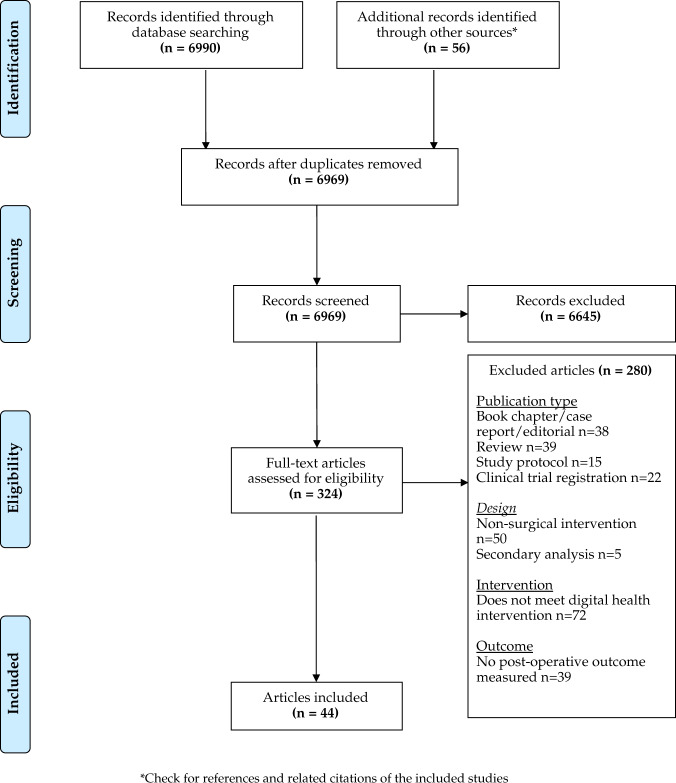
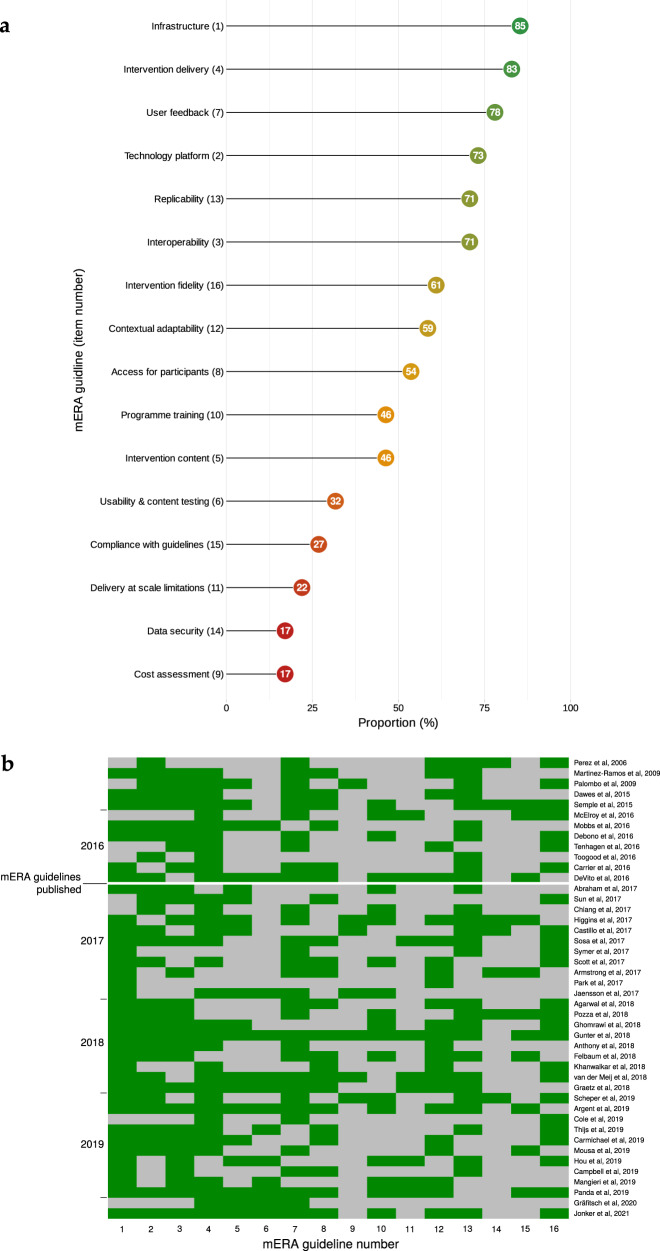
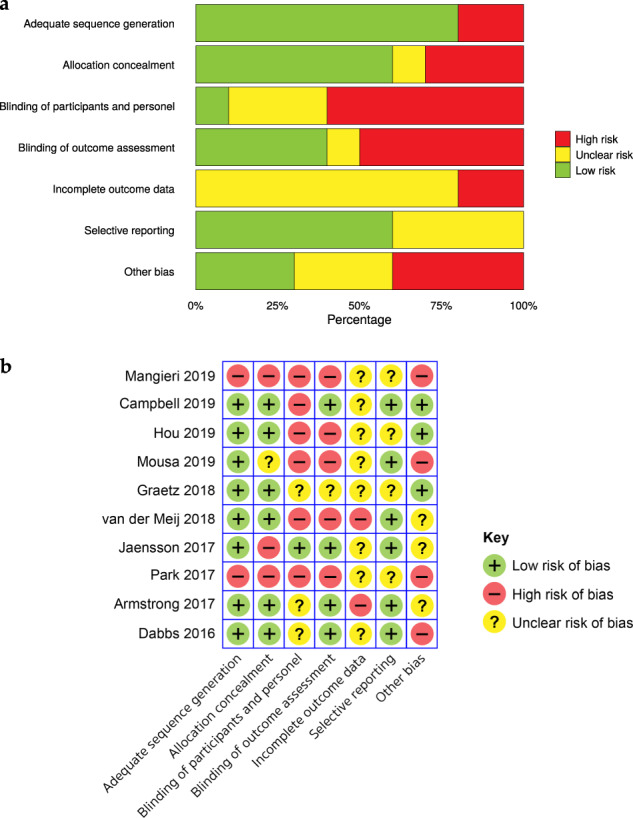
Complications following surgery are common and frequently occur the following discharge. Mobile and wearable digital health interventions (DHI) provide an opportunity to monitor and support patients during their postoperative recovery. Lack of high-quality evidence is often cited as a barrier to DHI implementation. This review captures and appraises the current use, evidence base and reporting quality of mobile and wearable DHI following surgery. Keyword searches were performed within Embase, Cochrane Library, Web of Science and WHO Global Index Medicus databases, together with clinical trial registries and Google scholar. Studies involving patients undergoing any surgery requiring skin incision where postoperative outcomes were measured using a DHI following hospital discharge were included, with DHI defined as mobile and wireless technologies for health to improve health system efficiency and health outcomes. Methodological reporting quality was determined using the validated mobile health evidence reporting and assessment (mERA) guidelines. Bias was assessed using the Cochrane Collaboration tool for randomised studies or MINORS depending on study type. Overall, 6969 articles were screened, with 44 articles included. The majority (n = 34) described small prospective study designs, with a high risk of bias demonstrated. Reporting standards were suboptimal across all domains, particularly in relation to data security, prior patient engagement and cost analysis. Despite the potential of DHI to improve postoperative patient care, current progress is severely restricted by limitations in methodological reporting. There is an urgent need to improve reporting for DHI following surgery to identify patient benefit, promote reproducibility and encourage sustainability.
Overview
The claims and statistics of this paper haven’t been checked yet.
Free: it reads the open-access text and checks the first 5 claims that cite a source we can check. Create a free account to check every claim.
Integrity signals
Registry
Cites
Statistics
Figures
Verification
Claims the paper makes
The claims and statistics of this paper haven’t been checked yet.
Free: it reads the open-access text and checks the first 5 claims that cite a source we can check. Create a free account to check every claim.
Claims other papers make about this one
Each is checked against this paper’s own text: does it say what the citing paper says it does?
The source backs part of the claim, not all of it — or backs it for a different population, condition or comparison.
In the citing paper
“Although digital self-help interventions can have positive effects, to optimise their benefits it is thus vital that they are systematically developed in a process of co-creation with stakeholders and patients (Klein et al., 2014; Scott et al., 2017; Knight et al., 2021).”
From Strength Back – A qualitative study on the co-creation of a positive psychology digital health intervention for spinal surgery patients (2023) · cites this paper as Knight et al., 2021
Experimental — accuracy not yet measuredThe source backs part of the claim, not all of it — or backs it for a different population, condition or comparison.
In the citing paper
“Their results indicate that digital health interventions have the potential to reduce complication rates, facilitate patient recovery, reduce inappropriate service use and improve longer-term outcomes after surgery.”
From Strength Back – A qualitative study on the co-creation of a positive psychology digital health intervention for spinal surgery patients (2023) · cites this paper as Knight et al., 2021
Experimental — accuracy not yet measuredThe cited source says what the claim attributes to it.
In the citing paper
“Interestingly, they also state that the studies in their review made little reference to engaging patients in the development of the digital health interventions.”
From Strength Back – A qualitative study on the co-creation of a positive psychology digital health intervention for spinal surgery patients (2023) · cites this paper as Knight et al., 2021
Self-check
Percentages, sums and reported differences re-computed from the paper’s own numbers.
The self-check needs the paper’s full text.
Citations
Cites
Preferred Reporting Items for Systematic Reviews and Meta-Analyses: the PRISMA statement
Moher, D., Liberati, A., Tetzlaff, J., Altman, D. G., & for the PRISMA Group (2009) · BMJ · doi:10.1136/bmj.b2535 · Cited by 83,823
Preferred Reporting Items for Systematic Reviews and Meta-Analyses: The PRISMA Statement
Moher, D., Liberati, A., Tetzlaff, J., Altman, D. G., & The PRISMA Group (2009) · PLoS Medicine · doi:10.1371/journal.pmed.1000097 · Cited by 64,042
Preferred reporting items for systematic reviews and meta-analyses: the PRISMA Statement.
(2009) · PubMed Central · Cited by 44,859
The Cochrane Collaboration's tool for assessing risk of bias in randomised trials
Higgins, J. P. T., Altman, D. G., Gotzsche, P. C., Juni, P., Moher, D., Oxman, A. D., Savovic, J., Schulz, K. F., Weeks, L., Sterne, J. A. C., et al. (2011) · BMJ · doi:10.1136/bmj.d5928 · Cited by 33,817
Dermyshi, E., Wang, Y., Yan, C., Hong, W., Qiu, G., Gong, X., & Zhang, T. (2017) · Neonatology · doi:10.1159/000454668 · Cited by 24,451
von Elm, E., Altman, D. G., Egger, M., Pocock, S. J., Gøtzsche, P. C., Vandenbroucke, J. P., & Initiative, F. T. S. (2007) · PLoS Medicine · doi:10.1371/journal.pmed.0040296 · Cited by 23,020
Wang, G., Ma, R., Qiao, G., Wada, K., Aizawa, Y., & Satoh, T. (2015) · Integrative Medicine International · doi:10.1159/000368408 · Cited by 18,657
von Elm, E., Altman, D. G., Egger, M., Pocock, S. J., Gøtzsche, P. C., & Vandenbroucke, J. P. (2008) · Journal of Clinical Epidemiology · doi:10.1016/j.jclinepi.2007.11.008 · Cited by 17,893
von Elm, E., Altman, D. G., Egger, M., Pocock, S. J., Gøtzsche, P. C., Vandenbroucke, J. P., & Initiative, F. T. S. (2007) · Annals of Internal Medicine · doi:10.7326/0003-4819-147-8-200710160-00010 · Cited by 17,796
CONSORT 2010 Statement: updated guidelines for reporting parallel group randomised trials
the CONSORT Group, Schulz, K. F., Altman, D. G., & Moher, D. (2010) · BMC Medicine · doi:10.1186/1741-7015-8-18 · Cited by 13,371
Research works printed but not linked: 1
- Altmetric. Guidelines for reporting of health interventions using mobile phones: mobile health (mHealth) evidence reporting and assessment (mERA) checklist: overview of attention for article published in British Medical Journal. https://www.altmetric.com/details/6208109. 26988021
Cited by
Artificial intelligence in surgery
Varghese, C., Harrison, E. M., O’Grady, G., & Topol, E. J. (2024) · Nature Medicine · doi:10.1038/s41591-024-02970-3 · Cited by 287
“One systematic review highlights 31 different wearable devices capable of monitoring vital signs, physiological parameters and physical activity 23 , but further work is required to realize the potential of these data, including improving the quality of research and reporting 126,127 .”
Self-citationDeniz-Garcia, A., Fabelo, H., Rodriguez-Almeida, A. J., Zamora-Zamorano, G., Castro-Fernandez, M., Alberiche Ruano, M. D. P., Solvoll, T., Granja, C., Schopf, T. R., Callico, G. M., et al. (2023) · Journal of Medical Internet Research · doi:10.2196/44030 · Cited by 268
“Other uses of AI-based mHealth apps have also been assessed, such as measuring patient outcomes after surgery [95] or managing public health challenges such as COVID-19 [96].”
On-Field Deployment and Validation for Wearable Devices
Kuo, C., Patton, D. A., Rooks, T. F., Tierney, G. J., McIntosh, A. S., Lynall, R. C., Esquivel, A. O., Daniel, R., Kaminski, T. W., Mihalik, J. P., et al. (2022) · Annals of Biomedical Engineering · doi:10.1007/s10439-022-03001-3 · Cited by 94
Wearable devices to monitor recovery after abdominal surgery: scoping review
Wells, C. I., Xu, W., Penfold, J. A., Keane, C., Gharibans, A. A., Bissett, I. P., & O’Grady, G. (2022) · BJS Open · doi:10.1093/bjsopen/zrac031 · Cited by 85
Prasanthi, S., Kumarachari, R. K., Bukke, S. P. N., Rajasekhar, E. S. K., Ashokkumar, J. A., & Eftekhari, Z. (2025) · Discover Oncology · doi:10.1007/s12672-025-02469-4 · Cited by 100
“This continuous monitoring allows for timely interventions, improving post-operative treatment strategies and reducing hospital readmissions [214].”
Metadata
- Authors
- Knight, S. R., Ng, N., Tsanas, A., Mclean, K., Pagliari, C., & Harrison, E. M.
- Affiliations
- University of Edinburgh (GB)
- Corresponding author
- Knight, Stephen R.
- ORCID
- Venue
- npj Digital Medicine
- Published
- 2021-11-12
- Volume
- 4
- Issue
- 1
- Pages
- 157-157
- ISSN
- 2398-6352 (ISSN-L)
- PMC
- PMC8590052
- OpenAlex
- W3213965463
- Cited by
- 104
- References
- 112
- Citations by year
- 2026: 30 · 2025: 25 · 2024: 19 · 2023: 18 · 2022: 11
- FWCI
- 2.49
- Type
- journal article
- Language
- en
- Open access
- gold
- doi.org
- Licence
- cc-by
- creativecommons.org/licenses/by/4.0 (tdm)
- creativecommons.org/licenses/by/4.0 (vor)
- Locations
- npj Digital Medicine (publishedVersion, cc-by)
- PubMed Central (publishedVersion, cc-by)
- PubMed (publishedVersion)
- DOAJ (DOAJ: Directory of Open Access Journals) (submittedVersion, cc-by-sa)
- Edinburgh Research Explorer (University of Edinburgh) (submittedVersion, cc-by)
- Funders
- DH | National Institute for Health Research (NIHR 17-0799)
- Topics
- Health Sciences › Health Professions › General Health Professions › Mobile Health and mHealth Applications
- Social Sciences › Psychology › Applied Psychology › Digital Mental Health Interventions
- Physical Sciences › Computer Science › Information Systems › Mobile Learning in Education
- Keywords
- mobile health, wearable devices, digital health interventions, postoperative recovery, postoperative complications, postoperative monitoring, patient outcomes, reporting quality, risk of bias, data security, patient engagement, cost analysis
About these checks
Registry, retraction, Cites and statistics results are computed, not judged, with one exception: a printed reference that no index lists is read once by a model before it counts as a citation error. Claims are extracted by a model and kept only when their quote appears verbatim in the text; each cited source is then checked, with a model’s help, for whether it says what the claim relies on. Those verdicts can be wrong — read the claim’s quote and the cited source before relying on one.
Statistics and arithmetic are recomputed, not judged.
Confidence bands are shown only for fields calibrated on our annotated test set. None is calibrated yet, so no band is shown.
What counts as a claim ›How we measure confidence ›How we check this ›
Are you an author, or do you see a problem with this page? Request a review
Data sources
Bibliographic data: Semantic Scholar, OpenAlex, Crossref.
Contains information from the Semantic Scholar Academic Graph Datasets, made available under the ODC Attribution License (ODC-BY 1.0).
Semantic Scholar’s data is described in: Kinney, R., et al. (2023). The Semantic Scholar Open Data Platform. arXiv:2301.10140.
