

A high-generalizability machine learning framework for predicting the progression of Alzheimer’s disease using limited data
Open accessThe DOI matches its Crossref record; 55 of the 55 references it cites were found in a registry or an index.
Abstract
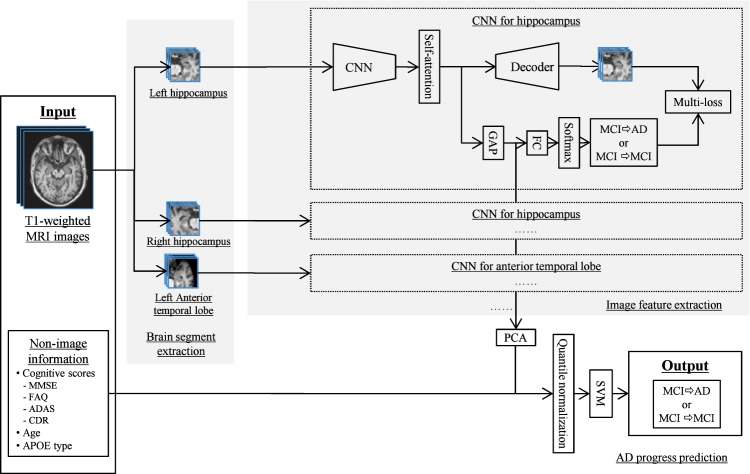
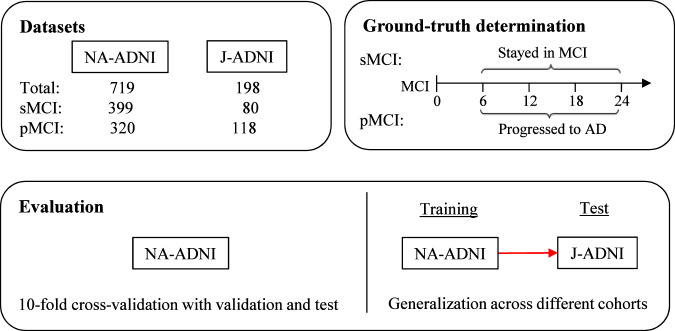
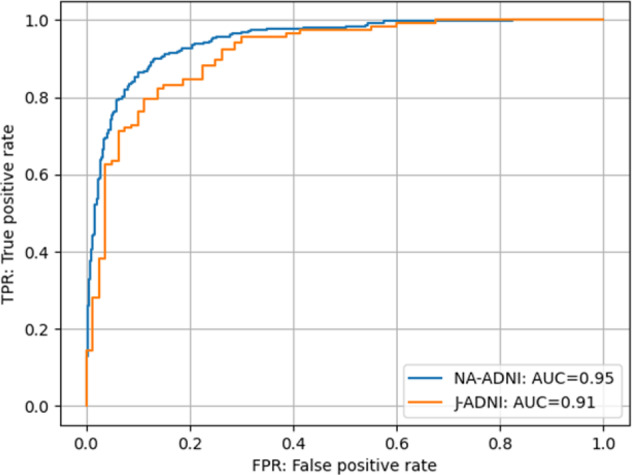
Alzheimer’s disease is a neurodegenerative disease that imposes a substantial financial burden on society. A number of machine learning studies have been conducted to predict the speed of its progression, which varies widely among different individuals, for recruiting fast progressors in future clinical trials. However, because the data in this field are very limited, two problems have yet to be solved: the first is that models built on limited data tend to induce overfitting and have low generalizability, and the second is that no cross-cohort evaluations have been done. Here, to suppress the overfitting caused by limited data, we propose a hybrid machine learning framework consisting of multiple convolutional neural networks that automatically extract image features from the point of view of brain segments, which are relevant to cognitive decline according to clinical findings, and a linear support vector classifier that uses extracted image features together with non-image information to make robust final predictions. The experimental results indicate that our model achieves superior performance (accuracy: 0.88, area under the curve [AUC]: 0.95) compared with other state-of-the-art methods. Moreover, our framework demonstrates high generalizability as a result of evaluations using a completely different cohort dataset (accuracy: 0.84, AUC: 0.91) collected from a different population than that used for training.
Overview
The claims and statistics of this paper haven’t been checked yet.
Free: it reads the open-access text and checks the first 5 claims that cite a source we can check. Create a free account to check every claim.
Integrity signals
Registry
Cites
Statistics
Figures
Verification
Claims the paper makes
The claims and statistics of this paper haven’t been checked yet.
Free: it reads the open-access text and checks the first 5 claims that cite a source we can check. Create a free account to check every claim.
Self-check
Percentages, sums and reported differences re-computed from the paper’s own numbers.
The self-check needs the paper’s full text.
Citations
Cites
Vaswani, A., Shazeer, N., Parmar, N., Uszkoreit, J., Jones, L., Gomez, A. N., Kaiser, L., & Polosukhin, I. (2017) · arXiv · doi:10.48550/arxiv.1706.03762 · Cited by 120,404
LeCun, Y., Bengio, Y., & Hinton, G. (2015) · Nature · doi:10.1038/nature14539 · Cited by 84,126
Faster R-CNN: Towards Real-Time Object Detection with Region Proposal Networks
Ren, S., He, K., Girshick, R., & Sun, J. (2017) · IEEE Transactions on Pattern Analysis and Machine Intelligence · doi:10.1109/tpami.2016.2577031 · Cited by 73,472
ImageNet: A large-scale hierarchical image database
Deng, J., Dong, W., Socher, R., Li, L.-J., Li, K., & Fei-Fei, L. (2009) · 2009 IEEE Conference on Computer Vision and Pattern Recognition · doi:10.1109/cvpr.2009.5206848 · Cited by 65,333
Densely Connected Convolutional Networks
Huang, G., Liu, Z., Van Der Maaten, L., & Weinberger, K. Q. (2017) · 2017 IEEE Conference on Computer Vision and Pattern Recognition (CVPR) · doi:10.1109/cvpr.2017.243 · Cited by 48,566
An Image is Worth 16x16 Words: Transformers for Image Recognition at Scale
Dosovitskiy, A., Beyer, L., Kolesnikov, A., Weissenborn, D., Zhai, X., Unterthiner, T., Dehghani, M., Minderer, M., Heigold, G., Gelly, S., et al. (2020) · arXiv · doi:10.48550/arxiv.2010.11929 · Cited by 47,472
Rich Feature Hierarchies for Accurate Object Detection and Semantic Segmentation
Girshick, R., Donahue, J., Darrell, T., & Malik, J. (2014) · 2014 IEEE Conference on Computer Vision and Pattern Recognition · doi:10.1109/cvpr.2014.81 · Cited by 32,684
A survey on Image Data Augmentation for Deep Learning
Shorten, C., & Khoshgoftaar, T. M. (2019) · Journal of Big Data · doi:10.1186/s40537-019-0197-0 · Cited by 13,203
V-Net: Fully Convolutional Neural Networks for Volumetric Medical Image Segmentation
Milletari, F., Navab, N., & Ahmadi, S.-A. (2016) · 2016 Fourth International Conference on 3D Vision (3DV) · doi:10.1109/3dv.2016.79 · Cited by 11,931
UMAP: Uniform Manifold Approximation and Projection
McInnes, L., Healy, J., Saul, N., & Großberger, L. (2018) · Journal of Open Source Software · doi:10.21105/joss.00861 · Cited by 9,826
Research works printed but not linked: 5
- Goto T Wang C Li Y Tsuboshita Y Multi-modal deep learning for predicting progression of Alzheimer’s disease using bi-linear shake fusion Proc. SPIE (Med. Imaging) 2020 11314 452 457
- Srivastava N Hinton G Krizhevsky A Sutskever I Salakhutdinov R Dropout: a simple way to prevent neural networks from overfitting J. Mach. Learn. Res. 2014 15 1929 1958
- Vincent P Larochelle H Bengio Y Manzagol PA Stacked denoising autoencoders: learning useful representations in a deep network with a local denoising criterion J. Mach. Learn. Res. 2010 11 3371 3408
- Buolamwini J Gebru T Gender shades: intersectional accuracy disparities in commercial gender classification Proc. Mach. Learn. Res. 2018 81 1 15
- Mattes, D., Haynor, D. R., Vesselle, H., Lewellen, T. K. & Eubank, W. Nonrigid multimodality image registration. Proc. SPIE 4322, Medical Imaging: Image Processing, 1609-1620(2001).
Cited by
Lu, P., Hu, L., Mitelpunkt, A., Bhatnagar, S., Lu, L., & Liang, H. (2024) · Biomedical Signal Processing and Control · doi:10.1016/j.bspc.2023.105669 · Cited by 68
“As a result, each estimate was given a distribution and a 95 % CI estimated using the 2.5 and 97.5 percentiles of the bootstrap samples [57].”
InfluentialShin, H.-J., Jeon, S., Seol, Y., Kim, S., & Kang, D. (2023) · Applied Sciences · doi:10.3390/app13063453 · Cited by 83
Tran, A. T., Zeevi, T., & Payabvash, S. (2025) · BioMedInformatics · doi:10.3390/biomedinformatics5020020 · Cited by 75
Chen, K., Weng, Y., Hosseini, A. A., Dening, T., Zuo, G., & Zhang, Y. (2023) · Neural Networks · doi:10.1016/j.neunet.2023.10.040 · Cited by 67
Mirkin, S., & Albensi, B. C. (2023) · Frontiers in Aging Neuroscience · doi:10.3389/fnagi.2023.1094233 · Cited by 46
“An additional study proposed a high-generalizability machine learning framework for predicting the progression of MCI to AD using limited data (Wang et al., 2022).”
BackgroundWang, C., Tachimori, H., Yamaguchi, H., Sekiguchi, A., Li, Y., Yamashita, Y., & Initiative, F. A. D. N. (2024) · Translational Psychiatry · doi:10.1038/s41398-024-02819-w · Cited by 39
“The SVR predictor outputted a continuous value of CDR-SB changes for each participant using image features and nonimage information at baseline.”
MethodSelf-citationJiang, H., Chen, P., Sun, Z., Liang, C., Xue, R., Zhao, L., Wang, Q., Li, X., Deng, W., Gao, Z., et al. (2023) · Neuropsychopharmacology · doi:10.1038/s41386-023-01658-5 · Cited by 23
Clinical prediction models using artificial intelligence approaches in dementia
Veronese, N., Bolzetta, F., Gallo, L., Durante, G., Vernuccio, L., Saccaro, C., Gambino, C. M., Custodero, C., Portincasa, P., Morotti, A., et al. (2025) · Aging Clinical and Experimental Research · doi:10.1007/s40520-025-03112-6 · Cited by 21
Yamada, S., Ito, H., Matsumasa, H., Ii, S., Otani, T., Tanikawa, M., Iseki, C., Watanabe, Y., Wada, S., Oshima, M., et al. (2024) · Frontiers in Aging Neuroscience · doi:10.3389/fnagi.2024.1362637 · Cited by 20
“…is often less prominent with ventricular dilatation (VD) and more prominent with Sylvian fissure dilation (SFD), which is also caused by medial temporal lobe atrophy, a well-known imaging feature specific to Alzheimer’s disease and mild cognitive impairment (Coupe et al., 2019; Wang et al., 2022).”
BackgroundApplications of Deep Learning for Drug Discovery Systems with BigData
Matsuzaka, Y., & Yashiro, R. (2022) · BioMedInformatics · doi:10.3390/biomedinformatics2040039 · Cited by 19
Richter-Laskowska, M., Sobotnicka, E., & Bednorz, A. (2025) · Scientific Reports · doi:10.1038/s41598-025-90460-y · Cited by 16
“It should be mentioned that the results of the screening test were used as labels in the output data, but not as input variables, a distinction from the common practices in other ML studies 19,23,26 .”
InfluentialRahman, M. M., Calhoun, V. D., & Plis, S. (2026) · Imaging Neuroscience · doi:10.1162/imag.a.1129 · Cited by 16
Fang, Z., Zhu, S., Chen, Y., Zou, B., Jia, F., Liu, C., Feng, X., Qiu, L., Qin, F., Fan, J., et al. (2024) · arXiv (Cornell University) · doi:10.48550/arxiv.2407.15719 · Cited by 16
Self-citationLi, L., Yan, T., Yan, R., Zeng, X., Du, Q., Wu, Z. F., & Pan, D. (2026) · Food & Function · doi:10.1039/d5fo01850a · Cited by 15
Zhao, H., Miao, C., Zhu, Y., Shu, Y., Wu, X., Yin, Z., Deng, X., Gong, W., Yang, Z., & Zou, W. (2025) · BMC Cancer · doi:10.1186/s12885-025-14462-9 · Cited by 14
“We searched published literature since 2020 and filtered the suitable comparison methods as follows: methods of wang et al. [43], Lin et al. [44], and Zhou et al. [45].”
Liu, S., Zheng, Y., Li, H., Pan, M., Fang, Z., Liu, M., Qiao, Y., Pan, N., Jia, W., & Ge, X. (2023) · Neuroscience · doi:10.1016/j.neuroscience.2023.09.003 · Cited by 13
Fan, X., Initiative, A. D. N., Li, H., Liu, L., Zhang, K., Zhang, Z., Chen, Y., Wang, Z., He, X., Xu, J., et al. (2023) · Journal of Alzheimer s Disease · doi:10.3233/jad-230705 · Cited by 12
Lee, S.-Y., Eagleson, R. M., Hearld, L. R., Gibson, M., Hearld, K. R., Hall, A. G., Burkholder, G., McMahon, J., Mahmood, S., Spraberry, C. T., et al. (2024) · JAMIA Open · doi:10.1093/jamiaopen/ooae086 · Cited by 12
Cross‐Dataset Evaluation of Dementia Longitudinal Progression Prediction Models
Zhang, C., An, L., Wulan, N., Nguyen, K., Orbán, C., Chen, P., Chen, C., Zhou, J. H., Liu, K., Yeo, B. T. T., et al. (2025) · Human Brain Mapping · doi:10.1002/hbm.70280 · Cited by 12
“First, many studies use data from only a fixed number of time points (often just one) to predict future outcomes (Hebling Vieira et al. 2022; Hett et al. 2021; Wang et al. 2022).”
Kumar, S., Yu, S., Michelson, A. P., Kannampallil, T., & Payne, P. (2024) · JAMIA Open · doi:10.1093/jamiaopen/ooae087 · Cited by 12
“33 For sMCI, all available imaging and cognition visits within 5 years from baseline were included; for pMCI, visits until progression were selected.”
MethodDang, M., Liu, B., Chen, Y., & Zhang, Z. (2026) · Psychoradiology · doi:10.1093/psyrad/kkag007 · Cited by 10
Premeaux, T. A., Bowler, S. A., Friday, C., Moser, C., Hoenigl, M., Lederman, M. M., LANDAY, A. L., Gianella, S., & Ndhlovu, L. C. (2024) · iScience · doi:10.1016/j.isci.2024.109945 · Cited by 10
“51 52–56 However, determining the most appropriate ML algorithm is integral and ideally based upon the consideration of data features and project requirements.”
Mou, F. S., Ahmed, T., Huda, M. N., & Nandi, A. K. (2026) · Artificial Intelligence Review · doi:10.1007/s10462-025-11484-4 · Cited by 9
Hybrid Deep Learning Algorithm For MRI Brain Alzheimer’s Disease Prediction
Karthikeyan, D., Nivasini, R., Raja, K. T., Madhivadhani, D., Sivakumar, B., & Priya, A. T. R. K. (2023) · International Conference on Energy, Materials and Communication Engineering (ICEMCE) · doi:10.1109/icemce57940.2023.10433984 · Cited by 9
Adaptable graph neural networks design to support generalizability for clinical event prediction
Tariq, A., Kaur, G., Su, L., Gichoya, J. W., Patel, B. N., & Banerjee, I. (2025) · Journal of Biomedical Informatics · doi:10.1016/j.jbi.2025.104794 · Cited by 9
Han, Y., Lam, J. C. K., Li, V. O. K., & Cheung, L. Y. L. (2025) · Data & Policy · doi:10.1017/dap.2025.8 · Cited by 9
“…hand, self-supervised learning aims to learn useful representations from data without explicit labels (such as whether AD or not), allowing AI models to learn from auxiliary tasks related to the main prediction task, such as input data reconstruction along with AD prediction (Wang et al., 2022).”
MetaWearS: A Shortcut in Wearable Systems Lifecycle with Only a Few ShotsPreprint
Amirshahi, A., Toosi, M. H., Mohammadi, S., Albini, S., Schiavone, P. D., Ansaloni, G., Aminifar, A., & Atienza, D. (2024) · arXiv (Cornell University) · doi:10.48550/arxiv.2408.01988 · Cited by 8
DCL-SE: Dynamic curriculum learning for spatiotemporal encoding of brain imaging
Zhou, M., Tong, X., Zhao, J., Cheng, M., Yang, L., Tian, L., & Wan, N. (2026) · Neural Networks · doi:10.1016/j.neunet.2026.109409 · Cited by 7
Hoang, G. M., Lee, Y., & Kim, J. G. (2023) · arXiv (Cornell University) · doi:10.48550/arxiv.2310.12574 · Cited by 8
Tian, X., Li, H., Lin, H., Li, C., Wang, Y.-P., Bai, H. X., Lan, W., & Liu, J. (2025) · Neural Networks · doi:10.1016/j.neunet.2025.107343 · Cited by 6
Lin, J., Pei, D., Chen, F.-Y., Wu, C., Lu, C., Huang, L.-Y., Kuo, C., Kuo, S., & Chen, Y. (2022) · Diagnostics · doi:10.3390/diagnostics12071619 · Cited by 6
Goto, M., Kamagata, K., Andica, C., Takabayashi, K., Uchida, W., Goto, T., Yuzawa, T., Kitamura, Y., Hatano, T., Hattori, N., et al. (2024) · Magnetic Resonance in Medical Sciences · doi:10.2463/mrms.mp.2023-0124 · Cited by 5
“17 Secondly, the normalized images were fed into deep learning models to segment the brain subregions.”
Self-citationZhai, Z., Kong, F., Zhu, Z., Dai, J., Cai, J., Xie, D., Shen, Y., Xu, Y., & Sun, T. (2023) · American Journal of Geriatric Psychiatry · doi:10.1016/j.jagp.2023.11.011 · Cited by 5
Deep Learning Based Feature Fusion Model for Classifying Alzheimer’s Disease Using Brain MRI Images
Adhora, N. R., Afroge, S., Kumar, K., & Marzouq, M. S. (2023) · International Conference on Computer and Information Technology (ICCIT) · doi:10.1109/iccit60459.2023.10441602 · Cited by 5
Jiang, Y., Zhou, K., He, H., Zhou, Y., Tang, J., Guan, T., Chen, S., Zhou, T., Tang, Y. Z., Wang, A., et al. (2024) · AAPS PharmSciTech · doi:10.1208/s12249-024-02973-w · Cited by 5
“…particularly with the L/S ratio ranging from 0.13 to 0.50, ethanol concentration from 40 to 80%, wet massing time from 60 to 180 s, and Su content between 0% and 80%, with limited data possibly leading to insufficient model training and limitations under different experimental conditions [68–70].”
InfluentialGLP-1 agonists in neurodegeneration: a multimodal biomarker-guided approach
Santiago, J. A., Gutierrez-Silva, J. C., Hsu, W.-C., Sanchez, K., Almanza, C., Ramos, W., Haq, I. U., & Rundek, T. (2025) · Trends in Molecular Medicine · doi:10.1016/j.molmed.2025.12.001 · Cited by 4
Sarangi, P., Agarwal, R., & Basu, T. (2025) · Artificial Intelligence in Medicine · doi:10.1016/j.artmed.2025.103324 · Cited by 3
Using Test-Time Data Augmentation for Cross-Domain Atrial Fibrillation Detection from ECG Signals
Soleimani, M., Toosi, M. H., Mohammadi, S., & Khalaj, B. H. (2026) · doi:10.1109/icee70628.2026.11710380 · Cited by 4
“The study also highlights that Test-Time Augmentation (TTA) enhances the model’s performance, with F1 scores improving significantly as the number of Monte Carlo simulation runs increases (figure 3).”
Barreto, W. S. U., & Ygnacio, M. A. C. (2024) · Latin-American Journal of Computing · Cited by 3
Deep learning methods to detect Alzheimer's disease from MRI: A systematic review
Coelho, M., Černý, M., & Tavares, J. M. R. S. (2023) · Expert Systems · doi:10.1111/exsy.13463 · Cited by 3
“…2020; Cui & Liu, 2019a, 2019b; Folego et al., 2020; Goenka & Tiwari, 2022; Guan et al., 2022; Jiang et al., 2022; Li & Liu, 2018, 2019; Liu et al., 2019; Mendoza-Léon et al., 2020; Ocasio & Duong, 2021; Qasim Abbas et al., 2023; Raghavaiah & Varadarajan, 2021; Wang et al., 2022; Wen et al., 2020).”
InfluentialSHAP-Based Supervised Clustering for Sample Classification and the Generalized Waterfall PlotPreprint
Lin, J., & Fukuyama, J. (2025) · arXiv (Cornell University) · doi:10.48550/arxiv.2510.08737 · Cited by 3
A Survey of Machine Learning-Based Approaches for Alzheimer’s Disease Prediction
Mathur, A., Dwivedi, R. K., & Rastogi, R. (2024) · doi:10.53555/kuey.v30i1.5984 · Cited by 2
Wu, X., Chunyu, N., Feng, L., & Zheng, J. (2025) · Digital Signal Processing · doi:10.1016/j.dsp.2025.105705 · Cited by 2
A Survey of Machine Learning Based Approaches for Neurological Disorder Predictions
Mathur, A., Dwivedi, R. K., & Rastogi, R. (2022) · International Conference on System Modeling & Advancement in Research Trends (SMART) · doi:10.1109/smart55829.2022.10046944 · Cited by 3
Tahzib-E-Alindo, Kubi, P., Islam, A., Zaher, M. A. H. B., & Ripon, S. (2023) · Lecture notes in computer science · doi:10.1007/978-3-031-48316-5_18 · Cited by 2
Alzheimer's Diagnosis System based on Magnetic Resonance Imaging using the VGG16 Algorithm
Barreto, W. S. U., & Ygnacio, M. A. C. (2024) · Latin-American Journal of Computing · doi:10.5281/zenodo.10402360 · Cited by 3
Li, V. O. K., Lam, J. C. K., & Han, Y. (2024) · medRxiv · doi:10.1101/2024.10.02.24314019 · Cited by 2
Yang, C., Peng, C., Huang, L., Chen, F. Y., Kuo, C., Wu, C., Hsia, T., & Lin, C.-Y. (2023) · World Journal of Clinical Cases · doi:10.12998/wjcc.v11.i33.7951 · Cited by 1
“Mach-L has emerged as a new mainstream modality for data analysis competitive with traditional MLR[12,13].”
Zhang, W., Yu, R., Ding, C., Jiang, M., & Dai, Q. (2025) · IEEE Transactions on Computational Biology and Bioinformatics · doi:10.1109/tcbbio.2025.3605968 · Cited by 1
“Using a dynamic GCN framework, evolving gene graphs have been thoroughly analyzed to explore abnormal regulatory mechanisms that govern disease stages [31], [32].”
High-resolution conditional MR image synthesis through the PACGAN framework
Lai, M., Marzi, C., Citi, L., & Diciotti, S. (2025) · Scientific Reports · doi:10.1038/s41598-025-16257-1 · Cited by 1
Allott, N., Bicer, M., Korgaonkar, J., Thomas, R., Banger, M. S., & McGregor, A. H. (2026) · BMJ Open · doi:10.1136/bmjopen-2025-107409 · Cited by 1
“23 26 27 Future work should focus on increasing dataset size and incorporating additional biomechanical features to enhance robustness.”
Domain-Adaptive Arrhythmia Classification Using a Hybrid Transformer on Wearable Heart SignalsPreprint
Toosi, M. H., & Mohammadi, S. (2026) · arXiv (Cornell University) · doi:10.48550/arxiv.2605.08199 · Cited by 1
Precision Medicine and Opportunities with Artificial Intelligence
Dhar, S. (2024) · Premier Journal of Artificial Intelligence · doi:10.70389/pjai.100001
A 2D-CNN Based System for the Classification of Alzheimer’s Disease Using Brain MRI Scans
Mathur, A., Dwivedi, R. K., & Rastogi, R. (2025) · Advances in intelligent systems research/Advances in Intelligent Systems Research · doi:10.2991/978-94-6463-700-7_2
A Review of Supervised Learning Techniques for Dementia Detection from Cognitive Data
Alshehhi, T., Yang, Y., Chen, F., & Ayesh, A. (2025) · Journal of Information & Knowledge Management · doi:10.1142/s0219649225500601
Bolzetta, F., Durante, G., Tessari, A., Lazzarin, M., Busonera, F., Pontarin, A., Villanova, M., Vernuccio, L., Saccaro, C., Custodero, C., et al. (2025) · Journal of Alzheimer s Disease · doi:10.1177/13872877251379898
Zeng, Y., & Sun, P. (2026) · Neuro-Oncology · doi:10.1093/neuonc/noag046
Zhang, C., Li, H., Tian, F., Sina Mansour, L., Orbán, C., Chen, C., Zhou, J. H., Yeo, B. T. T., Initiative, T. F. L. D. N., & ageing, T. A. I. B. A. L. F. S. O. (2026) · medRxiv · doi:10.64898/2026.07.02.26357089
Amirshahi, A., Toosi, M. H., Mohammadi, S., Albini, S., Schiavone, P. D., Ansaloni, G., Aminifar, A., & Atienza, D. (2026) · Communications Medicine · doi:10.1038/s43856-026-01740-1
“This direct transfer method is common in medical research across various data types, such as medical images 38 – 41 , biomedical signals 42 – 47 , electronic health records 48 – 51 , and their combinations 52 – 55 .”
Mathur, P., Gupta, A. K., & Sheth, F. (2026) · Discover Computing · doi:10.1007/s10791-026-10355-y
Vasan, S. S., & Jayalakshmi, P. (2026) · Frontiers in Digital Health · doi:10.3389/fdgth.2026.1874626
“Lastly, Wang et al. (22) introduced a hybrid machine learning model which needs re-training when new information is obtained, thereby limiting its scalability in clinical practice.”
Gradient Boosting-Based Framework for Alzheimer's Disease Prediction Using Clinical and Lifestyle
Yeshwanth Raj, S., G, R. S., & Amirthalakshmi, T. M. (2026) · International Conference on Power, Control and Computing Technologies (ICPC2T) · doi:10.1109/icpc2t68221.2026.11646411
Liu, X. (2026) · International Conference on Bioinformatics and Intelligent Computing (BIC) · doi:10.1145/3809986.3810069
“Mild cognitive impairment (MCI) converts to AD at rates of 10-15% annually [ 1 ] .”
Liquid neural networks for adaptive latent brain‐state modeling: A perspective
Zhang, Y., Yin, J., Ji, X., Ji, J., Lai, C. S., & Dong, Z. (2026) · Brain‐X · doi:10.1002/brx2.70053
“48–51] LNNs can organize sequential observations into continuously updated patient-state trajectories.”
Lian, Z., Fu, Y., Ma, P., Lyu, J., Ma, X., Liu, Z., & Ng, M. K. (2026) · Expert Systems with Applications · doi:10.1016/j.eswa.2026.134304
Swamy, K. V. (2024) · International Journal of Intelligent Systems and Applications in Engineering
Clarke, N., Huybrechts, M., Amin, J., Hotchkiss, L., Leighs, J., Leming, M., Saeed, U., Scott, C. J., Smeets, D., Tam, A., et al. (2026) · npj Digital Medicine · doi:10.1038/s41746-026-03296-9
Tong, J., Li, J., Wang, H., Chen, J., & Hua, Q. (2026) · Bioengineering · doi:10.3390/bioengineering13111296
Huang, Y., Su, Y., Wang, X., & Yao, S. (2026) · arXiv (Cornell University) · doi:10.48550/arxiv.2611.08188
Yamada, S., Ito, H., Matsumasa, H., Ii, S., Otani, T., Tanikawa, M., Iseki, C., Watanabe, Y., Wada, S., Oshima, M., et al. (2024) · doi:10.3389/fnagi.2024.1362637.s001
Metadata
- Authors
- Wang, C., Li, Y., Tsuboshita, Y., Sakurai, T., Goto, T., Yamaguchi, H., Yamashita, Y., Sekiguchi, A., Tachimori, H., Initiative, F. T. A. D. N., Wang, C., Li, Y., & Goto, T.
- Affiliations
- Fujifilm (Japan) (JP)
- National Center of Neurology and Psychiatry (JP)
- Keio University (JP)
- Venue
- npj Digital Medicine
- Published
- 2022-04-12
- Volume
- 5
- Issue
- 1
- Pages
- 43-43
- ISSN
- 2398-6352 (ISSN-L)
- PMC
- PMC9005545
- OpenAlex
- W4223442957
- Cited by
- 51
- References
- 54
- Citations by year
- 2026: 10 · 2025: 16 · 2024: 9 · 2023: 13 · 2022: 3
- FWCI
- 6.68
- Type
- journal article
- Language
- en
- Open access
- gold
- doi.org
- Licence
- cc-by
- creativecommons.org/licenses/by/4.0 (tdm)
- creativecommons.org/licenses/by/4.0 (vor)
- Locations
- npj Digital Medicine (publishedVersion, cc-by)
- PubMed Central (publishedVersion, cc-by)
- PubMed (publishedVersion)
- DOAJ (DOAJ: Directory of Open Access Journals) (submittedVersion, cc-by-sa)
- Funders
- U.S. Department of Defense (U01 AG024904, W81XWH, W81XWH-12-2-, W81XWH-12, W81XWH1220012, AG024904)
- Foundation for the National Institutes of Health (W81XWH-12-2-0012, U01AG024904, Grant U01 AG024904, AG024904)
- Alzheimer's Association (U01 AG024904, W81XWH-12-2-0012)
- Bristol-Myers Squibb (U01 AG024904, AG024904, W81XWH-12-2-0012)
- Eli Lilly and Company (U01 AG024904, AG024904, W81XWH-12-2-0012)
- Pfizer (AG024904, W81XWH-12-2-0012, U01 AG024904)
- Biogen (W81XWH-12-2-0012, U01 AG024904, AG024904)
- University of Southern California (W81XWH-12-2-0012, U01 AG024904)
- F. Hoffmann-La Roche (W81XWH-12-2-0012, AG024904, U01 AG024904)
- Meso Scale Diagnostics (U01 AG024904, AG024904, W81XWH-12-2-0012)
- Alzheimer's Disease Neuroimaging Initiative (W81XWH-12-2–0012, U01AG024904, AG024904, W81XWH-12-2-, Department of Defense award number W81XWH-12-2-0012)
- BioClinica (U01 AG024904, W81XWH-12-2-0012, AG024904)
- Novartis Pharmaceuticals Corporation (W81XWH-12-2-0012, U01 AG024904, AG024904)
- Northern California Institute for Research and Education (U01 AG024904, W81XWH-12-2-0012)
- Fujifilm Corporation
- Eisai (W81XWH-12-2-0012, U01 AG024904, AG024904)
- Servier (AG024904, W81XWH-12-2-0012, U01 AG024904)
- H. Lundbeck A/S (U01 AG024904, AG024904, W81XWH-12-2-0012)
- IXICO (AG024904, W81XWH-12-2-0012, U01 AG024904)
- National Institutes of Health (3u01ag024904-10s2, W81XWH, W81XWH-12-2-0012, U01-AG024904, Grant U01 AG024904, AG024904)
- Genentech (W81XWH-12-2-0012, AG024904, U01 AG024904)
- Canadian Institutes of Health Research (U01 AG024904, W81XWH-12-2-0012)
- Japan Society for the Promotion of Science (22K15777)
- Japan Science and Technology Agency (JPMJOP1842)
- National Institute on Aging (U01-AG-024904, W81XWH-12-2–0012, AG 024904)
- National Institute of Biomedical Imaging and Bioengineering (W81XWH-12-2-0012, U01 AG024904, AG024904)
- Program on Open Innovation Platform with Enterprises, Research Institute and Academia (JPMJOP1842)
- Topics
- Health Sciences › Medicine › Psychiatry and Mental health › Dementia and Cognitive Impairment Research
- Health Sciences › Health Professions › Health Information Management › Artificial Intelligence in Healthcare
- Physical Sciences › Computer Science › Artificial Intelligence › Machine Learning in Healthcare
- Keywords
- Alzheimer's disease, disease progression prediction, fast progressors, data scarcity, overfitting, generalizability, convolutional neural networks, brain segmentation, image feature extraction, linear support vector machine, cognitive decline, clinical trial recruitment
About these checks
Registry, retraction, Cites and statistics results are computed, not judged, with one exception: a printed reference that no index lists is read once by a model before it counts as a citation error. Claims are extracted by a model and kept only when their quote appears verbatim in the text; each cited source is then checked, with a model’s help, for whether it says what the claim relies on. Those verdicts can be wrong — read the claim’s quote and the cited source before relying on one.
Statistics and arithmetic are recomputed, not judged.
Confidence bands are shown only for fields calibrated on our annotated test set. None is calibrated yet, so no band is shown.
What counts as a claim ›How we measure confidence ›How we check this ›
Are you an author, or do you see a problem with this page? Request a review
Data sources
Bibliographic data: Semantic Scholar, OpenAlex, Crossref.
Contains information from the Semantic Scholar Academic Graph Datasets, made available under the ODC Attribution License (ODC-BY 1.0).
Semantic Scholar’s data is described in: Kinney, R., et al. (2023). The Semantic Scholar Open Data Platform. arXiv:2301.10140.
