

Natural language processing applied to mental illness detection: a narrative review
Open accessThe DOI matches its Crossref record; 213 of the 213 references it cites were found in a registry or an index.
Abstract
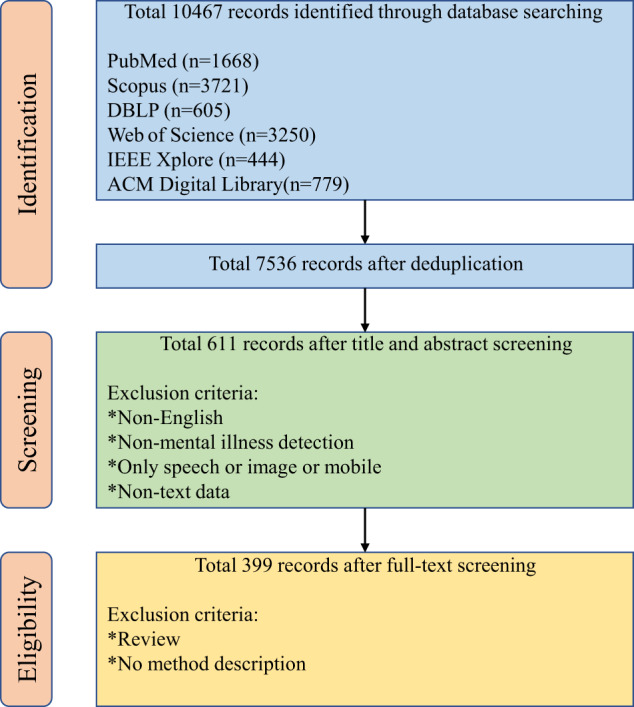
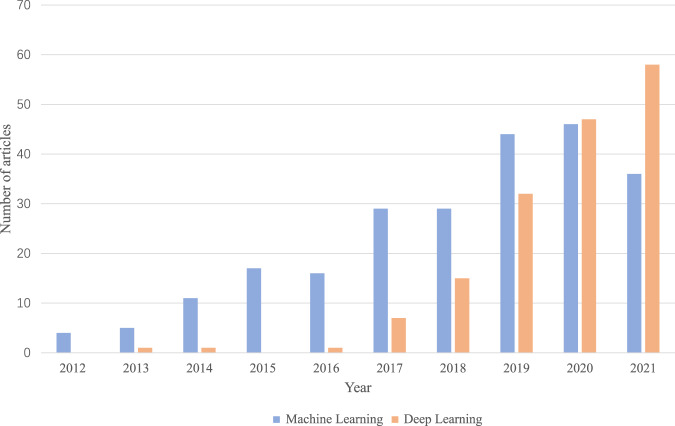
Mental illness is highly prevalent nowadays, constituting a major cause of distress in people’s life with impact on society’s health and well-being. Mental illness is a complex multi-factorial disease associated with individual risk factors and a variety of socioeconomic, clinical associations. In order to capture these complex associations expressed in a wide variety of textual data, including social media posts, interviews, and clinical notes, natural language processing (NLP) methods demonstrate promising improvements to empower proactive mental healthcare and assist early diagnosis. We provide a narrative review of mental illness detection using NLP in the past decade, to understand methods, trends, challenges and future directions. A total of 399 studies from 10,467 records were included. The review reveals that there is an upward trend in mental illness detection NLP research. Deep learning methods receive more attention and perform better than traditional machine learning methods. We also provide some recommendations for future studies, including the development of novel detection methods, deep learning paradigms and interpretable models.
Overview
The claims and statistics of this paper haven’t been checked yet.
Free: it reads the open-access text and checks the first 5 claims that cite a source we can check. Create a free account to check every claim.
Integrity signals
Registry
Cites
Statistics
Figures
Verification
Claims the paper makes
The claims and statistics of this paper haven’t been checked yet.
Free: it reads the open-access text and checks the first 5 claims that cite a source we can check. Create a free account to check every claim.
Claims other papers make about this one
Each is checked against this paper’s own text: does it say what the citing paper says it does?
The cited source says what the claim attributes to it.
In the citing paper
“In order to avoid missing studies, we crosschecked our study selection with existing literature reviews 8,10,13,17,19 and no additional studies were added.”
From Linguistic markers for identifying post-traumatic stress disorder and associated symptoms: a systematic literature review (2025) · cites this paper as [13]
Self-check
Percentages, sums and reported differences re-computed from the paper’s own numbers.
The self-check needs the paper’s full text.
Citations
Cites
Items 201–214 of 214
Guntuku, S. C., Giorgi, S., & Ungar, L. (2018) · Workshop on Computational Linguistics and Clinical Psychology (CLPsych) · doi:10.18653/v1/w18-0610 · Cited by 9 · cited 2×
“…patterns (Part-of-Speech (POS) 45 – 47 , Bag-of-words (BoW) 48 – 50 , Linguistic Inquiry and Word Count (LIWC) 51 – 53 ) and statistics (n-gram 54 – 56 , term frequency-inverse document frequency (TF-IDF) 57 – 59 , length of sentences or passages 60 – 62 ) because these features can be easily…”
MethodMarerngsit, S., & Thammaboosadee, S. (2020) · International Electrical Engineering Congress (iEECON) · doi:10.1109/ieecon48109.2020.229524 · Cited by 9 · cited 1×
“However, in most cases, we can apply these unsupervised models to extract additional features for developing supervised learning classi fi ers 56,85,106,107 .”
MethodDetection of Mental Illness Risk on Social Media through Multi-level SVMs
Hemmatirad, K., Bagherzadeh, H., Fazl-Ersi, E., & Vahedian, A. (2020) · Iranian Joint Congress on Fuzzy and Intelligent Systems · doi:10.1109/cfis49607.2020.9238692 · Cited by 9
Language Processing for Predicting Suicidal Tendencies: A Case Study in Greek Poetry
Zervopoulos, A., Geramanis, E., Toulakis, A., Papamichail, A., Triantafylloy, D., Tasoulas, T., & Kermanidis, K. L. (2019) · IFIP advances in information and communication technology · doi:10.1007/978-3-030-19909-8_15 · Cited by 6
Phan, H. T., Tran, C., Nguyên, N. T., & Hwang, D. (2020) · Lecture notes in computer science · doi:10.1007/978-3-030-55789-8_32 · Cited by 6
Predicting Mental Health of Scholars Using Contextual Word Embedding
Chaurasia, A., Prajapati, S. V., Tiru, P. A., Kumar, S., Gupta, R., & Chauhan, A. (2021) · International Conference on Computing for Sustainable Global Development · doi:10.1109/indiacom51348.2021.00166 · Cited by 6 · cited 2×
“Additionally, many researchers leveraged transformer-based pre-trained language representation models, including BERT 150,151 , DistilBERT 152 , Roberta 153 , ALBERT 150 , BioClinical BERT for clinical notes 31 , XLNET 154 , and GPT model 155 .”
BackgroundPersonality Disorders Identification in Written Texts
Šaloun, P., Ondrejka, A., Malčík, M., & Zelinka, I. (2016) · Lecture notes in electrical engineering · doi:10.1007/978-3-319-27247-4_13 · Cited by 4
Friedenberg, M., Amiri, H., Daumé, H., & Resnik, P. (2016) · Workshop on Computational Linguistics and Clinical Psychology (CLPsych) · doi:10.18653/v1/w16-0319 · Cited by 4 · cited 1×
“However, in most cases, we can apply these unsupervised models to extract additional features for developing supervised learning classi fi ers 56,85,106,107 .”
MethodAutomatic detection of psychological distress indicators in online forum posts
Saleem, S., Pacula, M., Chasin, R., Kumar, R., Prasad, R., Crystal, M. A., Marx, B. P., Sloan, D. M., Vasterling, J. J., & Speroff, T. (2012) · Cited by 4
Mental Distress Detection and Triage in Forum Posts: The LT3 CLPsych 2016 Shared Task System
Desmet, B., Jacobs, G., & Hoste, V. (2016) · Workshop on Computational Linguistics and Clinical Psychology (CLPsych) · doi:10.18653/v1/w16-0317 · Cited by 3
Data Preprocessing based Connecting Suicidal and Help-Seeking Behaviours
Mittal, A., Goyal, A., & Mittal, M. (2021) · International Conference on Computing Methodologies and Communication (ICCMC) · doi:10.1109/iccmc51019.2021.9418452 · Cited by 3
Depression Tendency Recognition Model Based on College Student’s Microblog Text
Qiu, J., & Gao, J. (2017) · IFIP advances in information and communication technology · doi:10.1007/978-3-319-68121-4_38 · Cited by 2 · cited 1×
“…based on machine learning methods used supervised learning, where they described one or more methods employed to detect mental illness: SVM 26,74 – 77 , Adaptive Boosting (AdaBoost) 71,78 – 80 , k-Nearest Neighbors (KNN) 38,81 – 83 , Decision Tree 84 – 87 , Random Forest 75,88 – 90 , Logistic…”
MethodDepressive Emotion Recognition Based on Behavioral Data
Su, Y., Zheng, H., Liu, X., & Zhu, T. (2019) · Lecture notes in computer science · doi:10.1007/978-3-030-15127-0_26 · Cited by 2
Cross-evaluation of social mining for classification of depressed online personas
Trifan, A., & Oliveira, J. L. (2021) · Berichte aus der medizinischen Informatik und Bioinformatik/Journal of integrative bioinformatics · doi:10.1515/jib-2020-0051 · Cited by 2
Research works printed but not linked: 22
- Khan A Husain MS Khan A Analysis of mental state of users using social media to predict depression! a survey Int. J. Adv. Res. Comput. Sci. 2018 9 100 106
- Trifan A Antunes R Matos S Oliveira JL Understanding depression from psycholinguistic patterns in social media texts Adv. Inf. Retr. 2020 12036 402
- Delahunty, F., Wood, I. D. & Arcan, M. First insights on a passive major depressive disorder prediction system with incorporated conversational chatbot. In Irish Conference on Artificial Intelligence and Cognitive Science (2018).
- Prakash, A., Agarwal, K., Shekhar, S., Mutreja, T. & Chakraborty, P. S. An ensemble learning approach for the detection of depression and mental illness over twitter data. In 2021 8th International Conference on Computing for Sustainable Global Development (INDIACom), pp. 565–570 (2021).
- Desmet, B. & Hoste, V. Recognising suicidal messages in dutch social media. In 9th International Conference on Language Resources and Evaluation (LREC), pp. 830–835 (2014).
- Zhou, D., Bousquet, O., Lal, T. N., Weston, J. & Schölkopf, B. Learning with local and global consistency. In Advances in Neural Information Processing Systems, pp. 321–328 (2004).
- Ghannay, S., Favre, B., Esteve, Y. & Camelin, N. Word embedding evaluation and combination. In Proc. Tenth International Conference on Language Resources and Evaluation (LREC’16), pp. 300–305 (2016).
- Mikolov, T., Chen, K., Corrado, G. & Dean, J. Efficient estimation of word representations in vector space. In Proc. 1st International Conference on Learning Representations (ICLR) Workshops Track. (2013).
- Devlin, J., Chang, M. W., Lee, K. & Toutanova, K. Bert: Pre-training of deep bidirectional transformers for languageunderstanding. In Proc. NAACL-HLT, pp. 4171–4186 (2019).
- Pascanu, R., Mikolov, T. & Bengio, Y. On the difficulty of training recurrent neural networks. In International Conference on Machine Learning, pp. 1310–1318 (2013).
- Bahdanau, D., Cho, K. & Bengio, Y. Neural machine translation by jointly learning to align and translate. In Proc. 3rd International Conference on Learning Representations (ICLR) (2015).
- Settles, B. Closing the loop: fast, interactive semi-supervised annotation with queries on features and instances. In Proc. 2011 Conference on Empirical Methods in Natural Language Processing, pp. 1467–1478 (2011).
- Maupomé, D. & Meurs, M. -J. Using topic extraction on social media content for the early detection of depression. In CLEF (Working Notes) vol. 2125 (2018)
- Wang, W. Y., Singh, S. & Li, J. Deep adversarial learning for nlp. In Proc. 2019 Conference of the North American Chapter of the Association for Computational Linguistics: Tutorials, pp. 1–5 (2019).
- Li, Y., Tian, X., Liu, T. & Tao, D. Multi-task model and feature joint learning. In Twenty-Fourth International Joint Conference on Artificial Intelligence (2015).
- Xu, Z., Pérez-Rosas, V. & Mihalcea, R. Inferring social media users’ mental health status from multimodal information. In Proc. 12th Language Resources and Evaluation Conference, pp. 6292–6299 (2020).
- Mittal, A. et al. Multi-modal detection of alzheimer’s disease from speech and text. In Proc. BIOKDD'21 (2021).
- Song, H., You, J., Chung, J. -W. & Park, J. C. Feature attention network: Interpretable depression detection from social media. In Proc. 32nd Pacific Asia Conference on Language, Information and Computation (2018).
- Stephen JJ Prabu P Detecting the magnitude of depression in twitter users using sentiment analysis Int. J. Electr. Comput. Eng. 2019 9 3247
- Mikolov, T., Sutskever, I., Chen, K., Corrado, G. S. & Dean, J. Distributed representations of words and phrases and their compositionality. In Advances in Neural Information Processing Systems, pp. 3111–3119 (2013).
- Bandyopadhyay, A., Achilles, L., Mandl, T., Mitra, M. & Saha, S. K. Identification of depression strength for users of online platforms: a comparison of text retrieval approaches. In Proc. CEUR Workshop Proceedings, vol. 2454, pp. 331–342 (2019).
- Zogan, H., Wang, X., Jameel, S. & Xu, G. Depression detection with multi-modalities using a hybrid deep learning model on social media. Preprint at arXiv https://arxiv.org/abs/2007.02847 (2020). PMC8795347 35106059 · arXiv
Cited by
Do AI chatbots improve students learning outcomes? Evidence from a meta‐analysis
Wu, R., & Yu, Z. (2024) · British Journal of Educational Technology · doi:10.1111/bjet.13334 · Cited by 576
Enhancing mental health with Artificial Intelligence: Current trends and future prospects
Olawade, D. B., Wada, O. Z., Odetayo, A., David-Olawade, A. C., Asaolu, F., & Eberhardt, J. (2024) · Journal of Medicine, Surgery, and Public Health · doi:10.1016/j.glmedi.2024.100099 · Cited by 514
“Natural Language Processing (NLP) techniques enable extracting valuable insights from written or spoken words [53,54].”
BackgroundNatural Language Processing for Smart Healthcare
Zhou, B., Yang, G., Shi, Z., & Ma, S. (2024) · IEEE Reviews in Biomedical Engineering · doi:10.1109/rbme.2022.3210270 · Cited by 230
“The data collected for such analysis may include text data such as social media posts, screening surveys, EHRs [220], and also speech data come from narrative interviews [221], etc. NLP techniques could also (automatically) provide effective psychotherapeutic interventions through web-based…”
BackgroundKhan, W., Daud, A., Khan, K., Muhammad, S., & Haq, R. (2023) · Natural Language Processing Journal · doi:10.1016/j.nlp.2023.100026 · Cited by 217
The now and future of ChatGPT and GPT in psychiatry
Cheng, S., Chang, C., Chang, W., Wang, H., Liang, C., Kishimoto, T., Chang, J. P., Kuo, J. S., & Su, K. (2023) · Psychiatry and Clinical Neurosciences · doi:10.1111/pcn.13588 · Cited by 188
Metadata
- Authors
- Zhang, T., Schoene, A. M., Ji, S., & Ananiadou, S.
- Affiliations
- University of Manchester (GB)
- Aalto University (FI)
- Corresponding author
- Ananiadou, Sophia
- Venue
- npj Digital Medicine
- Published
- 2022-04-08
- Volume
- 5
- Issue
- 1
- Pages
- 46-46
- ISSN
- 2398-6352 (ISSN-L)
- PMC
- PMC8993841
- OpenAlex
- W4223610593
- Semantic Scholar
- 099f8bf42b95a4c239bc338b05821b592c60f44b
- Cited by
- 476
- References
- 204
- Citations by year
- 2026: 101 · 2025: 144 · 2024: 124 · 2023: 85 · 2022: 22
- FWCI
- 14.07
- Type
- journal article
- Language
- en
- Open access
- gold
- doi.org
- Licence
- cc-by
- creativecommons.org/licenses/by/4.0 (tdm)
- creativecommons.org/licenses/by/4.0 (vor)
- Locations
- npj Digital Medicine (publishedVersion, cc-by)
- PubMed Central (publishedVersion, cc-by)
- PubMed (publishedVersion)
- Aaltodoc (Aalto University) (submittedVersion, cc-by)
- DOAJ (DOAJ: Directory of Open Access Journals) (submittedVersion)
- Research Explorer (The University of Manchester) (submittedVersion)
- Funders
- Alan Turing Institute
- Horizon 2020 Framework Programme (874703)
- Topics
- Social Sciences › Psychology › Social Psychology › Mental Health via Writing
- Physical Sciences › Computer Science › Artificial Intelligence › Sentiment Analysis and Opinion Mining
- Physical Sciences › Computer Science › Artificial Intelligence › Emotion and Mood Recognition
- Keywords
- mental disorder detection, natural language processing, early diagnosis, social media text analysis, clinical notes, deep learning, interpretable models, mental health services, text classification
About these checks
Registry, retraction, Cites and statistics results are computed, not judged, with one exception: a printed reference that no index lists is read once by a model before it counts as a citation error. Claims are extracted by a model and kept only when their quote appears verbatim in the text; each cited source is then checked, with a model’s help, for whether it says what the claim relies on. Those verdicts can be wrong — read the claim’s quote and the cited source before relying on one.
Statistics and arithmetic are recomputed, not judged.
Confidence bands are shown only for fields calibrated on our annotated test set. None is calibrated yet, so no band is shown.
What counts as a claim ›How we measure confidence ›How we check this ›
Are you an author, or do you see a problem with this page? Request a review
Data sources
Bibliographic data: Semantic Scholar, OpenAlex, Crossref.
Contains information from the Semantic Scholar Academic Graph Datasets, made available under the ODC Attribution License (ODC-BY 1.0).
Semantic Scholar’s data is described in: Kinney, R., et al. (2023). The Semantic Scholar Open Data Platform. arXiv:2301.10140.
