

The DOI matches its Crossref record; 158 of the 158 references it cites were found in a registry or an index.
A survey on clinical natural language processing in the United Kingdom from 2007 to 2022
Open accessAbstract
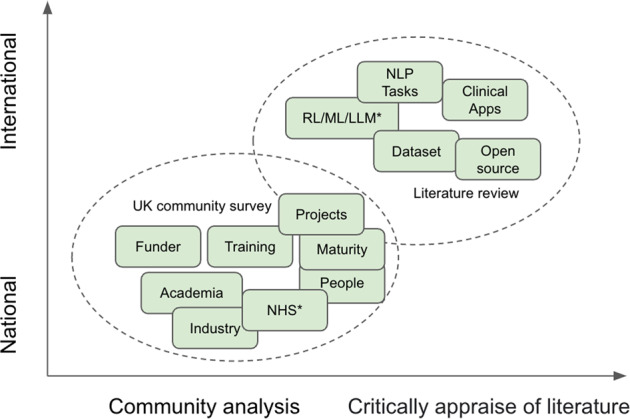
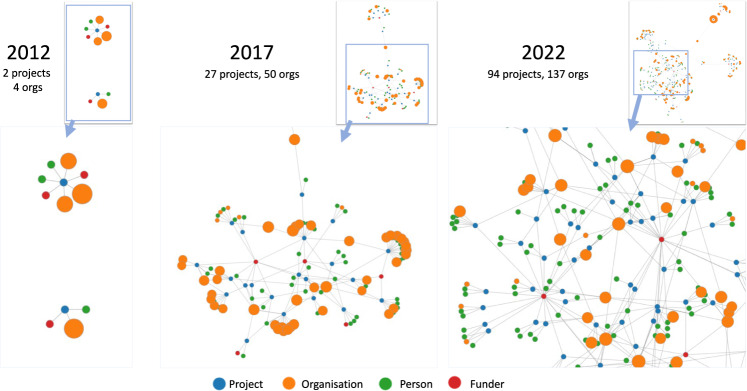
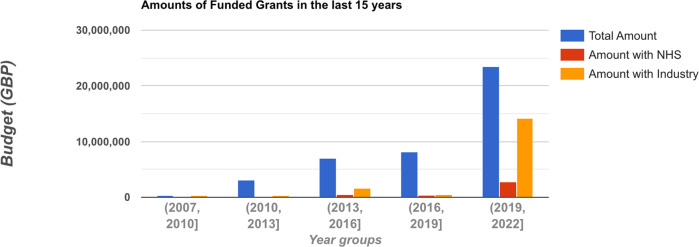
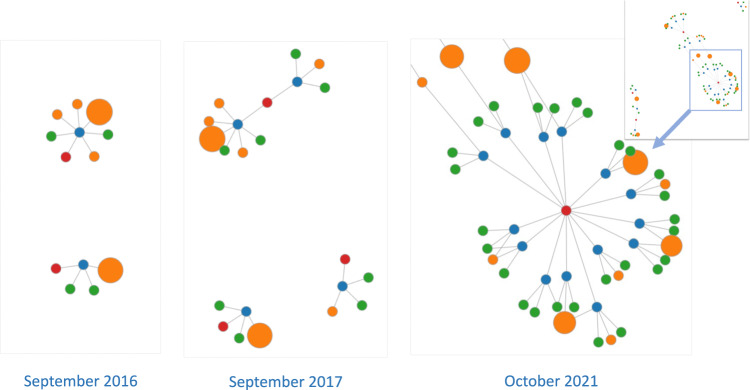
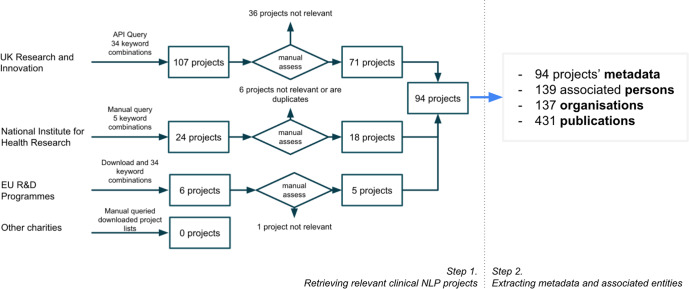
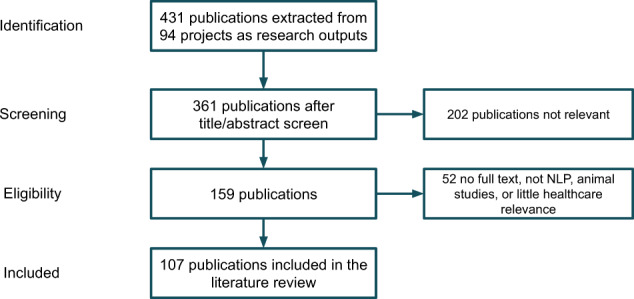
Much of the knowledge and information needed for enabling high-quality clinical research is stored in free-text format. Natural language processing (NLP) has been used to extract information from these sources at scale for several decades. This paper aims to present a comprehensive review of clinical NLP for the past 15 years in the UK to identify the community, depict its evolution, analyse methodologies and applications, and identify the main barriers. We collect a dataset of clinical NLP projects ( n = 94; £ = 41.97 m) funded by UK funders or the European Union’s funding programmes. Additionally, we extract details on 9 funders, 137 organisations, 139 persons and 431 research papers. Networks are created from timestamped data interlinking all entities, and network analysis is subsequently applied to generate insights. 431 publications are identified as part of a literature review, of which 107 are eligible for final analysis. Results show, not surprisingly, clinical NLP in the UK has increased substantially in the last 15 years: the total budget in the period of 2019–2022 was 80 times that of 2007–2010. However, the effort is required to deepen areas such as disease (sub-)phenotyping and broaden application domains. There is also a need to improve links between academia and industry and enable deployments in real-world settings for the realisation of clinical NLP’s great potential in care delivery. The major barriers include research and development access to hospital data, lack of capable computational resources in the right places, the scarcity of labelled data and barriers to sharing of pretrained models.
Overview
The claims and statistics of this paper haven’t been checked yet.
Run the check — free, no account needed. It reads the open-access text and checks the sources it cites.
Integrity signals
Registry
Cites
Statistics
Figures
Verification
Claims the paper makes
The claims and statistics of this paper haven’t been checked yet.
Run the check — free, no account needed. It reads the open-access text and checks the sources it cites.
Claims other papers make about this one
Each is checked against this paper’s own text: does it say what the citing paper says it does?
In the citing paper
“Existing natural language processing (NLP) methods to convert free-text clinical notes into structured data often require problem-specific annotations and model training.”
From A critical assessment of using ChatGPT for extracting structured data from clinical notes (2024) · cites this paper as [15]
In the citing paper
“However, a significant obstacle to developing these traditional medical NLP algorithms is the limited existence of human-annotated datasets and the costs associated with new human annotation15.”
From A critical assessment of using ChatGPT for extracting structured data from clinical notes (2024) · cites this paper as [15]
Self-check
Percentages, sums and reported differences re-computed from the paper’s own numbers.
The self-check needs the paper’s full text.
Citations
Cites
Efficient Estimation of Word Representations in Vector Space
Mikolov, T., Chen, K., Corrado, G., & Dean, J. (2013) · arXiv · doi:10.48550/arxiv.1301.3781 · Cited by 26,568
MIMIC-III, a freely accessible critical care database
Johnson, A. E. W., Pollard, T. J., Shen, L., Lehman, L.-W. H., Feng, M., Ghassemi, M., Moody, B., Szolovits, P., Anthony Celi, L., & Mark, R. G. (2016) · Scientific Data · doi:10.1038/sdata.2016.35 · Cited by 8,141
Factors associated with COVID-19-related death using OpenSAFELY
Williamson, E. J., Walker, A. J., Bhaskaran, K., Bacon, S., Bates, C., Morton, C. E., Curtis, H. J., Mehrkar, A., Evans, D., Inglesby, P., et al. (2020) · Nature · doi:10.1038/s41586-020-2521-4 · Cited by 6,674
The class imbalance problem: A systematic study1
Japkowicz, N., & Stephen, S. (2002) · Intelligent Data Analysis · doi:10.3233/ida-2002-6504 · Cited by 3,295
A Graph-theoretic perspective on centrality
Borgatti, S. P., & Everett, M. G. (2006) · Social Networks · doi:10.1016/j.socnet.2005.11.005 · Cited by 1,749
The Inevitable Application of Big Data to Health Care
Murdoch, T. B., & Detsky, A. S. (2013) · JAMA · doi:10.1001/jama.2013.393 · Cited by 1,676
2010 i2b2/VA challenge on concepts, assertions, and relations in clinical text
Uzuner, Ö., South, B. R., Shen, S., & DuVall, S. L. (2011) · Journal of the American Medical Informatics Association · doi:10.1136/amiajnl-2011-000203 · Cited by 1,292
Clinical information extraction applications: A literature review
Wang, Y., Wang, L., Rastegar-Mojarad, M., Moon, S., Shen, F., Afzal, N., Liu, S., Zeng, Y., Mehrabi, S., Sohn, S., et al. (2018) · Journal of Biomedical Informatics · doi:10.1016/j.jbi.2017.11.011 · Cited by 910
The State and Fate of Linguistic Diversity and Inclusion in the NLP World
Joshi, P., Santy, S., Budhiraja, A., Bali, K., & Choudhury, M. (2020) · Proceedings of the 58th Annual Meeting of the Association for Computational Linguistics · doi:10.18653/v1/2020.acl-main.560 · Cited by 766
Beto, Bentz, Becas: The Surprising Cross-Lingual Effectiveness of BERT
Wu, S., & Dredze, M. H. (2019) · Conference on Empirical Methods in Natural Language Processing (EMNLP) · doi:10.18653/v1/d19-1077 · Cited by 694
Research works printed but not linked: 9
- Lewin, I., Silins, I., Korhonen, A., Hogberg, J. & Stenius, U. A new challenge for text mining: cancer risk assessment. Proc. ISMB BioLINK Spec. Interest Group Text. Data Min. 20, 1–4 (2008).
- Baker, S., Korhonen, A. & Pyysalo, S. Cancer hallmark text classification using convolutional neural networks. In Proc. Fifth Workshop on Building and Evaluating Resources for Biomedical Text Mining (BioTxtM2016), 1–9 (2016).
- Limsopatham, N. & Collier, N. Learning orthographic features in bi-directional lstm for biomedical named entity recognition. In Proc. Fifth Workshop on Building and Evaluating Resources for Biomedical Text Mining (BioTxtM2016), 10–19 (2016).
- Wu, H. et al. SemEHR: a general-purpose semantic search system to surface semantic data from clinical notes for tailored care, trial recruitment, and clinical research. J. Am. Med. Inform. Assoc. 25, 530–537 (2018). · DOI
- Patel, R. et al. Impact of the covid-19 pandemic on remote mental healthcare and prescribing in psychiatry: an electronic health record study. BMJ Open 11, e046365 (2021). · DOI
- Congress, U. HR 3590: Patient Protection and Affordable Care Act. In 111th Congress, vol. 2010 (2009).
- Topol, E. et al. The topol review. Preparing the healthcare workforce to deliver the digital future. 1–48 (2019).
- Fruchterman, T. M. & Reingold, E. M. Graph drawing by force-directed placement. Software 21, 1129–1164 (1991).
- Devlin, J., Chang, M.-W., Lee, K. & Toutanova, K. BERT: Pre-training of deep bidirectional transformers for language understanding. In Proc. 2019 Conference of the North American Chapter of the Association for Computational Linguistics: Human Language Technologies, Volume 1 (Long and Short Papers), 4171–4186 (Association for Computational Linguistics, Minneapolis, Minnesota, 2019).
Cited by
Sorted by citations
Items 101–101 of 101
Yilmaz, A., Aksu, A. E. K., Yamen, D., Erdemir, V. A., Gürel, M. S., Gençoğlan, G., Posma, J. M., & Temelkuran, B. (2026) · doi:10.2196/preprints.114737
Metadata
- Authors
- Wu, H., Wang, M., Wu, J., Francis, F., Chang, Y.-H., Shavick, A., Dong, H., Poon, M. T. C., Fitzpatrick, N., Levine, A. P., Slater, K. T., Handy, A., Karwath, A., Gkoutos, G. V., Chelala, C., Shah, A. D., Stewart, R., Collier, N., Alex, B., Whiteley, W., Sudlow, C., Roberts, A., & Dobson, R. J. B.
- Affiliations
- University College London (GB)
- University of Edinburgh (GB)
- University of Oxford (GB)
- University of Birmingham (GB)
- Queen Mary University of London (GB)
- King's College London (GB)
- University of Cambridge (GB)
- Corresponding author
- Wu, Honghan
- ORCID
- Venue
- npj Digital Medicine
- Published
- 2022-12-21
- Volume
- 5
- Issue
- 1
- Pages
- 186-186
- ISSN
- 2398-6352 (ISSN-L)
- PMC
- PMC9770568
- OpenAlex
- W4312113143
- Cited by
- 101
- References
- 157
- Citations by year
- 2026: 29 · 2025: 40 · 2024: 18 · 2023: 13 · 2022: 1
- FWCI
- 1.87
- Type
- journal article
- Language
- en
- Open access
- gold
- doi.org
- Locations
- npj Digital Medicine (publishedVersion, cc-by)
- PubMed Central (publishedVersion, cc-by)
- PubMed (publishedVersion)
- ENLIGHTEN (Jurnal Bimbingan dan Konseling Islam) (acceptedVersion, cc-by-sa)
- DOAJ (DOAJ: Directory of Open Access Journals) (submittedVersion, cc-by-sa)
- UCL Discovery (University College London) (submittedVersion)
- University of Birmingham Research Portal (University of Birmingham) (submittedVersion, cc-by)
- Edinburgh Research Explorer (University of Edinburgh) (submittedVersion, cc-by)
- Apollo (University of Cambridge) (submittedVersion, cc-by)
- Apollo
- Apollo (cc-by)
- Funders
- DH | National Institute for Health Research (NIHR202639)
- British Council (UCL-NMU-SEU International Collaboration)
- University of Edinburgh (The Advanced Care Research Centre Programme)
- RCUK | Medical Research Council (MR/W014386, National Text Analytics Project)
- Topics
- Health Sciences › Medicine › Health Informatics › Biomedical Text Mining and Ontologies
- Physical Sciences › Computer Science › Artificial Intelligence › Machine Learning in Healthcare
- Physical Sciences › Computer Science › Artificial Intelligence › Topic Modeling
- Keywords
- clinical natural language processing, clinical research funding, research funding trends, disease phenotyping, clinical text mining, research collaboration networks, academia-industry collaboration, United Kingdom
About these checks
Registry, retraction, Cites and statistics results are computed, not judged, with one exception: a printed reference that no index lists is read once by a model before it counts as a citation error. Claims are extracted by a model and kept only when their quote appears verbatim in the text; each cited source is then checked, with a model’s help, for whether it says what the claim relies on. Those verdicts can be wrong — read the claim’s quote and the cited source before relying on one.
Statistics and arithmetic are recomputed, not judged.
Confidence bands are shown only for fields calibrated on our annotated test set. None is calibrated yet, so no band is shown.
What counts as a claim ›How we measure confidence ›How we check this ›
Are you an author, or do you see a problem with this page? Request a review
