

Solving the explainable AI conundrum by bridging clinicians’ needs and developers’ goals
Open accessPublished version of a preprint
The DOI matches its Crossref record; 35 of the 35 references it cites were found in a registry or an index.
Abstract
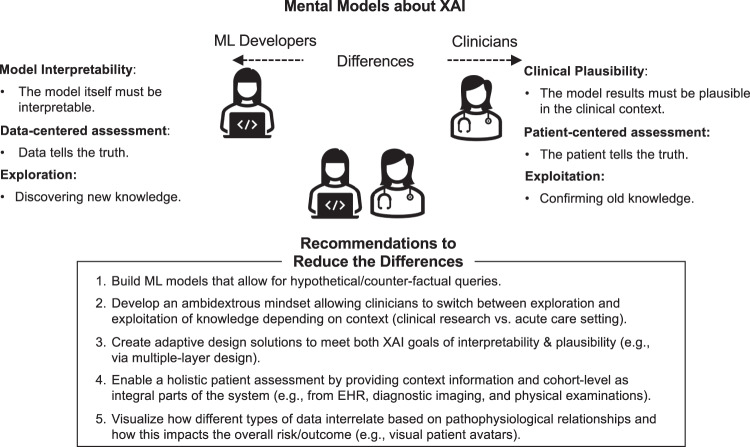
Explainable artificial intelligence (XAI) has emerged as a promising solution for addressing the implementation challenges of AI/ML in healthcare. However, little is known about how developers and clinicians interpret XAI and what conflicting goals and requirements they may have. This paper presents the findings of a longitudinal multi-method study involving 112 developers and clinicians co-designing an XAI solution for a clinical decision support system. Our study identifies three key differences between developer and clinician mental models of XAI, including opposing goals (model interpretability vs. clinical plausibility), different sources of truth (data vs. patient), and the role of exploring new vs. exploiting old knowledge. Based on our findings, we propose design solutions that can help address the XAI conundrum in healthcare, including the use of causal inference models, personalized explanations, and ambidexterity between exploration and exploitation mindsets. Our study highlights the importance of considering the perspectives of both developers and clinicians in the design of XAI systems and provides practical recommendations for improving the effectiveness and usability of XAI in healthcare.
Overview
The claims and statistics of this paper haven’t been checked yet.
Free: it reads the open-access text and checks the first 5 claims that cite a source we can check. Create a free account to check every claim.
Integrity signals
Registry
Cites
Statistics
Figures
Verification
Claims the paper makes
The claims and statistics of this paper haven’t been checked yet.
Free: it reads the open-access text and checks the first 5 claims that cite a source we can check. Create a free account to check every claim.
Claims other papers make about this one
Each is checked against this paper’s own text: does it say what the citing paper says it does?
The source backs part of the claim, not all of it — or backs it for a different population, condition or comparison.
In the citing paper
“Simple, interpretable visualizations, such as bar charts and line graphs, were preferred for understanding predictions at a glance.”
From Explainable AI in hospital clinical decision support systems: A scoping review of healthcare professionals’ perspectives (2026) · cites this paper as [27]
Experimental — accuracy not yet measuredThe source backs part of the claim, not all of it — or backs it for a different population, condition or comparison.
In the citing paper
“Five studies [23,25,27,28,34] specifically described using SHapley Additive exPlanations (SHAP)”
From Explainable AI in hospital clinical decision support systems: A scoping review of healthcare professionals’ perspectives (2026) · cites this paper as [27]
Experimental — accuracy not yet measuredThe cited source says what the claim attributes to it.
In the citing paper
“The XAI orchestrator should be integrated with time-effectiveness in mind since it was found that clinicians sometimes prefer rapid, less detailed information67.”
From Orchestrating explainable artificial intelligence for multimodal and longitudinal data in medical imaging (2024) · cites this paper as [67]
The cited source says what the claim attributes to it.
In the citing paper
“Impact in workflow related to how XAI systems aligned with and influenced work processes, and arose as a theme in 9 papers [23–27,30,31,33,35].”
From Explainable AI in hospital clinical decision support systems: A scoping review of healthcare professionals’ perspectives (2026) · cites this paper as [27]
The cited source says what the claim attributes to it.
In the citing paper
“Considering context and users was also reported, with some health professionals having limited time to interpret model explanations and make a decision [23,25,27,32].”
From Explainable AI in hospital clinical decision support systems: A scoping review of healthcare professionals’ perspectives (2026) · cites this paper as [27]
10 more claims about this paper
Create a free account to see every claim other papers make about this one.
Self-check
Percentages, sums and reported differences re-computed from the paper’s own numbers.
The self-check needs the paper’s full text.
Citations
Cites
User Acceptance of Information Technology: Toward A Unified View1
Venkatesh, V., Morris, M. G., Davis, G. B., & Davis, F. D. (2003) · MIS Quarterly · doi:10.2307/30036540 · Cited by 45,035
The Discovery of Grounded Theory; Strategies for Qualitative Research
Glaser, B. G., Strauss, A. L., & Strutzel, E. (1968) · Nursing Research · doi:10.1097/00006199-196807000-00014 · Cited by 39,449
Seeking Qualitative Rigor in Inductive Research: Notes on the Gioia Methodology
Gioia, D. A., Corley, K. G., & Hamilton, A. L. (2013) · Organizational Research Methods · doi:10.1177/1094428112452151 · Cited by 13,227
Standards for Reporting Qualitative Research: A Synthesis of Recommendations
O’Brien, B. C., Harris, I. B., Beckman, T. J., Reed, D. A., & Cook, D. A. (2014) · Academic Medicine · doi:10.1097/acm.0000000000000388 · Cited by 12,211
High-performance medicine: the convergence of human and artificial intelligence
Topol, E. J. (2019) · Nature Medicine · doi:10.1038/s41591-018-0300-7 · Cited by 10,450
Geurts, P., Ernst, D., & Wehenkel, L. (2006) · Machine Learning · doi:10.1007/s10994-006-6226-1 · Cited by 9,300
Confirmation Bias: A Ubiquitous Phenomenon in Many Guises
Nickerson, R. S. (1998) · Review of General Psychology · doi:10.1037/1089-2680.2.2.175 · Cited by 7,267
Rajpurkar, P., Chen, E., Banerjee, O., & Topol, E. J. (2022) · Nature Medicine · doi:10.1038/s41591-021-01614-0 · Cited by 3,212 · cited 5×
“However, implementation of these systems into clinical practice lags behind due to a lack of trust and system explainability 2,3 .”
InfluentialConfirmation, disconfirmation, and information in hypothesis testing
Klayman, J., & Ha, Y.-W. (1987) · Psychological Review · doi:10.1037/0033-295x.94.2.211 · Cited by 2,094
Causability and explainability of artificial intelligence in medicine
Holzinger, A., Langs, G., Denk, H., Zatloukal, K., & Müller, H. (2019) · WIREs Data Mining and Knowledge Discovery · doi:10.1002/widm.1312 · Cited by 1,885
Research works printed but not linked: 1
- Tabachnick, B. G., Fidell, L. S. & Ullman, J. B. Using multivariate statistics. (Pearson, 2019).
Cited by
Items 101–200 of 200
Albers, D. J., Cato, K., Layton, A., & Rossetti, S. C. (2025) · Journal of the American Medical Informatics Association · doi:10.1093/jamia/ocaf209 · Cited by 1
Chen, Z., Zeng, Z., Liu, G., Su, Y., Liu, C., Zhong, Y., Li, J., & Zuo, L. (2026) · Scandinavian Journal of Trauma Resuscitation and Emergency Medicine · doi:10.1186/s13049-026-01564-x · Cited by 1
“However, SHAP values have known limitations that are not acknowledged here [29].”
Devi, G. U., & Maram, B. (2025) · International Conference on Internet of Everything, Microwave Engineering, Communication and Networks (IEMECON) · doi:10.1109/iemecon69302.2025.11365821 · Cited by 1
“An example-based retrieval (case-basedexplanations) has demonstrated potential inaiding clinicians to engage in analogy-mediatedreasoning, to boost interpretive confidence inobservational testing, yet there is limited tightlycontrolled evidence regarding diagnostic accuracy gains [11].”
Gill, H. M., Hassan, D., Omoru, O. B., Bogan, F., Liu, J. X., Happe, M., Hajrasouliha, A. R., & Janga, S. C. (2026) · Scientific Reports · doi:10.1038/s41598-026-43573-x · Cited by 3
“Explainable DL models produce outputs that are traceable (attributable to distinct features), plausible (overlap at least partially with established knowledge), and interpretable (easy for target users to understand) 73,74 .”
Mechanistically Interpretable Wearable-Based Sleep Staging
Kadem, M., & Zheng, R. Y. (2025) · IEEE Annual Congress on Artificial Intelligence of Things (AIoT) · doi:10.1109/aiot66900.2025.00055 · Cited by 1
Emakhu, J., Brooks, R. C., Adrianto, I., Bossick, A. S., Haeusler, J., Welchans, M., Miller, J., Levin, A. M., & Su, W. (2026) · BMC Medical Informatics and Decision Making · doi:10.1186/s12911-026-03481-6 · Cited by 1
“However, SHAP values provide post-hoc feature attribution and do not establish causal drivers or treatment targets; rather, they describe how features contribute to model predictions and should be interpreted as indicators of model behavior rather than mechanistic explanations [62–64].”
Farhadi, A., Hosseinian, A., Zamanifar, A., & Taherkordi, A. (2026) · Springer eBooks · doi:10.1007/978-3-032-15088-2_2 · Cited by 1
Fikri, H., & Muchlis, M. (2026) · Jurnal Ilmiah Sistem Informasi · doi:10.51903/mp66jy72 · Cited by 1
Dzieran, R., Dağli, C. H., & Marley, R. J. (2026) · Current Transplantation Reports · doi:10.1007/s40472-026-00519-6 · Cited by 2
Empowering healthcare 5.0 with deep learning: techniques, trends, and future directions
Maji, P. K., Chakraborty, S., Sadiq, A., Basu, S., & Ghosh, K. (2026) · Artificial Intelligence Review · doi:10.1007/s10462-026-11593-8 · Cited by 2
Lihui, L., Hu, K., & Zhou, Y. (2026) · Digital Chinese Medicine · doi:10.1016/j.dcmed.2026.05.004 · Cited by 1
Lanfranchi, G., Marino, R., Gembillo, G., Santoro, D., & Villari, M. (2026) · VINE Journal of Information and Knowledge Management Systems · doi:10.1108/vjikms-01-2026-0010 · Cited by 1
Towards a Framework for Interdisciplinary Studies in Explainable Artificial Intelligence
Ziethmann, P., Stieler, F., Pfrommer, R., Schlögl-Flierl, K., & Bauer, B. (2024) · Lecture notes in computer science · doi:10.1007/978-3-031-60606-9_18 · Cited by 1
“[7] conducted a focus group interview with three clinicians and three developers to design an XAI solution for a clinical decision support system.”
Futri, I., Muryadi, E. I., & Saputra, D. C. E. (2024) · Buletin Ilmiah Sarjana Teknik Elektro · doi:10.12928/biste.v6i4.11641 · Cited by 1
“Meanwhile, studies by Yang et al. (2022) and Bienefeld et al. (2023) highlight the benefits of XAI in patient risk prediction but do not discuss how XAI can help bridge communication between patients and healthcare providers regarding care preferences [27][28].”
Ali, H., Farooq, M., & Shah, U. (2025) · Journal of Artificial Intelligence for Healthcare Systems · doi:10.68159/g968708531 · Cited by 1
Explainable and Interpretable AI for Voice and Speech Analysis in Clinical Care: Systematic Review
Ebraheem, M., Toghranegar, J., Bridge2AI-Voice Consortium, Bensoussan, Y., & Templeton, J. M. (2026) · Journal of Medical Internet Research · doi:10.2196/83790
Value-based Design Recommendations for AI driven Thermography for Breast Cancer Screening (Preprint)Preprint
Poll, A., Kacafírková, K. S., Moortel, L. D., Verhellen, A., Rumbeke, N. V., & Jacobs, A. (2024) · doi:10.2196/preprints.69419
Interpretable AI for medical image analysis: methods, evaluation, and clinical considerations
Gonçalves, T., Hedström, A., de Mortanges, A. P., Li, X., Müller, H., Cardoso, J. S., & Reyes, M. (2025) · Elsevier eBooks · doi:10.1016/b978-0-44-323761-4.00027-4 · Cited by 2
Predicting Prostate Cancer Without a Prostate: A Potential Problem with AIPreprint
Provenzano, D., Loew, M. H., Rao, Y. J., Batheja, V., & Haji-Momenian, S. (2025) · medRxiv · doi:10.1101/2025.03.04.25323311
The 5P Model as a Governance Framework
Noguera, J. J. M. (2025) · SpringerBriefs in public health · doi:10.1007/978-3-031-94763-6_4 · Cited by 1
Lee, J.-H. (2026) · Biomedical Signal Processing and Control · doi:10.1016/j.bspc.2026.110298
Explainable Xgboost for Clinician-Acceptable Diabetes Risk Prediction
Ammar, A., & Bassam, A. A. (2025) · IEEE International Conference on Quantum Photonics, Artificial Intelligence & Networking (QPAIN) · doi:10.1109/qpain66474.2025.11172226
Abayadeera, M. R., Shanawaz, M. S., Kavindya, K. D. N., Ganegoda, G. U., & Sandanayake, T. C. (2025) · Communications in computer and information science · doi:10.1007/978-981-95-4409-7_15
Dijkstra, H., Muppiri, M. S., Oosterhoff, J. H. F., Doornberg, J. N., Munster, B. C. V., & Verhoeff, M. (2025) · Health and Technology · doi:10.1007/s12553-025-01026-x
“To help overcome any negative perceptions and demys-tify the “black box” concept surrounding ML [ 11 ], efforts should focus on improving interpretability to healthcare providers through providing education on the clinical meaning of ML outputs, by means of explainable AI [ 52 ].”
Multimorbidity measurement strategies for predicting hospital visits
Neves, B. D., Moreira, J. M., Gonçalves, S., Cerejo, J., Mota, I., Silva, N. A., Leite, F., & Silva, M. J. (2025) · BMC Health Services Research · doi:10.1186/s12913-025-13817-z
Busch, F., Hoffmann, L., Truhn, D., Ortiz-Prado, E., Makowski, M. R., Bressem, K. K., & Adams, L. C. (2024) · Figshare · doi:10.6084/m9.figshare.27129365
Busch, F., Hoffmann, L., Truhn, D., Ortiz-Prado, E., Makowski, M. R., Bressem, K. K., & Adams, L. C. (2024) · Figshare · doi:10.6084/m9.figshare.27129362
Aplicação de machine learning para diagnóstico hematológico
Silva, M. Â. A. G. S. (2023) · Portuguese National Funding Agency for Science, Research and Technology (RCAAP Project by FCT)
Silva, A. F. S. P. F. D. (2025) · Portuguese National Funding Agency for Science, Research and Technology (RCAAP Project by FCT)
Editorial: Mental health in the age of artificial intelligence
Noble, J. M., Ha, K., & Greenshaw, A. (2026) · Frontiers in Psychiatry · doi:10.3389/fpsyt.2025.1750256
“The question of reproducibility and interpretability has become a cornerstone of responsible AI (13, 17), and Celeste et al. tackle it head-on in their contribution, “ A software pipeline for systematizing machine learning of sp eech data ” .”
AI strategies for drug discovery and bioactivity prediction: opportunities and challenges
Azad, A. K. (2026) · Elsevier eBooks · doi:10.1016/b978-0-443-34059-8.00013-0
Role of artificial intelligence in bladder cancer management
Jadeja, P., Rathod, D., Patel, R., Prajapati, J. B., Manchanda, R., & Mehta, A. (2026) · Elsevier eBooks · doi:10.1016/b978-0-443-36632-1.00008-0
Ma, Y. (2025) · PolyPublie (École Polytechnique de Montréal)
ARTIFICIAL INTELLIGENCE DALAM REKRUTMEN SDM MODERN (STRATEGI, SISTEM, DAN TRANSFORMASI ORGANISASI)
Jumarto, J. (., Andriansyah, A. (., Kristyanto, D. (., & Feriandy, F. (. (2025) · Neliti · Cited by 1
Maragadhavalli Meenakshi, M., & Jessintha, J. P. (2025) · IEEE International Conference for Women in Computing (InCoWoCo) · doi:10.1109/incowoco68239.2025.11407159
“…annotated and balanced dataset for very rare cases like tubal pregnancy, the need for interpretable models that do not negate predictive performance[18] or, underfitting or overfitting lead to poor prediction quality, generalizability across diverse populations and hospitals and computational…”
Bridging interpretability and clinical usability in explainable artificial intelligence
Shen, F., Phuyal, D., & Almeida, V. F. A. (2026) · JVS-Vascular Insights · doi:10.1016/j.jvsvi.2026.100403
Clinically Meaningful Explainability for NeuroAI: An Ethical, Technical, and Clinical PerspectivePreprint
Schopp, L., D’Imperio, A., Etesami, J., & Ienca, M. (2026) · SSRN Electronic Journal · doi:10.2139/ssrn.6425841
Explainable AI in Healthcare: Bridging the Gap Between Doctors and Models
Khadse, C., & Puri, C. (2026) · International Conference on Image Processing and Capsule Networks (ICIPCN) · doi:10.1109/icipcn67432.2026.11438566
“Collaboration between AI developers and clinicians is essential to design XAI tools that align with medical expertise and patient needs [20].”
Zipperling, D., Schmidt, L. M., Hahn, B., Kühl, N., & Kimbrough, S. (2026) · arXiv (Cornell University) · doi:10.48550/arxiv.2603.24448
“Generic (Bienefeld et al., 2023; Metsch et al., 2024; Müller et al., 2020; Thews et al., 1996) 3, 4, 6 SR1.”
InfluentialKalvala, S., & Baranidharan, B. (2025) · IEEE International Conference on Smart Innovations in Systems, Infrastructure, Mechanical, Power, AI and Computing Technologies (SISIMPACT) · doi:10.1109/sisimpact67725.2025.11439411
“The visual explanation approach will enable patients to better visualize their own risk factors and, ideally, strengthen their adherence to monitoring, treatment, and rehabilitation protocols [21].”
Silva, M., Melo, R., Carreiro, A. V., & Folgado, D. (2026) · CHI Conference Extended Abstracts on Human Factors in Computing Systems (CHI EA) · doi:10.1145/3772363.3798546
Yönder, H., Taşcanov, M. B., Sarıışık, G., Berhuni, M. S., Ocak, M., Kaplan, V., Acar, O., Elkan, H., Toprak, K., Tatlı, F., et al. (2026) · BMC Cardiovascular Disorders · doi:10.1186/s12872-026-05893-8
“Moreover, qualitative studies in clinical environments suggest that clinicians may find SHAP-based explanations difficult to translate into practical decision-making within routine care settings [49].”
Explainable Artificial Intelligence (XAI): Methods, Challenges, and Applications in Healthcare
Pandey, A. K., Chauhan, A., ., D., Kumar, S., Dutt, M., & Sharma, R. (2026) · International Journal of Computing and Artificial Intelligence · doi:10.33545/27076571.2026.v7.i4b.314
Examining developer perspectives on medical AI regulatory frameworks
Choo, C. M., Malik, S., Feng, M., Liu, N., Lwin, M. O., Xu, H., Goh, W. W. B., & Sung, J. J. Y. (2026) · npj Digital Medicine · doi:10.1038/s41746-026-02689-0
“Misalignment, whether due to differing priorities 5 or diverging intepretations 39 , may give rise to noncompliance and, consequently, ethical risks including cyber attacks and potential harm to patients 45 .”
InfluentialWilde, K. M., & Rugolon, F. (2026) · Communications in computer and information science · doi:10.1007/978-3-032-19099-4_16 · Cited by 1
Cai, J., Li, P., Feng, X., Wang, Y., Li, W., Chen, G., Zhu, T., Hao, X., & AIR-CG group (2026) · doi:10.2196/preprints.101309
Al-Absi, D. T., Simsekler, M. C. E., Yaqub, M. K., & Anwar, S. (2026) · Computers & Industrial Engineering · doi:10.1016/j.cie.2026.112107
Legal and Regulatory Considerations
Zamanifar, A., Jenabian, N. M., Farhadi, A., Asadollahi, M., & Safarpour, H. (2026) · Springer eBooks · doi:10.1007/978-3-032-15088-2_11
Toward trustworthy healthcare AI: designing academic research for translation readiness
Hekler, A., & Buettner, F. (2026) · Molecular Systems Biology · doi:10.1038/s44320-026-00219-4
“…while clinicians emphasize clinical plausibility; developers treat training data as the source of truth while clinicians prioritize patient-speci fi c context; and developers focus on discovering new patterns while clinicians rely on established medical knowledge (Bienefeld et al, 2023).”
Sharanya, S. N., & Prasad, N. (2026) · International Conference on Pervasive Computing and Social Networking (ICPCSN) · doi:10.1109/icpcsn68523.2026.11543683
“Bienefeld et al. [35] evaluated twelve metaheuristics for neurological feature selection, and reported that CSO was consistently competitive.”
Saoud, L. S., & Qureshi, O. A. (2026) · Communications in computer and information science · doi:10.1007/978-3-032-28819-6_31
INTERFACE DESIGN, ATTENTION, AND OVERRELIANCE IN CLINICAL XAI
Bacelar, A. (2026) · International Journal of Advanced Research · doi:10.21474/ijar01/23527
Bacelar, A. (2026) · International Journal of Advanced Research · doi:10.21474/ijar01/23524
Real-world readiness of explainable AI in clinical decision support: a systematic reviewPreprint
Milbeck, S., Pervan, M., Corriveau, B., Hama, L., Kringos, D. S., & Groene, O. (2026) · Research Square · doi:10.21203/rs.3.rs-10052279/v1
Xu, B., Zhang, R., Liu, Q., Yang, X., Lu, H., Chen, Y., Guo, X., Cui, G., Liu, K. M., Guo, Z. W., et al. (2026) · Scientific Reports · doi:10.1038/s41598-026-59810-2
“Therefore, interpretability is increasingly regarded as an important component of clinical AI systems, particularly when the model is intended to support diagnostic decision-making 52–54 .”
Qi, Y., Ma, K., Han, X., Xu, D., Zhang, X., & Xiang, M. (2026) · Bioengineering · doi:10.3390/bioengineering13070736
“Therefore, improving model interpretability is important for enhancing clinical trust and clinical translation [28–30].”
Retina-derived Quantitative Biomarkers of Brain HealthPreprint
Ma, T., Yan, T., Sun, J., Wu, N., Xu, M., Zhang, R., Zeng, N., Sun, Q., Hui, Y., Wu, Y., et al. (2026) · medRxiv · doi:10.64898/2026.07.05.26357344
Mansour, M., & Donmez, T. B. (2026) · Journal of Operational and Strategic Analytics · doi:10.56578/josa040204
Vasileva, D. A., & Reynolds, S. M. (2026) · International Journal of Medical and All Body Health Research · doi:10.54660/ijmbhr.2026.7.3.77-87
Evaluating Human factors Design in Clinician-Facing AI Applications: A Scoping Review (Preprint)Preprint
Frank, C. A., Stevens, A., & Engineer, L. D. (2026) · doi:10.2196/preprints.107400
Emovon, A., Driggers-Jones, L., Engelhard, M., Maslow, G., Dawson, G., Goldstein, B. A., & Franz, L. (2026) · JAMIA Open · doi:10.1093/jamiaopen/ooag145
Karcıoğlu, U. B. (2026) · Istanbul Yeni Yuzyil Universitesi Yeni Yuzyil Journal of Medical Sciences · doi:10.46629/jms.2026.2
Ding, P., Fang, T., Wang, Y., Liu, Z., Hu, F.-X., Wang, Y., Gao, Y., Wu, H., Cui, W., & Xu, X. (2026) · SSRN Electronic Journal · doi:10.2139/ssrn.6872765
Wu, D., Lookingbill, V., Vuruma, S. K. R., Aust, L., Yaddanapalli, B. S., Zhang, J., Markanti, R., Zhang, J., Li, X., Weissman, S., et al. (2026) · Journal of Medical Internet Research · doi:10.2196/91620
“These findings align with broader AI-powered CDSS research demonstrating the centrality of trust, explainability, and clinician-AI collaboration [5,25,39].”
Chen, F., Shang, D., Sun, D., & 王召平 (2026) · BMC Medical Informatics and Decision Making · doi:10.1186/s12911-026-03745-1
Innovación e inteligencia artificial en la investigación científica
Cando, D. A. F., Solórzano, I. P. P., Cifuentes, F. S. S., Torres, D. M. S. M., Ramos, C. A. S., & Fierro, C. S. E. (2026) · doi:10.67166/dms1bc09
Advances in artificial intelligence paradigms in medical image based disease diagnosis
Arora, A., & Tiwari, S. (2026) · Engineering Applications of Artificial Intelligence · doi:10.1016/j.engappai.2026.115812
A Machine Learning framework for explainable clinical diagnosis using health records
Machado, M., Rotink, D., Ugulino, W. C., & Moreira, J. L. R. (2026) · Healthcare Analytics · doi:10.1016/j.health.2026.100480
Yadav, K., & Gupta, T. (2026) · Journal of the Egyptian National Cancer Institute · doi:10.1186/s43046-026-00399-y
“Interpretability will remain important for safe deployment, but future work is likely to prioritize clinically grounded explanations that are stable, auditable, and aligned with validation requirements, rather than relying solely on post hoc attribution methods [88, 89].”
Explainable Artificial Intelligence in Healthcare: Progress, Challenges, and Future Directions
Ali, S. R. M., Nisha, D. A. M., Sathik, K. A., & Niasi, K. S. K. (2026) · International Journal of Integrative Studies (IJIS) · doi:10.63856/ijis/v2i7/07
From Informed Consent to Informed Dependence: Rethinking Autonomy in AI-Mediated Clinical Care
Lahtinen, M., Salo, E., & Virtanen, J. (2026) · Asian Journal of Ethics in Health and Medicine · doi:10.51847/9ylvg44hby
Ding, P., Fang, T., Wang, Y., Yu, W., Liu, Z., Hu, F.-X., Ya-qing, G., Wu, H.-Y., Cui, W., & Xu, X.-Q. (2026) · Research Square · doi:10.21203/rs.3.rs-10585348/v1
Inteligencia artificial para diseñar proyectos de investigación
Herrera, D. I. B., Casanova, G. F. A., Salazar, G. G. C., Guillin, J. A. C., & Herrera-Carrión, Á. P. (2026) · doi:10.67166/saw3wf10
Explainable Artificial Intelligence Framework for Trustworthy Decision Support Systems
Ahmad, A. (2026) · Formosa Journal of Science and Technology · doi:10.55927/fjst.v5i8.143
Portincasa, P., Khalil, M., Novielli, P., & Tangaro, S. (2026) · European Journal of Clinical Investigation · doi:10.1111/eci.70254
“Where deep learning is indispensable—for example, in medical imaging—XAI methods can still make model behaviour inspectable [44, 45].”
Zhang, B., Zhang, S.-W., & Wu, T.-Q. (2026) · Experimental Gerontology · doi:10.1016/j.exger.2026.113308
Vaithilingam, S. (2026) · Research Square · doi:10.21203/rs.3.rs-10962024/v1
Yang, Z., Li, L., Bo, S., Zhong, J., & Zhang, Y. (2026) · Journal of Translational Medicine · doi:10.1186/s12967-026-08529-9
“Developers typically seek technical explanations of the model’s internal logic, whereas clinicians require a clinical understanding of the model’s decision outcomes [124].”
Do XAI Methods Agree? A Comparative Study of Explainability in Brain MRI Imaging
Wyatt, J. L., & Stefanek, G. L. (2026) · Lecture notes in networks and systems · doi:10.1007/978-3-032-35078-7_10
Effective Implementation of XAI in Healthcare: Results from a Survey with Non-Technical Users
Inayat, Z., Açıl, O., Daneva, M., Sinderen, M. J. V., Guizzardi, G., & Santos, L. B. D. S. (2026) · IEEE International Requirements Engineering Conference Workshops (REW) · doi:10.1109/rew72749.2026.00086
“Drawing on previously published empirical research on stakeholders involvement in requirements engineering [33], our overall expectation behind this recommendation is that engaging clinicians, nurses and other stakeholders in the early design phases (through workshops, pilot programs, or iterative…”
Explainable Artificial Intelligence (AI) and Clinical Reliability in Histology
Rustamovna, A. B., Gayratovich, E. N., Xursandov, I., Nagendra, K. V., Dharrao, D. S., Dharrao, M., Sivaraman, S. K., & Singh, A. P. (2026) · Advances in computational intelligence and robotics book series · doi:10.4018/979-8-2600-1358-8.ch012
A Latent Measurement Layer with IRT Components for Explainable Machine Learning
Rodionov, A. V., & Я.А., К. (2026) · International Conference on Advanced Algorithms and Neural Networks (AANN) · doi:10.1109/aann71145.2026.11709232
Advanced machine learning-based differentiation of acute ischemic and hemorrhagic stroke
Arslan, A. O., Demirdöğen, F., Yalçınkaya, M., Köçken, K., Akçay, G., & Uzun, S. (2026) · Neurophysiology · doi:10.1007/s11062-026-10035-z
Tsai, L.-Y., Shih, Y.-N., Lee, S.-K., Chen, M., & Lan, Y.-C. (2026) · Frontiers in Medicine · doi:10.3389/fmed.2026.1958359
“…information systems evaluation frameworks by explicitly incorporating collaborative and human-centered characteristics — including explainability, support for human judgment, adaptive personalization, and safeguards for personal information — into the evaluation of AI-enabled DHTs (12, 13, 65, 66).”
Ren, Y., & Wu, J. (2026) · Discover Computing · doi:10.1007/s10791-026-10721-w
“…scheme of graph contrastive pre-training followed by few-shot fine-tuning handles the scarcity of crisis-positive samples, and the risk scores are broken down into behavioral-dimension attributions that give counselors interpretable decision support Tutun et al. [40], Bienefeld et al. [41].”
Kim, M., Kim, K. H., KIM, M., Kwon, S. J., Park, M. S., Kim, A. J., Lee, M., Park, M. H., Cha, H. K., Lee, M., et al. (2026) · JMIR Research Protocols · doi:10.2196/104230
“As highlighted by Bienefeld et al [61], mathematical feature weightings do not provide clinical actionability and are frequently perceived by clinicians as unhelpful in acute care settings.”
Lu, J., Chen, Z., Zheng, D., Liu, G., Wu, Y., Li, W., Zuo, L., & Tai, Q. (2026) · Frontiers in Physiology · doi:10.3389/fphys.2026.1922656
Clark, J. N., Wragg, M., Nielsen, E. E., Perelló-Nieto, M., Keshtmand, N., Ambler, M. T., Sharma, S., Bourdeaux, C., Brigden, A., & Santos‐Rodríguez, R. (2026) · JMIR Human Factors · doi:10.2196/91597
Bauer, J. M., & Michalowski, M. (2026) · PubMed · doi:10.1111/jep.70694
Wenda, N. K., Döring, A., Marx, S., Sievert, M., Goncalves, M., Kießlich, R., Senge, R., & Gosepath, J. (2026) · doi:10.2196/preprints.115441
Advanced E-Collaboration and Human-Robot Interaction for Early Diabetes Detection in Healthcare
Lobo, L. M. R. J., Mane, N. K., Yemul, A. S., & Manglaram, V. V. (2026) · Advances in computational intelligence and robotics book series · doi:10.4018/979-8-2600-1483-7.ch011
Yıldız, G. (2026) · Genel Tıp Dergisi · doi:10.54005/geneltip.1958245
Designing and Evaluating a Clinical Decision Support System to Assess Mild Cognitive Impairment
Chen, Y., Rekkas, P., Mehdiyev, R., Verbert, K., & Abeele, V. V. (2026) · ACM Transactions on Computing for Healthcare · doi:10.1145/3859240
Sriviboon, Y., & Jiamsanguanwong, A. (2026) · JMIR Medical Informatics · doi:10.2196/99472
Metadata
- Authors
- Bienefeld, N., Boss, J. M., Lüthy, R., Brodbeck, D., Azzati, J., Blaser, M., Willms, J., & Keller, E.
- Affiliations
- ETH Zurich (CH)
- University of Zurich (CH)
- FHNW University of Applied Sciences and Arts Northwestern Switzerland (CH)
- Corresponding author
- Bienefeld, Nadine
- Venue
- npj Digital Medicine
- Published
- 2023-05-22
- Volume
- 6
- Issue
- 1
- Pages
- 94-94
- ISSN
- 2398-6352 (ISSN-L)
- PMC
- PMC10202353
- OpenAlex
- W4377289493
- Semantic Scholar
- f72beb4fbab3a55455ad1403891855103bb470e1
- Cited by
- 159
- References
- 32
- Citations by year
- 2026: 68 · 2025: 52 · 2024: 31 · 2023: 8
- FWCI
- 14.99
- Type
- journal article
- Language
- en
- Open access
- gold
- doi.org
- Licence
- cc-by
- creativecommons.org/licenses/by/4.0 (tdm)
- creativecommons.org/licenses/by/4.0 (vor)
- Locations
- npj Digital Medicine (publishedVersion, cc-by)
- PubMed Central (publishedVersion, cc-by)
- PubMed (publishedVersion)
- Zurich Open Repository and Archive (University of Zurich) (acceptedVersion, cc-by-nc-nd)
- Repository for Publications and Research Data (ETH Zurich) (submittedVersion, cc-by)
- DOAJ (DOAJ: Directory of Open Access Journals) (submittedVersion, cc-by-sa)
- Zurich Open Repository and Archive (University of Zurich) (submittedVersion, cc-by)
- ETH Zürich Research Collection
- Zurich Open Repository and Archive (University of Zurich)
- Funders
- Schweizerischer Nationalfonds zur Förderung der Wissenschaftlichen Forschung (187331, 52441_1)
- Topics
- Physical Sciences › Computer Science › Artificial Intelligence › Explainable Artificial Intelligence (XAI)
- Health Sciences › Medicine › Health Informatics › Artificial Intelligence in Healthcare and Education
- Physical Sciences › Computer Science › Artificial Intelligence › Machine Learning in Healthcare
- Keywords
- explainable AI, clinical decision support systems, co-design, model interpretability, exploration and exploitation, ambidexterity, causal inference, personalized explanations, clinical implementation of AI
About these checks
Registry, retraction, Cites and statistics results are computed, not judged, with one exception: a printed reference that no index lists is read once by a model before it counts as a citation error. Claims are extracted by a model and kept only when their quote appears verbatim in the text; each cited source is then checked, with a model’s help, for whether it says what the claim relies on. Those verdicts can be wrong — read the claim’s quote and the cited source before relying on one.
Statistics and arithmetic are recomputed, not judged.
Confidence bands are shown only for fields calibrated on our annotated test set. None is calibrated yet, so no band is shown.
What counts as a claim ›How we measure confidence ›How we check this ›
Are you an author, or do you see a problem with this page? Request a review
Data sources
Bibliographic data: Semantic Scholar, OpenAlex, Crossref.
Contains information from the Semantic Scholar Academic Graph Datasets, made available under the ODC Attribution License (ODC-BY 1.0).
Semantic Scholar’s data is described in: Kinney, R., et al. (2023). The Semantic Scholar Open Data Platform. arXiv:2301.10140.
